
Table of Contents
As filed with the Securities and Exchange Commission on March 12, 2021.
Registration No. 333-253575
UNITED STATES
SECURITIES AND EXCHANGE COMMISSION
Washington, D.C. 20549
AMENDMENT NO. 1
TO
FORM F-1
REGISTRATION STATEMENT
UNDER
THE SECURITIES ACT OF 1933
Tuya Inc.
(Exact name of Registrant as specified in its charter)
Not Applicable
(Translation of Registrant’s name into English)
| Cayman Islands | 7372 | Not Applicable | ||
| (State or other jurisdiction of incorporation or organization) |
(Primary Standard Industrial Classification Code Number) |
(I.R.S. Employer Identification Number) |
10/F, Building A, Huace Center
Xihu District, Hangzhou City
Zhejiang, 310012
People’s Republic of China
+86 0571-86915981
(Address, Including Zip Code, and Telephone Number, Including Area Code, of Registrant’s Principal Executive Offices)
COGENCY GLOBAL INC.
122 East 42nd Street, 18th Floor New York, NY 10168
+1 800-221-0102
(Name, address, including zip code, and telephone number, including area code, of agent for service)
Copies to:
| Li He, Esq. James C. Lin, Esq. Davis Polk & Wardwell LLP c/o 18th Floor, The Hong Kong Club Building 3A Chater Road, Central Hong Kong +852 2533-3300 |
Shuang Zhao, Esq. Cleary Gottlieb Steen & Hamilton LLP c/o 37th Floor, Hysan Place 500 Hennessy Road, Causeway Bay Hong Kong +852 2521-4122 |
Approximate date of commencement of proposed sale to the public: As soon as practicable after the effective date of this registration statement.
If any of the securities being registered on this Form are to be offered on a delayed or continuous basis pursuant to Rule 415 under the Securities Act of 1933, check the following box. ☐
If this Form is filed to register additional securities for an offering pursuant to Rule 462(b) under the Securities Act, check the following box and list the Securities Act registration statement number of the earlier effective registration statement for the same offering. ☐
If this Form is a post-effective amendment filed pursuant to Rule 462(c) under the Securities Act, check the following box and list the Securities Act registration statement number of the earlier effective registration statement for the same offering. ☐
If this Form is a post-effective amendment filed pursuant to Rule 462(d) under the Securities Act, check the following box and list the Securities Act registration statement number of the earlier effective registration statement for the same offering. ☐
Indicate by check mark whether the registrant is an emerging growth company as defined in Rule 405 of the Securities Act of 1933.
Emerging growth company ☒
If an emerging growth company that prepares its financial statements in accordance with U.S. GAAP, indicate by check mark if the registrant has elected not to use the extended transition period for complying with any new or revised financial accounting standards† provided pursuant to Section 7(a)(2)(B) of the Securities Act. ☐
† The term “new or revised financial accounting standard” refers to any update issued by the Financial Accounting Standards Board to its Accounting Standards Codification after April 5, 2012.
CALCULATION OF REGISTRATION FEE
|
| ||||||||
| Title of each class of securities to be registered | Amount to be registered(2)(3) |
Proposed maximum offering price per share(3) |
Proposed maximum aggregate offering price(2)(3) |
Amount of registration fee | ||||
| Class A Ordinary shares, par value US$0.00005 per share(1)(2) |
50,128,500 | US$20.00 | US$1,002,570,000 | US$109,380.4(4) | ||||
|
| ||||||||
|
| ||||||||
| (1) | American depositary shares issuable upon deposit of Class A ordinary shares registered hereby will be registered under a separate registration statement on Form F-6 (Registration No. 333-254029). Each American depositary share represents one Class A ordinary share. |
| (2) | Includes Class A ordinary shares initially offered and sold outside the United States that may be resold from time to time in the United States either as part of their distribution or within 40 days after the later of the effective date of this registration statement and the date the shares are first bona fide offered to the public, and also includes Class A ordinary shares that are issuable upon the exercise of the underwriters’ over-allotment option. These Class A ordinary shares are not being registered for the purpose of sales outside the United States. |
| (3) | Estimated solely for the purpose of computing the amount of the registration fee pursuant to Rule 457(a) under the Securities Act of 1933. |
| (4) | The Registrant previously paid US$10,910 in connection with a prior filing of this Registration Statement on February 26, 2021, and the additional amount of US$98,470.4 is being paid herewith. |
The registrant hereby amends this registration statement on such date or dates as may be necessary to delay its effective date until the registrant shall file a further amendment which specifically states that this registration statement shall thereafter become effective in accordance with Section 8(a) of the Securities Act of 1933, as amended, or until the registration statement shall become effective on such date as the United States Securities and Exchange Commission, acting pursuant to such Section 8(a), may determine.
Table of Contents
The information in this prospectus is not complete and may be changed. We may not sell these securities until the registration statement filed with the Securities and Exchange Commission is effective. This prospectus is not an offer to sell these securities and it is not soliciting an offer to buy these securities in any state where the offer or sale is not permitted.
Subject to Completion
Preliminary Prospectus Dated March 12, 2021
43,590,000 American Depositary Shares

Tuya Inc.
Representing 43,590,000 Class A Ordinary Shares
This is an initial public offering of American depositary shares, or ADSs, representing Class A ordinary shares of Tuya Inc. We are offering a total of 43,590,000 ADSs, each representing one Class A ordinary share, par value US$0.00005 per share. The underwriters may also purchase up to 6,538,500 additional ADSs within 30 days to cover over-allotments, if any.
Prior to this offering, there has been no public market for the ADSs. We expect the initial public offering price will be between US$17.00 and US$20.00 per ADS. We intend to apply to list the ADSs representing our Class A ordinary shares on the New York Stock Exchange under the symbol “TUYA.”
Following the completion of this offering, our issued and outstanding share capital will consist of Class A ordinary shares and Class B ordinary shares. Mr. Xueji (Jerry) Wang, our Chief Executive Officer and director, and Mr. Liaohan (Leo) Chen, our director, will collectively beneficially own all of our issued Class B ordinary shares and will collectively be able to exercise 83.7% of the total voting power of our issued and outstanding share capital immediately following the completion of this offering, assuming the underwriters do not exercise their option to purchase additional ADSs. Holders of Class A ordinary shares and Class B ordinary shares have the same rights except for voting and conversion rights. Each Class A ordinary share is entitled to one vote and each Class B ordinary share is entitled to 15 votes. Each Class B ordinary share is convertible into one Class A ordinary share at any time by the holder thereof, while Class A ordinary shares are not convertible into Class B ordinary shares under any circumstances. Upon any sale, transfer, assignment or disposition of any Class B ordinary share by a holder thereof to any non-affiliate to such holder, each of such Class B ordinary share will be automatically and immediately converted into one Class A ordinary share. See “Description of Share Capital.”
A number of investors, including certain existing shareholders and their affiliates and third-party investors, have indicated their interest in subscribing for an aggregate of at least US$500 million of the ADSs being offered in this offering, including (i) US$100 million from our existing shareholder Tencent, (ii) at least US$100 million from Gaoling Fund, L.P. and YHG Investment, L.P., affiliates of our existing shareholder, or collectively Hillhouse Capital, (iii) an aggregate of at least US$300 million from Canada Pension Plan Investment Board, one or more funds affiliated with Dragoneer Investment Group, LLC, GIC Private Limited, funds affiliated with Tiger Global Management, LLC, and/or their affiliates. The subscriptions for ADSs are at the initial public offering price and on the same terms as the other ADSs being offered in this offering. Because the indications of interest are not binding agreements or commitments to purchase, such investors may determine to purchase more, fewer or no ADSs in this offering, and we and the underwriters may determine to sell more, fewer or no ADSs to them. The underwriters will receive the same underwriting discounts and commissions on any ADSs purchased by such investors as they will on any other ADSs sold to the public in this offering.
Neither the United States Securities and Exchange Commission nor any state securities commission has approved or disapproved of these securities or determined if this prospectus is truthful or complete. Any representation to the contrary is a criminal offense.
We are an “emerging growth company” under the US federal securities laws and will be subject to reduced public company reporting requirements. Investing in the ADSs involves risks. See “Risk Factors” beginning on page 22 of this prospectus.
| Per ADS |
Total |
|||||||
| Public offering price |
US$ | US$ | ||||||
| Underwriting discounts and commissions (1) |
US$ | US$ | ||||||
| Proceeds, before expenses, to us |
US$ | US$ | ||||||
| (1) | For a description of the compensation payable to the underwriters, see “Underwriting.” |
The underwriters expect to deliver the ADSs against payment in U.S. dollars in New York, New York on , 2021.
| MORGAN STANLEY | BofA Securities | CICC |
| TIGER BROKERS | CMBI |
The date of this prospectus is , 2021
Table of Contents

Table of Contents
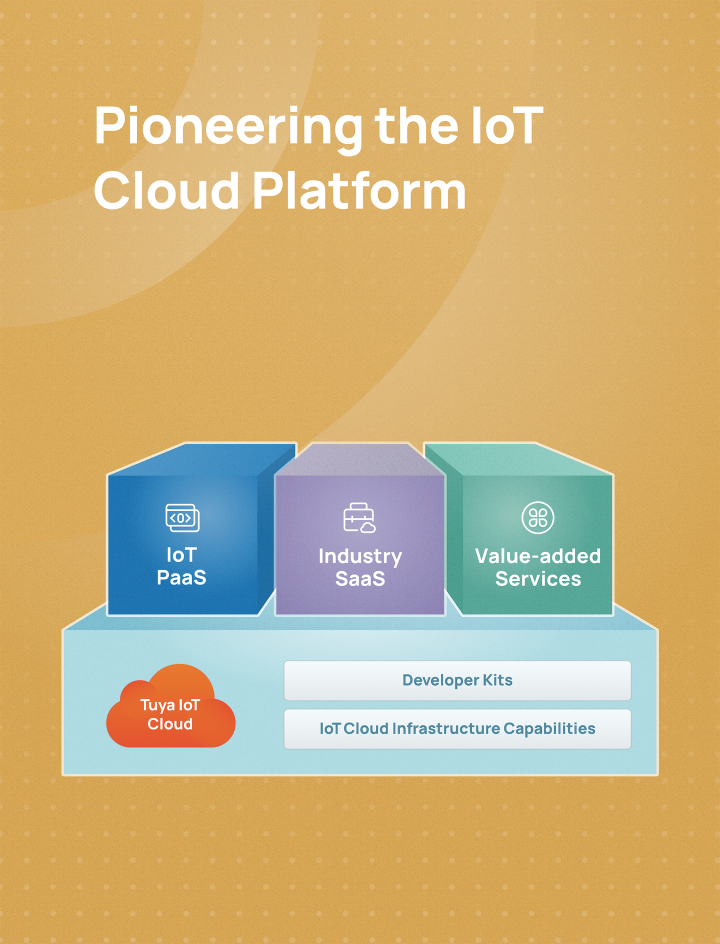
Table of Contents
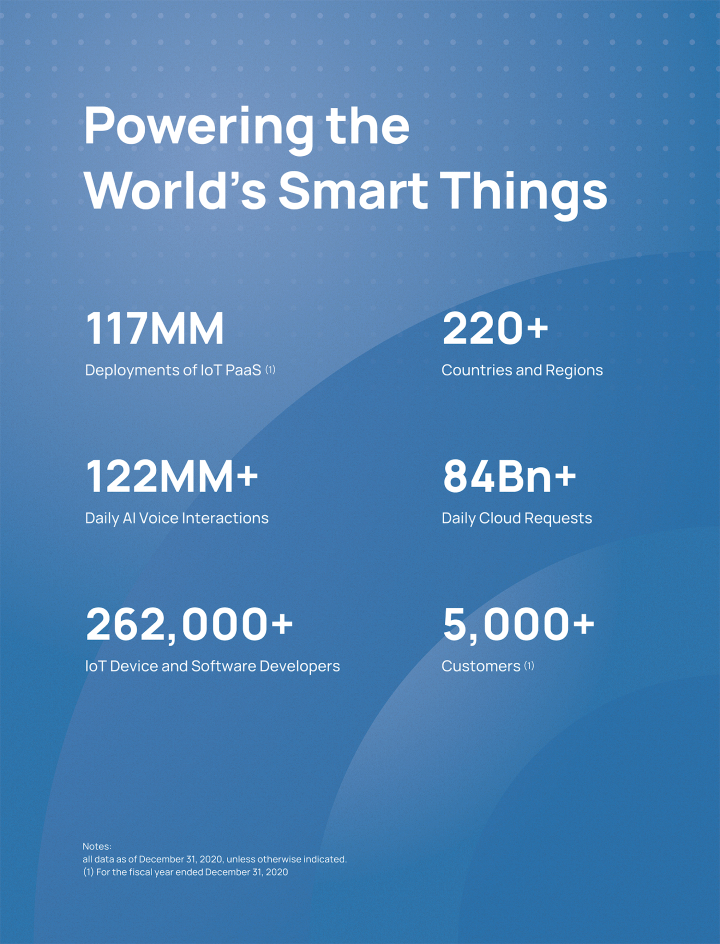
Table of Contents
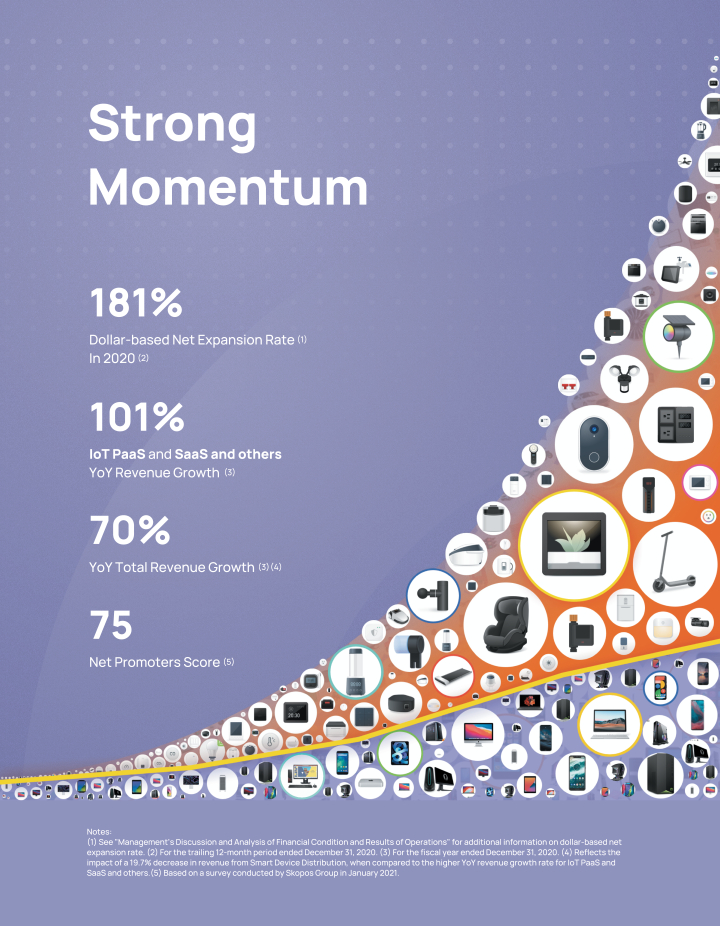
Table of Contents
Unless otherwise indicated or the context otherwise requires, all references in this prospectus to “Tuya Inc.” or the “Company,” “we,” “our,” “ours,” “us” or similar terms refer to Tuya Inc., together with its subsidiaries, and, in the context of describing our operations and consolidated financial information, its consolidated variable interest entity, or VIE.
We have not authorized anyone to provide any information other than that contained in this prospectus or in any free writing prospectus prepared by or on behalf of us or to which we may have referred you. We take no responsibility for, and can provide no assurance as to the reliability of, any other information that others may give you. We and the underwriters have not authorized any other person to provide you with different or additional information. Neither we nor the underwriters are making an offer to sell the ordinary shares in any jurisdiction where the offer or sale is not permitted. This offering is being made in the United States and elsewhere solely on the basis of the information contained in this prospectus. You should assume that the information appearing in this prospectus is accurate only as of the date on the front cover of this prospectus, regardless of the time of delivery of this prospectus or any sale of the ADSs representing our Class A ordinary shares. Our business, financial condition, results of operations and prospects may have changed since the date on the front cover of this prospectus.
Until , 2021 (the 25th day after the date of this prospectus), all dealers that buy, sell or trade the ADSs, whether or not participating in this offering, may be required to deliver a prospectus. This is in addition to the obligation of dealers to deliver a prospectus when acting as underwriters and with respect to their unsold allotments or subscriptions.
i
Table of Contents
The following summary is qualified in its entirety by, and should be read in conjunction with, the more detailed information and financial statements and the related notes appearing elsewhere in this prospectus. In addition to this summary, we urge you to read the entire prospectus carefully, especially the risks of investing in the ADSs discussed under “Risk Factors,” “Business,” and information contained in “Management’s Discussion and Analysis of Financial Condition and Results of Operations” before deciding whether to buy the ADSs.
Our Mission
Our mission is to build an IoT developer ecosystem and to enable everything to be smart.
Our Culture
We are a team of engineers and entrepreneurs with rich experience in software, cloud and enterprise services. Together as a team, we have a vision that in the era of Internet of Things, or IoT, every “thing” will be connected seamlessly to unleash enormous commercial opportunities through software and to create value for users. We founded Tuya based upon the principles of team spirit, innovation and unlimited courage. We firmly believe that success comes for those who share a common pursuit to change the world for the better, those who are reformers to constantly generate groundbreaking ideas, and those who are brave enough to face the challenges and turn these ideas into reality. These beliefs underpin all the work we do and are the foundation of our corporate culture.
Overview
We have pioneered a purpose-built IoT cloud platform that delivers a full suite of offerings, including Platform-as-a-Service, or PaaS, and Software-as-a-Service, or SaaS, to businesses and developers. IoT is fundamentally changing the world and creating enormous business opportunities. Our IoT PaaS offering enables businesses and developers to quickly and cost-effectively develop, launch, manage and monetize software-enabled devices and services. Our Industry SaaS offering enables businesses to easily and securely deploy, connect, and manage large numbers and different types of smart devices. We also offer businesses, developers and end users a wide range of cloud-based value-added services to improve their ability to develop and manage IoT experiences.
Through our IoT cloud platform, we have enabled developers to activate a vibrant IoT ecosystem of brands, OEMs, partners and end users to engage and communicate through a broad range of smart devices.
1
Table of Contents
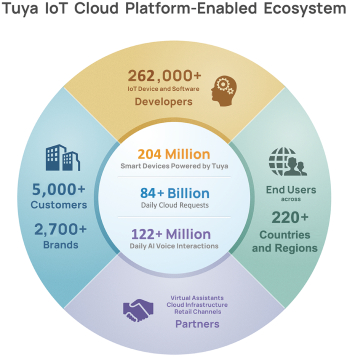
We had over 5,000 customers in 2020, primarily including brands, original equipment manufacturers or OEMs, industry operators and system integrators. For the same period, our IoT PaaS empowered over 2,700 brands to develop their smart devices, including leading brands such as Calex, Philips and Schneider Electric. Our IoT PaaS currently enables businesses and developers to develop smart devices in more than 1,100 categories sold across over 220 countries and regions globally. In 2020, we powered over 116.5 million smart devices, making us the largest IoT PaaS business in the global market of IoT PaaS in terms of the volume of smart devices powered, according to CIC. As of December 31, 2020, there were approximately 204.3 million smart devices powered by Tuya. We are also attracting an increasing number of Industry SaaS customers. We have also established a large and active community of over 262,000 IoT device and software developers as of December 31, 2020. Our IoT cloud platform is currently capable of processing over 84 billion cloud requests and over 122 million AI voice interactions daily. Today, smart devices powered by Tuya are available in over 100,000 stores all over the world.
IoT provides the opportunity of connecting every thing and every person. This offers a growth opportunity similar to that of the mobile internet. Today, billions of smartphone users run their lives on millions of apps. The mobile internet revolution is made possible by ubiquitous high speed connectivity, local capabilities in computing, storage and networking, and most importantly a software experience that transforms business operations and user interaction. We believe IoT will follow a similar evolution enabled by connectivity, computing, software and software development tools. The IoT developers are key to unlocking the IoT growth opportunity. As developers create more smart devices and IoT services, they need a software platform that enables them to develop efficiently and manage the complexities of the full development cycle.
We are the software platform for the IoT era. Traditionally, businesses offered static, disconnected devices that limited their ability to establish and maintain long-term relationships with their end users. We have built a neutral, comprehensive, cloud-native and developer-friendly platform, where businesses and developers can develop software applications that turn traditional devices into connected and active devices, engage with end users throughout the product lifecycle, and create new revenue opportunities.
2
Table of Contents
Our products enable customers across a broad range of industry verticals, such as smart home, smart business, healthcare, education and agriculture. Our multi-cloud platform allows customers to switch among major cloud infrastructure providers, such as Amazon Web Services, Microsoft Azure and Tencent Cloud, and integrates mainstream third-party technologies, such as Amazon Alexa, Google Assistant and Samsung SmartThings, to make smart devices more intelligent.
We have established a thriving ecosystem of brands, OEMs, developers, partners and end users on our platform due to powerful network effects. End users of smart devices demand a single interface to interact with various types of devices from different brands—an experience similar to using different apps on one smartphone. Our platform provides an open architecture to connect any device from any brand, while enabling users to manage all devices across brands through a single portal—the exact experience they desire. As a result, more brands want to join our platform to integrate their devices onto the single user interface through which devices from other brands are connected. These self-reinforcing network effects further increase our brand awareness and generates word-of-mouth referrals, helping us form an extensive, vibrant and increasingly interconnected IoT ecosystem.
We help our customers succeed and we benefit from their growth through our consumption-based revenue model as we deploy IoT PaaS to more smart devices developed by our customers. We had 188 premium IoT PaaS customers, defined as IoT PaaS customers who individually contributed more than US$100,000 of revenue during the immediately preceding 12-month periods, as of December 31, 2020. In 2020, our premium IoT PaaS customers contributed approximately 87% of our revenues generated from IoT PaaS. Our dollar-based net expansion rate of IoT PaaS was 181% for the trailing 12-month period ended December 31, 2020, indicating strong growth within our existing customer base.
We also provide Industry SaaS in select verticals to directly help businesses deliver a full IoT experience, driving efficiency, cost saving and productivity. For example, our Smart Hotel SaaS solution allows hotel managers to monitor from a single control point different aspects of hotel services, such as housekeeping, guest traffic control, property surveillance and maintenance. Our Smart Consumer Security SaaS solution enables home and business owners to monitor multiple smart consumer security devices, such as sensors and motion detectors, to enhance security and provide better control over their properties.
Our business has scaled rapidly in recent periods. For 2020, our revenue grew to US$179.9 million, representing an increase of 70% over the same period in 2019. We generated net loss of US$70.5 million and US$66.9 million in 2019 and 2020, respectively.
The Internet of Things Era
Internet of Things—the concept of connecting physical devices to a large, interconnected network—is profoundly transforming the way individuals interact with the physical world and changing how device companies develop products.
In the past decade, the mobile internet transformed people’s way of life. There was a convergence of operating systems and application development tools for smartphones, which drove a vibrant ecosystem of phones, users, developers and applications. Today there are billions of smartphone users and millions of mobile apps. These mobile apps enabled people to socialize online, consume local services and conduct their lives from a smartphone. The concept of “Social, Local, Mobile”, or SoLoMo, has created trillion dollars of value in mobile internet.
The IoT era transcends the mobile internet, with SoLoMo evolving to “Assistant, Space, Things”, generating a massive opportunity for value creation by businesses.
3
Table of Contents
The Growing Importance of a Software Experience
With favorable technology drivers, users want a software experience in IoT, and businesses need to deliver it.
| • | Consumers expect a software-like experience. Traditionally, consumer devices were largely designed with physical and manual interfaces. Consumers are accustomed to software-like experiences to program, control and interact with their devices in the most convenient ways. Recently, voice-enabled devices supported by Amazon Alexa, Google Assistant, Samsung SmartThings or other virtual assistants that further simplify interaction have proliferated rapidly. |
| • | Product companies must transform into software companies. As consumer preferences evolve, product companies recognize the need to deliver a differentiated experience by software-enabling their products. This enables product companies to transform into software companies. Products that are software enabled and internet connected allow branded product companies to gain valuable insights through feedback based on multi-dimensional data collected by the devices, and to offer and enhance user experience from improved product design and algorithms. |
Challenges in Delivering IoT and Software Experience
Businesses and developers still face a number of challenges in delivering software-enabled IoT offerings, which also affect the end user experience:
| • | Lack of development talent and capabilities. Both device and software development require new capabilities to support the design, release and management of software-enabled products. Such technology expertise—especially the knowledge, experience and talents necessary to support software deployed across millions of devices—is in short supply. |
| • | Cost and complexity to develop platform, tools and applications. For product companies and developers, significant investments are required to develop an IoT offering, ranging from developing scalable platform software or middleware as well as easy-to-use developer tools, all the way to designing and testing customer-facing applications. Rigorous requirements on security, compliance, scalability and interoperability bring additional cost and complexity. |
| • | Long time-to-market. There is an immediate need for brands and OEMs to deliver software-enabled experiences for traditional products. Undergoing such a transformation on their own or even integrating piecemeal offerings to tailor this, leads to long development cycles and often loss of market share. |
| • | Lack of standardized, easy-to-use infrastructure and tools for developers. Developers for smart devices and IoT software often face a lack of widely established standards given the industry is relatively nascent. It can take tremendous effort to develop common software infrastructure with a large variety of application programming interfaces, or APIs, that might not be compatible with each other or to migrate a set of developed software and data from one cloud provider to another. This common software infrastructure is often difficult for application developers to build and scale to support evolving application requirements. |
| • | Inconsistent user experience. End users are largely accustomed to the unified experience provided by the iOS and Android systems in mobile internet, where they can have intuitive and standardized interaction with applications on their smartphones. Currently, many smart devices lack that level of consistencies in software experience. End users might have to switch between different applications and user interfaces to control different devices, and cannot share data between them. Such friction and confusion can deter them from acquiring more smart devices and services. |
These significant challenges have created the need for an IoT platform that takes care of the complexities of developing, launching, supporting and growing IoT software, so businesses and developers can leverage full-stack infrastructure and tools to develop devices and software applications with ease.
4
Table of Contents
The Tuya Solution—An IoT Cloud Platform
We have pioneered an IoT cloud platform that empowers businesses and developers to transform from offering traditional products into providing software-enabled smart devices and IoT services that extend beyond the point of sale. Customers leverage our IoT cloud platform to quickly and cost-effectively launch, manage and monetize their software-enabled devices and services. We deliver a one-stop, developer-first, cloud-agnostic platform with broad use cases that allows our customers to digitalize their businesses and transform the experience of their end users. Through our platform we have established a thriving ecosystem of brands, OEMs, developers, partners and end users.
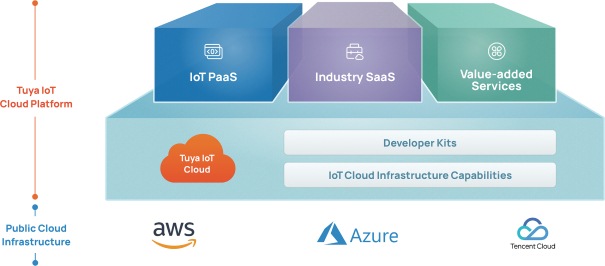
The foundation of our solution is Tuya IoT Cloud infrastructure, our unified underlying cloud infrastructure that provides a rich set of infrastructure capabilities and developer tools.
Based upon Tuya IoT Cloud infrastructure, we offer the following products and services:
| • | IoT PaaS. Our IoT PaaS combines cloud-based connectivity and basic IoT services, edge capabilities, app development and device optimization solutions, which we believe are the most fundamental elements of enabling a product with IoT. Our IoT PaaS can be seamlessly deployed on public or private cloud infrastructures such as Amazon Web Services, Microsoft Azure and Tencent Cloud. Our IoT PaaS transforms traditional products smoothly into IoT-enabled products with computing, storage and networking capabilities on the “edge”, laying the foundation for a low code or no code development environment. We also provide a rich set of developer tools and cloud-based services for customers to personalize or develop IoT applications that connect to our IoT cloud platform and manage their smart devices for a broad range of use cases. |
| • | Industry SaaS. We offer Industry SaaS, vertical-focused software solutions for a growing number of industry verticals. Businesses, such as hotel operators or property managers, leverage our SaaS solutions to intelligently manage their operations based on connected smart devices, thereby improving operating efficiency and optimizing costs. Our SaaS offerings are fully integrated with our IoT cloud infrastructure, device management apps and user apps, for customers to use in a plug-and-play manner. |
| • | Cloud-based value-added services and others. We have started to roll out a variety of services both to business customers and directly to the end users of Tuya-powered smart devices. We offer AI-powered virtual assistants and data analytics to business customers. We also offer a wide and expanding range of |
5
Table of Contents
| cloud-based services directly to end users including IoT data storage, push messaging and content services. |
The Benefits of Our IoT Cloud Platform
The key benefits to our business customers include:
| • | Scalable development talent and capabilities. Product companies that use our IoT cloud platform become more efficient in utilizing in-house resources dedicated to developing IoT software, and focus their talent on core business competences in product development instead of building their IoT software development platform and tools from scratch. We continue to expand features offered on our platform which enable our business customers to maintain IoT cloud services or codes more easily. |
| • | Reduction in cost and complexity. Businesses using our IoT cloud platform can save on the heavy investment in setting up and maintaining complex IT infrastructure. They are able to outsource complex IoT infrastructure requirements to us while we enable them to adopt the latest technologies with purpose-built capabilities for security, compliance and interoperability. |
| • | Short time-to-market. With our IoT cloud platform, businesses can launch smart devices and corresponding software applications with faster time-to-market, often within weeks or days, saving up to 90% of the time and uncertainty from developing a full stack for product releases, according to CIC. |
| • | Long-term customer engagement. More authorized user interaction and deeper user insight allow product companies to build a long-last relationship with their end users. We strategically enable businesses to conduct targeted marketing, e-commerce, and customer service beyond point of sale so that they can maintain improved customer relationships throughout the product lifecycle. |
The key benefits to developers on our IoT cloud platform include:
| • | Neutral and highly compatible infrastructure. Developers can develop software for multiple environments as our platform is cloud- and communication protocol-agnostic with comprehensive APIs and partnership with leading global technology providers. Such infrastructure enables device and software developers to create a standardized base across their product portfolio, and even allows their products to be able to connect other third party devices applying the same standards. |
| • | Low-code or no-code development tools. We significantly reduce the threshold for software development. Product companies can easily and quickly design, develop and launch scalable software-enabled smart devices through our intuitive, visual programming interfaces that enable rich software functionality to be developed with little or no programming expertise. At the same time, our rich set of development solutions make it easy for advanced developers to create applications efficiently with differentiated outcome. |
| • | Powerful data analytics. Developers can tap the deep insight from aggregated data generated by the devices connected to our IoT cloud platform to understand user feedback, improve product design, as well as personalize the end user experience, even across brands and product companies. |
The key benefits to end users include:
| • | Unified and consistent user experience across products and brands. Our IoT cloud platform empowers end users to interact with multiple products from multiple brands in their environment through one user interface that is simple, highly intuitive and frictionless, instead of switching between different apps for different brands and devices. Such experience extends to many aspects of their lives, from security, healthiness and entertainment to productivity and energy saving. |
6
Table of Contents
| • | Products with software services at a reasonable price. Consumers will not need to share significant upfront costs of platform and software development, and enjoy smarter and more powerful smart devices and value-added services at a reasonable price. |
Our Market Opportunity
We believe that as organizations transition from traditional product companies to digital businesses with software-enabled IoT products, a significant amount of IT spend will be allocated to IoT enablement. We provide these organizations a neutral, comprehensive and scalable platform with an open ecosystem. According to CIC, we are one of the earliest in the industry to provide full stack IoT solutions spanning the perception, network, cloud and application layers. Our vision is to become the largest platform to enable IoT products and services across the globe. Our technology and products address use cases in the large markets of IoT PaaS as well as IoT SaaS, which includes application software and analytics software spend on IoT. According to CIC, the worldwide IoT PaaS total addressable market is forecasted to grow from US$72.2 billion in 2019 to US$171.7 billion by 2024, representing a CAGR of 18.9%. China represents 26.2% and 28.9% of this market in 2019 and 2024, respectively. According to IDC, the worldwide IoT software total addressable market is forecasted to grow from US$129.2 billion in 2019 to US$237.0 billion by 2024, representing a CAGR of 12.9%. China represents 16.6% and 18.1% of this market in 2019 and 2024, respectively.
Our Competitive Strengths
Pioneer and Global Leader of IoT Cloud
Our first-mover advantage, scale and expertise allow us to partner with our customers to help them develop software that differentiates their products, thereby gaining significant IoT mindshare with our customers.
| • | Market disruptor and established leader. As a pioneer in IoT cloud platform that integrates both PaaS and SaaS, we enable businesses to transform traditional devices into software-enabled products. Our IoT PaaS currently enables businesses and developers to develop smart devices in more than 1,100 categories sold across over 220 countries and regions globally. We have also nurtured a large and active community of over 262,000 IoT device and software developers as of December 31, 2020. Today, smart devices powered by Tuya are available in over 100,000 stores all over the world. |
| • | Massive scale of operation. Our IoT cloud platform is currently capable of processing over 84 billion cloud requests and over 122 million AI voice interactions daily, allowing us to better understand our customers and continuously improve our service capabilities. |
Open and End-to-end IoT Cloud Platform
We have built an open and fully integrated IoT cloud platform that provides businesses and developers across the world with lifecycle services and enable them to build and manage applications effectively by taking care of the remaining complexity.
| • | Cloud agnostic. Our multi-cloud architecture does not depend on any single cloud service provider. It seamlessly integrates into major global cloud infrastructure such as Amazon Web Services, Microsoft Azure and Tencent Cloud. We enable global developers to easily transfer their completed and in-process software applications from one to another with low compliance risk and regulation friction. |
| • | Full-stack solution. We deliver a solution that addresses all kinds of needs from developers along the technology stack, from infrastructure support, operation and maintenance support, security and compliance monitoring, to data management, mainstream API access, end user application interfaces and industry-specific application-layer units. Developers can perform all IoT enablement tasks from design to launch using our IoT cloud platform only, without having to switch to different platforms. |
7
Table of Contents
| • | Open. We have designed our IoT cloud platform to be open. We have developed a rich collection of APIs that enable us to integrate quickly and easily with a broad range of cloud infrastructure components. We are not limited to any particular ecosystem. We deliver seamless integration with all leading IoT and smart home services, including voice control from Amazon Alexa and Google Assistant, as well as other key platforms like Samsung SmartThings. Our solution support a range of bandwidth applications and connectivity protocols, including Wi-Fi, ZigBee, dual radio, Bluetooth, 5G and NB-IoT, and can mix and match connectivity needs of our customers. Our open architecture future-proofs our platform from changes in underlying industry standards and components. |
Differentiated Technology and Data Capabilities
We fully leverage our cutting-edge technology to enable our customers to have better developing experience, and help them better serve end users.
| • | Simple but not simplistic. Our simple-to-use low- to no-code development tools and ready-to-use cutting-edge features take away the vast complexity of full stack IoT development. At the same time, developers can create differentiated products with our rich tools. |
| • | Reliable and scalable technology. Our worldwide infrastructure support ensures secure and stable coverage, providing low-latency, redundancy, and 99.9% uptime. Our IoT cloud platform is capable of handling over 84 billion cloud requests daily with an average device response time of less than 10 milliseconds. It also adopts a distributed and flexible service architecture that allows for real-time scaling, making it easy for customers to increase capacity. |
| • | Unique device data insights. Traditional businesses are provided with massive and insightful data on the usage of their devices and use of their devices. With the in-depth business insights generated from such data, businesses can better understand their end users, upgrade their software and hardware and deliver more comprehensive IoT-enabled services to them, leading to a sustainable relationship. |
Thriving Ecosystem with Powerful Network Effects
We have established a thriving ecosystem of brands, OEMs, developers, partners and end users on our platform due to powerful network effects. End users of smart devices demand a single interface to interact with various types of devices from different brands—an experience similar to using different apps on one smartphone. Our platform provides an open architecture to connect any device from any brand, while enabling users to manage all devices across brands through a single portal—the exact experience they desire. As a result, more brands want to join our platform to integrate their devices onto the single user interface through which devices from other brands are connected. These self-reinforcing network effects further increase our brand awareness and generates word-of-mouth referrals, helping us form an extensive, vibrant and increasingly interconnected IoT ecosystem. Additionally, we allow our customers to try out new ideas based on our consumption-based revenue model to accelerate their adoption of our platform and cultivate a vibrant culture for innovation.
| • | Large and loyal global customer base. We had over 5,000 customers in 2020, primarily including brands, OEMs, industry operators and system integrators. For the same period, our IoT PaaS empowered over 2,700 brands to develop their smart devices, including leading brands such as Calex, Philips and Schneider Electric, and are attracting an increasing number of Industry SaaS customers. Our IoT PaaS currently enables businesses and developers to develop smart devices in more than 1,100 categories sold across over 220 countries and regions globally. Our customers have high switching cost due to the tight connection with end users made possible on our IoT cloud platform. We recorded a dollar-based net expansion rate of our IoT PaaS customers of 181% for the trailing 12-month period ended December 31, 2020. |
8
Table of Contents
| • | Vibrant developer and partner network. We make IoT development easy for our device and software developers and encourage them to innovate. Many of those are focused on creating brand new IoT experience and developing fundamental software, which in turn attracts more developers focused on the application-level. As of December 31, 2020, we have attracted a large and active community of over 262,000 IoT device and software developers who develop smart devices in over 252,000 stock keeping units, or SKUs, 13,500 application software development kits, or SDKs, and 22,500 cloud-based SaaS applications. We also partner with virtual assistant service providers, cloud infrastructure providers and online and offline retail channels to strengthen our ecosystem. |
| • | Expansive end user base. In 2020, we powered over 116.5 million smart devices, making us the largest IoT PaaS business in the global market of IoT PaaS in terms of the volume of smart devices powered, according to CIC. As of December 31, 2020, there were approximately 204.3 million smart devices powered by Tuya. |
Our Growth Strategies
We believe we are the leading IoT cloud platform based on our leading position in the global market of IoT PaaS. According to CIC, we are the largest IoT PaaS business in the global market of IoT PaaS in terms of volume of smart devices powered in 2020. We intend to strengthen our position as the leading IoT cloud platform and continue to grow our business by pursuing the following strategies:
| • | Extend our technology leadership; |
| • | Deepen our relationship with our existing customers; |
| • | Acquire new customers; |
| • | Broaden our reach by expanding into verticals such as industrial and agriculture; |
| • | Grow and broaden our SaaS offerings; and |
| • | Expand “Powered by Tuya” brand awareness. |
Summary of Risks Affecting Our Company
Investing in the ADSs involves significant risks. You should carefully consider all of the information in this prospectus before making an investment in the ADSs. The main risks set forth below and others you should consider are discussed more fully in the section entitled “Risk Factors”, which you should read in its entirety.
| • | We operate in an emerging and evolving market, which may not develop at the rate or in the direction we expect. If our market does not grow as we expect, or if we cannot expand our products and services to meet the demands of this market, our revenue may decline, or fail to grow, and we may continue to incur operating losses. |
| • | We have a limited operating history, making it difficult to forecast our future results of operations. |
| • | Our recent growth may not be indicative of our future growth, and we may not be able to sustain our revenue growth rate in the future. Our growth also makes it difficult to evaluate our future prospects and may increase the risk that we will not be successful. |
| • | The markets in which we operate are competitive, and if we do not compete effectively, our business, operating results and financial condition could be harmed. |
| • | The success of our business is dependent upon our ability to maintain and expand our customer base and our ability to convince our customers to increase the use of our products and services. If we are |
9
Table of Contents
| unable to expand our customer base and/or the use of our products and services by our customers declines, our business may be harmed. |
| • | The audit report included in this prospectus is prepared by an auditor that is not inspected by the Public Company Accounting Oversight Board and, as such, our investors are deprived of the benefits of such inspection. |
| • | If the PRC government finds that the agreements that establish the structure for operating some of our operations in China do not comply with PRC regulations relating to the relevant industries, or if these regulations or the interpretation of existing regulations change in the future, we could be subject to severe penalties or be forced to relinquish our interests in those operations. |
| • | We rely on contractual arrangements with our VIE and its shareholders to use, or otherwise benefit from, certain licenses and approvals we may need in the future, which may not be as effective as direct ownership in providing operational control. |
| • | Changes in China’s economic, political or social conditions or government policies could have a material adverse effect on our business, financial condition and results of operations. |
| • | An active trading market for our ordinary shares or the ADSs may not develop and the trading price for the ADSs may fluctuate significantly. |
Contractual Arrangements and Corporate Structure
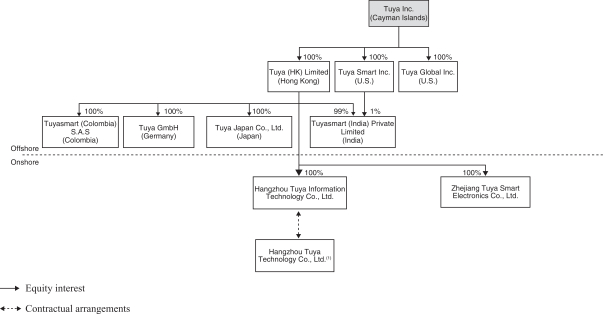
We are a Cayman Islands company and currently conduct substantially all of our business operations in the PRC through Hangzhou Tuya Information Technology Co. Ltd., our wholly-owned subsidiary incorporated in the PRC. Hangzhou Tuya Information Technology Co. Ltd. controls Hangzhou Tuya Technology Co., Ltd. through a series of contractual arrangements. As a result of these contractual arrangements, we have control over, and are the primary beneficiary of, Hangzhou Tuya Technology Co., Ltd.
The following chart illustrates our corporate structure, including our significant subsidiaries as that term is defined under Section 1-02 of Regulation S-X under the Securities Act, our VIE and certain other subsidiaries, as of the date of this prospectus:
10
Table of Contents
| Note: (1) | Shareholders of Hangzhou Tuya Technology are Xueji (Jerry) Wang (our director and CEO), Liaohan (Leo) Chen (our director), Yaona Lin (our employee), Ruixin Zhou (our CTO) and Peihong Chen (our employee), each holding approximately 60.7%, 13.1%, 11.5%, 9.8% and 4.9%, respectively, of equity interests in Hangzhou Tuya Technology. Xueji (Jerry) Wang, Liaohan (Leo) Chen, Yaona Lin, Ruixin Zhou and Peihong Chen each holds approximately 22.0%, 5.6%, 4.9%, 4.2% and 2.1%, respectively, of our equity interests immediately prior to the completion of this offering. |
11
Table of Contents
Our principal executive offices are located at Huace Center, Building A, 10/F, Xihu District, Hangzhou City, Zhejiang Province, 310012, People’s Republic of China. Our telephone number at this address is +86 0571-86915981. Our registered office in the Cayman Islands is located at Maples Corporate Services Limited, PO Box 309, Ugland House, Grand Cayman, KY1-1104, Cayman Islands. Our agent for service of process in the United States is Cogency Global Inc., located at 122 East 42nd Street, 18th Floor New York, NY 10168.
Investors should contact us for any inquiries through the address and telephone number of our principal executive office. Our principal website is www.tuya.com. The information contained on our website is not a part of this prospectus.
Implications of Being an Emerging Growth Company
As a company with less than US$1.07 billion in revenue for the last fiscal year, we qualify as an “emerging growth company” pursuant to the Jumpstart Our Business Startups Act of 2012 (as amended by the Fixing America’s Surface Transportation Act of 2015), or the JOBS Act. An emerging growth company may take advantage of specified reduced reporting and other requirements that are otherwise applicable generally to public companies. These provisions include exemption from the auditor attestation requirement under Section 404 of the Sarbanes-Oxley Act of 2002, or Section 404, in the assessment of the emerging growth company’s internal control over financial reporting. The JOBS Act also provides that an emerging growth company does not need to comply with any new or revised financial accounting standards until such date that a private company is otherwise required to comply with such new or revised accounting standards. We have elected to take advantage of such exemptions. As a result, our consolidated financial statements contained in this prospectus may not be directly comparable to those of other public companies.
We will remain an emerging growth company until the earliest of (i) the last day of our fiscal year during which we have total annual gross revenues of at least US$1.07 billion; (ii) the last day of our fiscal year following the fifth anniversary of the completion of this offering; (iii) the date on which we have, during the previous three-year period, issued more than US$1.0 billion in non-convertible debt; or (iv) the date on which we are deemed to be a “large accelerated filer” under the Securities Exchange Act of 1934, as amended, or the Exchange Act, which would occur if the market value of the ADSs that are held by non-affiliates exceeds US$700 million as of the last business day of our most recently completed second fiscal quarter. Once we cease to be an emerging growth company, we will not be entitled to the exemptions provided in the JOBS Act discussed above. See “Risk Factors—Risks Related to the ADSs and This Offering—We are an emerging growth company within the meaning of the Securities Act and may take advantage of certain reduced reporting requirements.”
Conventions Which Apply to This Prospectus
Unless we indicate otherwise, all information in this prospectus reflects the following:
| • | no exercise by the underwriters of their over-allotment option to purchase up to 6,538,500 additional ADSs representing 6,538,500 Class A ordinary shares from us; and |
Except where the context otherwise requires and for purposes of this prospectus only:
| • | “ADSs” refers to the American depositary shares, each representing one Class A ordinary share; |
| • | “APAC” refers to Asia Pacific; |
12
Table of Contents
| • | “China” or “PRC” refers to the People’s Republic of China, excluding, for the purpose of this prospectus only, Taiwan, Hong Kong and Macau; |
| • | “Class A ordinary share” refers to our Class A ordinary shares, par value US$0.00005 per share, which will be outstanding upon the completion of this offering; |
| • | “Class B ordinary share” refers to our Class B ordinary shares, par value US$0.00005 per share, which will be outstanding upon the completion of this offering; |
| • | “EMEA” refers to Europe, Middle-East and Africa; |
| • | “Hangzhou Tuya Technology” refers to Hangzhou Tuya Technology Co., Ltd.; |
| • | “RMB” or “Renminbi” refers to the legal currency of the People’s Republic of China; |
| • | “US$,” “dollars” or “U.S. dollars” refers to the legal currency of the United States; |
| • | “shares” or “ordinary shares” refer to our ordinary shares, par value US$0.00005 per share, and upon the completion of this offering, to our Class A ordinary shares and Class B ordinary shares, par value US$0.00005 per share; |
| • | “Tuya,” “we,” “us,” “our company,” and “our” refer to Tuya Inc., a Cayman Islands company and its subsidiaries and, in the context of describing our operations and consolidated financial information, its consolidated variable interest entity, or VIE; |
| • | “Tuya Information” refers to Hangzhou Tuya Information Technology Co., Ltd.; and |
| • | “variable interest entity” or “VIE” refers to the PRC entity of which we have power to control the management, and financial and operating policies and have the right to recognize and receive substantially all the economic benefits and in which we have an exclusive option to purchase all or part of the equity interests at the minimum price possible to the extent permitted by PRC law. |
This prospectus contains information derived from various public sources, including International Data Corporation, or IDC, and certain information from an industry report commissioned by us and prepared by CIC, a third-party industry research firm, to provide information regarding our industry and market position. Such information involves a number of assumptions and limitations, and you are cautioned not to give undue weight to these estimates. We have not independently verified the accuracy or completeness of the data contained in these industry publications and reports. The industry in which we operate is subject to a high degree of uncertainty and risk due to variety of factors, including those described in the “Risk Factors” section. These and other factors could cause results to differ materially from those expressed in these publications and reports.
13
Table of Contents
| Offering price range |
We currently estimate that the initial public offering price will be between US$17.00 and US$20.00 per ADS. | |
| ADSs offered by us |
43,590,000 ADSs (or 50,128,500 ADSs if the underwriters exercise their over-allotment option in full). | |
| The ADSs |
Each ADS represents one Class A ordinary share, par value US$0.00005 per share. The depositary will hold the Class A ordinary shares underlying the ADSs. You will have rights as provided in the deposit agreement. | |
| We do not expect to pay dividends in the foreseeable future. If, however, we declare dividends on our Class A ordinary shares, the depositary will pay you the cash dividends and other distributions it receives on our Class A ordinary shares, after deducting its fees and expenses in accordance with the terms set forth in the deposit agreement. | ||
| You may turn in the ADSs to the depositary in exchange for our Class A ordinary shares. The depositary will charge you fees for any exchange. | ||
| We may amend or terminate the deposit agreement without your consent. If you continue to hold the ADSs after an amendment to the deposit agreement, you agree to be bound by the deposit agreement as amended. | ||
| To better understand the terms of the ADSs, you should carefully read the “Description of American Depositary Shares” section of this prospectus. You should also read the deposit agreement, which is filed as an exhibit to the registration statement that includes this prospectus. | ||
| Ordinary shares |
We will issue 43,590,000 Class A ordinary shares represented by the ADSs in this offering (or 50,128,500 Class A ordinary shares if the underwriters exercise their option to purchase additional ADSs in full). | |
| Our ordinary shares will be divided into Class A ordinary shares and Class B ordinary shares immediately prior to the completion of this offering. Holders of Class A ordinary shares and Class B ordinary shares have the same rights except for voting and conversion rights. Each Class A ordinary share is entitled to one vote and each Class B ordinary share is entitled to 15 votes. Each Class B ordinary share is convertible into one Class A ordinary share at any time by the holder thereof, while Class A ordinary shares are not convertible into Class B ordinary shares under any circumstances. Upon any sale, transfer, assignment or disposition | ||
14
Table of Contents
| of any Class B ordinary share by a holder thereof to any non-affiliate of such holder, each of such Class B ordinary share will be automatically and immediately converted into one Class A ordinary share. | ||
| All options and restricted shares, regardless of grant dates, will entitle holders to the equivalent number of Class A ordinary shares once the vesting and exercising conditions on such share-based compensation awards are met. | ||
| See “Description of Share Capital.” | ||
| Ordinary shares outstanding immediately after this offering |
417,360,081 Class A ordinary shares, par value US$0.00005 per share (or 423,898,581 Class A ordinary shares if the underwriters exercise their option to purchase additional ADSs in full) and 142,400,000 Class B ordinary shares, par value US$0.00005 per share. | |
| Indication of Interest |
A number of investors, including certain existing shareholders and their affiliates and third-party investors, have indicated their interest in subscribing for an aggregate of at least US$500 million of the ADSs being offered in this offering, including (i) US$100 million from our existing shareholder Tencent, (ii) at least US$100 million from Gaoling Fund, L.P. and YHG Investment, L.P., affiliates of our existing shareholder, or collectively Hillhouse Capital, (iii) an aggregate of at least US$300 million from Canada Pension Plan Investment Board, one or more funds affiliated with Dragoneer Investment Group, LLC, GIC Private Limited, funds affiliated with Tiger Global Management, LLC, and/or their affiliates. The subscriptions for ADSs are at the initial public offering price and on the same terms as the other ADSs being offered in this offering. Because the indications of interest are not binding agreements or commitments to purchase, such investors may determine to purchase more, fewer or no ADSs in this offering, and we and the underwriters may determine to sell more, fewer or no ADSs to them. The underwriters will receive the same underwriting discounts and commissions on any ADSs purchased by such investors as they will on any other ADSs sold to the public in this offering. For additional information, see “Underwriting.” | |
| Over-allotment option |
We have granted the underwriters the right to purchase up to an additional 6,538,500 Class A ordinary shares from us within 30 days of the date of this prospectus, to cover over-allotments, if any, in connection with the offering. | |
| Listing |
We intend to apply to list the ADSs representing our Class A ordinary shares on the New York Stock Exchange, or NYSE, under the symbol “TUYA”. | |
15
Table of Contents
| Use of proceeds |
We estimate that the net proceeds to us from the offering will be approximately US$770.72 million. The principal purposes of this offering are to increase our capitalization and financial flexibility and create a public market for the ADSs. We intend to use the net proceeds from this offering for research and development, investment in technology infrastructure, marketing and branding, and other capital expenditure, as well as other general corporate purposes. See “Use of Proceeds.” | |
| Lock-up |
We, our directors, executive officers and existing shareholders have agreed with the underwriters, subject to certain exceptions, not to offer, sell, or dispose of any shares of our share capital or securities convertible into or exchangeable or exercisable for any shares of our share capital during the 180-day period following the date of this prospectus (other than Tencent Mobility Limited, one of our shareholders, whose lock-up period is one year following the date of this prospectus). See “Shares Eligible for Future Sale” and “Underwriting” for more information. | |
| Payment and settlement |
The underwriters expect to deliver the ADSs against payment therefor through the facilities of The Depository Trust Company on , 2021. | |
| Depositary |
The Bank of New York Mellon | |
| Taxation |
For Cayman, PRC and U.S. federal income tax considerations with respect to the ownership and disposition of the ADSs, see “Taxation.” | |
| Risk Factors |
See “Risk Factors” and other information included in this prospectus for discussions of the risks relating to investing in the ADSs. You should carefully consider these risks before deciding to invest in the ADSs. | |
Unless otherwise indicated, all information contained in this prospectus assumes no exercise of the option granted to the underwriters to purchase up to 6,538,500 additional ADSs to cover over-allotments, if any, in connection with the offering.
16
Table of Contents
SUMMARY CONSOLIDATED FINANCIAL AND OTHER DATA
The following tables present the summary consolidated financial and other data for Tuya Inc. and its subsidiaries. We have derived the summary consolidated statements of operations data for the years ended December 31, 2019 and 2020 and the summary consolidated balance sheets data as of December 31, 2019 and 2020 from our audited consolidated financial statements included elsewhere in this prospectus. You should read this data together with our consolidated financial statements and related notes included elsewhere in this prospectus and the sections titled “Selected Consolidated Financial Data” and “Management’s Discussion and Analysis of Financial Condition and Results of Operations.” Our historical results for any prior period are not necessarily indicative of the results that may be expected in the future.
| For the Year Ended December 31, |
||||||||||||||||
| 2019 | 2020 | |||||||||||||||
| US$ | % | US$ | % | |||||||||||||
| (in thousands, except for percentages, shares and per share data) |
||||||||||||||||
| Summary Consolidated Statements of Comprehensive Loss Data: |
||||||||||||||||
| Revenue |
105,789 | 100.0 | 179,874 | 100.0 | ||||||||||||
| Cost of revenue |
(78,003 | ) | (73.7 | ) | (117,937 | ) | (65.6 | ) | ||||||||
| Gross profit |
27,786 | 26.3 | 61,937 | 34.4 | ||||||||||||
| Operating expenses: |
||||||||||||||||
| Research and development expenses |
(52,003 | ) | (49.2 | ) | (77,430 | ) | (43.0 | ) | ||||||||
| Sales and marketing expenses |
(37,017 | ) | (35.0 | ) | (37,556 | ) | (20.9 | ) | ||||||||
| General and administrative expenses |
(12,196 | ) | (11.5 | ) | (17,868 | ) | (9.9 | ) | ||||||||
| Other operating (expenses)/incomes, net |
(10 | ) | (0.0 | ) | 1,071 | 0.6 | ||||||||||
| Total operating expenses |
(101,226 | ) | (95.7 | ) | (131,783 | ) | (73.3 | ) | ||||||||
| Loss from operations |
(73,440 | ) | (69.4 | ) | (69,846 | ) | (38.8 | ) | ||||||||
| Other income/(loss): |
||||||||||||||||
| Financial income, net |
3,326 | 3.1 | 3,220 | 1.8 | ||||||||||||
| Foreign exchange loss, net |
(239 | ) | (0.2 | ) | (80 | ) | (0.0 | ) | ||||||||
| Loss before income tax expense |
(70,353 | ) | (66.5 | ) | (66,706 | ) | (37.1 | ) | ||||||||
| Income tax expense |
(124 | ) | (0.1 | ) | (206 | ) | (0.1 | ) | ||||||||
| Net loss attributable to Tuya Inc. |
(70,477 | ) | (66.6 | ) | (66,912 | ) | (37.2 | ) | ||||||||
| Deemed dividend to convertible preferred shareholders |
(3,430 | ) | (3.2 | ) | — | — | ||||||||||
| Net loss attribute to ordinary shareholders |
(73,907 | ) | (69.9 | ) | (66,912 | ) | (37.2 | ) | ||||||||
| Net loss |
(70,477 | ) | (66.6 | ) | (66,912 | ) | (37.2 | ) | ||||||||
| Other comprehensive (loss)/income: |
||||||||||||||||
| Foreign currency translation |
(428 | ) | (0.4 | ) | 2,882 | 1.6 | ||||||||||
| Total comprehensive loss attributable to Tuya Inc. |
(70,905 | ) | (67.0 | ) | (64,030 | ) | (35.6 | ) | ||||||||
| Net loss attributable to ordinary shareholders |
(73,907 | ) | (69.9 | ) | (66,912 | ) | (37.2 | ) | ||||||||
| Net loss per share attributable to ordinary shareholders—basic and diluted |
(0.33 | ) | — | (0.30 | ) | — | ||||||||||
| Weighted average number of ordinary shares used in calculating net loss per share—basic and diluted |
221,980,000 | — | 221,980,000 | — | ||||||||||||
| Pro forma net loss per share attributable to ordinary shareholders, basic and diluted(1) (unaudited) |
(0.13 | ) | ||||||||||||||
| Pro forma weighted-average ordinary shares outstanding, basic and diluted(1) (unaudited) |
500,143,799 | |||||||||||||||
| Note: |
| (1) | Unaudited basic and diluted net loss per share was computed to give effect to the automatic conversion of all issued and outstanding convertible preferred shares into ordinary shares using the “if converted” method as though the conversion and reclassification had occurred as of the beginning of the year or the original date of issuance, if later. |
17
Table of Contents
| Note: | Share-based compensation expense was allocated as follows: |
| For the Year Ended December 31, |
||||||||
| 2019 | 2020 | |||||||
| US$ | US$ | |||||||
| (in thousands) | ||||||||
| Research and development expenses |
1,218 | 2,596 | ||||||
| Sales and marketing expenses |
1,109 | 1,529 | ||||||
| General and administrative expenses |
2,893 | 5,321 | ||||||
| Total |
5,220 | 9,446 | ||||||
| As of December 31, | ||||||||||||
| 2019 | 2020 | Pro forma(1) 2020 (unaudited) |
||||||||||
| US$ | US$ | US$ | ||||||||||
| (in thousands) | ||||||||||||
| Cash and cash equivalents |
213,258 | 158,792 | 158,792 | |||||||||
| Restricted cash |
29 | 163 | 163 | |||||||||
| Short-term investments |
16,663 | 20,976 | 20,976 | |||||||||
| Accounts receivable, net |
5,351 | 12,316 | 12,316 | |||||||||
| Notes receivable |
379 | 9,126 | 9,126 | |||||||||
| Inventories, net |
23,019 | 42,267 | 42,267 | |||||||||
| Prepayments and other current assets |
8,008 | 4,393 | 4,393 | |||||||||
| Total current assets |
266,707 | 248,033 | 248,033 | |||||||||
| Total assets |
279,404 | 267,323 | 267,323 | |||||||||
| Accounts payable |
12,176 | 23,159 | 23,159 | |||||||||
| Advance from customers |
14,051 | 27,078 | 27,078 | |||||||||
| Deferred revenue, current |
516 | 3,468 | 3,468 | |||||||||
| Accruals and other current liabilities |
19,698 | 31,738 | 31,738 | |||||||||
| Income tax payable |
155 | 159 | 159 | |||||||||
| Lease liabilities, current |
3,763 | 6,326 | 6,326 | |||||||||
| Total current liabilities |
50,359 | 91,928 | 91,928 | |||||||||
| Total liabilities |
55,830 | 98,323 | 98,323 | |||||||||
| Mezzanine equity |
||||||||||||
| Series A convertible preferred shares (US$0.00005 par value; 65,288,360 shares authorized, issued and outstanding as of December 31, 2019 and 2020, respectively; nil outstanding on a pro-forma basis as of December 31, 2020 (unaudited)) |
9,000 | 9,000 | — | |||||||||
| Series A-1 convertible preferred shares (US$0.00005 par value; 15,959,140 shares authorized as of December 31, 2019 and 2020, respectively; 12,222,267 shares issued and outstanding as of December 31, 2019 and 2020, respectively; nil outstanding on a pro-forma basis as of December 31, 2020 (unaudited)) |
2,680 | 2,680 | — | |||||||||
| Series B convertible preferred shares (US$0.00005 par value; 90,782,550 shares authorized as of December 31, 2019 and 2020, respectively; 87,756,440 shares issued and outstanding as of December 31, 2019 and 2020, respectively; nil outstanding on a pro-forma basis as of December 31, 2020 (unaudited)) |
29,000 | 29,000 | — | |||||||||
18
Table of Contents
| As of December 31, | ||||||||||||
| 2019 | 2020 | Pro forma(1) 2020 (unaudited) |
||||||||||
| US$ | US$ | US$ | ||||||||||
| (in thousands) | ||||||||||||
| Series C convertible preferred shares (US$0.00005 par value; 60,469,840 shares authorized as of December 31, 2019 and 2020, respectively; 60,468,490 shares issued and outstanding as of December 31, 2019 and 2020, respectively; nil outstanding on a pro-forma basis as of December 31, 2020 (unaudited)) |
115,007 | 115,007 | — | |||||||||
| Series D convertible preferred shares (US$0.00005 par value; 75,000,000 shares authorized December 31, 2019 and 2020, respectively; 52,428,242 shares issued and outstanding as of December 31, 2019 and 2020, respectively; nil outstanding on a pro-forma basis as of December 31, 2020 (unaudited)) |
177,980 | 177,980 | — | |||||||||
| Total mezzanine equity |
333,667 | 333,667 | — | |||||||||
| Total shareholders’ (deficit)/equity |
(110,093 | ) | (164,667 | ) | 169,000 | |||||||
| Total liabilities, mezzanine equity and shareholders’ (deficit)/equity |
279,404 | 267,323 | 267,323 | |||||||||
Note
| (1) | The unaudited pro-forma balance sheet as of December 31, 2020 assumes a Qualified IPO has occurred and presents an adjusted financial position as if all issued and outstanding convertible preferred shares had been converted into ordinary shares on December 31, 2020 at the conversion ratio of one for one. |
The following table presents our summary consolidated cash flows data for the years ended December 31, 2019 and 2020.
| For the Year Ended December 31, |
||||||||
| 2019 | 2020 | |||||||
| US$ | US$ | |||||||
| (in thousands) | ||||||||
| Summary Consolidated Cash Flows Data: |
||||||||
| Net cash used in operating activities |
(56,563 | ) | (49,211 | ) | ||||
| Net cash generated from/(used in) investing activities |
8,491 | (7,852 | ) | |||||
| Net cash generated from/(used in) financing activities |
174,230 | (172 | ) | |||||
| Effect of exchange rate changes on cash and cash equivalents, restricted cash |
(481 | ) | 2,903 | |||||
| Net increase/(decrease) in cash and cash equivalents, restricted cash |
125,677 | (54,332 | ) | |||||
| Cash and cash equivalents, restricted cash at the beginning of the year |
87,610 | 213,287 | ||||||
| Cash and cash equivalents, restricted cash at the end of the year |
213,287 | 158,955 | ||||||
Non-GAAP Financial Measure
We use adjusted loss for the year, which is a non-GAAP financial measure, in evaluating our operating results and for financial and operational decision-making purposes. We believe that adjusted loss for the year provides useful information about our results of operations and enhances the overall understanding of our past performance and future prospects.
Adjusted loss for the year should not be considered in isolation or construed as an alternative to loss from operations, net loss for the year or any other measure of performance or as an indicator of our operating performance. Investors are encouraged to review adjusted loss for the year and the reconciliation to its most directly comparable U.S. GAAP measure. Adjusted loss for the year presented here may not be comparable to
19
Table of Contents
similarly titled measures presented by other companies. Other companies may calculate similarly titled measures differently, limiting their usefulness as comparative measures to our data. We encourage investors and others to review our financial information in its entirety and not rely on a single financial measure.
Adjusted loss for the year represents net loss for the year excluding share-based compensation expenses, which we do not consider to be indicative of our core operating performance. The table below sets forth a reconciliation of our net loss for the year to adjusted loss for the year for the years indicated.
| For the Year Ended December 31, |
||||||||
| 2019 | 2020 | |||||||
| US$ | US$ | |||||||
| (in thousands) | ||||||||
| Net loss for the year |
(70,477 | ) | (66,912 | ) | ||||
| Adjustment: |
||||||||
| Share-based compensation expenses |
5,220 | 9,446 | ||||||
|
|
|
|
|
|||||
| Adjusted loss for the year |
(65,257 | ) | (57,466 | ) | ||||
Key Operating Metrics
We measure our business using the following key operating metrics. We use these metrics to assess the progress of our business, make decisions on where to allocate capital, time and technology investments and assess the near-term and long-term performance of our business.
| For the Year Ended December 31, |
||||||||
| 2019 | 2020 | |||||||
| Deployment of IoT PaaS (in millions) |
60.1 | 116.5 | ||||||
| Number of IoT PaaS customers |
2,328 | 3,296 | ||||||
| For the trailing 12-month period ended December 31, |
||||||||
| 2019 | 2020 | |||||||
| Number of premium IoT PaaS customers |
127 | 188 | ||||||
| For the trailing 12-month period ended | ||||||||||||||||||||
| December 31, 2019 |
March 31, 2020 |
June 30, 2020 |
September 30, 2020 |
December 31, 2020 |
||||||||||||||||
| Dollar-based net expansion rate for IoT PaaS |
188 | % | 173 | % | 160 | % | 179 | % | 181 | % | ||||||||||
Deployment of IoT PaaS
We monitor deployment of IoT PaaS as a key performance indicator of adoption of our IoT PaaS offering which has historically generated a substantial majority of our revenue. We call a smart device on which our IoT PaaS is deployed a “deployment” of IoT PaaS. The fees that we charge IoT PaaS customers are based on the number of IoT PaaS products that are deployed. As a result, our revenue from IoT PaaS grows as the number of deployments increases.
Number of IoT PaaS Customers
Our ability to grow the number of IoT PaaS customers is a key indicator of our business and future growth opportunities. We define an IoT PaaS customer for a given period as a customer who has directly placed at least one order for IoT PaaS with us during that period. While we serve both brands and OEMs, it is typically the OEMs, instead of brands, who directly place orders with us for IoT PaaS.
20
Table of Contents
Number of Premium IoT PaaS Customers
While we continue to grow IoT PaaS customers across all sizes, over time, we focus on growing the number of our premium customers to scale our business. We define a premium IoT PaaS customer as a customer as of a given date that contributed more than US$100,000 of revenue during the immediately preceding 12-month period.
Dollar-based Net Expansion Rate for IoT PaaS
Our ability to maintain long-term revenue growth is dependent on our ability to increase customers’ usage of our platform over time and grow revenue generated from existing customers. An important way for us to track our performance in this area is by measuring dollar-based net expansion rate for our IoT PaaS. To calculate the dollar-based net expansion rate for IoT PaaS for the current period, we first specify a measurement period consisting of the trailing two years from the current period end. Next, we define as our “cohort” the population of IoT PaaS customers for the first year of the measurement period (i.e. those have placed at least one order for IoT PaaS during that year). We then calculate the dollar-based net expansion rate as the quotient obtained by dividing the IoT PaaS revenue from this cohort in the second year of the measurement period by the IoT PaaS revenue from this the same cohort in the first year of the measurement period. The dollar-based net expansion rate for our IoT PaaS is affected by customers’ purchase cycles, which could fluctuate from time to time within a year, as well as a number of other factors including but not limited to new product introductions, customer mix promotional activities, and the variable timing and amount of customer purchases. As a result, the dollar-based net expansion rate for our IoT PaaS for the trailing 12-months period ended the last day of each quarter is an inherently volatile metric. Due to the negative impact of COVID-19 and a combination of the factors mentioned above, the dollar-based net expansion rate for our IoT PaaS decreased from 188% for the trailing 12-month period ended December 31, 2019 to 173% for the trailing 12-month period ended March 31, 2020 and further to 160% for the trailing 12-month period ended June 30, 2020. Our dollar-based net expansion rate for IoT PaaS has remained higher than 150% for five consecutive quarters since we began tracking this metric for the trailing 12-month period ended December 31, 2019. Our dollar-based net expansion rate demonstrates our strong ability to continue to expand customers’ usage of our platform over time and grow revenue generated from existing customers.
21
Table of Contents
Investing in the ADSs involves a high degree of risk. You should carefully consider the following risks and uncertainties and all other information contained in this prospectus before investing in the ADSs. Our business, financial condition, results of operations or prospects could also be harmed by risks and uncertainties not currently known to us or that we currently do not believe are material. If any of the risks actually occur, our business, financial condition, results of operations and prospects could be adversely affected. In that event, the market price of the ADSs could decline, and you could lose part or all of your investment.
Risks Related to Our Business and Industry
We operate in an emerging and evolving market, which may develop more slowly or differently than we expect. If our market does not grow as we expect, or if we cannot expand our products and services to meet the demands of this market, our revenue may decline, or fail to grow, and we may continue to incur operating losses.
The IoT PaaS and IoT SaaS markets are at an early stage of development. There is considerable uncertainty over the size and rate at which these markets will grow, as well as whether our products and services will be widely adopted. Moreover, the IoT cloud industry, including the IoT PaaS market and the IoT SaaS market, is subject to rapid technological change, evolving industry standards, changing regulations, as well as changing customer needs, requirements and preferences. The success of our business will depend, in part, on our ability to adapt and respond effectively to these changes on a timely basis. If we are unable to develop and launch new products and services or provide enhancements and new features to keep pace with rapid technological and industry changes, our business, results of operations and financial condition could be adversely affected. If new technologies emerge that are able to deliver competitive products and services at lower prices or more efficiently or securely, such technologies could adversely impact our ability to compete effectively.
Our products, services and platform must also integrate with a variety of network, hardware, software and technologies, and we need to continuously modify and enhance our products, services and platform to adapt to changes and innovation. For example, if customers adopt new software, we may be required to develop new versions of our products and services to be compatible with such new software. This development effort may require significant resources, which would adversely affect our business, results of operations and financial condition. Any failure of our products and services to operate effectively with evolving or new software and technologies could reduce the demand for our products and services. If we are unable to respond to these changes in a cost-effective manner, our products and services may become less marketable and less competitive or obsolete, and our business, results of operations and financial condition could be adversely affected.
We have a limited operating history, making it difficult to forecast our future results of operations.
We commenced our operations in 2014. Our relatively limited operating history makes it difficult to evaluate our current business and prospects, and to plan for our anticipated future growth. As a result of our limited operating history, our ability to accurately forecast our future results of operations is limited and subject to a number of uncertainties, including our ability to plan for and model future growth. Our historical revenue growth should not be considered indicative of our future performance.
Further, in future periods, our revenue growth could slow down or our revenue could decline for a number of reasons, including slowing demand for our offerings, increased competition, changes to technology, a decrease in the growth of our overall market, or our failure, for any reason, to continue to take advantage of growth opportunities. We have also encountered, and will continue to encounter, risks and uncertainties frequently experienced by growing companies in rapidly changing industries, such as the risks and uncertainties described below. If our assumptions regarding these risks and uncertainties and our future revenue growth are incorrect, or if we do not address these risks successfully, our operating and financial results could differ materially from our expectations, and our business could suffer.
22
Table of Contents
Our recent growth may not be indicative of our future growth, and we may not be able to sustain our revenue growth rate in the future. Our growth also makes it difficult to evaluate our future prospects and may increase the risk that we will not be successful.
We have experienced rapid growth since the inception of our operations. Our revenue increased by 70.0% from US$105.8 million for 2019 to US$179.9 million for 2020. However, you should not rely on the revenue growth of any prior quarterly or annual period as an indication of our future performance. We cannot assure you that we will be able manage our growth at the same rate as we did in the past, or avoid any decline in the future. To maintain our growth, we need to attract more customers, hire more qualified research and development, or R&D, staff and other staff, scale up our business and strengthen our technology infrastructure, among others. Moreover, our current and planned staffing, systems, policies, procedures and controls may not be adequate to support our future operations. To effectively manage the expected growth of our operations and personnel, we will also be required to refine our operational, financial and management controls and reporting systems and procedures. If we fail to efficiently manage the expansion of our business, our costs and expenses may increase faster than we planned and we may not successfully attract a sufficient number of customers and end users in a cost-effective manner, respond timely to competitive challenges, or otherwise execute our business strategies. Our growth requires significant financial resources and will continue to place significant demands on our management. There is no guarantee that we will be able to effectively manage any future growth in an efficient, cost-effective and timely manner, or at all. Our growth in a relatively short period of time is not necessarily indicative of results that we may achieve in the future. If we fail to effectively manage the growth of our business and operations, our reputation, results of operations and overall business and prospects could be negatively impacted.
The markets in which we operate are competitive, and if we do not compete effectively, our business, operating results and financial condition could be harmed.
The IoT PaaS and IoT SaaS markets are competitive and rapidly evolving. The principal competitive factors in these markets include ability to support multiple use cases on a single platform, ease of deployment, implementation and use, platform performance, scalability and reliability, global reach, brand awareness and reputation, the strength of sales and marketing efforts, as well as ability to ensure data security and privacy.
Some of our existing and potential competitors might have substantial competitive advantages, including larger scale, longer operating history, greater brand recognition, more established relationships with customers, suppliers, manufacturers and other business partners, and greater financial, research and development, marketing and other resources. As a result, our competitors may be able to respond more quickly and effectively than we can to new or changing opportunities, technologies, standards or customer requirements. In addition, some competitors may offer products or services that address one or a limited number of functions at lower prices, with greater depth than our products and services or in different geographies. Our existing and potential competitors may develop and market new products and services with comparable functionality to ours, and this could force us to offer our products and services at lower prices in order to remain competitive.
Some of our competitors are able to offer products and services at lower prices than ours, which may be attractive to certain customers even if those products and services offer different or fewer functionalities. If we are unable to maintain our current pricing due to the competitive pressures, our margins will be reduced and our business, results of operations and financial condition would be adversely affected. In addition, pricing pressures and increased competition could result in reduced revenue, reduced margins, increased losses or the failure of our products and services to achieve or maintain widespread market acceptance, any of which could harm our business, results of operations and financial condition.
With the introduction of new products and services and new market entrants, we expect competition to intensify in the future. In addition, some of our customers may choose to use our products and services and our competitors’ products and services at the same time, or choose to switch to other IoT platforms. As we expand
23
Table of Contents
the scope of our platform, products and services, we may face additional competition. If one or more of our competitors were to merge or partner with another of our competitors, the change in the competitive landscape could also adversely affect our ability to compete effectively.
The success of our business is dependent upon our ability to maintain and expand our customer base and our ability to convince our customers to increase the use of our products and services. If we are unable to expand our customer base and/or the use of our products and services by our customers declines, our business may be harmed.
Our ability to expand and generate revenue depends, in part, on our ability to maintain and expand our relationships with customers and convince them to increase their use of our products and services. If our customers do not increase their use of our products and services, our revenue may not grow and our results of operations may be harmed. It is difficult to predict the end users’ usage levels of smart devices accurately and the loss of customers or reductions in the end users’ usage levels may have a negative impact on our business, results of operations, and financial condition. Our customers may cease, or reduce their usage of our products and services due to a variety of reasons or factors, such as progress in technology that makes our products and services obsolete, unfounded allegations and rumors relating to the health effect of technologies such as 5G, or national security concerns caused by our products and services, that are outside our or our customers’ control. If a significant our number of customers cease using, or reduce their usage of, our products and services, or if the brands who place orders through our OEM customers cease to place orders from them, we may be required to spend significantly more on sales and marketing than we currently plan to spend in order to maintain or increase revenue. These additional expenditures could adversely affect our business, results of operations, and financial condition.
Our use of third-party suppliers involves certain risks that may result in, among others, increased costs, quality or compliance issues, or failure to timely manufacture the modules and finished smart devices, any of which could materially harm our business.
We use third-party suppliers to manufacture the modules where the edge capabilities of IoT PaaS are embedded, and in some circumstances, finished smart devices. We do not manufacture these modules or smart devices and do not own or operate any manufacturing facility. Instead, we are dependent on third-party suppliers to manufacture the modules and smart devices using their equipment and techniques. Our use of such third-party module suppliers involves a number of risks, including:
| • | insufficient capacity or delays in meeting our demand; |
| • | inadequate manufacturing yields, inferior quality and excessive costs; |
| • | inability to manufacture products that meet the agreed upon specifications; |
| • | inability to obtain an adequate supply of materials; |
| • | inability to comply with the relevant regulatory requirements for the manufacturing process; |
| • | limited warranties on products supplied to us; |
| • | inability to comply with our contractual obligations; |
| • | potential increases in prices; |
| • | a lack of direct control over delivery schedules or product quantity and quality; |
| • | delays in product shipment, shortages, a decrease in product quality and/or higher expenses; |
| • | increased exposure to potential misappropriation of our intellectual property; and |
| • | disruptions to supply chain, manufacturing process and business operation due to the COVID-19 pandemic. |
24
Table of Contents
If any of our suppliers is not able to perform its manufacturing obligations in the manner, timing and quality as agreed, we may not be able to, on a timely basis, find a suitable alternative on commercially acceptable terms. Disruptions of our relationships with such suppliers could negatively impact our business operations for an extended period of time. Any inability to acquire sufficient quantities of the modules and finished smart devices in a timely manner from these third-party suppliers could have a material negative impact on our business.
If we are not able to introduce new features or products successfully and to make enhancements to our existing products and services, our business and results of operations could be adversely affected.
To attract new customers and end users and keep our existing ones engaged, we must introduce new products and services and upgrade our existing offerings to meet their evolving preferences. It is difficult to predict the preferences of a particular customer or a specific group of customers. Changes and upgrades to our existing products may not be well received by our customers and end users, and newly introduced products or services may not achieve success as expected. For example, we may introduce new industry SaaS products for new industry verticals, with which we have little or no prior experience. Such efforts may require us to contribute a substantial amount of additional human capital and financial resources. We cannot assure you that any of such new products will achieve market acceptance or generate sufficient revenues to adequately compensate the costs and expenses incurred in relation to our development and promotion efforts. Enhancements and new products and services that we develop may not be introduced in a timely or cost-effective manner, may contain errors or defects, may have interoperability difficulties with our platform or other products and services or may not achieve the broad market acceptance necessary to generate significant revenue. If we fail to improve our existing products and introduce new ones in a timely or cost-effective manner, our ability to attract and retain customers and end users may be impaired, and our financial performance and prospects may be adversely affected.
We rely upon third-party providers of cloud-based infrastructure to host our platform. Any disruption in the operations of these third-party providers, limitations on capacity or interference with our use could adversely affect our business, financial condition and results of operations.
We currently serve our customers and end users from co-located data centers in China, the United States, Europe and India. We also use various third-party cloud-hosting providers such as AWS, Microsoft Azure and Tencent Cloud to provide cloud infrastructure for our platform. Our IoT PaaS and Industry SaaS products and value-added services all rely on the operations of this infrastructure. We do not control, or in some cases have limited control over, the operation of the data center facilities we use. Customers expect to access our platform at any time, without interruption or degradation of performance, and we provide a few customers with service-level commitments with respect to uptime. Any limitation on the capacity of our data centers or cloud infrastructure could impede our ability to onboard new customers or expand the usage of our existing customers, host our products or serve our customers, which could adversely affect our business, financial condition and results of operations. In addition, any incident affecting our data centers or cloud infrastructure that may be caused by cyber-attacks, natural disasters, fire, flood, severe storm, earthquake, power loss, outbreaks of contagious diseases, telecommunications failures, terrorist or other attacks, or other events beyond our control could negatively affect the cloud-based portion of our platform. A prolonged service disruption affecting our data centers or cloud-based services for any of the foregoing reasons would negatively impact our ability to serve our customers and could damage our reputation with current and potential customers, expose us to liability, cause us to lose customers or otherwise harm our business. We may also incur significant costs for using alternative providers or taking other actions in preparation for, or in response to, events that damage the third-party hosting services we use.
In the event that our service agreements relating to our data centers or cloud infrastructure are terminated, or there is a lapse of service, elimination of services or features that we utilize, interruption of internet service provider connectivity or damage to such facilities, we could experience interruptions in access to our platform, as well as significant delays and additional expense in arranging or creating new facilities and services or re-architecting our platform for deployment on a different data center provider or cloud infrastructure service provider, which could adversely affect our business, financial condition and results of operations.
25
Table of Contents
We benefit from integration of our products and services with those of our business partners. If these business partners choose not to partner with us in the future, our business and results of operations may be harmed.
We benefit from integration of our products and services with those of our business partners, such as the providers of cloud services used to support our platform. If entities who serve as our business partners change their cooperation model with us, our business, results of operations and financial condition may be adversely affected. We may also face competition from our business partners in a number of areas, including innovations in our businesses. Such competition may adversely affect our competitive position, business prospects and our relationship with our business partners. It may be necessary in the future to renegotiate agreements relating to various aspects of these collaborations or business partnerships. In addition, if our business partners choose not to partner with us, or choose to form collaborations with our competitors’ platforms, our business, financial condition and results of operations could be harmed.
Compliance with the rapidly evolving landscape of global data privacy and security laws may be challenging, and any failure or perceived failure to comply with such laws, or other concerns about our practices or policies with respect to the processing of personal data, could damage our reputation and deter current and potential customers and end users from using our platform and products and services or subject us to significant compliance costs or penalties, which could materially and adversely affect our business, financial condition and results of operations.
Failure to comply with the increasing number of data protection laws in the jurisdictions in which we operate, as well as concerns about our practices with regard to the collection, use, storage, retention, transfer, disclosure, and other processing of personal data, the security of personal data, or other privacy-related matters, such as cybersecurity breaches, misuse of personal data and data sharing without necessary safeguards, including concerns from our customers, employees and third parties with whom we conduct business, even if unfounded, could damage our reputation and operating results. As we seek to expand our business, we are, and may increasingly become, subject to various laws, regulations and standards, as well as contractual obligations, relating to data privacy and security in the jurisdictions in which we operate. The regulatory and legal frameworks regarding data privacy and security issues in many jurisdictions are constantly evolving and developing and can be subject to significant changes from time to time, including in ways that may result in conflicting requirements among various jurisdictions. Interpretation and implementation standards and enforcement practices are similarly in a state of flux and are likely to remain uncertain for the foreseeable future. As a result, we may not be able to comprehensively assess the scope and extent of our compliance responsibility at a global level, and may fail to fully comply with the applicable data privacy and security laws, regulations and standards. Moreover, these laws, regulations and standards may be interpreted and applied differently over time and from jurisdiction to jurisdiction, and it is possible that they will be interpreted and applied in ways that may have a material and adverse impact on our business, financial condition and results of operations.
In certain jurisdictions in which we operate, stringent, extra-territorial data protection laws exist which increase our compliance burden and the risk of scrutiny. For example, the General Data Protection Regulation (EU) 2016/679 (“GDPR”), which applies to the collection, use, storage, retention, transfer, disclosure, and other processing of personal data obtained from individuals located in the European Union (“EU”) or by businesses operating within the EU, became effective on May 25, 2018 and has resulted, and will continue to result, in significantly greater compliance burdens and costs for companies with customers, end users, or operations in the EU. The GDPR places stringent obligations and operational requirements on us as both a processor and controller of personal data and could make it more difficult or more costly for us to use and share personal data. Under the GDPR, data protection supervisory authorities are given various enforcement powers, including levying fines of up to 20 million Euros or up to 4% of an organization’s annual worldwide turnover, whichever is greater, for the preceding financial year, for non-compliance. Data subjects also have the right to be compensated for damages suffered as a result of a controller or processor’s non-compliance with the GDPR. While the GDPR provides a more harmonized approach to data protection regulation across the EU member states, it also gives EU member
26
Table of Contents
states certain areas of discretion and therefore laws and regulations in relation to certain data processing activities may differ on a member state by member state basis, which could further limit our ability to use and share personal data and could require localized changes to our operating model. In addition to the GDPR, the EU also has released a proposed Regulation on Privacy and Electronic Communications, or the ePrivacy Regulation, to replace the EU’s current Privacy and Electronic Communications Directive, or the ePrivacy Directive, to, among other things, better align EU member states and the rules governing online tracking technologies and electronic communications, such as unsolicited marketing and cookies, with the requirements of the GDPR. While the ePrivacy Regulation was originally intended to be adopted on May 25, 2018 (alongside the GDPR), it is currently going through the European legislative process, and commentators now expect it to be adopted in 2021. The current draft of the ePrivacy Regulation significantly increases fining powers to the same levels as GDPR and may require us to change our operational model and incur additional compliance expenses. Recent discussions were canceled due to the COVID-19 pandemic, further delaying enactment of this regulation, the details of which remain in flux. Additional time and effort may need to be spent addressing the new requirements in the potential ePrivacy Regulation as compared to the GDPR.
Under the GDPR, restrictions are placed on transfers of personal data outside of the European Economic Area to countries which have not been deemed “adequate” by the European Commission (including the United States and the PRC). As a global business, with customers and end users worldwide, we are susceptible to any changes in legal requirements affecting international data flows. The Court of Justice of the European Union (“CJEU”) issued a decision on July 16, 2020, invaliding the EU-US Privacy Shield Framework, which provided one mechanism for lawful cross-border transfers of personal data between the EU and the U.S. While the decision did not invalidate the use of standard contractual clauses, another mechanism for making lawful cross-border transfers, the decision has called the validity of standard contractual clauses into question under certain circumstances, and has made the legality of transferring personal data from the EU to the U.S. or various other jurisdictions outside of the EU more uncertain. Specifically, the CJEU stated that companies must now assess the validity of standard contractual clauses on a case by case basis, taking into consideration whether the standard contractual clauses provide sufficient protection in light of any access by the public authorities of the third country to where the personal data is transferred, and the relevant aspects of the legal system of such third country. While the European Data Protection Board recently issued certain draft guidance relating to ongoing use of the standard contractual clauses, including certain proposed amendments to the standard contractual clauses, the CJEU’s decision has increased uncertainty surrounding data transfers from the EU to third countries that may not offer the same level of protection for data subjects’ rights as the EU. Due to this evolving regulatory guidance, we may need to invest in additional technical, legal and organization safeguards in the future to avoid disruptions to data flows within our business and to and from our customers and service providers. Furthermore, this uncertainty, and its eventual resolution, may increase our costs of compliance, impede our ability to transfer data and conduct our business, and harm our business or results of operations.
Outside of the EU, many jurisdictions have adopted or are adopting new data privacy and security laws, which may result in additional expenses to us and increase the risk of non-compliance. For example, in the United States, various federal and state regulators, including governmental agencies like the Federal Trade Commission, have adopted, or are considering adopting, laws and regulations concerning personal data and data security. This patchwork of legislation and regulation may give rise to conflicts or differing views of personal privacy rights. For example, certain state laws may be more stringent or broader in scope, or offer greater individual rights, with respect to personal data than federal, international or other state laws, and such laws may differ from each other, all of which may complicate compliance efforts. One such comprehensive privacy law in the United States is the California Consumer Privacy Act (“CCPA”), which came into effect on January 1, 2020. Among other things, the CCPA requires companies that process information of California residents to make new detailed disclosures to consumers about such companies’ data collection, use and sharing practices, gives California residents expanded rights to access and delete their personal information, and to opt out of certain personal information sharing with (and sales of personal information to) third parties. The CCPA provides for civil penalties for violations, as well as a private right of action for certain data breaches that result in the loss of personal data. This private right of action is expected to increase the likelihood of, and risks associated with, data
27
Table of Contents
breach litigation. The CCPA was amended in September 2018, November 2019 and September 2020, and it is possible that further amendments will be enacted, but even in its current form it remains unclear how various provisions of the CCPA will be interpreted and enforced. Additionally, a new privacy law, the California Privacy Rights Act (“CPRA”), was approved by California voters in the election of November 3, 2020. The CPRA, which will take effect in most material respects on January 1, 2023, modifies the California Consumer Privacy Act significantly, including by expanding consumers’ rights with respect to certain sensitive personal information and creating a new state agency to oversee implementation and enforcement efforts, potentially resulting in further uncertainty and requiring us to incur additional costs and expenses in an effort to comply. Other state laws are changing rapidly and there have been ongoing discussions and proposals in the U.S. Congress with respect to new federal data privacy and security laws to which we would become subject if enacted. All of these evolving compliance and operational requirements impose significant costs that are likely to increase over time, may require us to modify our data processing practices and policies, divert resources from other initiatives and projects, and could restrict the way products and services involving data are offered, all of which may have a material and adverse impact on our business, financial condition and results of operations.
In recent years, the PRC government has tightened the regulation of the storage, sharing, use, disclosure and protection of personal data and information. In June 2017, the PRC Cyber Security Law promulgated by the Standing Committee of the National People’s Congress, or the SCNPC, took effect. In addition, the PRC government has issued for public consultation the drafts of a number of supplemental measures and guidelines, including, for example, the draft Measures on Security Assessment of Cross-Border Transfer of Personal Information and Important Data released in April 2017, the draft Measures on Security Assessment of Cross-Border Transfer of Personal Information released in June 2019, the draft Data Security Law released in July 2020, and the draft Personal Information Protection Law released in October 2020. These proposed laws and regulations require, among others, that personal information should be stored within the PRC unless, prior to the intended data transfer, an official security assessment carried out by the PRC government authorities has been completed and a number of other specified criteria has been met. Since the PRC Cybersecurity Law is relatively new and many of the supplemental measures and guidelines are in draft form and it is still uncertain when it would be signed into law and whether the final version would have any substantial changes from its draft form, interpretation standards and enforcement practices are likely to remain uncertain for the foreseeable future. In addition, while we do not believe our current business involves any transmission, use and exchange of information that comes under the definition of “cross-border transfer of personal data” under the PRC Cybersecurity Law, we cannot assure you that the PRC regulatory authorities will not take a view contrary to ours, thus requiring us to comply with the data localization, security assessment and other requirements under these proposed laws and regulations. In addition, as our business continues to grow, there may arise circumstances where we engage in such cross-border transfer of personal data, including in order to satisfy the legal and regulatory requirements, in which case we may need to comply with the foregoing requirements as well as any other limitations under PRC laws then applicable. Complying with these laws and requirements could cause us to incur substantial expenses or require us to alter or change our practices in a manner that could harm our business. Additionally, to the extent we are found to be not in compliance with these laws and requirements, we may be subject to fines, regulatory orders to suspend our operations or other regulatory and disciplinary sanctions, which could materially and adversely affect our business, financial condition and results of operations.
In addition to government regulation, privacy advocates and industry groups have and may in the future propose self-regulatory standards from time to time. These and other industry standards may legally or contractually apply to us, or we may elect to comply with such standards. We expect that there will continue to be new proposed laws and regulations concerning data privacy and security, and we cannot yet determine the impact such future laws, regulations and standards may have on our business. New laws, amendments to or re-interpretations of existing laws, regulations, standards and other obligations may require us to incur additional costs and restrict our business operations. For example, there is an increasing trend of jurisdictions requiring data localization, which may prohibit companies from storing data relating to resident individuals in data centers outside the relevant jurisdiction or, at a minimum, require a complete set of the data to be stored in data centers within the relevant jurisdiction. Because the interpretation and application of laws, regulations, standards and
28
Table of Contents
other obligations relating to data privacy and security are still uncertain, it is possible that these laws, regulations, standards and other obligations may be interpreted and applied in a manner that is inconsistent with our data processing practices and policies or the features of our products and services. If so, in addition to the possibility of fines, lawsuits, regulatory investigations, public censure, other claims and penalties, and significant costs for remediation and damage to our reputation, we could be materially and adversely affected if legislation or regulations are expanded to require changes in our data processing practices and policies or if governing jurisdictions interpret or implement their legislation or regulations in ways that negatively impact our business, financial condition and results of operations. Furthermore, the developing requirements relating to clear and prominent privacy notices (including in the context of obtaining informed and specific consents to the collection and processing of personal data, where applicable) may potentially deter end users from consenting to certain uses of their personal data. In general, negative publicity of us or our industry regarding actual or perceived violations of our end users’ privacy-related rights, including fines and enforcement actions against us or other similarly placed businesses, also may impair users’ trust in our privacy practices and make them reluctant to give their consent to share their data with us. Any inability to adequately address data privacy or security-related concerns, even if unfounded, or to comply with applicable laws, regulations, standards and other obligations relating to data privacy and security, could result in additional cost and liability to us, harm our reputation and brand, damage our relationships with consumers and have a material and adverse impact on our business, financial condition and results of operations.
With regard to our commercial arrangements, we and our counterparties, including business partners and external service providers, might be subject to contractual obligations regarding the processing of personal data. While we believe our and our counterparties’ conduct under these agreements is in material compliance with all applicable laws, regulations, standards, certifications and orders relating to data privacy or security, we or our counterparties may fail, or be alleged to have failed, to be in full compliance. In the event that our acts or omissions result in alleged or actual failure to comply with applicable laws, regulations, standards, certifications and orders relating to data privacy or security, we may incur liability. While we endeavor to include indemnification provisions or other protections in such agreements to mitigate liability and losses stemming from our counterparties’ acts or omissions, we may not always be able to negotiate for such protections and, even where we can, there is no guarantee that our counterparties will honor such provisions or that such protections will cover the full scope of our liabilities and losses.
While we strive to comply with our internal data privacy guidelines as well as all applicable data privacy and security laws and regulations, and contractual obligations in respect of personal data, there is no assurance that we are able to comply with these laws, regulations and contractual obligations in all respects. Any failure or perceived failure by us, external service providers or business partners to comply may result in proceedings or actions against us, including fines and penalties or enforcement orders (including orders to cease processing activities) being levied on us by government agencies or proceedings or actions against us by our business partners, customers or end-users, including class action privacy litigation in certain jurisdictions, and could damage our reputation and discourage current and future users from using our products and services, which could materially and adversely affect our business, financial condition and results of operations. In addition, compliance with applicable laws on data privacy requires substantial expenditure and resources, including to continually evaluate our policies and processes and adapt to new requirements that are or become applicable to us on a jurisdiction-by-jurisdiction basis, which would impose significant burdens and costs on our operations or may require us to alter our business practices. Concerns about the security of personal data also could lead to a decline in general Internet usage, which could result in a decrease in demand for our products and services and have a material and adverse effect on our business, financial condition and results of operations. Furthermore, if the local government authorities in our target markets require real-name registration for users of our platform, the growth of our customer and end-user bases may slow down and our business, financial condition and results of operations may be adversely affected.
29
Table of Contents
The expansion of our international operations exposes us to significant regulatory, economic and political risks, the failure to handle which may adversely affect our business, results of operations and financial condition.
Expansion of our operations and customer base worldwide is essential to our growth strategy. While we conduct our business primarily in China, we operate internationally with local offices in the U.S., India, Germany, and Japan, among other locations.
We expect that our international activities will continue to grow over the foreseeable future as we continue to pursue opportunities in existing and new markets, which will require significant management attention and financial resources worldwide. In connection with such expansion, we may face difficulties including costs associated with varying seasonality patterns, potential adverse movement of currency exchange rates, longer payment cycle difficulties in collecting accounts receivable in some countries, tariffs and trade barriers, a variety of regulatory or contractual limitations on our ability to operate, adverse tax events, reduced protection of intellectual property rights in some countries, political risks and a geographically and culturally diverse workforce and customer base. Failure to overcome any of these difficulties could harm our business.
In addition, we will face risks in doing business internationally that could adversely affect our business, including:
| • | the difficulty of managing and staffing international operations and the increased operations, travel, infrastructure and legal compliance costs associated with numerous international locations; |
| • | challenges to our corporate culture resulting from a dispersed workforce; |
| • | our ability to effectively price our products in competitive international markets; |
| • | potentially greater difficulty collecting accounts receivable and longer payment cycles; |
| • | the need to adapt and localize our products and services for specific countries; |
| • | the effect of differing governmental responses to the COVID-19 pandemic and the continuing impact of the pandemic on individuals, businesses and economies in various foreign jurisdictions; |
| • | difficulties in understanding and complying with local laws, regulations and customs in foreign jurisdictions; |
| • | difficulties with differing technical and environmental standards, privacy, cybersecurity, data protection and telecommunications regulations and certification requirements across multiple jurisdictions, which could prevent customers from deploying our products and services or limit their usage; |
| • | difficulties in understanding, and adapt our products and services to, local end-users’ habits and preferences; |
| • | the complexities of complying with current and future export controls and economic sanctions administered by the Department of Commerce Bureau of Industry and Security and the Treasury Department’s Office of Foreign Assets Control and other relevant sanctions authorities; |
| • | tariffs and other non-tariff trade barriers, such as quotas and local content rules; |
| • | more limited protection for intellectual property rights in some countries; |
| • | adverse tax consequences; |
| • | fluctuations in currency exchange rates, which could increase the price of our products and services in certain markets, increase the expenses of our international operations and expose us to foreign currency exchange rate risk or the cost and risk of hedging transaction if we choose to enter into such transactions in the future; |
30
Table of Contents
| • | currency control regulations, which might restrict or prohibit our conversion of other currencies into RMB and/or U.S. dollars; and |
| • | restrictions on the transfer of funds. |
Our failure to manage any of these risks successfully could harm our international operations, and adversely affect our business, operating results and financial condition. In some cases, compliance with the laws and regulations of one country could violate the laws and regulations of another country. As our global operations evolve, we cannot assure you that we are able to fully comply with the legal requirements of each jurisdiction and successfully adapt our business models to local market conditions. Due to the complexity involved in our international business expansion, we cannot assure you that we are or will be in compliance with all local laws.
The COVID-19 pandemic has disrupted our and our business partners’ operations and it, or any future health epidemic or other adverse public health developments, may continue to do so.
On January 30, 2020, the International Health Regulations Emergency Committee of the World Health Organization declared the novel coronavirus disease 2019, or COVID-19, outbreak a public health emergency of international concern, and on March 11, 2020 the World Health Organization declared the global COVID-19 outbreak a pandemic. The COVID-19 virus continues to spread rapidly worldwide, including where our customers, suppliers and end users are located and where we have business operations. During the COVID-19 pandemic, government authorities around the world have ordered businesses to close and people to remain at home while imposing significant restrictions on traveling and social gatherings. Our customers and suppliers are also affected by COVID-19 related restrictions and closures. These measures have impacted, and may further impact, our workforce and operations, the operations of our customers and suppliers and other business partners. There continues to be significant uncertainties associated with the COVID-19 pandemic, including with respect to the ultimate spread of the virus, the severity of the disease, the duration of the outbreak, the possibility of successive waves of outbreaks, further actions that may be taken by governmental authorities around the world to contain the virus or to treat its impact, and the scope and length of the resulting economic downturn. The economic downturn due to COVID-19 may adversely affect our customers’ ability to pay and customer demand for and end user usage of our products and services, which would adversely affect our operating results and financial condition.
Failure to contain the further spread of COVID-19 will prolong and exacerbate the general economic downturn. In addition, while the potential impact and duration of the COVID-19 pandemic on the global economy and our business in particular may be difficult to assess or predict, the pandemic has resulted in, and may continue to result in, significant disruption of global financial markets, which may reduce our ability to access capital or our customers’ ability to pay us for past or future purchases, which could negatively affect our liquidity. The COVID-19 pandemic could also reduce the demand for our products and services. In the first quarter of 2020, we experienced a decline in demand for IoT PaaS due to reduced production capacity of OEM customers as COVID-19 containment measures began to be widely introduced across China where substantially all of them were located. Additionally, throughout the first three quarters of 2020, the travel restrictions and social distancing guidelines imposed by governments globally have reduced the amount of international travels and in-person meetings, which in turn limited our ability to engage in in-person marketing with brands, particularly those brands based in the U.S. and Europe. Although our number of deployments largely returned to pre-COVID levels in the second quarter of 2020 as our OEM customers began to resume operations and clear the backlogs since restrictions in China continued to be eased and that we recorded a significant growth of our number of deployments in the third and fourth quarters of 2020 both consecutively and as compared to the same period in 2019, there is no guarantee that the prolonged pandemic will not affect the demands for our products and services in the future. In addition, a recession or financial market correction resulting from the spread of COVID-19 could decrease overall technology spending, adversely affecting demand for our products and services, our business and the value of the ADSs.
31
Table of Contents
The global pandemic of COVID-19 continues to rapidly evolve, and we will continue to monitor the COVID-19 situation closely. The ultimate impact of the COVID-19 pandemic or a similar health epidemic is highly uncertain and subject to change. The extent of the impact of the COVID-19 pandemic on our operational and financial performance, including our ability to execute our business strategies and initiatives, will depend on future developments, including, but not limited to, the duration and spread of the pandemic, its severity, the actions to contain the disease or treat its impact, related restrictions on travel, and the duration, timing and severity of the impact on customer spending, including any recession resulting from the pandemic, all of which are uncertain and cannot be predicted. To the extent the COVID-19 pandemic adversely affects our business and financial results, it may also heighten other risks described in this “Risk Factors” section. For additional information of the impact of COVID-19 on our business, see “Management’s Discussion and Analysis of Financial Condition and Results of Operations—Impact of COVID-19.”
If we fail to manage the operation of our platform and infrastructure, our customers and end users may experience service outages and delays in the deployment of our products and services.
We have experienced significant growth in the number of customers and end users and the amounts of data that our cloud platform supports. We seek to maintain sufficient excess capacity on our cloud platform to meet the needs of all of our customers and end users. We also seek to maintain excess capacity to facilitate the rapid provision of new customer deployments and the expansion of existing customer deployments. In addition, we need to properly manage our technological operations infrastructure and cloud platform, and to respond to security threats, cyber-attacks and performance and reliability problems that may arise from time to time, in order to support version control, changes in hardware and software parameters and the evolution of our products and services. However, the provision of new hosting infrastructure requires adequate lead-time. We have experienced, and may in the future experience, system disruptions, outages and other performance problems. These types of problems may be caused by a variety of factors, including infrastructure changes, human or software errors, viruses, security attacks, fraud, spikes in customer and end user usage and denial of service issues. In some instances, we may not be able to identify the cause or causes of these performance problems within an acceptable period of time. Further, if our contractual and other business relationships with our cloud infrastructure providers are terminated, suspended, or suffer a material change to which we are unable to adapt, such as the elimination of services or features on which we depend, we could be unable to provide our platform and could experience significant delays and incur additional expense in transitioning customers to a different cloud infrastructure provider. Any difficulties these providers face, including the potential of certain network traffic receiving priority over other traffic (i.e., lack of net neutrality), may adversely affect our business, and we exercise little control over these providers, which increases our vulnerability to problems with the services they provide. Any disruptions, outages, defects, and other performance and quality problems with our platform or with our products and services and internet infrastructure on which they rely, or any material change in our contractual and other business relationships with our cloud infrastructure providers, could result in reduced use of our platform, increased expenses, including service credit obligations, and harm to our brand and reputation, any of which could have a material adverse effect on our business, financial condition, and results of operations.
Defects, errors or any other problems associated with our products and services could diminish demand for our products or services, harm our business and results of operations and subject us to liability.
Our customers use our products and services for important aspects of their businesses, and any errors, defects or disruptions to our products and services and any other performance problems with our products and services could damage our customers’ businesses and, in turn, hurt our brand and reputation. We provide regular updates to our products and services, which have in the past contained, and may in the future contain, undetected errors, failures, vulnerabilities and bugs when first introduced or released. Real or perceived errors, failures, bugs or security vulnerabilities in our products could result in negative publicity, loss of or delay in market acceptance of our platform, loss of competitive position, lower customer retention or claims by customers for losses sustained by them. In such an event, we may be required, or may choose, for customer relations or other reasons, to expend additional resources in order to help correct the problem. As a result, our reputation and our brand
32
Table of Contents
could be harmed, and our business, operating results and financial condition may be adversely affected. Moreover, certain edge capabilities that we offer are embedded in modules manufactured by certain third-party suppliers; we also use third-party suppliers to manufacture the finished smart devices for our smart device distribution customers. Such modules and finished smart devices may contain defects, errors or other product issues, which may negatively impact the performance of our platform, our products and services, and Tuya-powered smart devices, damage our reputation, harm our ability to attract new and existing customers, and incur significant support, repair or replacement costs even if we can be reimbursed from the third-party suppliers.
We generate a significant portion of our revenues from a limited number of major customers and any loss of business from these customers could have a negative impact on our revenues and harm our business.
We derive a significant portion of our revenues from a limited number of major customers. Our five largest customers in 2019 and 2020 accounted for approximately 20% of our revenues. Our ability to maintain close relationships with major customers is essential to the success of our business. As we have cultivated a large and diversified customer base across different industry verticals, none of our customers is material to our total revenue. However, the purchase orders placed by specific customers may vary from period to period, and we typically do not have long-term purchase commitments from customers not enrolled in our membership program. As a result, most of our customers could reduce or cease their use of our products and services at any time without any penalty or termination charges. A major customer in one year may not provide the same level of revenues for us in any subsequent year. In addition, reliance on any individual customer for a significant portion of our revenues may give that customer a degree of pricing leverage when negotiating contracts and terms of service with us.
Many factors not within our control could cause the loss of, or reduction in, business or revenues from any customer, and these factors are not predictable. These factors include, among others, pricing pressure from competitors, a change in a customer’s business strategy, or failure of a module supplier to develop competitive products. Our customers may choose to pursue alternative technologies and develop alternative products in addition to, or in lieu of, our products, either on their own or in collaboration with others, including our competitors. The loss of any major customer, or a significant decrease in the volume of customer demand or the price at which we sell our products to customers, could materially adversely affect our financial condition and results of operations.
We have a history of net loss and may not be able to achieve or sustain profitability in the future.
We have experienced net loss in each period since inception. We generated net loss of US$70.5 million and US$66.9 million in 2019 and 2020, respectively. As of December 31, 2020, we had an accumulated deficit of US$192.5 million. We intend to continue to invest significantly in enhancing our platform and expanding our sales and marketing teams. We will also incur increased general and administrative expenses associated with our growth, including costs related to internal systems and operating as a public company. We may not be able to increase our revenue enough to offset the increase in operating expenses resulting from these investments. If we are unable to achieve and sustain profitability, or if we are unable to achieve the revenue growth that we expect from these investments, the value of our business and stock may decrease.
Additionally, we recorded net cash operating outflow of US$49.2 million for 2020. If we continue to experience net cash operating outflow in the future, our business, liquidity, financial condition and results of operations may be materially and adversely affected. Although we have sufficient working capital for at least the next twelve months, there is no assurance that we will always generate sufficient net income or operating cash flows to meet our working capital requirements and repay our liabilities as they become due, due to a variety of factors. For actions we intend to take to finance our future working capital requirements and capital expenditures, see “Management’s Discussion and Analysis of Financial Condition and Results of Operations—Liquidity and Capital Resources.” There can be no assurance that we will be able to successfully take any of these actions in a
33
Table of Contents
timely manner, including prudently managing our working capital, or raising additional equity or debt financing on terms that are acceptable to us. Our failure to take these actions as and when necessary could materially adversely affect our liquidity, results of operations, financial condition and ability to operate.
We cannot guarantee that our future monetization strategies will be successfully implemented or generate sustainable revenues and profit.
We have developed a diversified revenue model and plan to explore additional opportunities to monetize our customer base and technology by, for example, promoting additional value-added services to end users to generate more subscription fees. If these efforts fail to achieve our anticipated results, we may not be able to increase or maintain our revenue growth. Specifically, in order to increase the number of our customers and end users and their levels of spending, we will need to address a number of challenges, including providing consistent quality products and services; continuing to innovate and stay ahead of our competitors; and improving the effectiveness and efficiency of our sales and marketing efforts. If we fail to address any of these challenges, we may not be successful in increasing the number of our customers and end users and their expenditures with us, which could have a material adverse impact on our business, financial condition and results of operations.
Our results may fluctuate from period to period, and if we fail to meet securities analysts’ and investors’ expectations, the trading price of the ADSs and the value of your investment could decline substantially.
Our operating results have fluctuated from period to period and will continue to vary in the future as a result of a variety of factors, many of which are outside of our control and are unpredictable. For example, our revenue model is based in large part on end user adoption and usage of our customers’ applications, which can constrain our ability to forecast revenue. If operating results for any particular period fall below securities analysts’ and investors’ expectations, then the trading price of the ADSs could decline substantially. Some factors that may cause our operating results to fluctuate from period to period include:
| • | our ability to attract, retain and increase revenue from customers and end users; |
| • | market acceptance of our products and services and our ability to introduce new products and services and enhance existing products and services; |
| • | competition and the actions of our competitors, including pricing changes and the introduction of new products and services, services and geographies; |
| • | our ability to control costs and operating expenses, including the fees that we pay cloud infrastructure providers and module suppliers; |
| • | changes in our pricing as a result of our negotiations with our larger customers or our optimization efforts or otherwise; |
| • | the rate of expansion and productivity of our sales force; |
| • | change in the mix of products and services that our customers and end users use; |
| • | changes in end user and customer demand as end users increase and decrease their demands for smart home products due to the imposition or easing of stay-at- home, travel and other government mandates or changes in end user or customer demand for our products and services in response to the COVID-19 pandemic; |
| • | the expansion of our business, particularly in international markets; |
| • | changes in foreign currency exchange rates; |
| • | changes in laws, regulations or regulatory enforcement, in China, the United States or other countries, that impact our ability to market, sell or deliver our products; |
34
Table of Contents
| • | significant security breaches of, technical difficulties with, or interruptions to, the delivery and use of our products and services on our platform; |
| • | general economic and political conditions that may adversely affect a prospective customer’s ability or willingness to adopt our products and services, delay a prospective customer’s adoption decision, reduce the revenue that we generate from the use of our products and services or impact customer retention; |
| • | extraordinary expenses such as litigation or other dispute-related settlement payments; |
| • | sales tax and other tax determinations by authorities in the jurisdictions in which we conduct business; |
| • | the impact of new accounting pronouncements; |
| • | expenses incurred in connection with mergers, acquisitions or other strategic transactions and integrating acquired business, technologies, services, products and other assets; and |
| • | fluctuations in share-based compensation expense. |
The occurrence of one or more of the foregoing and other factors may cause our operating results to vary significantly. As such, we believe that period-to-period comparisons of our operating results may not be meaningful and should not be relied upon as an indication of future performance. If we fail to meet or exceed the expectations of investors or securities analysts, then the trading price of the ADSs could fall substantially, and we could face costly lawsuits, including securities class action suits.
Failure to effectively develop and expand our marketing and sales capabilities could harm our ability to increase our customer base and achieve broader market acceptance of our products and services.
Historically, we have relied on the adoption of our products and services by developers through our self-service portal as well as more targeted sales efforts. Our ability to further increase our customer base and achieve broader market acceptance of our platform will significantly depend on our ability to expand our marketing and sales operations. We plan to continue expanding our sales force, both domestically and internationally. We also plan to dedicate significant resources to sales and marketing programs. All of these efforts will require us to invest significant financial and other resources and if they fail to attract additional customers and end users our business will be harmed.
We believe that there is significant competition for sales personnel, including sales representatives, sales managers, and sales engineers, with the skills and technical knowledge that we require. Our ability to achieve significant revenue growth will depend, in large part, on our success in recruiting, training, and retaining sufficient numbers of sales personnel to support our growth. New hires require significant training and may take significant time before they achieve full productivity. Our new hires may not become productive as quickly as we expect, if at all, and we may be unable to hire or retain sufficient numbers of qualified individuals in the markets where we do business or plan to do business. In addition, particularly if we continue to grow rapidly, new members of our sales force will have relatively little experience working with us, our products and platform, and our business model. If we are unable to hire and train sufficient numbers of effective sales personnel, our sales personnel do not reach significant levels of productivity in a timely manner, or our sales personnel are not successful in acquiring new customers and end users or expanding usage by existing customers and end users, our business will be harmed.
We believe that continued growth in our business is also dependent upon identifying, developing and maintaining strategic relationships with additional retail channels that can drive substantial revenue. If we fail to identify additional channel partners in a timely and cost-effective manner, or at all, or are unable to assist our current and future channel partners in independently selling and deploying our products and services, then our business, operating results, and financial condition could be adversely affected.
35
Table of Contents
Any failure to offer high-quality developer and customer support may adversely affect our relationships with our developers and customers.
High quality, ongoing developer and customer support are critical to the successful marketing, sale and adoption of our products and services. Many of our large customers depend on our customer support team to assist them in deploying our products and services effectively, help them resolve post-deployment issues quickly and provide ongoing support. As we grow our developer and customer base, we will need to further invest in and expand our developer and customer support teams, which could strain our resources and reduce profit margins. If we do not devote sufficient resources or otherwise do not help our developers and customers adopt our products and services, quickly resolve any post-implementation matters, and provide effective ongoing developer and customer support and training, our ability to expand sales to existing and future developers and customers and our reputation would be adversely affected. Our support teams will face additional challenges associated with our international operations, including those associated with delivering support and documentation in multiple languages. We might also face additional difficulties associated with providing customer support and warranties to our smart device distribution customers as we may not be able to control customer service terms of third party suppliers. Increased demand for developer and customer support, without corresponding revenue, could increase costs and adversely affect our business, operating results and financial condition. Any failure to maintain high-quality developer and customer support, or a market perception that we do not maintain high-quality developer and customer support, could adversely affect our reputation, business, operating results and financial condition.
Our business depends on our strong reputation and the value of Tuya brand. If we are unable to maintain and enhance our Tuya brand and increase market awareness of Tuya and its products and services, our business, operating results and financial condition may be adversely affected.
We must maintain and enhance the “Tuya” brand identity and increase market awareness of Tuya-powered smart devices generally and our products and services. The successful promotion of our brand will depend on our efforts to achieve widespread acceptance of our platform and products and services, attract and retain customers and our ability to maintain our current market leadership and successfully differentiate our products and services from competitors. These efforts require substantial expenditures, and we anticipate that they will increase as our market becomes more competitive and as we expand into new markets. These investments in brand promotion and thought leadership may not yield increased revenue. To the extent they do, the resulting revenue still may not be enough to offset the increased expenses we incur. In addition, independent industry analysts often provide reviews of our products and competing products and services, which may significantly influence the perception of our products and services. If these reviews are negative or not as strong as reviews of our competitors’ products and services, our brand may be harmed. Adverse publicity (whether or not justified) relating to events or activities attributed to us, members of our workforce, agents, or third parties we rely on, may tarnish our reputation and reduce the value of our brand. Our brand value also depends on our ability to provide secure and trustworthy products and services as well as our ability to protect and use end users’ data in a manner that meets their expectations. In addition, a security incident which results in unauthorized disclosure of our end users’ sensitive data could cause material reputational harm. Damage to our reputation and loss of brand equity may reduce demand for our products and services and thus have an adverse effect on our future financial results, as well as require additional resources to rebuild our reputation and restore the value of the brands and could also reduce the trading price of the ADSs.
We could incur substantial costs in protecting or defending our intellectual property rights, and any failure to protect our intellectual property could adversely affect our business, operating results and financial condition.
Our success depends, in part, on our ability to protect our brand, trade secrets, trademarks, patents, domain names, copyrights and proprietary methods and technologies, whether registered or not, that we develop under patent and other intellectual property laws of China, the United States and other jurisdictions, so that we can prevent others from using our inventions and proprietary information. We currently rely on patents, trademarks,
36
Table of Contents
copyrights and trade secret law to protect our intellectual property rights. However, we cannot assure you that any of our intellectual property rights will not be challenged, invalidated or circumvented, or that our intellectual property will be sufficient to provide us with competitive advantages. In addition, we may be subject to allegation of infringement of other parties’ proprietary rights, and other parties may misappropriate our intellectual property rights, which would cause us to suffer economic or reputational damages. Because of the rapid pace of technological change, we cannot assure you that all of our proprietary technologies and similar intellectual property rights can be patented in a timely or cost-effective manner, or at all.
We maintain and facilitate certain technical measures and access control mechanisms internally to ensure secure access to our proprietary information by our employees and consultants. We also maintain internal policies requiring our employees and consultants to enter into confidentiality agreements to control access to our proprietary information. However, if our employees and consultants do not fully comply with these internal policies, such policies may not effectively prevent disclosure of our confidential information, and it may be possible for unauthorized parties to copy our software or other proprietary technology or information, or to develop similar software independently without our having an adequate remedy for unauthorized use or disclosure of our confidential information.
In addition, the laws of some countries do not protect intellectual property and other proprietary rights to the same extent as the laws of the United States. Statutory laws and regulations are subject to judicial interpretation and enforcement and may not be applied consistently due to the lack of clear guidance on statutory interpretation. Confidentiality, invention assignment and non-compete agreements may be breached by counterparties, and there may not be adequate remedies available to us for any such breach. Accordingly, we may not be able to effectively protect our intellectual property rights or to enforce our contractual rights. To the extent we expand our international activities, our exposure to unauthorized copying, transfer and use of our proprietary technology or information may increase.
Preventing any unauthorized use of our intellectual property is difficult and costly and the steps we take may be inadequate to prevent the misappropriation of our intellectual property. Litigation may be necessary in the future to enforce our intellectual property rights, determine the validity and scope of our proprietary rights or those of others, or defend against claims of infringement or invalidity. Such litigation could be costly, time-consuming and distracting to management, result in a diversion of significant resources, the narrowing or invalidation of portions of our intellectual property and have an adverse effect on our business, operating results and financial condition. Our efforts to enforce our intellectual property rights may be met with defenses, counterclaims and countersuits attacking the validity and enforceability of our intellectual property rights or alleging that we infringe the counterclaimant’s own intellectual property. Any of our patents, trade secrets, copyrights, trademarks or other intellectual property rights could be challenged by others or invalidated through administrative process or litigation. We can provide no assurance that we will prevail in such litigation. In addition, our proprietary methods and technologies that are regarded as trade secrets may be leaked or otherwise become available to, or be independently discovered by, our competitors and in these cases we would not be able to assert any trade secret rights against those parties. Costly and time-consuming litigation could be necessary to enforce and determine the scope of our proprietary rights, and failure to obtain or maintain trade secret protection could adversely affect our competitive business position. To the extent that our employees or consultants use intellectual property owned by others in their work for us, disputes may arise as to the rights in related know-how and inventions.
There can be no assurance that our particular ways and means of protecting our intellectual property and proprietary rights, including business decisions about when to file patent applications and trademark applications, will be adequate to protect our business or that our competitors will not independently develop similar technology. We could be required to spend significant resources to monitor and protect our intellectual property rights. If we fail to protect and enforce our intellectual property and proprietary rights adequately, our competitors might gain access to our technology and our business, operating results and financial condition could be adversely affected.
37
Table of Contents
Unauthorized or improper disclosures of personal data, cyber-attacks or other security incidents or data breaches that affect our networks or systems, or those of our cloud service providers or our customers, whether inadvertent or purposeful, could degrade our ability to conduct our business, compromise the integrity of our products and services, platform and data, result in significant data losses and the theft of our intellectual property, damage our reputation, expose us to liability to third parties and require us to incur significant additional costs to maintain the security of our networks and data which could adversely affect our business, financial condition and results of operations.
We depend significantly on our technology infrastructure, IT systems, data and other equipment and systems to conduct virtually all of our business operations, ranging from our internal operations and research and development activities to our marketing and sales efforts and communications with our customers, end users, suppliers and business partners. In addition, our products and services collect and store data of customers and end users, some of which may involve sensitive information, including personal data, trade secrets and other proprietary information. Internal or external individuals or entities may attempt to penetrate our network security, or that of our platform, and to disrupt or cause harm to our business operations, including by sabotaging or misappropriating our personal or proprietary information or that of our customers, end users, employees, suppliers and business partners or to cause interruptions of our products and services and platform. Because the vulnerabilities and techniques used by such individuals or entities to access, disrupt or sabotage devices, systems and networks change frequently and may not be recognized until launched against a target, we may be unable to anticipate these techniques, and we may not become aware in a timely manner of such a security breach, which could exacerbate any damage we experience.
While we take reasonable measures to protect the security of, and against unauthorized access to, our systems, as well as the security of personal data and proprietary information, it is possible that our security controls and other security practices we follow may not prevent the improper access to or disclosure of personal data or proprietary information. We also rely on systems provided by third parties, including our clients, which may also suffer security breaches or unauthorized access to or disclosure of personal data or proprietary information. Additionally, we depend on our employees and contractors to appropriately handle confidential and sensitive data, including customer data, and to deploy our IT resources in a safe and secure manner that does not expose our network systems to security breaches or the loss of data. Any data security incidents, including internal malfeasance by our employees, unauthorized access or usage, virus or similar breach or disruption of us or our service providers could result in loss of confidential or proprietary information or personal data, damage to our reputation, loss of customers and end users, litigation, regulatory investigations, fines, penalties and other liabilities. Accordingly, if our cybersecurity measures or those of our customers fail to protect against unauthorized access, attacks (which may include sophisticated cyberattacks), the compromise or mishandling of data, or other misconduct or malfeasance, including by computer hackers, employees, contractors, vendors, customers and business partners, as well as software bugs, human error or technical malfunctions, then our reputation, business, operating results and financial condition could be adversely affected. Cyberattacks and other security incidents aimed at our products could lead to third-party claims that our product failures have caused damage to our customers or end users, and this risk is enhanced by the increasingly connected nature of our products.
Cybersecurity threats and attacks that we may be subject to may take a variety of forms ranging from individuals or groups of hackers to sophisticated organizations, including state-sponsored actors. Cybersecurity risks range from viruses, worms, and other malicious software programs, including phishing attacks, to “mega breaches” targeted against cloud services and other hosted software, any of which can result in disclosure of confidential information and intellectual property, defective products, production downtimes, and compromised data, including personal data. As the techniques used to obtain unauthorized access or sabotage systems change frequently and generally are not identified until they are launched against a target, we may be unable to anticipate these attacks or to implement adequate preventative measures. There has been an increase in the frequency and sophistication of cyber and other security threats we face, and our customers are increasingly requiring cyber and other security protections and standards in our products, and we may incur additional costs to comply with such demands.
38
Table of Contents
Any unauthorized access, acquisition, use, or destruction of information we collect, store, transmit, or otherwise process, the unavailability of such information, or other disruptions of our ability to provide solutions to our clients, regardless of whether it originates or occurs on our systems or those of third party service providers or clients, could expose us to significant liability under our contracts, regulatory actions, litigation, investigations, remediation obligations, damage to our reputation and brand, theft of intellectual property, supplemental disclosure obligations, loss of customer, consumer, and partner confidence in the security of our applications, destruction of information, indemnity obligations, impairment to our business, and resulting fees, costs, expenses, loss of revenues, and other potential liabilities and harms to our business. In addition, if a high profile security breach occurs within our industry, our customers and potential customers may lose trust in the security of our systems and information even if we are not directly affected.
Many statutory requirements, both in China, the U.S., as well as in other jurisdictions in which we operate, include obligations for companies to notify individuals of security breaches involving certain personal data, which could result from breaches experienced by us or our external service providers. These laws are not consistent, and compliance in the event of a widespread data breach is difficult and may be costly. In addition, such mandatory disclosures could lead to negative publicity and may cause our current and prospective customers to lose confidence in the effectiveness of our data security measures. See “—Risk Factors—Risks Related to Our Business and Industry—Compliance with the rapidly evolving landscape of global data privacy and security laws may be challenging, and any failure or perceived failure to comply with such laws, or other concerns about our practices or policies with respect to the processing of personal data, could damage our reputation and deter current and potential customers and end users from using our platform and products and services or subject us to significant compliance costs or penalties, which could materially and adversely affect our business, financial condition and results of operations.”
We may in the future become involved in legal proceedings, litigations and disputes relating to alleged infringement of intellectual property rights, which could adversely affect our business, operating results and financial condition.
There is considerable patent and other intellectual property development activity in our industry. Our future success depends, in part, on not infringing the intellectual property rights of others. Our competitors or other third parties may in the future claim that our products and services or platform and underlying technology infringe on their intellectual property rights, and we may be found to be infringing on such rights. We may be unaware of the intellectual property rights of others that may cover some or all of our technology. Any claims or litigation could cause us to incur significant expenses and, if successfully asserted against us, could require that we pay substantial damages or ongoing royalty payments, prevent us from offering our products and services, require us to develop alternative non-infringing technology or require that we comply with other unfavorable terms, any of which could have a material adverse effect on our business and results of operations. We may also be obligated to indemnify our customers or business partners in connection with any such litigation and to obtain licenses or modify our products and services or platform, which could further exhaust our resources. Even if we were to prevail in the event of claims or litigation against us, any claim or litigation regarding intellectual property could be costly and time-consuming and divert the attention of our management and other employees from our business. Patent infringement, trademark infringement, trade secret misappropriation and other intellectual property claims and proceedings brought against us, whether successful or not, could harm our brand, business, operating results and financial condition.
If we are unable to hire, retain and motivate qualified personnel, our business will suffer.
Our future success depends, in part, on our ability to continue to attract and retain highly skilled personnel. We believe that there is, and will continue to be, intense competition for highly skilled management, technical, sales and other personnel with experience in the industries in which we operate. We must provide competitive compensation packages and a high-quality work environment to hire, retain and motivate employees. If we are unable to retain and motivate our existing employees and attract qualified personnel to fill important positions,
39
Table of Contents
we may be unable to manage our business effectively, including the development, marketing and sale of our products and services, which could adversely affect our business, operating results and financial condition. To the extent we hire personnel from competitors, we also may be subject to allegations that they have been improperly solicited or divulged proprietary or other confidential information.
We may acquire or invest in business, technologies, services, products and other assets, which may divert our management’s attention and result in the incurrence of debt or dilution to our shareholders. We may be unable to integrate acquired businesses and technologies successfully or achieve the expected benefits of such acquisitions.
We may evaluate and consider potential strategic transactions, including acquisitions of, or investments in, businesses, technologies, services, products and other assets in the future. We also may enter into relationships with other businesses to expand our products and services, which could involve preferred or exclusive licenses, additional channels of distribution, discount pricing or investments in other companies.
Any acquisition, investment or business relationship may result in unforeseen operating difficulties and expenditures. In particular, we may encounter difficulties assimilating or integrating the businesses, technologies, products, personnel or operations of the acquired companies, particularly if the key personnel of the acquired company choose not to work for us, their products or services are not easily adapted to work with our platform, or we have difficulty retaining the customers of any acquired business due to changes in ownership, management or otherwise. Acquisitions also may disrupt our business, divert our resources or require significant management attention that would otherwise be available for development of our existing business. Moreover, the anticipated benefits of any acquisition, investment or business relationship may not be realized or we may be exposed to unknown risks or liabilities.
Negotiating these transactions can be time consuming, difficult and expensive, and our ability to complete these transactions may often be subject to approvals that are beyond our control. Consequently, these transactions, even if announced, may not be completed. For one or more of those transactions, we may:
| • | issue additional equity securities that would dilute our existing shareholders; |
| • | use cash that we may need in the future to operate our business; |
| • | incur large charges or substantial liabilities; |
| • | incur debt on terms unfavorable to us or that we are unable to repay; |
| • | encounter difficulties retaining key employees of the acquired company or integrating diverse offerings or business cultures; or |
| • | become subject to adverse tax consequences, substantial depreciation, or deferred compensation charges. The occurrence of any of these foregoing could adversely affect our business, operating results and financial condition. |
Negative publicity about us, our products and services, operations and our directors, management and business partners may adversely affect our reputation and business.
We may, from time to time, receive negative publicity, including negative internet and blog postings, ratings or comments on social media platforms or through traditional media about our company, our business, our directors and management, our brands, our products and services, our suppliers or other business partners. Certain of such negative publicity may be the result of malicious harassment or unfair competition acts by third parties. We may even be subject to government or regulatory investigation as a result of such third-party conduct and may be required to spend significant time and incur substantial costs to defend ourselves against such third-party conduct, and we may not be able to conclusively refute each of the allegations within a reasonable period of time, or at all.
40
Table of Contents
We may receive complaints from our customers and end users on our products and services, pricing and customer support. If we do not handle customer complaints effectively, our brand and reputation may suffer, our customers and end users may lose confidence in us and they may reduce or cease their use of our products and services. Our success depends, in part, on our ability to generate positive customer feedback and minimize negative feedback on social media channels where existing and potential customers and end users seek and share information. If actions we take or changes we make to our products and services or platform upset these customers and end users, their online commentary could negatively affect our brand and reputation. Complaints or negative publicity about us, our products and services or platform could materially and adversely impact our ability to attract and retain customers and end users, our business, results of operations and financial condition.
Seasonality may cause fluctuations in our sales and operating results.
We have in the past experienced, and expect in the future to continue to experience, seasonal fluctuations in our revenue and sales from time to time, with the fourth quarter historically being our strongest quarter for sales to new and existing customers, as a result of the holiday season and customers’ buying patterns. We have experienced lower growth in revenue in the first quarter as a result the reduced capacity of OEM customers located in China due to the Lunar New Year. The rapid growth in our business has offset this seasonal trend to some extent, however, we expect the historical seasonality trends to continue to impact our results of operations and financial condition.
We face certain risks relating to the real properties that we lease.
We lease office spaces from third parties for our operations in China, the United States, India, Germany, Japan and Colombia. Any limitations on the leased properties, or lessors’ title to such properties, may impact our use of the offices, or in extreme cases, result in relocation, which may in turn adversely affect our business operations. In addition, certain lease agreements of our leased properties in China have not been registered with the relevant PRC government authorities as required by PRC law, and although failure to do so does not in itself invalidate the leases, we may be exposed to potential fines if we fail to rectify within the prescribed time period after receiving notices from the relevant PRC government authorities. Furthermore, certain lessors of our leased properties have not provided us with valid property ownership certificates or any other documentation proving their right to lease those properties to us. As of the date of this prospectus, we are not aware of any actions or claims raised by any third parties challenging our use of these properties we currently lease, nor have we received any notices from the PRC government authorities. If our lessors are not the owners of the properties or they have not obtained consents from the owners or their lessors or permits from the relevant government authorities, our leases could be invalidated. If leases are invalid, we may face the risk of moving out of the leased property.
Changes in laws and regulations related to the internet or changes in the internet infrastructure itself may diminish the demand for our products and services, and could adversely affect our business, operating results and financial condition.
The future success of our business depends on the continued use of the internet as well as continued demand for smart devices and our products and services. The PRC and foreign governments have in the past adopted, and may in the future adopt, laws or regulations affecting the use of the internet as a commercial medium.
Almost all access to the internet in China is maintained through state-owned telecommunication operators under the administrative control and regulatory supervision of the MIIT. In addition, the national networks in China are connected to the internet through state-owned international gateways, which are the only channels through which a domestic user can connect to the internet outside of China. We may face similar or other limitations in other countries in which we operate. We may not have access to alternative networks in the event of disruptions, failures or other problems with the internet infrastructure in China or elsewhere. In addition, the internet infrastructure in the countries in which we operate may not support the demands associated with continued growth in internet usage.
41
Table of Contents
Changes in these laws or regulations could require us to modify our products and services in order to comply with these changes. In addition, government agencies or private organizations have imposed and may impose additional taxes, fees or other charges for accessing the internet or commerce conducted via the internet. These laws or charges could limit the growth of internet-related commerce or communications generally, or result in reductions in the demand for internet-based products and services such as our products and platform. In addition, the use of the internet as a business tool could be adversely affected due to delays in the development or adoption of new standards and protocols to handle increased demands of internet activity, security, reliability, cost, ease-of-use, accessibility and quality of service. The performance of the internet and its acceptance as a business tool has been adversely affected by “viruses,” “worms,” and similar malicious programs. If the use of the internet is reduced as a result of these or other issues, then demand for our products and services could decline, which could adversely affect our business, operating results and financial condition.
We may have insufficient computing resources, transmission bandwidth and storage space, which could result in disruptions and our business, results of operations and financial condition could be adversely affected.
Our operations are dependent in part upon transmission bandwidth provided by third-party telecommunications network providers, access to data centers to house our servers and other computing resources. There can be no assurance that we are adequately prepared for unexpected increases in bandwidth and data center demands by our customers and end users. The bandwidth and data centers we use may become unavailable for a variety of reasons, including service outages, payment disputes, network providers going out of business, natural disasters, networks imposing traffic limits, or governments adopting regulations that impact network operations. These bandwidth providers may become unwilling to sell us adequate transmission bandwidth at fair market prices, if at all. This risk is heightened where market power is concentrated with one or a few major networks. We also may be unable to move quickly enough to augment capacity to reflect growing traffic or security demands. Failure to put in place the capacity we require could result in a reduction in, or disruption of, service to our customers and ultimately a loss of those customers. Such a failure could result in our inability to acquire new customers demanding capacity not available on our platform. See also “—We rely upon third-party providers of cloud-based infrastructure to host our platform. Any disruption in the operations of these third-party providers, limitations on capacity or interference with our use could adversely affect our business, financial condition and results of operations.”
Our products and services rely on the stable performance of servers, networks, IT infrastructure and data processing systems, and any disruption to such servers, networks, assets or systems due to internal or external factors could diminish demand for our products and services, harm our business, our reputation and results of operations and subject us to liability.
We rely in part upon the stable performance of our servers, networks, IT infrastructure, and data processing systems for provision of our products and services. Disruptions to such servers, networks, assets or systems may occur due to internal or external factors, such as inappropriate maintenance, defects in the servers, cyber-attacks or other malicious attacks or hacks targeted at us, occurrence of catastrophic events or human errors. Such disruptions could result in negative publicity, loss of or delay in market acceptance of our products and services, loss of competitive position, lower customer retention or claims by customers for losses sustained by them, or loss, destruction or unauthorized use of, or access to, data (including personal data for which we may incur liability under applicable data protection laws). In such an event, we may need to expend additional resources to bring the incident to an end, mitigate the liability associated with the fallout of such incident, make notifications to regulators and individuals affected, replace damaged systems or assets, defend ourselves in legal proceedings and compensate customers or end users. In addition, we may not carry insurance to compensate us for any losses that may result from claims arising from disruption in servers. As a result, our reputation and our brand could be harmed, and our business, results of operations and financial condition may be adversely affected.
42
Table of Contents
We may, from time to time, rely on intellectual properties that we license from third parties, including product designs that are integrated with our internally developed products.
We may, from time to time, rely on intellectual properties that we license from third parties, including third-party product design, which is used with certain of our products. Although we may have executed contracts containing certain warranties of non-infringement of such licensed intellectual properties with such third parties, we cannot be certain that our licensors are not infringing the intellectual property rights of third parties or that our licensors have sufficient rights to the licensed intellectual property in all jurisdictions in which we may sell our products. Some of our agreements with our licensors may be terminated for convenience by them. If we are unable to continue to license any of these intellectual properties on commercially reasonable terms, we will face delays in releases of certain products or we will be required to re-design our products until equivalent, non-infringing design can be licensed or developed and integrated into our current products. This effort could take significant time (during which we would be unable to continue to offer our affected products) and expense and may ultimately not be successful. In addition, our inability to obtain certain licenses or other rights might require us to engage in litigation regarding these matters, which could have a material adverse effect on our business, results of operations, prospects, and financial condition.
We and our directors, management, employees and shareholders may from time to time be subject to claims, controversies, lawsuits, other legal and administrative proceedings and fines, which could have a material adverse effect on our business, results of operations, financial condition and reputation.
We are currently not party to any material legal or administrative proceedings. However, we have been, and may from time to time in the future be, subject to or involved in various claims, controversies, lawsuits, other legal and administrative proceedings and fines relating to our business operations inside and outside China. Lawsuits and other administrative or legal proceedings that may arise in the course of our operations can involve substantial costs, including the costs associated with investigation, litigation and possible settlement, judgment, penalty or fine. In addition, lawsuits and other legal and administrative proceedings may be costly and time consuming and may require a commitment of management and personnel resources that will be diverted from our normal business operations. There may also be negative publicity associated with litigation that could decrease consumer acceptance of our product offerings, regardless of whether the allegations are valid or whether we are ultimately found liable. In addition, our directors, management, shareholders and employees may from time to time be subject to litigation, regulatory investigations, proceedings and/or negative publicity or otherwise face potential liability and expense in relation to commercial, labor, employment, securities or other matters, which could adversely affect our reputation and results of operations. As a result, litigation may adversely affect our business, financial condition, results of operations or liquidity.
We may require additional capital to support our business and response to business opportunities, and this capital might not be available on acceptable terms, if at all.
We intend to continue to make investments to support our business and may require additional funds. In particular, we may seek additional funds to develop new products and enhance our platform and existing products, expand our operations, including our sales and marketing efforts and our presence outside of China, improve our infrastructure or acquire complementary businesses, technologies, services, products and other assets. Accordingly, we may need to engage in equity or debt financings to secure additional funds. If we raise additional funds through future issuances of equity or convertible debt securities, our shareholders could suffer significant dilution, and any new equity securities we issue could have rights, preferences and privileges superior to holders of our ordinary shares. Any debt financing that we may secure in the future could involve restrictive covenants relating to our capital raising activities and other financial and operational matters, which may make it more difficult for us to obtain additional capital and to pursue business opportunities. We may not be able to obtain additional financing on terms favorable to us, if at all. If we are unable to obtain adequate financing or financing on terms satisfactory to us when we require it, our ability to continue to support our business growth, scale our infrastructure, develop product enhancements and to respond to business challenges could be significantly impaired, and our business, operating results and financial condition may be adversely affected.
43
Table of Contents
We face exposure to foreign currency exchange rate fluctuations, and such fluctuations could adversely affect our business, operating results and financial condition.
As we continue to expand our international operations, we will become increasingly exposed to the effects of fluctuations in currency exchange rates. Although the majority of our cash generated from revenue is denominated in Renminbi, a small amount is denominated in other currencies, and our expenses are generally denominated in the currencies of the jurisdictions in which we conduct our operations. Because we conduct business in currencies other than U.S. dollars but report our operating results in U.S. dollars, we also face translation exposure to fluctuations in currency exchange rates, which could hinder our ability to predict our future results and earnings and could impact our operating results.
The value of the Renminbi against the U.S. dollar and other currencies has in the past fluctuated significantly, and may in the future continue to do so, affected by, among other things, changes in political and economic conditions and the foreign exchange policy adopted by the PRC government. With the development of the foreign exchange market and progress towards interest rate liberalization and Renminbi internationalization, the PRC government may in the future announce further changes to the exchange rate system, and we cannot assure you that the Renminbi will not appreciate or depreciate significantly in value against the U.S. dollar in the future. It is difficult to predict how market forces or PRC or U.S. government policy may impact the exchange rate between the Renminbi and the U.S. dollar in the future.
We are a holding company and we rely on dividends paid by our WFOE in China for our cash needs. Any significant fluctuation of Renminbi against the U.S. dollar could adversely affect our business, operating results and financial condition, and the value of any dividends payable in U.S. dollars. To the extent that we need to convert U.S. dollars we receive from this offering into Renminbi for our operations, appreciation of the Renminbi against the U.S. dollar would have an adverse effect on the Renminbi amount we would receive. Conversely, if we decide to convert our Renminbi into U.S. dollars for the purpose of making payments for dividends on our ordinary shares or for other business purposes, appreciation of the U.S. dollar against the Renminbi would have a negative effect on the U.S. dollar amount.
If we fail to establish and maintain proper and effective internal control over financial reporting to remediate our material weaknesses, we may be unable to accurately report our results of operations, meet our reporting obligations or prevent fraud.
Section 404 of the Sarbanes-Oxley Act of 2002, or Section 404, requires that we establish and maintain internal control over financial reporting and disclosure controls and procedures. An effective internal control environment is necessary to enable us to produce reliable financial reports and is an important component of our efforts to prevent and detect financial reporting errors and fraud. Upon the completion of this offering, we will become a public company subject to the Sarbanes-Oxley Act of 2002. Section 404 requires that we include a report from management on the effectiveness of our internal control over financial reporting in our annual report on Form 20-F beginning with our annual report for the fiscal year ending December 31, 2022. In addition, once we cease to be an “emerging growth company” as such term is defined in the JOBS Act, our independent registered public accounting firm must attest to and report on the effectiveness of our internal control over financial reporting. In addition, after we become a public company, our reporting obligations may place a significant strain on our management, operational and financial resources and systems for the foreseeable future. We may be unable to timely complete our evaluation testing and any required remediation.
In the course of preparing and auditing our consolidated financial statements as of and for the years ended December 31, 2019 and 2020, we and our independent registered public accounting firm identified a material weakness in our internal control over financial reporting. According to the U.S. Public Company Accounting Oversight Board, a “material weakness” is a deficiency, or a combination of deficiencies, in internal control over financial reporting, such that there is a reasonable possibility that a material misstatement of our company’s
44
Table of Contents
annual or interim consolidated financial statements will not be prevented or detected on a timely basis. The material weakness identified relates to our lack of sufficient and competent financial reporting and accounting personnel with appropriate knowledge and experience to address complex U.S. GAAP accounting issues and to prepare and review financial statements and related disclosures in accordance with U.S. GAAP and SEC reporting requirements. We are in the process of implementing a number of measures to address the material weakness. See “Management’s Discussion and Analysis of Financial Condition and Results of Operations—Internal Control Over Financial Reporting.” However, we cannot assure you that these measures may fully address the material weakness and deficiencies in our internal control over financial reporting or that we may conclude that they have been fully remediated.
During the course of documenting and testing our internal control procedures, in order to satisfy the requirements of Section 404, we or our auditor may identify other deficiencies in our internal control over financial reporting that are deemed to be material weaknesses and render our internal control over financial reporting ineffective. In addition, if we fail to maintain the adequacy of our internal control over financial reporting, as these standards are modified, supplemented or amended from time to time, we may not be able to conclude on an ongoing basis that we have effective internal control over financial reporting in accordance with Section 404. If we fail to achieve and maintain an effective internal control environment, we could suffer material misstatements in our financial statements and fail to meet our reporting obligations, which would likely cause investors to lose confidence in our reported financial information. This could in turn limit our access to capital markets, harm our results of operations, and lead to a decline in the trading price of the ADSs. Additionally, ineffective internal control over financial reporting could expose us to increased risk of fraud or misuse of corporate assets and subject us to potential delisting from the stock exchange on which we list, regulatory investigations and civil or criminal sanctions. We may also be required to restate our financial statements for prior periods.
Our business is subject to the risks of earthquakes, fire, floods, pandemics and other natural catastrophic events, and to interruption by man-made problems such as power disruptions or terrorism.
A significant natural disaster, such as an earthquake, fire, flood or pandemic, occurring at our headquarters, at one of our local offices and facilities or where a business partner is located could adversely affect our business, operating results and financial condition. Further, if a natural disaster or man-made problem were to affect our service providers, this could adversely affect the ability of our customers and end users to use our products and services. In addition, natural disasters and acts of terrorism could cause disruptions in our or our customers’ businesses, national economies or the world economy as a whole, as is the case currently due to the COVID-19 pandemic. We also rely on our network and third-party infrastructure and enterprise applications and internal technology systems for our engineering, sales and marketing, and operations activities. Although we maintain incident management and disaster response plans, in the event of a major disruption caused by a natural disaster or man-made problem, we may be unable to continue our operations and may endure system interruptions, reputational harm, delays in our development activities, lengthy interruptions in service, breaches of data security and loss of critical data, any of which could adversely affect our business, operating results and financial condition.
In addition, computer malware, viruses and computer hacking, fraudulent use attempts and phishing attacks have become more prevalent in our industry, have occurred on our platform and have impacted some of our customers (i.e., solution providers) in the past and may occur on our platform in the future. Any failure to maintain performance, reliability, security, integrity and availability of our products and services and technical infrastructure, including third-party infrastructure and services upon which we rely, may expose us to significant consequences, including legal and financial exposure and loss of customers and end users, and give rise to litigation, consumer protection actions, or harm to our reputation, and as a result, may hinder our ability to retain existing customers and end users and attract new customers and end users.
45
Table of Contents
We have limited business insurance coverage, so that any uninsured occurrence of business disruption may result in substantial costs to us and the diversion of our resources, which could have an adverse effect on our results of operations and financial condition.
While we do maintain information and network technology errors or omissions liability insurance and cyber enterprise risk management insurance, our business insurance is limited; we do not maintain any liability insurance or property insurance policies covering our equipment and facilities for injuries, death or losses due to fire, earthquake, flood or any other disaster. Consistent with customary industry practice in China, we do not maintain business interruption insurance, nor do we maintain key-man life insurance. We have determined that the costs of insuring for related risks and the difficulties associated with acquiring such insurance on commercially reasonable terms make it impractical. Any uninsured damage to our facilities or technology infrastructures or disruption of our business operations could require us to incur substantial costs and divert our resources, which could have an adverse effect on our business, financial condition and results of operations.
We have granted, and may continue to grant, share-based awards, which will increase our share-based compensation and may have an adverse effect on our results of operations.
We have adopted a share option scheme in December 2014 (the “2015 Equity Incentive Plan” or “2015 Plan,” as amended in July 2020 and February 2021). We account for compensation costs for all share-based awards using a fair-value based method and recognize expenses in our consolidated statements of comprehensive loss in accordance with U.S. GAAP. The maximum aggregate number of shares that we are authorized to issue pursuant to the 2015 Equity Incentive Plan, as amended, is 76,778,005, provided that, starting on January 1, 2022, on the first day of each fiscal year thereafter, the total number of shares available for issuance under the 2015 Plan will be increased by an amount equal to the least of (i) 2% of the aggregate number of shares of all classes of our ordinary shares issued and outstanding on the last day of the immediately preceding fiscal year and (ii) such number of shares as determined by our board of directors. As of the date of this prospectus, options to purchase a total of 62,965,000 have been granted and are outstanding under such plan. We did not issue any restricted shares or restricted share units under such plan as of the date of the prospectus. In 2019 and 2020, we recorded US$5.2 million and US$9.4 million, respectively, in share-based compensation expenses, respectively. In January 2021, we entered into agreements with certain optionees under the 2015 Plan to amend the exercise price of certain outstanding share options held by these optionees located outside the United States to purchase our ordinary shares. As a result of this share option repricing, we estimated a total incremental share-based compensation expense of approximately US$8.8 million to be recorded on our consolidated financial statements starting from 2021, which included approximately US$2.0 million (related to the legally vested share options) to be recognized immediately in January 2021, and the remaining US$6.8 million (related to the legally unvested share options) to be recognized on a prospective basis over the remaining requisite service period for the optionees. In January 2021, we granted total 9,255,000 share options under the 2015 Plan to our employees and non-employees, which was only subject to service conditions. As a result of this share option grant, we estimated a total share-based compensation expense of approximately US$113.1 million to be recorded on our consolidated financial statements over a vesting period of four years starting from 2021. In late February 2021, we granted a total of 5,405,000 share options under the 2015 Plan to our employees and non-employees, which was only subject to service conditions. As a result of this share option grant, we estimated a total share-based compensation expense of approximately US$77.1 million to be recorded on our consolidated financial statements over a vesting period of four years starting from 2021. We believe the granting of share-based awards is of significant importance to our ability to attract and retain key personnel and employees, and we will continue to grant share-based awards in the future. As a result, our expenses associated with share-based compensation will increase, which may have an adverse effect on our results of operations.
The estimates of market opportunity, forecasts of market growth included in this prospectus may prove to be inaccurate, and any real or perceived inaccuracies may harm our reputation and negatively affect our business.
Market opportunity estimates and growth forecasts included in this prospectus are subject to significant uncertainty and are based on assumptions and estimates that may not prove to be accurate. The variables that go
46
Table of Contents
into the calculation of our market opportunity are subject to change over time, and there is no guarantee that any particular number or percentage of addressable companies or end users covered by our market opportunity estimates will purchase our products and services at all or generate any particular level of revenue for us. Even if the market in which we compete meets the size estimates and growth forecasted in this prospectus, our business could fail to grow for a variety of reasons, including reasons outside of our control, such as competition in our industry.
Risks Related to Our Corporate Structure
If the PRC government finds that the agreements that establish the structure for operating some of our operations in China do not comply with PRC regulations relating to the relevant industries, or if these regulations or the interpretation of existing regulations change in the future, we could be subject to severe penalties or be forced to relinquish our interests in those operations.
Foreign ownership of telecommunication businesses is subject to restrictions under current PRC laws and regulations. For example, foreign investors are generally not allowed to own more than 50% of the equity interests in an information service provider or other value-added telecommunication service provider (other than operating e-commerce) and the major foreign investor in a value-added telecommunication service provider in China must have experience in providing value-added telecommunications services overseas and maintain a good track record in accordance with the Guidance Catalog of Industries for Foreign Investment promulgated in 2007, as amended, the Catalog of Industries for Encouraged Foreign Investment (2019 Edition), the Special Management Measures (Negative List) for the Access of Foreign Investment (2020 Edition), and other applicable laws and regulations.
Accordingly, none of our subsidiaries is eligible to provide information service or other value-added telecommunication service, which foreign-owned companies are restricted from conducting in China. To comply with PRC laws and regulations, we may only conduct such business activities through our VIEs in China.
We are a Cayman Islands company and currently conduct substantially all of our business operations in the PRC through Tuya Information, our wholly-owned subsidiary incorporated in the PRC. We have, through Tuya Information, entered into a series of contractual arrangements with our VIE and its shareholders, respectively, which enable us to (i) exercise effective control over our VIE, (ii) receive substantially all of the economic benefits of our VIE, (iii) have the pledge right over the equity interests in our VIE as the pledgee; and (iv) have an exclusive option to purchase all or part of the equity interests in our VIE when and to the extent permitted by PRC law. As a result of these contractual arrangements, we have control over and are the primary beneficiary of our VIE and hence consolidate their financial results under U.S. GAAP. See “Corporate History and Structure” for further details.
In the opinion of our PRC legal counsel, Jia Yuan Law Offices, (i) the ownership structures of our WFOE and our VIE in China, both currently and immediately after giving effect to this offering, are not in violation of provisions of applicable PRC laws and regulations currently in effect; and (ii) the contractual arrangements between our WFOE, our VIE and its shareholders governed by PRC law are not in violation of provisions of applicable PRC laws or regulations currently in effect, and valid and binding upon each party to such arrangements and enforceable against each party thereto in accordance with their terms and applicable PRC laws and regulations currently in effect. However, we have been further advised by our PRC legal counsel that there are substantial uncertainties regarding the interpretation and application of current and future PRC laws, regulations and rules. Thus, the PRC governmental authorities may take a view contrary to the opinion of our PRC legal counsel. It is uncertain whether any new PRC laws or regulations relating to variable interest entity structure will be adopted or if adopted, what they would provide. If we or our VIE is found to be in violation of any existing or future PRC laws or regulations, or fail to obtain or maintain any of the required permits or approvals to operate our business, the relevant PRC governmental authorities would have broad discretion to take action in dealing with such violations or failures, including:
| • | revoking the business licenses and/or operating licenses of such entities; |
47
Table of Contents
| • | imposing fines on us; |
| • | confiscating any of our income that they deem to be obtained through illegal operations; |
| • | discontinuing or placing restrictions or onerous conditions on the operations of our VIE; |
| • | placing restrictions on our right to collect revenues; |
| • | shutting down our servers or blocking our app or websites; or |
| • | requiring us to restructure our ownership structure or operations; |
Any of these events could cause significant disruption to our business operations and severely damage our reputation, which would in turn have a material adverse effect on our financial condition and results of operations. If occurrences of any of these events results in our inability to direct the activities of our VIE in China that most significantly impact its economic performance and/or our failure to receive the economic benefits and residual returns from our VIE, and we are unable to restructure our ownership structure and operations in a satisfactory manner, we may not be able to consolidate the financial results of our VIE in our consolidated financial statements in accordance with U.S. GAAP.
We rely on contractual arrangements with our VIE and its shareholders to use, or otherwise benefit from, certain licenses and approvals we may need in the future, which may not be as effective as direct ownership in providing operational control.
We have relied and expect to continue to rely on contractual arrangements with our VIE and its shareholders to conduct a portion of our operations in China. These contractual arrangements, however, may not be as effective as direct ownership in providing us with control over our VIE. For example, our VIE and its shareholders could breach their contractual arrangements with us by, among other things, failing to conduct the operations of our VIE in an acceptable manner or taking other actions that are detrimental to our interests.
If we had direct ownership of our VIE in China, we would be able to exercise our rights as a shareholder to effect changes in the board of directors of our VIE, which in turn could implement changes, subject to any applicable fiduciary obligations, at the management and operational level. However, under the current contractual arrangements, we rely on the performance by our VIE and its shareholders of their obligations under the contracts to exercise control over our VIE. If any dispute relating to these contracts remains unresolved, we will have to enforce our rights under these contracts through the operations of PRC law and arbitration, litigation and other legal proceedings and therefore will be subject to uncertainties in the PRC legal system. See “—Any failure by our VIE or its shareholders to perform their obligations under our contractual arrangements with them would have a material and adverse effect on part of our business”.
Any failure by our VIE or its shareholders to perform their obligations under our contractual arrangements with them would have a material and adverse effect on part of our business.
If our VIE or its shareholders fail to perform their respective obligations under the contractual arrangements, we may have to incur substantial costs and expend additional resources to enforce such arrangements. We may also have to rely on legal remedies under PRC law, including seeking specific performance or injunctive relief, and contractual remedies, which we cannot assure you will be sufficient or effective under PRC law. For example, if the shareholders of our VIE were to refuse to transfer their equity interests in our VIE to us or our designee when we exercise the purchase option pursuant to these contractual arrangements, or if they were otherwise to act in bad faith toward us, then we may have to take legal actions to compel them to perform their contractual obligations.
All the agreements under our contractual arrangements are governed by PRC law and provide for the resolution of disputes through arbitration in China. Accordingly, these contracts would be interpreted in
48
Table of Contents
accordance with PRC law and any disputes would be resolved in accordance with PRC legal procedures. As a result, uncertainties in the PRC legal system could limit our ability to enforce these contractual arrangements. See “—Risks Related to Doing Business in China—The uncertainties in the PRC legal system could materially and adversely affect us”. Meanwhile, there are very few precedents and little formal guidance as to how contractual arrangements in the context of a consolidated variable interest entity should be interpreted or enforced under PRC law. There remain significant uncertainties regarding the ultimate outcome of such arbitration if legal action becomes necessary. In addition, under PRC law, rulings by arbitrators are final, parties cannot appeal the arbitration results in courts, and if the losing parties fail to carry out the arbitration awards within a prescribed time limit, the prevailing parties may only enforce the arbitration awards in PRC courts through arbitration award recognition proceedings, which would require additional expenses and delay. In the event we are unable to enforce these contractual arrangements, or if we suffer significant delay or other obstacles in the process of enforcing these contractual arrangements, we may not be able to exert effective control over our VIE, and our business financial condition and results of operations may be negatively affected.
The shareholders of our VIE may have potential conflicts of interest with us, which may materially and adversely affect part of our business.
The shareholders of our VIE may have actual or potential conflicts of interest with us. These shareholders may breach, or cause our VIE to breach, or refuse to renew, the existing contractual arrangements we have with them and our VIE, which would have a material and adverse effect on our ability to effectively control our VIE and receive economic benefits from them. For example, the shareholders may be able to cause our agreements with our VIE to be performed in a manner adverse to us by, among other things, failing to remit payments due under the contractual arrangements to us on a timely basis. We cannot assure you that when conflicts of interest arise any or all of these shareholders will act in the best interests of our company or such conflicts will be resolved in our favor.
Currently, we do not have any arrangements to address potential conflicts of interest between these shareholders and our company, except that we may invoke the right under the equity pledge agreements with the shareholders of the VIE to enforce the equity pledge in the case of the shareholders’ breach of the contractual arrangements. For individuals who are also our directors and officers, we rely on them to abide by the laws of the Cayman Islands, which provide that directors and officers owe a fiduciary duty to the company that requires them to act in good faith and in what they believe to be the best interests of the company and not to use their position for personal gains. The shareholders of our VIE have executed powers of attorney to appoint one of our WFOE or a person designated by one of our WFOE to vote on their behalf and exercise voting rights as shareholders of our VIE. If we cannot resolve any conflict of interest or dispute between us and the shareholders of our VIE, we would have to rely on legal proceedings, which could result in disruption of part of our business and subject us to substantial uncertainty as to the outcome of any such legal proceedings.
The shareholders of our VIE may be involved in personal disputes with third parties or other incidents that may have an adverse effect on their respective equity interests in our VIE and the validity or enforceability of our contractual arrangements with our VIE and its shareholders. For example, in the event that any of the shareholders of our VIE divorces his or her spouse, the spouse may claim that the equity interest of the VIE held by such shareholder is part of their community property and should be divided between such shareholder and the spouse. If such claim is supported by the court, the relevant equity interest may be obtained by the shareholder’s spouse or another third party who is not subject to obligations under our contractual arrangements, which could result in a loss of the effective control over the VIE by us. Similarly, if any of the equity interests of our VIE is inherited by a third party with whom the current contractual arrangements are not binding, we could lose our control over the VIE or have to maintain such control by incurring unpredictable costs, which could cause significant disruption to part of our business and operations and harm our financial condition and results of operations.
49
Table of Contents
Contractual arrangements we have entered into with our VIE may be subject to scrutiny by the PRC tax authorities. A finding that we owe additional taxes could negatively affect our financial condition and the value of your investment.
Under applicable PRC laws and regulations, arrangements and transactions among related parties may be subject to audit or challenge by the PRC tax authorities. We could face material and adverse tax consequences if the PRC tax authorities determine that the contractual arrangements in relation to our VIE were not entered into on an arm’s-length basis in such a way as to result in an impermissible reduction in taxes under applicable PRC laws, rules and regulations, and adjust income of our VIE in the form of a transfer pricing adjustment. A transfer pricing adjustment could, among other things, result in a reduction of expense deductions recorded by our VIE for PRC tax purposes, which could in turn increase their tax liabilities without reducing our PRC subsidiaries’ tax expenses. In addition, the PRC tax authorities may impose late payment fees and other administrative sanctions on our VIE for the adjusted but unpaid taxes according to the applicable regulations. Our financial position could be materially and adversely affected if our VIE’s tax liabilities increase or if they are required to pay late payment fees and other penalties.
We may lose the ability to use and benefit from assets held by our VIE that are material or supplementary to the operation of our business if our VIE goes bankrupt or becomes subject to dissolution or liquidation proceeding.
As part of our contractual arrangements with our VIE, such entity may in the future hold certain assets that are material or supplementary to the operation of our business. If our VIE goes bankrupt and all or part of its assets become subject to liens or rights of creditors, we may be unable to continue some or all of our business activities we currently conduct through the contractual arrangement, which could materially and adversely affect our business, financial condition and results of operations. Under the contractual arrangements, our VIE may not, in any manner, sell, transfer, mortgage or dispose of their assets or legal or beneficial interests in the business without our prior consent. If our VIE undergoes voluntary or involuntary liquidation proceeding, unrelated creditors may claim rights to some or all of these assets, thereby hindering our ability to operate part of our business, which could materially and adversely affect our business, financial condition and results of operations.
Substantial uncertainties exist with respect to the interpretation and implementation of the newly enacted Foreign Investment Law and how it may impact the viability of our current corporate structure, corporate governance and operations.
The value-added telecommunications services that we conduct through our VIE and its subsidiaries are subject to foreign investment restrictions set forth in the Special Management Measures (Negative List) for the Access of Foreign Investment issued by the Ministry of Commerce, or the MOFCOM, and the National Development and Reform Commission, or the NDRC, effective July 2020.
On March 15, 2019, the National People’s Congress promulgated the Foreign Investment Law, or the Foreign Investment Law (2019), which became effective on January 1, 2020 and replaced the Sino-Foreign Equity Joint Venture Enterprise Law, the Sino-Foreign Cooperative Joint Venture Enterprise Law and the Wholly Foreign-Owned Enterprise Law to become the legal foundation for foreign investment in the PRC. Since it is relatively new, uncertainties still exist in relation to its interpretation and implementation. For instance, under the Foreign Investment Law (2019), “foreign investment” refers to the investment activities directly or indirectly conducted by foreign individuals, enterprises or other entities in China. Though it does not explicitly classify contractual arrangements as a form of foreign investment, there is no assurance that foreign investment via contractual arrangements would not be interpreted as a type of indirect foreign investment activities in the future. In addition, the definition of foreign investment contains a catch-all provision which includes investments made by foreign investors through means stipulated in laws, administrative regulations or provisions of the State Council. Therefore, it still leaves leeway for future laws, administrative regulations or provisions promulgated by the State Council to provide for contractual arrangements as a form of foreign investment. In any of these cases,
50
Table of Contents
it will be uncertain whether our contractual arrangements will be deemed to be in violation of the market access requirements for foreign investment under the PRC laws and regulations. If further actions shall be taken under future laws, administrative regulations or provisions of the State Council, we may face substantial uncertainties as to whether we can complete such actions. Failure to do so could materially and adversely affect our current corporate structure, corporate governance and operations.
Our post-offering amended and restated memorandum and articles of association designate the courts of the Cayman Islands as the sole and exclusive judicial forum for certain legal actions related to us, which may discourage lawsuits with respect to such claims.
Our post-offering amended and restated memorandum and articles of association provide that the courts of the Cayman Islands will be the sole and exclusive forum for lawsuits asserting certain stockholder claims (including claims asserted derivatively for our benefit), such as claims against directors and officers for breach of a fiduciary duty, claims arising under any provision of the Companies Act or our post-offering amended and restated memorandum and articles of association, or claims governed by the internal affairs doctrine; additionally, the federal courts of the United States of America shall have exclusive jurisdiction for claims arising under the federal securities laws of the United States, unless otherwise agreed by us in writing. This is a general summary of the article; you should refer to the language of our post-offering amended and restated memorandum and articles of association for details.
Because the applicability of the exclusive forum provision is limited to the extent permitted by applicable law, we do not intend for the exclusive forum provision to apply to suits brought to enforce any duty or liability created by the Exchange Act or any other claim for which the federal courts have exclusive jurisdiction, and acknowledge that federal courts have concurrent jurisdiction over all suits brought to enforce any duty or liability created by the Securities Act. We note that there is uncertainty as to whether a court would enforce the provision as it applies to the Securities Act and that investors cannot waive compliance with the federal securities laws and the rules and regulations thereunder may have the effect of discouraging lawsuits against our directors and officers.
Risks Related to Doing Business in China
A severe or prolonged downturn in the PRC or global economy could materially and adversely affect our business, results of operations and financial condition.
The global macroeconomic environment is facing challenges, including the economic slowdown in the Eurozone since 2014, potential impact of the United Kingdom’s exit from the EU on January 31, 2020, and the adverse impact on the global economies and financial markets as the COVID-19 outbreak continues to evolve into a worldwide health crisis in 2020. The growth of the PRC economy has slowed down since 2012 compared to the previous decade and the trend may continue. There is considerable uncertainty over the long-term effects of the expansionary monetary and fiscal policies adopted by the central banks and financial authorities of some of the world’s leading economies, including the United States and China. There have been concerns over unrest and terrorist threats in the Middle East, Europe and Africa and over the conflicts involving Ukraine, Syria and North Korea. There have also been concerns on the relationship among China and other Asian countries, which may result in or intensify potential conflicts in relation to territorial disputes, and the trade disputes between the United States and China. The ongoing trade tensions between the United States and China may have tremendous negative impact on the economies of not merely the two countries concerned, but the global economy as a whole. It is unclear whether these challenges and uncertainties will be contained or resolved, and what effects they may have on the global political and economic conditions in the long term.
Economic conditions in China are sensitive to global economic conditions, changes in domestic economic and political policies, and the expected or perceived overall economic growth rate in China. While the economy in China has grown significantly over the past decades, growth has been uneven, both geographically and among
51
Table of Contents
various sectors of the economy, and the rate of growth has been slowing in recent years. Although growth of China’s economy remained relatively stable, there is a possibility that China’s economic growth may materially decline in the near future. Any severe or prolonged slowdown in the global or PRC economy may materially and adversely affect our business, results of operations and financial condition.
Changes in China’s economic, political or social conditions or government policies could have a material adverse effect on our business, financial condition and results of operations.
Substantially all of our assets and operations are located in China. Accordingly, our business, financial condition, results of operations and prospects may be influenced to a significant degree by political, economic and social conditions in China generally. The Chinese economy differs from the economies of most developed countries in many respects, including the level of government involvement, level of development, growth rate, control of foreign exchange and allocation of resources. Although the Chinese government has implemented measures emphasizing the utilization of market forces for economic reform, the reduction of state ownership of productive assets, and the establishment of improved corporate governance in business enterprises, a substantial portion of productive assets in China is still owned by the government. In addition, the Chinese government continues to play a significant role in regulating industry development by imposing industrial policies. The Chinese government also exercises significant control over China’s economic growth through allocating resources, controlling payment of foreign currency-denominated obligations, setting monetary policy and providing preferential treatment to particular industries or companies.
While the Chinese economy has experienced significant growth over past decades, growth has been uneven, both geographically and among various sectors of the economy. In addition, the rate of growth has been slowing since 2012, and the impact of COVID-19 on the Chinese and global economies in 2020 is likely to be severe. In particular, National Bureau of Statistics of China reported a 6.8% drop in gross domestic product (GDP) for the first quarter of 2020 compared with the same period of 2019. Any adverse changes in economic conditions in China, in the policies of the Chinese government or in the laws and regulations in China could have a material adverse effect on the overall economic growth of China. Such developments could adversely affect our business and results of operations, lead to a reduction in demand for our services and adversely affect our competitive position. The Chinese government has implemented various measures to encourage economic growth and guide the allocation of resources. Some of these measures may benefit the overall Chinese economy, but may have a negative effect on us. For example, our financial condition and results of operations may be adversely affected by government control over capital investments or changes in tax regulations. In addition, in the past the Chinese government has implemented certain measures, including interest rate adjustment, to control the pace of economic growth. These measures may cause decreased economic activity in China, which may adversely affect our business and results of operations.
If relations between China and the United States deteriorate, our business, operating results and financial condition could be adversely affected.
At various times during recent years, the United States and China have had significant disagreements over monetary, economic, political and social issues, including currently in relation to the COVID-19 pandemic, and future relations between these two countries may deteriorate. Changes in political conditions and changes in the state of China-U.S. relations are difficult to predict and could adversely affect our business, operating results and financial condition. In addition, because we operate our business primarily in China, any deterioration in political or trade relations might cause a public perception in the United States or elsewhere that might cause our products and services to become less attractive. We cannot predict what effect any changes in China-U.S. relations may have on our ability to access capital or effectively do business in China or the United States. Any unfavorable government policies on international trade, such as capital controls or tariffs, or the U.S. dollar payment and settlement system may affect the demand for our products, impact the competitive position of our products, prevent us from selling products in certain countries, or even our participation in the U.S. dollar payment and settlement system, which would materially and adversely affect our international operations, results of operations
52
Table of Contents
and financial condition. If any new tariffs, legislation and/or regulations are implemented, or if existing trade agreements are renegotiated or, in particular, if the U.S. government takes retaliatory trade actions due to the recent U.S.-China trade tension, such changes could have an adverse effect on our business, financial condition and results of operations. Recently, the U.S. government escalated tensions between the U.S. and China by revoking Hong Kong’s special trading status and further sanctioning Chinese companies such as Huawei. Moreover, any political or trade controversies between the United States and China, whether or not directly related to our business, could cause investors to be unwilling to hold or buy the ADSs and consequently cause the trading price of the ADSs to decline.
We may be required to obtain and maintain permits and licenses to operate certain of our business operations under PRC law.
Telecommunications operators in China are subject to regulation by, and under the supervision of, the MIIT, the primary regulator of the telecommunications industry in China. Other PRC government authorities also take part in regulating the telecommunications industry in areas such as tariff policies and foreign investment. The MIIT, under the direction of the State Council, has been preparing a draft telecommunications law, which, once adopted, will become the fundamental telecommunications statute and the legal basis for telecommunications regulations in China. In 2000, the State Council promulgated a set of telecommunications regulations, or the Telecommunications Regulations, that apply in the interim period prior to the adoption of the telecommunications law.
Pursuant to the Catalog of Telecommunications Business of the PRC, or the Catalog, most recently amended in June 2019, providers of internet data center (IDC) services, including “internet-based resource collaboration” (IRC) services, are required to obtain an IDC license. As advised by Jia Yuan Law Firm, our PRC legal counsel, IRC services are defined quite broadly under the Catalog to include the provision “in a shared, collaborative manner” of “data storage, application deployment and other internet-based services that are readily accessible and easily modifiable on an on-demand basis.” We have recently inquired with competent PRC regulatory authorities for clarification of the requirement of IDC license and were informed that it generally applies to Infrastructure-as-a-Service, or IaaS, providers that engage in server hosting business or those that provide developers with internet-based development environments. It generally does not apply to providers of application development middleware, such as APIs and SDKs, or providers of data storage services where data is generated by individual users and is used for their personal use only.
We rely on third-party cloud-hosting providers such as AWS, Microsoft Azure and Tencent Cloud to provide cloud infrastructure for our platform. We do not engage in server hosting business ourselves. In addition, while our business involves the transmission of IoT data, such data is dynamic, as opposed to static, meaning that it continually changes after it is recorded in order to maintain its integrity. The data, such as smart device usage data, is generally generated by individual users for their personal use only. Based on the above, we do not believe we are required to obtain an IDC license. Additionally, as of the date of this prospectus, we have not received any notice of warning or been subject to any penalties or disciplinary action from competent government authorities for not having an IDC license for IoT PaaS. However, there are still significant uncertainties relating to the interpretation and implementation of the scope of IDC and/or IRC services under the Catalog. We cannot assure you that the PRC regulatory authorities will not ultimately take a view contrary to our opinion, or that the requirements in the Catalog will not be interpreted and applied in a manner that is inconsistent with our understanding as described above. If this were to occur, we may be required to obtain an IDC license, and if we are not able to obtain such license in a timely manner, or at all, we may be subject to penalties and fines or, in extreme cases, confiscation of the gains derived from the operations or even being required to discontinue the operations for which the IDC license is required.
The interpretation and application of existing PRC laws, regulations and policies and possible new laws, regulations or policies relating to the internet industry have created substantial uncertainties regarding the legality of existing and future foreign investments in, and the businesses and activities of, internet businesses in
53
Table of Contents
China, including our business. We cannot assure you that we have obtained all the permits or licenses required for conducting our business in China or will be able to maintain our existing licenses or obtain new ones. If the PRC government considers that we were operating without the proper approvals, licenses or permits or promulgates new laws and regulations that require additional approvals or licenses or imposes additional restrictions on the operation of any part of our business, it has the power, among other things, to levy fines, confiscate our income, revoke our business licenses, and require us to discontinue our relevant business or impose restrictions on the affected portion of our business. Any of these actions by the PRC government may have a material adverse effect on our business and results of operations.
The uncertainties in the PRC legal system could materially and adversely affect us.
The PRC legal system is a civil law system based on written statutes. Unlike the common law system, prior court decisions under the civil law system may be cited for reference but have limited precedential value.
In 1979, the PRC government began to promulgate a comprehensive system of laws and regulations governing economic matters in general. The overall effect of legislation over the past four decades has significantly enhanced the protections afforded to various forms of foreign investments in China. However, China has not developed a fully integrated legal system, and recently enacted laws and regulations may not sufficiently cover all aspects of economic activities in China. In particular, the PRC legal system is based on written statutes and prior court decisions have limited value as precedents. Since these laws and regulations are relatively new and the PRC legal system continues to rapidly evolve, the interpretations of many laws, regulations and rules may not be uniform and enforcement of these laws, regulations and rules involves uncertainties. These uncertainties may affect our judgment on the relevance of legal requirements and our ability to enforce our contractual rights or tort claims. In addition, the regulatory uncertainties may be exploited through unmerited or frivolous legal actions or threats in attempts to extract payments or benefits from us. Furthermore, the PRC legal system is based in part on government policies and internal rules, some of which are not published on a timely basis or at all and may have a retroactive effect. As a result, we may not be aware of our violation of any of these policies and rules until sometime after the violation. In addition, any administrative and court proceedings in China may be protracted, resulting in substantial costs and diversion of resources and management attention.
You may experience difficulties in effecting service of legal process, enforcing foreign judgments or bringing actions in China against us or our management named in the prospectus based on foreign laws.
We are a company incorporated under the laws of the Cayman Islands, we conduct substantially all of our operations in China, and substantially all of our assets are located in China. In addition, some of our senior executive officers reside within China for a significant portion of the time and are PRC nationals. As a result, it may be difficult for our shareholders to effect service of process upon us or those persons inside China. In addition, China does not have treaties providing for the reciprocal recognition and enforcement of judgments of courts with the Cayman Islands and many other countries and regions. Therefore, recognition and enforcement in China of judgments of a court in any of these non-PRC jurisdictions in relation to any matter not subject to a binding arbitration provision may be difficult or impossible.
Shareholder claims that are common in the United States, including securities law class actions and fraud claims, generally are difficult to pursue as a matter of law or practicality in China. For example, in China, there are significant legal and other obstacles to obtaining information needed for shareholder investigations or litigation outside China or otherwise with respect to foreign entities. Although the local authorities in China may establish a regulatory cooperation mechanism with the securities regulatory authorities of another country or region to implement cross-border supervision and administration, such regulatory cooperation with the securities regulatory authorities in the Unities States have not been efficient in the absence of mutual and practical cooperation mechanism. According to Article 177 of the PRC Securities Law which became effective in March 2020, no overseas securities regulator is allowed to directly conduct investigation or evidence collection
54
Table of Contents
activities within the territory of the PRC. Accordingly, without the consent of the competent PRC securities regulators and relevant authorities, no organization or individual may provide the documents and materials relating to securities business activities to overseas parties. See also “—Risks Relating to the ADSs and this Offering—You may face difficulties in protecting your interests, and your ability to protect your rights through U.S. courts may be limited, because we are incorporated under Cayman Islands law” for risks associated with investing in us as a Cayman Islands company.
We may rely on dividends and other distributions on equity paid by our PRC subsidiaries to fund any cash and financing requirements we may have, and any limitation on the ability of our PRC subsidiaries to make payments to us could have a material and adverse effect on our ability to conduct our business.
We are a Cayman Islands holding company and we rely principally on dividends and other distributions on equity from our PRC subsidiaries for our cash requirements, including for services of any debt we may incur. Our PRC subsidiaries’ ability to distribute dividends is based upon their distributable earnings. Current PRC regulations permit our PRC subsidiaries to pay dividends to their respective shareholders only out of their accumulated profits, if any, determined in accordance with PRC accounting standards and regulations. In addition, each of our PRC subsidiaries are required to set aside at least 10% of its after-tax profits each year, if any, to fund a statutory reserve until such reserve reaches 50% of each of their registered capitals. These reserves are not distributable as cash dividends. If our PRC subsidiaries incur debt on their own behalf in the future, the instruments governing the debt may restrict their ability to pay dividends or make other payments to us. Any limitation on the ability of our PRC subsidiaries to distribute dividends or other payments to their respective shareholders could materially and adversely limit our ability to grow, make investments or acquisitions that could be beneficial to our businesses, pay dividends or otherwise fund and conduct our business.
To address the persistent capital outflow and the RMB’s depreciation against the U.S. dollar in the fourth quarter of 2016, the People’s Bank of China and the State Administration of Foreign Exchange, or SAFE, have implemented a series of capital control measures in the subsequent months, including stricter vetting procedures for China-based companies to remit foreign currency for overseas acquisitions, dividend payments and shareholder loan repayments. For instance, the Circular on Promoting the Reform of Foreign Exchange Management and Improving Authenticity and Compliance Review, or the SAFE Circular 3, issued on January 26, 2017, provides that the banks shall, when dealing with dividend remittance transactions from domestic enterprise to its offshore shareholders of more than US$50,000, review the relevant board resolutions, original tax filing form and audited financial statements of such domestic enterprise based on the principal of genuine transaction. The PRC government may continue to strengthen its capital controls and our PRC subsidiaries’ dividends and other distributions may be subject to tightened scrutiny in the future. Any limitation on the ability of our PRC subsidiaries to pay dividends or make other distributions to us could materially and adversely limit our ability to grow, make investments or acquisitions that could be beneficial to our business, pay dividends, or otherwise fund and conduct our business.
In addition, the Enterprise Income Tax Law and its implementation rules provide that a withholding tax at a rate of 10% will be applicable to dividends payable by Chinese companies to non-PRC-resident enterprises unless reduced under treaties or arrangements between the PRC central government and governments of other countries or regions where the non-PRC resident enterprises are tax resident. Pursuant to the tax agreement between Mainland China and the Hong Kong Special Administrative Region, the withholding tax rate in respect to the payment of dividends by a PRC enterprise to a Hong Kong enterprise may be reduced to 5% from a standard rate of 10% if the Hong Kong enterprise (i) directly holds at least 25% of the PRC enterprise, (ii) is a tax resident in Hong Kong and (iii) could be recognized as a beneficial owner of the dividend from PRC tax perspective. Under administrative guidance, a Hong Kong resident enterprise must meet the following conditions, among others, in order to apply the reduced withholding tax rate: (i) it must be a company; (ii) it must directly own the required percentage of equity interests and voting rights in the PRC resident enterprise; and (iii) it must have directly owned such required percentage in the PRC resident enterprise throughout the 12 months prior to receiving the dividends. Nonresident enterprises are not required to obtain pre-approval from the
55
Table of Contents
relevant tax authority in order to enjoy the reduced withholding tax. Instead, nonresident enterprises and their withholding agents may, by self-assessment and on confirmation that the prescribed criteria to enjoy the tax treaty benefits are met, directly apply the reduced withholding tax rate, and file necessary forms and supporting documents when performing tax filings, which will be subject to post-tax filing examinations by the relevant tax authorities. Accordingly, our Hong Kong subsidiary may be able to benefit from the 5% withholding tax rate for the dividends it receives from our PRC subsidiaries, if it satisfies the conditions prescribed under Guoshuihan [2009] 81 and other relevant tax rules and regulations. However, if the relevant tax authorities consider the transactions or arrangements we have are for the primary purpose of enjoying a favorable tax treatment, the relevant tax authorities may adjust the favorable withholding tax in the future. Accordingly, there is no assurance that the reduced 5% will apply to dividends received by our Hong Kong subsidiary from our PRC subsidiaries. This withholding tax will reduce the amount of dividends we may receive from our PRC subsidiaries.
The custodians or authorized users of our controlling non-tangible assets, including chops and seals, may fail to fulfill their responsibilities, or misappropriate or misuse these assets.
Under the PRC law, legal documents for corporate transactions, including agreements and contracts are executed using the chop or seal of the signing entity or with the signature of a legal representative whose designation is registered and filed with relevant PRC market regulation authorities.
In order to secure the use of our chops and seals, we have established internal control procedures and rules for using these chops and seals. In any event that the chops and seals are intended to be used, the responsible personnel will submit the application which will then be verified and approved by authorized employees in accordance with our internal control procedures and rules. In addition, in order to maintain the physical security of our chops, we generally have them stored in secured locations accessible only to authorized employees. Although we monitor such authorized employees, the procedures may not be sufficient to prevent all instances of abuse or negligence. There is a risk that our employees could abuse their authority, for example, by entering into a contract not approved by us or seeking to gain control of one of our subsidiaries or VIE. If any employee obtains, misuses or misappropriates our chops and seals or other controlling non-tangible assets for whatever reason, we could experience disruption to our normal business operations. We may have to take corporate or legal action, which could involve significant time and resources to resolve and divert management from our operations.
If the preferential tax treatments and government subsidies granted by PRC government become unavailable, our results of operation and financial condition may be adversely affected.
Our PRC subsidiaries are subject to the PRC corporate income tax at a standard rate of 25% on their taxable income, but in 2019 and 2020, preferential tax treatment was available to one of our PRC subsidiaries. Tuya Information was recognized as a “High-tech Enterprise” in November 2018, which allowed it to apply an income tax rate of 15% for the subsequent three years.
We cannot assure you that the PRC policies on preferential tax treatments will not change or that the current preferential tax treatments we enjoy or will be entitled to enjoy will not be canceled. Moreover, we cannot assure you that our PRC subsidiaries will be able to renew the same preferential tax treatments upon expiration. If any such change, cancelation or discontinuation of preferential tax treatment occurs, the relevant PRC subsidiaries will be subject to the PRC enterprise income tax, or EIT, at a rate of 25% on taxable income. As a result, the increase in our tax charge could materially and adversely affect our results of operations.
56
Table of Contents
PRC regulation of loans to and direct investment in PRC entities by offshore holding companies and governmental control of currency conversion may restrict or delay us from using the proceeds of this offering to make loans or additional capital contributions to our PRC subsidiaries and making loans to our VIE or its subsidiaries, which could adversely affect our liquidity and our ability to fund and expand our business.
We are an offshore holding company conducting our operations in China through our PRC subsidiaries and our VIE. We may make loans to our PRC subsidiaries and VIE subject to the approval from governmental authorities and limitation of amount, or we may make additional capital contributions to our PRC subsidiaries in China.
Any loans to our PRC subsidiaries in China, which are treated as foreign-invested enterprises under PRC law, are subject to PRC regulations and foreign exchange loan registrations. For example, loans by us to our PRC subsidiaries in China to finance their activities cannot exceed statutory limits and must be registered with the local counterpart of SAFE. In addition, a foreign invested enterprise shall use its capital pursuant to the principle of authenticity and self-use within its business scope. The capital of a foreign invested enterprise shall not be used for the following purposes: (i) directly or indirectly used for payment beyond the business scope of the enterprises or the payment prohibited by relevant laws and regulations; (ii) directly or indirectly used for investment in securities investments other than banks’ principal-secured products unless otherwise provided by relevant laws and regulations; (iii) the granting of loans to non-affiliated enterprises, except where it is expressly permitted in the business license; and (iv) paying the expenses related to the purchase of real estate that is not for self-use (except for the foreign-invested real estate enterprises).
SAFE promulgated the Notice of the State Administration of Foreign Exchange on Reforming the Administration of Foreign Exchange Settlement of Capital of Foreign-invested Enterprises, or SAFE Circular 19, effective June 2015, in replacement of the Circular on the Relevant Operating Issues Concerning the Improvement of the Administration of the Payment and Settlement of Foreign Currency Capital of Foreign-Invested Enterprises, the Notice from the State Administration of Foreign Exchange on Relevant Issues Concerning Strengthening the Administration of Foreign Exchange Businesses, and the Circular on Further Clarification and Regulation of the Issues Concerning the Administration of Certain Capital Account Foreign Exchange Businesses. Although SAFE Circular 19 allows RMB capital converted from foreign currency-denominated registered capital of a foreign-invested enterprise to be used for equity investments within China, it also reiterates the principle that RMB converted from the foreign currency-denominated capital of a foreign-invested company may not be directly or indirectly used for purposes beyond its business scope. Thus, it is unclear whether SAFE will permit such capital to be used for equity investments in China in actual practice. SAFE promulgated the Notice of the State Administration of Foreign Exchange on Reforming and Standardizing the Foreign Exchange Settlement Management Policy of Capital Account, or SAFE Circular 16, effective on June 9, 2016, which reiterates some of the rules set forth in SAFE Circular 19, but changes the prohibition against using RMB capital converted from foreign currency- denominated registered capital of a foreign-invested company to issue RMB entrusted loans to a prohibition against using such capital to issue loans to non-associated enterprises. Violations of SAFE Circular 19 and SAFE Circular 16 could result in administrative penalties. SAFE Circular 19 and SAFE Circular 16 may significantly limit our ability to transfer any foreign currency we hold, including the net proceeds from this offering, to our PRC subsidiaries, which may adversely affect our liquidity and our ability to fund and expand our business in China.
On October 23, 2019, SAFE issued Notice by the State Administration of Foreign Exchange of Further Facilitating Cross-border Trade and Investment, or Circular 28, which took effect on the same day. Circular 28, subject to certain conditions, allows foreign-invested enterprises whose business scope does not include investment, or non-investment foreign-invested enterprises, to use their capital funds to make equity investments in China. Since Circular 28 was issued only recently, its interpretation and implementation in practice are still subject to substantial uncertainties.
57
Table of Contents
In light of the various requirements imposed by PRC regulations on loans to and direct investment in PRC entities by offshore holding companies, we cannot assure you that we will be able to complete the necessary government registrations or obtain the necessary government approvals on a timely basis, if at all, with respect to future loans to our PRC subsidiaries or VIE or future capital contributions by us to our wholly foreign-owned subsidiaries in China. As a result, uncertainties exist as to our ability to provide prompt financial support to our PRC subsidiaries or VIE when needed. If we fail to complete such registrations or obtain such approvals, our ability to use the proceeds we expect to receive from this offering and to capitalize or otherwise fund our PRC operations may be negatively affected, which could materially and adversely affect our liquidity and our ability to fund and expand our business.
Governmental control of currency conversion may limit our ability to utilize our revenues effectively and affect the value of your investment.
The PRC government imposes controls on the convertibility of the Renminbi into foreign currencies and, in certain cases, the remittance of currency out of China. We receive substantially all of our revenues in Renminbi. Under our current corporate structure, our Cayman Islands holding company primarily relies on dividend payments from our PRC subsidiaries to fund any cash and financing requirements we may have. Under existing PRC foreign exchange regulations, payments of current account items, including profit distributions, interest payments and trade and service-related foreign exchange transactions, can be made in foreign currencies without prior approval of SAFE by complying with certain procedural requirements. Specifically, under the existing exchange restrictions, without prior approval of SAFE, cash generated from the operations of our PRC subsidiaries in China may be used to pay dividends to our company. However, approval from or registration with appropriate government authorities is required where Renminbi is to be converted into foreign currency and remitted out of China to pay capital expenses such as the repayment of loans denominated in foreign currencies. As a result, we need to obtain SAFE approval to use cash generated from the operations of our PRC subsidiaries and VIE to pay off their respective debt in a currency other than Renminbi owed to entities outside China, or to make other capital expenditure payments outside China in a currency other than Renminbi. The PRC government may at its discretion restrict access to foreign currencies for current account transactions in the future. If the foreign exchange control system prevents us from obtaining sufficient foreign currencies to satisfy our foreign currency demands, we may not be able to pay dividends in foreign currencies to our shareholders, including holders of the ADSs.
The approval of the China Securities Regulatory Commission, or the CSRC, may be required in connection with this offering under a PRC regulation.
On August 8, 2006, six PRC regulatory agencies, including the MOFCOM, the State-Owned Assets Supervision and Administration Commission, or the SASAC, the SAT, the State Administration for Industry and Commerce, or the SAIC, the CSRC, and the State Administration of Foreign Exchange, or the SAFE, jointly adopted the Regulations on Mergers and Acquisitions of Domestic Enterprises by Foreign Investors, or the M&A Rules, which came into effect on September 8, 2006 and were amended on June 22, 2009. The M&A Rules include, among other things, provisions that purport to require that an offshore special purpose vehicle that is controlled by PRC domestic companies or individuals and that has been formed for the purpose of an overseas listing of securities through acquisitions of PRC domestic companies or assets to obtain the approval of the CSRC prior to the listing and trading of such special purpose vehicle’s securities on an overseas stock exchange. On September 21, 2006, the CSRC published on its official website procedures regarding its approval of overseas listings by special purpose vehicles. However, substantial uncertainty remains regarding the scope and applicability of the M&A Rules to offshore special purpose vehicles.
While the application of the M&A Rules remains unclear, we believe, based on the advice of our PRC legal counsel, Jia Yuan Law Offices, that the CSRC approval is not required in the context of this offering because (1) our WFOE was incorporated as a foreign-invested enterprise by means of foreign direct investments rather than by merger with or acquisition of any PRC domestic companies as defined under the M&A Rules and
58
Table of Contents
(2) there is no statutory provision that clearly classifies the contractual arrangement among our WFOE, our VIE and our VIE’s shareholders as transactions regulated by the M&A Rules. There can be no assurance that the relevant PRC government agencies, including the CSRC, would reach the same conclusion as our PRC legal counsel. If the CSRC or other PRC regulatory body subsequently determines that we need to obtain the CSRC’s approval for this offering or if the CSRC or any other PRC government authorities promulgates any interpretation or implements rules that would require us to obtain CSRC or other governmental approvals for this offering, we may face adverse actions or sanctions by the CSRC or other PRC regulatory agencies. In any such event, these regulatory agencies may impose fines and penalties on our operations in China, limit our operating privileges in China, delay or restrict the repatriation of the proceeds from this offering into the PRC or take other actions that could adversely affect our business, operating results and financial condition, as well as our ability to complete this offering. The CSRC or other PRC regulatory agencies may also take actions requiring us, or making it advisable for us, to halt this offering before settlement and delivery of the ADSs offered by this prospectus. Consequently, if you engage in market trading or other activities in anticipation of and prior to settlement and delivery, you do so at the risk that such settlement and delivery may not occur. In addition, if the CSRC or other regulatory agencies later promulgate new rules or explanations requiring us to obtain their approvals for this offering, we may be unable to obtain waivers of such approval requirements. Any uncertainties or negative publicity regarding such approval requirements could materially and adversely affect the trading price of the ADSs.
Certain PRC regulations may make it more difficult for us to pursue growth through acquisitions.
Among other things, the Regulations on Mergers and Acquisitions of Domestic Enterprises by Foreign Investors, or the M&A Rules, adopted by six PRC regulatory agencies in 2006 and amended in 2009, established additional procedures and requirements that could make merger and acquisition activities by foreign investors more time-consuming and complex. Such regulation requires, among other things, that MOFCOM be notified in advance of any change of control transaction in which a foreign investor takes control of a PRC domestic enterprise, if (i) any important industry is concerned, (ii) such transaction involves factors that have or may have impact on the national economic security, or (iii) such transaction will lead to a change in control of a domestic enterprise which holds a famous trademark or PRC time-honored brand. Moreover, the Anti-Monopoly Law promulgated by the Standing Committee of the NPC which became effective in 2008 requires that transactions which are deemed concentrations and involve parties with specified turnover thresholds must be cleared by the relevant anti-monopoly authority before they can be completed. In addition, PRC national security review rules which became effective in September 2011 require acquisitions by foreign investors of PRC companies engaged in military related or certain other industries that are crucial to national security be subject to security review before consummation of any such acquisition. We may pursue potential strategic acquisitions that are complementary to our business and operations. Complying with the requirements of these regulations to complete such transactions could be time-consuming, and any required approval processes, including obtaining approval or clearance from the competent governmental authority, may delay or inhibit our ability to complete such transactions, which could affect our ability to expand our business or maintain our market share.
Failure to make adequate contributions to various employee benefit plans as required by PRC regulations may subject us to penalties.
We are required under PRC laws and regulations to participate in various government sponsored employee benefit plans, including certain social insurance, housing funds and other welfare-oriented payment obligations, and contribute to the plans in amounts equal to certain percentages of salaries, including bonuses and allowances, of our employees up to a maximum amount specified by the local government from time to time at locations where we operate our businesses. The requirement of employee benefit plans has not been implemented consistently by the local governments in China given the different levels of economic development in different locations. If we fail to make adequate payments in the future, we may be required to make up the contributions for these plans in the amount of 110% of the amount in the preceding month. If we fail to make or supplement contributions of social security premiums within the stipulated period, the social security premiums collection
59
Table of Contents
agency may enquire into the deposit accounts of the employer with banks and other financial institutions. In an extreme situation, where we failed to contribute social security premiums in full amount and do not provide guarantee, the social security premiums collection agency may apply to a Chinese court for seizure, foreclosure or auction of our properties of value equivalent to the amount of social security premiums payable, and the proceeds from auction shall be used for contribution of social security premiums. If we are subject to deposit, seizure, foreclosure or auction in relation to the underpaid employee benefits, our financial condition and results of operations may be adversely affected.
PRC regulations relating to the establishment of offshore special purpose companies by PRC residents may subject our PRC resident beneficial owners or our PRC subsidiaries to liability or penalties, limit our ability to inject capital into our PRC subsidiaries, limit our PRC subsidiaries’ ability to increase their registered capital or distribute profits to us, or may otherwise adversely affect us.
In July 2014, SAFE promulgated the Circular on Relevant Issues Concerning Foreign Exchange Control on Domestic Residents’ Offshore Investment and Financing and Roundtrip Investment Through Special Purpose Vehicles, or SAFE Circular 37, to replace the Notice on Relevant Issues Concerning Foreign Exchange Administration for Domestic Residents’ Financing and Roundtrip Investment Through Offshore Special Purpose Vehicles, or SAFE Circular 75, which ceased to be effective upon the promulgation of SAFE Circular 37. SAFE Circular 37 requires PRC residents (including PRC individuals and PRC corporate entities) to register with SAFE or its local branches in connection with their direct or indirect offshore investment activities. SAFE Circular 37 is applicable to our shareholders who are PRC residents and may be applicable to any offshore acquisitions that we make in the future.
SAFE Circular 37 requires registration with, and approval from, Chinese government authorities in connection with direct or indirect control of an offshore entity by PRC residents. The term “control” under SAFE Circular 37 is broadly defined as the operation rights, beneficiary rights or decision- making rights acquired by PRC residents in the offshore special purpose vehicles, or SPVs, by means of acquisition, trust, proxy, voting rights, repurchase, convertible bonds or other arrangements. In addition, any PRC resident who is a direct or indirect shareholder of an SPV is required to update its filed registration with the local branch of SAFE with respect to that SPV, to reflect any material change. On February 13, 2015, the SAFE promulgated a Notice on Further Simplifying and Improving Foreign Exchange Administration Policy on Direct Investment, or SAFE Notice 13, which became effective on June 1, 2015. Under SAFE Notice 13, applications for foreign exchange registration of inbound foreign direct investments and outbound overseas direct investments, including those required under SAFE Circular 37, will be filed with qualified banks instead of SAFE. The qualified banks will directly examine the applications and accept registrations under the supervision of SAFE.
These regulations may have a significant impact on our present and future structuring and investment. We intend to structure and execute our future offshore acquisitions in a manner consistent with these regulations and any other relevant legislation. However, because it is presently uncertain how the SAFE regulations and any future legislation concerning offshore or cross-border transactions will be interpreted and implemented by the relevant government authorities in connection with our future offshore financings or acquisitions, we cannot provide any assurances that we will be able to comply with, qualify under, or obtain any approvals required by the regulations or other legislation. Furthermore, we cannot assure you that any PRC shareholders of our company or any PRC company into which we invest will be able to comply with those requirements. Any failure or inability by such individuals or entities to comply with SAFE regulations may subject us to fines or legal sanctions, such as restrictions on our cross-border investment activities or our PRC subsidiaries’ ability to distribute dividends to, or obtain foreign exchange-denominated loans from, our company or prevent us from making distributions or paying dividends. As a result, our business operations and our ability to make distributions to you could be materially and adversely affected.
Furthermore, as these foreign exchange regulations are still relatively new and their interpretation and implementation has been constantly evolving, it is unclear how these regulations, and any future regulation
60
Table of Contents
concerning offshore or cross-border transactions, will be interpreted, amended and implemented by the relevant government authorities. For example, we may be subject to a more stringent review and approval process with respect to our foreign exchange activities, such as remittance of dividends and foreign-currency-denominated borrowings, which may adversely affect our financial condition and results of operations. In addition, if we decide to acquire a PRC domestic company, we cannot assure you that we or the owners of such company, as the case may be, will be able to obtain the necessary approvals or complete the necessary filings and registrations required by the foreign exchange regulations. This may restrict our ability to implement our acquisition strategy and could adversely affect our business and prospects.
Any failure to comply with PRC regulations regarding the registration requirements for employee stock incentive plans may subject the PRC plan participants or us to fines and other legal or administrative sanctions.
In February 2012, SAFE promulgated the Notices on Issues Concerning the Foreign Exchange Administration for Domestic Individuals Participating in Stock Incentive Plan of Overseas Publicly Listed Company, replacing earlier rules promulgated in 2007. Pursuant to these rules, PRC citizens and non-PRC citizens who reside in China for a continuous period of not less than one year who participate in any stock incentive plan of an overseas publicly listed company, subject to a few exceptions, are required to register with SAFE through a domestic qualified agent, which could be the PRC subsidiaries of such overseas-listed company, and complete certain other procedures. In addition, an overseas-entrusted institution must be retained to handle matters in connection with the exercise or sale of stock options and the purchase or sale of shares and interests. In addition, SAFE Circular 37 stipulates that PRC residents who participate in a share incentive plan of an overseas non-publicly-listed special purpose company may register with SAFE or its local branches before they obtain the incentive shares or exercise the share options. We and our executive officers and other employees who are PRC citizens or who reside in the PRC for a continuous period of not less than one year and who have been or will be granted incentive shares or options are or will be subject to these regulations. Failure to complete the SAFE registrations may subject them to fines and legal sanctions, and there may be additional restrictions on the ability of them to exercise their stock options or remit proceeds gained from sale of their stock into the PRC. We also face regulatory uncertainties that could restrict our ability to adopt additional incentive plans for our directors, executive officers and employees under PRC law. See “Regulation—Regulation Related to Stock Incentive Plans.”
If we are classified as a PRC resident enterprise for PRC enterprise income tax purposes, such classification could result in unfavorable tax consequences to us and our non-PRC shareholders and ADS holders.
Under the PRC Enterprise Income Tax Law and its implementation rules, an enterprise established outside of the PRC with its “de facto management body” within the PRC is considered a “resident enterprise” and will be subject to the enterprise income tax on its global income at the rate of 25%. The implementation rules define the term “de facto management body” as the body that exercises full and substantial control and overall management over the business, productions, personnel, accounts and properties of an enterprise. In 2009, the State Administration of Taxation, or SAT, issued a circular, known as SAT Circular 82, which provides certain specific criteria for determining whether the “de facto management body” of a PRC-controlled enterprise that is incorporated offshore is located in China. Although this circular only applies to offshore enterprises controlled by PRC enterprises or PRC enterprise groups, not those controlled by PRC individuals or foreigners, the criteria set forth in the circular may reflect the SAT’s general position on how the “de facto management body” text should be applied in determining the tax resident status of all offshore enterprises. According to SAT Circular 82, an offshore incorporated enterprise controlled by a PRC enterprise or a PRC enterprise group will be regarded as a PRC tax resident by virtue of having its “de facto management body” in China, and will be subject to PRC enterprise income tax on its global income only if all of the following conditions are met: (i) the primary location of the day-to-day operational management is in the PRC; (ii) decisions relating to the enterprise’s financial and human resource matters are made or are subject to approval by organizations or personnel in the PRC; (iii) the
61
Table of Contents
enterprise’s primary assets, accounting books and records, company seals, and board and shareholder resolutions are located or maintained in the PRC; and (iv) at least 50% of voting board members or senior executives habitually reside in the PRC.
We believe our company is not a PRC resident enterprise for PRC tax purposes. However, the tax resident status of an enterprise is subject to determination by the PRC tax authorities and uncertainties remain with respect to the interpretation of the term “de facto management body.” If the PRC tax authorities determine that our company or any of our offshore subsidiaries is a PRC resident enterprise for enterprise income tax purposes, our company or the relevant offshore subsidiaries will be subject to PRC enterprise income on its worldwide income at the rate of 25%. Furthermore, if we are treated as a PRC tax resident enterprise, we will be required to withhold a 10% tax from dividends we pay to our shareholders that are non- resident enterprises, including the holders of the ADSs. In addition, non-resident enterprise shareholders (including our ADS holders) may be subject to PRC tax at a rate of 10% on gains realized on the sale or other disposition of ADSs or ordinary shares, if such gain is treated as derived from a PRC source. Furthermore, if we are deemed a PRC resident enterprise, dividends paid to our non-PRC individual shareholders (including our ADS holders) and any gain realized on the transfer of ADSs or ordinary shares by such shareholders may be subject to PRC tax at a rate of 20% (which, in the case of dividends, may be withheld at source by us). These rates may be reduced by an applicable tax treaty, but it is unclear whether our non-PRC shareholders would, in practice, be able to obtain the benefits of any tax treaties between their country of tax residence and the PRC in the event that we are treated as a PRC resident enterprise. Any such tax may reduce the returns on your investment in the ADSs or ordinary shares.
We face uncertainty with respect to indirect transfers of equity interests in PRC resident enterprises by their non-PRC resident companies.
On February 3, 2015, the SAT issued the Public Notice Regarding Certain Corporate Income Tax Matters on Indirect Transfer of Properties by Non- Tax Resident Enterprises, or SAT Bulletin 7, which came into effect on February 3, 2015, but will also apply to cases where their PRC tax treatments are not yet concluded. SAT Bulletin 7 redefines the applicable scope to expand the subject of the indirect share transfers to China taxable assets which includes equity investments in PRC resident enterprises, assets of Chinese establishment and immoveable properties in China. In addition, SAT Bulletin 7 has introduced safe harbors for internal group restructurings and the purchase and sale of equity through a public securities market. SAT Bulletin 7 also brings challenges to both foreign transferor and transferee (or other person who is obligated to pay for the transfer) of taxable assets.
On October 17, 2017, the SAT issued the Announcement of the State Administration of Taxation on Issues Concerning the Withholding of Non- resident Enterprise Income Tax at Source, or SAT Bulletin 37, which came into effect on December 1, 2017. The SAT Bulletin 37 further clarifies the practice and procedure of the withholding of non-resident enterprise income tax.
Where a non-resident enterprise transfers taxable assets in China indirectly by disposing of the equity interests of an overseas holding company, which is an Indirect Transfer, the non-resident enterprise as either transferor or transferee, or the PRC entity whose equity is transferred, may report such Indirect Transfer to the relevant tax authority. Using a “substance over form” principle, the PRC tax authority may disregard the existence of the overseas holding company if it lacks a reasonable commercial purpose and was established for the purpose of reducing, avoiding or deferring PRC tax. As a result, gains derived from such Indirect Transfer may be subject to PRC enterprise income tax, and the transferee or other person who is obligated to pay for the transfer is obligated to withhold the applicable taxes, currently at a rate of 10% for the transfer of equity interests in a PRC resident enterprise. Both the transferor and the transferee may be subject to penalties under PRC tax laws if the transferee fails to withhold the taxes and the transferor fails to pay the taxes.
We face uncertainties as to the reporting and other implications of certain past and future transactions where PRC taxable assets are involved, such as offshore restructuring, sale of the shares in our offshore subsidiaries and
62
Table of Contents
investments. Our company may be subject to filing obligations or taxed if our company is transferor in such transactions, and may be subject to withholding obligations if our company is transferee in such transactions, under SAT Bulletin 7 and/or SAT Bulletin 37. For transfer of shares in our company by investors who are non-PRC resident enterprises, our PRC subsidiaries may be requested to assist in the filing under SAT Bulletin 7 and/or SAT Bulletin 37. As a result, we may be required to expend valuable resources to comply with SAT Bulletin 7 and/or SAT Bulletin 37 or to request the relevant transferors from whom we purchase taxable assets to comply with these circulars, or to establish that our company should not be taxed under these circulars, which may have a material adverse effect on our financial condition and results of operations.
Regulation and censorship of information disseminated over the internet in China may adversely affect our business and reputation and subject us to liability for information displayed on our website.
China has enacted laws and regulations governing Internet access and the distribution of products, services, news, information, audio-video programs and other content through the Internet. In the past, the PRC government has prohibited the distribution of information through the internet that it deems to be in violation of PRC laws and regulations. If any of the information offered on our platform was deemed by the PRC government to violate any content restrictions, we would not be able to continue to display such content and could become subject to penalties, including confiscation of income, fines, suspension of business and revocation of required licenses, which could materially and adversely affect our business, financial condition and results of operations.
The audit report included in this prospectus is prepared by an accounting firm that is not inspected by the PCAOB and, as such, our investors are deprived of the benefits of such inspection.
Our audit report included in this prospectus is prepared by an accounting firm that is not inspected by the PCAOB. Companies that are publicly traded in the United States must have their financial statements audited by an independent public accounting firm registered with the PCAOB. This lack of the PCAOB inspections in China prevents the PCAOB from fully evaluating audits and quality control procedures of our auditor. As a result, we and investors in our ADSs are deprived of the benefits of such PCAOB inspections, which could cause investors in our ADSs to lose confidence in our audit procedures and the quality of our financial statements.
The continued impasse on the ability of the PCAOB to inspect or investigate PCAOB-registered accounting firms in China and U.S. regulatory and legislative focus, including recent enactment of the Holding Foreign Companies Accountable Act, may (i) adversely affect the market price of our ADSs and (ii) eventually require us to delist our securities from the U.S. markets.
Over the past decade, the U.S. securities regulators (SEC and PCAOB) and their Chinese counterparts (the China Securities Regulatory Commission, or CSRC, and the PRC Ministry of Finance) have been in an impasse over the PCAOB’s ability to inspect or investigate the audit work of accounting firms that audit the financial statements of China-based companies. Under U.S. securities laws, publicly listed companies are required to have their financial statements audited by independent public accounting firms registered with the PCAOB. Under the Sarbanes-Oxley Act of 2002, the PCAOB is required to inspect the PCAOB-registered accounting firms to assess compliance with auditing standards and bring enforcement actions for non-compliance with such standards. If requested by the PCAOB or the SEC, PCAOB-registered accounting firms are required to provide the audit work papers and other related information for inspection. However, the PCAOB currently does not have free access to inspect the work of auditors of China-based companies, including our company. Article 177 of the revised PRC Securities Law prohibits, without the approval of the securities regulatory authority in China, (i) foreign securities regulators from engaging in any inspection activities within China and (ii) anyone from providing any documents or materials relating to capital markets activities to foreign parties.
To seek a framework for cooperation, in May 2013, the PCAOB entered into a Memorandum of Understanding on Enforcement Cooperation, or the MOU, with the CSRC and the PRC Ministry of Finance, which establishes a cooperative framework among the parties for the production and exchange of audit
63
Table of Contents
documents relevant to investigations undertaken by the PCAOB, the CSRC or the PRC Ministry of Finance in the United States and the PRC, respectively. Despite the MOU, the Chairmen of each of the SEC and the PCAOB issued a joint statement in December 2018 alleging continuing, significant issues relating to the ability of the PCAOB to inspect the audit work papers and practices of PCAOB-registered accounting firms in China with respect to their audit work of U.S.-listed companies with operations in China. The SEC and the PCAOB reiterated these allegations and highlighted such risks in another joint statement in April 2020.
As part of the continued regulatory scrutiny in the United States on access to audit and other information currently protected by laws in China, in December 2020, the U.S. Congress passed the Holding Foreign Companies Accountable Act, or the HFCAA, which had passed the U.S. Senate in May 2020. The HFCAA was signed into law by the President in December 2020. The HFCAA would amend the Sarbanes-Oxley Act to require the SEC to determine each company that is required to file periodic reports with the SEC that has retained an accounting firm: (i) that is located in a foreign jurisdiction and (ii) whom the PCAOB is unable to inspect or investigate due to the position taken by an authority in the foreign jurisdiction (as determined by the PCAOB). If the SEC determines that the PCAOB has been unable to inspect or investigate such accounting firm for three consecutive years, it will prohibit such company from trading its securities on a U.S. securities exchange or in any “over-the-counter” exchange. It is unclear when the SEC will issue the implementation rules of the HFCAA and when such rules will become effective.
In addition, in August 2020, the President’s Working Group on Financial Markets, or the PWG, released a report recommending that the SEC take certain steps, including adopting enhanced listing standards on U.S. stock exchanges, to protect U.S. investors from the perceived risks of Chinese companies. This would require, as a condition to initial and continued listing on a U.S. stock exchange, PCAOB access to work papers of the principal audit firm for the audit of the listed company. Companies unable to satisfy this standard as a result of governmental restrictions may satisfy this standard by providing a co-audit from an audit firm with comparable resources and experience where the PCAOB determines it has sufficient access to audit work papers and practices to conduct an appropriate inspection of the co-audit firm. There is currently no legal framework under which such a co-audit may be legally conducted for companies based in China. The proposed new listing standards would allow for a transition period until January 1, 2022 for listed companies, but would apply immediately to ban new listings once the necessary rulemakings and standard-setting are effective.
It is unclear if and when the SEC will make rules to implement the recommendations proposed in the PWG report, especially in light of its rulemaking pursuant to the HFCAA. Upon the effectiveness of the SEC implementation rules relating to the HFCAA (and PWG report, if applicable), we will be subject to the requirement to have our financial statements audited by an accounting firm for which the PCAOB can inspect and investigate. Failure to comply with such requirements could ultimately result in a de-listing of the ADSs from NYSE. In addition, the uncertainty around the HFCAA and PWG report could adversely affect the market price of our ADSs.
Risks Related to the ADSs and this Offering
An active trading market for our ordinary shares or the ADSs may not develop and the trading price for the ADSs may fluctuate significantly.
We have submitted an application to list the ADSs on the NYSE. Prior to the completion of this offering, there has been no public market for the ADSs or our ordinary shares, and we cannot assure you that a liquid public market for the ADSs will develop. If an active public market for the ADSs does not develop following the completion of this offering, the market price and liquidity of the ADSs may be materially and adversely affected. The initial public offering price for the ADSs will be determined by negotiation between us and the underwriters based upon several factors, and the trading price of the ADSs after this offering could decline below the initial public offering price. As a result, investors in our securities may experience a significant decrease in the value of their ADSs.
64
Table of Contents
A number of investors, including certain existing shareholders and their affiliates and third-party investors, have indicated their interest in subscribing for an aggregate of at least US$500 million of the ADSs being offered in this offering, including (i) US$100 million from our existing shareholder Tencent, (ii) at least US$100 million from Gaoling Fund, L.P. and YHG Investment, L.P., affiliates of our existing shareholder, or collectively Hillhouse Capital, (iii) an aggregate of at least US$300 million from Canada Pension Plan Investment Board, one or more funds affiliated with Dragoneer Investment Group, LLC, GIC Private Limited, funds affiliated with Tiger Global Management, LLC, and/or their affiliates. The subscriptions for ADSs are at the initial public offering price and on the same terms as the other ADSs being offered in this offering. Such subscriptions may reduce the available public float for the ADSs, which may consequently reduce the liquidity of the ADSs relative to what it would have been had these ADSs been subscribed by the public.
You must rely on the judgment of our management as to the use of the net proceeds from this offering, and such use may not produce income or increase our ADS price.
We have not determined a specific use for a portion of the net proceeds of this offering, and our management will have considerable discretion in the application of the proceeds received by us. You will not have the opportunity, as part of your investment decision, to assess whether proceeds are being used appropriately. The proceeds may be used for corporate purposes that do not improve our efforts to achieve or maintain profitability or increase our ADS price. The proceeds from this offering may be placed in investments that do not produce income or that lose value.
The trading price of the ADSs is likely to be volatile, which could result in substantial losses to investors.
The trading price of the ADSs could fluctuate widely due to factors beyond our control. This may happen because of broad market and industry factors, including the performance and fluctuation of the market prices of other companies with business operations located mainly in China that have listed their securities in the United States. Furthermore, the stock market in general has experienced extreme price and volume fluctuations that have often been unrelated or disproportionate to the operating performance of companies like us. These broad market and industry factors may materially reduce the market price of the ADSs, regardless of our operating performance. In addition to market and industry factors, the price and trading volume for the ADSs may be highly volatile for factors specific to our own operations, including but not limited to the following:
| • | macro-economic factors in China; |
| • | variations in our net revenues, earnings and cash flows; |
| • | announcements of new investments, acquisitions or joint ventures by us or our competitors; |
| • | announcements of new offerings, solutions and expansions by us or our competitors; |
| • | changes in financial estimates by securities analysts; |
| • | detrimental adverse publicity about us, our services or our industry; |
| • | announcements of new regulations, rules or policies relevant to our business; |
| • | additions or departures of key personnel; |
| • | allegations of a lack of effective internal control over financial reporting, inadequate corporate governance policies, or allegations of fraud, among other things, involving China- based issuers; |
| • | our major shareholders’ business performance and reputation; |
| • | release of lock-up or other transfer restrictions on our outstanding equity securities or sales of additional equity securities; |
| • | political or trade tensions between the United States and China; and |
| • | actual or potential litigation or regulatory investigations. |
65
Table of Contents
Any of these factors may result in large and sudden changes in the volume and price at which the ADSs will trade.
Because our initial public offering price is substantially higher than our net tangible book value per share, you will experience immediate and substantial dilution.
If you purchase ADSs in this offering, you will pay more for your ADSs than the amount paid by our existing shareholders for their ordinary shares on a per ADS basis. As a result, you will experience immediate and substantial dilution of approximately US$16.46 per ADS, based on an assumed initial public offering price of US$18.50 per ADS, the midpoint of the estimated public offering price range shown on the front cover of this prospectus. See “Dilution” for a more complete description of how the value of your investment in the ADSs will be diluted upon completion of this offering.
If securities or industry analysts do not publish research or reports about our business, or if they adversely change their recommendations regarding the ADSs, the market price for the ADSs and trading volume could decline.
The trading market for the ADSs depends in part on the research and reports that securities or industry analysts publish about us or our business. If research analysts do not establish and maintain adequate research coverage or if one or more of the analysts who covers us downgrades the ADSs or publishes inaccurate or unfavorable research about our business, the market price for the ADSs would likely decline. If one or more of these analysts cease coverage of our company or fail to publish reports on us regularly, we could lose visibility in the financial markets, which, in turn, could cause the market price or trading volume for the ADSs to decline.
Substantial future sales or perceived potential sales of the ADSs in the public market could cause the price of the ADSs to decline.
Sales of the ADSs in the public market after this offering, or the perception that these sales could occur, could cause the market price of the ADSs to decline. All ADSs sold in this offering will be freely transferable without restriction or additional registration under the Securities Act. The remaining ordinary shares issued and outstanding after this offering will be available for sale, upon the expiration of the 180-day lock-up period (or the one-year lock-up period for Tencent Mobility Limited, one of our shareholders) beginning from the date of this prospectus, subject to volume and other restrictions as applicable provided in Rules 144 and 701 under the Securities Act. Any or all of these shares may be released prior to the expiration of the lock-up period at the discretion of the representatives of the underwriters of this offering. To the extent shares are released before the expiration of the lock-up period and sold into the market, the market price of the ADSs could decline.
Techniques employed by short sellers may drive down the market price of the ADSs.
Short selling is the practice of selling securities that the seller does not own but rather has borrowed from a third party with the intention of buying identical securities back at a later date to return to the lender. The short seller hopes to profit from a decline in the value of the securities between the sale of the borrowed securities and the purchase of the replacement shares, as the short seller expects to pay less in that purchase than it received in the sale. As it is in the short seller’s interest for the price of the security to decline, many short sellers publish, or arrange for the publication of, negative opinions regarding the relevant issuer and its business prospects in order to create negative market momentum and generate profits for themselves after selling a security short. These short attacks have, in the past, led to selling of shares in the market.
Public companies that have substantially all of their operations in China have been the subject of short selling. Much of the scrutiny and negative publicity has centered on allegations of a lack of effective internal control over financial reporting resulting in financial and accounting irregularities and mistakes, inadequate corporate governance policies or a lack of adherence thereto and, in many cases, allegations of fraud. As a result, many of these companies are now conducting internal and external investigations into the allegations and, in the interim, are subject to shareholder lawsuits and/or enforcement actions by the SEC or other U.S. authorities.
66
Table of Contents
It is not clear what effect such negative publicity could have on us. If we were to become the subject of any unfavorable allegations, whether such allegations are proven to be true or untrue, we could have to expend a significant amount of resources to investigate such allegations and/or defend ourselves. While we would strongly defend against any such short seller attacks, we may be constrained in the manner in which we can proceed against the relevant short seller by principles of freedom of speech, applicable state law or issues of commercial confidentiality. Such a situation could be costly and time-consuming, and could distract our management from growing our business. Even if such allegations are ultimately proven to be groundless, allegations against us could severely impact our business operations, and any investment in the ADSs could be greatly reduced or even rendered worthless.
Because we do not expect to pay dividends in the foreseeable future after this offering, you must rely on a price appreciation of the ADSs for a return on your investment.
We currently intend to retain most, if not all, of our available funds and any future earnings to fund the development and growth of our business. As a result, we do not expect to pay any cash dividends in the foreseeable future. Therefore, you should not rely on an investment in the ADSs as a source for any future dividend income.
Our board of directors has complete discretion as to whether to distribute dividends, subject to certain requirements of Cayman Islands law. In addition, our shareholders may by ordinary resolution declare a dividend, but no dividend may exceed the amount recommended by our directors. Under Cayman Islands law, a Cayman Islands company may pay a dividend out of either profit or share premium account, provided that in no circumstances may a dividend be paid if this would result in the company being unable to pay its debts as they fall due in the ordinary course of business. Even if our board of directors decides to declare and pay dividends, the timing, amount and form of future dividends, if any, will depend on our future results of operations and cash flow, our capital requirements and surplus, the amount of distributions, if any, received by us from our subsidiaries, our financial condition, contractual restrictions and other factors deemed relevant by our board of directors. Accordingly, the return on your investment in the ADSs will likely depend entirely upon any future price appreciation of the ADSs. There is no guarantee that the ADSs will appreciate in value after this offering or even maintain the price at which you purchased the ADSs. You may not realize a return on your investment in the ADSs and you may even lose your entire investment in the ADSs.
You may not have the same voting rights as the holders of our Class A ordinary shares and may not be able to exercise your right to direct how the Class A ordinary shares represented by your ADSs are voted.
Holders of the ADSs do not have the same rights as our registered shareholders. As a holder of ADSs, you will not have any direct right to attend general meetings of our shareholders or to cast any votes at such meetings. You will only be able to exercise the voting rights that are carried by the underlying Class A ordinary shares represented by your ADSs indirectly by giving voting instructions to the depositary in accordance with the provisions of the deposit agreement. Under the deposit agreement, you may vote only by giving voting instructions to the depositary. If we instruct the depositary to ask for your instructions, then upon receipt of your voting instructions, the depositary will try, as far as practicable, to vote the underlying Class A ordinary shares represented by your ADSs in accordance with your instructions. If we do not instruct the depositary to ask for your instructions, the depositary may still vote in accordance with instructions you give, but it is not required to do so. You will not be able to directly exercise your right to vote with respect to the underlying Class A ordinary shares represented by your ADSs unless you withdraw the shares and become the registered holder of such shares prior to the record date for the general meeting. Under our post-offering amended and restated memorandum and articles of association that will become effective immediately prior to the completion of this offering, the minimum notice period required to be given by our company to our registered shareholders for convening a general meeting is seven business days.
When a general meeting is convened, you may not receive sufficient advance notice of the meeting to surrender your ADSs for the purpose of withdrawal of the Class A ordinary shares underlying your ADSs and
67
Table of Contents
become the registered holder of such shares to allow you to vote directly with respect to any specific matter or resolution to be considered and voted upon at the general meeting. In addition, under our post-offering amended and restated memorandum and articles of association that will become effective immediately prior to completion of this offering, for the purposes of determining those shareholders who are entitled to attend and vote at any general meeting, our directors may close our register of members and fix in advance a record date for such meeting, and such closure of our register of members or the setting of such a record date may prevent you from surrendering your ADS for the purpose of withdrawing the Class A ordinary shares underlying your ADSs and becoming the registered holder of such shares prior to the record date, so that you would not be able to attend the general meeting or to vote directly. If we ask for your instructions, the depositary will notify you of the upcoming vote and will arrange to deliver our voting materials to you. We have agreed to give the depositary at least 40 days’ prior notice of shareholder meetings. Nevertheless, we cannot assure you that you will receive the voting materials in time to ensure that you can instruct the depositary to vote the underlying Class A ordinary shares represented by your ADSs. In addition, the depositary and its agents are not responsible for failing to carry out voting instructions or for their manner of carrying out your voting instructions. This means that you may not be able to exercise your right to direct how the Class A ordinary shares underlying your ADSs are voted and you may have no legal remedy if the Class A ordinary shares underlying your ADSs are not voted as you requested.
You may face difficulties in protecting your interests, and your ability to protect your rights through U.S. courts may be limited, because we are incorporated under Cayman Islands law.
We are an exempted company incorporated under the laws of the Cayman Islands. Our corporate affairs are governed by our memorandum and articles of association, the Companies Act (2020 Revision) of the Cayman Islands and the common law of the Cayman Islands. The rights of shareholders to take action against our directors, actions by our minority shareholders and the fiduciary duties of our directors to us under Cayman Islands law are to a large extent governed by the common law of the Cayman Islands. The common law of the Cayman Islands is derived in part from comparatively limited judicial precedent in the Cayman Islands as well as from the common law of England and Wales, the decisions of whose courts are of persuasive authority, but are not binding, on a court in the Cayman Islands. The rights of our shareholders and the fiduciary duties of our directors under Cayman Islands law are not as clearly established as they would be under statutes or judicial precedent in some jurisdictions in the United States. In particular, the Cayman Islands have a less developed body of securities laws than the United States. Some U.S. states, such as Delaware, have more fully developed and judicially interpreted bodies of corporate law than the Cayman Islands. In addition, Cayman Islands companies may not have standing to initiate a shareholder derivative action in a federal court of the United States. Moreover, while under Delaware law, controlling shareholders owe fiduciary duties to the companies they control and their minority shareholders, under Cayman Islands law, our controlling shareholders do not owe any such fiduciary duties to our company or to our minority shareholders. Accordingly, our controlling shareholders may exercise their powers as shareholders, including the exercise of voting rights in respect of their shares, in such manner as they think fit.
Shareholders of Cayman Islands exempted companies like us have no general rights under Cayman Islands law to inspect corporate records (other than the memorandum and articles of association, the register of mortgages and charges and any special resolutions passed by shareholders) or to obtain copies of lists of shareholders of these companies. Our directors have discretion under our articles of association to determine whether or not, and under what conditions, our corporate records may be inspected by our shareholders, but are not obliged to make them available to our shareholders. This may make it more difficult for you to obtain the information needed to establish any facts necessary for a shareholder motion or to solicit proxies from other shareholders in connection with a proxy contest.
Certain corporate governance practices in the Cayman Islands, which is our home country, differ significantly from requirements for companies incorporated in other jurisdictions such as the United States. If we choose to follow home country practice, our shareholders may be afforded less protection than they otherwise would under rules and regulations applicable to U.S. domestic issuers.
68
Table of Contents
As a result of all of the above, our public shareholders may have more difficulty in protecting their interests in the face of actions taken by our management, members of the board of directors or controlling shareholders than they would as public shareholders of a company incorporated in the United States. For a discussion of significant differences between the provisions of the Companies Act of the Cayman Islands and the laws applicable to companies incorporated in the United States and their shareholders, see “Description of Share Capital—Differences in Corporate Law.”
It may be difficult for overseas regulators to conduct investigations or collect evidence within China.
Shareholder claims or regulatory investigation that are common in the United States generally are difficult to pursue as a matter of law or practicality in China. For example, in China, there are significant legal and other obstacles to providing information needed for regulatory investigations or litigation initiated outside China. Although the authorities in China may establish a regulatory cooperation mechanism with the securities regulatory authorities of another country or region to implement cross-border supervision and administration, such cooperation with the securities regulatory authorities in the Unities States may not be efficient in the absence of mutual and practical cooperation mechanism. Furthermore, according to Article 177 of the PRC Securities Law, or Article 177, which became effective in March 2020, no overseas securities regulator is allowed to directly conduct investigation or evidence collection activities within the territory of the PRC. While detailed interpretation of or implementation rules under Article 177 have yet to be promulgated, the inability for an overseas securities regulator to directly conduct investigation or evidence collection activities within China may further increase difficulties faced by you in protecting your interests.
Certain judgments obtained against us by our shareholders may not be enforceable.
We are an exempted company limited by shares incorporated under the laws of the Cayman Islands and substantially all of our assets are located outside of the United States. Substantially all of our current operations are conducted in China. In addition, some of our current directors and officers are nationals and residents of countries other than the United States. Most of the assets of these persons are located outside the United States. As a result, it may be difficult or impossible for you to bring an action against us or against these individuals in the United States in the event that you believe that your rights have been infringed under the U.S. federal securities laws or otherwise. Even if you are successful in bringing an action of this kind, the laws of the Cayman Islands and of China may render you unable to enforce a judgment against our assets or the assets of our directors and officers. For more information regarding the relevant laws of the Cayman Islands and China, see “Enforceability of Civil Liabilities.” However, the deposit agreement gives you the right to submit claims against us to binding arbitration, and arbitration awards may be enforceable against us and our assets in China even when court judgments are not.
You may not receive cash dividends if the depositary decides it is impractical to make them available to you.
The depositary will pay cash dividends on the ADSs only to the extent that we decide to distribute dividends on our ordinary shares or other deposited securities, and we do not have any present plan to pay any cash dividends on our ordinary shares in the foreseeable future. To the extent that there is a distribution, the depositary of the ADSs has agreed to pay to you the cash dividends or other distributions it or the custodian receives on our ordinary shares or other deposited securities after deducting its fees and expenses. You will receive these distributions in proportion to the number of ordinary shares your ADSs represent. However, the depositary may, at its discretion, decide that it is inequitable or impractical to make a distribution available to any holders of ADSs. For example, the depositary may determine that it is not practicable to distribute certain property through the mail, or that the value of certain distributions may be less than the cost of mailing them. In these cases, the depositary may decide not to distribute such property to you.
69
Table of Contents
ADSs holders may not be entitled to a jury trial with respect to claims arising under the deposit agreement, which could result in less favorable outcomes to the plaintiff(s) in any such action.
The deposit agreement governing the ADSs representing our Class A ordinary shares provides that, to the fullest extent permitted by law, ADS holders waive the right to a jury trial for any claim they may have against us or the depositary arising out of or relating to our shares, the ADSs or the deposit agreement, including any claim under the U.S. federal securities laws.
If we or the depositary were to oppose a jury trial based on this waiver, the court would have to determine whether the waiver was enforceable based on the facts and circumstances of the case in accordance with applicable state and federal law. To our knowledge, the enforceability of a contractual pre-dispute jury trial waiver in connection with claims arising under the federal securities laws has not been finally adjudicated by the United States Supreme Court. However, we believe that a contractual pre-dispute jury trial waiver provision is generally enforceable, including under the laws of the State of New York, which govern the deposit agreement, or by a federal or state court in the City of New York, which has non-exclusive jurisdiction over matters arising under the deposit agreement. In determining whether to enforce a contractual pre-dispute jury trial waiver, courts will generally consider whether a party knowingly, intelligently and voluntarily waived the right to a jury trial. We believe that this would be the case with respect to the deposit agreement and the ADSs. It is advisable that you consult legal counsel regarding the jury waiver provision before investing in the ADSs.
If you or any other owners or holders of ADSs bring a claim against us or the depositary in connection with matters arising under the deposit agreement or the ADSs, including claims under federal securities laws, you or such other owners or holders may not be entitled to a jury trial with respect to such claims, which may have the effect of limiting and discouraging lawsuits against us or the depositary. If a lawsuit is brought against us or the depositary under the deposit agreement, it may be heard only by a judge or justice of the applicable trial court, which would be conducted according to different civil procedures and may result in different outcomes than a trial by jury would have, including outcomes that could be less favorable to the plaintiff(s) in any such action.
Nevertheless, if this jury trial waiver is not permitted by applicable law, an action could proceed under the terms of the deposit agreement with a jury trial. No condition, stipulation or provision of the deposit agreement or the ADSs serves as a waiver by any owners or holders of ADSs or by us or the depositary of compliance with any substantive provision of the U.S. federal securities laws and the rules and regulations promulgated thereunder.
Our proposed dual-class share structure with different voting rights, as well as the concentration of our share ownership among executive officers, directors and principal shareholders, may limit your ability to influence corporate matters and could discourage others from pursuing any change of control transactions that holders of our Class A ordinary shares and the ADSs may view as beneficial.
We have adopted a dual-class share structure such that our ordinary shares will consist of Class A ordinary shares and Class B ordinary shares, which is conditional upon, and will become effective immediately prior to the completion of this offering. In respect of matters requiring the votes of shareholders, each Class A ordinary share is entitled to one vote and each Class B ordinary share is entitled to 15 votes. Each Class B ordinary share is convertible into one Class A ordinary share at any time by the holder thereof. Class A ordinary shares are not convertible into Class B ordinary shares under any circumstances. We will sell Class A ordinary shares represented by the ADSs in this offering. For more information, see “Description of Share Capital.”
Mr. Xueji (Jerry) Wang, our Chief Executive Officer and director, and Mr. Liaohan (Leo) Chen, our director, will collectively beneficially own all of our issued and outstanding Class B ordinary shares immediately prior to the completion of this offering. These Class B ordinary shares will constitute approximately 25.4% of our total issued and outstanding share capital and 83.7% of the aggregate voting power of our total issued and outstanding share capital immediately following the completion of this offering, assuming the underwriters do not exercise their option to purchase additional ADSs.
70
Table of Contents
As a result of this dual-class share structure and the concentration of control, upon completion of this offering, Mr. Xueji (Jerry) Wang and Mr. Liaohan (Leo) Chen as a group will have significant influence over our business, including decisions regarding mergers, consolidations, liquidations and the sale of all or substantially all of our assets, election of directors and other significant corporate actions. In addition, our executive officers, directors, and principal shareholders and their affiliated entities together beneficially own approximately 63.8% of our outstanding ordinary shares on an as-converted basis immediately after the completion of this offering, assuming the underwriters do not exercise their option to purchase additional ADSs. These shareholders may take actions that are not in the best interest of us or our other shareholders. This concentration of control may discourage, delay or prevent a change in control of our company, which could have the effect of depriving our other shareholders of the opportunity to receive a premium for their shares as part of a sale of our company and may reduce the price of the ADSs. It will also limit your ability to influence corporate matters and could discourage others from pursuing any potential merger, takeover or other change of control transactions that holders of Class A ordinary shares and ADSs may view as beneficial.
You may experience dilution of your holdings due to the inability to participate in rights offerings.
We may, from time to time, distribute rights to our shareholders, including rights to acquire securities. However, we cannot make such rights available to you in the United States unless we register both the rights and the securities to which the rights relate under the Securities Act or an exemption from the registration requirements is available. Under the deposit agreement, the depositary will not distribute rights to holders of ADSs unless the distribution and sale of rights and the securities to which these rights relate are either exempt from registration under the Securities Act with respect to all holders of ADSs, or are registered under the provisions of the Securities Act. The depositary may, but is not required to, attempt to sell these undistributed rights to third parties, and may allow the rights to lapse. We may be unable to establish an exemption from registration under the Securities Act, and we are under no obligation to file a registration statement with respect to these rights or underlying securities or to endeavor to have a registration statement declared effective. Accordingly, holders of the ADSs may be unable to participate in our rights offerings and may experience dilution of their holdings as a result.
You may be subject to limitations on the transfer of your ADSs.
Your ADSs are transferable on the books of the depositary. However, the depositary may close its books at any time or from time to time when it deems it expedient in connection with the performance of its duties. The depositary may also close its books in emergencies, and on weekends and public holidays. The depositary may refuse to deliver, transfer or register transfers of the ADSs generally when our share register or the books of the depositary are closed, or at any time if we or the depositary thinks it is advisable to do so because of any requirement of law or of any government or governmental body, or under any provision of the deposit agreement, or for any other reason.
We are an emerging growth company within the meaning of the Securities Act and may take advantage of certain reduced reporting requirements.
We are an “emerging growth company,” as defined in the JOBS Act, and we may take advantage of certain exemptions from requirements applicable to other public companies that are not emerging growth companies, including, most significantly, not being required to comply with the auditor attestation requirements of Section 404 of the Sarbanes-Oxley Act of 2002 for so long as we remain an emerging growth company. As a result, if we elect not to comply with such auditor attestation requirements, our investors may not have access to certain information they may deem important.
71
Table of Contents
The post-offering amended and restated memorandum and articles of association that we will adopt and will become effective immediately prior to the completion of this offering contain anti-takeover provisions that could discourage a third party from acquiring us and adversely affect the rights of holders of our ordinary shares and ADSs.
Our post-offering amended and restated memorandum and articles of association that we will adopt and will become effective immediately prior to the completion of this offering contain certain provisions to limit the ability of others to acquire control of our company or cause us to engage in change-of-control transactions, including provisions that authorize our board of directors to issue preferred shares in one or more series and to designate the price, rights, preferences, privileges and restrictions of such preferred shares without any further vote or action by our shareholders. These provisions could have the effect of depriving our shareholders and ADS holders of the opportunity to sell their shares or ADSs at a premium over the prevailing market price by discouraging third parties from seeking to obtain control of our company in a tender offer or similar transactions.
We are a foreign private issuer within the meaning of the rules under the Exchange Act, and as such we are exempt from certain provisions applicable to U.S. domestic public companies.
Because we qualify as a foreign private issuer under the Exchange Act, we are exempt from certain provisions of the securities rules and regulations in the United States that are applicable to U.S. domestic issuers, including:
| • | the rules under the Exchange Act requiring the filing with the SEC of quarterly reports on Form 10-Q or current reports on Form 8-K; |
| • | the sections of the Exchange Act regulating the solicitation of proxies, consents or authorizations in respect of a security registered under the Exchange Act; |
| • | the sections of the Exchange Act requiring insiders to file public reports of their stock ownership and trading activities and liability for insiders who profit from trades made in a short period of time; and |
| • | the selective disclosure rules by issuers of material nonpublic information under Regulation FD. |
We are required to file an annual report on Form 20-F within four months of the end of each fiscal year. In addition, we intend to publish our results on a quarterly basis as press releases, distributed pursuant to the rules and regulations of the NYSE. Press releases relating to financial results and material events will also be furnished to the SEC on Form 6-K. However, the information we are required to file with or furnish to the SEC will be less extensive and less timely compared to that required to be filed with the SEC by U.S. domestic issuers. As a result, you may not be afforded the same protections or information that would be made available to you were you investing in a U.S. domestic issuer, which may be difficult for overseas regulators to conduct investigation or collect evidence within China.
We will incur increased costs as a result of being a public company, particularly after we cease to qualify as an emerging growth company.
Upon completion of this offering, we will become a public company and expect to incur significant legal, accounting and other expenses that we did not incur as a private company. The Sarbanes-Oxley Act of 2002, as well as rules subsequently implemented by the SEC and NYSE, impose various requirements on the corporate governance practices of public companies. As a company with less than US$1.07 billion in revenues for our last fiscal year, we qualify as an “emerging growth company” pursuant to the JOBS Act. An emerging growth company may take advantage of specified reduced reporting and other requirements that are otherwise applicable generally to public companies. These provisions include exemption from the auditor attestation requirement under Section 404 of the Sarbanes-Oxley Act of 2002 in the assessment of the emerging growth company’s internal control over financial reporting and permission to delay adopting new or revised accounting standards until such time as those standards apply to private companies.
72
Table of Contents
We expect these rules and regulations to increase our legal and financial compliance costs and to make some corporate activities more time-consuming and costly. After we are no longer an “emerging growth company”, we expect to incur significant expenses and devote substantial management effort toward ensuring compliance with the requirements of Section 404 of the Sarbanes-Oxley Act of 2002 and the other rules and regulations of the SEC. For example, as a result of becoming a public company, we will need to increase the number of independent directors and adopt policies regarding internal controls and disclosure controls and procedures. We also expect that operating as a public company will make it more difficult and more expensive for us to obtain director and officer liability insurance, and we may be required to accept reduced policy limits and coverage or incur substantially higher costs to obtain the same or similar coverage. In addition, we will incur additional costs associated with our public company reporting requirements. It may also be more difficult for us to find qualified persons to serve on our board of directors or as executive officers. We are currently evaluating and monitoring developments with respect to these rules and regulations, and we cannot predict or estimate with any degree of certainty the amount of additional costs we may incur or the timing of such costs.
In the past, shareholders of a public company often brought securities class action suits against the company following periods of instability in the market price of that company’s securities. If we were involved in a class action suit, it could divert a significant amount of our management’s attention and other resources from our business and operations, which could harm our results of operations and require us to incur significant expenses to defend the suit. Any such class action suit, whether or not successful, could harm our reputation and restrict our ability to raise capital in the future. In addition, if a claim is successfully made against us, we may be required to pay significant damages, which could have a material adverse effect on our financial condition and results of operations.
As an exempted company incorporated in the Cayman Islands, we are permitted to adopt certain home country practices in relation to corporate governance matters that differ significantly from the NYSE corporate governance listing standards. These practices may afford less protection to shareholders than they would enjoy if we complied fully with the NYSE corporate governance listing standards.
As a Cayman Islands exempted company listed on the NYSE, we are subject to corporate governance listing standards of NYSE. However, NYSE rules permit a foreign private issuer like us to follow the corporate governance practices of its home country. Certain corporate governance practices in the Cayman Islands, which is our home country, may differ significantly from the NYSE corporate governance listing standards. We currently intend to follow Cayman Islands corporate governance practices in lieu of the corporate governance requirements of the NYSE that listed companies must have a majority of independent directors and that the audit committee consists of at least three members. To the extent that we choose to follow home country practice, our shareholders may be afforded less protection than they otherwise would enjoy under NYSE corporate governance listing standards applicable to U.S. domestic issuers.
We may be a passive foreign investment company, which could result in adverse U.S. federal income tax consequences to U.S. investors owning the ADSs or ordinary shares.
In general, a non-U.S. corporation is a PFIC for any taxable year in which (i) 75% or more of its gross income consists of passive income or (ii) 50% or more of the average value of its assets (generally determined on a quarterly basis) consists of assets that produce, or are held for the production of, passive income. For purposes of the above calculations, a non-U.S. corporation that owns, directly or indirectly, at least 25% by value of the shares of another corporation is treated as if it held its proportionate share of the assets of the other corporation and received directly its proportionate share of the income of the other corporation. Passive income generally includes dividends, interest, rents, royalties and certain gains. Cash is generally a passive asset for these purposes. The value of a company’s goodwill is an active asset under the PFIC rules to the extent attributable to activities that produce active income.
Based on the expected composition of our income and assets and the estimated value of our assets, including goodwill, which is based on the expected price of the ADSs in this offering, we do not expect to be a PFIC for
73
Table of Contents
our current taxable year or in the foreseeable future. However, our PFIC status for any taxable year is an annual determination that can be made only after the end of that year and will depend on the composition of our income and assets and the value of our assets (including goodwill) from time to time. The value of our goodwill may be determined, in large part, by reference to the market price of the ADSs, which could be volatile. Furthermore, we will hold a substantial amount of cash following this offering and therefore our risk of being a PFIC for any taxable year will increase if our market capitalization declines. Moreover, it is not entirely clear how the contractual arrangements between us and our VIE will be treated for purposes of the PFIC rules, and we may be or become a PFIC if our VIE is not treated as owned by us for these purposes. Accordingly, there can be no assurance that we will not be a PFIC for our current or any future taxable year.
If we were a PFIC for any taxable year during which a U.S. investor held an ADS or an ordinary share, certain adverse U.S. federal income tax consequences could apply to the U.S. Holder. See “Taxation—Material U.S. Federal Income Tax Considerations—Passive Foreign Investment Company Rules.”
74
Table of Contents
CAUTIONARY STATEMENT REGARDING FORWARD-LOOKING STATEMENTS
This prospectus contains statements that constitute forward-looking statements. Many of the forward-looking statements contained in this prospectus can be identified by the use of forward-looking words such as “anticipate,” “believe,” “could,” “expect,” “should,” “plan,” “intend,” “estimate” and “potential,” among others.
Forward-looking statements appear in a number of places in this prospectus and include, but are not limited to, statements regarding our intent, belief or current expectations. Forward-looking statements are based on our management’s beliefs and assumptions and on information currently available to our management. Such statements are subject to risks and uncertainties, and actual results may differ materially from those expressed or implied in the forward-looking statements due to of various factors, including, but not limited to, those identified under the section entitled “Risk Factors” in this prospectus. These risks and uncertainties include factors relating to:
| • | general economic, political, demographic and business conditions in China and globally; |
| • | our ability to implement our growth strategy; |
| • | the success of operating initiatives, including advertising and promotional efforts and new product and service development by us and our competitors; |
| • | our ability to develop and apply our technologies to support and expand our product and service offerings; |
| • | the expected growth of the IoT PaaS and SaaS industries in China and globally; |
| • | the availability of qualified personnel and the ability to retain such personnel; |
| • | competition in the IoT PaaS and SaaS industries; |
| • | changes in government policies and regulation; |
| • | other factors that may affect our financial condition, liquidity and results of operations; and |
| • | other risk factors discussed under “Risk Factors.” |
Forward-looking statements speak only as of the date they are made, and we do not undertake any obligation to update them in light of new information or future developments or to release publicly any revisions to these statements in order to reflect later events or circumstances or to reflect the occurrence of unanticipated events.
75
Table of Contents
We expect to receive total estimated net proceeds from this offering of approximately US$770.72 million, or approximately US$886.85 million if the underwriters exercise their option to purchase additional ADSs in full, based on the midpoint of the estimated initial public offering price range set forth on the front cover of this prospectus, after deducting underwriting discounts and commissions and the estimated offering expenses payable by us.
We intend to use the net proceeds from this offering for the following purposes:
| • | research and development; |
| • | investment in technology infrastructure, marketing and branding, and other capital expenditure; and |
| • | other general corporate purposes. |
If an unforeseen event occurs or business conditions change, we may use the proceeds of this offering differently than as described in this prospectus. In utilizing the proceeds from this offering, we are permitted under PRC laws and regulations to provide funding to our PRC subsidiaries only through loans or capital contributions, and to our consolidated VIE only through loans, and only if we satisfy the applicable government registration and approval requirements. We cannot assure you that we will be able to meet these requirements on a timely basis, if at all. See “Risk Factors—Risks Related to Doing Business in China—PRC regulation of loans to and direct investment in PRC entities by offshore holding companies and governmental control of currency conversion may delay us from using the proceeds of this offering to make loans or additional capital contributions to our PRC subsidiary, which could materially and adversely affect our liquidity and our ability to fund and expand our business.”
Pending use of the net proceeds, we intend to hold our net proceeds in short-term, interest-bearing, financial instruments or demand deposits.
76
Table of Contents
We have not previously declared or paid any cash dividend or dividend in kind and we have no plan to declare or pay any dividends in the near future on our shares or the ADSs representing our Class A ordinary shares. We currently intend to retain most, if not all, of our available funds and any future earnings to operate and expand our business.
We are a holding company incorporated in the Cayman Islands. We may rely on dividends from our PRC subsidiaries for our cash requirements, including any payment of dividends to our shareholders. PRC regulations may restrict the ability of our PRC subsidiaries to pay dividends to us. See “Regulation—Regulations on Foreign Exchange—Dividend Distribution.”
Our board of directors has discretion as to whether to distribute dividends, subject to certain requirements of Cayman Islands law. In addition, our shareholders may by ordinary resolution declare a dividend, but no dividend may exceed the amount recommended by our board of directors. Under Cayman Islands law, a Cayman Islands company may pay a dividend out of either profit or share premium account, provided that in no circumstances may a dividend be paid if this would result in the company being unable to pay its debts as they fall due in the ordinary course of business. Even if our board of directors decides to pay dividends, the form, frequency and amount will depend upon our future operations and earnings, capital requirements and surplus, general financial condition, contractual restrictions and other factors that the board of directors may deem relevant. If we pay any dividends on our ordinary shares, we will pay those dividends which are payable in respect of the Class A ordinary shares underlying the ADSs to the depositary, as the registered holder of such Class A ordinary shares, and the depositary then will pay such amounts to the ADS holders in proportion to the Class A ordinary shares underlying the ADSs held by such ADS holders, subject to the terms of the deposit agreement, including the fees and expenses payable thereunder. See “Description of American Depositary Shares.”
77
Table of Contents
The table below sets forth our capitalization as of December 31, 2020:
| • | on an actual basis; |
| • | on a pro forma basis to give effect to (i) the automatic conversion or redesignation of 65,288,360 issued and outstanding Series A preferred shares, 12,222,267 issued and outstanding Series A-1 preferred shares, 87,756,440 issued and outstanding Series B preferred shares, 60,468,490 issued and outstanding Series C preferred shares, 52,428,242 issued and outstanding Series D preferred shares and 79,580,000 issued and outstanding ordinary shares into Class A ordinary shares, on a one-for-one basis, immediately prior to the completion of this offering, and (ii) the automatic conversion or redesignation of a total of 142,400,000 issued and outstanding ordinary shares into Class B ordinary shares, on a one-for-one basis, immediately prior to the completion of this offering; and |
| • | on a pro forma as adjusted basis to give effect to (i) the automatic conversion or re-designation of 65,288,360 issued and outstanding Series A preferred shares, 12,222,267 issued and outstanding Series A-1 preferred shares, 87,756,440 issued and outstanding Series B preferred shares, 60,468,490 issued and outstanding Series C preferred shares, 52,428,242 issued and outstanding Series D preferred shares and 79,580,000 issued and outstanding ordinary shares into Class A ordinary shares, on a one-for-one basis, immediately prior to the completion of this offering, (ii) the automatic conversion or redesignation of a total of 142,400,000 issued and outstanding ordinary shares into Class B ordinary shares, on a one-for-one basis, immediately prior to the completion of this offering; (iii) the issuance and sale of Class A ordinary shares in this offering, and the receipt of approximately US$770.72 million in estimated net proceeds, considering an offering price of US$18.50 per ADS (the midpoint of the estimated initial public offering price range set forth on the front cover of this prospectus), after deduction of the underwriting discounts and commissions and estimated offering expenses payable by us, and the use of proceeds therefrom; and (iv) the issuance and sale of an aggregate of 16,026,282 ordinary shares to NVMB XIV Holdings Limited and Tencent Mobility Limited on February 1, 2021 and February 2, 2021, respectively, with total consideration of approximately US$200 million. |
78
Table of Contents
You should read this table together with our consolidated financial statements and the related notes included elsewhere in this prospectus and the information under “Management’s Discussion and Analysis of Financial Condition and Results of Operations.”
| As of December 31, 2020 | ||||||||||||
| Actual | Pro forma | Pro forma as adjusted(1) |
||||||||||
| US$ | US$ | US$ | ||||||||||
| (in thousands) | ||||||||||||
| Mezzanine equity |
||||||||||||
| Series A preferred shares (US$0.00005 par value; 65,288,360 shares authorized, 65,288,360 shares issued and outstanding on an actual basis, and none outstanding on a pro forma or a pro forma as adjusted basis) |
9,000 | — | — | |||||||||
| Series A-1 preferred shares (US$0.00005 par value; 15,959,140 shares authorized, 12,222,267 shares issued and outstanding on an actual basis, and none outstanding on a pro forma or a pro forma as adjusted basis) |
2,680 | — | — | |||||||||
| Series B preferred shares (US$0.00005 par value; 90,782,550 shares authorized, 87,756,440 shares issued and outstanding on an actual basis, and none outstanding on a pro forma or a pro forma as adjusted basis) |
29,000 | — | — | |||||||||
| Series C preferred shares (US$0.00005 par value; 60,469,840 shares authorized, 60,468,490 shares issued and outstanding on an actual basis, and none outstanding on a pro forma or a pro forma as adjusted basis) |
115,007 | — | — | |||||||||
| Series D preferred shares (US$0.00005 par value; 75,000,000 shares authorized, 52,428,242 shares issued and outstanding on an actual basis, and none outstanding on a pro forma or a pro forma as adjusted basis) |
177,980 | — | — | |||||||||
| Total mezzanine equity |
333,667 | — | — | |||||||||
| Ordinary shares (US$0.00005 par value; 692,500,110 shares authorized, 221,980,000 shares issued and outstanding on an actual basis, 500,143,799 shares issued and outstanding on a pro forma basis, and no shares issued and outstanding on a pro forma as adjusted basis) |
11 | — | — | |||||||||
| Class A ordinary shares (US$0.00005 par value; none outstanding on an actual basis, 357,743,799 issued and outstanding on a pro forma basis, and 417,360,081 shares issued and outstanding on a pro forma as adjusted basis) |
— | 18 | 21 | |||||||||
| Class B ordinary shares (US$0.00005 par value; none outstanding on an actual basis, 142,400,000 issued and outstanding on a pro forma basis and a pro forma as adjusted basis) |
— | 7 | 7 | |||||||||
| Additional paid-in capital(2) |
27,315 | 360,968 | 1,331,687 | |||||||||
| Subscription receivables from shareholders |
— | — | — | |||||||||
| Accumulated other comprehensive loss |
481 | 481 | 481 | |||||||||
| Accumulated deficit |
(192,474 | ) | (192,474 | ) | (192,474 | ) | ||||||
|
|
|
|
|
|
|
|||||||
| Total shareholders’ (deficit)/equity(2) |
(164,667 | ) | 169,000 | 1,139,722 | ||||||||
|
|
|
|
|
|
|
|||||||
| Total liabilities, mezzanine equity and shareholders’ (deficit)/equity |
267,323 | 267,323 | 1,238,045 | |||||||||
|
|
|
|
|
|
|
|||||||
| Note: |
(1) | The pro forma as adjusted information discussed above is illustrative only. Our additional paid-in capital, total shareholders’ (deficit)/equity and total capitalization following the completion of this offering are subject to adjustment based on the actual initial public offering price and other terms of this offering determined at pricing. |
| (2) | Assuming the number of ADSs offered by us as set forth on the cover page of this prospectus remains the same, and after deduction of underwriting discounts and commissions and the estimated offering expenses payable by us, a US$1.00 change in the assumed initial public offering price of US$18.50 per ADS (the midpoint of the estimated initial public offering price range set forth on the front cover of this prospectus) would, in the case of an increase, increase and, in the case of a decrease, decrease each of additional paid-in capital, total shareholders’ (deficit)/equity and total capitalization by US$41.85 million. |
79
Table of Contents
If you invest in the ADSs, your interest will be diluted to the extent of the difference between the initial public offering price per ADS and our net tangible book value per ADS after this offering. Dilution results from the fact that the initial public offering price per Class A ordinary share is substantially in excess of the book value per ordinary share attributable to the existing shareholders for our presently outstanding ordinary shares.
Our net tangible book value as of December 31, 2020 was approximately US$168.46 million, or US$0.76 per Class A ordinary share and US$0.76 per ADS. Our net tangible book value as of December 31, 2020 as adjusted to reflect the issuance and sale of an aggregate of 16,026,282 ordinary shares to NVMB XIV Holdings Limited and Tencent Mobility Limited on February 1, 2021 and February 2, 2021, respectively was approximately US$368.46 million, or US$1.55 per Class A ordinary share and US$1.55 per ADS. Net tangible book value represents the amount of our total consolidated tangible assets, less the amount of our total consolidated liabilities. Dilution is determined by subtracting net tangible book value per ordinary share, after giving effect to the additional proceeds we will receive from this offering, from the assumed initial public offering price of US$18.50 per Class A ordinary share, which is the midpoint of the estimated initial public offering price range set forth on the cover page of this prospectus adjusted to reflect the ADS-to-ordinary share ratio, and after deducting underwriting discounts and commissions and estimated offering expenses payable by us.
Without taking into account any other changes in such net tangible book value after December 31, 2020, other than to give effect to (i) the conversion of all of our ordinary shares and preferred shares into Class A ordinary shares or Class B ordinary shares, as the case may be, on a one-to-one basis which will occur automatically immediately prior to the completion of this offering; (ii) our issuance and sale of Class A ordinary shares represented by the 43,590,000 ADSs offered in this offering at an assumed initial public offering price of US$18.50 per ADS, the midpoint of the estimated initial public offering price range set forth on the front cover of this prospectus, after deduction of the underwriting discounts and commissions and estimated offering expenses payable by us, and (iii) the issuance and sale of an aggregate of 16,026,282 ordinary shares to NVMB XIV Holdings Limited and Tencent Mobility Limited on February 1, 2021 and February 2, 2021, respectively, and the automatic conversion or re-designation of these ordinary shares into Class A ordinary shares, on a one-for-one basis, immediately prior to the completion of this offering, our pro forma as adjusted net tangible book value as of December 31, 2020 would have been approximately US$1,139.18 million, or US$2.04 per ordinary share and US$2.04 per ADS, to existing shareholders and an immediate dilution in net tangible book value of US$16.46 per ordinary share, or US$16.46 per ADS, to purchasers of ADSs in this offering. The following table illustrates such dilution:
| Initial public offering price per Class A ordinary share |
US$ | 18.50 | ||
| Net tangible book value per ordinary share as of December 31, 2020 |
US$ | 0.76 | ||
| Net tangible book value per ordinary share as of December 31, 2020 as adjusted to reflect the issuance and sale of an aggregate of 16,026,282 ordinary shares to NVMB XIV Holdings Limited and Tencent Mobility Limited on February 1, 2021 and February 2, 2021, respectively |
US$ | 1.55 | ||
| Pro forma net tangible book value per ordinary share after giving effect to the automatic conversion of all of our preferred shares |
US$ | 0.34 | ||
| Pro forma net tangible book value per ordinary share as adjusted to give effect to the automatic conversion of all of our preferred shares and this offering and issuance and sale of an aggregate of 16,026,282 ordinary shares to NVMB XIV Holdings Limited and Tencent Mobility Limited on February 1, 2021 and February 2, 2021, respectively |
US$ | 2.04 | ||
| Amount of dilution in net tangible book value per ordinary share to new investors in this offering |
US$ | 16.46 | ||
|
|
|
|||
| Amount of dilution in net tangible book value per ADS to new investors in this offering |
US$ | 16.46 | ||
|
|
|
The pro forma information discussed above is illustrative only.
80
Table of Contents
The following table summarizes, on a pro forma basis as of December 31, 2020 as adjusted to reflect the issuance and sale of an aggregate of 16,026,282 ordinary shares to NVMB XIV Holdings Limited and Tencent Mobility Limited on February 1, 2021 and February 2, 2021, respectively the differences between the existing shareholders and the new investors with respect to the number of Class A ordinary shares purchased from us in this offering, the total consideration paid and the average price per Class A ordinary share paid at the initial public offering price of US$18.50 per ADS, the midpoint of the estimated initial public offering price range set forth on the front cover of this prospectus, before deducting underwriting discounts and commissions and estimated offering expenses. The total number of ordinary shares does not include the Class A ordinary shares underlying the ADSs issuable upon the exercise of the over-allotment option granted to the underwriters.
| Ordinary shares Purchased |
Total Consideration | Average Price Per Ordinary Share |
Average Price Per ADS |
|||||||||||||||||||||
| Amount (in thousands of US$) |
Percent | |||||||||||||||||||||||
| Number | Percent | US$ | US$ | |||||||||||||||||||||
| Existing shareholders |
516,170,081 | 92.21 | % | 537,367,992 | 39.99 | % | 1.04 | 1.04 | ||||||||||||||||
| New investors |
43,590,000 | 7.79 | % | 806,415,000 | 60.01 | % | 18.50 | 18.50 | ||||||||||||||||
|
|
|
|
|
|
|
|
|
|||||||||||||||||
| Total |
559,760,081 | 100.00 | % | 1,343,782,992 | 100.00 | % | ||||||||||||||||||
|
|
|
|
|
|
|
|
|
|||||||||||||||||
The discussion and tables above also assume no exercise of any stock options outstanding as of the date of this prospectus. As of the date of this prospectus, there are 62,965,000 ordinary shares issuable upon exercise of outstanding stock options, and there are a total of 13,813,005 ordinary shares available for future issuance upon the exercise of grants under our 2015 Equity Incentive Plan. Our 2015 Equity Incentive Plan provides for annual automatic increases in the number of ordinary shares reserved thereunder. See the section of this prospectus captioned “Management—Equity Incentive Plan—2015 Equity Incentive Plan.” To the extent that any of these options are exercised, there will be further dilution to new investors.
81
Table of Contents
ENFORCEABILITY OF CIVIL LIABILITIES
Cayman Islands
We are incorporated in the Cayman Islands as an exempted company with limited liability in order to enjoy the following benefits:
| • | political and economic stability; |
| • | an effective judicial system; |
| • | a favorable tax system; |
| • | the absence of exchange control or currency restrictions; and |
| • | the availability of professional and support services. |
However, certain disadvantages accompany incorporation in the Cayman Islands. These disadvantages include, but are not limited to, the following:
| • | the Cayman Islands has a less developed body of securities laws as compared to the United States and these securities laws provide significantly less protection to investors; and |
| • | Cayman Islands companies may not have standing to sue before the federal courts of the United States. |
Our constitutional documents do not contain provisions requiring that disputes, including those arising under the securities laws of the United States, between us, our officers, directors and shareholders, be arbitrated.
Substantially all of our operations are conducted in China, and substantially all of our assets are located in China. A majority of our directors and executive officers are nationals or residents of jurisdictions other than the United States and a substantial portion of their assets are located outside the United States. As a result, it may be difficult for a shareholder to effect service of process within the United States upon these persons, or to enforce against us or them judgments obtained in United States courts, including judgments predicated upon the civil liability provisions of the securities laws of the United States or any state in the United States.
We have appointed Cogency Global Inc. as our agent upon whom process may be served in any action brought against us under the securities laws of the United States.
Maples and Calder (Hong Kong) LLP, our counsel as to Cayman Islands law, and Jia Yuan Law Offices, our counsel as to PRC law, have advised us, respectively, that there is uncertainty as to whether the courts of the Cayman Islands and China, respectively, would:
| • | recognize or enforce judgments of United States courts obtained against us or our directors or officers predicated upon the civil liability provisions of the securities laws of the United States or any state in the United States; or |
| • | entertain original actions brought in each respective jurisdiction against us or our directors or officers predicated upon the securities laws of the United States or any state in the United States. |
Maples and Calder (Hong Kong) LLP has informed us that it is uncertain whether the courts of the Cayman Islands would (i) recognize or enforce judgments of U.S. courts obtained against us or our directors or officers that are predicated upon the civil liability provisions of the federal securities laws of the United States or the securities laws of any state in the United States, or (ii) entertain original actions brought in the Cayman Islands against us or our directors or officers that are predicated upon the federal securities laws of the United States or the securities laws of any state in the United States. Maples and Calder (Hong Kong) LLP has informed us that although there is no statutory enforcement in the Cayman Islands of judgments obtained in the federal or state courts of the United States (and the Cayman Islands are not a party to any treaties for the reciprocal enforcement
82
Table of Contents
or recognition of such judgments), a judgment obtained in such jurisdiction will be recognized and enforced in the courts of the Cayman Islands at common law, without any reexamination of the merits of the underlying dispute, by an action commenced on the foreign judgment debt in the Grand Court of the Cayman Islands, provided such judgment (a) is given by a foreign court of competent jurisdiction, (b) imposes on the judgment debtor a liability to pay a liquidated sum for which the judgment has been given, (c) is final, (d) is not in respect of taxes, a fine or a penalty, and (e) was not obtained in a manner and is not of a kind the enforcement of which is contrary to natural justice or the public policy of the Cayman Islands. However, the Cayman Islands courts are unlikely to enforce a judgment obtained from the U.S. courts under civil liability provisions of the U.S. federal securities law if such judgment is determined by the courts of the Cayman Islands to give rise to obligations to make payments that are penal or punitive in nature. A Cayman Islands court may stay enforcement proceedings if concurrent proceedings are being brought elsewhere.
PRC
We have been advised by Jia Yuan Law Offices, our PRC legal counsel, that there is uncertainty as to whether the courts of the PRC would enforce judgments of United States courts or Cayman courts obtained against us or these persons predicated upon the civil liability provisions of the United States federal and state securities laws. Jia Yuan Law Offices has further advised us that the recognition and enforcement of foreign judgments are provided for under PRC Civil Procedures Law. PRC courts may recognize and enforce foreign judgments in accordance with the requirements of PRC Civil Procedures Law based either on treaties between China and the country where the judgment is made or on reciprocity between jurisdictions. China does not have any treaties or other form of reciprocity with the United States or the Cayman Islands that provide for the reciprocal recognition and enforcement of foreign judgments. In addition, according to the PRC Civil Procedures Law, courts in the PRC will not enforce a foreign judgment against us or our directors and officers if they decide that the judgment violates the basic principles of PRC law or national sovereignty, security or public interest. As a result, it is uncertain whether and on what basis a PRC court would enforce a judgment rendered by a court in the United States or in the Cayman Islands. Under the PRC Civil Procedures Law and the PRC Law on Choice of Law for Foreign-related Civil Relationships, foreign shareholders may originate actions based on PRC law against us in the PRC, if they can establish sufficient nexus to the PRC for a PRC court to have jurisdiction, and meet other procedural requirements, including, among others, the plaintiff must have a direct interest in the case, and there must be a concrete claim, a factual basis and a cause for the suit. However, it would be difficult for foreign shareholders to establish sufficient nexus to the PRC by virtue only of holding the ADSs or ordinary shares.
83
Table of Contents
OUR HISTORY AND CORPORATE STRUCTURE
Our Corporate History
We commenced our operations in June 2014 through Hangzhou Tuya Technology Co., Ltd., or Hangzhou Tuya Technology.
In August 2014, Tuya, Inc., our current ultimate holding company, was incorporated under the laws of the Cayman Islands.
In September 2014, Tuya (HK) Limited, currently a wholly-owned subsidiary of Tuya Inc., was incorporated under the laws of Hong Kong.
In December 2014, Hangzhou Tuya Information Technology Co., Ltd. (formerly known as Hangzhou Aixiangji Technology Co., Ltd.), or Tuya Information, was incorporated in the PRC. Tuya Information is currently a wholly-owned subsidiary of Tuya (HK) Limited.
In June 2018, we effected a 10-for-1 share subdivision, following which each of our issued and unissued ordinary shares and preferred shares was subdivided into ten ordinary shares and preferred shares, respectively.
Tuya Information has entered into a series of contractual arrangements, as amended and restated, with Hangzhou Tuya Technology and its shareholders, through which we obtained control over Hangzhou Tuya Technology and its subsidiaries. As a result, we are regarded as the primary beneficiary of Hangzhou Tuya Technology and its subsidiaries. We treat them as our consolidated affiliated entities under U.S. GAAP, and have consolidated the financial results of these entities in our consolidated financial statements in accordance with U.S. GAAP. We refer to Tuya Information as our wholly foreign owned entity, or WFOE, and to Hangzhou Tuya Technology as our variable interest entity, or VIE, in this prospectus. For more details and risks related to our VIE structure, please see “—Contractual Arrangements with our VIE and Its Shareholders” and “Risk Factors—Risks Related to Our Corporate Structure.”
84
Table of Contents
Our Corporate Structure
The following chart illustrates our corporate structure, including our significant subsidiaries as that term is defined under Section 1-02 of Regulation S-X under the Securities Act, our VIE and certain other subsidiaries, as of the date of this prospectus:
| Note: (1) | Shareholders of Hangzhou Tuya Technology are Xueji (Jerry) Wang (our director and CEO), Liaohan (Leo) Chen (our director), Yaona Lin (our employee), Ruixin Zhou (our CTO) and Peihong Chen (our employee), each holding approximately 60.7%, 13.1%, 11.5%, 9.8% and 4.9%, respectively, of Hangzhou Tuya Technology’s equity interests. Xueji (Jerry) Wang, Liaohan (Leo) Chen, Yaona Lin, Ruixin Zhou and Peihong Chen each holds approximately 22.0%, 5.6%, 4.9%, 4.2% and 2.2%, respectively, of our equity interests immediately prior to the completion of this offering. |
Contractual Arrangements with Our VIE and its Shareholders
We are a company organized under the law of the Cayman Islands and currently conducts substantially all of our business operations in the PRC through Tuya Information, our wholly-owned subsidiary incorporated in the PRC.
Current PRC laws and regulations impose certain restrictions or prohibitions on foreign ownership of companies that engage in value-added telecommunication services and certain other businesses. As we may in the future engage in such services and businesses, we have, through Tuya Information, entered into a series of contractual arrangements, as amended and restated, with Hangzhou Tuya Technology, our VIE, as well as its shareholders. As a result of these contractual arrangements, we exert effective control over, and are considered the primary beneficiary of, our VIE and consolidate its operating results in our financial statements under the U.S. GAAP.
The following is a summary of the contractual arrangements by and among Tuya Information, Hangzhou Tuya Technology and the shareholders of Hangzhou Tuya Technology. For the complete text of these contractual arrangements, please see the copies filed as exhibits to the registration statement filed with the SEC of which this prospectus forms a part.
In the opinion of Jia Yuan Law Offices, our PRC legal counsel, the contractual arrangements described below are valid, binding and enforceable under current PRC law. However, these contractual arrangements may
85
Table of Contents
not be as effective in providing control as direct ownership. There are substantial uncertainties regarding the interpretation and application of current or future PRC laws and regulations. We have been further advised by our PRC legal counsel that if the PRC government finds that the agreements that establish the VIE structure do not comply with applicable PRC laws and regulations, we could be subject to penalties including being required to cease the operations carried out through the VIE. For a detailed discussion of the risks and uncertainties related to these contractual arrangements and our corporate structure, please see “Risk Factors—Risks Related to Our Corporate Structure.”
Exclusive Business Cooperation Agreement
Under this exclusive business cooperation agreement, Tuya Information has agreed to provide the following services to Hangzhou Tuya Technology:
| • | the licensing of software legally owned by Tuya Information; |
| • | the development, maintenance and update of software involved in Hangzhou Tuya Technology’s business; |
| • | the design, installation, daily management, maintenance and updating of network system, hardware and databased design; |
| • | the technical support and training for employees of Hangzhou Tuya Technology; |
| • | the assistance in consultancy, collection and research of technology and market information (excluding market research business that wholly foreign-owned enterprises are prohibited from conducting under PRC law; |
| • | the provision of business management consultation; |
| • | the provision of marketing and promotion services; |
| • | the leasing of equipment or properties; and |
| • | other services requested by Hangzhou Tuya Technology from time to time to the extent permitted under PRC law. |
Hangzhou Tuya Technology has agreed to pay monthly services fees to Tuya Information in discretion of Hangzhou Tuya Technology after considering certain factors as specified in the exclusive business cooperation agreement. This agreement was effective from December 23, 2014 and will continue to be effective unless it is terminated by written notice of Tuya Information or according to the provisions in the agreement. Unless otherwise required by applicable laws, Hangzhou Tuya Technology shall not have any right to terminate this exclusive business cooperation agreement in any event.
Equity Interest Pledge Agreement
Xueji (Jerry) Wang, one of the shareholders of Hangzhou Tuya Technology, entered into an equity pledge agreement with Tuya Information and Hangzhou Tuya Technology, originally dated December 23, 2014 and amended and restated on August 23, 2019. Each of Liaohan (Leo) Chen, Yaona Lin, Ruixin Zhou and Peihong Chen, the shareholders of Hangzhou Tuya Technology, entered into an equity pledge agreement with Tuya Information and Hangzhou Tuya Technology, each originally dated December 23, 2014 and amended on August 23, 2019. Under such equity interest pledge agreements, each of Xueji (Jerry) Wang, Liaohan (Leo) Chen, Yaona Lin, Ruixin Zhou and Peihong Chen pledged his or her respective equity interest in Hangzhou Tuya Technology to Tuya Information to secure his or her obligations under the applicable exclusive business cooperation agreement, exclusive option agreement, and powers of attorney. Each of Xueji (Jerry) Wang, Liaohan (Leo) Chen, Yaona Lin, Ruixin Zhou and Peihong Chen further agreed to not transfer or pledge his or her respective equity interest in Hangzhou Tuya Technology without the prior written consent of Tuya
86
Table of Contents
Information. Each of the equity pledge agreement will remain binding until the respective pledger, Xueji (Jerry) Wang, Liaohan (Leo) Chen, Yaona Lin, Ruixin Zhou and Peihong Chen, as the case may be, discharges all his or her obligations and pays all his or her indebtedness under the above-mentioned agreements. As the date of this prospectus, the equity pledges under the equity interest pledge agreement have been registered with competent PRC regulatory authority.
Exclusive Option Agreement
Under the exclusive option agreement entered into by Tuya Information, Hangzhou Tuya Technology and Xueji (Jerry) Wang, originally dated December 23, 2014 and amended and restated on August 23, 2019, and the exclusive option agreements entered into by Tuya Information, Hangzhou Tuya Technology and each of Liaohan (Leo) Chen, Yaona Lin, Ruixin Zhou and Peihong Chen, each dated December 23, 2014, each of Xueji (Jerry) Wang, Liaohan (Leo) Chen, Yaona Lin, Ruixin Zhou and Peihong Chen granted Tuya Information an option to purchase all or a portion of his or her respective equity interest in Hangzhou Tuya Technology at a price equal to the higher of RMB1.0 and the minimum amount of consideration permitted by PRC law. In addition, under each exclusive purchase option agreement, Hangzhou Tuya Technology has granted Tuya Information an option to purchase all or a portion of the assets held by Hangzhou Tuya Technology or its subsidiaries for the minimum amount of consideration permitted by PRC law. Each of Hangzhou Tuya Technology, Xueji (Jerry) Wang, Liaohan (Leo) Chen, Yaona Lin, Ruixin Zhou and Peihong Chen agreed not to transfer, mortgage or permit any security interest to be created on any equity interest in or material assets of Hangzhou Tuya Technology without the prior written consent of Tuya Information. Each exclusive purchase option agreement shall remain in effect until all of the equity interests in Hangzhou Tuya Technology have been acquired by Tuya Information.
Powers of Attorney
Pursuant to a power of attorney issued by Xueji (Jerry) Wang and accepted by Tuya Information on August 23, 2019 and a series of powers of attorney issued by each of Liaohan (Leo) Chen, Yaona Lin, Ruixin Zhou and Peihong Chen and accepted by Tuya Information on December 23, 2014, each of Xueji (Jerry) Wang, Liaohan (Leo) Chen, Yaona Lin, Ruixin Zhou and Peihong Chen irrevocably appointed Tuya Information as their exclusive agent and attorney to act on their behalf on all shareholder matters of Hangzhou Tuya Technology and exercise all rights as shareholders of Hangzhou Tuya Technology. These powers of attorney shall remain valid during the period that each of them is a shareholder of Hangzhou Tuya Technology.
Spousal Consents
Each of the spouse of Xueji (Jerry) Wang, Liaohan (Leo) Chen, Yaona Lin, Ruixin Zhou and Peihong Chen has signed a spousal consent. Under each of the spousal consent, the signing spouse undertook not to make any assertions in connection with the equity interests in Hangzhou Tuya Technology held by her spouse. Moreover, each spouse agreed that the disposition of the equity interest in Hangzhou Tuya Technology which is held by and registered under the name of her spouse shall be made pursuant to the above-mentioned exclusive business cooperation agreement, exclusive option agreement and powers of attorney, as amended from time to time. In addition, in the event that any of them obtains any equity interest in Hangzhou Tuya Technology held by their respective spouses for any reason, such spouse agreed to be bound by similar obligations and agreed to enter into similar contractual arrangements.
87
Table of Contents
SELECTED CONSOLIDATED OPERATING AND FINANCIAL DATA
The following selected consolidated statements of comprehensive loss data for the years ended December 31, 2019 and 2020, summary consolidated balance sheets data as of December 31, 2019 and 2020 and selected consolidated cash flows data for the years ended December 31, 2019 and 2020 have been derived from audited consolidated financial statements included elsewhere in this prospectus. Our consolidated financial statements are prepared and presented in accordance with accounting principles generally accepted in the United States of America, or U.S. GAAP. Our historical results are not necessarily indicative of results expected for future periods. You should read this Selected Consolidated Operating and Financial Data section together with our consolidated financial statements and the related notes and “Management’s Discussion and Analysis of Financial Condition and Results of Operations” included elsewhere in this prospectus.
| For the Year Ended December 31, | ||||||||||||||||
| 2019 | 2020 | |||||||||||||||
| US$ | % | US$ | % | |||||||||||||
| (in thousands, except for percentages, shares and per share data) |
||||||||||||||||
| Selected Consolidated Statements of Operation: |
||||||||||||||||
| Revenue |
105,789 | 100.0 | 179,874 | 100.0 | ||||||||||||
| Cost of revenue |
(78,003 | ) | (73.7 | ) | (117,937 | ) | (65.6 | ) | ||||||||
| Gross profit |
27,786 | 26.3 | 61,937 | 34.4 | ||||||||||||
| Operating expenses: |
||||||||||||||||
| Research and development expenses |
(52,003 | ) | (49.2 | ) | (77,430 | ) | (43.1 | ) | ||||||||
| Sales and marketing expenses |
(37,017 | ) | (35.0 | ) | (37,556 | ) | (20.9 | ) | ||||||||
| General and administrative expenses |
(12,196 | ) | (11.5 | ) | (17,868 | ) | (9.9 | ) | ||||||||
| Other operating (expenses)/incomes, net |
(10 | ) | (0.0 | ) | 1,071 | 0.6 | ||||||||||
| Total operating expenses |
(101,226 | ) | (95.7 | ) | (131,783 | ) | (73.3 | ) | ||||||||
| Loss from operations |
(73,440 | ) | (69.4 | ) | (69,846 | ) | (38.9 | ) | ||||||||
| Other income/(loss): |
||||||||||||||||
| Financial income, net |
3,326 | 3.1 | 3,220 | 1.8 | ||||||||||||
| Foreign exchange loss, net |
(239 | ) | (0.2 | ) | (80 | ) | (0.0 | ) | ||||||||
| Loss before income tax expense |
(70,353 | ) | (66.5 | ) | (66,706 | ) | (37.1 | ) | ||||||||
| Income tax expense |
(124 | ) | (0.1 | ) | (206 | ) | (0.1 | ) | ||||||||
| Net loss attributable to Tuya Inc. |
(70,477 | ) | (66.6 | ) | (66,912 | ) | (37.2 | ) | ||||||||
| Deemed dividend to convertible preferred shareholders |
(3,430 | ) | (3.2 | ) | — | — | ||||||||||
| Net loss attribute to ordinary shareholders |
(73,907 | ) | (69.9 | ) | (66,912 | ) | (37.2 | ) | ||||||||
| Net loss |
(70,477 | ) | (66.6 | ) | (66,912 | ) | (37.2 | ) | ||||||||
| Other comprehensive (loss)/income: |
||||||||||||||||
| Foreign currency translation |
(428 | ) | (0.4 | ) | 2,882 | 1.6 | ||||||||||
| Total comprehensive loss attributable to Tuya Inc. |
(70,905 | ) | (67.0 | ) | (64,030 | ) | (35.6 | ) | ||||||||
| Net loss attributable to ordinary shareholders |
(73,097 | ) | (69.9 | ) | (66,912 | ) | (37.2 | ) | ||||||||
| Net loss per share attributable to ordinary shareholders—basic and diluted |
(0.33 | ) | — | (0.30 | ) | — | ||||||||||
| Weighted average number of ordinary shares used in computing net loss per share—basic and diluted |
221,980,000 | — | 221,980,000 | — | ||||||||||||
88
Table of Contents
| Note: (1) | Share-based compensation expense was allocated as follows: |
| For the Year Ended December 31, |
||||||||
| 2019 | 2020 | |||||||
| US$ | US$ | |||||||
| (in thousands) | ||||||||
| Research and development expenses |
1,218 | 2,596 | ||||||
| Sales and marketing expenses |
1,109 | 1,529 | ||||||
| General and administrative expenses |
2,893 | 5,321 | ||||||
| Total |
5,220 | 9,446 | ||||||
The following table presents our selected consolidated balance sheet data as of December 31, 2019 and 2020.
| As of December 31, | ||||||||
| 2019 | 2020 | |||||||
| US$ | US$ | |||||||
| (in thousands) | ||||||||
| Selected Consolidated Balance Sheets Data: |
||||||||
| Cash and cash equivalents |
213,258 | 158,792 | ||||||
| Restricted cash |
29 | 163 | ||||||
| Short-term investments |
16,663 | 20,976 | ||||||
| Accounts receivable, net |
5,351 | 12,316 | ||||||
| Notes receivable |
379 | 9,126 | ||||||
| Inventories, net |
23,019 | 42,267 | ||||||
| Prepayments and other current assets |
8,008 | 4,393 | ||||||
| Total current assets |
266,707 | 248,033 | ||||||
| Total assets |
279,404 | 267,323 | ||||||
| Accounts payable |
12,176 | 23,159 | ||||||
| Advance from customers |
14,051 | 27,078 | ||||||
| Deferred revenue, current |
516 | 3,468 | ||||||
| Accruals and other current liabilities |
19,698 | 31,738 | ||||||
| Income tax payables |
155 | 159 | ||||||
| Lease liabilities, current |
3,763 | 6,326 | ||||||
| Total current liabilities |
50,359 | 91,928 | ||||||
| Total liabilities |
55,830 | 98,323 | ||||||
| Total mezzanine equity |
333,667 | 333,667 | ||||||
| Total shareholders’ deficit |
(110,093 | ) | (164,667 | ) | ||||
| Total liabilities, mezzanine equity and shareholders’ deficit |
279,404 | 267,323 | ||||||
89
Table of Contents
The following table presents our selected consolidated cash flows data for the years ended December 31, 2019 and 2020.
| For the Year Ended December 31, |
||||||||
| 2019 | 2020 | |||||||
| US$ | US$ | |||||||
| (in thousands) | ||||||||
| Selected Consolidated Cash Flows Data: |
||||||||
| Net cash used in operating activities |
(56,563 | ) | (49,211 | ) | ||||
| Net cash generated from/(used in) investing activities |
8,491 | (7,852 | ) | |||||
| Net cash generated from/(used in) financing activities |
174,230 | (172 | ) | |||||
| Effect of exchange rate changes on cash and cash equivalents, restricted cash |
(481 | ) | 2,903 | |||||
| Net increase/(decrease) in cash and cash equivalents, restricted cash |
125,677 | (54,322 | ) | |||||
| Cash and cash equivalents, restricted cash at the beginning of the year |
87,610 | 213,287 | ||||||
| Cash and cash equivalents, restricted cash at the end of the year |
213,287 | 158,955 | ||||||
Non-GAAP Financial Measure
We use adjusted loss for the year, which is a non-GAAP financial measure, in evaluating our operating results and for financial and operational decision-making purposes. We believe that adjusted loss for the year provides useful information about our results of operations and enhances the overall understanding of our past performance and future prospects.
Adjusted loss for the year should not be considered in isolation or construed as an alternative to loss from operations, net loss for the year or any other measure of performance or as an indicator of our operating performance. Investors are encouraged to review adjusted loss for the year and the reconciliation to its most directly comparable U.S. GAAP measure. Adjusted loss for the year presented here may not be comparable to similarly titled measures presented by other companies. Other companies may calculate similarly titled measures differently, limiting their usefulness as comparative measures to our data. We encourage investors and others to review our financial information in its entirety and not rely on a single financial measure.
Adjusted loss for the year represents net loss for the year excluding share-based compensation expenses, which we do not consider to be indicative of our core operating performance. The table below sets forth a reconciliation of our net loss for the year to adjusted loss for the year for the years indicated.
| For the Year Ended December 31, |
||||||||
| 2019 | 2020 | |||||||
| US$ | US$ | |||||||
| (in thousands) | ||||||||
| Net loss for the year |
(70,477 | ) | (66,912 | ) | ||||
| Adjustment: |
||||||||
| Share-based compensation expenses |
5,220 | 9,446 | ||||||
|
|
|
|
|
|||||
| Adjusted loss for the year |
(65,257 | ) | (57,466 | ) | ||||
90
Table of Contents
MANAGEMENT’S DISCUSSION AND ANALYSIS OF FINANCIAL CONDITION AND RESULTS OF OPERATIONS
You should read the following discussion and analysis of our financial condition and results of operations in conjunction with the section entitled “Selected Consolidated Operating and Financial Data” and our consolidated financial statements and the related notes included elsewhere in this prospectus. This discussion contains forward-looking statements that involve risks and uncertainties. Our actual results and the timing of events could differ materially from those anticipated in these forward-looking statements as a result of various factors, including those set forth under “Risk Factors” and elsewhere in this prospectus.
Overview
We have pioneered a purpose-built IoT cloud platform that delivers a full suite of offerings, including Platform-as-a-Service, or PaaS, and Software-as-a-Service, or SaaS, to businesses and developers. IoT is fundamentally changing the world and creating enormous business opportunities. Our IoT PaaS offering enables businesses and developers to quickly and cost-effectively develop, launch, manage and monetize software-enabled devices and services. Our Industry SaaS offering enables businesses to easily and securely deploy, connect, and manage large numbers and different types of smart devices. We also offer businesses, developers and end-users a wide range of cloud-based value-added services to improve their ability to develop and manage IoT experiences.
We had over 5,000 customers in 2020, primarily including brands, OEMs, industry operators and system integrators. For the same period, our IoT PaaS empowered over 2,700 brands to develop their smart devices, including leading brands such as Calex, Philips and Schneider Electric. As we have cultivated a large and diversified customer base across different industry verticals, none of our customers is material to our total revenue. Our IoT PaaS currently enables businesses and developers to develop smart devices in more than 1,100 categories sold across over 220 countries and regions globally. In 2020, we powered over 116.5 million smart devices, making us the largest IoT PaaS business in the global market of IoT PaaS in terms of the volume of smart devices powered, according to CIC. As of December 31, 2020, there were approximately 204.3 million smart devices powered by Tuya. We are also attracting an increasing number of Industry SaaS customers. We have also established a large and active community of over 262,000 IoT device and software developers as of December 31, 2020. Our IoT cloud platform is currently capable of processing over 84 billion cloud requests and over 122 million AI voice interactions daily. Today, smart devices powered by Tuya are available in over 100,000 stores all over the world.
91
Table of Contents
Since our inception in 2014, we have achieved significant product and customer milestones:
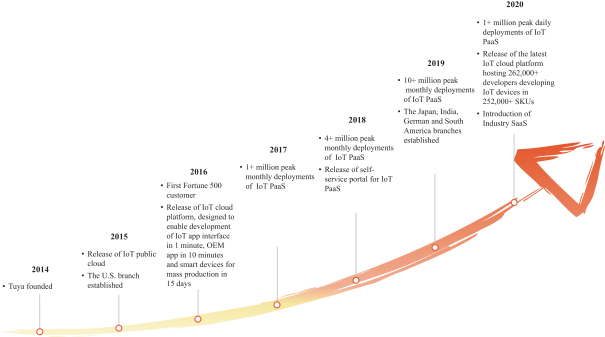
Our platform serves a wide range of customers with a highly flexible technology infrastructure. We offer our IoT cloud platform to brands and their in-house IoT developers and OEMs, as well as third-party developers, with services extensible directly to end users. Our customers and the brands we serve span a broad range of industry verticals, such as smart home, smart business, healthcare, education and agriculture. Our platform is multi-cloud, allowing customers to switch among major cloud infrastructure providers, such as Amazon Web Services, Microsoft Azure and Tencent Cloud. Our platform also integrates mainstream third-party technologies, such as Amazon Alexa, Google Assistant and Samsung SmartThings, to make smart devices more intelligent.
We have established a thriving ecosystem of brands, OEMs, developers, partners and end users on our platform due to powerful network effects. End users of smart devices demand a single interface to interact with various types of devices from different brands—an experience similar to using different apps on one smartphone. Our platform provides an open architecture to connect any device from any brand, while enabling users to manage all devices across brands through a single portal—the exact experience they desire. As a result, more brands want to join our platform to integrate their devices onto the single user interface through which devices from other brands are connected. These self-reinforcing network effects further increase our brand awareness and generates word-of-mouth referrals, helping us form an extensive, vibrant and increasingly interconnected IoT ecosystem.
We help our customers succeed and we benefit from their growth through our consumption-based revenue model as we deploy IoT PaaS to more smart devices developed by our customers. We had 188 premium IoT PaaS customers, defined as IoT PaaS customers who individually contributed more than US$100,000 of revenue during the immediately preceding 12-month periods, as of December 31, 2020. In 2020, our premium IoT PaaS customers contributed approximately 87% of our revenues generated from IoT PaaS. Our dollar-based net expansion rate of IoT PaaS was 181% for the trailing 12-month period ended December 31, 2020, indicating strong growth within our existing customer base.
We have pioneered an IoT cloud platform that empowers businesses and developers to transform from offering traditional products into providing software-enabled smart devices and IoT services. The foundation of
92
Table of Contents
our solution is Tuya IoT Cloud infrastructure, our unified underlying cloud infrastructure that provides a rich set of infrastructure capabilities and developer tools. Based upon Tuya IoT Cloud infrastructure, we offer the following products and services:
IoT PaaS
Our IoT PaaS is an integrated, all-in-one product that enables customers to quickly, and cost-effectively build and manage software-enabled IoT devices.
Our IoT PaaS combines cloud-based connectivity and basic IoT services, edge capabilities, app development, and device optimization solutions, which we believe are the most fundamental elements of technology enabling a product to become smart. We generate revenue from the fees we charge for these capabilities as a single, integrated offering and generally do not make any one of these capabilities available without the others. We believe that an integrated approach helps improve the value and usage of our IoT PaaS. We call a smart device on which our IoT PaaS is deployed a “deployment” of IoT PaaS. The fees that we charge IoT PaaS customers are based on the number of IoT PaaS products that are deployed. As a result, our revenue from IoT PaaS grows as the number of deployments increases. We typically do not impose minimum order requirements or usage requirement on customers, making us a valuable partner for newcomers to the IoT space as we enable them to kick-start their ventures with little upfront cost.
Our IoT PaaS serves both brands and OEMs. It is typically our OEM customers who directly place orders for deployment of IoT PaaS. In addition, we also work closely with the brands to plan, design, develop and market their smart devices. Our close relationship with brands enables our softwares and services to be adopted rapidly and allows us to significantly improve our visibility to brands on a global scale cost-efficiently. We offer a membership program to our customers that gives them the option to pay a membership fee primarily in exchange for IoT PaaS discounts based on a tiered membership status in accordance with their expected deployment volume. The membership program allows us to foster long-term relationship with our customers. In 2020, approximately 63% of our IoT PaaS deployments were from our membership customers.
Smart device distribution
Some of our customers, primarily brands and system integrators, prefer not to deal with multiple OEMs. These customers have the option to purchase directly from us finished smart devices deployed with IoT PaaS sourced from qualified OEMs. They typically place purchase orders directly with us by specifying the type of smart devices. We then source these products for these customers by engaging qualified partner OEMs based on the type of products, hardware specifications and other metrics.
SaaS and others
We offer Industry SaaS, focused software solutions that enable businesses to easily and securely deploy, connect, and manage large numbers and different types of IoT devices, driving efficiency, cost saving and productivity. Currently, we charge our Industry SaaS customers a basic annual subscription fee that allows them to support certain number of user accounts initially plus, in some cases, an incremental fee annually for each additional number of user accounts added to their networks. We may also charge a one-time project-based fee, particularly for new customers. We primarily market our Industry SaaS to system integrators with leading positions in their respective verticals and geographies, so that we can leverage their industry expertise and existing customer bases to quickly gain market shares and build brand awareness.
We also generate a portion of our SaaS and others revenues from (i) certain services we offer to brands and OEMs that are complementary to IoT PaaS, as well as (ii) a wide variety of cloud-based services we offer directly to end users of Tuya-powered smart devices. The complementary services for IoT PaaS customers
93
Table of Contents
primarily include mobile app customization services, AI-powered virtual assistants, and data analytics, as well as approximately 50 other ancillary value-added services, such as device testing, product certification and joint R&D of innovative IoT applications, among other things. The cloud-based services for end users include basic services, such as receiving app updates, that we offer for free, and a curated suite of premium cloud-based services accessible to end users for a fee, such as IoT data storage, push messaging and content services.
For more information, see “Business—Our Products and Services—For Business Customers Developing Smart Devices—IoT PaaS” and “Business—Our Products and Services—For End Users Using Smart Devices.”
Impact of COVID-19
Since December 2019, the outbreak of COVID-19 has resulted in prolonged mandatory quarantines, lockdown, closures of businesses and facilities, travel restrictions and social distancing guidelines imposed by the governments worldwide.
The COVID-19 pandemic has caused temporary disruption to our business operations during the first quarter of 2020. In the first quarter of 2020, we experienced a decline in demand for IoT PaaS due to reduced production capacity of OEM customers as COVID-19 containment measures began to be widely introduced across China, where substantially all of them were located, which adversely affected our results of operations in that quarter. Additionally, throughout 2020, the travel restrictions and social distancing guidelines imposed by governments globally have reduced the amount of international travels and in-person meetings, which in turn limited our ability to engage in in-person marketing with brands, particularly those brands based in the U.S. and Europe. There remains significant uncertainties associated with the COVID-19 pandemic, including with respect to the ultimate spread of the virus, the severity of the disease, the duration of the pandemic and further actions that may be taken by governmental authorities around the world to contain the virus or to treat its impact, and the full extent to which the COVID-19 pandemic will directly or indirectly impact our business, results of operations, cash flows and financial condition will depend on future developments that are highly uncertain and cannot be accurately predicted. See “Risk Factors—Risks Related to Our Business and Industry—We face risks related to natural disasters, extreme weather conditions, health epidemics and other catastrophic incidents, which could significantly disrupt our operations.”
As COVID-19-related restrictions were being lifted in China, our OEM customers have gradually resumed normal operations, clearing their backlogs since the second quarter of 2020. The number of deployments of IoT PaaS largely returned to pre-COVID levels in the second quarter of 2020, and we recorded a significant growth in deployments of IoT PaaS in the third and fourth quarters of 2020 both consecutively and as compared to the same period in 2019. Moreover, we believe that the value of software-enabled IoT experience and the connectivity, convenience and efficiency that it enables is heightened throughout the pandemic. People’s interactions with IoT devices have increased as they continue to work, learn, and play from home. Businesses and organizations are increasingly relying on IoT technologies to perform tasks that can no longer handled manually due to COVID-19 related restrictions and closures. We expect this trend to persist post-pandemic and continue to drive demand for quality IoT products and services in the long run. To capture this growth opportunity, we intend to continue to invest in growing our customer, developer and partner bases, broadening our product offerings, and expanding our brand awareness.
94
Table of Contents
Key Operating Metrics
We manage our business using the following key operating metrics. We use these metrics to assess the progress of our business, make decisions on where to allocate capital, time and technology investments and assess the near-term and long-term performance of our business.
| For the Year Ended December 31, |
||||||||
| 2019 | 2020 | |||||||
| Deployment of IoT PaaS (in millions) |
60.1 | 116.5 | ||||||
| Number of IoT PaaS customers |
2,328 | 3,296 | ||||||
| For the trailing 12-month period ended December 31, |
||||||||
| 2019 | 2020 | |||||||
| Number of premium IoT PaaS customers |
127 | 188 | ||||||
| For the trailing 12-month period ended | ||||||||||||||||||||
| December 31, 2019 |
March 31, 2020 |
June 30, 2020 | September 30, 2020 |
December 31, 2020 |
||||||||||||||||
| Dollar-based net expansion rate for IoT PaaS |
188 | % | 173 | % | 160 | % | 179 | % | 181 | % | ||||||||||
Deployment of IoT PaaS
We monitor deployment of IoT PaaS as a key performance indicator of adoption of our IoT PaaS offering which has historically generated a substantial majority of our revenue. We call a smart device on which our IoT PaaS is deployed a “deployment” of IoT PaaS. The fees that we charge IoT PaaS customers are based on the number of IoT PaaS products that are deployed. As a result, our revenue from IoT PaaS grows as the number of deployments increases.
Number of IoT PaaS Customers
Our ability to grow the number of IoT PaaS customers is a key indicator of our business and future growth opportunities. We define an IoT PaaS customer for a given period as a customer who has directly placed at least one order for IoT PaaS with us during that period. While we serve both brands and OEMs, it is typically the OEMs, instead of brands, who directly place orders with us for IoT PaaS.
Number of Premium IoT PaaS Customers
While we continue to grow IoT PaaS customers across all sizes, over time, we focus on growing the number of our premium customers to scale our business. We define a premium IoT PaaS customer as a customer as of a given date that contributed more than US$100,000 of revenue during the immediately preceding 12-month period.
Dollar-based Net Expansion Rate for IoT PaaS
Our ability to maintain long-term revenue growth is dependent on our ability to increase customers’ usage of our platform over time and grow revenue generated from existing customers. An important way for us to track our performance in this area is by measuring dollar-based net expansion rate for our IoT PaaS. To calculate the dollar-based net expansion rate for IoT PaaS for the current period, we first specify a measurement period consisting of the trailing two years from the current period end. Next, we define as our “cohort” the population of
95
Table of Contents
IoT PaaS customers for the first year of the measurement period (i.e. those have placed at least one order for IoT PaaS during that year). We then calculate the dollar-based net expansion rate as the quotient obtained by dividing the IoT PaaS revenue from this cohort in the second year of the measurement period by the IoT PaaS revenue from this the same cohort in the first year of the measurement period. The dollar-based net expansion rate for our IoT PaaS is affected by customers’ purchase cycles, which could fluctuate from time to time within a year, as well as a number of other factors including but not limited to new product introductions, customer mix promotional activities, and the variable timing and amount of customer purchases. As a result, the dollar-based net expansion rate for our IoT PaaS for the trailing 12-months period ended the last day of each quarter is an inherently volatile metric. Due to the negative impact of COVID-19 and a combination of the factors mentioned above, the dollar-based net expansion rate for our IoT PaaS decreased from 188% for the trailing 12-month period ended December 31, 2019 to 173% for the trailing 12-month period ended March 31, 2020 and further to 160% for the trailing 12-month period ended June 30, 2020. Our dollar-based net expansion rate for IoT PaaS has remained higher than 150% for five consecutive quarters since we began tracking this metric for the trailing 12-month period ended December 31, 2019. Our dollar-based net expansion rate demonstrates our strong ability to continue to expand customers’ usage of our platform over time and grow revenue generated from existing customers.
Factors Affecting Our Performance
Market Adoption of IoT Cloud Platform
Our future success depends in large part on the market adoption of IoT cloud platforms which, in turn, has been driven by the proliferation of smart devices. As technology advances, businesses and end users have an increasing demand for a software experience, driving IoT to an inflection point. However, brands and developers still face a number of challenges, such as the cost and complexity associated with developing an integrated IoT cloud platform. We see growing demand for our platform because we are in a unique position to deliver a one-stop, developer-first, cloud-agnostic IoT platform with broad use cases that allows our customers to digitalize their businesses and transform the experience of their end users. We believe that the benefits of our platform put us in a strong position to capture the significant market opportunity ahead.
Expanding Usage by Existing Customers
We have amassed a large and diversified customer base covering a wide spectrum of verticals. We believe that there are significant growth opportunities within our existing customers. As our platform is built to be product- and brand-agnostic, many customers using our IoT cloud platform for one product category expand their usage to more brands, categories and use cases in order to maximize the benefits of our platform and ensure consistent, high quality IoT experience for their end users. Through the increase in usage, we grow more brands and OEMs on our platform into larger customers, such as premium customers who contribute more than US$100,000 of revenue within 12 months. As this trend continues over time, our brand awareness also increases, generating word-of-mouth referrals that not only attract more brands, developers and partners, but also lead to growing end user demand, better user insights and a more vibrant IoT ecosystem. We expect to expand into additional product categories and use cases to expand cross- and up-selling opportunities and continue to invest in sales and marketing and customer success activities to achieve additional revenue growth from existing customers. We believe that these efforts will have a long-term, positive impact on our business and results of operations.
New Customer Acquisition
Our operating results and growth prospects will depend in part on our ability to attract new customers. We are intensely focused on growing our customer base. We continue to invest in our sales and marketing efforts and developer community outreach, which are critical to driving customer acquisition. We have built a developer and partner network through our effective marketing efforts which continuously raises awareness of our IoT cloud platform. For example, through our self-service developer portal, a developer can begin using our platform and
96
Table of Contents
developing a smart device within minutes. This has allowed us to acquire customers rapidly and cost-effectively. Furthermore, we seek to improve the breadth and quality of our platform and products, and to enhance our brand recognition, which will allow us to capture additional market share, better optimize the pricing of our products and services, and reach customers in a broader range of verticals and use cases.
Investment for Growth
We are committed to delivering industry-leading products to continue building and maintaining credibility with the global IoT community. We believe that the comprehensiveness of our product offerings and our continued efforts to introduce new features and capabilities on our platform provide us with a significant competitive advantage. We intend to continue to enhance our platform by expanding the functionality of existing products, developing new products, and delving into more verticals and use cases to support the growth of our business, and to invest heavily in our engineering capabilities and marketing activities to maintain our strong position in the developer community.
Seasonality
We have in the past experienced, and expect in the future to continue to experience, seasonal fluctuations in our revenue and sales from time to time, with the fourth quarter historically being our strongest quarter for sales to new and existing customers, as a result of the holiday season and customers’ buying patterns. We have experienced lower growth in revenue in the first quarter as a result the reduced capacity of OEM customers located in China due to the Lunar New Year. We expect the historical seasonality trends to continue to have a material impact on our results of operations and financial condition.
Revenue Mix
Our products and services primarily consist of IoT PaaS, smart device distribution, Industry SaaS and cloud-based value-added services. Our results of operations are affected by our product mix, as different products have a range of margin and profitability profiles. For example, an increase in the revenue contribution from products with higher margin profile generally leads to an increase in our overall profit margin. Our product mix may shift over time due to the combination of a variety of factors, including customer demands and preferences, competition, our ability to maintain and expand customer relationships, our ability to forecast market and technology trends, and our sales and marketing efforts. We continuously monitor the margin mix of our offerings and seek to increase the percentage of revenue from products and use cases with attractive margin profiles.
Effect of Currency Translation
We currently derive a significant majority of our revenues from IoT PaaS which, in turn, are generated primarily through our contracts with OEMs located in the PRC. These revenues are predominantly denominated in RMB. We operate internationally with local offices in the U.S., India, Germany, and Japan, among other locations, and expect that our international activities will continue to grow over the foreseeable future as we pursue opportunities in existing and new markets. Our reporting and functional currency is the U.S. dollar. The financial statements of our subsidiaries and consolidated affiliated entities using functional currencies other than the U.S. dollar, such as RMB, are translated to the U.S. dollar. As a result, as RMB depreciates or appreciates against the U.S. dollar, our revenue presented in U.S. dollars will be negatively or positively affected. See “—Quantitative and Qualitative Disclosure about Market Risk—Foreign exchange risk.”
97
Table of Contents
Key Components of Results of Operations
Revenues
We generate revenues from three sources, namely (i) IoT PaaS; (ii) smart device distribution; and (iii) SaaS and others. The following table sets forth a breakdown of our revenues, in absolute amounts and as percentages of total revenues, for the periods indicated.
| For the Year Ended December 31, |
||||||||||||||||
| 2019 | 2020 | |||||||||||||||
| US$ | % | US$ | % | |||||||||||||
| (in thousands, except for percentages) | ||||||||||||||||
| Revenues |
||||||||||||||||
| IoT PaaS |
76,365 | 72.2 | 151,677 | 84.3 | ||||||||||||
| Smart device distribution |
27,474 | 26.0 | 22,071 | 12.3 | ||||||||||||
| SaaS and others |
1,950 | 1.8 | 6,126 | 3.4 | ||||||||||||
|
|
|
|
|
|
|
|
|
|||||||||
| Total revenues |
105,789 | 100.0 | 179,874 | 100.0 | ||||||||||||
|
|
|
|
|
|
|
|
|
|||||||||
IoT PaaS. We generate IoT PaaS revenue from the fees charged to customers based on the number of IoT PaaS products we deploy.
Smart device distribution. For our smart device distribution service, we generate revenues from sales to select brands and system integrators on an on-demand basis of finished Tuya-powered smart devices sourced from contracted OEMs. We strategically position smart device distribution as a way to nurture long-term customer relationship and have kept it at a relatively small scale.
SaaS and others. We generate our SaaS and others revenues from (i) the subscription fees charged to customers of Industry SaaS and (ii) the fees that we receive for certain value-added services we offer to brands and OEMs, such as AI-powered virtual assistants and data analytics, and a wide variety of cloud-based services we offer directly to end users of Tuya-powered smart devices.
See “—Business Model” and “Business—Our Products” for details about how we generate our revenues.
Cost of Revenue; Gross Margin
Our cost of revenue consists of the costs directly related to providing our products to our customers. These costs and expenses primarily include (i) purchase price of materials (e.g. the modules on which the edge capabilities of IoT PaaS are embedded); (ii) manufacturing charges from outsourced factories; (iii) estimated warranty costs; (iv) inventory write-downs; (v) payroll cost of production support personnel; and (vi) third-party cloud infrastructure expenses that are directly attributable to the provision of our products and services.
Gross profit is equal to our total revenues less cost of revenues. Gross profit as a percentage of our total revenues is referred to as gross margin. The following table sets forth our gross margins for the periods indicated.
| For the Year Ended December 31, |
||||||||
| 2019 | 2020 | |||||||
| (%) | ||||||||
| IoT PaaS |
28.7 | 35.9 | ||||||
| Smart device distribution |
16.0 | 13.0 | ||||||
| SaaS and others |
75.8 | 75.6 | ||||||
| Overall gross margin |
26.3 | 34.4 | ||||||
|
|
|
|
|
|||||
98
Table of Contents
Our cost of revenue and gross margin have been and will continue to be affected by a number of factors, including economies of scale, improved efficiency achieved through effective R&D, and product mix, among other things. We expect our cost of revenue to increase in absolute amount as our business continues to grow. While our overall gross margin could fluctuate from period to period depending on the interplay of the above mentioned factors, we expect our overall gross margin to increase in the future, primarily driven by (i) increased revenue contribution from SaaS and others, which generally have a higher gross margin, and (ii) improved efficiency as a result of our continued investment in R&D. For the drivers behind the increase in the gross margins of IoT PaaS and other related details, see “—2020 Compared to 2019—Cost of Revenue; Gross Margin.”
Operating Expenses
The following table sets forth a breakdown of our operating expenses, in absolute amounts and as percentages of our total revenue, for the periods indicated.
| For the Year Ended December 31, | ||||||||||||||||
| 2019 | 2020 | |||||||||||||||
| US$ | % of total revenue |
US$ | % of total revenue |
|||||||||||||
| (in thousands, except for percentages) | ||||||||||||||||
| Operating expenses |
||||||||||||||||
| Research and development expenses |
52,003 | 49.2 | 77,430 | 43.0 | ||||||||||||
| Sales and marketing expenses |
37,017 | 35.0 | 37,556 | 20.9 | ||||||||||||
| General and administrative expenses |
12,196 | 11.5 | 17,868 | 9.9 | ||||||||||||
| Other operating expenses/(incomes), net |
10 | 0.0 | (1,071 | ) | (0.6 | ) | ||||||||||
|
|
|
|
|
|
|
|
|
|||||||||
| Total operating expenses |
101,226 | 95.7 | 131,783 | 73.3 | ||||||||||||
|
|
|
|
|
|
|
|
|
|||||||||
Research and development expenses. Research and development expenses consist primarily of (i) employee-related costs, including salaries, benefits, bonuses and share-based compensation, for our research and development personnel; (ii) bandwidth and cloud infrastructure costs; (iii) rental expenses; (iv) depreciation; and (v) other expenses associated with our research and development activities.
We believe that continued investment in research and development is key to our future growth. We expect to continue to invest substantially in our research and development efforts to improve customer experience, adding new features and functionalities to our platform and products and launching new products and services. As a result, we expect our research and development expenses to continue to increase in absolute amount in the foreseeable future.
Sales and marketing expenses. Sales and marketing expenses consist primarily of (i) employee-related costs, including salaries, bonuses, benefits and share-based compensation, for our employees responsible for business development, branding and marketing; (ii) marketing costs related to our developer conferences and events; and (iii) other sales and marketing expenses, including those spent on content and social media marketing.
We plan to continue to invest in sales and marketing to promote our brand, grow our developer and partner network, and retain our existing customers and attract new customers. As a result, we expect our sales and marketing expenses to increase in absolute amount in the foreseeable future. We expect our sales and marketing expenses to decrease as a percentage of our revenue over the long term as we benefit from our enhanced brand awareness and economies of scale, while such expenses may fluctuate as a percentage of our revenue from period to period depending on the timing and extent of these expenses and due to seasonality.
General and administrative expenses. Our general and administrative expenses consist of employee-related costs, including salaries, bonuses, benefits and share-based compensation paid to general and administrative
99
Table of Contents
personnel and other expenses associated with our general and administrative activities. We expect our general and administrative expenses to increase in the foreseeable future as we incur additional expenses as a result of operating as a public company and to meet the increased compliance requirements associated with our international expansion.
Other operating expenses/(incomes), net. Other operating incomes primarily consist of government grants and other operating expenses primarily consist of tax surcharges. We recorded net other operating expenses of US$10.0 thousand in 2019 and net other operating incomes of US$1.1 million in 2020.
Other Income/(Loss)
Other income primarily consists of financial income and foreign exchange loss. Our other income was US$3.1 million and US$3.1 million in 2019 and 2020, respectively.
Taxation
Cayman Islands
We are incorporated in the Cayman Islands. Under the current laws of the Cayman Islands, we are not subject to income, corporation or capital gains tax in the Cayman Islands. In addition, our payment of dividends, if any, is not subject to withholding tax in the Cayman Islands.
Hong Kong
Our subsidiaries in Hong Kong, including Tuya (HK) Limited, our wholly-owned subsidiary, are subject to Hong Kong profits tax on their activities conducted in Hong Kong at a uniform tax rate of 16.5%. Under Hong Kong tax law, our subsidiaries in Hong Kong are exempted from income tax on their qualified foreign-derived income and there is no withholding tax in Hong Kong on remittance of dividends. No provision for Hong Kong profits tax was made as we had no estimated taxable income that was subject to Hong Kong profits tax during 2019 and 2020.
PRC
Our subsidiaries and consolidated VIE in China are companies incorporated under PRC law and, as such, are subject to PRC enterprise income tax on their taxable income in accordance with the relevant PRC income tax laws. Pursuant to the PRC Enterprise Income Tax Law, or PRC EIT Law, which became effective on January 1, 2008, a uniform 25% enterprise income tax rate is generally applicable to both foreign-invested enterprises and domestic enterprises, except where a special preferential rate applies. In 2019 and 2020, preferential tax treatment was available to one of our PRC subsidiaries. Hangzhou Tuya Information Technology Co., Ltd was recognized as a high-tech enterprise in November 2018, which allowed it to apply an income tax rate of 15% within the validity period of high-tech enterprise certificate. The enterprise income tax is calculated based on the entity’s global income as determined under PRC tax laws and accounting standards.
We are subject to VAT on the products sold and services provided. We are also subject to surcharges on VAT payments in accordance with PRC law.
As a Cayman Islands holding company, we may receive dividends from our PRC subsidiaries through Tuya (HK) Limited. The PRC EIT Law and its implementing rules provide that dividends paid by a PRC entity to a nonresident enterprise for income tax purposes is subject to PRC withholding tax at a rate of 10%, and may be
100
Table of Contents
subject to reduction by an applicable tax treaty with China. Pursuant to the Arrangement between Mainland China and the Hong Kong Special Administrative Region for the Avoidance of Double Taxation and Tax Evasion on Income, the withholding tax rate in respect to the payment of dividends by a PRC enterprise to a Hong Kong enterprise may be reduced to 5% from a standard rate of 10% if the Hong Kong enterprise (i) directly holds at least 25% of the PRC enterprise, (ii) is a tax resident in Hong Kong and (iii) could be recognized as a Beneficial Owner of the dividend from PRC tax perspective. Pursuant to the Notice of the State Administration of Taxation on the Issues concerning the Application of the Dividend Clauses of Tax Agreements, or Guoshuihan [2009] 81, a Hong Kong resident enterprise must meet the following conditions, among others, in order to apply the reduced withholding tax rate: (i) it must be a company; (ii) it must directly own the required percentage of equity interests and voting rights in the PRC resident enterprise; and (iii) it must have directly owned such required percentage in the PRC resident enterprise throughout the 12 months prior to receiving the dividends. In October 2019, the State Administration of Taxation issued Announcement of the State Taxation Administration on Issuing the Measures for Non-resident Taxpayers’ Enjoyment of Treaty Benefits, or SAT Circular 35, which became effective on January 1, 2020. SAT Circular 35 provides that nonresident enterprises are not required to obtain pre-approval from the relevant tax authority in order to enjoy the reduced withholding tax. Instead, nonresident enterprises and their withholding agents may, by self-assessment and on confirmation that the prescribed criteria to enjoy the tax treaty benefits are met, directly apply the reduced withholding tax rate, and file necessary forms and supporting documents when performing tax filings, which will be subject to post-tax filing examinations by the relevant tax authorities. Accordingly, Tuya (HK) Limited may be able to benefit from the 5% withholding tax rate for the dividends it receives from its PRC subsidiaries, if it satisfies the conditions prescribed under Guoshuihan [2009] 81 and other relevant tax rules and regulations. However, according to Guoshuihan [2009] 81 and SAT Circular 35, if the relevant tax authorities consider the transactions or arrangements we have are for the primary purpose of enjoying a favorable tax treatment, the relevant tax authorities may adjust the favorable withholding tax in the future.
If our holding company in the Cayman Islands or any of our subsidiaries outside of China were deemed to be a “resident enterprise” under the PRC EIT Law, it would be subject to enterprise income tax on its worldwide income at a rate of 25%. See “Risk Factors—Risks Related to Doing Business in China—If we are classified as a PRC resident enterprise for PRC enterprise income tax purposes, such classification could result in unfavorable tax consequences to us and our non-PRC shareholders and ADS holders.”
101
Table of Contents
Results of Operations
The following table summarizes our consolidated results of operations and as percentages of our total revenues for the periods presented.
| For the Year Ended December 31, | ||||||||||||||||
| 2019 | 2020 | |||||||||||||||
| US$ | % | US$ | % | |||||||||||||
| (in thousands, except for percentages, shares and per share data) |
||||||||||||||||
| Consolidated Statements of Operation: |
||||||||||||||||
| Revenue |
105,789 | 100.0 | 179,874 | 100.0 | ||||||||||||
| Cost of revenue |
(78,003 | ) | (73.7 | ) | (117,937 | ) | (65.6 | ) | ||||||||
| Gross profit |
27,786 | 26.3 | 61,937 | 34.4 | ||||||||||||
| Operating expenses: |
||||||||||||||||
| Research and development expenses(1) |
(52,003 | ) | (49.2 | ) | (77,430 | ) | (43.1 | ) | ||||||||
| Sales and marketing expenses(1) |
(37,017 | ) | (35.0 | ) | (37,556 | ) | (20.9 | ) | ||||||||
| General and administrative expenses(1) |
(12,196 | ) | (11.5 | ) | (17,868 | ) | (9.9 | ) | ||||||||
| Other operating (expenses)/incomes, net |
(10 | ) | (0.0 | ) | 1,071 | 0.6 | ||||||||||
| Total operating expenses |
(101,226 | ) | (95.7 | ) | (131,783 | ) | (73.3 | ) | ||||||||
| Loss from operations |
(73,440 | ) | (69.4 | ) | (69,846 | ) | (38.9 | ) | ||||||||
| Other income/(loss): |
||||||||||||||||
| Financial income, net |
3,326 | 3.1 | 3,220 | 1.8 | ||||||||||||
| Foreign exchange loss, net |
(239 | ) | (0.2 | ) | (80 | ) | (0.0 | ) | ||||||||
| Loss before income tax expense |
(70,353 | ) | (66.5 | ) | (66,706 | ) | (37.1 | ) | ||||||||
| Income tax expense |
(124 | ) | (0.1 | ) | (206 | ) | (0.1 | ) | ||||||||
| Net loss attributable to Tuya Inc. |
(70,477 | ) | (66.6 | ) | (66,912 | ) | (37.2 | ) | ||||||||
| Note: (1) | Includes share-based compensation expense as follows: |
| For the Year Ended December 31, |
||||||||
| 2019 | 2020 | |||||||
| US$ | US$ | |||||||
| (in thousands) | ||||||||
| Research and development expenses |
1,218 | 2,596 | ||||||
| Sales and marketing expenses |
1,109 | 1,529 | ||||||
| General and administrative expenses |
2,893 | 5,321 | ||||||
|
|
|
|
|
|||||
| Total |
5,220 | 9,446 | ||||||
2020 Compared to 2019
Revenues
| For the Year Ended December 31, |
Change | |||||||||||||||
| 2019 | 2020 | US$ | % | |||||||||||||
| (US$ in thousands except for percentages) | ||||||||||||||||
| Total revenues |
105,789 | 179,874 | 74,085 | 70.0 | ||||||||||||
Our revenues increased by 70.0% from US$105.8 million for 2019 to US$179.9 million for 2020, primarily driven by increases in our revenue from IoT PaaS and SaaS and others, partially offset by a decrease in the revenue from smart device distribution.
102
Table of Contents
IoT PaaS
Our revenues generated from IoT PaaS increased by 98.6% from US$76.4 million for 2019 to US$151.7 million for 2020, mainly driven by an increase in our number of deployments by 93.8% from 60.1 million to 116.5 million which, in turn, was driven by (i) growth in the SKUs and categories of products supported by IoT PaaS; and (ii) increased sales to existing customers as their sale of smart devices continued to grow and to a lesser extent, acquisition of new customers. Of the increase in revenues generated from IoT PaaS, US$62.0 million was due to sales to existing customers and US$13.3 million was due to sales to new customers.
Smart device distribution
Our revenues generated from smart device distribution decreased by 19.7% from US$27.5 million for 2019 to US$22.1 million for 2020, as we strategically decided to keep our smart device distribution services at a relatively small scale.
SaaS and others
Our revenues generated from SaaS and others increased by 214.2% from US$2.0 million for 2019 to US$6.1 million for 2020, primarily driven by an increase in revenues from the Industry SaaS business which started to grow and to a lesser extent, an increase in revenues from value-added services we offer to customers, particularly data analytics and app customization services. We launched our Industry SaaS business in March 2020, and its rapid growth since its inception was mainly driven by strong demand from business operators for sophisticated, brand-agnostic Industry SaaS offerings.
Cost of Revenue and Gross Margin
| For the Year Ended December 31, |
Change | |||||||||||||||
| 2019 | 2020 | US$ | % | |||||||||||||
| (US$ in thousands except for percentages) | ||||||||||||||||
| Cost of Revenue |
78,003 | 117,937 | 39,934 | 51.2 | % | |||||||||||
Our cost of revenue increased by 51.2% from US$78.0 million for 2019 to US$117.9 million for 2020, primarily driven by an increase of US$42.8 million in the cost of revenue of IoT PaaS and to a lesser extent, an increase of US$1.0 million in the cost of revenue of SaaS and others, largely driven by growths in these businesses. The increase in our cost of revenue was partially offset by a decrease of US$3.9 million in the cost of revenue of smart device distribution.
Gross Margin
As a result of the foregoing, our gross profit increased by 122.9% from US$27.8 million for 2019 to US$61.9 million for 2020.
Our overall gross margin increased from 26.3% for 2019 to 34.4% for 2020 due to an increase in the gross margin of IoT PaaS, while the gross margin of smart device distribution decreased from 16.0% to 13.0% and the gross margin of SaaS and others remained relatively stable during these periods. The gross margin of IoT PaaS increased from 28.7% for 2019 to 35.9% for 2020, primarily due to (i) our increased economies of scale and cost savings as our business continued to grow, and (ii) improved efficiency relating to IoT PaaS deployment achieved through effective R&D. The gross margin of smart device distribution decreased by 3% due to normal fluctuations caused by different customer mix and variable timing and amount of customer purchases from period to period.
103
Table of Contents
Total Operating Expenses
Our total operating expenses increased by 30.2% from US$101.2 million for 2019 to US$131.8 million for 2020, mainly attributable to the increased expenses in research and development, sales and marketing and general and administrative as discussed below.
| For the Year Ended December 31, |
Change | |||||||||||||||
| 2019 | 2020 | US$ | % | |||||||||||||
| (US$ in thousands except for percentages) | ||||||||||||||||
| Total operating expenses |
101,226 | 131,783 | 30,557 | 30.2 | ||||||||||||
Research and development expenses
| For the Year Ended December 31, |
Change | |||||||||||||||
| 2019 | 2020 | US$ | % | |||||||||||||
| (US$ in thousands except for percentages) | ||||||||||||||||
| Research and development expenses |
52,003 | 77,430 | 25,427 | 48.9 | ||||||||||||
Our research and development expenses increased by 48.9% from US$52.0 million for 2019 to US$77.4 million for 2020. The increase was mainly attributable to an increase of US$22.8 million in employee-related costs which, in turn, was driven by an increase in the number of our research and development employees and an increase in their compensation levels, as we continued to intensify our research and development efforts. As of December 31, 2019 and 2020, we had 1,009 and 1,637 research and development employees, respectively.
Sales and marketing expenses
| For the Year Ended December 31, |
Change | |||||||||||||||
| 2019 | 2020 | US$ | % | |||||||||||||
| (US$ in thousands except for percentages) |
||||||||||||||||
| Sales and marketing expenses |
37,017 | 37,556 | 539 | 1.5 | ||||||||||||
Our sales and marketing expenses increased by 1.5% from US$37.0 million for 2019 to US$37.6 million for 2020. The increase was mainly attributable to an increase of US$5.7 million in employee-related costs, partially offset by a decrease of US$4.1 million in marketing spending as a result of the slowdown in our marketing efforts through in-person conferences and events due to COVID-19.
General and administrative expenses
| For the Year Ended December 31, |
Change | |||||||||||||||
| 2019 | 2020 | US$ | % | |||||||||||||
| (US$ in thousands except for percentages) | ||||||||||||||||
| General and administrative expenses |
12,196 | 17,868 | 5,672 | 46.5 | ||||||||||||
Our general and administrative expenses increased by 46.5% from US$12.2 million for 2019 to US$17.9 million for 2020, mainly attributable to a US$4.0 million increase in employee-related costs, including a US$2.4 million increase in share-based compensation. This, in turn, was due to an increase in the number of our general and administrative employees. We had 83 and 115 general and administrative employees, respectively, as of December 31, 2019 and 2020.
104
Table of Contents
Other operating (expenses)/incomes, net
| For the Year Ended December 31, |
Change | |||||||||||||||
| 2019 | 2020 | US$ | % | |||||||||||||
| (US$ in thousands except for percentages) | ||||||||||||||||
| Other operating (expenses)/incomes, net |
(10 | ) | 1,071 | 1,081 | (10,810.0 | )% | ||||||||||
Our other operating (expenses)/incomes, net changed from other operating expenses, net of US$10.0 thousand for 2019 to other operating incomes, net of US$1.1 million for 2020, which was mainly attributable to incentive subsidies granted by the PRC government to IoT companies in 2020.
Other Income/(Loss)
| For the Year Ended December 31, |
Change | |||||||||||||||
| 2019 | 2020 | US$ | % | |||||||||||||
| (US$ in thousands except for percentages) | ||||||||||||||||
| Other income/(loss) |
3,087 | 3,140 | 53 | 1.7 | % | |||||||||||
We generated other income of US$3.09 million and US$3.14 million, respectively, for 2019 and 2020. The increase in other income was mainly due to decreased foreign exchange loss, net in the amount of US$0.16 million and decreased financial income, net in the amount of US$0.11 million.
Income Tax Expense
| For the Year Ended December 31, |
Change | |||||||||||||||
| 2019 | 2020 | US$ | % | |||||||||||||
| (US$ in thousands except for percentages) | ||||||||||||||||
| Income tax expense |
124 | 206 | 82 | 66.1 | % | |||||||||||
We had an income tax expense of US$0.1 million for 2019 and US$0.2 million for 2020.
Net Loss for the Period
| For the Year Ended December 31, |
Change | |||||||||||||||
| 2019 | 2020 | US$ | % | |||||||||||||
| (US$ in thousands except for percentages) | ||||||||||||||||
| Net loss for the period |
70,477 | 66,912 | (3,565 | ) | (5.1 | )% | ||||||||||
As a result of the foregoing, we recorded net loss of US$70.5 million and US$66.9 million, respectively, for 2019 and 2020.
Non-GAAP Financial Measure
We use adjusted loss for the year, which is a non-GAAP financial measure, in evaluating our operating results and for financial and operational decision-making purposes. We believe that adjusted loss for the year provides useful information about our results of operations and enhances the overall understanding of our past performance and future prospects.
105
Table of Contents
Adjusted loss for the year should not be considered in isolation or construed as an alternative to loss from operations, net loss for the year or any other measure of performance or as an indicator of our operating performance. Investors are encouraged to review adjusted loss for the year and the reconciliation to its most directly comparable U.S. GAAP measure. Adjusted loss for the year presented here may not be comparable to similarly titled measures presented by other companies. Other companies may calculate similarly titled measures differently, limiting their usefulness as comparative measures to our data. We encourage investors and others to review our financial information in its entirety and not rely on a single financial measure.
Adjusted loss for the year represents net loss for the year excluding share-based compensation expenses, which we do not consider to be indicative of our core operating performance. The table below sets forth a reconciliation of our net loss for the year to adjusted loss for the year for the years indicated.
| For the Year Ended December 31, |
||||||||
| 2019 | 2020 | |||||||
| US$ | US$ | |||||||
| (in thousands) | ||||||||
| Net loss for the year |
(70,477 | ) | (66,912 | ) | ||||
| Adjustment: |
||||||||
| Share-based compensation expenses |
5,220 | 9,446 | ||||||
|
|
|
|
|
|||||
| Adjusted loss for the year |
(65,257 | ) | (57,466 | ) | ||||
106
Table of Contents
Selected Quarterly Results of Operations
The following table sets forth our unaudited consolidated quarterly results of operations for the periods indicated. You should read the following table in conjunction with our consolidated financial statements and related notes included elsewhere in this prospectus. We have prepared the unaudited consolidated quarterly financial information on the same basis as our audited consolidated financial statements. The unaudited consolidated quarterly financial information includes all adjustments, consisting only of normal and recurring adjustments, that we consider necessary for a fair statement of our operating results for the quarters presented. Historical results are not necessarily indicative of the results that may be expected for the full fiscal year or any other period.
| For the Three Months Ended | ||||||||||||||||||||||||||||||||
| March 31, 2019 |
June 30, 2019 |
September 30, 2019 |
December 31, 2019 |
March 31, 2020 |
June 30, 2020 |
September 30, 2020 |
December 31, 2020 |
|||||||||||||||||||||||||
| Revenue: |
||||||||||||||||||||||||||||||||
| IoT PaaS |
12,779 | 16,044 | 22,591 | 24,951 | 15,216 | 29,144 | 52,846 | 54,471 | ||||||||||||||||||||||||
| Smart device distribution |
3,382 | 5,589 | 10,209 | 8,294 | 3,010 | 8,453 | 4,457 | 6,151 | ||||||||||||||||||||||||
| SaaS and others |
89 | 191 | 682 | 988 | 720 | 1,236 | 1,777 | 2,393 | ||||||||||||||||||||||||
|
|
|
|
|
|
|
|
|
|
|
|
|
|
|
|
|
|||||||||||||||||
| Total revenue |
16,250 | 21,824 | 33,482 | 34,233 | 18,946 | 38,833 | 59,080 | 63,015 | ||||||||||||||||||||||||
| Cost of revenue |
(12,321 | ) | (16,314 | ) | (24,719 | ) | (24,649 | ) | (13,207 | ) | (27,085 | ) | (38,750 | ) | (38,895 | ) | ||||||||||||||||
| Gross profit |
3,929 | 5,510 | 8,763 | 9,584 | 5,739 | 11,748 | 20,330 | 24,120 | ||||||||||||||||||||||||
| Operating expenses: |
||||||||||||||||||||||||||||||||
| Research and development expenses |
(9,690 | ) | (11,657 | ) | (13,501 | ) | (17,155 | ) | (15,825 | ) | (16,086 | ) | (20,052 | ) | (25,467 | ) | ||||||||||||||||
| Sales and marketing expenses |
(6,353 | ) | (8,369 | ) | (8,534 | ) | (13,761 | ) | (8,519 | ) | (7,443 | ) | (9,802 | ) | (11,792 | ) | ||||||||||||||||
| General and administrative expenses |
(2,137 | ) | (2,421 | ) | (3,719 | ) | (3,919 | ) | (3,430 | ) | (3,825 | ) | (4,393 | ) | (6,220 | ) | ||||||||||||||||
| Other operating incomes/(expenses), net |
13 | (21 | ) | 21 | (23 | ) | 252 | 28 | 137 | 654 | ||||||||||||||||||||||
|
|
|
|
|
|
|
|
|
|
|
|
|
|
|
|
|
|||||||||||||||||
| Total operating expenses |
(18,167 | ) | (22,468 | ) | (25,733 | ) | (34,858 | ) | (27,522 | ) | (27,326 | ) | (34,110 | ) | (42,825 | ) | ||||||||||||||||
|
|
|
|
|
|
|
|
|
|
|
|
|
|
|
|
|
|||||||||||||||||
| Loss from operations |
(14,238 | ) | (16,958 | ) | (16,970 | ) | (25,274 | ) | (21,783 | ) | (15,578 | ) | (13,780 | ) | (18,705 | ) | ||||||||||||||||
|
|
|
|
|
|
|
|
|
|
|
|
|
|
|
|
|
|||||||||||||||||
| Financial income, net |
631 | 565 | 1,099 | 1,031 | 1,192 | 766 | 654 | 608 | ||||||||||||||||||||||||
| Foreign exchange (loss)/gain, net |
(483 | ) | 133 | 75 | 36 | (10 | ) | 146 | 51 | (267 | ) | |||||||||||||||||||||
|
|
|
|
|
|
|
|
|
|
|
|
|
|
|
|
|
|||||||||||||||||
| Loss before income tax expense |
(14,090 | ) | (16,260 | ) | (15,796 | ) | (24,207 | ) | (20,601 | ) | (14,666 | ) | (13,075 | ) | (18,364 | ) | ||||||||||||||||
| Income tax expense |
(54 | ) | (50 | ) | (8 | ) | (12 | ) | (38 | ) | (76 | ) | (75 | ) | (17 | ) | ||||||||||||||||
|
|
|
|
|
|
|
|
|
|
|
|
|
|
|
|
|
|||||||||||||||||
| Net loss |
(14,144 | ) | (16,310 | ) | (15,804 | ) | (24,219 | ) | (20,639 | ) | (14,742 | ) | (13,150 | ) | (18,381 | ) | ||||||||||||||||
|
|
|
|
|
|
|
|
|
|
|
|
|
|
|
|
|
|||||||||||||||||
| Net loss attributable to Tuya Inc. |
(14,144 | ) | (16,310 | ) | (15,804 | ) | (24,219 | ) | (20,639 | ) | (14,742 | ) | (13,150 | ) | (18,381 | ) | ||||||||||||||||
|
|
|
|
|
|
|
|
|
|
|
|
|
|
|
|
|
|||||||||||||||||
| Deemed dividend from preferred shareholders |
— | — | — | (3,430 | ) | — | — | — | — | |||||||||||||||||||||||
|
|
|
|
|
|
|
|
|
|
|
|
|
|
|
|
|
|||||||||||||||||
| Net loss attributable to ordinary shareholders |
(14,144 | ) | (16,310 | ) | (15,804 | ) | (27,649 | ) | (20,639 | ) | (14,742 | ) | (13,150 | ) | (18,381 | ) | ||||||||||||||||
|
|
|
|
|
|
|
|
|
|
|
|
|
|
|
|
|
|||||||||||||||||
| Net loss |
(14,144 | ) | (16,310 | ) | (15,804 | ) | (24,219 | ) | (20,639 | ) | (14,742 | ) | (13,150 | ) | (18,381 | ) | ||||||||||||||||
| Other comprehensive (loss)/income |
||||||||||||||||||||||||||||||||
| Foreign currency translation |
(222 | ) | (437 | ) | 849 | (618 | ) | (321 | ) | (34 | ) | 1,543 | 1694 | |||||||||||||||||||
|
|
|
|
|
|
|
|
|
|
|
|
|
|
|
|
|
|||||||||||||||||
| Total comprehensive loss attributable to Tuya Inc. |
(14,366 | ) | (16,747 | ) | (14,955 | ) | (24,837 | ) | (20,960 | ) | (14,776 | ) | (11,607 | ) | (16,687 | ) | ||||||||||||||||
|
|
|
|
|
|
|
|
|
|
|
|
|
|
|
|
|
|||||||||||||||||
107
Table of Contents
| Note: (1) | Share-based compensation expense was allocated as follows: |
| For the Three Months Ended | ||||||||||||||||||||||||||||||||
| March 31, 2019 |
June 30, 2019 |
September 30, 2019 |
December 31, 2019 |
March 31, 2020 |
June 30, 2020 |
September 30, 2020 |
December 31, 2020 |
|||||||||||||||||||||||||
| Research and development expenses |
212 | 284 | 324 | 398 | 412 | 406 | 817 | 961 | ||||||||||||||||||||||||
| Sales and marketing expenses |
159 | 266 | 285 | 399 | 323 | 183 | 619 | 404 | ||||||||||||||||||||||||
| General and administrative expenses |
406 | 677 | 819 | 991 | 1,079 | 1,123 | 1,432 | 1,687 | ||||||||||||||||||||||||
| Total |
777 | 1,227 | 1,428 | 1,788 | 1,814 | 1,712 | 2,868 | 3,052 | ||||||||||||||||||||||||
Our revenue from IoT PaaS has generally increased sequentially in the quarters presented primarily due to the continued increase in the number of deployment of IoT PaaS, except for a decline in the first quarter of 2020 mainly due to COVID-19. We experienced a decline in demand for IoT PaaS in the first quarter of 2020 due to reduced production capacity of OEM customers, as COVID-19 containment measures began to be widely introduced across China where substantially all of these OEMs were located. Our revenue from IoT PaaS and number of deployments of IoT PaaS have largely returned to pre-COVID levels in the second quarter of 2020. Our revenue from smart device distribution depends, to a greater extent, on customers’ purchase patterns and demands as we strategically position smart device distribution as a way to nurture long term customer relationship, and thus fluctuates from period to period. Our revenue from SaaS and others have also increased sequentially over the quarters presented, except for a decrease in the first quarter of 2020 as a result of the negative impact of COVID-19. Since we launched our Industry SaaS business in March 2020, our revenue from SaaS and others has experienced rapid growth driven by strong demand from business operators for sophisticated, brand-agnostic industry SaaS offerings.
Liquidity and Capital Resources
Cash Flows and Working Capital
Our principal sources of liquidity have been cash generated from private sales of equity securities. As of December 31, 2020, we had US$179.8 million in cash and cash equivalents and short-term investment. As of December 31, 2020, cash and cash equivalents in an aggregate amount of RMB268.1 million and US$6.9 million, total equivalent to US$48.0 million, were held by our subsidiaries in the PRC; cash and cash equivalents, mainly denominated in US$, of total equivalent to US$109.1 million were held by our subsidiaries in Hong Kong; and the cash and cash equivalents, mainly denominated in U.S. dollars, EUR, and Japanese Yen, of total equivalent to US$1.7 million were held by Tuya Inc. and its other overseas subsidiaries. Our cash and cash equivalents and short-term investments consist of bank deposits and investments in short-term wealth management products offered by financial institutions in the PRC, most of which have original maturities of three months or less when purchased. We believe that our current cash and cash equivalents, balance of short-term investments and anticipated cash flows from operations will be sufficient to meet our anticipated cash needs, including cash needs for working capital and capital expenditures, for at least the next 12 months.
We intend to finance our future working capital requirements and capital expenditures primarily from cash expected to be generated from operating activities and funds raised from financing activities, including the net proceeds we will receive from this offering. We may not be able to obtain additional financing on terms favorable to us, if at all. If we are unable to obtain adequate financing or financing on terms satisfactory to us when we require it, our ability to continue to support our business growth, scale our infrastructure, develop product enhancements and to respond to business challenges could be significantly impaired, and our business, operating results and financial condition may be adversely affected. See “Risk Factors—Risks Related to Our
108
Table of Contents
Business and Our Industry—We may require additional capital to support our business and response to business opportunities, and this capital might not be available on acceptable terms, if at all.”
Additionally, historically we have not been profitable or generated positive operating cash flows. We generated net loss of US$70.5 million and US$66.9 million in 2019 and 2020, respectively. As of December 31, 2020, we had an accumulated deficit of US$192.5 million. We recorded net cash operating outflows of US$56.6 million and US$49.2 million in 2019 and 2020. If we are unable to achieve and sustain profitability, or if we continue to experience net cash operating outflows in the future, our business, liquidity, financial condition and results of operations may be materially and adversely affected. See “Risk Factors—Risks Related to Our Business and Our Industry—We have a history of net losses and may not be able to achieve or sustain profitability in the future.”
The following table presents our consolidated cash flow data for the periods presented.
| For the Year Ended December 31, |
||||||||
| 2019 | 2020 | |||||||
| US$ | US$ | |||||||
| (in thousands) | ||||||||
| Net cash used in operating activities |
(56,563 | ) | (49,211 | ) | ||||
| Net cash generated from/(used in) investing activities |
8,491 | (7,852 | ) | |||||
| Net cash generated from/(used in) financing activities |
174,230 | (172 | ) | |||||
| Effect of exchange rate changes on cash and cash equivalents, restricted cash |
(481 | ) | 2,903 | |||||
| Net increase/(decrease) in cash and cash equivalents, restricted cash |
125,677 | (54,332 | ) | |||||
| Cash and cash equivalents, restricted cash at the beginning of the year |
87,610 | 213,287 | ||||||
| Cash and cash equivalents, restricted cash at the end of the year |
213,287 | 158,955 | ||||||
Operating Activities
Net cash used in operating activities was US$49.2 million in 2020. The difference between our net loss of US$66.9 million and the net cash used in operating activities was mainly due to (i) an increase in advance from customers of US$13.0 million which was largely driven by our overall business growth and increased number of customers, (ii) an increase in accruals and other payables of US$11.9 million, (iii) an increase in accounts payables of US$11.0 million due to increased payables to our suppliers which, in turn, was largely driven by our overall business growth, and (iv) share-based compensation of US$9.4 million, partially offset by (i) an increase in inventories of US$19.8 million as we increased our stock of materials to meet the needs of our growing business, (ii) an increase in notes receivable of US$8.7 million due to increased customer payments in the form of commercial notes, and (iii) an increase in accounts receivable of US$7.2 million, driven by our overall business growth and increased number of customers.
Net cash used in operating activities was US$56.6 million in 2019. The difference between our net loss of US$70.5 million and the net cash used in operating activities was mainly due to (i) an increase in accruals and other payables of US$11.8 million, (ii) an increase in accounts payable of US$7.5 million, (iii) share-based compensation of US$5.2 million, and (iv) an increase in amortization of right-of use assets of US$2.6 million, partially offset by (i) an increase in inventories of US$11.0 million, (ii) an increase in accounts receivable of US$4.0 million and (iii) a decrease in operating lease liabilities of US$2.3 million. The foregoing increases in accounts payable, inventories, and accounts receivable were primarily driven by our overall business growth in 2019.
Investing Activities
Net cash used in investing activities was US$7.9 million in 2020, which was primarily attributable to payment for short-term investments of US$196.8 million, partially offset by (i) proceeds from disposal of
109
Table of Contents
short-term investments of US$192.5 million and (ii) proceeds from disposal of a long-term investment of US$0.2 million. Our short-term investment mainly include bank time deposits and investments in short-term wealth management products offered by financial institutions in the PRC.
Net cash generated from investing activities was US$8.5 million in 2019, which was primarily attributable to (i) proceeds from investments in short-term investments of US$281.5 million and (ii) proceeds from disposal of property, equipment and software of US$5.0 thousand, partially offset by (i) payment for short-term investments of US$270.4 million, (ii) purchase of property, equipment and software of US$2.5 million and (iii) payment for long-term investments of US$0.1 million. Our short-term investment are investments in short-term wealth management products offered by financial institutions in the PRC.
Financing Activities
Net cash used in financing activities in 2020 was US$172 thousand, which was due to payments of deferred offering costs of US$182 thousand, partially offset by subscription contributions from shareholders of US$10 thousand.
Net cash generated from financing activities in 2019 was US$174.2 million, which was primarily attributable to proceeds from issuance of Series D preferred shares to investors in September and November 2019 of US$178.0 million (see “Description of Share Capital—History of Securities Issuances” for details), partially offset by a payment for repurchase of convertible preferred shares of US$3.8 million.
Capital Expenditures
Our capital expenditures are incurred primarily in connection with purchase of property, equipment and software. Our capital expenditures were US$2.5 million and US$3.2 million, respectively, in 2019 and 2020. We intend to fund our future capital expenditures with our existing cash balance and proceeds from this offering. We will continue to make capital expenditures to meet the expected growth of our business.
Contractual Obligations
The following table sets forth our contractual obligations and commitments as of December 31, 2020.
| Payments Due by Years Ending | ||||||||||||||||||||
| Total | Less than 1 year |
1-3 years | 3-5 years | More than 5 years |
||||||||||||||||
| (US$ in thousands) | ||||||||||||||||||||
| Operating leases(1) |
12,732 | 6,832 | 5,835 | 65 | — | |||||||||||||||
| Purchase obligations(2) |
2,382 | — | 2,382 | — | — | |||||||||||||||
| Total |
15,114 | 6,832 | 8,217 | 65 | — | |||||||||||||||
Notes:
| (1) | Operating leases represent total future minimum rent payments under non-cancelable operating lease agreements for our office premises. |
| (2) | Purchase obligations represent total future minimum payments under a contract with one cloud infrastructure provider. |
Holding Company Structure
Tuya Inc. is a holding company with no material operations of its own. We conduct our operations through our PRC and other international subsidiaries. As a result, our ability to pay dividends depends upon dividends paid by our subsidiaries. If our subsidiaries incur debt on their own behalf in the future, the instruments governing their debt may restrict their ability to pay dividends to us.
110
Table of Contents
In addition, our subsidiaries in China are permitted to pay dividends to us only out of their retained earnings, if any, as determined in accordance with the Accounting Standards for Business Enterprise as promulgated by the Ministry of Finance of the PRC, or PRC GAAP. In accordance with PRC company laws, our consolidated VIE in China must make appropriations from their after-tax profit to non-distributable reserve funds including (i) statutory surplus fund and (ii) discretionary surplus fund. The appropriation to the statutory surplus fund must be at least 10% of the after-tax profits calculated in accordance with PRC GAAP. Appropriation is not required if the statutory surplus fund has reached 50% of the registered capital of our consolidated VIE. Appropriation to discretionary surplus fund is made at the discretion of our consolidated VIE. Pursuant to the law applicable to China’s foreign investment enterprise, our subsidiaries that are foreign investment enterprise in the PRC have to make appropriation from their after-tax profit, as determined under PRC GAAP, to reserve funds including (i) general reserve fund, (ii) enterprise expansion fund and (iii) staff bonus and welfare fund. The appropriation to the general reserve fund must be at least 10% of the after-tax profits calculated in accordance with PRC GAAP. Appropriation is not required if the reserve fund has reached 50% of the registered capital of our subsidiary. Appropriation to the other two reserve funds are at our subsidiary’s discretion.
We are permitted under PRC laws and regulations to provide funding to our PRC subsidiaries in China through capital contributions or loans, subject to the approval of government authorities and limits on the amount of capital contributions and loans. In addition, our subsidiaries in China may provide RMB funding to our consolidated VIE only through entrusted loans. See “Risk Factors—Risks Related to Doing Business in China—PRC regulation of loans to and direct investment in PRC entities by offshore holding companies and governmental control of currency conversion may restrict or delay us from using the proceeds of this offering to make loans or additional capital contributions to our PRC subsidiaries and making loans to our VIE or its subsidiaries, which could adversely affect our liquidity and our ability to fund and expand our business” and “Use of Proceeds.” The ability of our subsidiaries in China to make dividends or other cash payments to us is subject to various restrictions under PRC laws and regulations. See “Risk Factors—Risks Related to Doing Business in China—We may rely on dividends and other distributions on equity paid by our PRC subsidiaries to fund any cash and financing requirements we may have, and any limitation on the ability of our PRC subsidiaries to make payments to us could have a material and adverse effect on our ability to conduct our business” and “Risk Factors—Risks Related to Doing Business in China—If we are classified as a PRC resident enterprise for PRC enterprise income tax purposes, such classification could result in unfavorable tax consequences to us and our non-PRC shareholders and ADS holders.”
Internal Control Over Financial Reporting
Prior to this offering, we have been a private company with limited accounting and financial reporting personnel and other resources to address our internal controls and procedures. In connection with the audit of our consolidated financial statements as of and for the years ended December 31, 2019 and 2020, we and our independent registered public accounting firm identified a material weakness in our internal control over financial reporting. As defined in the standards established by the Public Company Accounting Oversight Board of the United States, a “material weakness” is a deficiency, or a combination of deficiencies, in internal control over financial reporting such that there is a reasonable possibility that a material misstatement of the company’s annual or interim financial statements will not be prevented or detected on a timely basis.
The material weakness identified is our company’s lack of sufficient and competent financial reporting and accounting personnel with appropriate knowledge and experience to address complex U.S. GAAP accounting issues and to prepare and review financial statements and related disclosures in accordance with U.S. GAAP and SEC reporting requirement.
To remedy our identified material weakness, we have started to undertake steps to strengthen our internal control over financial reporting, including: (i) hiring more qualified resources including competent financial controllers and financial reporting managers, equipped with relevant U.S. GAAP and SEC reporting experiences
111
Table of Contents
and qualifications to strengthen the financial reporting function and to set up financial and system control framework, (ii) implementing regular and continuous U.S. GAAP accounting and financial reporting training programs for our accounting and financial reporting personnel, (iii) enhancing an internal audit function as well as engaging an external consulting firm to assist us to assess Sarbanes-Oxley compliance readiness and improve overall internal controls and (iv) sponsoring some of our accounting and financial reporting personnel to take the Uniform Certified Public Accountant Examination exam.
The process of designing and implementing an effective financial reporting system is a continuous effort that requires us to anticipate and react to changes in our business and the economic and regulatory environments and to expend significant resources to maintain a financial reporting system that is adequate to satisfy our reporting obligation. See “Risk Factors—Risks Related to Our Business and Industry—If we fail to establish and maintain proper and effective internal control over financial reporting to remediate our material weaknesses, we may be unable to accurately report our results of operations, meet our reporting obligations or prevent fraud.”
As a company with less than US$1.07 billion in revenue for our last fiscal year, we qualify as an “emerging growth company” pursuant to the JOBS Act. An emerging growth company may take advantage of specified reduced reporting and other requirements that are otherwise applicable generally to public companies. These provisions include exemption from the auditor attestation requirement under Section 404 of the Sarbanes-Oxley Act of 2002, in the assessment of the emerging growth company’s internal control over financial reporting. The JOBS Act also provides that an emerging growth company does not need to comply with any new or revised financial accounting standards until such date that a private company is otherwise required to comply with such new or revised accounting standards. We have elected to take advantage of such exemptions. However, pursuant to Section 404 and the related rules adopted by the SEC, we, as a public company after being listed, are required to maintain adequate internal control over financial reporting and include our management’s assessment of the effectiveness of our company’s internal control over financial reporting in our annual report for the fiscal year ending December 31, 2022.
Off-Balance Sheet Arrangements
We have not entered into any financial guarantees or other commitments to guarantee the payment obligations of any third parties. We have not entered into any derivative contracts that are indexed to our shares and classified as shareholder’s equity, or that are not reflected in our consolidated financial statements. Furthermore, we do not have any retained or contingent interest in assets transferred to an unconsolidated entity that serves as credit, liquidity or market risk support to such entity. We do not have any variable interest in any unconsolidated entity that provides financing, liquidity, market risk or credit support to us or engages in leasing, hedging or research and development services with us.
Quantitative and Qualitative Disclosure about Market Risk
Interest Rate Risk
Our exposure to interest rate risk primarily relates to the interest income generated by excess cash, which is mostly held in interest-bearing bank deposits. We have not used any derivative financial instruments to manage our interest risk exposure. Interest-earning instruments carry a degree of interest rate risk. We have not been exposed, nor do we anticipate being exposed, to material risks due to changes in interest rates. However, our future interest income may be lower than expected due to changes in market interest rates.
Foreign Exchange Risk
We currently derive a significant majority of our revenues from IoT PaaS which, in turn, are generated primarily through our contracts with OEMs located in the PRC. These revenues are predominantly denominated in RMB. A substantial portion of our expenses are also denominated in RMB. Our reporting and
112
Table of Contents
functional currency is the U.S. dollar. The financial statements of our subsidiaries and consolidated affiliated entities using functional currencies other than U.S. dollar, such as RMB, are translated to the U.S. dollar. As a result, as RMB depreciates or appreciates against the U.S. dollar, our revenue presented in U.S. dollars will be negatively or positively affected. We have not used any derivative financial instruments to hedge exposure to such risk. Although our exposure to foreign exchange risks should be limited in general, the value of your investment in the ADSs will be affected by the exchange rate between U.S. dollar and RMB because the value of our business is effectively denominated in RMB, while the ADSs representing our Class A ordinary shares will be traded in U.S. dollars.
The value of the RMB against the U.S. dollar and other currencies is affected by changes in China’s political and economic conditions and by China’s foreign exchange policies, among other things. In July 2005, the PRC government changed its decades-old policy of pegging the value of the RMB to the U.S. dollar, and the RMB appreciated more than 20% against the U.S. dollar over the following three years. Since October 1, 2016, the RMB has joined the International Monetary Fund (IMF)’s basket of currencies that make up the Special Drawing Right (SDR), along with the U.S. dollar, the Euro, the Japanese yen and the British pound. With the development of the foreign exchange market and progress towards interest rate liberalization and RMB internationalization, the PRC government may in the future announce further changes to the exchange rate system and there is no guarantee that the RMB will not appreciate or depreciate significantly in value against the U.S. dollar in the future. It is difficult to predict how market forces or PRC or U.S. government policy may impact the exchange rate between the RMB and the U.S. dollar in the future.
To the extent that we need to convert U.S. dollars into RMB for our operations, appreciation of RMB against the U.S. dollar would reduce the RMB amount we receive from the conversion. Conversely, if we decide to convert RMB into U.S. dollars for the purpose of making payments for dividends on our ordinary shares or ADSs, servicing our outstanding debt, or for other business purposes, appreciation of the U.S. dollar against the RMB would reduce the U.S. dollar amounts available to us.
Inflation Risk
Since our inception, inflation in China has not materially impacted our results of operations. According to the National Bureau of Statistics of China, the year-over-year percent changes in the consumer price index for December 2018 and 2019 were increases of 1.9% and 4.5%, respectively. Although we have not in the past been materially affected by inflation since our inception, we can provide no assurance that we will not be affected in the future by higher rates of inflation in China.
Critical Accounting Policies, Judgments and Estimates
Revenue Recognition
We account for revenue in accordance with Accounting Standards Codification (ASC) Topic 606, Revenue From Contracts With Customers (ASC 606) for all periods presented. According to ASC 606, revenue is recognized when control of the promised goods or services is transferred to the customers, in an amount that reflects the consideration We expect to be entitled to in exchange for those goods or services. We determine revenue recognition through the following steps: (1) identify the contract(s) with a customer, (2) identify the performance obligations in the contract, (3) determine the transaction price, (4) allocate the transaction price to the performance obligations in the contract, and (5) recognize revenue when (or as) the entity satisfies a performance obligation. We assess our revenue arrangements against specific criteria in order to determine if it is acting as principal or agent. Revenue arrangements with multiple performance obligations are divided into separate distinct goods or services. We allocate the transaction price to each performance obligation based on the relative standalone selling price of the goods or services provided.
113
Table of Contents
Revenue is recorded net of value-added tax.
Our revenue was disaggregated by its major revenue streams in the years presented as follows:
| Year ended December 31, | ||||||||
| 2019 | 2020 | |||||||
| IoT PaaS |
76,365 | 151,677 | ||||||
| Smart device distribution |
27,474 | 22,071 | ||||||
| SaaS and others |
1,950 | 6,126 | ||||||
|
|
|
|
|
|||||
| Total revenue |
105,789 | 179,874 | ||||||
|
|
|
|
|
|||||
I. Revenue from IoT PaaS
Our IoT PaaS combines cloud-based connectivity and basic IoT services, edge capabilities (including modules and IoT operating system embedded), device optimization solutions, and app development. Customers are charged based on the number of IoT PaaS product to be deployed on smart devices. We determined there are two distinct performance obligations in the delivery of IoT PaaS including (1) IoT PaaS product with edge capabilities, device optimization solutions and app development and; (2) cloud-based connectivity and basic IoT services provided to customers and end consumers. We allocate the transaction price to each performance obligation based on their relative standalone selling price. The standalone selling price for IoT PaaS is estimated based on the competitor’s pricing for similar products in the market, adjusted for entity-specific factors. As the standalone selling price of the cloud-based connectivity and basic IoT services is not directly observable, it is estimated by us by using an expected cost plus a margin approach. Key areas of judgment include the selection of relevant cloud and other costs necessary to satisfy the performance obligation and estimated profit margins. For the delivery of IoT PaaS product, revenue is recognized when IoT PaaS products are accepted by customers, which is the point that control of the product is transferred to the customers. A receivable is recognized when the IoT PaaS products are delivered and accepted by customers as this is the point in time that the consideration is unconditional. For cloud-based connectivity and basic IoT services, revenue is deferred and subsequently recognized from the end consumer’s activation to the end of the estimated IoT PaaS product’s life cycle on a straight-line basis. Based on our historical information, activation occurs, on average, an estimated 6 months after the IoT PaaS products are delivered to customers. The length of life cycle of the IoT PaaS products is estimated based on the historical data in previous years and by referencing the life cycle of different smart devices (e.g. lighting, security and monitoring devices) which ranged from 1.5 to 2 years.
Customers have a general right of return of the unqualified IoT PaaS products. Historically, the rate of return has not been material.
We started a membership program (the “2019 Membership Program”) in the fourth quarter of 2019. In the 2019 Membership Program, customers pay a fixed fee in exchange for IoT PaaS discount, VIP technical support, valued added services (“VAS” i.e. customized app development), and free participation in promotional activities. The promise to provide for technical support related services, the promotion related services and VAS are considered immaterial promises in the contract and are not considered distinct performance obligations. The membership fee is refundable if the volume requirements are met when the membership period ends. We historically generally refunds the membership fees even if the volume requirements are not met. Therefore, We do not expect being able to keep any of the membership fees and such fees are recorded as a refund liability under the 2019 Membership Program.
We launched a new membership program (the “2020 Membership Program”) in the fourth quarter of 2020 and are no longer offering the 2019 Membership Program. In the 2020 Membership Program, customers pay a non-refundable fixed fee in exchange for member-exclusive IoT PaaS discounts within the membership period of typically 12 months. We record the upfront fixed membership fee as a deferred revenue and recognize revenue on a straight-line basis typically over the 12-month membership period in which customers entitle to the membership.
114
Table of Contents
II. Revenue from smart device distribution
In certain circumstances, we offer select brands, primarily customers who prefer not to deal with multiple OEMs, an option to purchase directly from our finished smart devices where IoT PaaS is deployed. After the brands place purchase orders directly with us, we then source the appropriate smart devices from OEMs based on the type of devices, hardware specifications and other metrics. We determine that there are two distinct performance obligations for its smart device distribution including the (1) smart devices embedded with IoT PaaS; and (2) cloud-based connectivity and basic IoT services. The transaction price allocation and revenue recognition are the same as the revenue from IoT PaaS.
We present the revenue generated from its smart device distribution on a gross basis as we have control of the smart devices before they are transferred to the brand customers. In making this determination, we conclude we met the principles of control and also that we are the primary obligor to the brand customers, are subject to inventory risk and have latitude in establishing prices.
III. Revenue from SaaS and others
SaaS and other revenue mainly include industry SaaS, customized software development and configuration, and other VAS to both business customers and the end consumers.
Industry SaaS is a vertical-focused software solution that enables businesses to easily and securely deploy, connect, and manage large numbers of smart devices for which we generally charge an annual subscription fee. These services include software authorization and standard SaaS platform maintenances and technical support.
Customized software development and configuration mainly relate to contracts for the specific IT needs of the brands. The contracts generally include fixed milestone payments determined based on expected labor hours to complete the milestone.
VAS primarily includes complementary services that are provided to brands and OEMs such as app launch, AI-powered virtual voice assistants, and data analytics and others. Such arrangements with the customers are short term and the performance obligations are satisfied at one point in time. VAS also include cloud-based services for the end customers such as IoT data storage, push messaging, object detection and digital content.
There are different kinds of contracts included in the SaaS and others, and each contract may contain multiple elements. We identify the distinct performance allocations and allocates transaction price to each distinct performance obligation based on relative estimated standalone selling price. Revenue is recognized when the performance obligations are satisfied, which is either over a period of time or at one point in time.
Remaining performance obligations
The remaining performance obligations primarily relate to our provision of i) cloud-based connectivity and basic IoT services; ii) membership services; and iii) SaaS and others, and all three of them are included in deferred revenue.
The amounts allocated to the cloud-based connectivity and basic IoT services are deferred and recognized on a straight-line basis over the estimated IoT PaaS product’s life cycle. We apportion deferred revenue between current and non-current based upon cloud-based connectivity and basic IoT services to be provided over the life cycle of smart devices. Deferred revenue relating to our cloud services that have an expiration date of less than 12 months are classified as current, otherwise non-current.
Starting from the fourth quarter of 2020, there are i) upfront fixed membership fee received and recorded as part of the deferred revenue, it is recognized as revenue on a straight-line basis typically over the 12-month
115
Table of Contents
membership period in which customers are entitled to the membership; and ii) amounts related to providing Industry SaaS (included in SaaS and others), in general, we charge annual subscription fee, which is deferred and recognized on a straight-line basis typically over the 12-month service period.
As of December 31, 2019 and 2020, the aggregate amount of transaction price allocated to the remaining performance obligations was US$0.8 million and US$4.2 million respectively, of which US$0.5 million and US$3.5 million were recorded in current deferred revenue while US$0.3 million and US$0.7 million were recorded in non-current deferred revenue respectively.
Our contract liability, including both deferred revenue and the advance from customers, is US$14.8 million and US$31.3 million as of December 31, 2019 and 2020 respectively.
We apply the practical expedient to omit disclosure of information about the transaction price allocated to remaining performance obligations and when revenue will be recognized, for the related contract has a duration of one year or less. The remaining amounts recorded in non-current deferred revenue of US$0.3 million and US$0.7 million as of December 31, 2019 and 2020, respectively, would likely be recognized within 18-24 months.
We provide warranty for IoT PaaS and smart device distribution mainly for one year. We accrue a warranty reserve for all IoT PaaS and smart device distribution, which include our best estimate of the projected costs to repair or replace items under warranties. These estimates are based on actual claims incurred to date and an estimate of the nature, frequency and costs of future claims. These estimates are inherently uncertain given our relatively short history of sales, and changes to the historical or projected warranty experience may cause material changes to the warranty reserve when we accumulate more actual data and experience in the future. The warranty reserve expected to be incurred is included within accruals and other liabilities in our consolidated balance sheets included elsewhere in this prospectus.
Share-based Compensation
We grant restricted shares to the founders (also as key member of the management) and our share options to eligible employees and nonemployees. We account for these share-based awards in accordance with ASC 718 Compensation — Stock Compensation.
The founders and employees’ share-based awards are measured at the grant date fair value of the awards and recognized as expenses using a straight-line method over the requisite service period, which is the vesting period. For share-based awards granted with only service conditions to our PRC employees, we allow accelerated full vesting upon occurrence of a change in control (including defined in our 2015 Equity Incentive Plan), cumulative share-based compensation expenses for the share-based awards should be recorded upon the completion of the change in control.
For nonemployees’ share-based awards, we adopted ASU 2018-07 “Improvements to Nonemployee Share-Based Payment Accounting” for the periods presented. In accordance with ASU 2018-07, it clarifies that equity-classified nonemployee share-based awards are measured at the grant date. The definition of the term grant date is amended to generally state the date at which a grantor and a grantee reach a mutual understanding of the key terms and conditions of a share-based payment award. Nonemployee share-based awards are measured at the grant date fair value of the awards and recognized as expenses using a straight-line method over the requisite service period, which is the vesting period.
All transactions in which goods or services are received in exchange for equity instruments are accounted for based on the fair value of the consideration received or the fair value of the equity instrument issued, whichever is more reliably measurable.
We adopted the binomial option-pricing model to measure the value of share options. For more information about the determination of the fair value of share options, see “Management’s Discussion and Analysis of Financial Condition and Results of Operations—Critical Accounting Policies, Judgments and Estimates—Fair value of share options.”
116
Table of Contents
The assumptions used in share-based compensation expense recognition represent management’s best estimates, but these estimates involve inherent uncertainties and application of management judgment. If factors change or different assumptions are used, the share-based compensation expenses could be materially different for any period. Moreover, the estimates of fair value of the awards are not intended to predict actual future events or the value that ultimately will be realized by grantees who receive share-based awards. In accordance with ASU 2016-09, we made an entity-wide accounting policy election to account for forfeitures when they occur.
| Year ended December 31, | ||||
| 2019 |
2020 | |||
| Exercise price (US$) |
0.79~1.08 | 0.3~1.08 | ||
| Exercise multiple |
2.2~2.8 | 2.2~2.8 | ||
| Risk-free interest rate |
2.08%~2.79% | 0.70%~0.82% | ||
| Expected term (in years) |
10 | 10 | ||
| Expected dividend yield |
— | — | ||
| Expected volatility |
50.30%~51.13% | 50.66%~50.96% | ||
| Expected forfeiture rate (post-vesting) |
4.19% | 3.88% | ||
| Fair value of the underlying shares on the date of options grants (US$) |
1.56~2.66 | 2.66~3.02 | ||
| Fair value of share option (US$) |
1.02~1.98 | 1.98~2.54 | ||
The expected volatility at the grant date and each option valuation date was estimated based on the annualized standard deviation of the daily return embedded in historical share prices of comparable peer companies with a time horizon equal to the expected expiry of the term of the options. We have not declared or paid any cash dividends on our capital stock, and we do not anticipate any dividend payments in the foreseeable future. Expected term is the contract life of the options. We estimated the risk-free interest rate based on the yield to maturity of U.S. treasury bonds denominated in US dollars at the option valuation date.
For the purpose of determining the estimated fair value of our share options, we believe the expected volatility and the estimated fair value of our ordinary shares are the most critical assumptions. Changes in these assumptions could significantly affect the fair value of share options and hence the amount of stock-based compensation we recognize in our consolidated financial statements. Since we did not have a trading history for our shares sufficient to calculate our own historical volatility, the expected volatility of our future ordinary share price was estimated based on the price volatility of the shares of comparable public companies that operate in the same or similar business.
Subsequent to December 31, 2020, (i) on January 5, 2021, we granted a total of 9,255,000 share options to our employee and non-employees, (ii) on January 13, 2021, we entered into agreements with certain optionees under the 2015 Plan to amend the exercise price of certain outstanding share options held by these optionees located outside of the U.S. to purchase our ordinary shares, (iii) in early February 2021, we issued total 16,026,282 shares of ordinary shares for US$12.48 per share, with total consideration of approximately US$200 million from two investors at fair market price, including one holder of our Series D Preferred Shares and (iv) on February 21, 2021, we granted a total of 5,405,000 share options to our employee and non-employees.
Mezzanine Equity
Mezzanine equity represents the Series A, Series A-1, Series B, Series C and Series D convertible preferred shares (collectively, the “Preferred Shares”) issued by us. Preferred Shares are contingently redeemable upon the occurrence of an event that is outside of our control. Therefore, we classify the Preferred Shares as mezzanine equity.
Fair value of ordinary shares
Prior to our initial public offering, we were a private company with no quoted market prices for our ordinary shares. We therefore needed to make estimates of financial forecast at various dates for the purpose of determining the fair value of our ordinary shares at the date of the grant of share-based compensation awards to our employees as one of the inputs into determining the grant date fair value of the option.
117
Table of Contents
The following table sets forth the fair value of our ordinary shares estimated at the grant dates of options with the assistance from an independent valuation firm.
| Date of valuation |
Fair Value Per Share |
DLOM |
Discount Rates | |||
| January 4, 2019 |
1.56 | 25.00% | 21.00% | |||
| May 15, 2019 |
2.57 | 24.00% | Not applicable. | |||
| November 11, 2019 |
2.57 | 24.00% | Not applicable. | |||
| April 27, 2020 |
2.82 | 19.00% | 20.00% | |||
| July 31, 2020 |
2.82 | 19.00% | 20.00% | |||
| January 5, 2021 |
12.48 | Not applicable. |
Not applicable. | |||
| January 13, 2021 |
12.48 | Not applicable. |
Not applicable. | |||
| February 21, 2021 |
14.46 | 5% | Not applicable. |
The option-pricing method was used to allocate equity value of our company to preferred and ordinary shares, taking into account the guidance prescribed by the AICPA Audit and Accounting Practice Aid. This method requires making estimates of the anticipated timing of a potential liquidity event, such as a sale of our company or an initial public offering, and estimates of the volatility of our equity securities. The anticipated timing is based on the plans of our board and management. The other major assumptions used in calculating the fair value of ordinary shares include:
| • | Weighted average cost of capital, or WACC: The WACCs were determined in consideration of factors including risk-free rate, comparative industry risk, equity risk premium, company size and non-systematic risk factors. |
| • | Comparable companies: In deriving the WACCs, which are used as the discount rates under the income approach, certain publicly traded companies in the internet industry were selected for reference as our guideline companies. |
| • | Discount for lack of marketability, or DLOM: DLOM was quantified by the protective put options mode. Under this option-pricing method, which assumed that the put option is struck at the price of the stock before the privately held shares can be sold, the cost of the put option was considered as a basis to determine the DLOM. This option pricing method is one of the methods commonly used in estimating DLOM as it can take into consideration factors such as timing of a liquidity event, for instance an initial public offering, and estimated volatility of our shares. The farther the valuation date is from an expected liquidity event, the higher the put option value is and thus the higher the implied DLOM is. The lower DLOM is used for the valuation, the higher the determined fair value of the ordinary shares becomes. DLOM remained around 24% in 2019 and decreased to around 5% in February 2021. |
The determination of the equity value requires complex and subjective judgments to be made regarding prospects of the industry and the products at the valuation date, our projected financial and operating results, our unique business risks and the liquidity of our shares.
The fair value of our ordinary shares increased from US$1.56 in January 2019 to US$2.57 in November 2019, which was primarily due to (i) the increased deployments of our Tuya IoT PaaS, which achieved more than 10 million deployments per month in the last quarter of 2019; (ii) in September and November 2019, we issued a total of 52,428,242 Series D preferred shares to certain investors, which provided us an additional amount of US$178.0 million in capital for business expansion and contributed to the increase in fair value of our ordinary shares during this period and (iii) the organic growth of our business and continuous improvement in our financial performance. For more information about such securities issuance, see “Description of Share Capital—History of Securities Issuances—Preferred Shares.”
The fair value of our ordinary shares further increased from US$2.57 in November 2019 to US$2.82 in July 2020, which was primarily due to further continuous growth of our business and continuous improvement in our
118
Table of Contents
financial performance, as our number of deployments largely returned to pre-COVID levels in the second quarter of 2020 as our OEM customers began to resume operations and clear the backlogs since restrictions in China continued to be eased and that we recorded a significant growth of our number of deployments in the third quarter of 2020 both consecutively and as compared to the same period in 2019.
The fair value of our ordinary shares in January 2021 was benchmarked against the issuance price of our ordinary shares to Tencent Mobility Limited and NVMB XIV Holdings Limited in early February 2021. The fair value of our ordinary shares further increased from US$2.82 in July 2020 to US$12.48 in January 2021, which was primarily due to a combination of the following factors:
| • | organic growth of our business and the continuous improvement in our financial performance and an updated business outlook. More specifically: |
| • | despite the negative impact of COVID-19, our IoT PaaS and SaaS and others revenues in the second half of 2020 increased by 227% as compared to the same period in 2019 and increased by 241% as compared to the first half of 2020; |
| • | the increased deployments of our IoT PaaS; the deployment of our IoT PaaS in January 2021 significantly exceeded our deployments in the first quarter of 2020; |
| • | the significant increases in both the number of our IoT PaaS premium customers and the revenue contribution per IoT PaaS premium customer in the second half of 2020 as compared to the first half of 2020; |
| • | the introduction of new Industry SaaS offering in 2020 and the winning of contracts with key accounts, including those among China’s top 30 leading real estate groups, in the fourth quarter of 2020; |
| • | the gross margins of our core business IoT PaaS have increased from 30.5% in the first quarter of 2020 to 34.9% in the third quarter of 2020; the gross margins of our core business IoT PaaS increased further to 40.1% in the fourth quarter of 2020 as compared to the previous quarter; |
| • | the continued upgrade of our IoT cloud platform and further improvement of our IoT device and software developer system in the second half of 2020 and the significant increases in the number of SDKs and SaaS applications developed using this platform; as of December 31, 2020, over 13,500 SDKs and 22,500 cloud-base SaaS applications had been developed using this platform, as compared to over 8,000 SDKs and 12,000 cloud-base SaaS applications as of September 30, 2020. |
| • | the improvement in global capital markets sentiment from the second quarter of 2020. More specifically, the CCS ETF-PowerShares and the HKC TMT Index increased by 42.59% and 37.58%, respectively, from June 30, 2020 to January 29, 2021 (based on data published by Wind and EastMoney). Additionally, the P/S multiples of seven SaaS and PaaS companies (NASDAQ: MDB, NYSE: TWLO, NASDAQ: API, NYSE: ESTC, NASDAQ: CRWD, NYSE: ZEN and 2013.HK) ranged from 16.34x to 62.66x on January 29, 2021, representing significant increases as compared to their P/S multiples ranging from 10.92x to 44.24x on June 30, 2020. The average P/S multiple of these companies increased from 24.59x to 36.25x, while the median hits 35.13x, increasing by 59.10% between June 30, 2020 and January 31, 2021 (based on data published by Capital IQ). |
| • | since the kicking-off of our IPO plan in the second half of 2020, we have made continued progress towards our IPO, and we increased our estimated probability of a successful IPO from 50% in early July 2020 to 90% in January 2021 accordingly. The holders of our convertible redeemable preferred shares currently enjoy substantial economic rights and preferences over the holders of the ordinary shares. Because our preferred shares will be automatically redesigned as ordinary shares upon the completion of our IPO, as the probability of our IPO increased, the valuation of our ordinary shares has also increased. |
The fair value of our ordinary shares increased from US$12.48 in January 2021 to US$14.46 in February 2021, which was primarily due to (i) further increase of our estimated probability of a successful IPO to 95% in
119
Table of Contents
February 2021, (ii) further decrease of DLOM to around 5% in February 2021, as we made continued progress towards our IPO, and (iii) increase of P/S multiples by around 10% from January 2021 to February 2021 as a result of further improvement in global capital markets sentiment.
The fair value of our ordinary shares increased from US$14.46 in February 2021 further to US$18.50 the midpoint of the estimated public offering price range shown on the front cover of this prospectus, was primarily attributable to the following factors:
| • | Reduced cost of capital and discount for lack of marketability |
| • | Due to the imminent initial public offering, if the we performs a valuation of our ordinary shares as of the initial public offering date using the same methodology with the other assumptions unchanged, the implied discount for marketability would have further decreased from 5.0% to 0.0%, and all outstanding preferred shares would be converted into ordinary shares. As a result, the per share value would increase from US$14.46 to US$15.22. Our initial public offering will increase the liquidity and marketability of our ordinary shares. Our initial public offering will also provide us with additional capital, enhance our ability to access capital markets to grow our business, and raise our overall profile. |
| • | Substantial growth in our business performance and prospects |
| • | Organic growth of our business and the continuous improvement in our financial performance and updated business outlook, with particularly further growth of the followings in the 2-month period ended February 28, 2021: (i) our core business IoT PaaS and SaaS and others revenues; (ii) the gross margins of our business IoT PaaS as well as our overall gross margins; (iii) the contribution from our core business IoT PaaS and SaaS and other revenue to our total revenues further increased in the 2-month period ended February 28, 2021; and (iv) the number of our employees, most of which were research and development personnel. |
| • | Increased business and revenue expectation, given that (i) during the year 2020, especially in the fourth quarter of 2020, we experienced significant business growth; (ii) we has also observed the increasing acceptance of, and demand for, a software-enabled IoT experience globally as people continue to work, learn, and play from home, which we believe will continue to drive demands for smart devices and services powered by our IoT PaaS in the long term. |
As a result of the above factors, the expectations for our business and financial performance in terms of revenue, number of customers, the number of use cases supported, etc., have increased relative to the date of our most recent valuation.
| • | The continued recovery of the global economic situation and the improvement of COVID-19 situation leading to stronger investor confidence and increased expectations. |
Since December 2020 when the global spread of COVID-19 reached its peak, the COVID-19 situations have stabilized in different regions in the world, and the global economic situation and global market is recovering. Different from other cloud infrastructure companies or SaaS or PaaS companies in other industries, our business is deeply integrated with our customers’ own businesses, which in turn are affected by the ultimate demands and purchasing power of the end users. The recovery of the end-user market and customers’ own business are positive signals for our business to maintain rapid growth, which has led to stronger investor confidence in us and our valuation and future performance.
Once a public trading market of the ADSs has been established in connection with the completion of this offering, it will no longer be necessary for us to estimate the fair value of our ordinary shares in connection with our accounting for granted share options.
Recent Accounting Pronouncements
For detailed discussion on recent accounting pronouncements, see Note 2 to our Consolidated Financial Statements.
120
Table of Contents
Certain information, including statistics and estimates, set forth in this section and elsewhere in this prospectus and all tables and graphs set forth in this section has been derived from an industry report commissioned by us and independently prepared by CIC in connection with this offering. We believe that the sources of such information are appropriate, and we have taken reasonable care in extracting and reproducing such information. We have no reason to believe that such information is false or misleading in any material respect or that any fact has been omitted that would render such information false or misleading in any material respect. However, neither we nor any other party involved in this offering has independently verified such information, and neither we nor any other party involved in this offering makes any representation as to the accuracy or completeness of such information. Therefore, investors are cautioned not to place any undue reliance on the information, including statistics and estimates, set forth in this section or similar information included elsewhere in this prospectus.
The Internet of Things Era
Internet of Things—the concept of connecting physical devices to a large, interconnected network—is profoundly transforming the way individuals interact with the physical world and changing how device companies develop products.
In the past decade, the mobile internet transformed people’s way of life. Proliferation of high-speed connectivity and advancements in computing, storage and networking capabilities enabled billions of people to communicate using smart mobile phones, or smartphones. Additionally, cloud-based technologies enabled development of mobile software applications, or apps that brought fundamental changes to customer experience and business operations. As a result, there was a convergence of operating systems that run mobile devices and mobile software app development tools, which drove a vibrant ecosystem of phones, users, developers and applications. Today there are billions of mobile phone users and millions of mobile apps. These mobile apps enabled people to socialize online, consume local services and conduct their lives from a smartphone. The concept of Social, Local, Mobile, or SoLoMo, has created trillion dollars of value in mobile internet.
The IoT era transcends the mobile internet, with distributed computing integrated with cloud infrastructure, supporting a rich set of applications and cloud-based services. As each dimension of SoLoMo extends into the IoT era, there is a massive opportunity for value creation by businesses.
| • | Social will evolve to Assistant, understanding user needs with built-in and cloud-based AI such as voice interaction. |
| • | Local will evolve to Space, maximizing user mobility by covering broader service possibilities such as autonomous driving and checkout-free shopping. |
| • | Mobile will evolve to Things, making more devices smart beyond the phones, ranging from smart home to smart manufacturing. |
Today, a confluence of favorable technology progresses are driving IoT to an inflection point:
| • | Cost and size of components are rapidly declining. Steady technology improvements in microprocessors, memory and networking are making components smaller and less expensive. |
| • | High speed networking is ubiquitous. High speed communication, supported by numerous protocols such as WiFi, 5G, Bluetooth and ZigBee, is increasingly available allowing everything to be connected at all times, often at negligible cost. |
| • | Cloud computing is readily available. Centralized computing infrastructure becomes widely accessible and highly scalable for cloud-based software. |
121
Table of Contents
Broadening Use Cases and Vertical Applications
Similar to mobile in past decade, IoT is fundamentally changing people’s way of life through millions of applications for a broad range of use cases. The following select vertical applications illustrate the value proposition, and hence accelerating demand, for mobile-like software experiences from IoT:
| • | Smart home. Home appliances, when powered with connectivity and software interface, can be controlled remotely as well as based on time or environment inputs, ultimately driving cost efficiency and end user convenience. |
| • | Smart business. Connected and software-enabled lighting, appliances and smart consumer security systems for commercial use cases coupled with centralized data management allow business operators to monitor, control and program these systems, thereby optimizing asset utilization and reducing operating costs. One such example is smart retail—IoT enablement can bring self-served fast check out shopping experience to retail stores. |
| • | Smart industries: |
| • | Smart manufacturing. Software-enabled connected factory equipment allows for sensing, measurement, control and communication of everything occurring throughout the manufacturing process. These devices enable remote monitoring and predictive maintenance of the equipment. |
| • | Smart transportation. With software-enabled infrastructure, vehicles, traffic and mobility management, users are able to make better use of the transportation network in areas such as routing, handling hazardous situations, parking, improving fuel efficiency and complying with speed limits, in addition to developing smarter infrastructure for the future. |
| • | Smart healthcare. IoT-enabled digital healthcare systems can seamlessly connect patients, hospitals, and device and medicine suppliers, increase the efficiency of medical resources utilization, automate the workflow and improve the operating efficiency at hospitals. Additionally, analytics on the massive amount of data generated by smart health devices can help physicians make more timely, informed decisions as well as take proactive measures for better health management. |
| • | Smart energy and utilities. Sensors, connectivity and analytics are applied to electric grid infrastructure to enable better efficiency, improve reliability, reduce emissions, and integrate more renewable and distributed energy resources. There will also be increasing IoT applications-enabled field devices and consumer energy technology devices at the edge of the grid. |
| • | Smart agriculture. Leveraging sensors, software, connectivity and data analytics, IoT-enabled agriculture helps increase the throughput and quality of crops, while reducing human labor. |
Proliferation of Smart Devices
Growing end user demand for smart devices, driven by increased affordability and improved user experiences, is driving brands to embrace IoT in their products, and developers to create an innovative new generation of user centric software applications, which in turn is leading to more use cases and further demand for IoT. This virtuous cycle is driving significant growth in the number of IoT devices. According to CIC, shipment of devices related to smart home and smart business reached 762.8 million in 2019 and is expected to grow to 2.5 billion by 2024, representing a CAGR of 26.7%; shipment of devices related to smart industries reached 427.5 million in 2019 and is expected to grow to 1.3 billion by 2024, representing a CAGR of 25.1%. Average penetration rate of connected devices among total incremental device shipment in home and business operations is 4.3% in 2019 and is expected to grow to 11.7% in 2024. Average penetration rate of connected devices among total incremental device shipment related to industrial operations is 11.9% in 2019 and is expected to grow to 22.4% in 2024. The chart below shows IoT devices shipment volume by year from 2019 to 2024.
122
Table of Contents
Worldwide IoT Device Shipment Volume (in Millions)
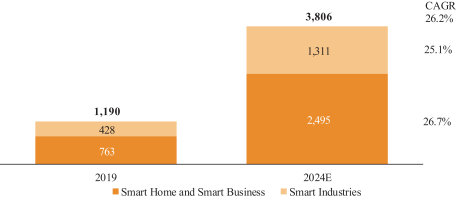
Note:
| (1) | IoT devices related to smart home and smart business include lighting, electrical accessories, home appliances, smart consumer security and monitoring devices, healthcare products, education and entertainment devices, central control devices and others. IoT devices related to smart industries include those used for manufacturing, transportation and logistics, healthcare, energy, public utilities and agriculture. |
Global Spend on IoT Technologies
A large number of these software-enabled devices and associated applications are transforming industries, changing city landscapes and impacting many aspects of human economic activities. The significant value creation potential is driving massive spend on IoT worldwide. According to IDC, the overall global IoT market, including hardware, software and services, is expected to grow from US$659.2 billion in 2019 to US$1,112.6 billion in 2024, representing a CAGR of 11.0%.
Asia Pacific including Japan had the largest share of the global IoT spend in 2019, representing 45.2% of the overall spend. It is forecasted to continue to contribute the most to the overall spend, growing at 11.3% CAGR from 2019 to 2024 and representing 45.8% of the market in 2024. Americas and EMEA accounted for 28.8% and 25.9% share of the overall spend in 2019, respectively. They are forecasted to grow at 9.3% and 12.4% CAGR, respectively, from 2019 to 2024. The chart below shows regional spend in 2019 and 2024.
Worldwide Internet of Things Spend by Region (US$ in Billions)
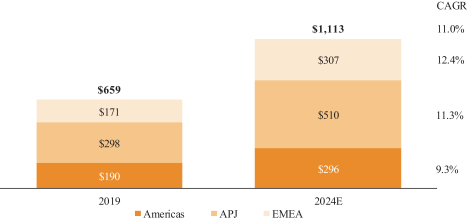
123
Table of Contents
IoT Platform-as-a-Service
With the proliferation of software, there was a heightened need for organizations to make their software development cycles and feature update process time- and cost-efficient. Platform-as-a-Service, or PaaS, emerged as a solution. It is a platform where third party providers deliver software, infrastructure and hardware such as networking, storage, operating systems, middleware and development tools needed for software developers to build and manage software efficiently.
Similarly, with the proliferation of IoT, there is increasing demand from brands and other IoT developers for third-party IoT PaaS providers who can provide tools to make the software-enabled IoT product’s development and update process both time- and cost-efficient. IoT PaaS provides a platform with the software, infrastructure and hardware needed to develop software-enabled IoT products and services efficiently.
Brands and OEMs leverage IoT PaaS to design and deliver software-enabled products to end users. Developers use tools from IoT PaaS to create solutions for more use cases. Technology providers partner with IoT PaaS to reach a broader set of customers. IoT PaaS presents strong value propositions to these key participants in the IoT ecosystem.
| • | Brands and OEMs. Shorter time-to-market, lower total cost, interoperability with multiple clouds and protocols and global scalability will be the key drivers for brands and OEMs to adopt IoT PaaS. |
| • | Developers. Top-tier IoT PaaS offerings can empower IoT developers with end-to-end and low-code / no-code development platform, large number of out-of-the-box features and the ability to tap insights from aggregated data generated from connected devices across product manufacturers. |
| • | Technology partners. Partnering with IoT PaaS providers will provide technology vendors access to brands and OEMs who could potentially integrate their solutions, as well as a large community of IoT developers who may become part of their user base. |
According to CIC, the total addressable market for IoT PaaS in 2019 was US$72.2 billion, out of which US$26.6 billion was attributable to smart home and smart business use cases, and US$45.6 billion was attributable to smart industry use cases. They estimate this overall IoT PaaS market to grow at a CAGR of 18.9% from 2019 to 2024 to reach US$171.7 billion, out of which US$57.9 billion is attributable to smart home and smart business, and US$113.8 billion is attributable to smart industries. China accounts for US$18.9 billion and US$49.7 billion of the overall IoT PaaS market in 2019 and 2024, respectively, representing a CAGR of 21.3%. The chart below shows IoT PaaS market opportunities in 2019 and 2024.
IoT PaaS Total Addressable Market (US$ in Billions)
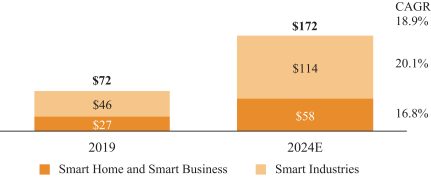
Note:
| (1) | Segments related to smart home and smart business include lighting, electrical accessories, home appliances, smart consumer security and monitoring devices, healthcare products, education and entertainment devices, central control devices and others. Segments related to smart industries include manufacturing, transportation and logistics, healthcare, energy, public utilities and agriculture. |
124
Table of Contents
The total addressable market is calculated by aggregating the individual market opportunity of each segment. Market sizes of most segments were calculated by multiplying the annual shipment volume of penetrable IoT devices within those segments by the unit revenue opportunity of each device. Market sizes of a few other segments, such as manufacturing production lines, were calculated by multiplying the number of incremental IoT devices needed for IoT enablement by the unit revenue opportunity of each device.
IoT Software-as-a-Service
Proliferation of IoT devices has paved way for Software-as-a-Service, or SaaS, IoT solutions designed for business operators across multiple verticals. Business operators are increasingly adopting these IoT SaaS solutions to optimize cost and improve operating efficiency, while focusing on their core competencies. As an example, hotel administrators can use such a software solution to manage its software-enabled IoT devices in the hotel. The software would automatically turn off air conditioning when no customer is detected in a particular room for certain time period, thereby realizing energy cost savings. IoT SaaS customers, by nature, are end users of software-enabled IoT devices, which provides inputs and data for the SaaS solutions. Therefore, further penetration of IoT SaaS will lead to enhanced demand for smart devices from brands and OEMs, who in turn will start leveraging end-to-end IoT PaaS solutions for device development and activation.
According to IDC, IoT software spend has reached US$129.2 billion in 2019 and is forecasted to grow to US$237.0 billion by 2024, representing a CAGR of 12.9%. Software represents 19.6% and 21.3% of the total IoT spend in 2019 and 2024, respectively. IoT software spend in China is estimated to be US$21.5 billion in 2019 and US$42.9 billion in 2024, representing a CAGR of 14.8%. Within IoT software there are a range of categories such as application software, analytics software, security software and others. The chart below shows market opportunity of IoT software in 2019 and 2024.
Total IoT Software Spend (US$ in Billions)
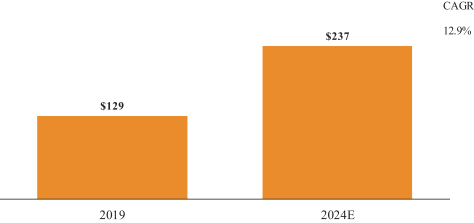
Limitations of Existing Offerings
Existing solutions in the market lack comprehensive features needed for either IoT PaaS or IoT SaaS, let alone both. Most of the providers attempt to solve only a small part of the problem. In many cases, these vendors lack focus on IoT or do not have the expertise to build end-to-end offerings. We broadly categorize the existing solutions as following:
| • | Cloud providers. |
| • | Lack of end-to-end offerings. These player primarily only focus on providing cloud computing capabilities required in the IoT scenario. |
125
Table of Contents
| • | Lack of neutrality. Cloud providers usually build solutions around their own cloud infrastructure, hence are difficult to be adopted by other IoT players. |
| • | Lagging in traction with brands and OEMs. With the focus on cloud driven offerings and their own ecosystems, they have not built the relationships with major brands and OEMs to power their devices. |
| • | Channel conflicts. Additionally, some public cloud providers also operate large ecommerce platforms that may create channel conflicts with device makers and retailers. |
| • | In-house development. Traditional device brands typically do not have the talent or skills for IoT platform development. Managing an IoT platform is not core to their business either. A few new-generation device brands do have better platform capabilities and a large end user base, but their closed ecosystem prevents them from becoming a true enabler for the industry. |
| • | Third-party platforms. Third-party platforms are typically subscale and have not been able to establish a large global user base, which is essential to form the virtuous network effects with the increasing value driven from device operation insights. Further, they typically do not provide end-to-end, integrated solutions. |
| • | IoT SaaS vendors. Existing vendors are mostly niche players focusing on siloed industries or verticals. Some vendors also only focus on specific geographic locations. Additionally, the market currently lacks vendors offering IoT SaaS solutions integrated with IoT PaaS offerings. |
Our Market Opportunity
We believe that as organizations transition from traditional product companies to digital businesses with software-enabled IoT products, a significant amount of IT spend will be allocated to IoT enablement. We provide these organizations a neutral, comprehensive and scalable platform with an open ecosystem. According to CIC, we are one of the earliest in the industry to provide full stack IoT solutions spanning the perception, network, cloud and application layers. Our vision is to become the largest platform to enable IoT products and services across the globe. Our technology and products address use cases in the large markets of IoT PaaS as well as IoT SaaS, which includes application software and analytics software spend on IoT. According to CIC, the worldwide IoT PaaS total addressable market is forecasted to grow from US$72.2 billion in 2019 to US$171.7 billion by 2024, representing a CAGR of 18.9%. China represents 26.2% and 28.9% of this market in 2019 and 2024, respectively. According to IDC, the worldwide IoT software total addressable market is forecasted to grow from US$129.2 billion in 2019 to US$237.0 billion by 2024, representing a CAGR of 12.9%. China represents 16.6% and 18.1% of this market in 2019 and 2024, respectively.
126
Table of Contents
Our Mission
Our mission is to build an IoT developer ecosystem and to enable everything to be smart.
Our Culture
We are a team of engineers and entrepreneurs with rich experience in software, cloud and enterprise services. Together as a team, we have a vision that in the era of Internet of Things, every “thing” will be connected seamlessly to unleash enormous commercial opportunities through software and to create value for users. We founded Tuya based upon the principles of team spirit, innovation and unlimited courage. We firmly believe that success comes for those who share a common pursuit to change the world for the better, those who are reformers to constantly generate groundbreaking ideas, and those who are brave enough to face the challenges and turn these ideas into reality. These beliefs underpin all the work we do and are the foundation of our corporate culture.
Overview
We have pioneered a purpose-built IoT cloud platform that delivers a full suite of offerings, including Platform-as-a-Service, or PaaS, and Software-as-a-Service, or SaaS, to businesses and developers. IoT is fundamentally changing the world and creating enormous business opportunities. Our IoT PaaS offering enables businesses and developers to quickly and cost-effectively develop, launch, manage and monetize software-enabled devices and services. Our Industry SaaS offering enables businesses to easily and securely deploy, connect, and manage large numbers and different types of smart devices. We also offer businesses, developers and end users a wide range of cloud-based value-added services to improve their ability to develop and manage IoT experiences.
Through our IoT cloud platform, we have enabled developers to activate a vibrant IoT ecosystem of brands, OEMs, partners and end users to engage and communicate through a broad range of smart devices.
127
Table of Contents
We had over 5,000 customers in 2020, primarily including brands, OEMs, industry operators and system integrators. For the same period, our IoT PaaS empowered over 2,700 brands to develop their smart devices, including leading brands such as Calex, Philips and Schneider Electric. As we have cultivated a large and diversified customer base across different industry verticals, none of our customers is material to our total revenue. Our IoT PaaS currently enables businesses and developers to develop smart devices in more than 1,100 categories sold across over 220 countries and regions globally. In 2020, we powered over 116.5 million smart devices, making us the largest IoT PaaS business in the global market of IoT PaaS in terms of the volume of smart devices powered, according to CIC. As of December 31, 2020, there were approximately 204.3 million smart devices powered by Tuya. We are also attracting an increasing number of Industry SaaS customers. We have also established a large and active community of over 262,000 IoT device and software developers as of December 31, 2020. Our IoT cloud platform is currently capable of processing over 84 billion cloud requests and over 122 million AI voice interactions daily. Today, smart devices powered by Tuya are available in over 100,000 stores all over the world.
IoT provides the opportunity of connecting every thing and every person. This offers a growth opportunity similar to that of the mobile internet. Today, billions of smartphone users run their lives on millions of apps. The mobile internet revolution is made possible by ubiquitous high speed connectivity, local capabilities in computing, storage and networking, and most importantly a software experience that transforms business operations and user interaction. We believe IoT will follow a similar evolution enabled by connectivity, computing, software and software development tools. The IoT developers are key to unlocking the IoT growth opportunity. As developers create more smart devices and IoT services, they need a software platform that enables them to develop efficiently and manage the complexities of the full development cycle.
We are the software platform for the IoT era. Traditionally, businesses offered static, disconnected devices that limited their ability to establish and maintain long-term relationships with their end users. We have built a neutral, comprehensive, cloud-native and developer-friendly platform, where businesses and developers can develop software applications that turn traditional devices into connected and active devices, engage with end users throughout the product lifecycle, and create new revenue opportunities.
Our products enable customers across a broad range of industry verticals, such as smart home, smart business, healthcare, education and agriculture. Our multi-cloud platform allows customers to switch among major cloud infrastructure providers, such as Amazon Web Services, Microsoft Azure and Tencent Cloud, and integrates mainstream third-party technologies, such as Amazon Alexa, Google Assistant and Samsung SmartThings, to make smart devices more intelligent.
We have established a thriving ecosystem of brands, OEMs, developers, partners and end users on our platform due to powerful network effects. End users of smart devices demand a single interface to interact with various types of devices from different brands—an experience similar to using different apps on one smartphone. Our platform provides an open architecture to connect any device from any brand, while enabling users to manage all devices across brands through a single portal—the exact experience they desire. As a result, more brands want to join our platform to integrate their devices onto the single user interface through which devices from other brands are connected. These self-reinforcing network effects further increase our brand awareness and generates word-of-mouth referrals, helping us form an extensive, vibrant and increasingly interconnected IoT ecosystem.
We help our customers succeed and we benefit from their growth through our consumption-based revenue model as we deploy IoT PaaS to more smart devices developed by our customers. We had 188 premium IoT PaaS customers, defined as IoT PaaS customers who individually contributed more than US$100,000 of revenue during the immediately preceding 12-month periods, as of December 31, 2020. For the same period, our premium IoT PaaS customers contributed approximately 87% of our revenues generated from IoT PaaS. Our dollar-based net expansion rate of IoT PaaS was 181% for the trailing 12-month period ended December 31, 2020, indicating strong growth within our existing customer base.
128
Table of Contents
We also provide Industry SaaS in select verticals to directly help businesses deliver a full IoT experience, driving efficiency, cost saving and productivity. For example, our Smart Hotel SaaS solution allows hotel managers to monitor from a single control point different aspects of hotel services, such as housekeeping, guest traffic control, property surveillance and maintenance. Our Smart Consumer Security SaaS solution enables home and business owners to monitor multiple smart consumer security devices, such as sensors and motion detectors, to enhance security and provide better control over their properties.
Our business has scaled rapidly in recent periods. For 2020, our revenue grew to US$179.9 million, representing an increase of 70% over the same period in 2019. We generated net loss of US$70.5 million and US$66.9 million in 2019 and 2020, respectively.
The Internet of Things Era
Internet of Things—the concept of connecting physical devices to a large, interconnected network—is profoundly transforming the way individuals interact with the physical world and changing how device companies develop products.
In the past decade, the mobile internet transformed people’s way of life. There was a convergence of operating systems and application development tools for smartphones, which drove a vibrant ecosystem of phones, users, developers and applications. Today there are billions of smartphone users and millions of mobile apps. These mobile apps enabled people to socialize online, consume local services and conduct their lives from a smartphone. The concept of “Social, Local, Mobile”, or SoLoMo, has created trillion dollars of value in mobile internet.
The IoT era transcends the mobile internet, with SoLoMo evolving to “Assistant, Space, Things”, generating a massive opportunity for value creation by businesses.
The Growing Importance of a Software Experience
With favorable technology drivers, users want a software experience in IoT, and businesses need to deliver it.
| • | Consumers expect a software-like experience. Traditionally, consumer devices were largely designed with physical and manual interfaces. Consumers are accustomed to software-like experiences to program, control and interact with their devices in the most convenient ways. Recently, voice-enabled devices supported by Amazon Alexa, Google Assistant, Samsung SmartThings or other virtual assistants that further simplify interaction have proliferated rapidly. |
| • | Product companies must transform into software companies. As consumer preferences evolve, product companies recognize the need to deliver a differentiated experience by software-enabling their products. This enables product companies to transform into software companies. Products that are software enabled and internet connected allow branded product companies to gain valuable insights through feedback based on multi-dimensional data collected by the devices, and to offer and enhance user experience from improved product design and algorithms. |
Challenges in Delivering IoT and Software Experience
Businesses and developers still face a number of challenges in delivering software-enabled IoT offerings, which also affect the end user experience:
| • | Lack of development talent and capabilities. Both device and software development require new capabilities to support the design, release and management of software-enabled products. Such technology expertise—especially the knowledge, experience and talents necessary to support software deployed across millions of devices—is in short supply. |
129
Table of Contents
| • | Cost and complexity to develop platform, tools and applications. For product companies and developers, significant investments are required to develop an IoT offering, ranging from developing scalable platform software or middleware as well as easy-to-use developer tools, all the way to designing and testing customer-facing applications. Rigorous requirements on security, compliance, scalability and interoperability bring additional cost and complexity. |
| • | Long time-to-market. There is an immediate need for brands and OEMs to deliver software-enabled experiences for traditional products. Undergoing such a transformation on their own or even integrating piecemeal offerings to tailor this, leads to long development cycles and often loss of market share. |
| • | Lack of standardized, easy-to-use infrastructure and tools for developers. Developers for smart devices and IoT software often face a lack of widely established standards given the industry is relatively nascent. It can take tremendous effort to develop common software infrastructure with a large variety of application programming interfaces, or APIs, that might not be compatible with each other or to migrate a set of developed software and data from one cloud provider to another. This common software infrastructure is often difficult for application developers to build and scale to support evolving application requirements. |
| • | Inconsistent user experience. End users are largely accustomed to the unified experience provided by the iOS and Android systems in mobile internet, where they can have intuitive and standardized interaction with applications on their smartphones. Currently, many smart devices lack that level of consistencies in software experience. End users might have to switch between different applications and user interfaces to control different devices, and cannot share data between them. Such friction and confusion can deter them from acquiring more smart devices and services. |
These significant challenges have created the need for an IoT platform that takes care of the complexities of developing, launching, supporting and growing IoT software, so businesses and developers can leverage full-stack infrastructure and tools to develop devices and software applications with ease.
The Tuya Solution—An IoT Cloud Platform
We have pioneered an IoT cloud platform that empowers businesses and developers to transform from offering traditional products into providing software-enabled smart devices and IoT services that extend beyond the point of sale. Customers leverage our IoT cloud platform to quickly and cost-effectively launch, manage and monetize their software-enabled devices and services. We deliver a one-stop, developer-first, cloud-agnostic platform with broad use cases that allows our customers to digitalize their businesses and transform the experience of their end users. Through our platform we have established a thriving ecosystem of brands, OEMs, developers, partners and end users.
130
Table of Contents
The foundation of our solution is Tuya IoT Cloud infrastructure, our unified underlying cloud infrastructure that provides a rich set of infrastructure capabilities and developer tools.
Based upon Tuya IoT Cloud infrastructure, we offer the following products and services:
| • | IoT PaaS. Our IoT PaaS combines cloud-based connectivity and basic IoT services, edge capabilities, app development and device optimization solutions, which we believe are the most fundamental elements of enabling a product with IoT. Our IoT PaaS can be seamlessly deployed on public or private cloud infrastructures such as Amazon Web Services, Microsoft Azure and Tencent Cloud. Our IoT PaaS transforms traditional products smoothly into IoT-enabled products with computing, storage and networking capabilities on the “edge”, laying the foundation for a low code or no code development environment. We also provide a rich set of developer tools and cloud-based services for customers to personalize or develop IoT applications that connect to our IoT cloud platform and manage their smart devices for a broad range of use cases. |
| • | Industry SaaS. We offer Industry SaaS, vertical-focused software solutions for a growing number of industry verticals. Businesses, such as hotel operators or property managers, leverage our SaaS solutions to intelligently manage their operations based on connected smart devices, thereby improving operating efficiency and optimizing costs. Our SaaS offerings are fully integrated with our IoT cloud infrastructure, device management apps and user apps, for customers to use in a plug-and-play manner. |
| • | Cloud-based value-added services and others. We have started to roll out a variety of services both to business customers and directly to the end users of Tuya-powered smart devices. We offer AI-powered virtual assistants and data analytics to business customers. We also offer a wide and expanding range of cloud-based services directly to end users including IoT data storage, push messaging and content services. |
The Benefits of Our IoT Cloud Platform
The key benefits to our business customers include:
| • | Scalable development talent and capabilities. Product companies that use our IoT cloud platform become more efficient in utilizing in-house resources dedicated to developing IoT software, and focus their talent on core business competences in product development instead of building their IoT software development platform and tools from scratch. We continue to expand features offered on our platform which enable our business customers to maintain IoT cloud services or codes more easily. |
131
Table of Contents
| • | Reduction in cost and complexity. Businesses using our IoT cloud platform can save on the heavy investment in setting up and maintaining complex IT infrastructure. They are able to outsource complex IoT infrastructure requirements to us while we enable them to adopt the latest technologies with purpose-built capabilities for security, compliance and interoperability. |
| • | Short time-to-market. With our IoT cloud platform, businesses can launch smart devices and corresponding software applications with faster time-to-market, often within weeks or days, saving up to 90% of the time and uncertainty from developing a full stack for product releases, according to CIC. |
| • | Long-term customer engagement. More authorized user interaction and deeper user insight allow product companies to build a long-last relationship with their end users. We strategically enable businesses to conduct targeted marketing, e-commerce, and customer service beyond point of sale so that they can maintain improved customer relationships throughout the product lifecycle. |
The key benefits to developers on our IoT cloud platform include:
| • | Neutral and highly compatible infrastructure. Developers can develop software for multiple environments as our platform is cloud- and communication protocol-agnostic with comprehensive APIs and partnership with leading global technology providers. Such infrastructure enables device and software developers to create a standardized base across their product portfolio, and even allows their products to be able to connect other third party devices applying the same standards. |
| • | Low-code or no-code development tools. We significantly reduce the threshold for software development. Product companies can easily and quickly design, develop and launch scalable software-enabled smart devices through our intuitive, visual programming interfaces that enable rich software functionality to be developed with little or no programming expertise. At the same time, our rich set of development solutions make it easy for advanced developers to create applications efficiently with differentiated outcome. |
| • | Powerful data analytics. Developers can tap the deep insight from aggregated data generated by the devices connected to our IoT cloud platform to understand user feedback, improve product design, as well as personalize the end user experience, even across brands and product companies. |
The key benefits to end users include:
| • | Unified and consistent user experience across products and brands. Our IoT cloud platform empowers end users to interact with multiple products from multiple brands in their environment through one user interface that is simple, highly intuitive and frictionless, instead of switching between different apps for different brands and devices. Such experience extends to many aspects of their lives, from security, healthiness and entertainment to productivity and energy saving. |
| • | Products with software services at a reasonable price. Consumers will not need to share significant upfront costs of platform and software development, and enjoy smarter and more powerful smart devices and value-added services at a reasonable price. |
Our Competitive Strengths
Pioneer and Global Leader of IoT Cloud
Our first-mover advantage, scale and expertise allow us to partner with our customers to help them develop software that differentiates their products, thereby gaining significant IoT mindshare with our customers.
| • | Market disruptor and established leader. As a pioneer in IoT cloud platform that integrates both PaaS and SaaS, we enable businesses to transform traditional devices into software-enabled products. Our IoT PaaS currently enables businesses and developers to develop smart devices in more than 1,100 categories sold across over 220 countries and regions globally. We have also nurtured a large and active community of over 262,000 IoT device and software developers as of December 31, 2020. Today, smart devices powered by Tuya are available in over 100,000 stores all over the world. |
132
Table of Contents
| • | Massive scale of operation. Our IoT cloud platform is currently capable of processing over 84 billion cloud requests and over 122 million AI voice interactions daily, allowing us to better understand our customers and continuously improve our service capabilities. |
Open and End-to-end IoT Cloud Platform
We have built an open and fully integrated IoT cloud platform that provides businesses and developers across the world with lifecycle services and enable them to build and manage applications effectively by taking care of the remaining complexity.
| • | Cloud agnostic. Our multi-cloud architecture does not depend on any single cloud service provider. It seamlessly integrates into major global cloud infrastructure such as Amazon Web Services, Microsoft Azure and Tencent Cloud. We enable global developers to easily transfer their completed and in-process software applications from one to another with low compliance risk and regulation friction. |
| • | Full-stack solution. We deliver a solution that addresses all kinds of needs from developers along the technology stack, from infrastructure support, operation and maintenance support, security and compliance monitoring, to data management, mainstream API access, end user application interfaces and industry-specific application-layer units. Developers can perform all IoT enablement tasks from design to launch using our IoT cloud platform only, without having to switch to different platforms. |
| • | Open. We have designed our IoT cloud platform to be open. We have developed a rich collection of APIs that enable us to integrate quickly and easily with a broad range of cloud infrastructure components. We are not limited to any particular ecosystem. We deliver seamless integration with all leading IoT and smart home services, including voice control from Amazon Alexa and Google Assistant, as well as other key platforms like Samsung SmartThings. Our solution support a range of bandwidth applications and connectivity protocols, including Wi-Fi, ZigBee, dual radio, Bluetooth, 5G and NB-IoT, and can mix and match connectivity needs of our customers. Our open architecture future-proofs our platform from changes in underlying industry standards and components. |
Differentiated Technology and Data Capabilities
We fully leverage our cutting-edge technology to enable our customers to have better developing experience, and help them better serve end users.
| • | Simple but not simplistic. Our simple-to-use low- to no-code development tools and ready-to-use cutting-edge features take away the vast complexity of full stack IoT development. At the same time, developers can create differentiated products with our rich tools. |
| • | Reliable and scalable technology. Our worldwide infrastructure support ensures secure and stable coverage, providing low-latency, redundancy, and 99.9% uptime. Our IoT cloud platform is capable of handling over 84 billion cloud requests daily with an average device response time of less than 10 milliseconds. It also adopts a distributed and flexible service architecture that allows for real-time scaling, making it easy for customers to increase capacity. |
| • | Unique device data insights. Traditional businesses are provided with massive and insightful data on the usage of their devices and use of their devices. With the in-depth business insights generated from such data, businesses can better understand their end users, upgrade their software and hardware and deliver more comprehensive IoT-enabled services to them, leading to a sustainable relationship. |
Thriving Ecosystem with Powerful Network Effects
We have established a thriving ecosystem of brands, OEMs, developers, partners and end users on our platform due to powerful network effects. End users of smart devices demand a single interface to interact with various types of devices from different brands—an experience similar to using different apps on one smartphone.
133
Table of Contents
Our platform provides an open architecture to connect any device from any brand, while enabling users to manage all devices across brands through a single portal—the exact experience they desire. As a result, more brands want to join our platform to integrate their devices onto the single user interface through which devices from other brands are connected. These self-reinforcing network effects further increase our brand awareness and generates word-of-mouth referrals, helping us form an extensive, vibrant and increasingly interconnected IoT ecosystem. Additionally, we allow our customers to try out new ideas based on our consumption-based revenue model to accelerate their adoption of our platform and cultivate a vibrant culture for innovation.
| • | Large and loyal global customer base. We had over 5,000 customers in 2020, primarily including brands, OEMs, industry operators and system integrators. For the same period, our IoT PaaS empowered over 2,700 brands to develop their smart devices, including leading brands such as Calex, Philips and Schneider Electric, and are attracting an increasing number of Industry SaaS customers. Our IoT PaaS currently enables businesses and developers to develop smart devices in more than 1,100 categories sold across over 220 countries and regions globally. Our customers have high switching cost due to the tight connection with end users made possible on our IoT cloud platform. We recorded a dollar-based net expansion rate of our IoT PaaS customers of 181% for the trailing 12-month period ended December 31, 2020. |
| • | Vibrant developer and partner network. We make IoT development easy for our device and software developers and encourage them to innovate. Many of those are focused on creating brand new IoT experience and developing fundamental software, which in turn attracts more developers focused on the application-level. As of December 31, 2020, we have attracted a large and active community of over 262,000 IoT device and software developers who develop smart devices in over 252,000 SKUs, 13,500 application software development kits, or SDKs, and 22,500 cloud-based SaaS applications. We also partner with virtual assistant service providers, cloud infrastructure providers and online and offline retail channels to strengthen our ecosystem. |
| • | Expansive end user base. In 2020, we powered over 116.5 million smart devices, making us the largest IoT PaaS business in the global market of IoT PaaS, according to CIC. As of December 31, 2020, there were approximately 204.3 million smart devices powered by Tuya. |
Our Growth Strategies
We believe we are the leading IoT cloud platform based on our leading position in the global market of IoT PaaS. According to CIC, we are the largest IoT PaaS business in the global market of IoT PaaS in terms of volume of smart devices powered in 2020. We intend to strengthen our position as the leading IoT cloud platform and continue to grow our business by pursuing the following strategies.
Extend Our Technology Leadership
We will continue to invest in research and innovation, particularly in our core capabilities such as IoT core, edge computing, AI algorithms and data analytics, to extend our technology leadership in the industry. We plan to bring additional features and functionalities to our PaaS and SaaS offerings and scale our value-added services to end users of Tuya-powered products.
Deepen Our Relationship with Existing Customers
We grow with our customers as they develop and sell more Tuya-powered smart devices. To achieve this, we help our customers increase sales volume of products already powered by Tuya, thereby encouraging them to bring more product families to our platform. We leverage our ecosystem partners to help customers further penetrate online e-commerce platforms and offline retail channels. Customers with initial success tend to expand our services to more product families to maximize the benefits of our platform.
A robust long-term customer relationship helps us lock in deployment and increase customers’ stickiness. We strive to develop and maintain long-term relationship with our customers through our dedicated membership
134
Table of Contents
program. We plan to attract more customers to our membership program. In 2020, approximately 63% of our IoT PaaS deployments were from our membership customers.
Acquire New Customers
We believe the low penetration rate of smart devices presents significant opportunities for us to tap into new customers. We strive to acquire new customers to grow our customer base. We will strengthen the network effects of our platform to attract more brands to join our platform and promote our brand awareness and word-of-mouth referrals, which in turn enables us to acquire new customers rapidly at low customer acquisition costs. We will also enhance our sales and marketing efforts to attract new customers to try out our products and services and accelerate their adoption of our platform.
Broaden Our Reach by Expanding into New Verticals Such as Industrial and Agriculture
We have successfully attracted brands from a number of verticals including smart home and smart business. We intend to broaden our reach into more verticals such as industrials and agriculture. We will continue to develop more products and acquire new customers in all these verticals globally through our effective product development capabilities and R&D efforts.
Grow and Broaden Our SaaS Offerings
We develop pilot SaaS solutions to set a benchmark for SaaS application on top of our IoT cloud platform. We have seen significant growth in revenues generated by our SaaS solutions for selected verticals spanning over smart commercial lighting, smart hotel, smart consumer security, smart apartment, smart community and real estate, to name a few. We intend to penetrate into more verticals including industrials and agriculture, and develop sector-defining SaaS applications that cater to the needs of end users in such verticals.
Expand Brand Awareness
We aim to increase brand awareness among the end users by promoting the “Powered by Tuya” concept. We intend to educate our end users the critical role Tuya plays in delivering a connected and software product experience for them. Additionally, we have also rolled out selected value-added services to end users such as internet protocol camera, or IP camera, cloud storage service for a fee. As we introduce more services directly to end users, our brand will be increasingly recognized. Growing mind share among the end users will attract more business customers and developers to our platform.
Our Products and Services
We offer our products and services to all key IoT stakeholders.
We set out to offer IoT PaaS to customers developing smart devices, including brands and their OEMs. Over time, we have extended our offerings to those who use smart devices. We offer flagship Industry SaaS to businesses in select verticals and a growing suite of cloud-based value-added services to end users.
For Business Customers Developing Smart Devices
IoT PaaS
Our IoT PaaS is an integrated, all-in-one product for customers to quickly, easily and cost-effectively build and manage smart devices. In 2020, we powered over 116.5 million devices via IoT PaaS, making us the world’s largest IoT cloud platform in the global market of IoT PaaS, according to CIC.
135
Table of Contents
Our IoT PaaS combines cloud-based connectivity and basic IoT services, edge capabilities, app development, and device optimization solutions which we believe are the most fundamental elements of IoT capabilities. Customers can also leverage our extensive developer toolkits, including SDKs and open APIs, to customize for desired use cases and functionalities.
| • | Cloud-based connectivity and basic IoT services. End users can easily connect a Tuya-powered device to our IoT cloud platform by scanning the QR code. Our IoT cloud platform then assigns a unique virtual ID to the device and pairs it with a “digital twin,” A digital twin enables real-time, closed-loop exchanges of data between the cloud and the physical smart device throughout its lifecycle. As the status of the device changes, the digital twin synchronizes with it and “closes the loop” by sending data back to the device to enable innovative functions. Through data analytics, digital twin can improve IoT deployment efficiency and help developers find ways to optimize existing smart devices. |
Digital twin and the cloud-based connectivity it enables offer many features hard to imagine in the pre-IoT era, such as using a smartphone to control multiple devices remotely and predicting failure based on patterns learned from vast amounts of IoT data. It also brings convenience and safety to end users. For example, when a sensor connected to the cloud detects kids coming home, it sends a text message to the parents asking them to unlock the door remotely; when smoke is detected while nobody is at home, it automatically turns off the gas and sends alerts. End users also benefit from basic IoT services such as automatic device scene switches based on real-time weather data stored on the cloud. Digital twins also make troubleshooting easier and less costly by providing developers with a virtual test environment to troubleshoot problems without making any changes to the physical device.
The below screenshots illustrate how a developer can configure our IoT cloud platform for a broad categories of products.
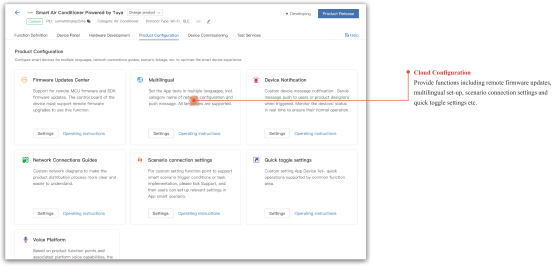
136
Table of Contents
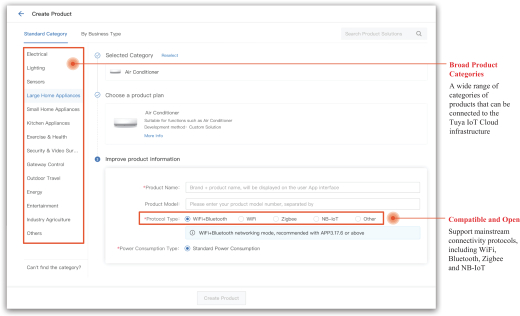
| • | IoT edge capabilities. To become “smart,” a device must be embedded with underlying capabilities such as connectivity, storage and data processing, which we call “edge” capabilities. Our IoT PaaS offers an extensive library of edge capabilities for customers to choose from, as well as visualized, simple tools and dashboards for them to quickly find what they need. Our IoT PaaS currently supports all mainstream wireless technologies, including Wi-Fi, Bluetooth, ZigBee, dual radio, and 5G, and other IoT edge capabilities. |
The below screenshot illustrates how a developer leverages IoT PaaS to embed edge capabilities.
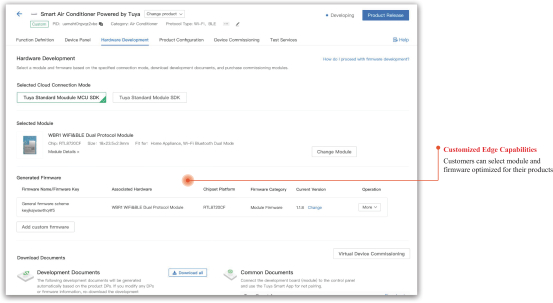
The edge capabilities we offer are all pre-coded and ready-to-use, giving our customers significantly faster time-to-market than writing the codes from scratch.
| • | App development. A powerful, easy-to-use app is key to a superior IoT experience. We offer “white label” apps with minimal modification required to give customers the fastest time-to-market. This |
137
Table of Contents
| “one-app-for-all” approach enables end users to manage multiple devices, even those of different brands and categories, using one app only. Our customers may choose to engage us to design tailor-made apps or, in many more cases, customize the apps themselves or through third-party developers with simple-to-use developer tools that we offer. |
The below screenshot showcases our “one-app-for-all” approach that enables end users to manage various functions and different categories of devices.
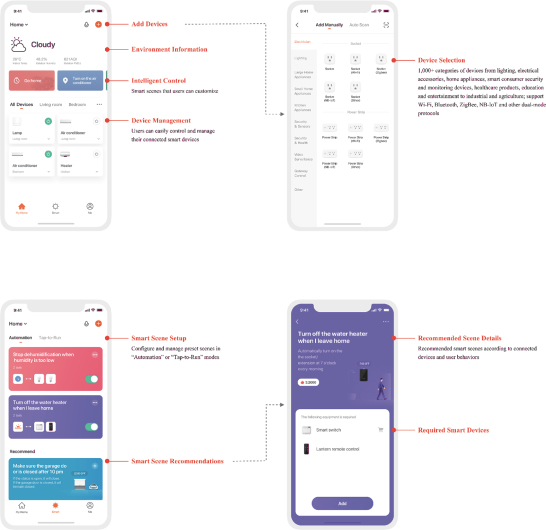
| • | Device optimization solutions. Even equipped with the edge capabilities, a device may not function well if the hardware is incompatible with the software. We bridge this gap for customers by helping them optimize the design, manufacturing and configuration of Tuya-powered devices to ensure that the hardware and software integrate seamlessly to deliver the desired use cases and functionality. We also provide developers with a suite of analytics and debugging tools to help them independently identify root causes and troubleshoot problems. |
138
Table of Contents
Cloud-based services
Complementary to our IoT PaaS, we also offer the following cloud-based services:
| • | AI-powered virtual assistants. We enable our customers to quickly add voice control powered by Amazon’s Alexa, Google Assistant and Samsung SmartThings to their devices. |
| • | Data analytics. Our IoT PaaS leverages powerful AI and big data analytics to help customers collect, process, store and analyze extensive device-level and app-level data, generating actionable insights that would have been impossible without our centralized cloud infrastructure. |
| • | Others. In addition, we provide approximately 50 other ancillary value-added services, such as IP camera cloud storage service, app function expansion service, device testing, “Work with Alexa” certification, “ZigBee Alliance” certification, and joint research and development of innovative IoT applications, among other things. |
The following flow chart illustrates how we connect and empower key stakeholders surrounding our IoT PaaS, i.e. brands (including retailers offering private-label smart devices), OEMs, and end users. For more information about the value-added services we provide to end users, see “—For End Users Using Smart Devices.”
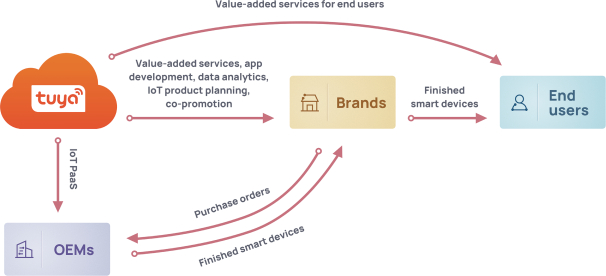
Smart Device Distribution
We believe the efficient distribution of Tuya-powered smart devices to target audiences is key to our long term competitive edge and sustainability. Over the years, we have built a robust in-house distribution network consisting of (i) Tuya Expo, a dedicated business-to-business, or B2B, platform connecting brands globally with an extensive network of OEMs, and (ii) Tuya Mall, an online platform that helps our customers to build their own online marketplace to sell and distribute smart devices. Tuya Expo is currently offered for free; for Tuya Mall, we offer a one-month free trial, after which we charge a small subscription fee based on the period of time such service is requested.
Some of our customers, primarily brands and system integrators, prefer not to deal with multiple OEMs. These customers have the option to purchase directly from us finished smart devices deployed with IoT PaaS sourced from qualified OEMs. They typically place purchase orders directly with us by specifying the type of smart devices. We then source these products for these customers by engaging qualified partner OEMs based on the type of products, hardware specifications and other metrics. We earn the difference between the prices at
139
Table of Contents
which the products are sourced and sold. We believe there are continued demands in the market for this type of services, and we intend to continue to help our brand customers save time, cut costs, gain visibility into the supply chain and ensure an efficient distribution process by providing quality smart device distribution services.
For Business Customers Using Smart Devices
Industry SaaS
We offer Industry SaaS, vertical-focused software solutions that enable businesses to easily and securely deploy, connect, and manage large numbers and different types of smart devices. Just like how billions of people use apps to enjoy mobile technology, we design Industry SaaS as plug-and-play everyday tools for people to interact with and harness the power of IoT. Industry SaaS makes lives easier, healthier and more enjoyable, and drives efficiency, cost saving and productivity for businesses of all sizes across industries.
Our Industry SaaS is built to be brand-agnostic and is compatible with Tuya-powered devices across brands and categories. We believe this is the key reason our customers choose us over other IoT SaaS providers, especially those that only support certain brands exclusively. Industry SaaS customers are responsible for sourcing the smart devices themselves, from OEMs recommended by us or via other channels based on their own preferences.
We offer Industry SaaS to selected verticals with significant potential of monetizing our IoT capabilities. We also inspire and enable developers to push the boundary of Industry SaaS by creating more innovative applications and use cases.
Set out below are our Industry SaaS’s current and future offerings and some of the use cases they enable:
| • | Smart Commercial Lighting SaaS solution is a cloud-based one-stop solution specifically designed for the commercial lighting use cases to deliver convenience, better experience and energy saving. It includes a comprehensive set of functions ranging from device control to ergonomic lighting and green building management, as well as maintenance services and onsite trouble-shooting. |
| • | Smart commercial lighting—puts property owners or managers in total control of all their devices and all the data generated via an easy-to-use dashboard and data interface. Through a map of the lighting layout, property owners or managers can easily view and monitor all devices and maintenance needs through built-in reporting and analytics. This will, in turn, allow them to implement strategies to reduce energy and maintenance costs. |
| • | Human centric lighting—brings the natural changes of light intensity and color temperature indoors by using artificial light to imitate natural light, which provides optimized work and living environments. |
| • | Smart Hotel SaaS solution is a full-featured management solution for hotels and resorts, designed to not only provide convenience for hotel guests, but also drive automation, efficiency and responsiveness for the hospitality industry. |
| • | Our Smart Hotel SaaS solution allows the management to monitor different aspects of hotel services, such as housekeeping, guest traffic control, property surveillance and maintenance, from a single control point. |
| • | Guests staying at a hotel utilizing our smart hotel app can adjust the heating, cooling and lighting in a room to personalize their surroundings, without having to adjust every individual device. |
| • | Hotels are able to save on utilities bills by taking advantage of human activity detection-based lighting and air conditioning in common areas and guest rooms. |
| • | Smart Consumer Security SaaS solution allows home and business owners to monitor multiple smart customer security devices, including door and window sensors and motion detectors, to enhance |
140
Table of Contents
| security and provide better control over their properties. It can be customized easily to address the security and safety needs of campuses, residential buildings, healthcare facilities and a range of other commercial and industrial sectors and use cases, such as: |
| • | Geo-fencing—a feature that utilizes location information of user’s smartphones to trigger certain actions. As a user comes near his parking lot, the smart consumer security system can sense that he is close to home, and switches on the lighting for the front door. |
| • | Web portal for alerts—our smart consumer security software transforms standard monitoring into intelligent and effective detection and alert system, allowing users to receive status updates or alerts via their mobile phones. |
| • | Smart Apartment SaaS solution offers a comprehensive toolkit for landlords and rental apartment operators to seamlessly connect smart door locks, sockets and other smart devices to increase the value of their properties and make them easier to manage. It is compatible with all mainstream property management systems, or PMS, as well as customers’ own systems purpose-built for a wide range of use cases, including campuses, offices and other commercial facilities. |
| • | The resident experience—a resident can monitor energy and utilities usage, create simple one-click actions to streamline her routines or create access credentials for all her guests. |
| • | The rental property management experience—an apartment manager can detect water leakage through our smart apartment software as soon as it happens and immediately alerted the construction team to prevent the leaks from spreading. |
| • | Smart Community and Real Estate SaaS solution digitalizes, streamlines and automates every aspect of residential housing and residential community management via IoT. From home automation to elderly care and neighborhood safety, it provides real estate developers and property management companies a unified, interoperable portal to connect and manage large numbers of smart devices on the premises. |
| • | Not only are daily maintenance tasks made more convenient, our Smart Community and Real Estate SaaS solution also transforms neighborhoods into vibrant socio-economic communities that offer a better quality of life for all. |
| • | Resident stickiness is improved through cloud-based connectivity. By studying residents’ habits, such as the frequency they change their water filters, property management companies are better suited to staying on top of resident trends, adapting to those trends and therefore making living spaces more desirable and improving their services. |
We primarily market our Industry SaaS to system integrators and also sell directly to individual industry operators, such as hotel or property managers. We mainly target large, established organizations with leading positions in their respective verticals and geographies, so that we can leverage their industry expertise and existing customer bases to quickly gain market shares and build brand awareness.
For End Users Using Smart Devices
We want to make Tuya part of people’s everyday life and make their IoT experience seamless. Since our inception, we have allowed end users to connect to our IoT cloud platform to access a wide variety of basic cloud-based services, such as receiving app updates, for free. We also give end users the option to pay a fee to access a curated suite of cloud-based value-added services:
| • | IoT data storage—users can save their device usage, such as IP camera data, and other data to the cloud that’s accessible and sync-able across multiple devices; |
| • | Push messaging—sends users SMS text messages when a specific event (e.g., fire alarm going off) happens; |
141
Table of Contents
| • | Content—a wide and well-curated library of digital content that enhances users’ IoT experience, such as music, podcasts and even a bedtime story that users can ask their Tuya-powered virtual assistant to tell for their kids. |
As we gain more insights about customer demands through their feedback, we will continue to roll out additional value-added services for end users, aiming to provide an engaging and continuously improved customer experience.
Tuya IoT Cloud
Our IoT platform and product offerings are supported by Tuya IoT Cloud infrastructure, our unified underlying infrastructure.
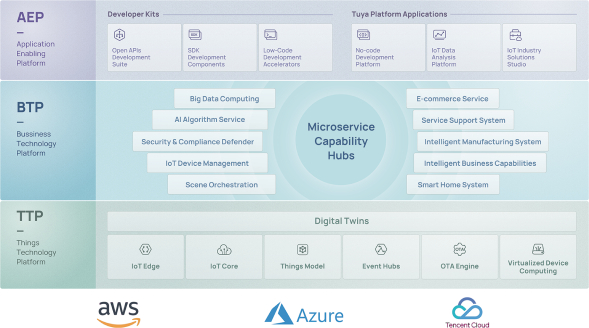
| • | Things Technology Platform (TTP) is the general IoT connection and management platform that includes the following components. These components enable the digital twins function that allows for real-time, closed-loop exchanges of data between the cloud and the physical smart devices throughout their life cycle, improves IoT deployment efficiency and helps developers optimize existing smart devices. |
| • | IoT Edge features edge computing capabilities that bring computation to the edge. IoT devices can spend less time communicating with the cloud, react more quickly to local changes and operate more securely and reliably; |
| • | IoT Core is the core ability to connect, authorize, authenticate and manage digital twins devices; |
| • | Things Model creates virtual representations of physical smart devices that enable analysis of data and monitoring of systems to prevent downtime, test new devices by using simulations, and troubleshoot problems even before they occur; |
| • | Event Hubs provides a unified streaming platform with time retention buffer, decoupling event producers from event consumers; |
| • | Over-the-air Engine, or OTA Engine, provides unified OTA strategy and data analysis, predicts when devices need upgrades, reduces device OTA risks, and optimizes device usage activities; |
142
Table of Contents
| • | Virtualized Device Computing enhances a smart device’s hardware capabilities from the cloud platform by managing device access and scenes control through the edge of the network. |
| • | Business Technology Platform (BTP) is the competency center that provides the technology foundation to the upper layer of our Tuya IoT Cloud in the form of modular micro-services. It brings together a suite of service modules, such as big data computing, AI algorithm service and IoT device management, that work together to provide the best customer experience. |
| • | Application Enabling Platform (AEP) includes Tuya Platform Applications and Developer Kits that allows us to deliver IoT PaaS, Industry SaaS and other value-added services. |
| • | Developer Kits allow developers to integrate tailored-made Tuya IoT cloud capabilities through a comprehensive set of APIs, SDKs and low-code development accelerators that allow developers to add, customize, or integrate systems and functionality based on specific requirements and needs. |
| • | Tuya Platform Applications combine no-code development platform, IoT data analysis platform and IoT industry solution studio to provide full platform-based business service capabilities. |
We have deployed data centers hosted worldwide, including in China, the United States, Europe and India. Tuya IoT Cloud infrastructure is currently capable of processing over 122 million AI voice interactions daily from our five global data centers, with an average per-command processing time of less than 0.01 second, which is up to 30 times faster than the industry peers, according to CIC.
Research & Development
Our leadership is built by our creative and dedicated teams who are passionate about IoT. As of December 31, 2020, we had a research and development team of 1,637 engineers, researchers and scientists whose expertise spans across a significant number of different subject areas such as IoT, industry design, cloud computing, AI and machine learning and data analytics. Our research and development team is responsible for the design, development, testing, and operation of our platform, including the underlying Tuya Cloud infrastructure, addressing new use cases, and scouting technological and business model innovations in IoT.
We have invested substantially in research and development. These investments have continued to result in the launch of innovative products that have helped us attract new customers and sell more to our existing customers.
Our Customers
Our growth strategies are tailored around our customers and their specific demands. For example, we have proactively engaged in co-marketing with well established, leading brands to promote the “Powered by Tuya” brand awareness. For leading OEMs in target categories and those with large demands in our products, we are focused on providing bespoke support and services by, for example, offering free trials of product enhancements and new features and functionality.
We had over 5,000 customers in 2020, primarily including brands, OEMs, industry operators and system integrators. For the same period, our IoT PaaS empowered over 2,700 brands to develop their smart devices, including leading brands such as Calex, Philips and Schneider Electric, and had an increasing number of Industry SaaS customers. As we have cultivated a large and diversified customer base across different industry verticals, none of our customers is material to our total revenue. Our IoT PaaS enabled businesses to develop smart devices for more than 1,100 device categories sold across over 220 countries and regions. In January 2021, we achieved a Net Promoter Score (NPS) of 75, which indicated a high degree of satisfaction for our products and services among our customers. NPS measures the willingness of customers to recommend a company’s products or services to other potential customers, and is viewed as a proxy for measuring customers’ loyalty and satisfaction with a company’s product or service.
143
Table of Contents
We are proud to serve customers across the globe. The following is a representative sampling of our customers by regions:
| Americas |
Europe |
Asia-Pacific | ||
| Monster |
Schneider Electric | Softbank | ||
| Westinghouse |
Philips | Panasonic | ||
| Hampton |
Orange | Lenovo | ||
| Heathco |
Calex | Haier | ||
| Sodimac |
Dorel Juvenile | Sino-Ocean Group | ||
| Lloyd’s |
Yandex | Flipkart |
We use dollar-based net expansion rate for IoT PaaS as a useful indicator of our customers’ loyalty and tendency to expand their usage of our platform over time. For the trailing 12-month period ended December 31, 2019, March 31, 2020, June 30, 2020, September 30, 2020 and December 31, 2020, the dollar-based net expansion rates for IoT PaaS were 188%, 173%, 160%, 179% and 181%, respectively. For a detailed discussion of dollar-based net expansion rate for IoT PaaS and certain other key operating metrics, see “Summary—Key Operating Metrics.”
Customer Case Studies
The following are examples of how some of our customers have adopted our products and services. We believe these customers’ usage is representative of usage by our customers generally and shows the breadth of our platform and adoption across geographies, verticals, and customer size.
Electro Cirkel Retail (Calex)
Calex is a leading decorative and functional lighting brand in Europe. It was looking to venture into the smart home market and approached many potential IoT partners, but none of them met its expectation for an IoT cloud platform that was cost-efficient, protocol-agnostic and future-proof.
In July 2018, Calex began to utilize Tuya’s IoT PaaS to develop smart devices. The partnership was initially focused on Wi-Fi smart bulbs, but quickly expanded to support over 100 SKUs across a broad mix of categories ranging from electrical, lighting and sensing products, to home appliances and consumer security devices. By the end of 2020, Calex had distributed more than 6,000,000 Tuya-powered smart devices since partnership with Tuya. Smart device distribution of Calex in 2020 more than doubled from 2019, enabling over one million homes to be smart. Today, consumers can buy Calex smart products powered by Tuya through over 7,000 online and offline retail channels across Europe, including Carrefour, Tesco and Leroy Merlin.
The partnership with Tuya has not only enabled Calex to accelerate time-to-market of its smart devices, but also significantly reduced their price points, allowing Calex to gain early market share and expand its smart home footprint for a longer term benefit. “We’ve shown that with a much lower price we can still have the same functionality and quality,” said Will Smits, Managing Director at Calex. Tuya’s protocol-agnostic architecture also allows Calex to cost-efficiently expand into new categories and use cases, and to access a wide range of device and usage data that Calex can use to inform its customer services and product strategies.
Monster
Monster is the world’s leading manufacturer and brand of high-performance headphones and an innovative leader in the entertainment space for nearly four decades. It offers advanced connectivity solutions for professional musicians, home entertainment, computing, mobile and gaming, as well as high performance AC power and conditioning products.
144
Table of Contents
In January 2019, Monster teamed up with us to co-create a new line of “Monster Smart Powered by Tuya.” These smart product lines complement their established cable, headphones, and speaker offerings, and include innovative solutions for controlling everything from home entertainment to power, security and more. Monster Smart Powered by Tuya products will benefit from Monster’s world-renowned expertise in product design and development, while being supported by Tuya’s unsurpassed IoT cloud platform, including big data capabilities that enable geolocation and environment-sensing features.
Through more than 4,000 online and offline sales locations, outlets and retail channels such as Walmart, Monster’s smart product shipment tripled in 2020. The new electrical products line will also be launched soon in early 2021. As Head of Monster Noel Lee noted, “we think IoT and smart products will help consumers have a better life in so many ways and we’re looking forward to directing our innovation with Tuya in all things smart—starting with lighting, power and security.”
A leading global supermarket chain
Our customer is an International discount supermarket chain that operates over 12,000 stores across Europe and the United States. As the concept of smart living is being embraced by more and more retail chains, our customer wanted to put down its own collection of smart products.
After evaluating multiple other cloud platforms, our customer decided to partner with us in October 2019. Utilizing our brand-agnostic platform and easy-to-use developer toolkits, this customer quickly launched its own smart product line and immediately turned out well with a large collection of more than 40 SKUs, such as LED lamps, motion sensors, and home appliances. These products are compatible with multiple protocols such as ZigBee, Wifi and Bluetooth.
Since November 2020, these products are sold in more than 8,000 stores across 19 countries in Europe under our customer’s own brand, and we have deployed more than 3,500,000 IoT PaaS for this customer. We believe that with our strong customer support, rapid development cycle and comprehensive ecosystem, we can help our customer develop more series of smart products and enable more end users to experience the concept of smart living made possible by our IoT cloud platform.
Reallink Smart Habitat, Sino-Ocean Group
Reallink Smart Habitat is an intelligent real estate brand under Sino-Ocean Group, one of China’s leading real estate developers. Sino-Ocean group ranks within top 10 in terms of brand value among Chinese real estate companies and ranks 202 in the 2020 Fortune China 500 list, which it has been on for 11 consecutive years.
Reallink focuses on developing intelligent real estate applications. As a pioneer in the real estate industry through technological innovation, Reallink has been looking for IoT SaaS solutions to improve the quality of life of their residents while enhancing operational efficiency.
In the past two years, Reallink has been working on adopting the Tuya IoT cloud platform and real estate industry SaaS to create its own cloud-based IoT management system, which saves cost, resources and time as compared to developing the system on their own. Due to the brand-agnostic nature of our platform, Reallink can easily deploy and manage smart devices from various brands in the properties they develop and operate. With easy-to-use development tools and APIs, Reallink can also customize SaaS functions for specific scenarios such as real estate development and property management. Our IoT cloud platform allows Reallink to easily integrate internal and external systems and transform from a traditional real estate company to a smart one with IoT functions. Reallink is currently discussing more collaboration opportunities with Tuya.
Sales, Marketing and Branding
We generate sales primarily through our direct marketing efforts targeting brands and OEMs, with a focus on attracting new customers as well as expanding usage within our existing customer base. We offer a
145
Table of Contents
membership program to our customers that gives them the option to pay a membership fee primarily in exchange for IoT PaaS discounts based on a tiered membership status in accordance with their expected deployment volume. The membership program allows us to foster long-term relationship with our customers. In 2020, approximately 63% of our IoT PaaS deployments were from our membership customers. We also generate customer leads indirectly through offline retail channels and e-commerce platforms. We currently operate dedicated regional sales forces covering a number of our key overseas markets, such as the U.S., India, Japan and Germany.
As we expand our footprint globally, we have invested substantially in developing localized marketing strategies and employing sales and support staff. In particular, we focus on educating customers about the “Powered by Tuya” smart ecosystem. We raise customers’ awareness that any smart device labeled with the “Powered by Tuya” tag can interact with each other regardless of brands and product categories.
We utilize a multitude of sales and marketing channels, including:
| • | online marketing channels such as search engine optimization, private domain operations and the online developer platform on our website; |
| • | offline channels such as word-of-mouth referrals from brands owners, OEMs, retailers and other industry participants; |
| • | brand marketing through industry conferences and events, including Mobile World Congress, International Consumer Electronics Show, and Hong Kong Electronics Fair where we demonstrate how we empower developers to push the boundary of IoT; and |
| • | developer outreach via code sharing platforms and Q&A websites such as GitHub and Zhihu. |
Intellectual Property
We rely on a combination of patent, copyright, trade secret and trademark laws as well as contractual restrictions such as confidentiality agreements, licenses and intellectual property assignment agreements. We also maintain a policy requiring our employees, contractors, consultants and other third parties to enter into confidentiality and proprietary rights agreements to control access to our proprietary information. As of the date of this prospectus, we have registered 190 patents, 316 trademarks, 91 copyrights, and 95 domain names in China and overseas. We have registered “Tuya” and “Powered by Tuya” as trademarks.
Despite our efforts to protect our proprietary rights, unauthorized parties may attempt to copy or otherwise obtain and use our technology. Monitoring unauthorized use of our technology is difficult and costly, and we cannot be certain that the steps we have taken will prevent misappropriation of our technology. From time to time, we may have to resort to litigation to enforce our intellectual property rights, which could result in substantial costs and diversion of our resources. In addition, third parties may initiate lawsuits against us alleging infringement of their proprietary rights or declaring their non-infringement of our intellectual property rights. In the event of a successful claim of infringement and our failure or inability to develop non-infringing technology or license the infringed or similar technology on a timely basis, our business could be harmed. Even if we are able to license the infringed or similar technology, license fees could be substantial and may adversely affect our results of operations. See “Risk Factors—Risks Related to Our Business and Industry—We may in the future be subject to legal proceedings and litigation, including intellectual property disputes, which are costly and may subject us to significant liability and increased costs of doing business.”
Data Security and Privacy
When providing our products and services, we may have access to certain data of our customers and of end users of our customers, primarily certain machine generated data produced by the smart devices powered by us.
146
Table of Contents
While we have access to such data, we process but do not have control over most data. We have designed strict data protection policies to ensure that the collection, use, storage, transmission and dissemination of such data are in compliance with applicable laws and with prevalent industry practice.
We have established an all-round information system in reference to data security requirements and best practices and intend to continually invest heavily in data security and customer privacy protection. Our information system applies multiple layers of safeguards, including internal and external firewalls, enterprise-standard web application firewalls, risk management platform, and runtime application self-protection, or RASP, a security technology that detects and blocks computer attacks using information from inside the running software. We encrypt data throughout its lifecycle to safeguard privacy and enhance data security. We implement a robust internal authentication and authorization system to ensure confidential and important data can only be accessed through computers for authorized use and only authorized staff can access those computers. We have clear and strict authorization and authentication procedures and policies in place. Our employees only have access to data which is directly relevant and necessary for their responsibilities and for limited purposes and are required to verify authorization upon every access attempt. We have also implemented robust internal rules and procedures, including security assessment in the design and implementation of R&D projects and code auditing, to ensure that the designed security requirements are met in our R&D activities and code quality and security.
We have completed information security, privacy and compliance certifications/validations with the consultation of various global agencies, and now serves as one of the IoT platforms with the most comprehensive certificates in Asia. We have obtained ISO 27001 Information Security Management System Certification, ISO 27017 Certification for Information Security of Cloud Services, ISO 27018 Certification for Protection of Personally Identifiable Information and are fully committed to complying with GDPR and CCPA. We have also partnered with top privacy compliance and cyber security firms, such as TrustArc and NCC Group, for privacy management and penetration testing.
In addition, we have adopted the Tuya Incident and Data Breach Response Plan, which provides a well-defined, organized approach for handling any potential threat to servers and data, as well as taking appropriate action when the data breach concerns personal information. We have also established an incident response team that comprises of an Information Security Officer (ISO), a Data Protection Officer (DPO), an Information Privacy Officer (IPO) and a Customer Service Officer (CSO) to provide a quick, effective and orderly response to servers and personal information related potential or actual incidents such as virus infections, hacker attempts and break-ins, improper disclosure of confidential information, system service interruptions, breach of personal information, and other events with serious information security implications
As of the date of this prospectus, we have not received any claim from any third party against us on the ground of infringement of such party’s right to data protection as provided by the PRC General Principles of Civil Law or any applicable laws and regulations in other jurisdictions, and we have not experienced any material data loss or breach incidents. See “Risk Factors—Risks Related to Our Business and Industry—Unauthorized or improper disclosures of personal data, cyber-attacks or other security incidents or data breaches that affect our networks or systems, or those of our customers, whether inadvertent or purposeful, could degrade our ability to conduct our business, compromise the integrity of our products and services, platform and data, result in significant data losses and the theft of our intellectual property, damage our reputation, expose us to liability to third parties and require us to incur significant additional costs to maintain the security of our networks and data which could adversely affect our business, financial condition and results of operations”.
Our People
We had 1,504 and 2,258 full-time employees as of December 31, 2019 and 2020, respectively.
147
Table of Contents
The following table sets forth the breakdowns of our employees by functions as of December 31, 2020:
| Function |
Number of Employees |
Percentage | ||||||
| Research and development |
1,637 | 72 | % | |||||
| Sales and marketing |
506 | 22 | % | |||||
| General and administrative |
115 | 5 | % | |||||
|
|
|
|
|
|||||
| Total |
2,258 | 100 | % | |||||
|
|
|
|
|
|||||
We are subject to, and comply with, applicable labor law requirements, which may automatically make our employees subject to industry-wide collective bargaining agreements. We believe that we maintain a good working relationship with our employees, and we have not experienced any material labor disputes in the past. None of our employees are represented by labor unions with respect to his or her employment.
Facilities
Our principal executive office is located in Hangzhou, China under a lease that expires in 2023. In addition, we operate internationally with local headquarters in the U.S., India, Germany, and Japan. These offices are leased, and we do not own any real property. We believe that our current facilities are adequate to meet our current needs.
Competition
The global IoT platform market is rapidly evolving and increasingly competitive. Currently, our competitors include both large, well established IoT service providers, such as Amazon AWS in the United States and the IoT business of Alibaba Cloud in China, and less-established IoT companies or companies that offer capabilities that compete with some of our offerings.
We believe that none of our competitors currently competes directly with us across all of our offerings, and we compete favorably on the basis of the factors below:
| • | ability to support multiple use cases on a single platform; |
| • | ease of deployment, implementation and use; |
| • | platform performance, interoperability, scalability and reliability; |
| • | ability to help customers achieve global IoT deployment; |
| • | ability to build a supply chain ecosystem; |
| • | customer support and platform maintenance; |
| • | brand awareness and reputation; |
| • | sales and marketing efforts; and |
| • | ability to ensure data security and privacy. |
See the section titled “Risk Factors” for a more comprehensive description of risks related to competition.
Insurance
We do not maintain any liability insurance or property insurance policies covering our equipment and facilities for injuries, death or losses due to fire, earthquake, flood or any other disaster. Consistent with customary industry practice in China, we do not maintain business interruption insurance, nor do we maintain
148
Table of Contents
key-man life insurance. We maintain cybersecurity insurance policies to cover the costs associated with a breach of third-party data in the event that the data is lost or stolen, and technical errors & omissions policies for liabilities in connection with failures of a service or software.
Legal Proceedings
From time to time, we may be subject to various claims and legal actions that arise in the ordinary course of our business. We are not presently a party to any litigation the outcome of which, we believe, if determined adversely to us, would individually or taken together have a material adverse effect on our business, operating results, cash flows, or financial condition. Defending such proceedings is costly and can impose a significant burden on management and employees. The results of any current or future litigation cannot be predicted with certainty, and regardless of the outcome, litigation can have an adverse impact on us because of defense and settlement costs, diversion of management resources, and other factors.
149
Table of Contents
Regulation Relating to Foreign Investment
The establishment, operation and management of corporate entities in China are governed by the Company Law of the PRC (the “Company Law”), which was promulgated by the Standing Committee of the National People’s Congress on December 29, 1993 and amended on December 25, 1999, August 28, 2004, October 27, 2005, December 28, 2013 and October 26, 2018 respectively, and became effective on October 26, 2018. Under the Company Law, companies are generally classified into two categories, namely limited liability companies and joint stock limited companies. The Company Law also applies to foreign-invested limited liability companies. According to the Company Law, any stipulations by other PRC laws governing foreign investment shall prevail over the Company Law.
On March 15, 2019, the National People’s Congress approved the Foreign Investment Law, which came into effect on January 1, 2020 and replaced the Sino-Foreign Equity Joint Venture Enterprise Law, the Sino-Foreign Cooperative Joint Venture Regulation Relating to Foreign Investment Enterprise Law and the Wholly Foreign-Invested Enterprise Law and became the legal foundation for foreign investment in the PRC. On December 26, 2019, the State Council issued the Regulations on Implementing the Foreign Investment Law which came into effect on January 1, 2020 and replaced the Regulations on Implementing the Sino-Foreign Equity Joint Venture Enterprise Law, Provisional Regulations on the Duration of Sino-Foreign Equity Joint Venture Enterprise Law, the Regulations on Implementing the Wholly Foreign-Invested Enterprise Law and the Regulations on Implementing the Sino-foreign Cooperative Joint Venture Enterprise Law.
Pursuant to the PRC Foreign Investment Law (2019), foreign investment means the investment activities within the PRC directly or indirectly conducted by foreign natural persons, enterprises, and other organizations (the “foreign investor”), including the following circumstances: (i) a foreign investor, individually or collectively with other investors, establishes a foreign-invested enterprise within PRC; (ii) a foreign investor acquires any shares, equities, portion of property, or other similar interest in an enterprise within the PRC; (iii) a foreign investor, individually or collectively with other investors, invests in a new project within the PRC; and (iv) foreign investors invest in the PRC through any other methods under laws, administrative regulations, or provisions prescribed by the State Council of the PRC. The PRC applies the administrative system of pre-establishment national treatment plus negative list to foreign investment. Where a foreign investor invests in a field prohibited from investment by the Negative List (2020) (as defined below), the competent department shall order cessation of investment activity, disposition of shares and assets or adoption of other necessary measures during a specified period, and restoration to the state before investment; and its illegal income, if any, shall be confiscated. Where the investment activity of a foreign investor violates any special administrative measure for restrictive access asset out in the Negative List (2020), the competent department shall order the investor to take corrective action during a specified period and adopt necessary measures to meet the requirements of the special administrative measure. Where the investment activity of a foreign investor violates the Negative List (2020), it shall be otherwise subject to corresponding legal liabilities under the applicable law.
On December 30, 2019, the Ministry of Commerce and the State Administration for Market Regulation issued the Measures for the Reporting of Foreign Investment Information, which came into effect on January 1, 2020 and replaced Interim Measures for the Recordation Administration of the Formation and Modification of Foreign-Funded Enterprises , and thus for foreign investors carrying out investment activities directly or indirectly in China, instead of filing formalities, foreign investors shall report their foreign investment information to the commerce authorities.
Special Administrative Measures (Negative List) for the Access of Foreign Investment (2020) (the “Negative List”) was promulgated by the National Development and Reform Commission and the Ministry of Commerce on June 23, 2020 and became effective on July 23, 2020 and set out the “prohibited” and “restricted” industries for foreign investment. Investing in an industry that falls within the restricted category of the Negative
150
Table of Contents
List requires the permit granted by competent authorities, while foreign investors may not invest in any prohibited field on the Negative List. Fields not on the Negative List shall be administered under the principle of equal treatment to both domestic and foreign investment.
Licenses for Value-Added Telecommunication Services
The Telecommunications Regulations of the People’s Republic of China (the “Telecommunications Regulations”), promulgated by the State Council on September 25, 2000 and last amended on February 6, 2016, provide a regulatory framework for telecommunications services providers in mainland China. The Telecommunications Regulations require telecommunications services providers to obtain an operating license prior to the commencement of their operations. The Telecommunications Regulations categorize telecommunications businesses into basic telecommunications businesses and value-added telecommunications businesses. According to the Catalog of Telecommunications Business, attached to the Telecommunications Regulations and last amended by the Ministry of Industry and Information Technology (“MIIT”) on June 6, 2019, the company’s existing business doesn’t fall within value-added telecommunications services.
Our VIE holds a valid SP License.
Registration for Import and Export Goods
Pursuant to the Customs Law of the People’s Republic of China promulgated by the SCNPC on January 22, 1987 and amended on July 8, 2000, June 29, 2013, December 28, 2013, November 7, 2016 and November 4, 2017 unless otherwise stipulated, the declaration of import and export goods may be made by consignees and consignors themselves, and such formalities may also be completed by their entrusted customs brokers that have registered with the Customs. The consignees and consignors for import or export of goods and the customs brokers engaged in customs declaration shall register with the Customs in accordance with the laws.
Pursuant to the Administrative Provisions of the Customs of the People’s Republic of China on the Registration of Customs Declaration Entities promulgated by the General Administration of Customs on March 13, 2014 and last amended on May 29, 2018, the registration of customs declaration entities comprises the registration of the customs declaration enterprise and the registration of the consignor or consignee of imported and exported goods. The consignor or consignee of imported and exported goods shall register with local customs in accordance with the laws.
In addition, the Foreign Trade Law of the PRC which was promulgated by the SCNPC on May 12, 1994 and last amended on November 7, 2016, and the Measures for the Record Filing and Registration of Foreign Trade Business Operators, which was promulgated by the MOFCOM on June 25, 2004 and last amended on November 30, 2019, require any foreign trade business operator that is engaged in the import and export of goods or technology shall be registered for archival purposes with the administrative department of foreign trade of the State Council or the institution entrusted thereby, unless it is otherwise provided for by any law, administrative regulation or the foreign trade department of the State Council. The specific measures for archival registration shall be formulated by the foreign trade department of the State Council. Where any foreign trade business operator that fails to file for record and registration according to relevant provisions, the customs may not handle the procedures of customs declarations and release of the import or export goods.
Regulation Relating to Information Security and Confidentiality of User Information
Internet content in China is regulated and restricted from a state security standpoint. On December 28, 2000, the Standing Committee of the PRC National People’s Congress enacted the Decisions on Maintaining Internet Security, later amended and became effective on August 27, 2009, which subject violators to criminal punishment in China for any effort to: (1) use the internet to market fake and substandard products or carry out false publicity for any commodity or service; (2) use the internet for the purpose of damaging the commercial
151
Table of Contents
good will and product reputation of any other person; (3) use the internet for the purpose of infringing on the intellectual property of any person; (4) use the internet for the purpose of fabricating and spreading false information that affects the trading of securities and futures or otherwise jeopardizes the financial order; or (5) create any pornographic website or webpage on the internet, provide links to pornographic websites, or disseminate pornographic books and magazines, movies, audio-visual products, or images. Pursuant to Administrative Measures for the Security Protection of Computer Information Networks Linked to the Internet which was approved by the State Council on December 11, 1997 and promulgated by the Ministry of Public Security on December 16, 1997 and revised by the State Council on January 8, 2011, the Internet is prohibited to be used in ways which, among other things, would result in a leakage of state secrets or a spread of socially destabilizing content. On December 13, 2005, the Ministry of Public Security promulgated Provisions on the Technical Measures for the Protection of the Security of the Internet which requires internet service providers to take proper measures including anti-virus, data back-up and other related measures, to keep records of certain information about its users (including user registration information, log-in and log-out time, IP address, content and time of posts by users) for at least 60 days, and to detect illegal information, stop transmission of such information, and keep relevant records. If an internet information service provider violates these measures, the Ministry of Public Security and the local security bureaus may revoke its operating license and shut down its websites. Pursuant to Circular of the Ministry of Public Security, the State Secrecy Bureau, the State Cipher Code Administration and the Information Office of the State Council on Printing and Distributing the Administrative Measures for the Graded Protection of Information Security which was promulgated on June 22, 2007, the state shall, by formulating nationally effective administrative norms and technical standards for the graded protection of information security, organize citizens, legal persons and other organizations to grade information systems and protect their security, and supervise and administer the graded protection work. The security protection grade of an information system may be classified into the five grades. To newly build an information system of Grade II or above, its operator or user shall, within 30 days after it is put into operation, handle the record-filing procedures at the local public security organ at the level of municipality divided into districts or above of its locality.
PRC governmental authorities have enacted laws and regulations on internet use to protect personal information from any unauthorized disclosure. On December 28, 2012, the Standing Committee of the PRC National People’s Congress promulgated the Decision on Strengthening Network Information Protection to enhance the legal protection of information security and privacy on the internet. On July 16, 2013, the MIIT promulgated the Provisions on Protection of Personal Information of Telecommunication and Internet Users to regulate the collection and use of users’ personal information in the provision of telecommunication services and internet information services in China. Telecommunication business operators and internet service providers are required to establish its own rules for collecting and use of users’ information and cannot collect or use users’ information without users’ consent. Telecommunication business operators and internet service providers are prohibited from disclosing, tampering with, damaging, selling or illegally providing others with, collected personal information. According to the Measures on Punishment for Infringement of Consumer Rights, which is promulgated by State Administration for Industry and Commerce of the PRC on January 5, 2015 and amended on October 23, 2020, business operators collecting and using personal information of consumers must comply with the principles of legitimacy, propriety and necessity, specify the purpose, method and scope of collection and use of the information, and obtain the consent of the consumers whose personal information is to be collected. Business operators may not (1) collect or use personal information of consumers without their consent, (2) unlawfully divulge, sell or provide personal information of consumers to others or (3) send commercial information to consumers without their consent or request, or when a consumer has explicitly declined to receive such information. General Rules of the Civil Law of the PRC that was issued on March 15, 2017 and took effect on October 1, 2017 provides that natural persons’ personal information shall be protected by law and any organizations and individuals shall legally collect personal information and ensure the security of personal information collected. It is not allowed to illegally collect, use, process or transfer the personal information. Civil Code of the People’s Republic of China was issued on May 28, 2020 and will take effect on January 1, 2021 stipulates the protection of Personal Information.
152
Table of Contents
On November 7, 2016, Standing Committee of the PRC National People’s Congress published the Cyber Security Law of the PRC, which took effect on June 1, 2017 and requires network operators to perform certain functions related to cyber security protection and the strengthening of network information management. For instance, under the Cyber Security Law, network operators of key information infrastructure shall store within the territory of the PRC all the personal information and important data collected and produced within the territory of PRC and their purchase of network products and services that may affect national securities shall be subject to national cyber security review.
On May 8, 2017, Supreme People’s Court and Supreme People’s Procuratorate published the Interpretation of the Supreme People’s Court and the Supreme People’s Procuratorate on Several Issues concerning the Application of Law in the Handling of Criminal Cases of Infringing on Citizens’ Personal Information, which took effect on June 1, 2017 and strengthened the punishment for the criminal activities of infringing on citizens’ personal information.
Administrative Provisions on Mobile Internet Applications Information Services (the “App Provisions”) promulgated by the Cyberspace Administration of China on June 28, 2016 and became effective on August 1, 2016 regulated the App information service providers and the App Store service providers. Under the App Provisions, the App information service providers shall acquire relevant qualifications required by laws and regulations and implement the information security management responsibilities strictly and fulfill their obligations as follows: (i) shall authenticate the identity information of the registered users including their mobile telephone number and other identity information under the principle that mandatory real name registration at the back-office end, and voluntary real name display at the front-office end, (ii) shall establish and perfect the mechanism for the protection of users’ information, and follow the principle of legality, rightfulness and necessity, indicate expressly the purpose, method and scope of collection and use and obtain the consent of users while collecting and using users’ personal information, (iii) shall establish and perfect the mechanism for the examination and management of information content, and in terms of any information content released that violates laws or regulations, take such measures as warning, restricting the functions, suspending the update and closing the accounts as the case may be, keep relevant records and report the same to relevant competent authorities, (iv) shall safeguard users’ right to know and to make choices when users are installing or using such applications, and shall neither start such functions as collecting the information of users’ positions, accessing users’ contacts, turning on the camera and recording the sound, or any other function irrelevant to the services, nor force fully install any other irrelevant applications without prior consent of users when noticed expressly, (v) shall respect and protect the intellectual properties and shall neither produce nor release any application that infringes others’ intellectual properties; and (vi) shall record the users’ log information and keep the same for 60 days.
Regulations Relating to Product Quality
Products made in mainland China are subject to the Product Quality Law of the People’s Republic of China, which was promulgated on February 22, 1993, last amended on December 29, 2018. According to the Product Quality Law, a manufacturer of a product is responsible to compensate for the damages to any person or property caused by the defect of such a product, unless the manufacturer is able to prove that: (i) it has not circulated the product; (ii) the defect did not exist at the time when the product was circulated; or (iii) scientific or technological knowledge at the time when the product was circulated was not such that it allowed the defect to be discovered.
The Consumer Rights and Interests Protection Law of the People’s Republic of China (the “Consumers Protection Law”) was promulgated on October 31, 1993 and became effective on January 1, 1994. The Consumers Protection Law has been further revised on August 27, 2009 and October 25, 2013. According to the Consumers Protection Law, unless otherwise provided by this law, an operator that provides products or services may bear civil liability in accordance with the Product Quality Law and other relevant laws and regulations.
153
Table of Contents
According to the Administrative Regulations for Compulsory Product Certification, which was promulgated by the General Administration of Quality Supervision, Inspection and Quarantine P.R.C. (the “AQSIQ”) (which has merged into the State Administration for Market Regulation) on July 3, 2009, products specified by the state shall not be delivered, sold, imported or used in other business activities until they are certified (the “Compulsory Product Certification”) and labeled with China Compulsory Certification mark. For products that are subject to Compulsory Product Certification, the state implements unified product catalogs (the “3C Catalog”), unified compulsory requirements, standards and compliance assessment procedures in technical specification, unified certification marks and unified charging standards.
Regulation Relating to Intellectual Property Rights
Regulation on Patents
The National People’s Congress adopted the Patent Law of the People’s Republic of China in 1984 and amended it in 1992, 2000 and 2008, respectively. A patentable invention, utility model or design must meet three conditions: novelty, inventiveness and practical applicability. Patents cannot be granted for scientific discoveries, rules and methods for intellectual activities, methods used to diagnose or treat diseases, animal and plant breeds or substances obtained by means of nuclear transformation. The Patent Office under the State Intellectual Property Office is responsible for receiving, examining and approving patent applications. A patent is valid for a twenty-year term for an invention and a ten-year term for a utility model or design, starting from the application date. Except under certain specific circumstances provided by law, any third party user must obtain consent or a proper license from the patent owner to use the patent, or else the use will constitute an infringement of the rights of the patent holder.
Regulation on Copyright
In accordance with the Copyright Law of the PRC which was promulgated by Standing Committee of the National People’s Congress on September 7, 1990 and last amended on November 11, 2020, and will take effect on June 1, 2021. Chinese citizens, legal persons or other entities own the copyright in their works whether published or not, including written works; oral works; music, comedy arts of talking and singing, dance and acrobatics; work of art and architecture work; photographic works; cinematographic work and work created by the method similar to the film production method; engineering design drawing, product design drawing, map, sketch and other graphic works and model works; computer software and other works specified by laws and administrative regulations. The rights a copyright owner has include but not limited to the following rights of the person and property rights: the right of publication, right of authorship, right of modification, right of integrity, right of reproduction, distribution right, rental right, right of network communication, translation right and right of compilation.
In accordance with the Regulations on the Protection of Computer Software promulgated by the State Council on June 4, 1991 and last amended on January 30, 2013, Chinese citizens, legal persons or other entities own the copyright, including the right of publication, right of authorship, right of modification, right of reproduction, distribution right, rental right, right of network communication, translation right and other right software copyright owners shall have in software developed by them, regard less of whether it has been published. In accordance with the Measures for the Registration of Computer Software Copyright promulgated by the National Copyright Administration on February 20, 2002, software copyrights, exclusive licensing contracts for software copyrights and software copyright transfer contracts shall be registered, and the National Copyright Administration shall be the competent authority for the administration of software copyright registration and designates the Copyright Protection Center of China as a software registration authority. The Copyright Protection Center of China shall grant a registration certificate to a computer software copyright applicant who complies with regulations.
154
Table of Contents
Regulation on Trademark
Trademarks are protected by the Trademark Law of the PRC (Revised in 2019) which was promulgated on August 23, 1982 and last amended on April 23, 2019 and come into effect on November 1, 2019, respectively as well as the Implementation Regulation of the PRC Trademark Law adopted by the State Council on August 3, 2002 (Revised in 2014). In China, registered trademarks include commodity trademarks, service trademarks, collective marks and certification marks.
The Trademark Office under the SAIC handles trademark registrations and grants a term of ten years to registered trademarks. Trademarks are renewable every ten years where a registered trademark needs to be used after the expiration of its validity term. A registration renewal application shall be filed within six months prior to the expiration of the term. A trademark registrant may license its registered trademark to another party by entering into a trademark license contract. Trademark license agreements must be filed with the Trademark Office to be recorded. The licensor shall supervise the quality of the commodities on which the trademark is used, and the licensee shall guarantee the quality of such commodities. The Trademark Law of PRC has adopted a “first come, first file” principle with respect to trademark registration. Where trademark for which a registration application has been made is identical or similar to another trademark which has already been registered or been subject to a preliminary examination and approval for use on the same kind of or similar commodities or services, the application for registration of such trademark may be rejected. Any person applying for the registration of a trademark may not prejudice the existing right first obtained by others, nor may any person register in advance a trademark that has already been used by another party and has already gained a “sufficient degree of reputation” through such party’s use. Trademarks are granted for a term of ten years. 12 months prior to the expiration of the ten-year term, the trademark registrant shall apply for the renewal of registration; if the trademark registrant does not make the renewal during the foregoing period, another six months extension can be granted.
Regulation on Domain Name
In accordance with the Measures for the Administration of Internet Domain Names which was promulgated by the Ministry of Industry & Information Technology on August 24, 2017 and came into effect on November 1, 2017, whoever engages in Internet domain name services and its operation and maintenance, supervision and administration and other related activities within the territory of the People’s Republic of China shall abide by these Measures.
In accordance with the Notice of the Ministry of Industry and Information Technology on Regulating the Use of Domain Names in Internet Information Services which was promulgated by the Ministry of Industry and Information Technology of the PRC on November 27, 2017 and came into effect on January 1, 2018, Internet access service providers shall verify the identity of each Internet information service provider, and shall not provide services to any Internet information service provider who fails to provide real identity information.
Regulations Relating to Data Privacy and Security
Our practices with regard to the collection, use, storage, retention, transfer, disclosure, and other processing of personal data make us subject to various state, federal, and international privacy laws, rules and regulations, including, among others, the General Data Protection Regulation (EU) 2016/679 (“GDPR”), the California Consumer Privacy Act of 2018 (“CCPA”) and the recently passed California Privacy Rights Act (“CPRA”), and the various cybersecurity and data privacy regulations under PRC law. These laws and regulations, or other state, federal and international laws and regulations applicable to us and our business, provide consumers with various rights and protections, impose restrictions on our processing activities, impose requirements for the safeguarding and proper destruction of personal data and, in certain circumstances, impose obligations to notify affected individuals and governmental authorities, among others, of security breaches affecting personal data.
The GDPR, which applies to the collection, use, storage, retention, transfer, disclosure, and other processing of personal data obtained from individuals located in the EU or by businesses operating within the EU, became
155
Table of Contents
effective on May 25, 2018 and has resulted, and will continue to result, in significantly greater compliance burdens and costs for companies with customers, users, or operations in the EU. The GDPR places stringent obligations and operational requirements on processors and controllers of personal data and could make it more difficult or more costly for us to use and transfer personal data. Under the GDPR, data protection supervisory authorities are also given various enforcement powers, including levying fines of up to 20 million Euros or up to 4% of an organization’s annual worldwide turnover, whichever is greater, for the preceding financial year, for non-compliance.
Outside of the EU, many jurisdictions have adopted, are adopting or are considering adopting new data privacy and security laws, which may result in additional expenses and operational burdens for us and increase the risk of noncompliance. At the U.S. federal, state and local level, there is increased focus on regulating the collection, storage, use, retention, security, disclosure, transfer and other processing of confidential, sensitive and personal information. In recent years, we have seen significant changes to data privacy regulations across the U.S. As of January 1, 2020, the CCPA increased privacy rights for California residents and imposed obligations on companies that process their personal information, including an obligation to provide certain new disclosures to such residents. Specifically, among other things, the CCPA created new consumer rights, and corresponding obligations on covered businesses, relating to the access to, deletion of, and sharing of personal information collected by covered businesses, including a consumer’s right to opt out of certain sales of their personal information. The CCPA also provides for civil penalties for violations, as well as a private right of action for certain data breaches that result in the loss of personal information. The CCPA was amended in September 2018, November 2019 and September 2020, and it is possible that further amendments will be enacted, but even in its current form it remains unclear how various provisions of the CCPA will be interpreted and enforced. Additionally, a new privacy law, the CPRA, was approved by California voters in the election of November 3, 2020. The CPRA, which will take effect in most material respects on January 1, 2023, modifies the CCPA significantly, including by expanding consumers’ rights with respect to certain personal data and creating a new state agency to oversee implementation and enforcement efforts, potentially resulting in further uncertainty and requiring us to incur additional costs and expenses in an effort to comply.
We expect that data privacy and security matters will only receive greater attention and focus from legislators and regulators in the coming years, as well as further increased public scrutiny. While we have adopted certain policies and procedures pursuant to applicable data privacy and security laws and regulations, including our privacy policy and certain internal data protection policies, these policies and procedures may need to be updated when additional information concerning best practices is made available through guidance from regulators or published enforcement decisions, and further detailed policies and procedures may need to be adopted in the future in order to better support our compliance with applicable data privacy and security laws and regulations. Moreover, future changes in data privacy and security laws and regulations may impact our operations and business in ways that are difficult to predict. See “Risk Factors—Compliance with the rapidly evolving landscape of global data privacy and security laws may be challenging, and any failure or perceived failure to comply with such laws, or other concerns about our practices or policies with respect to the processing of personal data, could damage our reputation and deter current and potential customers and users from using our platform and products and services or subject us to significant compliance costs or penalties, which could materially and adversely affect our business, financial condition and results of operations.”
Regulation Relating to Employment and Social Welfare
Regulation on Labor
Pursuant to the Labor Contract Law, issued on June 29, 2007, amended on December 28, 2012 and newly effective on July 1, 2013, labor contracts shall be concluded in writing if labor relationships are to be or have been established between enterprises or institutions and the laborers. Enterprises and institutions are forbidden to force laborers to work beyond the time limit and employers shall pay laborers for overtime work in accordance with national regulations. In addition, labor wages shall not be lower than local standards on minimum wages and shall be paid to laborers in a timely manner.
156
Table of Contents
According to the Labor Law of the PRC promulgated on July 5, 1994 and last amended and newly effective on December 29, 2018, enterprises and institutions shall establish and improve their system of work place safety and sanitation, strictly abide by state rules and standards on workplace safety, educate laborers in labor safety and sanitation in the PRC. Labor safety and sanitation facilities shall comply with state-fixed standards. Enterprises and institutions shall provide laborers with a safe workplace and sanitation conditions which are in compliance with state stipulations and the relevant articles of labor protection.
Regulation on Social Insurance and Housing Fund
As required under the Regulation of Insurance for Labor Injury implemented on January 1, 2004, amended on December 20, 2010 and effective on January 1, 2011, the Provisional Measures for Maternity Insurance of Employees of Corporation implemented on January 1, 1995, the Decisions on the Establishment of a Unified Program for Basic Old-Aged Pension Insurance of the State Council issued on July 16, 1997, the Decisions on the Establishment of the Medical Insurance Program for Urban Workers of the State Council promulgated on December 14, 1998, The Unemployment Insurance Measures promulgated on January 22, 1999,the Social Insurance Law of the PRC implemented on July 1, 2011 and amended on December 29, 2018 and the Interim Regulations on the Collection and Payment of Social Insurance Premiums promulgated on January 22, 1999 and amended on March 24, 2019 , enterprises are obliged to provide their employees in the PRC with welfare schemes covering pension insurance, unemployment insurance, maternity insurance, labor injury insurance and medical insurance. These payments are made to local administrative authorities and any employer that fails to contribute may be fined and ordered to make up within a prescribed time limit.
In accordance with the Regulations on the Management of Housing Funds which was promulgated by the State Council on April 3, 1999 and last amended on March 24, 2019, enterprises must register at the competent managing center for housing funds and upon the examination by such managing center of housing funds, these enterprises shall complete procedures for opening an account at the relevant bank for the deposit of employees’ housing funds. Enterprises are also required to pay and deposit housing funds on behalf of their employees in full and in a timely manner.
Regulation Relating to Tax
Enterprise Income Tax
According to the EIT Law and its relevant implementation regulations, taxpayers consist of resident enterprises and non-resident enterprises. Resident enterprises are defined as enterprises that are established in China in accordance with PRC laws, or that are established in accordance with the laws of foreign countries but whose actual or de facto control is administered from within the PRC. Non-resident enterprises are defined as enterprises that are set up in accordance with the laws of foreign countries and whose actual administration is conducted outside the PRC, but have established institutions or premises in the PRC, or have no such established institutions or premises but have income generated from inside the PRC. Under the EIT Law and relevant implementing regulations, a uniform corporate income tax rate of 25% is applicable. However, if non-resident enterprises have not formed permanent establishments or premises in the PRC, or if they have formed permanent establishment institutions or premises in the PRC but there is no actual relationship between the relevant income derived in the PRC and the established institutions or premises set up by them, the enterprise income tax is, in that case, set at the rate of 10% for their income sourced from inside the PRC.
According to the EIT Law and relevant implementation regulations, the EIT tax rate of a high and new technology enterprise is 15%. Pursuant to the Administrative Measures for the Recognition of High and New Technology Enterprises, effected on January 1, 2008 and amended on January 29, 2016, the certificate of a high and new technology enterprise is valid for three years. An enterprise shall, after being accredited as a high-tech enterprise, fill out and submit the statements on annual conditions concerning the intellectual property rights, scientific and technical personnel, expenses on research and development and operating income for the previous year on the “website for the administration of accreditation of high-tech enterprises”.
157
Table of Contents
The Notice on Taxation Policies for Further Encouraging the Development of the Software and Integrated Circuit Industries, which was promulgated by the Ministry of Finance and the SAT on April 20, 2012 and effected on January 1, 2011 and the Notice on Issues Relating to the Preferential Policies for Enterprise Income Tax in Software and Integrated Circuits Industry promulgated by the Ministry of Finance, the SAT, the NDRC and the MIIT on May 4, 2016, provide that, upon certification, newly established integrated circuit design enterprises and eligible software enterprises shall be exempt from the enterprise income tax for the first two years of the preferential period, and shall be levied thereon at half of the statutory rate of 25% for the next three years until the expiration of the preferential period. The preferential period starts from the first profitable year before December 31, 2017.
Value-Added Tax
Pursuant to the Provisional Regulations on Value-Added Tax of the PRC promulgated by the State Council on December 13, 1993 and subsequently amended on November 10, 2008, February 6, 2016 and November 19, 2017 respectively, taxpayers engaging in sale of goods, provision of processing services, repairs and replacement services or importation of goods within the territory of the PRC shall pay value-added tax (the “VAT”).
On November 16, 2011, the MOF and the SAT jointly promulgated the Pilot Plan for Levying Value-Added Tax in Lieu of Business Tax. Starting from January 1, 2012, the PRC government has been gradually implementing a pilot program in certain provinces and municipalities, to levy a 6% VAT on revenue generated from certain kinds of services in lieu of the business tax.
On March 23, 2016, the PRC Ministry of Finance and the SAT jointly issued the Notice of the Ministry of Finance and the State Administration of Taxation on Implementing the Pilot Program of Replacing Business Tax with Value-Added Tax in an All-round Manner (the “Circular36”) which confirms that business tax will be completely replaced by VAT from May 1, 2016. The Notice of the Ministry of Finance and the SAT on the Adjustment to VAT Rates, promulgated on April 4, 2018 and effective as of May 1, 2018, adjusted the applicative rate of Value-Added Tax as follows: (1) The deduction rates of 17% and 11% applicable to the taxpayers who have VAT taxable sales activities or imported goods are adjusted to 16% and 10%, respectively. (2) The deduction rate of 11% originally applicable to the taxpayers who purchase agricultural products is adjusted to 10%. (3) When taxpayers purchase agricultural products for production, sales, or consignment processing, to which the tax rate of 16% is applicable, the input tax amount shall be calculated at the deduction rate of 12%. (4) For the export goods to which a tax rate of 17% was originally applicable and the export rebate rate was 17%, the export rebate rate is adjusted to 16%. For the export good sand cross-border taxable activities to which a tax rate of 11% was originally applicable and the export rebate rate was 11%, the export rebate rate is adjusted to 10%. (5) For the goods or cross-border taxable activities specified in Paragraph 4 hereof that are exported or sold by foreign trade enterprises before July 31, 2018, if VAT has been levied at the rate not adjusted at the time of purchase, the export rebate rate not adjusted shall be applicable; if the VAT has been levied at the adjusted tax rate at the time of purchase, the adjusted export tax rebate rate shall be applicable. To the goods or cross-border taxable activities specified in Paragraph 4 hereof that are exported or sold by production enterprises before July 31, 2018, the export rebate rate not adjusted shall be applicable.
Dividend Withholding Tax
Furthermore, pursuant to the Notice of the State Administration of Taxation on the Issues concerning the Application of the Dividend Clauses of Tax Agreements, which was promulgated and effective on February 20, 2009, all of the following requirements should be satisfied where a fiscal resident of the other party to the tax agreement needs to be entitled to such tax agreement treatment as being taxed at a tax rate specified in the tax agreement for the dividends paid to it by a PRC resident company: (1) such a fiscal resident who obtains dividends should be a company as provided in the tax agreement; (2) owner’s equity interests and voting shares of the PRC resident company directly owned by such a fiscal resident reaches a specified percentage; and (3) the equity interests of the PRC resident company directly owned by such a fiscal resident, at any time during the 12 months prior to the acquisition of the dividends, reaches a percentage specified in the tax agreement.
158
Table of Contents
In addition, according to the Announcement of the State Taxation Administration on Issuing the Measures for Non-resident Taxpayers’ Enjoyment of Treaty Benefits, promulgated by the SAT on October 14, 2019 and became effective on January 1, 2020, where a non-resident enterprise that receives dividends from a PRC resident enterprise wishes to enjoy the favorable tax benefits under the convention treatment, it may be entitled to the convention treatment itself when filing a tax return or making a withholding declaration through a withholding agent, subject to the subsequent administration by the tax authorities.
Regulation Relating to Foreign Exchange
Pursuant to the Foreign Exchange Administration Regulations of the PRC, as amended in August 5, 2008, the RMB is freely convertible for current account items, including the distribution of dividends, interest payments, trade and service-related foreign exchange transactions, but not for capital account items, such as direct investments, loans, repatriation of investments and investments in securities outside of China, unless the SAFE’s prior approval is obtained and prior registration with SAFE is made. On May 10, 2013, SAFE promulgated the Notice of the State Administration of Foreign Exchange on Issuing the Provisions on the Foreign Exchange Administration of Domestic Direct Investment of Foreign Investors and the Supporting Documents (the “SAFE Circular No. 21”). It provided for and simplified the operational steps and regulations on foreign exchange matters related to direct investment by foreign investors, including foreign exchange registration, account opening and use, receipt and payment of funds, and settlement and sales of foreign exchange.
Pursuant to the Notice of the State Administration of Foreign Exchange on Further Improving and Adjusting Foreign Exchange Administration Policies for Direct Investment (the “SAFE Circular No. 59”) promulgated by SAFE on November 19, 2012, that became effective on December 17, 2012 and was further amended on May 4, 2015, approval is not required for the opening of an account entry in foreign exchange accounts under direct investment. SAFE Notice No. 59 also simplified the capital verification and confirmation formalities for foreign invested entities, the foreign capital and foreign exchange registration formalities required for the foreign investors to acquire equities from Chinese party, and further improved the administration on exchange settlement of foreign exchange capital of foreign invested entities.
Pursuant to the Notice of the State Administration of Foreign Exchange on Issues concerning Foreign Exchange Administration of the Overseas Investment and Financing and the Round-tripping Investment Made by Domestic Residents through Special-Purpose Companies (the “SAFE Circular No. 37”), promulgated by SAFE and which became effective on July 4, 2014, (1) a PRC resident (“PRC Resident”) shall register with the local SAFE branch before he or she contributes assets or equity interests in an overseas special purpose vehicle (“Overseas SPV”), that is directly established or controlled by the PRC Resident for the purpose of conducting investment or financing; and (2) following the initial registration, the PRC Resident is also required to register with the local SAFE branch for any major change, in respect of the Overseas SPV, including, among other things, a change of the Overseas SPV’s PRC Resident shareholder(s), name of the Overseas SPV, term of operation, or any increase or reduction of the Overseas SPV’s registered capital, share transfer or swap, and merger or division. Pursuant to SAFE Circular No.37, failure to comply with these registration procedures may result in penalties.
Pursuant to the Notice of the State Administration of Foreign Exchange on Further Simplifying and Improving Policies for the Foreign Exchange Administration of Direct Investment (the “Circular 13”), which was promulgated on February 13, 2015 and became effective on June 1, 2015, the foreign exchange registration under domestic direct investment and the foreign exchange registration under overseas direct investment is directly reviewed and handled by banks in accordance with the Circular 13, and the SAFE and its branches shall perform indirect regulation over the foreign exchange registration via banks.
159
Table of Contents
Regulation Relating to Dividend Distribution
The principal laws, rule and regulations governing dividends distribution by companies in the PRC are the PRC Company Law, which applies to both PRC domestic companies and foreign-invested companies, and the Foreign Investment Law and its implementing rules, which apply to foreign-invested companies. Under these laws, regulations and rules, both domestic companies and foreign-invested companies in the PRC are required to set aside as general reserves at least 10% of their after-tax profit, until the cumulative amount of their reserves reaches 50% of their registered capital. PRC companies are not permitted to distribute any profits until any losses from prior fiscal years have been offset. Profits retained from prior fiscal years may be distributed together with distributable profits from the current fiscal year.
Regulations Relating to Employee Equity Incentive Plan
Pursuant to SAFE Circular 37, PRC residents who participate in equity incentive plan in overseas non-publicly-listed companies may submit applications to SAFE or its local branches for the foreign exchange registration with respect to offshore special purpose companies. In addition, pursuant to the Notice of Issues Related to the Foreign Exchange Administration for Domestic Individuals Participating in Stock Incentive Plan of Overseas Listed Company(the “SAFE Circular 7”) which was issued by the SAFE on February 15, 2012, employees, directors, supervisors, and other senior management participating in any equity incentive plan of an overseas publicly-listed company who are PRC citizens or who are non-PRC citizens residing in China for a continuous period of not less than one year, subject to a few exceptions, are required to register with SAFE through a domestic agency as regulated in SAFE Circular 7.
In addition, the SAT has issued certain circulars concerning employee stock options and restricted shares, including the Circular on Issues Concerning the Individual Income Tax on Share-option Incentives (the “Circular 461”) which was promulgated and took effective on August 24, 2009. Under Circular 461 and other relevant laws and regulations, employees working in the PRC who exercise stock options or are granted restricted shares will be subject to PRC individual income tax. The PRC subsidiaries of an overseas listed company are required to file documents related to employee stock options and restricted shares with relevant tax authorities and to withhold individual income taxes of employees who exercise their stock option or purchase restricted shares. If the employees fail to pay or the PRC subsidiaries fail to withhold income tax in accordance with relevant laws and regulations, the PRC subsidiary may face sanctions imposed by the tax authorities or other PRC governmental authorities.
Regulation Relating to M&A and Overseas Listing
The Regulations on Mergers and Acquisitions of Domestic Enterprises by Foreign Investors (the “M&A Rules”), was promulgated by six PRC ministries including MOFCOM, the State-owned Assets Supervision and Administration Commission of the State Council, the SAT, the State Administration for Industry & Commerce (the “SAIC”), the CSRC, and State Administration of Foreign Exchange (the “SAFE”) on August 8, 2006, became effective on September 8, 2006, and was amended and became effective on June 22, 2009. The M&A Rules stipulate that a foreign investor is required to obtain necessary approvals when it: (1) acquires the equity of a domestic enterprise so as to convert the domestic enterprise into a foreign-invested enterprise; (2) subscribes for the increased capital of a domestic enterprise so as to convert the domestic enterprise into a foreign-invested enterprise; (3) establishes a foreign-invested enterprise through which it purchases the assets of any domestic enterprise and operates these assets; or (4) purchases the assets of a domestic enterprise, and then invests such assets to establish a foreign-invested enterprise. The M&A Rules, among other things, further prescribed that a special purpose vehicle, formed for overseas listing purposes and controlled directly or indirectly by PRC companies or individuals, shall be approved by the MOFCOM prior to its establishment and obtain the approval of the CSRC prior to the listing and trading of such special purpose vehicle’s securities on an overseas stock exchange.
Pursuant to the Notice of the Foreign Investment Administration of the Ministry of Commerce on Distributing the Manual of Guidance on Administration for Foreign Investment Access , which was issued and
160
Table of Contents
became effective on December 18, 2008 by the MOFCOM, notwithstanding the fact that (1) the domestic shareholder is connected with the foreign investor or not; or (2) the foreign investor is the existing shareholder or the new investor, the M&A Rules shall not apply to the transfer of an equity interest in an incorporated foreign-invested enterprise from the domestic shareholder to the foreign investor.
161
Table of Contents
Directors and Executive Officers
The following table sets forth information regarding our executive officers and directors as of the date of this prospectus.
| Directors and Executive Officers |
Age | Position/Title | ||||
| Xueji (Jerry) Wang |
38 | Director, Founder, Chief Executive Officer | ||||
| Liaohan (Leo) Chen |
38 | Director, Founder, President | ||||
| Yi (Alex) Yang* |
38 | Director Appointee, Co-founder, Chief Operation Officer | ||||
| Yao (Jessie) Liu* |
45 | Director Appointee, Senior Vice President, Chief Financial Officer | ||||
| Ruixin Zhou |
38 | Co-founder, Chief Technology Officer | ||||
| Scott Sandell |
56 | Independent Director | ||||
| Carmen Chang |
72 | Independent Director | ||||
| Jeff Immelt* |
65 | Director Appointee | ||||
| Qing Gao* |
49 | Independent Director Appointee | ||||
| Jing Hong* |
47 | Independent Director Appointee | ||||
| * | Each of Yi (Alex) Yang, Yao (Jessie) Liu, Jeff Immelt, Qing Gao and Jing Hong has accepted appointment as a director, which will be immediately effective upon the SEC’s declaration of effectiveness of our registration statement on Form F-1, of which this prospectus is a part. |
Xueji (Jerry) Wang founded Tuya in 2014 and currently serves as a director and our chief executive officer. Prior to founding Tuya, Mr. Wang worked as a senior director in Alibaba. He was responsible for launching a number of major technology and product innovations for Alibaba Cloud and Alipay, including Alibaba’s QR code payment system. Mr. Wang also served in a number of key roles at Alibaba Capital and Taobao. In 2003, Mr. Wang founded PHPWind, one of the most popular open source forums in China acquired by Alibaba in 2008. In 2012, Mr. Wang was recognized by Forbes as a member of China’s Thirty Entrepreneurs Under 30. Mr. Wang holds a bachelor’s degree in Information and Technology Science from Zhejiang Sci-Tech University.
Liaohan (Leo) Chen co-founded Tuya in 2014 and currently serves as a director and our president. Prior to co-founding Tuya, Mr. Chen served as an operations director at Alibaba Cloud and worked on Alibaba’s O2O business. Mr. Chen co-founded PHPWind with Xueji (Jerry) Wang, our founder, director and chief executive officer, in 2003. Mr. Chen holds a master’s degree in Computer Applied Technology from Zhejiang Sci-Tech University.
Yi (Alex) Yang co-founded Tuya in 2014 and has served as our chief operation officer since May 2015, responsible for our sales, business development and product operations. Mr. Yang will serve as our director immediately upon the effectiveness of our registration statement on Form F-1, of which this prospectus is a part. Prior to co-founding Tuya, Mr. Yang worked at Alibaba where he was responsible for launching a number of Alibaba’s strategic initiatives, such as Cloud E-commerce and Cloud OS. Mr. Yang holds a bachelor’s degree in International Economics and Trade from Guangdong University of Foreign Studies.
Yao (Jessie) Liu has served as our senior vice president and chief financial officer since May 2019. Ms. Liu will serve as our director immediately upon the effectiveness of our registration statement on Form F-1, of which this prospectus is a part. Prior to joining Tuya, Ms. Liu served as an executive director at the investment banking division of UBS between 2009 and 2014, and a managing director at RED Capital, a global strategic investment group, between 2014 and 2016. Ms. Liu is also a founding partner of RJ Capital, an investment management and advisory firm, where she worked between 2016 and 2018. Ms. Liu holds an MBA from the Wharton School of the University of Pennsylvania and a bachelor’s degree in Chemistry from Xiamen University.
162
Table of Contents
Ruixin Zhou co-founded Tuya in 2014 and has served as our chief technology officer since June 2014. Mr. Zhou has been leading our technology teams and is playing a vital role in building the Tuya IoT cloud platform. Mr. Zhou has over 10 years’ experience in infrastructure development. Prior to co-founding Tuya in 2014, Mr. Zhou served at PHPWind and Alibaba. Mr. Zhou holds a bachelor’s degree in Applied Mathematics from Zhejiang Sci-Tech University.
Scott Sandell served as our director between December 2014 and August 2017 and has been re-appointed as a director since April 2018. Mr. Sandell has served as Managing General Partner of New Enterprise Associates, Inc. (NEA), a venture capital firm, since April 2017, Co-Managing General Partner from March 2015 to April 2017, and as a General Partner since September 2000. Mr. Sandell joined NEA in January 1996 and served as head of the firm’s technology investing practice for 10 years. He currently serves as lead independent director of Cloudflare, Inc. (NYSE: NET), an internet security company, and as a director of Bloom Energy Corporation (NYSE: BE), a clean energy company, as well as several privately-held companies. Mr. Sandell previously served on the board of directors of Fusion-io, Inc., a computer hardware and software systems company acquired by SanDisk Corporation, Tableau Software, Inc., a software company, Workday, Inc., a provider of on demand financial management and human capital management software, and Spreadtrum Communications, Inc., a semiconductor company acquired by Tsinghua Unigroup. Mr. Sandell holds an A.B. in Engineering from Dartmouth College and an M.B.A. from Stanford University.
Carmen Chang has served as our director since December 2014. Ms. Chang joined NEA in 2012 and serves as a General Partner and Chairman and Head in Asia. Prior to joining NEA, Ms. Chang was a partner at a major Silicon Valley law firm. Ms. Chang is currently an affiliate of the Center for International Security and Cooperation at Stanford University and a fellow for the Rock Center for Corporate Governance, a joint initiative of Stanford Law School and the Stanford Graduate School of Business. Currently, Ms. Chang also serves on the board of directors of Woebot, Moqi, Cista, and Simple Psychology. Ms. Chang received a M.A. degree in Modern Chinese History from Stanford University, and a Juris Doctor degree from Stanford Law School.
Jeff Immelt will serve as our director immediately upon the effectiveness of our registration statement on Form F-1, of which this prospectus is a part. Mr. Immelt joined NEA in 2018 as a Venture Partner on both the technology and healthcare investing teams. Mr. Immelt previously served as chairman and CEO of GE for 16 years where he revamped the company’s strategy, global footprint, workforce and culture. Mr. Immelt has been named one of the “World’s Best CEOs” three times by Barron’s. He also serves on the board for NEA portfolio companies Bloom Energy Corporation, Bright Health, Cleo, Collective Health, Desktop Metal, Formlabs, Radiology Partners, and Tri Alpha Energy. In addition, Mr. Immelt is on the board of Sila Nanotechnologies and Twilio, a public company that leads in mobile communication, and HCICV (a publicly traded SPAC). Mr. Immelt holds a B.A. in Applied Mathematics and Economics from Dartmouth College and an MBA from Harvard Business School.
Qing Gao has served as an observer on our Board of Directors since August 2017 and will serve as our director immediately upon the effectiveness of our registration statement on Form F-1, of which this prospectus is a part. Ms. Gao currently serves as a partner managing director at China International Capital Corporation Limited (“CICC”). She is the founding partner and manager of several private equity funds at the CICC Capital Management Department. In 2016, she raised and founded CICC Genesis, one of the largest venture capital funds of funds in China. Prior to 2016, she worked at the Investment Banking Department of CICC. She also served as the co-head of the Super-Enterprise Group and the head of Human Resources Committee at the department. Prior to joining CICC in 1998, Ms. Gao worked at the Audit Division of Arthur Andersen. She holds a B.S. degree in International Finance from Renmin University of China. She is a Certified Public Accountant in China and holds securities professional licenses in both China and Hong Kong SAR.
Jing Hong will serve as our director immediately upon the effectiveness of our registration statement on Form F-1, of which this prospectus is a part. Ms. Hong is the founding partner of Gaocheng Capital, a growth fund focusing on innovation and software sectors. Before establishing Gaocheng Capital, Ms. Hong was a partner
163
Table of Contents
and head of private equity of Hillhouse Capital Group. Prior to joining Hillhouse, she served as the managing director and head of global emerging markets consumer sector of General Atlantic LLC, and she also served as the head of General Atlantic LLC’s Beijing office. In addition, Ms. Hong has worked for Warburg Pincus LLC and McKinsey & Company. Ms. Hong has been engaged in growth stage private equity investment for over 15 years, led private investments including Alibaba, Meituan, Didi, ZTO Express, Kidswant, Youzan, Mysoft, Wind, and Yitu Technology, etc. She holds an MBA degree from Harvard Business School and a B.A. degree in International Finance and a M.A. degree in Engineering Management from Tsinghua University.
Employment Agreements and Indemnification Agreements
We have entered into employment agreements with each of our executive officers. Each of our executive officers is employed for indefinite duration until the employment is terminated pursuant to the employment agreement or as mutually agreed between the executive officer and us. We may terminate an executive officer’s employment for cause at any time without advance notice in certain events. We may terminate an executive officer’s employment by giving a prior written notice. An executive officer may terminate his or her employment at any time by giving a prior written notice.
Each executive officer has agreed to hold, unless expressly consented to by us, at all times during and after the termination of his or her employment agreement, in strict confidence and not to use, any of our confidential information or the confidential information of our customers and suppliers. In addition, each executive officer has agreed to be bound by certain non-competition and non-solicitation restrictions during the term of his or her employment and for two years following the last date of employment.
We have also entered into indemnification agreements with each of our directors and executive officers. Under these agreements, we agree to indemnify our directors and executive officers against certain liabilities and expenses incurred by such persons in connection with claims made by reason of their being a director or officer of our company.
Board of Directors
Our board of directors will consist of nine directors, including four independent directors, namely Scott Sandell, Carmen Chang, Jing Hong and Qing Gao, upon the SEC’s declaration of effectiveness of our registration statement on Form F-1 to which this prospectus forms a part. Each of Xueji (Jerry) Wang and Liaohan (Leo) Chen will serve as the co-chairman of our board of directors. A director is not required to hold any shares in our company to qualify to serve as a director. The Corporate Governance Rules of the NYSE generally require that a majority of an issuer’s board of directors must consist of independent directors. However, the Corporate Governance Rules of the NYSE permit foreign private issuers like us to follow “home country practice” in certain corporate governance matters. We rely on this “home country practice” exception and do not have a majority of independent directors serving on our board of directors.
A director who is in any way, whether directly or indirectly, interested in a contract or proposed contract with our company is required to declare the nature of his or her interest at a meeting of our directors. A general notice given to the directors by any director to the effect that he or she is a member, shareholder, director, partner, officer or employee of any specified company or firm and is to be regarded as interested in any contract or transaction with that company or firm shall be deemed a sufficient declaration of interest for the purposes of voting on a resolution in respect to a contract or transaction in which he/she has an interest, and after such general notice it shall not be necessary to give special notice relating to any particular transaction. A director may vote in respect of any contract or proposed contract or arrangement notwithstanding that he/she may be interested therein and if he/she does so, his/her vote shall be counted and he/she may be counted in the quorum at any meeting of the directors at which any such contract or proposed contract or arrangement is considered, provided (i) such director, if his or her interest in such contract or arrangement is material, has declared the nature of his or her interest at the earliest meeting of the board at which it is practicable for him or her to do so, either specifically or by way of a general notice and (ii) if such contract or arrangement is a transaction with a related party, such transaction has been approved by the audit committee.
164
Table of Contents
Our board of directors may exercise all of the powers of our company to borrow money, to mortgage or charge its undertaking, property and uncalled capital, or any part thereof, and to issue debentures, debenture stock or other securities whenever money is borrowed or as security for any debt, liability or obligation of our company or of any third party. None of our directors has a service contract with us that provides for benefits upon termination of service as a director.
Committees of the Board of Directors
We intend to establish an audit committee, a compensation committee and a nominating and corporate governance committee under our board of directors immediately upon the effectiveness of our registration statement on Form F-1, of which this prospectus is a part, and have adopted a charter for each of the three committees. Each committee’s members and functions are described below.
Audit Committee. Our audit committee will consist of Jing Hong and Qing Gao, and is chaired by Qing Gao. We have determined that each of Jing Hong and Qing Gao satisfies the requirements of Section 303A of the Corporate Governance Rules of the NYSE and meets the independence standards under Rule 10A-3 under the Securities Exchange Act of 1934, as amended. We have determined that Jing Hong qualifies as an “audit committee financial expert.” The audit committee oversees our accounting and financial reporting processes and the audits of the financial statements of our company. The audit committee is responsible for, among other things:
| • | reviewing and recommending to our board for approval, the appointment, re-appointment or removal of the independent auditor, after considering its annual performance evaluation of the independent auditor; |
| • | approving the remuneration and terms of engagement of the independent auditor and pre-approving all auditing and non-auditing services permitted to be performed by our independent auditors; |
| • | obtaining a written report from our independent auditor describing matters relating to its independence and quality control procedures; |
| • | reviewing with the independent registered public accounting firm any audit problems or difficulties and management’s response; |
| • | discussing with our independent auditor, among other things, the audits of the financial statements, including whether any material information should be disclosed, issues regarding accounting and auditing principles and practices; |
| • | reviewing and approving all proposed related party transactions, as defined in Item 7 of Form 20-F; |
| • | reviewing and recommending the financial statements for inclusion within our quarterly earnings releases and to our board for inclusion in our annual reports; |
| • | discussing the annual audited financial statements with management and the independent registered public accounting firm; |
| • | reviewing the adequacy and effectiveness of our accounting and internal control policies and procedures and any special steps taken to monitor and control major financial risk exposures; |
| • | periodically reviewing and reassessing the adequacy of the committee charter; |
| • | at least annually, approving annual audit plans, and undertaking an annual performance evaluation of the internal audit function; |
| • | overseeing and evaluating the handling of complaints and whistleblowing; |
165
Table of Contents
| • | meeting separately and periodically with management and the independent registered public accounting firm; |
| • | monitoring compliance with our code of business conduct and ethics, including reviewing the adequacy and effectiveness of our procedures to ensure proper compliance; and |
| • | reporting regularly to the board. |
Compensation Committee. Our compensation committee will consist of Xueji (Jerry) Wang, Scott Sandell and Carmen Chang and is chaired by Carmen Chang. The compensation committee assists the board in reviewing and approving the compensation structure, including all forms of compensation, relating to our directors and executive officers. Our chief executive officer may not be present at any committee meeting during which their compensation is deliberated upon. The compensation committee is responsible for, among other things:
| • | overseeing the development and implementation of compensation programs in consultation with our management; |
| • | reviewing and approving, or recommending to the board for its approval, the compensation for our executive officers; |
| • | reviewing periodically and submitting for board’s approval of any incentive compensation or equity plans, programs or other similar arrangements; |
| • | overseeing our regulatory compliance with respect to compensation matters, including our policies on restrictions on compensation plans and loans to directors and executive officers; |
| • | periodically reviewing and reassessing the adequacy of the committee charter; |
| • | selecting compensation consultant, legal counsel or other adviser only after taking into consideration all factors relevant to that person’s independence from management; and |
| • | reporting regularly to the board. |
Nominating and Corporate Governance Committee. Our nominating and corporate governance committee will consist of Xueji (Jerry) Wang, Carmen Chang and Jing Hong, and is chaired by Xueji (Jerry) Wang. We have determined that each of Carmen Chang and Jing Hong satisfies the “independence” requirements of Section 303A of the Corporate Governance Rules of the NYSE. The nominating and corporate governance committee assists the board in selecting individuals qualified to become our directors and in determining the composition of the board and its committees. The nominating and corporate governance committee is responsible for, among other things:
| • | recommending nominees to the board for election or re-election to the board, or for appointment to fill any vacancy on the board; |
| • | reviewing periodically the current composition of the board with regards to characteristics such as issues of judgment, diversity, age, skills, background and experience; |
| • | reviewing candidates’ qualifications for membership on the board or a committee of the board based on the criteria approved by the board; |
| • | making recommendations to the board as to determinations of director independence; |
| • | reviewing and reassessing the adequacy of the committee charter; |
| • | reviewing and approving compensation (including equity-based compensation) for our directors; and |
| • | evaluating the performance and effectiveness of the board as a whole. |
Duties and Functions of Directors
Under Cayman Islands law, our directors owe fiduciary duties to our company, including a duty of loyalty, a duty to act honestly and a duty to act in what they consider in good faith to be in our best interests. Our directors
166
Table of Contents
must also exercise their powers only for a proper purpose. Our directors also owe to our company a duty to act with skill and care. It was previously considered that a director need not exhibit in the performance of his duties a greater degree of skill than may reasonably be expected from a person of his knowledge and experience. However, English and Commonwealth courts have moved towards an objective standard with regard to the required skill and care and these authorities are likely to be followed in the Cayman Islands. In fulfilling their duty of care to us, our directors must ensure compliance with our memorandum and articles of association, as amended and restated from time to time. Our company has the right to seek damages if a duty owed by our directors is breached. In limited exceptional circumstances, a shareholder may have the right to seek damages in our name if a duty owed by our directors is breached. In accordance with our post-offering amended and restated articles of association, the functions and powers of our board of directors include, among others, (i) convening shareholders’ annual general meetings and reporting its work to shareholders at such meetings, (ii) declaring dividends, (iii) appointing officers and determining their terms of offices and responsibilities, and (iv) approving the transfer of shares of our company, including the registering of such shares in our share register. In addition, in the event of a tie vote, the chairman of our board of directors has, in addition to his personal vote, the right to cast a tie-breaking vote.
Terms of Directors and Officers
Our officers are elected by and serve at the discretion of the board. A director shall hold office until the expiration of his or her term or his or her successor shall have been elected and qualified, or until his or her office is otherwise vacated. A director may be removed from office by ordinary resolution of shareholders or the affirmative vote of a simple majority of the other directors present and voting at a board meeting, provided that in the event that the chairman is to be removed by the affirmative vote of a simple majority of the other directors present and voting at a board meeting, such affirmative vote shall include the vote of at least one Management Director (as defined under the post-offering amended and restated memorandum and articles of association). If a Management Director is removed from office or otherwise ceases to be a director, Mr. Xueji (Jerry) Wang shall have the right to appoint another person as a director and as replacement of the former Management Director by delivering a written notice to us and such replacement shall become effective automatically upon the delivery of such notice without any further action or resolution of the directors or shareholders, provided that Mr. Xueji (Jerry) Wang shall not be entitled to exercise such right if he and his affiliates do not beneficially own any shares. A director will be removed from office automatically if, among other things, the director (i) resigns by notice in writing to our company; (ii) dies, becomes bankrupt or makes any arrangement or composition with his or her creditors generally; (iii) is prohibited by any applicable law or stock exchange rules from being a director; (iv) is found to be or becomes of unsound mind; or (v) is removed from office pursuant to any other provision of our post offering amended and restated memorandum and articles of association.
Interested Transactions
A director may, subject to any separate requirement for audit committee approval under applicable law or applicable NYSE rules, vote in respect of any contract or transaction in which he or she is interested, provided that the nature of the interest of any directors in such contract or transaction is disclosed by him or her at or prior to its consideration and any vote in that matter.
Compensation of Directors and Executive Officers
For the fiscal year ended December 31, 2020, we paid an aggregate of US$0.7 million in cash to our executive officers, and we did not pay any cash compensation to our non-executive directors. We have not set aside or accrued any amount to provide pension, retirement or other similar benefits to our directors and executive officers. Our PRC subsidiaries and our VIEs are required by law to make contributions equal to certain percentages of each employee’s salary for his or her pension insurance, medical insurance, unemployment insurance and other statutory benefits and a housing provident fund. For equity incentive grants to our directors and executive officers, see “—Equity Incentive Plan.”
167
Table of Contents
Equity Incentive Plan
2015 Equity Incentive Plan
We adopted an employee equity incentive plan, or the 2015 Plan, on December 23, 2014, which was amended in July 2020 and February 2021. The purpose of the 2015 Plan is to attract and retain the best available personnel for positions of substantial responsibility, to provide additional incentives to selected Employees, Directors, and Consultants and to promote the success of our business. Under the 2015 Plan, the maximum aggregate number of ordinary shares we are authorized to issue pursuant to equity awards granted thereunder is 76,778,005 shares, provided that, starting on January 1, 2022, on the first day of each fiscal year thereafter, the total number of shares available for issuance under the 2015 Plan will be increased by an amount equal to the least of (i) 2% of the aggregate number of shares of all classes of our ordinary shares issued and outstanding on the last day of the immediately preceding fiscal year and (ii) such number of shares as determined by our board of directors. As of the date of this prospectus, options to purchase a total of 62,965,000 ordinary shares are outstanding under the 2015 Plan, and 27,969,167 of such options had vested and become exercisable.
The following paragraphs summarize the terms of the 2015 Plan.
Types of Awards. The 2015 Plan permits the awards of options, restricted shares and restricted share units as the Administrator may determine.
Plan Administration. The 2015 Plan shall be administrated by the board or any committee of the board.
Eligibility. Any employee, director or consultant of the company and qualified members with 10% shall be eligible to participate in the 2015 Plan.
Award Agreement. Each grant of an award under the 2015 Plan shall be evidenced by an award agreement between the participant and the company. Each award shall be subject to all applicable terms and conditions of the 2015 Plan and may be subject to any other terms and conditions that are not inconsistent with the 2015 Plan and that the plan administrator deems appropriate for inclusion in an award agreement. The provisions of the various award agreements entered into under the 2015 Plan need not be identical.
Terms and Conditions of Award. The award agreement shall set forth the provisions, terms, and conditions of each award including, but not limited to, the types of awards, award vesting schedule, number of awards to be granted and the number of shares to be covered by the awards, exercise price, any restrictions or limitations on the award and term of each award.
Amendment, Suspension or Termination of the 2015 Plan. With the approval of the board of any plan amendment to the extent necessary or desirable to comply with applicable law, the plan administrator may at any time amend, alter, suspend, or terminate the 2015 Plan; no amendment, alteration, suspension, or termination of the 2015 Plan shall materially and adversely affect any award previously granted pursuant to the 2015 Plan unless mutually agreed otherwise between the participant and the administrator, which agreement must be in writing and signed by the participant and the company.
168
Table of Contents
The following table summarizes, as of the date of this prospectus, the number of ordinary shares under outstanding options, restricted shares and other equity awards that we granted to our directors and executive officers:
| Ordinary Shares |
Exercise Price |
Date of Grant |
Date of Expiration | |||||
| Xueji (Jerry) Wang |
* | 0.2 | February 21, 2021 | February 20, 2031 | ||||
| Liaohan (Leo) Chen |
— | — | — | — | ||||
| Yi (Alex) Yang** |
6,500,000 | 0.2 | from August 6, 2015 to January 5, 2021 | from August 5, 2025 to January 4, 2031 | ||||
| Ruixin Zhou |
— | — | — | — | ||||
| Yao (Jessie) Liu** |
* | 0.2 | from May 15, 2019 to January 5, 2021 | from May 14, 2029 to January 4, 2031 | ||||
| Scott Sandell |
— | — | — | — | ||||
| Carmen Chang |
— | — | — | — | ||||
| Jeff Immelt** |
* |
1.08 |
November 11, 2019 |
November 10, 2029 | ||||
| Qing Gao** |
— | — | — | — | ||||
| Jing Hong** |
— | — | — | — | ||||
|
|
|
|
| |||||
| All directors and executive officers as a group |
15,100,000 | 0.2 to 1.08 | from August 6, 2015 to February 21, 2021 | from August 5, 2025 to February 20, 2031 | ||||
|
|
|
|
|
| * | Less than 1% of our total outstanding shares. |
| ** | Each of Yi (Alex) Yang, Yao (Jessie) Liu, Jeff Immelt, Qing Gao and Jing Hong has accepted appointment as a director, which will be immediately effective upon the SEC’s declaration of effectiveness of our registration statement on Form F-1, of which this prospectus is a part. |
As of the date of this prospectus, our employees other than members of our senior management as a group held options to purchase 47,865,000 ordinary shares, with exercise prices ranging from US$0.04135 per share to US$2.88 per share.
For discussions of our accounting policies and estimates for awards granted pursuant to the 2015 Plan, see “Management’s Discussion and Analysis of Financial Condition and Results of Operations—Critical Accounting Policies, Judgments and Estimates—Share-based compensation.
169
Table of Contents
The following table sets forth information concerning the beneficial ownership of our ordinary shares as of the date of this prospectus, assuming conversion of all of our outstanding Series A, Series A-1, Series B, Series C and Series D preferred shares into ordinary shares on a one-to-one basis, by:
| • | each of our directors and executive officers; and |
| • | each person known to us to beneficially own more than 5% of our ordinary shares. |
We have adopted a dual-class voting structure which will become effective immediately prior to the completion of this offering. The issued and outstanding ordinary shares beneficially owned prior to this offering by (i) Mr. Xueji (Jerry) Wang, our Chief Executive Officer and director, and (ii) Mr. Liaohan (Leo) Chen, our director, will be converted into Class B ordinary shares, and the remaining issued and outstanding ordinary shares and all the Series A, Series A-1, Series B, Series C and Series D preferred shares prior to this offering will be converted into Class A ordinary shares, in each case on a one-to-one basis immediately prior to the completion of this offering.
The calculations in the table below are based on 516,170,081 ordinary shares on an as-converted basis outstanding as of the date of this prospectus and 559,760,081 ordinary shares outstanding immediately after the completion of this offering, including (i) 43,590,000 Class A ordinary shares to be sold by us in this offering in the form of ADSs (assuming that the underwriters do not exercise their option to purchase additional ADSs), (ii) 142,400,000 Class B ordinary shares re-designed and converted form issued and outstanding ordinary shares beneficially owned prior to this offering by Mr. Xueji (Jerry) Wang and Mr. Liaohan (Leo) Chen; and (iii) 373,770,081 Class A ordinary shares re-designated and converted from the other issued and outstanding ordinary shares and all the issued and outstanding preferred shares prior to this offering.
Beneficial ownership is determined in accordance with the rules and regulations of the SEC. In computing the number of shares beneficially owned by a person and the percentage ownership of that person, we have included shares that the person has the right to acquire within 60 days, including through the exercise of any option, warrant, or other right or the conversion of any other security. These shares, however, are not included in the computation of the percentage ownership of any other person.
170
Table of Contents
Certain existing shareholders and their affiliates have indicated their interest in subscribing for an aggregate of at least US$200 million of the ADSs being offered in this offering, including (i) US$100 million from our existing shareholder Tencent and (ii) at least US$100 million from Gaoling Fund, L.P. and YHG Investment, L.P., affiliates of our existing shareholder, or collectively Hillhouse Capital. The subscriptions for ADSs are at the initial public offering price and on the same terms as the other ADSs being offered in this offering. Because the indications of interest are not binding agreements or commitments to purchase, such investors may determine to purchase more, fewer or no ADSs in this offering, and we and the underwriters may determine to sell more, fewer or no ADSs to them. For additional information, see “Underwriting.” Therefore, the following table does not reflect any potential purchase by these existing shareholders. If any of our ADSs are purchased by these existing shareholders, the number and percentage of our ordinary shares beneficially owned by them immediately after this offering will differ from those set forth in the following table.
| Ordinary Shares Beneficially Owned Prior to This Offering |
Class A Ordinary Shares Beneficially Owned After This Offering |
Class B Ordinary Shares Beneficially Owned After This Offering |
Percentage of Beneficial Ownership After This Offering |
Voting Power After This Offering*** |
||||||||||||||||||||
| Number | %** | Number | Number | % | % | |||||||||||||||||||
| Directors and Executive Officers:† |
||||||||||||||||||||||||
| Xueji (Jerry) Wang(1) |
113,600,000 | 22.0 | — | 113,600,000 | 20.3 | 66.7 | ||||||||||||||||||
| Liaohan (Leo) Chen(2) |
28,800,000 | 5.6 | — | 28,800,000 | 5.1 | 16.9 | ||||||||||||||||||
| Yi (Alex) Yang†† |
* | * | * | — | * | * | ||||||||||||||||||
| Ruixin Zhou(3) |
21,600,000 | 4.2 | 21,600,000 | — | 3.9 | 0.8 | ||||||||||||||||||
| Yao (Jessie) Liu†† |
* | * | * | — | * | * | ||||||||||||||||||
| Scott Sandell(4) |
123,284,633 | 23.9 | 123,284,633 | — | 22.0 | 4.8 | ||||||||||||||||||
| Carmen Chang |
— | — | — | — | — | — | ||||||||||||||||||
| Jeff Immelt†† |
* | * | * | — | * | * | ||||||||||||||||||
| Qing Gao†† |
— | — | — | — | — | — | ||||||||||||||||||
| Jing Hong(5)†† |
12,222,267 | 2.4 | 12,222,267 | — | 2.2 | 0.5 | ||||||||||||||||||
| All directors and executive officers as a group |
304,151,345 | 58.4 | 161,751,345 | 142,400,000 | 53.9 | 89.8 | ||||||||||||||||||
| Principal Shareholders: |
||||||||||||||||||||||||
| NEA entities(6) |
123,284,633 | 23.9 | 123,284,633 | — | 22.0 | 4.8 | ||||||||||||||||||
| Tuya Group Inc.(7) |
86,600,000 | 16.8 | — | 86,600,000 | 15.5 | 50.9 | ||||||||||||||||||
| Tencent Mobility Limited(8) |
55,924,749 | 10.8 | 55,924,749 | — | 10.0 | 2.2 | ||||||||||||||||||
| Unileo Limited(9) |
27,357,264 | 5.3 | — | 27,357,264 | 4.9 | 16.1 | ||||||||||||||||||
| Tenet Group Limited(10) |
27,000,000 | 5.2 | — | 27,000,000 | 4.8 | 15.9 | ||||||||||||||||||
Notes:
| * | Less than 1% of our total outstanding shares on an as-converted basis. |
| ** | For each person and group included in this table, percentage ownership is calculated by dividing the number of shares beneficially owned by such person or group by the sum of (i) 516,170,081, being the number of ordinary shares on an as-converted basis outstanding as of the date of this prospectus, and (ii) the number of ordinary shares underlying share options held by such person or group that are exercisable within 60 days after the date of this prospectus. |
| *** | For each person and group included in this column, percentage of voting power is calculated by dividing the voting power beneficially owned by such person or group by the voting power of all of our ordinary shares as a single class. |
| † | The address of our directors and executive officers (except Scott Sandell, Carmen Chang, Jeff Immelt, Qing Gao and Jing Hong) is Huace Center, Building A, 10/F, Xihu District, Hangzhou City Zhejiang, 310000, People’s Republic of China. The address of Scott Sandell, Carmen Chang and Jeff Immelt is 1954 Greenspring Drive, Suite 600, Timonium, MD 21093. The address of Qing Gao is 1 Jian Guo Men Wai Ave., China World Tower 3B, F26, 100004, Beijing, China. The address of Jing Hong is Suite 1213, 12/F West Tower, Genesis Beijing, No. 8 Xinyuan South Road, Chaoyang District, 100027 P.R. China. |
| †† | Each of Yi (Alex) Yang, Yao (Jessie) Liu, Jeff Immelt, Qing Gao and Jing Hong has accepted appointment as a director, which will be immediately effective upon the SEC’s declaration of effectiveness of our registration statement on Form F-1, of which this prospectus is a part. |
| (1) | Represents (i) 86,600,000 ordinary shares held of record by Tuya Group Inc., a British Virgin Islands company wholly owned by Xueji (Jerry) Wang; and (ii) 27,000,000 ordinary shares held of record by Tenet Group Limited, a British Virgin Islands company ultimately |
171
Table of Contents
| wholly owned by the trustee of a trust constituted under the laws of the Cayman Islands, with Xueji (Jerry) Wang being the settlor of the trust. The registered address of both Tuya Group Inc. and Tenet Group Limited is Craigmuir Chambers, Road Town, Tortola, VG 1110, British Virgin Islands. |
| (2) | Represents (i) 1,442,736 ordinary shares held of record by Tuya Technology Inc., a company registered in British Virgin Islands in which Liaohan (Leo) Chen holds approximately 33.3% of equity interests, and (ii) 27,357,264 ordinary shares held of record by Unileo Limited, a company registered in British Virgin Islands wholly owned by Liaohan (Leo) Chen. The registered address of Tuya Technology Inc. is Craigmuir Chambers, Road Town, Tortola, VG 1110, British Virgin Islands. The registered address of Unileo Limited is Craigmuir Chambers, Road Town, Tortola. VG 1110, British Virgin Islands. |
| (3) | Represents (i) 1,080,000 ordinary shares held of record by Tuya Technology Inc., a company registered in British Virgin Islands in which Ruixin Zhou holds approximately 25.0% of equity interests, and (ii) 20,520,000 ordinary shares held of record by Valgolden Limited, a company registered in British Virgin Islands wholly owned by Ruixin Zhou. The registered address of Tuya Technology Inc. is Craigmuir Chambers, Road Town, Tortola, VG 1110, British Virgin Islands. The registered address of Valgolden Limited is Craigmuir Chambers. Road Town, Tortola, VG 1110, British Virgin Islands. |
| (4) | Represents the 58,034,100 Series A preferred shares, 45,391,270 Series B preferred shares, 18,402,260 Series C preferred shares and 1,457,003 Series D preferred shares disclosed in footnote (6) below that are held directly by New Enterprise Associates 14, L.P. and NEA 15 Opportunity Fund, L.P. Scott Sandell has disclaimed beneficial ownership of all the above referenced securities (as described in footnote (5) below) except to the extent of his actual pecuniary interest therein. |
| (5) | Represents 12,222,267 Series A-1 preferred shares held of record by GTY Holdings Limited, a company registered in the Cayman Islands. The registered address of GTY Holdings Limited is Cayman Corporate Centre, 27 Hospital Road, George Town, Grand Cayman KY1-9008, Cayman Islands. Jing Hong is the beneficial owner and general partner of the funds that own GTY Holdings Limited. |
| (6) | Represents 58,034,100 Series A preferred shares, 45,391,270 Series B preferred shares, 7,886,680 Series C preferred shares and 611,941 Series D preferred shares held of record by New Enterprise Associates 14, L.P. (“NEA 14”) and 10,515,580 Series C preferred shares and 845,062 Series D preferred shares held of record by NEA 15 Opportunity Fund L.P. (“NEA 15-OF”). The shares directly held by NEA 14 are indirectly held by NEA Partners 14, L.P. (“Partners 14”), which is the sole general partner of NEA 14; NEA 14 GP, LTD (“NEA 14 LTD”), the sole general partner of Partners 14; and each of the individual directors of NEA 14 LTD (collectively, the “NEA 14 Directors”). The NEA 14 Directors are Scott Sandell, one of our directors, and certain other individuals. Partners 14, NEA 14 LTD, and the NEA 14 Directors share voting and dispositive power with regard to the shares held directly by NEA 14. The shares directly held by NEA 15-OF are indirectly held by NEA Partners 15-OF, L.P. (“Partners 15-OF”), the sole general partner of NEA 15-OF; NEA 15 GP, LLC (“NEA 15 LLC”), which is the sole general partner of Partners 15-OF; and each of the individual managers of NEA 15 LLC (collectively, the “NEA 15 Managers”). The NEA 15 Managers are Scott Sandell, one of our directors, and certain other individuals. Partner 15-OF, NEA 15 LLC and the NEA 15 Managers share voting and dispositive power with regard to the shares owned directly by NEA 15-OF. All indirect holders of the above referenced shares disclaim beneficial ownership of all applicable shares except to the extent of their actual pecuniary interest therein. The address for the above referenced NEA entities is 1954 Greenspring Drive, Suite 600, Timonium, MD 21093. |
| (7) | Represents 86,600,000 ordinary shares held of record by Tuya Group Inc. Tuya Group Inc. is wholly owned by Xueji (Jerry) Wang. |
| (8) | Represents 49,514,236 Series D preferred shares and 6,410,513 ordinary shares held of record by Tencent Mobility Limited, a company registered in Hong Kong. The registered address of Tencent Mobility Limited is Three Pacific Place, 1 Queen’s Road East, Wanchai, Hong Kong. Tencent Mobility Limited is wholly owned by Tencent Holdings Limited, a company listed on the Hong Kong Stock Exchange (Stock code: 00700). |
| (9) | Represents 27,357,264 ordinary shares held of record by Unileo Limited. Unileo Limited is wholly owned by Liaohan (Leo) Chen. |
| (10) | Represents 27,000,000 ordinary shares held of record by Tenet Group Limited, a company registered in British Virgin Islands ultimately wholly owned by the trustee of a trust constituted under the laws of the Cayman Islands, with Xueji (Jerry) Wang being the settlor of the trust. The registered address of Tenet Group Limited is Craigmuir Chambers, Road Town, Tortola, VG 1110, British Virgin Islands. |
As of the date of this prospectus, a total of 16,066,480 Series C preferred shares and 845,062 Series D preferred shares are held by record holders in the United States, representing 3.3% of the outstanding ordinary shares on an as-converted basis. None of our Series A preferred shares, Series A-1 preferred shares, Series B preferred shares and ordinary shares are held by record holders in the United States. We are not aware of any arrangement that may, at a subsequent date, result in a change of control of our company. See “Description of Share Capital—History of Securities Issuances” for a description of issuances of our ordinary shares and preferred shares that have resulted in significant changes in ownership held by our major shareholders.
172
Table of Contents
Contractual Arrangements
See “Corporate History and Structure” for a description of the contractual arrangements by and among our PRC subsidiary, our VIE and the shareholders of our VIE.
Employment Agreements and Indemnification Agreements
See “Management—Employment Agreements and Indemnification Agreements.”
Private Placements
See “Description of Share Capital—History of Securities Issuances.”
Share Incentives
See “Management—Equity Incentive Plan.”
Other Related Party Transactions
As of December 31, 2019 and December 31, 2020, we had receivables of US$10,000 and nil relating to the amount payable by certain shareholders to subscribe for ordinary shares, respectively. The receivable has been paid as of the date of this prospectus.
173
Table of Contents
We are a Cayman Islands company and our affairs are governed by our memorandum and articles of association, as amended and restated from time to time, and Companies Act (As Revised) of the Cayman Islands, which we refer to as the “Companies Act” below, and the common law of the Cayman Islands.
As of the date hereof, our authorized share capital consists of US$50,000 divided into (i) 692,500,110 ordinary shares with a par value of US$0.00005 each, (ii) 65,288,360 Series A preferred shares with a par value of US$0.00005 each, (iii)15,959,140 Series A-1 preferred shares with a par value of US$0.00005 each, (iv)90,782,550 Series B preferred shares with a par value of US$0.00005 each, (v) 60,469,840 Series C preferred shares with a par value of US$0.00005 each, and (vi)75,000,000 Series D preferred shares with a par value of US$0.00005 each. As of the date of this prospectus, there are 238,006,282 ordinary shares, 65,288,360 Series A preferred shares, 12,222,267 Series A-1 preferred shares, 87,756,440 Series B preferred shares, 60,468,490 Series C preferred shares and 52,428,242 Series D preferred shares issued and outstanding. As of the date of this prospectus, our total issued share capital is US$25,808.50. All of our issued and outstanding ordinary shares and preferred shares are fully paid. Immediately prior to the completion of this offering, all of our issued and outstanding preferred shares will be converted into, and re-designated and re-classified, as ordinary shares on a one-for-one basis.
We have adopted the eighth amended and restated memorandum and articles of association, which will become effective and replace the current seventh amended and restated memorandum and articles of association in its entirety immediately prior to the completion of this offering. Our eighth amended and restated memorandum and articles of association provides that, immediately prior to the closing of this offering, we will have two classes of ordinary shares, the Class A ordinary shares and Class B ordinary shares. Our authorized share capital immediately prior to the completion of the offering will be US$50,000 divided into 1,000,000,000 ordinary shares of a par value of US$0.00005 each, comprising of (a) 600,000,000 Class A ordinary shares of a par value of US$0.00005 each, (b) 200,000,000 Class B ordinary shares of a par value of US$0.00005 each, and (c) 200,000,000 shares of such class or classes as our board of directors may determine. All issued and outstanding ordinary shares beneficially owned by (i) Mr. Xueji (Jerry) Wang, our Chief Executive Officer and director; and (ii) Mr. Liaohan (Leo) Chen, our director, will be immediately and automatically converted into Class B ordinary shares on a one-for-one basis, and all the other issued and outstanding ordinary shares and all the issued and outstanding Series A, Series A-1, Series B, Series C and Series D preferred shares prior to this offering will be automatically converted into Class A ordinary shares on a one-for-one basis immediately prior to the completion of this offering. We will offer Class A ordinary shares represented by the ADSs in this offering. All incentive shares, including options, regardless of grant dates, will entitle holders to an equivalent number of Class A ordinary shares once the applicable vesting and exercising conditions are met.
The following are summaries of material provisions of our post-offering amended and restated memorandum and articles of association and the Companies Act insofar as they relate to the material terms of our ordinary shares that we expect will become effective upon the closing of this offering.
Ordinary Shares
Ordinary Shares. Holders of ordinary shares will have the same rights. All of our issued and outstanding ordinary shares are fully paid and non-assessable. Our ordinary shares are issued in registered form and are issued when registered in our register of members. We may not issue share to bearer. Our shareholders who are non-residents of the Cayman Islands may freely hold and transfer their ordinary shares.
Dividends. The holders of our ordinary shares are entitled to such dividends as may be declared by our board of directors subject to our post-offering amended and restated memorandum and articles of association and the Companies Act. Our post-offering amended and restated articles of association provide that dividends may be declared and paid out of our profits, realized or unrealized, or from any reserve set aside from profits which our
174
Table of Contents
board of directors determine is no longer needed. Dividends may also be declared and paid out of share premium account or any other fund or account which can be authorized for this purpose in accordance with the Companies Act. No dividend may be declared and paid unless our directors determine that, immediately after the payment, we will be able to pay our debts as they become due in the ordinary course of business and we have funds lawfully available for such purpose.
Classes of Ordinary Shares. Our ordinary shares are divided into Class A ordinary shares and Class B ordinary shares. Except for conversion rights and voting rights, the Class A ordinary shares and Class B ordinary shares shall carry equal rights and rank pari passu with one another, including but not limited to the rights to dividends and other capital distributions.
Conversion. A Class B ordinary share is convertible into one Class A ordinary share at any time by the holder thereof, while Class A ordinary shares are not convertible into Class B ordinary shares under any circumstances. Upon any sale, transfer, assignment or disposition of Class B ordinary shares by a holder thereof to any person which is not an affiliate of such holder, or upon a change of beneficial ownership of any Class B ordinary shares as a result of which any person who is not an affiliate of the holders of such ordinary shares becomes a beneficial owner of such ordinary shares, such Class B ordinary shares shall be automatically and immediately converted into an equal number of Class A ordinary shares. The Class B ordinary shares, if any, beneficially owned by Mr. Xueji (Jerry) Wang and his affiliates, shall be automatically and immediately converted into an equal number of Class A ordinary shares upon Mr. Xueji (Jerry) Wang ceasing to be our director. For the avoidance of doubt, (i) a sale, transfer, assignment or disposition shall be effective upon the Company’s registration of such sale, transfer, assignment or disposition in the Register of Members; (ii) the creation of any pledge, charge, encumbrance or other third-party right of whatever description on any Class B ordinary shares to secure any contractual or legal obligations shall not be deemed as a sale, transfer, assignment or disposition unless and until any such pledge, charge, encumbrance or other third-party right is enforced and results in the third party who is not an affiliate of the relevant member becoming a beneficial owner of the relevant Class B ordinary shares in which case all the related Class B ordinary shares shall be automatically and immediately converted into the same number of Class A ordinary shares, (iii) any sale, transfer, assignment or disposition of any Class B ordinary shares by a holder thereof to any person which is a beneficial owner of Class B ordinary shares shall not trigger the automatic conversion of such Class B ordinary shares into Class A ordinary shares; and (iv) in the event that Mr. Liaohan (Leo) Chen ceases to be a director or an executive officer or employee of the Company, any and all of the Class B ordinary shares beneficially owned by Mr. Liaohan (Leo) Chen and any affiliate of Mr. Liaohan (Leo) Chen shall be automatically and immediately converted into an equal number of Class A ordinary shares; provided that in the event that Mr. Liaohan (Leo) Chen ceases to be a director or an executive officer or employee of the Company and has, prior to or concurrently with his ceasing to be in such position, delegated the voting power on any of the Class B ordinary shares that he beneficially owns to Mr. Xueji (Jerry) Wang and/or an affiliate of Mr. Xueji (Jerry) Wang through voting proxy, voting agreement or similar arrangement, the automatic conversion into Class A ordinary shares of such Class B ordinary shares the voting power of which is so delegated shall not be triggered. For the purpose of the foregoing sentence, an “affiliate” of a given shareholder means any other person that, directly or indirectly, controls, is controlled by or is under common control with such person, and for the purposes of the foregoing definition of “affiliate,” “control” means, in relation to any person, the power or authority, whether exercised or not, to direct the business, management and policies of such person, directly or indirectly, whether through the ownership of voting securities, by contract or otherwise; provided, that such power or authority shall conclusively be presumed to exist upon possession of beneficial ownership or power to direct the vote of more than 50% of the votes entitled to be cast at a meeting of the members or shareholders of such person or power to control the composition of a majority of the board of directors of such person.
Voting Rights. In respect of all matters subject to a shareholders’ vote, holders of Class A ordinary shares and Class B ordinary shares shall, at all times, vote together as one class on all matters submitted to a vote by the members at any such general meeting. Each Class A ordinary share shall be entitled to one vote on all matters subject to the vote at general meetings of our company, and each Class B ordinary share shall be entitled to 15
175
Table of Contents
votes on all matters subject to the vote at general meetings (including extraordinary general meetings) of our company. Voting at any meeting of shareholders shall be determined by poll and not on a show of hands.
An ordinary resolution to be passed at a meeting by the shareholders requires the affirmative vote of a simple majority of all votes, calculated on a fully converted basis, cast by those shareholders entitled to vote who are present in person or by proxy at a general meeting, while a special resolution requires the affirmative vote of no less than two-thirds of all votes, calculated on a fully converted basis, cast by those shareholders entitled to vote who are present in person or by proxy at a general meeting. A special resolution will be required for important matters such as a change of name or making changes to our post-offering amended and restated memorandum and articles of association.
General Meetings of Shareholders. A quorum required for a meeting of shareholders consists of shareholders holding a majority of all votes attaching to the issued and outstanding shares entitled to vote at general meetings present in person or by proxy or, if a corporation or other non-natural person, by its duly authorized representative. Our post-offering amended and restated memorandum and articles of association provide that we may (but are not obliged to) in each year hold a general meeting as our annual general meeting in which case we will specify the meeting as such in the notices calling it, and the annual general meeting will be held at such time and place as may be determined by our directors. We, however, will hold an annual shareholders’ meeting during each fiscal year, as required by the Listing Rules at the NYSE. Each general meeting, other than an annual general meeting, shall be an extraordinary general meeting. Shareholders’ annual general meetings and any other general meetings of our shareholders may be called by a majority of our board of directors or our chairman or upon a requisition of shareholders holding at the date of deposit of the requisition not less than one-third of all votes attaching to the issued and outstanding shares entitled to vote at general meetings, in which case the directors are obliged to call such meeting and to put the resolutions so requisitioned to a vote at such meeting; however, our post-offering amended and restated memorandum and articles of association do not provide our shareholders with any right to put any proposals before annual general meetings or extraordinary general meetings not called by such shareholders. Advance notice of at least seven (7) business days is required for the convening of our annual general meeting and other general meetings unless such notice is waived in accordance with our articles of association.
Transfer of Ordinary Shares. Subject to the restrictions in our post-offering amended and restated memorandum and articles of association as set out below, any of our shareholders may transfer all or any of his or her ordinary shares by an instrument of transfer in the usual or common form or any other form approved by our board of directors.
Our board of directors may, in its absolute discretion, decline to register any transfer of any ordinary share which is not fully paid up or on which we have a lien. Our board of directors may also decline to register any transfer of any ordinary share unless:
| • | the instrument of transfer is lodged with us, accompanied by the certificate for the ordinary shares to which it relates and such other evidence as our board of directors may reasonably require to show the right of the transferor to make the transfer; |
| • | the instrument of transfer is in respect of only one class of shares; |
| • | the instrument of transfer is properly stamped, if required; |
| • | in the case of a transfer to joint holders, the number of joint holders to whom the ordinary share is to be transferred does not exceed four; |
| • | the shares are free from any lien in favor of the Company; and |
| • | a fee of such maximum sum as the NYSE may determine to be payable or such lesser sum as our directors may from time to time require is paid to us in respect thereof. |
176
Table of Contents
If our directors refuse to register a transfer they shall, within three months after the date on which the instrument of transfer was lodged, send to each of the transferor and the transferee notice of such refusal.
The registration of transfers may, after compliance with any notice required of the NYSE, be suspended and the register closed at such times and for such periods as our board of directors may from time to time determine, provided, however, that the registration of transfers shall not be suspended nor the register closed for 30 more than days in any year as our board may determine.
Liquidation. On the winding up of our company, if the assets available for distribution amongst our shareholders shall be more than sufficient to repay the whole of the share capital at the commencement of the winding up, the surplus shall be distributed amongst our shareholders in proportion to the par value of the shares held by them at the commencement of the winding up, subject to a deduction from those shares in respect of which there are monies due, of all monies payable to our company for unpaid calls or otherwise. If our assets available for distribution are insufficient to repay all of the paid-up capital, the assets will be distributed so that the losses are borne by our shareholders in proportion to the par value of the shares held by them.
Calls on Ordinary Shares and Forfeiture of Ordinary Shares. Our board of directors may from time to time make calls upon shareholders for any amounts unpaid on their ordinary shares in a notice served to such shareholders at least 14 clear days prior to the specified time of payment. The ordinary shares that have been called upon and remain unpaid are subject to forfeiture.
Redemption, Repurchase and Surrender of Ordinary Shares. We may issue shares on terms that such shares are subject to redemption, at our option or at the option of the holders thereof, on such terms and in such manner as may be determined, before the issue of such shares, by our board of directors. Our company may also repurchase any of our shares provided that the manner and terms of such purchase have been approved by our board of directors, or are otherwise authorized by our post-offering amended and restated memorandum and articles of association. Under the Companies Act, the redemption or repurchase of any share may be paid out of our company’s profits or out of the proceeds of a fresh issue of shares made for the purpose of such redemption or repurchase, or out of capital (including share premium account and capital redemption reserve) if the company can, immediately following such payment, pay its debts as they fall due in the ordinary course of business. In addition, under the Companies Act no such share may be redeemed or repurchased (a) unless it is fully paid up, (b) if such redemption or repurchase would result in there being no shares outstanding, or (c) if the company has commenced liquidation. In addition, our company may accept the surrender of any fully paid share for no consideration.
Variations of Rights of Shares. If at any time our share capital is divided into different classes or series of shares, the rights attached to any class or series of shares (unless otherwise provided by the terms of issue of the shares of that class or series), whether or not our company is being wound- up, may be varied with the consent in writing of the holders of not less than a majority of the issued shares of that class or series or with the sanction of a special resolution at a separate meeting of the holders of the shares of the class or series. The rights conferred upon the holders of the shares of any class issued shall not, unless otherwise expressly provided by the terms of issue of the shares of that class, be deemed to be varied by the creation or issue of further shares ranking pari passu with such existing class of shares.
Inspection of Books and Records. Holders of our ordinary shares have no general right under Cayman Islands law to inspect or obtain copies of our list of shareholders or our corporate records (other than the memorandum and articles of association, the register of mortgages and charges, and copies of any special resolutions passed by our shareholders). However, we will provide our shareholders with annual audited financial statements. See “Where You Can Find Additional Information.”
Issuance of Additional Shares. Our post-offering amended and restated memorandum of association authorize our board of directors to issue additional ordinary shares from time to time as our board of directors shall determine, to the extent of available authorized but unissued shares.
177
Table of Contents
Our post-offering amended and restated memorandum of association also authorize our board of directors to establish from time to time one or more series of preferred shares and to determine, with respect to any series of preferred shares, the terms and rights of that series, including:
| • | the designation of the series; |
| • | the number of shares of the series; |
| • | the dividend rights, dividend rates, conversion rights, voting rights; and |
| • | the rights and terms of redemption and liquidation preferences. |
Our board of directors may issue preferred shares without action by our shareholders to the extent authorized but unissued. Issuance of these shares may dilute the voting power of holders of ordinary shares.
Anti-Takeover Provisions. Some provisions of our post-offering amended and restated memorandum and articles of association may discourage, delay or prevent a change of control of our company or management that shareholders may consider favorable, including provisions that authorize our board of directors to issue preferred shares in one or more series and to designate the price, rights, preferences, privileges and restrictions of such preferred shares without any further vote or action by our shareholders, and limit the ability of shareholders to requisition and convene general meetings of shareholders.
However, under Cayman Islands law, our directors may only exercise the rights and powers granted to them under our post-offering memorandum and articles of association for a proper purpose and for what they believe in good faith to be in the best interests of our company.
Exempted Company. We are an exempted company with limited liability under the Companies Act. The Companies Act distinguishes between ordinary resident companies and exempted companies. Any company that is registered in the Cayman Islands but conducts business mainly outside of the Cayman Islands may apply to be registered as an exempted company. The requirements for an exempted company are essentially the same as for an ordinary company except that an exempted company:
| • | does not have to file an annual return of its shareholders with the Registrar of Companies; |
| • | is not required to open its register of members for inspection; |
| • | does not have to hold an annual general meeting; |
| • | may issue negotiable or bearer shares or shares with no par value; |
| • | may obtain an undertaking against the imposition of any future taxation (such undertakings are usually given for 20 years in the first instance); |
| • | may register by way of continuation in another jurisdiction and be deregistered in the Cayman Islands; |
| • | may register as a limited duration company; and |
| • | may register as a segregated portfolio company. |
“Limited liability” means that the liability of each shareholder is limited to the amount unpaid by the shareholder on that shareholder’s shares of the company (except in exceptional circumstances, such as involving fraud, the establishment of an agency relationship or an illegal or improper purpose or other circumstances in which a court may be prepared to pierce or lift the corporate veil).
Register of Members
Under the Companies Act, we must keep a register of members and there should be entered therein:
| • | the names and addresses of our members, a statement of the shares held by each member (including the amount paid or agreed to be considered as paid, on the shares of each member, and confirmation of |
178
Table of Contents
| whether each relevant category of shares held by each member carries voting rights under our articles of association, and if so, whether such voting rights are conditional); |
| • | the date on which the name of any person was entered on the register as a member; and |
| • | the date on which any person ceased to be a member. |
Under the Companies Act, the register of members of our company is prima facie evidence of the matters set out therein (that is, the register of members will raise a presumption of fact on the matters referred to above unless rebutted) and a member registered in the register of members is deemed as a matter of the Companies Act to have legal title to the shares as set against its name in the register of members. Upon completion of this offering, we will perform the procedure necessary to immediately update the register of members to record and give effect to the issuance of shares by us to the Depositary (or its nominee) as the depositary. Once our register of members has been updated, the shareholders recorded in the register of members will be deemed to have legal title to the shares set against their name.
If the name of any person is incorrectly entered in or omitted from our register of members, or if there is any default or unnecessary delay in entering on the register the fact of any person having ceased to be a member of our company, the person or member aggrieved (or any member of our company or our company itself) may apply to the Grand Court of the Cayman Islands for an order that the register be rectified, and the Court may either refuse such application or it may, if satisfied of the justice of the case, make an order for the rectification of the register.
Differences in Corporate Law
The Companies Act is derived, to a large extent, from the older Companies Acts of England, but does not follow many recent English law statutory enactments. In addition, the Companies Act differs from laws applicable to United States corporations and their shareholders. Set forth below is a summary of the significant differences between the provisions of the Companies Act applicable to us and the laws applicable to companies incorporated in the State of Delaware.
Mergers and Similar Arrangements. The Companies Act permits mergers and consolidations between Cayman Islands companies and between Cayman Islands companies and non-Cayman Islands companies. For these purposes, (a) “merger” means the merging of two or more constituent companies and the vesting of their undertaking, property and liabilities in one of such companies as the surviving company, and (b) a “consolidation” means the combination of two or more constituent companies into a consolidated company and the vesting of the undertaking, property and liabilities of such companies to the consolidated company. In order to effect such a merger or consolidation, the directors of each constituent company must approve a written plan of merger or consolidation, which must then be authorized by (a) a special resolution of the shareholders of each constituent company, and (b) such other authorization, if any, as may be specified in such constituent company’s articles of association. The written plan of merger or consolidation must be filed with the Registrar of Companies of the Cayman Islands together with a declaration as to the solvency of the consolidated or surviving company, a declaration as to the assets and liabilities of each constituent company and an undertaking that a copy of the certificate of merger or consolidation will be given to the members and creditors of each constituent company and that notification of the merger or consolidation will be published in the Cayman Islands Gazette. Court approval is not required for a merger or consolidation which is effected in compliance with these statutory procedures.
A merger between a Cayman parent company and its Cayman subsidiary or subsidiaries does not require authorization by a resolution of shareholders of that Cayman subsidiary if a copy of the plan of merger is given to every member of that Cayman subsidiary to be merged unless that member agrees otherwise. For this purpose a company is a “parent” of a subsidiary if it holds issued shares that together represent at least ninety percent (90%) of the votes at a general meeting of the subsidiary.
179
Table of Contents
The consent of each holder of a fixed or floating security interest over a constituent company is required unless this requirement is waived by a court in the Cayman Islands.
Save in certain limited circumstances, a shareholder of a Cayman constituent company who dissents from the merger or consolidation is entitled to payment of the fair value of his shares (which, if not agreed between the parties, will be determined by the Cayman Islands court) upon dissenting to the merger or consolidation, provide the dissenting shareholder complies strictly with the procedures set out in the Companies Act. The exercise of dissenter rights will preclude the exercise by the dissenting shareholder of any other rights to which he or she might otherwise be entitled by virtue of holding shares, save for the right to seek relief on the grounds that the merger or consolidation is void or unlawful.
Separate from the statutory provisions relating to mergers and consolidations, the Companies Act also contains statutory provisions that facilitate the reconstruction and amalgamation of companies by way of schemes of arrangement, provided that the arrangement is approved by a majority in number of each class of shareholders and creditors with whom the arrangement is to be made, and who must in addition represent three-fourths in value of each such class of shareholders or creditors, as the case may be, that are present and voting either in person or by proxy at a meeting, or meetings, convened for that purpose. The convening of the meetings and subsequently the arrangement must be sanctioned by the Grand Court of the Cayman Islands. While a dissenting shareholder has the right to express to the court the view that the transaction ought not to be approved, the court can be expected to approve the arrangement if it determines that:
| • | the statutory provisions as to the required majority vote have been met; |
| • | the shareholders have been fairly represented at the meeting in question and the statutory majority are acting bona fide without coercion of the minority to promote interests adverse to those of the class; |
| • | the arrangement is such that may be reasonably approved by an intelligent and honest man of that class acting in respect of his interest; and |
| • | the arrangement is not one that would more properly be sanctioned under some other provision of the Companies Act. |
The Companies Act also contains a statutory power of compulsory acquisition which may facilitate the “squeeze out” of a dissenting minority shareholder upon a tender offer. When a tender offer is made and accepted by holders of 90.0% of the shares affected within four months, the offeror may, within a two-month period commencing on the expiration of such four-month period, require the holders of the remaining shares to transfer such shares to the offeror on the terms of the offer. An objection can be made to the Grand Court of the Cayman Islands but this is unlikely to succeed in the case of an offer which has been so approved unless there is evidence of fraud, bad faith or collusion.
If an arrangement and reconstruction is thus approved, or if a tender offer is made and accepted, a dissenting shareholder would have no rights comparable to appraisal rights, which would otherwise ordinarily be available to dissenting shareholders of Delaware corporations, providing rights to receive payment in cash for the judicially determined value of the shares.
Shareholders’ Suits. In principle, we will normally be the proper plaintiff to sue for a wrong done to us as a company, and as a general rule a derivative action may not be brought by a minority shareholder. However, based on English authorities, which would in all likelihood be of persuasive authority in the Cayman Islands, the Cayman Islands court can be expected to follow and apply the common law principles (namely the rule in Foss v. Harbottle and the exceptions thereto) which permit a minority shareholder to commence a class action against or derivative actions in the name of the company to challenge actions where:
| • | a company acts or proposes to act illegally or ultra vires; |
180
Table of Contents
| • | the act complained of, although not ultra vires, could only be effected duly if authorized by more than a simple majority vote that has not been obtained; and |
| • | those who control the company are perpetrating a “fraud on the minority.” |
Indemnification of Directors and Executive Officers and Limitation of Liability. Cayman Islands law does not limit the extent to which a company’s memorandum and articles of association may provide for indemnification of officers and directors, except to the extent any such provision may be held by the Cayman Islands courts to be contrary to public policy, such as to provide indemnification against civil fraud or the consequences of committing a crime. Our post-offering amended and restated memorandum and articles of association provide that that we shall indemnify our officers and directors and any trustee against all actions, proceedings, costs, charges, losses, damages and expenses that they or any of them shall or may incur or sustain by reason of any act done or omitted in or about the execution of their duty in their respective offices or trusts, except such (if any) as they shall incur or sustain by or through their own fraud or dishonesty, and no such director or officer or trustee shall be answerable for the acts, receipts, neglects or defaults of any other director or officer or trustee or for joining in any receipt for the sake of conformity or for the solvency or honesty of any banker or other persons with whom any monies or effects belonging to us may be lodged or deposited for safe custody or for any insufficiency of any security upon which any of our monies may be invested or for any other loss or damage due to any such cause as aforesaid or which may happen in or about the execution of his or her office or trust unless the same shall happen through the fraud or dishonesty of such director or officer or trustee. This standard of conduct is generally the same as permitted under the Delaware General Corporation Law for a Delaware corporation.
In addition, we have entered into indemnification agreements with our directors and executive officers that provide such persons with additional indemnification beyond that provided in our post-offering amended and restated memorandum and articles of association.
Insofar as indemnification for liabilities arising under the Securities Act may be permitted to our directors, officers or persons controlling us under the foregoing provisions, we have been informed that in the opinion of the SEC, such indemnification is against public policy as expressed in the Securities Act and is therefore unenforceable.
Directors’ Fiduciary Duties. Under Delaware corporate law, a director of a Delaware corporation has a fiduciary duty to the corporation and its shareholders. This duty has two components: the duty of care and the duty of loyalty. The duty of care requires that a director act in good faith, with the care that an ordinarily prudent person would exercise under similar circumstances. Under this duty, a director must inform himself of, and disclose to shareholders, all material information reasonably available regarding a significant transaction. The duty of loyalty requires that a director acts in a manner he reasonably believes to be in the best interests of the corporation. He must not use his corporate position for personal gain or advantage. This duty prohibits self-dealing by a director and mandates that the best interest of the corporation and its shareholders take precedence over any interest possessed by a director, officer or controlling shareholder and not shared by the shareholders generally. In general, actions of a director are presumed to have been made on an informed basis, in good faith and in the honest belief that the action taken was in the best interests of the corporation. However, this presumption may be rebutted by evidence of a breach of one of the fiduciary duties. Should such evidence be presented concerning a transaction by a director, the director must prove the procedural fairness of the transaction, and that the transaction was of fair value to the corporation.
As a matter of Cayman Islands law, a director of a Cayman Islands company is in the position of a fiduciary with respect to the company and therefore it is considered that he owes the following duties to the company—a duty to act bona fide in the best interests of the company, a duty not to make a profit based on his position as director (unless the company permits him to do so), a duty not to put himself in a position where the interests of the company conflict with his personal interest or his duty to a third party, and a duty to exercise powers for the
181
Table of Contents
purpose for which such powers were intended. A director of a Cayman Islands company owes to the company a duty to act with skill and care. It was previously considered that a director need not exhibit in the performance of his duties a greater degree of skill than may reasonably be expected from a person of his knowledge and experience. However, English and Commonwealth courts have moved towards an objective standard with regard to the required skill and care and these authorities are likely to be followed in the Cayman Islands.
Shareholder Action by Written Consent. Under the Delaware General Corporation Law, a corporation may eliminate the right of shareholders to act by written consent by amendment to its certificate of incorporation. The Companies Act and our post-offering amended and restated articles of association provide that our shareholders may approve corporate matters by way of a unanimous written resolution signed by or on behalf of each shareholder who would have been entitled to vote on such matter at a general meeting without a meeting being held.
Shareholder Proposals. Under the Delaware General Corporation Law, a shareholder has the right to put any proposal before the annual meeting of shareholders, provided it complies with the notice provisions in the governing documents. A special meeting may be called by the board of directors or any other person authorized to do so in the governing documents, but shareholders may be precluded from calling special meetings.
The Companies Act provide shareholders with only limited rights to requisition a general meeting, and does not provide shareholders with any right to put any proposal before a general meeting. However, these rights may be provided in a company’s articles of association. Our post-offering amended and restated articles of association allow our shareholders holding in aggregate not less than one-third of all votes attaching to the issued and outstanding shares of our company entitled to vote at general meetings to requisition an extraordinary general meeting of our shareholders, in which case our board is obliged to convene an extraordinary general meeting and to put the resolutions so requisitioned to a vote at such meeting. Other than this right to requisition a shareholders’ meeting, our post-offering amended and restated articles of association do not provide our shareholders with any other right to put proposals before annual general meetings or extraordinary general meetings not called by such shareholders. As an exempted Cayman Islands company, we are not obliged by law to call shareholders’ annual general meetings.
Cumulative Voting. Under the Delaware General Corporation Law, cumulative voting for elections of directors is not permitted unless the corporation’s certificate of incorporation specifically provides for it. Cumulative voting potentially facilitates the representation of minority shareholders on a board of directors since it permits the minority shareholder to cast all the votes to which the shareholder is entitled on a single director, which increases the shareholder’s voting power with respect to electing such director. There are no prohibitions in relation to cumulative voting under the laws of the Cayman Islands but our post-offering amended and restated articles of association do not provide for cumulative voting. As a result, our shareholders are not afforded any less protections or rights on this issue than shareholders of a Delaware corporation.
Removal of Directors. Under the Delaware General Corporation Law, a director of a corporation with a classified board may be removed only for cause with the approval of a majority of the outstanding shares entitled to vote, unless the certificate of incorporation provides otherwise. Under our post-offering amended and restated articles of association, directors may be removed with or without cause, by an ordinary resolution of our shareholders. A director shall hold office until the expiration of his or her term or his or her successor shall have been elected and qualified, or until his or her office is otherwise vacated. A director may be removed from office by ordinary resolution of shareholders or the affirmative vote of a simple majority of the other directors present and voting at a board meeting, provided that in the event that the chairman is to be removed by the affirmative vote of a simple majority of the other directors present and voting at a board meeting, such affirmative vote shall include the vote of at least one Management Director (as defined under the post-offering amended and restated memorandum and articles of association). In addition, a director’s office shall be vacated if the director (i) becomes bankrupt or makes any arrangement or composition with his creditors; (ii) is found to be or becomes of unsound mind or dies; (iii) resigns his office by notice in writing to the company; (iv) without special leave of
182
Table of Contents
absence from our board of directors, is absent from three consecutive meetings of the board and the board resolves that his office be vacated; (v) is prohibited by law from being a director; or (vi) is removed from office pursuant to any other provisions of our post-offering amended and restated memorandum and articles of association.
Transactions with Interested Shareholders. The Delaware General Corporation Law contains a business combination statute applicable to Delaware corporations whereby, unless the corporation has specifically elected not to be governed by such statute by amendment to its certificate of incorporation, it is prohibited from engaging in certain business combinations with an “interested shareholder” for three years following the date that such person becomes an interested shareholder. An interested shareholder generally is a person or a group who or which owns or owned 15% or more of the target’s outstanding voting share within the past three years. This has the effect of limiting the ability of a potential acquirer to make a two-tiered bid for the target in which all shareholders would not be treated equally. The statute does not apply if, among other things, prior to the date on which such shareholder becomes an interested shareholder, the board of directors approves either the business combination or the transaction which resulted in the person becoming an interested shareholder. This encourages any potential acquirer of a Delaware corporation to negotiate the terms of any acquisition transaction with the target’s board of directors.
Cayman Islands law has no comparable statute. As a result, we cannot avail ourselves of the types of protections afforded by the Delaware business combination statute. However, although Cayman Islands law does not regulate transactions between a company and its significant shareholders, the directors of the Company are required to comply with fiduciary duties which they owe to the Company under Cayman Islands laws, including the duty to ensure that, in their opinion, any such transactions must be entered into bona fide in the best interests of the company, and are entered into for a proper corporate purpose and not with the effect of constituting a fraud on the minority shareholders.
Dissolution; Winding up. Under the Delaware General Corporation Law, unless the board of directors approves the proposal to dissolve, dissolution must be approved by shareholders holding 100% of the total voting power of the corporation. Only if the dissolution is initiated by the board of directors may it be approved by a simple majority of the corporation’s outstanding shares. Delaware law allows a Delaware corporation to include in its certificate of incorporation a supermajority voting requirement in connection with dissolutions initiated by the board.
Under Cayman Islands law, a company may be wound up by either an order of the courts of the Cayman Islands or by a special resolution of its members or, if the company is unable to pay its debts as they fall due, by an ordinary resolution of its members. The court has authority to order winding up in a number of specified circumstances including where it is, in the opinion of the court, just and equitable to do so. Under the Companies Act and our post-offering amended and restated articles of association, our company may be dissolved, liquidated or wound up by a special resolution of our shareholders.
Variation of Rights of Shares. Under the Delaware General Corporation Law, a corporation may vary the rights of a class of shares with the approval of a majority of the outstanding shares of such class, unless the certificate of incorporation provides otherwise. Under Cayman Islands law and our post-offering amended and restated articles of association, if our share capital is divided into more than one class of shares, we may vary the rights attached to any class with the written consent of the holders of a majority of the issued shares of that class or with the sanction of a special resolution passed at a general meeting of the holders of the shares of that class.
Amendment of Governing Documents. Under the Delaware General Corporation Law, a corporation’s governing documents may be amended with the approval of a majority of the outstanding shares entitled to vote, unless the certificate of incorporation provides otherwise. Under the Companies Act and our post-offering amended and restated memorandum and articles of association, our memorandum and articles of association may only be amended by a special resolution of our shareholders.
183
Table of Contents
Rights of Nonresident or Foreign Shareholders. There are no limitations imposed by our post-offering amended and restated memorandum and articles of association on the rights of nonresident or foreign shareholders to hold or exercise voting rights on our shares. In addition, there are no provisions in our post-offering amended and restated memorandum and articles of association governing the ownership threshold above which shareholder ownership must be disclosed.
History of Securities Issuances
The following is a summary of our securities issuances in the past three years. In June 2018, we effected a 10-for-1 share split of each of our issued and unissued ordinary shares and preferred shares with par value per share divided by 10. All the information of number of shares below has been retroactively adjusted to give effect to such 10-for-1 share split. The par value per ordinary share and the par value per convertible preferred share also have been retroactively revised as if they had been adjusted in proportion to the share split.
Preferred Shares
On April 16, 2018, we issued 7,886,680 Series C preferred shares to New Enterprise Associates 14, L.P. for a consideration of US$14,999,992.16.
On April 16, 2018, we issued 10,515,580 Series C preferred shares to NEA 15 Opportunity Fund, L.P. for a consideration of US$20,000,002.23.
On April 16, 2018, we issued 7,886,680 Series C preferred shares to Global Bridge Capital USD Fund I, L.P. for a consideration of US$14,999,992.16.
On April 16, 2018, we issued 2,628,890 Series C preferred shares to CMC Master Fund, L.P. for a consideration of US$4,999,991.05.
On April 16, 2018, we issued 2,339,710 Series C preferred shares to Quadrille Technologies III FPCI for a consideration of US$4,449,988.04.
On April 16, 2018, we issued 3,940 Series C preferred shares to Christie, Brandon Daniel for a consideration of US$7,493.65.
On May 2, 2018, we issued 18,402,260 Series C preferred shares to The Northern Trust Company (ABN 62 126 279 918), in its capacity as custodian for the Future Fund Investment Company No.1 Pty Ltd (ACN 130 318 188) for a consideration of US$34,999,994.39.
On May 2, 2018, we issued 7,886,680 Series C preferred shares to China Broadband Capital Partners IV, L.P. for a consideration of US$14,999,992.16.
On May 2, 2018, we issued 2,918,070 Series C preferred shares to Quadrille Tuya, LLC for a consideration of US$5,549,994.06.
On September 16, 2019, we issued 49,514,236 Series D preferred shares to Tencent Mobility Limited for a consideration of US$169,918,003.69.
On September 16, 2019, we issued 611,941 Series D preferred shares to New Enterprise Associates 14, L.P. for a consideration of US$2,099,997.93.
On September 16, 2019, we issued 845,062 Series D preferred shares to NEA 15 Opportunity Fund, L.P. for a consideration of US$2,899,999.27.
184
Table of Contents
On November 1, 2019, we issued 1,457,003 Series D preferred shares to China Broadband Capital Partners IV, L.P. for a consideration of US$4,999,997.20.
As none of the holders of our Series A preferred shares were related parties prior to such holders’ initial investment in our securities, the price of our Series A preferred shares was determined based on negotiations between us and the investors and were approved by our board of directors. Our Series A preferred shares, Series A-1 preferred shares, Series B preferred shares, Series C preferred shares and Series D preferred shares will automatically convert into ordinary shares upon the completion of this offering at an initial conversion ratio of one-to-one, adjusted for share splits, share dividends, recapitalizations and similar transactions.
Ordinary Shares
On February 1, 2021, we issued 9,615,769 ordinary shares to NVMB XIV Holdings Limited for a consideration of US$119,999,989.24.
On February 2, 2021, we issued 6,410,513 ordinary shares to Tencent Mobility Limited for a consideration of US$79,999,996.99.
Option and Restricted Share Grants
We have granted options to purchase our ordinary shares and restricted shares to certain of our executive officers and employees. See “Management—Equity Incentive Plan.”
Shareholders Agreement
Our currently effective fifth amended and restated shareholders agreement was entered into on September 11, 2019 by and among us, our shareholders, and certain other parties named therein.
The current shareholders agreement provides for certain special rights, including registration right, right of first refusal, right of co-sale, and drag-along right and contains provisions governing the board of directors and other corporate governance matters. Those special rights (except the registration right as described below), as well as the corporate governance provisions, will terminate upon the completion of this offering. Scott Sandell and Carmen Chang were appointed to our board of directors pursuant to the terms of the shareholders agreement which provides that New Enterprise Associates 14, L.P., NEA 15 Opportunity Fund, L.P. and their affiliates shall be entitled to designate two directors of our board who are elected by the holders of our series A preferred shares. Such right to designate directors will also terminate upon the completion of this offering.
Registration Rights
Pursuant to the current shareholders agreement, we have granted certain registration rights to our shareholders, provided that no shareholder shall be entitled to exercise any such registration right after the earlier of (i) four years following the consummation of a Qualified IPO that provides for an offering price per share equal to at least two times the issue price of the Series D preferred shares and results in gross proceeds of no less than US$400 million (“Qualified IPO”); or (ii) with respect to any holder, the date on which such holder may sell all of such holder’s registrable securities under Rule 144 of the Securities Act in any ninety (90)-day period. Set forth below is a description of the registration rights granted under the current shareholders agreement.
Demand Registration Rights. At any time or from time to time after the earlier of (i) the third (3rd) anniversary of the date of the consummation of the purchase and sale of the Series D Preferred Shares or (ii) the date that is six (6) months after the closing of the IPO, upon a written request from the holders of at least 20% of the registrable securities then outstanding, we shall promptly give written notice of the proposed registration to all other Holders and shall, use our reasonable best efforts to effect as soon as practicable, the
185
Table of Contents
registration under the Securities Act of all registrable securities which the holders request to be registered within 15 days after the mailing of such notice by us, provided, however, that the Company shall not be obligated to effect more than two such demand registrations.
Piggyback Registration Rights. If we propose to file a registration statement for a public offering of our securities, we must offer holders of our registrable securities an opportunity to include in the registration the registrable securities that the holders have requested to be registered. There shall be no limit on the number of times the holders may request registration of registrable securities pursuant to such piggyback registration rights.
If the underwriter advises the holders initiating the registration request pursuant to the piggyback registration rights in writing that marketing factors require a limitation on the number of shares to be underwritten, then the underwriter may (i) in the event the offering is the Company’s IPO, exclude all of the registrable securities (so long as the only securities included in such offering are those sold for the account of the Company and no securities of other selling shareholders are included), or (ii) otherwise exclude the registrable securities requested to be registered, provided that (A) no registrable securities shall be excluded unless all other equity securities (except for securities sold for the account of the Company) are excluded from the registration and underwriting and so long as the number of registrable securities to be included in such registration is allocated among all holders in proportion, as nearly as practicable, to the respective amounts of registrable securities requested by such Holders to be included and (B) the amount of registrable securities to be included in such registration shall not be reduced below twenty five percent (25%) of the total amount of securities included in such registration.
Form F-3 or S-3 Registration Rights. In case we receive from any holders of registrable securities then outstanding written requests that we effect a registration on Form F-3 or Form S-3, as the case may be, we shall, subject to certain limitations, file a registration statement on Form F-3 or Form S-3 covering the registrable securities and other securities so requested to be registered as soon as practicable after receipt of the request or requests of the holders.
Expenses of Registration. We will bear all registration expenses incurred in connection with any demand, piggyback or F-3 registration, subject to certain limitations.
186
Table of Contents
DESCRIPTION OF AMERICAN DEPOSITARY SHARES
American Depositary Shares
The Bank of New York Mellon, as depositary, will register and deliver American Depositary Shares, also referred to as ADSs. Each ADS will represent one Class A ordinary share (or a right to receive one Class A ordinary share) deposited with The Hongkong and Shanghai Banking Corporation Limited, as custodian for the depositary in Hong Kong. Each ADS will also represent any other securities, cash or other property that may be held by the depositary. The deposited shares together with any other securities, cash or other property held by the depositary are referred to as the deposited securities. The depositary’s office at which the ADSs will be administered and its principal executive office are located at 240 Greenwich Street, New York, New York 10286.
You may hold ADSs either (A) directly (i) by having an American Depositary Receipt, also referred to as an ADR, which is a certificate evidencing a specific number of ADSs, registered in your name, or (ii) by having uncertificated ADSs registered in your name, or (B) indirectly by holding a security entitlement in ADSs through your broker or other financial institution that is a direct or indirect participant in The Depository Trust Company, also called DTC. If you hold ADSs directly, you are a registered ADS holder, also referred to as an ADS holder. This description assumes you are an ADS holder. If you hold the ADSs indirectly, you must rely on the procedures of your broker or other financial institution to assert the rights of ADS holders described in this section. You should consult with your broker or financial institution to find out what those procedures are.
Registered holders of uncertificated ADSs will receive statements from the depositary confirming their holdings.
As an ADS holder, we will not treat you as one of our shareholders and you will not have shareholder rights. Cayman Islands law governs shareholder rights. The depositary will be the holder of the shares underlying your ADSs. As a registered holder of ADSs, you will have ADS holder rights. A deposit agreement among us, the depositary, ADS holders and all other persons indirectly or beneficially holding ADSs sets out ADS holder rights as well as the rights and obligations of the depositary. New York law governs the deposit agreement and the ADSs.
The following is a summary of the material provisions of the deposit agreement. For more complete information, you should read the entire deposit agreement and the form of ADR. Directions on how to obtain copies of those documents are provided on “Where You Can Find Additional Information.”
Dividends and Other Distributions
How will you receive dividends and other distributions on the shares?
The depositary has agreed to pay or distribute to ADS holders the cash dividends or other distributions it or the custodian receives on shares or other deposited securities, upon payment or deduction of its fees and expenses. You will receive these distributions in proportion to the number of shares your ADSs represent.
Cash. The depositary will convert any cash dividend or other cash distribution we pay on the shares into U.S. dollars, if it can do so on a reasonable basis and can transfer the U.S. dollars to the United States. If that is not possible or if any government approval is needed and cannot be obtained, the deposit agreement allows the depositary to distribute the foreign currency only to those ADS holders to whom it is possible to do so. It will hold the foreign currency it cannot convert for the account of the ADS holders who have not been paid. It will not invest the foreign currency and it will not be liable for any interest.
Before making a distribution, any withholding taxes, or other governmental charges that must be paid will be deducted. See “Taxation.” The depositary will distribute only whole U.S. dollars and cents and will round fractional cents to the nearest whole cent. If the exchange rates fluctuate during a time when the depositary cannot convert the foreign currency, you may lose some of the value of the distribution.
187
Table of Contents
Shares. The depositary may distribute additional ADSs representing any shares we distribute as a dividend or free distribution. The depositary will only distribute whole ADSs. It will sell shares which would require it to deliver a fraction of an ADS (or ADSs representing those shares) and distribute the net proceeds in the same way as it does with cash. If the depositary does not distribute additional ADSs, the outstanding ADSs will also represent the new shares. The depositary may sell a portion of the distributed shares (or ADSs representing those shares) sufficient to pay its fees and expenses in connection with that distribution.
Rights to purchase additional shares. If we offer holders of our securities any rights to subscribe for additional shares or any other rights, the depositary may (i) exercise those rights on behalf of ADS holders, (ii) distribute those rights to ADS holders or (iii) sell those rights and distribute the net proceeds to ADS holders, in each case after deduction or upon payment of its fees and expenses. To the extent the depositary does not do any of those things, it will allow the rights to lapse. In that case, you will receive no value for them. The depositary will exercise or distribute rights only if we ask it to and provide satisfactory assurances to the depositary that it is legal to do so. If the depositary will exercise rights, it will purchase the securities to which the rights relate and distribute those securities or, in the case of shares, new ADSs representing the new shares, to subscribing ADS holders, but only if ADS holders have paid the exercise price to the depositary. U.S. securities laws may restrict the ability of the depositary to distribute rights or ADSs or other securities issued on exercise of rights to all or certain ADS holders, and the securities distributed may be subject to restrictions on transfer.
Other Distributions. The depositary will send to ADS holders anything else we distribute on deposited securities by any means it thinks is legal, fair and practical. If it cannot make the distribution in that way, the depositary has a choice. It may decide to sell what we distributed and distribute the net proceeds, in the same way as it does with cash. Or, it may decide to hold what we distributed, in which case ADSs will also represent the newly distributed property. However, the depositary is not required to distribute any securities (other than ADSs) to ADS holders unless it receives satisfactory evidence from us that it is legal to make that distribution. The depositary may sell a portion of the distributed securities or property sufficient to pay its fees and expenses in connection with that distribution. U.S. securities laws may restrict the ability of the depositary to distribute securities to all or certain ADS holders, and the securities distributed may be subject to restrictions on transfer.
The depositary is not responsible if it decides that it is unlawful or impractical to make a distribution available to any ADS holders. We have no obligation to register ADSs, shares, rights or other securities under the Securities Act. We also have no obligation to take any other action to permit the distribution of ADSs, shares, rights or anything else to ADS holders. This means that you may not receive the distributions we make on our shares or any value for them if it is illegal or impractical for us to make them available to you.
Deposit, Withdrawal and Cancellation
How are ADSs issued?
The depositary will deliver ADSs if you or your broker deposits shares or evidence of rights to receive shares with the custodian. Upon payment of its fees and expenses and of any taxes or charges, such as stamp taxes or stock transfer taxes or fees, the depositary will register the appropriate number of ADSs in the names you request and will deliver the ADSs to or upon the order of the person or persons that made the deposit.
How can ADS holders withdraw the deposited securities?
You may surrender your ADSs to the depositary for the purpose of withdrawal. Upon payment of its fees and expenses and of any taxes or charges, such as stamp taxes or stock transfer taxes or fees, the depositary will deliver the shares and any other deposited securities underlying the ADSs to the ADS holder or a person the ADS holder designates at the office of the custodian. Or, at your request, risk and expense, the depositary will deliver the deposited securities at its office, if feasible. However, the depositary is not required to accept surrender of ADSs to the extent it would require delivery of a fraction of a deposited share or other security. The depositary may charge you a fee and its expenses for instructing the custodian regarding delivery of deposited securities.
188
Table of Contents
How do ADS holders interchange between certificated ADSs and uncertificated ADSs?
You may surrender your ADR to the depositary for the purpose of exchanging your ADR for uncertificated ADSs. The depositary will cancel that ADR and will send to the ADS holder a statement confirming that the ADS holder is the registered holder of uncertificated ADSs. Upon receipt by the depositary of a proper instruction from a registered holder of uncertificated ADSs requesting the exchange of uncertificated ADSs for certificated ADSs, the depositary will execute and deliver to the ADS holder an ADR evidencing those ADSs.
Voting Rights
How do you vote?
ADS holders may instruct the depositary how to vote the number of deposited shares their ADSs represent. If we request the depositary to solicit your voting instructions (and we are not required to do so), the depositary will notify you of a shareholders’ meeting and send or make voting materials available to you. Those materials will describe the matters to be voted on and explain how ADS holders may instruct the depositary how to vote. For instructions to be valid, they must reach the depositary by a date set by the depositary. The depositary will try, as far as practical, subject to the laws of the Cayman Islands and the provisions of our articles of association or similar documents, to vote or to have its agents vote the shares or other deposited securities as instructed by ADS holders. If we do not request the depositary to solicit your voting instructions, you can still send voting instructions, and, in that case, the depositary may try to vote as you instruct, but it is not required to do so.
Except by instructing the depositary as described above, you won’t be able to exercise voting rights unless you surrender your ADSs and withdraw the shares. However, you may not know about the meeting enough in advance to withdraw the shares. In any event, the depositary will not exercise any discretion in voting deposited securities and it will only vote or attempt to vote as instructed.
We cannot assure you that you will receive the voting materials in time to ensure that you can instruct the depositary to vote your shares. In addition, the depositary and its agents are not responsible for failing to carry out voting instructions or for the manner of carrying out voting instructions. This means that you may not be able to exercise voting rights and there may be nothing you can do if your shares are not voted as you requested.
In order to give you a reasonable opportunity to instruct the depositary as to the exercise of voting rights relating to Deposited Securities, if we request the Depositary to act, we agree to give the depositary notice of any such meeting and details concerning the matters to be voted upon at least 45 days in advance of the meeting date.
Fees and Expenses
| Persons depositing or withdrawing
shares or ADS holders must |
For: | |
| • US$5.00 (or less) per 100 ADSs (or portion of 100 ADSs) |
• Issuance of ADSs, including issuances resulting from a distribution of shares or rights or other property
• Cancellation of ADSs for the purpose of withdrawal, including if the deposit agreement terminates | |
| • US$.05 (or less) per ADS |
• Any cash distribution to ADS holders | |
| • A fee equivalent to the fee that would be payable if securities distributed to you had been shares and the shares had been deposited for issuance of ADSs |
• Distribution of securities distributed to holders of deposited securities (including rights) that are distributed by the depositary to ADS holders | |
| • US$.05 (or less) per ADS per calendar year |
• Depositary services | |
189
Table of Contents
| Persons depositing or withdrawing
shares or ADS holders must |
For: | |
| • Registration or transfer fees |
• Transfer and registration of shares on our share register to or from the name of the depositary or its agent when you deposit or withdraw shares | |
| • Expenses of the depositary |
• Cable (including SWIFT) and facsimile transmissions (when expressly provided in the deposit agreement)
• Converting foreign currency to U.S. dollars | |
| • Taxes and other governmental charges the depositary or the custodian has to pay on any ADSs or shares underlying ADSs, such as stock transfer taxes, stamp duty or withholding taxes |
• As necessary | |
| • Any charges incurred by the depositary or its agents for servicing the deposited securities |
• As necessary | |
The depositary collects its fees for delivery and surrender of ADSs directly from investors depositing shares or surrendering ADSs for the purpose of withdrawal or from intermediaries acting for them. The depositary collects fees for making distributions to investors by deducting those fees from the amounts distributed or by selling a portion of distributable property to pay the fees. The depositary may collect its annual fee for depositary services by deduction from cash distributions or by directly billing investors or by charging the book-entry system accounts of participants acting for them. The depositary may collect any of its fees by deduction from any cash distribution payable (or by selling a portion of securities or other property distributable) to ADS holders that are obligated to pay those fees. The depositary may generally refuse to provide fee-attracting services until its fees for those services are paid.
From time to time, the depositary may make payments to us to reimburse us for costs and expenses generally arising out of establishment and maintenance of the ADS program, waive fees and expenses for services provided to us by the depositary or share revenue from the fees collected from ADS holders. In performing its duties under the deposit agreement, the depositary may use brokers, dealers, foreign currency dealers or other service providers that are owned by or affiliated with the depositary and that may earn or share fees, spreads or commissions.
The depositary may convert currency itself or through any of its affiliates, or the custodian or we may convert currency and pay U.S. dollars to the depositary. Where the depositary converts currency itself or through any of its affiliates, the depositary acts as principal for its own account and not as agent, advisor, broker or fiduciary on behalf of any other person and earns revenue, including, without limitation, transaction spreads, that it will retain for its own account. The revenue is based on, among other things, the difference between the exchange rate assigned to the currency conversion made under the deposit agreement and the rate that the depositary or its affiliate receives when buying or selling foreign currency for its own account. The depositary makes no representation that the exchange rate used or obtained by it or its affiliate in any currency conversion under the deposit agreement will be the most favorable rate that could be obtained at the time or that the method by which that rate will be determined will be the most favorable to ADS holders, subject to the depositary’s obligation to act without negligence or bad faith. The methodology used to determine exchange rates used in currency conversions made by the depositary is available upon request. Where the custodian converts currency, the custodian has no obligation to obtain the most favorable rate that could be obtained at the time or to ensure that the method by which that rate will be determined will be the most favorable to ADS holders, and the depositary makes no representation that the rate is the most favorable rate and will not be liable for any direct or indirect losses associated with the rate. In certain instances, the depositary may receive dividends or other distributions from the us in U.S. dollars that represent the proceeds of a conversion of foreign currency or
190
Table of Contents
translation from foreign currency at a rate that was obtained or determined by us and, in such cases, the depositary will not engage in, or be responsible for, any foreign currency transactions and neither it nor we make any representation that the rate obtained or determined by us is the most favorable rate and neither it nor we will be liable for any direct or indirect losses associated with the rate.
Payment of Taxes
You will be responsible for any taxes or other governmental charges payable on your ADSs or on the deposited securities represented by any of your ADSs. The depositary may refuse to register any transfer of your ADSs or allow you to withdraw the deposited securities represented by your ADSs until those taxes or other charges are paid. It may apply payments owed to you or sell deposited securities represented by your ADSs to pay any taxes owed and you will remain liable for any deficiency. If the depositary sells deposited securities, it will, if appropriate, reduce the number of ADSs to reflect the sale and pay to ADS holders any proceeds, or send to ADS holders any property, remaining after it has paid the taxes.
Tender and Exchange Offers; Redemption, Replacement or Cancellation of Deposited Securities
The depositary will not tender deposited securities in any voluntary tender or exchange offer unless instructed to do so by an ADS holder surrendering ADSs and subject to any conditions or procedures the depositary may establish.
If deposited securities are redeemed for cash in a transaction that is mandatory for the depositary as a holder of deposited securities, the depositary will call for surrender of a corresponding number of ADSs and distribute the net redemption money to the holders of called ADSs upon surrender of those ADSs.
If there is any change in the deposited securities such as a sub-division, combination or other reclassification, or any merger, consolidation, recapitalization or reorganization affecting the issuer of deposited securities in which the depositary receives new securities in exchange for or in lieu of the old deposited securities, the depositary will hold those replacement securities as deposited securities under the deposit agreement. However, if the depositary decides it would not be lawful and practical to hold the replacement securities because those securities could not be distributed to ADS holders or for any other reason, the depositary may instead sell the replacement securities and distribute the net proceeds upon surrender of the ADSs.
If there is a replacement of the deposited securities and the depositary will continue to hold the replacement securities, the depositary may distribute new ADSs representing the new deposited securities or ask you to surrender your outstanding ADRs in exchange for new ADRs identifying the new deposited securities.
If there are no deposited securities underlying ADSs, including if the deposited securities are cancelled, or if the deposited securities underlying ADSs have become apparently worthless, the depositary may call for surrender of those ADSs or cancel those ADSs upon notice to the ADS holders.
Amendment and Termination
How may the deposit agreement be amended?
We may agree with the depositary to amend the deposit agreement and the ADRs without your consent for any reason. If an amendment adds or increases fees or charges, except for taxes and other governmental charges or expenses of the depositary for registration fees, facsimile costs, delivery charges or similar items, or prejudices a substantial right of ADS holders, it will not become effective for outstanding ADSs until 30 days after the depositary notifies ADS holders of the amendment. At the time an amendment becomes effective, you are considered, by continuing to hold your ADSs, to agree to the amendment and to be bound by the ADRs and the deposit agreement as amended.
191
Table of Contents
How may the deposit agreement be terminated?
The depositary will initiate termination of the deposit agreement if we instruct it to do so. The depositary may initiate termination of the deposit agreement if
| • | 60 days have passed since the depositary told us it wants to resign but a successor depositary has not been appointed and accepted its appointment; |
| • | we delist the ADSs from an exchange in the United States on which they were listed and do not list the ADSs on another exchange in the United States or make arrangements for trading of ADSs on the U.S. over-the-counter market; |
| • | we delist our shares from an exchange outside the United States on which they were listed and do not list the shares on another exchange outside the United States; |
| • | the depositary has reason to believe the ADSs have become, or will become, ineligible for registration on Form F-6 under the Securities Act of 1933; |
| • | we appear to be insolvent or enter insolvency proceedings; |
| • | all or substantially all the value of the deposited securities has been distributed either in cash or in the form of securities; |
| • | there are no deposited securities underlying the ADSs or the underlying deposited securities have become apparently worthless; or |
| • | there has been a replacement of deposited securities. |
If the deposit agreement will terminate, the depositary will notify ADS holders at least 90 days before the termination date. At any time after the termination date, the depositary may sell the deposited securities. After that, the depositary will hold the money it received on the sale, as well as any other cash it is holding under the deposit agreement, unsegregated and without liability for interest, for the pro rata benefit of the ADS holders that have not surrendered their ADSs. Normally, the depositary will sell as soon as practicable after the termination date.
After the termination date and before the depositary sells, ADS holders can still surrender their ADSs and receive delivery of deposited securities, except that the depositary may refuse to accept a surrender for the purpose of withdrawing deposited securities or reverse previously accepted surrenders of that kind that have not settled if it would interfere with the selling process. The depositary may refuse to accept a surrender for the purpose of withdrawing sale proceeds until all the deposited securities have been sold. The depositary will continue to collect distributions on deposited securities, but, after the termination date, the depositary is not required to register any transfer of ADSs or distribute any dividends or other distributions on deposited securities to the ADSs holder (until they surrender their ADSs) or give any notices or perform any other duties under the deposit agreement except as described in this paragraph.
Limitations on Obligations and Liability
Limits on our Obligations and the Obligations of the Depositary; Limits on Liability to Holders of ADSs
The deposit agreement expressly limits our obligations and the obligations of the depositary. It also limits our liability and the liability of the depositary. We and the depositary:
| • | are only obligated to take the actions specifically set forth in the deposit agreement without negligence or bad faith, and the depositary will not be a fiduciary or have any fiduciary duty to holders of ADSs; |
| • | are not liable if we are or it is prevented or delayed by law or by events or circumstances beyond our or its ability to prevent or counteract with reasonable care or effort from performing our or its obligations under the deposit agreement; |
192
Table of Contents
| • | are not liable if we or it exercises discretion permitted under the deposit agreement; |
| • | are not liable for the inability of any holder of ADSs to benefit from any distribution on deposited securities that is not made available to holders of ADSs under the terms of the deposit agreement, or for any special, consequential or punitive damages for any breach of the terms of the deposit agreement; |
| • | have no obligation to become involved in a lawsuit or other proceeding related to the ADSs or the deposit agreement on your behalf or on behalf of any other person; |
| • | may rely upon any documents we believe or it believes in good faith to be genuine and to have been signed or presented by the proper person; |
| • | are not liable for the acts or omissions of any securities depository, clearing agency or settlement system; and |
| • | the depositary has no duty to make any determination or provide any information as to our tax status, or any liability for any tax consequences that may be incurred by ADS holders as a result of owning or holding ADSs or be liable for the inability or failure of an ADS holder to obtain the benefit of a foreign tax credit, reduced rate of withholding or refund of amounts withheld in respect of tax or any other tax benefit. |
In the deposit agreement, we and the depositary agree to indemnify each other under certain circumstances.
Requirements for Depositary Actions
Before the depositary will deliver or register a transfer of ADSs, make a distribution on ADSs, or permit withdrawal of shares, the depositary may require:
| • | payment of stock transfer or other taxes or other governmental charges and transfer or registration fees charged by third parties for the transfer of any shares or other deposited securities; |
| • | satisfactory proof of the identity and genuineness of any signature or other information it deems necessary; and |
| • | compliance with regulations it may establish, from time to time, consistent with the deposit agreement, including presentation of transfer documents. |
The depositary may refuse to deliver ADSs or register transfers of ADSs when the transfer books of the depositary or our transfer books are closed or at any time if the depositary or we think it advisable to do so.
Your Right to Receive the Shares Underlying your ADSs
ADS holders have the right to cancel their ADSs and withdraw the underlying shares at any time except:
| • | when temporary delays arise because: (i) the depositary has closed its transfer books or we have closed our transfer books; (ii) the transfer of shares is blocked to permit voting at a shareholders’ meeting; or (iii) we are paying a dividend on our shares; |
| • | when you owe money to pay fees, taxes and similar charges; or |
| • | when it is necessary to prohibit withdrawals in order to comply with any laws or governmental regulations that apply to ADSs or to the withdrawal of shares or other deposited securities. |
This right of withdrawal may not be limited by any other provision of the deposit agreement.
Direct Registration System
In the deposit agreement, all parties to the deposit agreement acknowledge that the Direct Registration System, also referred to as DRS, and Profile Modification System, also referred to as Profile, will apply to the
193
Table of Contents
ADSs. DRS is a system administered by DTC that facilitates interchange between registered holding of uncertificated ADSs and holding of security entitlements in ADSs through DTC and a DTC participant. Profile is a feature of DRS that allows a DTC participant, claiming to act on behalf of a registered holder of uncertificated ADSs, to direct the depositary to register a transfer of those ADSs to DTC or its nominee and to deliver those ADSs to the DTC account of that DTC participant without receipt by the depositary of prior authorization from the ADS holder to register that transfer.
In connection with and in accordance with the arrangements and procedures relating to DRS/Profile, the parties to the deposit agreement understand that the depositary will not determine whether the DTC participant that is claiming to be acting on behalf of an ADS holder in requesting registration of transfer and delivery as described in the paragraph above has the actual authority to act on behalf of the ADS holder (notwithstanding any requirements under the Uniform Commercial Code). In the deposit agreement, the parties agree that the depositary’s reliance on and compliance with instructions received by the depositary through the DRS/Profile system and in accordance with the deposit agreement will not constitute negligence or bad faith on the part of the depositary.
Shareholder communications; inspection of register of holders of ADSs
The depositary will make available for your inspection at its office all communications that it receives from us as a holder of deposited securities that we make generally available to holders of deposited securities. The depositary will send you copies of those communications or otherwise make those communications available to you if we ask it to. You have a right to inspect the register of holders of ADSs, but not for the purpose of contacting those holders about a matter unrelated to our business or the ADSs.
Jury Trial Waiver
The deposit agreement provides that, to the extent permitted by law, ADS holders waive the right to a jury trial of any claim they may have against us or the depositary arising out of or relating to our shares, the ADSs or the deposit agreement, including any claim under the U.S. federal securities laws. If we or the depositary opposed a jury trial demand based on the waiver, the court would determine whether the waiver was enforceable in the facts and circumstances of that case in accordance with applicable case law. You will not, by agreeing to the terms of the deposit agreement, be deemed to have waived our or the depositary’s compliance with U.S. federal securities laws or the rules and regulations promulgated thereunder.
194
Table of Contents
SHARES ELIGIBLE FOR FUTURE SALE
Upon completion of this offering, we will have 43,590,000 ADSs outstanding, representing 43,590,000 Class A ordinary shares, or approximately 7.8% of our outstanding ordinary shares, assuming the underwriters do not exercise their option to purchase additional ADSs. All of the ADSs sold in this offering will be freely transferable by persons other than our “affiliates” without restriction or further registration under the Securities Act. Sales of substantial amounts of the ADSs in the public market could adversely affect prevailing market prices of the ADSs. Prior to this offering, there has been no public market for our Class A ordinary shares or the ADSs, and while the ADSs have been approved for listing on the NYSE, we cannot assure you that a regular trading market will develop in the ADSs.
Lock-up Agreements
We, our directors, executive officers and existing shareholders have agreed, subject to some exceptions, not to transfer or dispose of, directly or indirectly, any of our ordinary shares, in the form of ADSs or otherwise, or any securities convertible into or exchangeable or exercisable for our ordinary shares, in the form of ADSs or otherwise, for a period of 180 days (or one year for Tencent Mobility Limited, one of our shareholders) after the date of this prospectus. After the expiration of the 180-day period, the ordinary shares or ADSs held by our directors, executive officers and our existing shareholders may be sold subject to the restrictions under Rule 144 under the Securities Act or by means of registered public offerings.
Rule 144
All of our ordinary shares outstanding prior to this offering are “restricted shares” as that term is defined in Rule 144 under the Securities Act and may be sold publicly in the United States only if they are subject to an effective registration statement under the Securities Act or pursuant to an exemption from the registration requirements. Under Rule 144 as currently in effect, a person who has beneficially owned our restricted shares for at least six months is generally entitled to sell the restricted securities without registration under the Securities Act beginning 90 days after the date of this prospectus, subject to certain additional restrictions.
Our affiliates may sell within any three-month period a number of restricted shares that does not exceed the greater of the following:
| • | 1% of the then outstanding Class A ordinary shares of the same class, in the form of ADSs or otherwise, which will equal approximately 435,900 Class A ordinary shares immediately after this offering, assuming the underwriters do not exercise their option to purchase additional ADSs; or |
| • | the average weekly trading volume of our Class A ordinary shares in the form of ADSs or otherwise on the NYSE during the four calendar weeks preceding the date on which notice of the sale is filed with the SEC. |
Affiliates who sell restricted securities under Rule 144 may not solicit orders or arrange for the solicitation of orders, and they are also subject to notice requirements and the availability of current public information about us.
Persons who are not our affiliates are only subject to one of these additional restrictions, the requirement of the availability of current public information about us, and this additional restriction does not apply if they have beneficially owned our restricted shares for more than one year.
Rule 701
In general, under Rule 701 of the Securities Act as currently in effect, each of our employees, consultants or advisors who purchases our ordinary shares from us in connection with a compensatory stock or option plan or
195
Table of Contents
other written agreement relating to compensation is eligible to resell such ordinary shares 90 days after we became a reporting company under the Exchange Act in reliance on Rule 144, but without compliance with some of the restrictions, including the holding period, contained in Rule 144.
196
Table of Contents
The following discussion of Cayman Islands, PRC and United States federal income tax consequences of an investment in the ADSs or Class A ordinary shares is based upon laws and relevant interpretations thereof in effect as of the date of this prospectus, all of which are subject to change. This discussion does not deal with all possible tax consequences relating to an investment in the ADSs or Class A ordinary shares, such as the tax consequences under state, local and other tax laws. To the extent that the discussion relates to matters of Cayman Islands tax law, it represents the opinion of Maples and Calder (Hong Kong) LLP, our Cayman Islands counsel. To the extent that the discussion relates to matters of PRC tax law, it represents the opinion of Jia Yuan Law Offices, our PRC legal counsel.
Cayman Islands Taxation
The Cayman Islands currently levies no taxes on individuals or corporations based upon profits, income, gains or appreciation, and there is no taxation in the nature of inheritance tax or estate duty. There are no other taxes likely to be material to us or holders of the ADSs or ordinary shares levied by the government of the Cayman Islands, except for stamp duties which may be applicable on instruments executed in, or after execution brought within the jurisdiction of the Cayman Islands. The Cayman Islands is not party to any double tax treaties that are applicable to any payments made to or by our company. There are no exchange control regulations or currency restrictions in the Cayman Islands.
Payments of dividends and capital in respect of the ADSs or Class A ordinary shares will not be subject to taxation in the Cayman Islands and no withholding will be required on the payment of a dividend or capital to any holder of the ADSs or Class A ordinary shares, nor will gains derived from the disposal of the ADSs or Class A ordinary shares be subject to Cayman Islands income or corporation tax.
People’s Republic of China Taxation
Under the PRC EIT Law, which became effective on January 1, 2008 and amended on February 24, 2017, an enterprise established outside the PRC with “de facto management bodies” within the PRC is considered a “resident enterprise” for PRC enterprise income tax purposes and is generally subject to a uniform 25% enterprise income tax rate on its worldwide income. Under the implementation regulations to the PRC EIT Law, a “de facto management body” is defined as a body that has material and overall management and control over the manufacturing and business operations, personnel and human resources, finances and properties of an enterprise.
In addition, the SAT Circular 82 issued by the SAT in April 2009 specifies that certain offshore incorporated enterprises controlled by PRC enterprises or PRC enterprise groups will be classified as PRC resident enterprises if the following are located or resident in the PRC: (a) senior management personnel and departments that are responsible for daily production, operation and management; (b) financial and personnel decision making bodies; (c) key properties, accounting books, company seal, minutes of board meetings and shareholders’ meetings; and (d) half or more of the senior management or directors having voting rights. Further to SAT Circular 82, the SAT issued the SAT Bulletin 45, which took effect in September 2011, to provide more guidance on the implementation of SAT Circular 82. SAT Bulletin 45 provides for procedures and administration details of determination on resident status and administration on post-determination matters. Our company is a company incorporated outside the PRC. As a holding company, its key assets are its ownership interests in its subsidiaries, and its key assets are located, and its records (including the resolutions of its board of directors and the resolutions of its shareholders) are maintained, outside the PRC. As such, we do not believe that our company meets all of the conditions above or is a PRC resident enterprise for PRC tax purposes. For the same reasons, we believe our other entities outside of China are not PRC resident enterprises either. However, the tax resident status of an enterprise is subject to determination by the PRC tax authorities and uncertainties remain with respect to the interpretation of the term “de facto management body.” There can be no assurance that the PRC government will ultimately take a view that is consistent with us.
197
Table of Contents
If the PRC tax authorities determine that our Cayman Islands holding company is a PRC resident enterprise for PRC enterprise income tax purposes, a number of unfavorable PRC tax consequences could follow. For example, a 10% withholding tax would be imposed on dividends we pay to our non-PRC enterprise shareholders (including the ADS holders). In addition, non-resident enterprise shareholders (including the ADS holders) may be subject to PRC tax on gains realized on the sale or other disposition of ADSs or Class A ordinary shares, if such income is treated as sourced from within the PRC. Furthermore, if we are deemed a PRC resident enterprise, dividends paid to our non-PRC individual shareholders (including the ADS holders) and any gain realized on the transfer of ADSs or Class A ordinary shares by such shareholders may be subject to PRC tax at a rate of 20% (which, in the case of dividends, may be withheld at source by us). These rates may be reduced by an applicable tax treaty, but it is unclear whether non-PRC shareholders of our company would be able to obtain the benefits of any tax treaties between their country of tax residence and the PRC in the event that we are treated as a PRC resident enterprise. See “Risk Factors—Risks Related to Doing Business in China—If we are classified as a PRC resident enterprise for PRC enterprise income tax purposes, such classification could result in unfavorable tax consequences to us and our non-PRC shareholders and ADS holders.”
Material U.S. Federal Income Tax Considerations
The following are material U.S. federal income tax consequences to the U.S. Holders described below of owning and disposing of ADSs or Class A ordinary shares, but it does not purport to be a comprehensive description of all of the tax considerations that may be relevant to a particular person’s decision to acquire ADSs. This discussion applies only to a U.S. Holder that acquires ADSs in this offering and that holds the ADSs or Class A ordinary shares as capital assets for U.S. federal income tax purposes. In addition, it does not describe all of the tax consequences that may be relevant in light of a U.S. Holder’s particular circumstances, including alternative minimum tax or Medicare contribution tax consequences, and tax consequences applicable to U.S. Holders subject to special rules, such as:
| • | certain financial institutions; |
| • | dealers or traders in securities that use a mark-to-market method of tax accounting; |
| • | persons holding ADSs or Class A ordinary shares as part of a straddle, conversion transaction, integrated transaction or similar transaction; |
| • | persons whose functional currency for U.S. federal income tax purposes is not the U.S. dollar; |
| • | entities classified as partnerships for U.S. federal income tax purposes (and investors therein); |
| • | tax-exempt entities, “individual retirement accounts” or “Roth IRAs”; |
| • | persons that own or are deemed to own 10% or more of our stock by vote or value; or |
| • | persons holding ADSs or Class A ordinary shares in connection with a trade or business conducted outside the United States. |
If an entity that is classified as a partnership for U.S. federal income tax purposes owns ADSs or Class A ordinary shares, the U.S. federal income tax treatment of its partners will generally depend on the status of its partners and the activities of the partnership. Partnerships owning ADSs or Class A ordinary shares and their partners should consult their tax advisers as to the particular U.S. federal income tax consequences of owning and disposing of ADSs or Class A ordinary shares.
This discussion is based on the Internal Revenue Code of 1986, as amended (the “Code”), administrative pronouncements, judicial decisions, final, temporary and proposed Treasury regulations and the income tax treaty between the United States and the PRC (the “Treaty”), all as of the date hereof, any of which is subject to change, possibly with retroactive effect. This discussion assumes that each obligation under the deposit agreement and any related agreement will be performed in accordance with its terms.
198
Table of Contents
For purposes of this discussion, a “U.S. Holder” is a person that is for U.S. federal income tax purposes a beneficial owner of ADSs or Class A ordinary shares and:
| • | a citizen or individual resident of the United States; |
| • | a corporation, or other entity taxable as a corporation, created or organized in or under the laws of the United States, any state therein or the District of Columbia; or a |
| • | an estate or trust the income of which is subject to U.S. federal income taxation regardless of its source. |
In general, a U.S. Holder who owns ADSs will be treated as the owner of the underlying Class A ordinary shares represented by those ADSs for U.S. federal income tax purposes. Accordingly, no gain or loss will be recognized if a U.S. Holder exchanges ADSs for the underlying Class A ordinary shares represented by those ADSs.
This discussion does not address the effects of any state, local or non-U.S. tax laws, or any U.S. federal taxes other than income taxes (such as U.S. federal estate or gift tax consequences). U.S. Holders should consult their tax advisers concerning the U.S. federal, state, local and non-U.S. tax consequences of owning and disposing of ADSs or Class A ordinary shares in their particular circumstances.
Taxation of Distributions
This discussion is subject to the discussion under “—Passive Foreign Investment Company Rules” below.
Distributions other than certain pro rata distributions of ADSs or Class A ordinary shares will be treated as dividends to the extent paid out of our current or accumulated earnings and profits (as determined under U.S. federal income tax principles). Because we do not maintain calculations of our earnings and profits under U.S. federal income tax principles, it is expected that distributions generally will be reported to U.S. Holders as dividends for U.S. federal income tax purposes. Dividends will not be eligible for the dividends-received deduction generally available to U.S. corporations under the Code. Subject to applicable limitations, dividends paid on our ADSs to certain non-corporate U.S. Holders may be taxable at a favorable rate.
Dividends will be included in a U.S. Holder’s income generally on the date of the U.S. Holder’s, or in the case of ADSs, the Depositary’s, receipt. The amount of any dividend income paid in currency other than U.S. dollars will be the U.S. dollar amount calculated by reference to the spot rate in effect on the date of receipt, regardless of whether the payment is in fact converted into U.S. dollars on that date. If the dividend is converted into U.S. dollars on the date of receipt, a U.S. Holder generally should not be required to recognize foreign currency gain or loss in respect of the amount received. A U.S. Holder may have foreign currency gain or loss if the dividend is converted into U.S. dollars after the date of receipt.
Dividends generally will be treated as “passive category” foreign-source income for foreign tax credit purposes. As described in “—People’s Republic of China Taxation,” dividends paid by the Company may be subject to PRC withholding tax. For U.S. federal income tax purposes, the amount of the dividend income will include amounts withheld in respect of any PRC withholding tax. Subject to applicable limitations, which vary depending upon the U.S. Holder’s circumstances, PRC taxes withheld from dividend payments (at a rate not exceeding the applicable rate provided in the Treaty in the case of a U.S. Holder that is eligible for the benefits of the Treaty) generally will be creditable against the U.S. Holder’s U.S. federal income tax liability. The rules governing foreign tax credits are complex and U.S. Holders should consult their tax advisers regarding the creditability of foreign tax credits in their particular circumstances. In lieu of claiming a credit, a U.S. Holder may elect to deduct such PRC taxes in computing its taxable income, subject to applicable limitations. An election to deduct foreign taxes instead of claiming foreign tax credits applies to all foreign taxes paid or accrued in the taxable year.
Sale or Other Disposition of ADSs or Class A Ordinary Shares
This discussion is subject to the discussion under “—Passive Foreign Investment Company Rules” below.
199
Table of Contents
For U.S. federal income tax purposes, gain or loss realized on the sale or other taxable disposition of ADSs or Class A ordinary shares will be capital gain or loss, and will be long-term capital gain or loss if the U.S. Holder held the ADSs or Class A ordinary shares for more than one year. The amount of the gain or loss will equal the difference between the U.S. Holder’s tax basis in the ADSs or Class A ordinary shares disposed of and the amount realized on the disposition, in each case as determined in U.S. dollars.
As described in “—People’s Republic of China Taxation” above, gains on the sale of ADSs or Class A ordinary shares may be subject to PRC taxes if we are treated as a PRC resident enterprise for PRC tax purposes. A U.S. Holder will be entitled to use foreign tax credits to offset only the portion of its U.S. federal income tax liability that is attributable to foreign-source income. Because under the Code capital gains of U.S. persons are generally treated as U.S.-source income, this limitation may preclude a U.S. Holder from claiming a credit for all or a portion of any PRC taxes imposed on any such gains. However, U.S. Holders that are eligible for the benefits of the Treaty may be able to elect to treat the gain as PRC-source income for foreign tax credit purposes and therefore claim foreign tax credits in respect of PRC taxes on disposition gains. U.S. Holders should consult their tax advisers regarding their eligibility for the benefits of the Treaty and the creditability of any PRC tax on disposition gains in their particular circumstances.
Passive Foreign Investment Company Rules
In general, a non-U.S. corporation is a PFIC for any taxable year in which (i) 75% or more of its gross income consists of passive income or (ii) 50% or more of the average value of its assets (generally determined on a quarterly basis) consists of assets that produce, or are held for the production of, passive income. For purposes of the above calculations, a non-U.S. corporation that owns, directly or indirectly, at least 25% by value of the shares of another corporation is treated as if it held its proportionate share of the assets of the other corporation and received directly its proportionate share of the income of the other corporation. Passive income generally includes dividends, interest, rents, royalties and certain gains. Cash is generally a passive asset for these purposes. The value of a company’s goodwill is an active asset under the PFIC rules to the extent attributable to activities that produce active income.
Based on the expected composition of our income and assets and the value of our assets, including goodwill, which is based on the expected price of the ADSs in this offering, we do not expect to be a PFIC for our current taxable year or in the foreseeable future. However, our PFIC status for any taxable year is an annual determination that can be made only after the end of that year and will depend on the composition of our income and assets and the value of our assets from time to time (which may be determined, in large part, by reference to the market price of the ADSs, which could be volatile). Furthermore, we will hold a substantial amount of cash following this offering and therefore our risk of being a PFIC for any taxable year will increase if our market capitalization declines. Moreover, it is not entirely clear how the contractual arrangements between us and our VIE will be treated for purposes of the PFIC rules, and we may be or become a PFIC if our VIE is not treated as owned by us for these purposes. Accordingly, there can be no assurance that we will not be a PFIC for our current or any future taxable year.
If we are a PFIC for any taxable year and any entity in which we own or are treated as owning equity interests (including our VIE) is also a PFIC (any such entity, a “Lower-tier PFIC”), a U.S. Holder will be deemed to own a proportionate amount (by value) of the shares of each Lower-tier PFIC and will be subject to U.S. federal income tax according to the rules described in the subsequent paragraph on (i) certain distributions by a Lower-tier PFIC and (ii) dispositions of shares of Lower-tier PFICs, in each case as if the U.S. Holder held such shares directly, even though the U.S. Holder will not receive the proceeds of those distributions or dispositions.
In general, if we are a PFIC for any taxable year during which a U.S. Holder holds ADSs or Class A ordinary shares, gain recognized by such U.S. Holder on a sale or other disposition (including certain pledges) of its ADSs or Class A ordinary shares will be allocated ratably over that U.S. Holder’s holding period. The amounts allocated to the taxable year of the sale or disposition and to any year before we became a PFIC will be taxed as ordinary income. The amount allocated to each other taxable year will be subject to tax at the highest
200
Table of Contents
rate in effect for individuals or corporations, as appropriate, for that taxable year, and an interest charge will be imposed on the resulting tax liability for each such year. Furthermore, to the extent that distributions received by a U.S. Holder in any year on its ADSs or Class A ordinary shares exceed 125% of the average of the annual distributions on the ADSs or Class A ordinary shares received during the preceding three taxable years or the U.S. Holder’s holding period for the ADSs or Class A ordinary shares, whichever is shorter, such distributions will be subject to taxation in the same manner. If we are a PFIC for any taxable year during which a U.S. Holder owned ADSs or Class A ordinary shares, we will generally continue to be treated as a PFIC with respect to the U.S. Holder for all succeeding years during which the U.S. Holder owned ADSs or Class A ordinary shares, even if we cease to meet the threshold requirements for PFIC status, unless the U.S. Holder makes a timely “deemed sale” election, in which case any gain on the deemed sale will be taxed under the PFIC rules described above.
Alternatively, if we are a PFIC and if the ADSs are “regularly traded” on a “qualified exchange,” as defined in applicable Treasury regulations, a U.S. Holder could make a mark-to-market election that will result in tax treatment different from the general tax treatment for PFICs described in the preceding paragraph. The ADSs will be treated as “regularly traded” for any calendar year in which more than a de minimis quantity of the ADSs are traded on a qualified exchange on at least 15 days during each calendar quarter. NYSE, where our ADSs are expected to be listed, is a qualified exchange for this purpose. If a U.S. Holder makes the mark-to-market election, the U.S. Holder generally will recognize as ordinary income any excess of the fair market value of the ADSs at the end of each taxable year in which we are a PFIC over their adjusted tax basis, and will recognize an ordinary loss in respect of any excess of the adjusted tax basis of the ADSs over their fair market value at the end of the taxable year (but only to the extent of the net amount of income previously included as a result of the mark-to-market election). If a U.S. Holder makes the election, the U.S. Holder’s tax basis in the ADSs will be adjusted to reflect the income or loss amounts recognized. Any gain recognized on the sale or other disposition of ADSs in a year when the Company is a PFIC will be treated as ordinary income and any loss will be treated as an ordinary loss (but only to the extent of the net amount of income previously included as a result of the mark-to-market election, with any excess treated as capital loss). If a U.S. Holder makes the mark-to-market election, distributions paid on ADSs will be treated as discussed under “—Taxation of Distributions” above, but subject to the discussion in the following paragraph. There is no law, regulation or administrative guidance that provides for a right to apply a mark-to-market treatment to any Lower-tier PFIC that is not publicly traded. Therefore, if we are a PFIC for any taxable year, U.S. Holders could be subject to the general PFIC rules described in the preceding paragraph with respect to any Lower-tier PFIC even if they made a mark-to-market election with respect to us.
If we are a PFIC (or with respect to a particular U.S. Holder are treated as a PFIC) for a taxable year in which we pay a dividend or for the prior taxable year, the favorable tax rate described above with respect to dividends paid to certain non-corporate U.S. Holders will not apply.
We do not intend to provide the information that will otherwise enable U.S. Holders to make a “qualified electing fund election,” which will have resulted in alternate treatment if we are a PFIC for any taxable year.
If we are a PFIC for any taxable year during which a U.S. Holder owned any ADSs or Class A ordinary shares, the U.S. Holder will generally be required to file annual reports with the Internal Revenue Service.
U.S. Holders should consult their tax advisers regarding the determination of whether we are a PFIC for any taxable year and the potential application of the PFIC rules to their ownership of ADSs or Class A ordinary shares.
Information Reporting and Backup Withholding
Payments of dividends and sales proceeds from the sale or exchange of our ADSs or Class A ordinary shares, that are made within the United States or through certain U.S.-related financial intermediaries generally are subject to information reporting, and may be subject to backup withholding, unless (i) the U.S. Holder is a
201
Table of Contents
corporation or other exempt recipient or (ii) in the case of backup withholding, the U.S. Holder provides a correct taxpayer identification number and certifies that it is not subject to backup withholding, generally on Internal Revenue Service Form W-9. Backup withholding is not an additional tax. The amount of any backup withholding from a payment to a U.S. Holder will be allowed as a credit against the U.S. Holder’s U.S. federal income tax liability and may entitle it to a refund, provided that the required information is timely furnished to the Internal Revenue Service.
Certain U.S. Holders who are individuals (or certain specified entities) may be required to report information relating to their ownership of ADSs or Class A ordinary shares, or non-U.S. accounts through which ADSs or Class A ordinary shares are held. U.S. Holders should consult their tax advisers regarding their reporting obligations with respect to the ADSs or Class A ordinary shares.
A holder that is not a U.S. Holder may be required to comply with certification and identification procedures in order to establish its exemption from information reporting and backup withholding.
202
Table of Contents
Under the terms and subject to the conditions in an underwriting agreement dated the date of this prospectus, the underwriters named below, for whom Morgan Stanley & Co. LLC, BofA Securities, Inc. and China International Capital Corporation Hong Kong Securities Limited are acting as representatives, have severally agreed to purchase, and we have agreed to sell to them, severally, the number of ADSs indicated below:
| Name |
Number of |
|||
| Morgan Stanley & Co. LLC |
||||
| BofA Securities, Inc. |
||||
| China International Capital Corporation Hong Kong Securities Limited |
||||
| Tiger Brokers (NZ) Limited |
||||
| CMB International Capital Limited |
||||
|
|
|
|||
| Total |
43,590,000 | |||
|
|
|
|||
The underwriters and the representatives are collectively referred to as the “underwriters” and the “representatives,” respectively. The underwriters are offering the ADSs subject to their acceptance of the ADSs from us and subject to prior sale. The underwriting agreement provides that the obligations of the several underwriters to pay for and accept delivery of the ADSs offered by this prospectus are subject to the approval of certain legal matters by their counsel and to certain other conditions. The underwriters are obligated, severally and not jointly, to take and pay for all of the ADSs offered by this prospectus if any such ADSs are taken. However, the underwriters are not required to take or pay for the ADSs covered by the underwriters’ over-allotment option described below.
The underwriters initially propose to offer part of the ADSs directly to the public at the public offering price listed on the cover page of this prospectus and part to certain dealers. After the initial offering of the ADSs, the offering price and other selling terms may from time to time be varied by the representatives.
We have granted to the underwriters an option, exercisable for 30 days from the date of this prospectus, to purchase up to 6,538,500 additional ADSs at the public offering price listed on the cover page of this prospectus less underwriting discounts and commissions. The underwriters may exercise this option solely for the purpose of covering over-allotments, if any, made in connection with the offering of the ADSs offered by this prospectus. To the extent the option is exercised, each underwriter will become obligated, subject to certain conditions, to purchase about the same percentage of the additional ADSs as the number listed next to the underwriter’s name in the preceding table bears to the total number of ADSs listed next to the names of all underwriters in the preceding table.
The following table sets forth the per ADS and total public offering price, underwriting discounts and commissions, and proceeds before expenses to us. These amounts are shown assuming both no exercise and full exercise of the underwriters’ option to purchase up to an additional 6,538,500 ADSs.
| Total | ||||||
| Per ADS | No Exercise | Full Exercise | ||||
| Public offering price |
US$ | US$ | US$ | |||
| Underwriting discounts and commissions to be paid by us |
US$ | US$ | US$ | |||
| Proceeds, before expenses, to us |
US$ | US$ | US$ | |||
The estimated offering expenses payable by us, exclusive of the underwriting discounts and commissions, are approximately US$3.6 million.
Some of the underwriters are expected to make offers and sales both inside and outside the U.S. through their respective selling agents. Any offers or sales in the U.S. will be conducted by broker-dealers registered with
203
Table of Contents
the SEC. China International Capital Corporation Hong Kong Securities Limited is not a broker-dealer registered with the SEC and, to the extent that its conduct may be deemed to involve participation in offers or sales of ADSs in the United States, those offers or sales will be made through one or more SEC-registered broker-dealers in compliance with the applicable laws and regulations. Tiger Brokers (NZ) Limited is not a broker-dealer registered with the SEC and, to the extent that its conduct may be deemed to involve participation in offers or sales of ADSs in the United States, those offers or sales will be made through one or more SEC-registered broker-dealers in compliance with applicable laws and regulations. CMB International Capital Limited is not a broker-dealer registered with the SEC and may not make sales in the United States or to U.S. persons. CMB International Capital Limited has agreed that it does not intend to and will not offer or sell any of the ADSs in the United States or to any U.S. persons in connection with this offering.
The address of Morgan Stanley & Co. LLC is 1585 Broadway, New York, NY 10036, United States. The address of BofA Securities, Inc. is One Bryant Park, New York, NY 10036, United States. The address of China International Capital Corporation Hong Kong Securities Limited is 29/F, One International Finance Centre, 1 Harbour View Street, Central, Hong Kong. The address of Tiger Brokers (NZ) Limited is Level 16, 191 Queen Street, Auckland Central, New Zealand, 1010. The address of CMB International Capital Limited is 45F, Champion Tower, 3 Garden Road, Central, Hong Kong.
We will apply to list the ADSs on the NYSE under the trading symbol “TUYA.”
We and all directors and officers and the holders of all of our outstanding shares have agreed that, without the prior written consent of the representatives, we and they will not, during the period ending 180 days (or one year for Tencent Mobility Limited, one of our shareholders) after the date of this prospectus, or the restricted period:
| • | offer, pledge, sell, contract to sell, sell any option or contract to purchase, purchase any option or contract to sell, grant any option, right or warrant to purchase, lend or otherwise transfer or dispose of, directly or indirectly, any ordinary shares or ADSs or any securities convertible into or exercisable or exchangeable for ordinary shares or ADSs or publicly disclose the intention to do any of the foregoing; |
| • | file any registration statement with the SEC relating to the offering of any ordinary shares, ADSs or any securities convertible into or exercisable or exchangeable for ordinary shares or ADSs (other than a registration statement on Form S-8); or |
| • | enter into any swap or other arrangement that transfers to another, in whole or in part, any of the economic consequences of ownership of the ordinary shares or ADSs, |
whether any such transaction described above is to be settled by delivery of ordinary shares, ADSs, or such other securities, in cash or otherwise. In addition, we and each such person agrees that, without the prior written consent of the representatives on behalf of the underwriters, we or such other person will not, during the restricted period, make any demand for, or exercise any right with respect to, the registration of any ordinary shares, ADSs, or any security convertible into or exercisable or exchangeable for ordinary shares or ADSs.
The restrictions described in the immediately preceding paragraph are subject to certain exceptions, including, among other things:
| • | the sale of shares to the underwriters in this offering; |
| • | transactions relating to ordinary shares or ADSs or any other securities convertible into or exercisable or exchangeable for ordinary shares or ADSs acquired in this offering or in open market transactions after the completion of this offering, provided that no filing under Section 16(a) of the Exchange Act shall be required or shall be voluntarily made in connection with subsequent sales of ordinary shares or other securities acquired in such transactions; |
204
Table of Contents
| • | transfer of ordinary shares or any securities convertible into ordinary shares as a bona fide gift, through will or intestacy, to immediate family members, to any trust for the direct or indirect benefit of the locked-up party, to any entity beneficially owned and controlled by the locked-up party or by operation of law, provided that each transferee shall be subject to the restrictions described in the immediately preceding paragraph and such transfer does not involve a disposition for value; |
| • | the exercise of any rights to acquire any ordinary shares or ADSs by means of cash or cashless exercises pursuant to our equity incentive plans described in this prospectus, provided that any securities received upon such exercise shall be subject to the restrictions described in the immediately preceding paragraph; and |
| • | the establishment of a trading plan pursuant to Rule 10b5-1 under the Exchange Act for the transfer of ordinary shares or ADSs, provided that (i) such plan does not provide for the transfer of ordinary shares or ADSs during the restricted period and (ii) to the extent a public announcement or filing under the Exchange Act, if any, is required or voluntarily made regarding the establishment of such plan, such announcement or filing shall include a statement to the effect that no transfer of ordinary shares or ADSs may be made under such plan during the restricted period. |
| • | the issuance by us of ordinary shares upon the exercise of an option or the conversion of a security outstanding on the date of this prospectus of which the underwriters have been advised in writing. |
| • | the issuance of any securities by us in connection with our bona fide acquisition of one or more businesses, products or technologies, joint ventures, commercial relationships or other strategic corporate transactions, provided that the recipients of such securities execute a lock-up agreement in favor of the underwriters containing substantially the same obligations as those set forth in the lock-up letter, the form of which is an exhibit to the underwriting agreement. |
The representatives, in their sole discretion, may release the ordinary shares, ADSs and other securities subject to the lock-up agreements described above in whole or in part at any time. Subject to compliance with the notification requirements under FINRA Rule 5131 applicable to lock-up agreements with our directors or officers, if the representatives, in their sole discretion, agree to release or waive the restrictions set forth in a lock-up agreement for an officer or director of us and provides us with notice of the impending release or waiver at least three business days before the effective date of the release or waiver, we agree to announce the impending release or waiver by issuing a press release through a major news service at least two business days before the effective date of the release or waiver. Currently, there are no agreements, understandings or intentions, tacit or explicit, to release any of the securities from the lock-up agreements prior to the expiration of the corresponding period.
In order to facilitate the offering of the ADSs, the underwriters may engage in transactions that stabilize, maintain or otherwise affect the price of the ADSs. Specifically, the underwriters may sell more ADSs than they are obligated to purchase under the underwriting agreement, creating a short position. A short sale is covered if the short position is no greater than the number of ADSs available for purchase by the underwriters under the over- allotment option. The underwriters can close out a covered short sale by exercising the over-allotment option or purchasing ADSs in the open market. In determining the source of ADSs to close out a covered short sale, the underwriters will consider, among other things, the open market price of ADSs compared to the price available under the over-allotment option. The underwriters may also sell ADSs in excess of the over-allotment option, creating a naked short position. The underwriters must close out any naked short position by purchasing ADSs in the open market. A naked short position is more likely to be created if the underwriters are concerned that there may be downward pressure on the price of the ADSs in the open market after pricing that could adversely affect investors who purchase in this offering. As an additional means of facilitating this offering, the underwriters may bid for, and purchase, ADSs in the open market to stabilize the price of the ADSs. These activities may raise or maintain the market price of the ADSs above independent market levels or prevent or retard a decline in the market price of the ADSs. The underwriters are not required to engage in these activities, and may end any of these activities at any time.
205
Table of Contents
We and the underwriters have agreed to indemnify each other against certain liabilities, including liabilities under the Securities Act.
The underwriters and their respective affiliates are full service financial institutions engaged in various activities, which may include securities trading, commercial and investment banking, financial advisory, investment management, investment research, principal investment, hedging, financing and brokerage activities. Certain of the underwriters and their respective affiliates have, from time to time, performed, and may in the future perform, various financial advisory and investment banking services for us, for which they received or will receive customary fees and expenses.
In addition, in the ordinary course of their various business activities, the underwriters and their respective affiliates may make or hold a broad array of investments and actively trade debt and equity securities (or related derivative securities) and financial instruments (including bank loans) for their own account and for the accounts of their customers and may at any time hold long and short positions in such securities and instruments. Such investment and securities activities may involve our securities and instruments. The underwriters and their respective affiliates may also make investment recommendations or publish or express independent research views in respect of such securities or instruments and may at any time hold, or recommend to clients that they acquire, long or short positions in such securities and instruments.
Indication of Interest
A number of investors, including certain existing shareholders and their affiliates and third-party investors, have indicated their interest in subscribing for an aggregate of at least US$500 million of the ADSs being offered in this offering, including (i) US$100 million from our existing shareholder Tencent, (ii) at least US$100 million from Gaoling Fund, L.P. and YHG Investment, L.P., affiliates of our existing shareholder, or collectively Hillhouse Capital, (iii) an aggregate of at least US$300 million from Canada Pension Plan Investment Board, one or more funds affiliated with Dragoneer Investment Group, LLC, GIC Private Limited, funds affiliated with Tiger Global Management, LLC, and/or their affiliates. The subscriptions for ADSs are at the initial public offering price and on the same terms as the other ADSs being offered in this offering. Because the indications of interest are not binding agreements or commitments to purchase, such investors may determine to purchase more, fewer or no ADSs in this offering, and we and the underwriters may determine to sell more, fewer or no ADSs to them. The underwriters will receive the same underwriting discounts and commissions on any ADSs purchased by such investors as they will on any other ADSs sold to the public in this offering.
Pricing of the Offering
Prior to this offering, there has been no public market for our ordinary shares or ADSs. The initial public offering price was determined by negotiations between us and the representatives. Among the factors considered in determining the initial public offering price were our future prospects and those of our industry in general, our sales, earnings and certain other financial and operating information in recent periods, and the price-earnings ratios, price-sales ratios, market prices of securities, and certain financial and operating information of companies engaged in activities similar to ours, the general condition of the securities markets at the time of this offering, the recent market prices of, and demand for, publicly traded ordinary share of generally comparable companies, and other factors deemed relevant by the representatives and us. Neither we nor the underwriters can assure investors that an active trading market will develop for the ADSs, or that the ADSs will trade in the public market at or above the initial public offering price.
Electronic Offer, Sale and Distribution of ADSs
A prospectus in electronic format may be made available on websites maintained by one or more underwriters, or selling group members, if any, participating in this offering. The representatives may agree to allocate a number of ADSs to underwriters for sale to their online brokerage account holders. Internet
206
Table of Contents
distributions will be allocated by the representatives to underwriters that may make Internet distributions on the same basis as other allocations. In addition, ADSs may be sold by the underwriters to securities dealers who resell ADSs to online brokerage account holders. Other than the prospectus in electronic format, the information on any underwriter’s or selling group member’s website and any information contained in any other website maintained by any underwriter or selling group member is not part of the prospectus or the registration statement of which this prospectus forms a part, has not been approved and/or endorsed by us or any underwriter or selling group member in its capacity as underwriter or selling group member and should not be relied upon by investors.
Selling Restrictions
No action may be taken in any jurisdiction other than the United States that would permit a public offering of the ADSs or the possession, circulation or distribution of this prospectus in any jurisdiction where action for that purpose is required. Accordingly, the ADSs may not be offered or sold, directly or indirectly, and neither the prospectus nor any other offering material or advertisements in connection with the ADSs may be distributed or published in or from any country or jurisdiction except under circumstances that will result in compliance with any applicable laws, rules and regulations of any such country or jurisdiction.
Australia. This document has not been lodged with the Australian Securities & Investments Commission and is only directed to certain categories of exempt persons. Accordingly, if you receive this document in Australia:
| a) | you confirm and warrant that you are either: |
| i. | “sophisticated investor” under section 708(8)(a) or (b) of the Corporations Act 2001 (Cth) of Australia, or the Corporations Act; |
| ii. | “sophisticated investor” under section 708(8)(c) or (d) of the Corporations Act and that you have provided an accountant’s certificate to the company which complies with the requirements of section 708(8)(c)(i) or (ii) of the Corporations Act and related regulations before the offer has been made; |
| iii. | person associated with the company under section 708(12) of the Corporations Act; or |
| iv. | “professional investor” within the meaning of section 708(11)(a) or (b) of the Corporations Act; |
and to the extent that you are unable to confirm or warrant that you are an exempt sophisticated investor, associated person or professional investor under the Corporations Act, any offer made to you under this document is void and incapable of acceptance;
| b) | you warrant and agree that you will not offer any of the ADSs issued to you pursuant to this document for resale in Australia within 12 months of those ADSs being issued unless any such resale offer is exempt from the requirement to issue a disclosure document under section 708 of the Corporations Act. |
Canada. The ADSs may be sold in Canada only to purchasers resident or located in the Provinces of Ontario, Québec, Alberta and British Columbia, purchasing, or deemed to be purchasing, as principal that are accredited investors, as defined in National Instrument 45-106 Prospectus Exemptions or subsection 73.3(1) of the Securities Act (Ontario), and are permitted clients, as defined in National Instrument 31-103 Registration Requirements, Exemptions and Ongoing Registrant Obligations. Any resale of the ADSs must be made in accordance with an exemption from, or in a transaction not subject to, the prospectus requirements of applicable securities laws.
Securities legislation in certain provinces or territories of Canada may provide a purchaser with remedies for rescission or damages if this prospectus (including any amendment thereto) contains a misrepresentation, provided that the remedies for rescission or damages are exercised by the purchaser within the time limit prescribed by the securities legislation of the purchaser’s province or territory. The purchaser should refer to any applicable provisions of the securities legislation of the purchaser’s province or territory for particulars of these rights or consult with a legal advisor.
207
Table of Contents
Pursuant to section 3A.3 of National Instrument 33-105 Underwriting Conflicts, or NI 33-105, the underwriters are not required to comply with the disclosure requirements of NI 33-105 regarding underwriter conflicts of interest in connection with this offering.
Cayman Islands. This prospectus does not constitute an invitation or offer to the public in the Cayman Islands of the ADSs, whether by way of sale or subscription. The underwriters have not offered or sold, and will not offer or sell, directly or indirectly, any ADSs in the Cayman Islands.
Dubai International Financial Centre (“DIFC”). This prospectus relates to an Exempt Offer in accordance with the Markets Rules 2012 of the Dubai Financial Services Authority (the “DFSA”). This prospectus is intended for distribution only to persons of a type specified in the Markets Rules 2012 of the DFSA. It must not be delivered to, or relied on by, any other person. The DFSA has no responsibility for reviewing or verifying any documents in connection with Exempt Offers. The DFSA has not approved this prospectus supplement nor taken steps to verify the information set forth herein and has no responsibility for this prospectus. The securities to which this prospectus relates may be illiquid and/or subject to restrictions on their resale. Prospective purchasers of the securities offered should conduct their own due diligence on the securities. If you do not understand the contents of this prospectus you should consult an authorized financial advisor.
In relation to its use in the DIFC, this prospectus is strictly private and confidential and is being distributed to a limited number of investors and must not be provided to any person other than the original recipient, and may not be reproduced or used for any other purpose. The interests in the securities may not be offered or sold directly or indirectly to the public in the DIFC.
European Economic Area and the United Kingdom. In relation to each Member State of the European Economic Area which has implemented the Prospectus Directive (each, a “Relevant Member State”) an offer to the public of any shares which are the subject of the offering contemplated by this prospectus may not be made in that Relevant Member State unless the prospectus has been approved by the competent authority in such Relevant Member State or, where appropriate, approved in another Relevant Member State and notified to the competent authority in that Relevant Member State, all in accordance with the Prospectus Directive, except that an offer to the public in that Relevant Member State of any shares may be made at any time under the following exemptions under the Prospectus Directive, if they have been implemented in that Relevant Member State:
| • | to legal entities which are authorized or regulated to operate in the financial markets or, if not so authorized or regulated, whose corporate purpose is solely to invest in securities; |
| • | to any legal entity which has two or more of (1) an average of at least 250 employees during the last financial year; (2) a total balance sheet of more than €43,000,000 and (3) an annual net turnover of more than €50,000,000, as shown in its last annual or consolidated accounts; |
| • | by the underwriters to fewer than 100 or, if the Relevant Member State has implemented the relevant provision of the 2010 PD Amending Directive, 150, natural or legal persons (other than “qualified investors” as defined in the Prospectus Directive) subject to obtaining the prior consent of the representatives for any such offer; or |
| • | in any other circumstances falling within Article 3(2) of the Prospectus Directive; provided that no such offer of shares shall result in a requirement for the publication by us or any representative of a prospectus pursuant to Article 3 of the Prospectus Directive or supplement a prospectus pursuant to Article 16 of the Prospectus Directive. |
Any person making or intending to make any offer of shares within the EEA should only do so in circumstances in which no obligation arises for us or any of the underwriters to produce a prospectus for such offer. Neither we nor the underwriters have authorized, nor do they authorize, the making of any offer of shares through any financial intermediary, other than offers made by the underwriters which constitute the final offering of shares contemplated in this prospectus.
208
Table of Contents
For the purposes of this provision, and your representation below, the expression an “offer to the public” in relation to any shares in any Relevant Member State means the communication in any form and by any means of sufficient information on the terms of the offer and any shares to be offered so as to enable an investor to decide to purchase any shares, as the same may be varied in that Relevant Member State by any measure implementing the Prospectus Directive in that Relevant Member State and the expression “Prospectus Directive” means Directive 2003/71/EC (including the 2010 PD Amending Directive, to the extent implemented in the Relevant Member State) and includes any relevant implementing measure in each Relevant Member State and the expression “2010 PD Amending Directive” means Directive 2010/73/EU.
Each person in a Relevant Member State who receives any communication in respect of, or who acquires any shares under, the offer of shares contemplated by this prospectus will be deemed to have represented, warranted and agreed to and with us and each underwriter that:
| • | it is a “qualified investor” within the meaning of the law in that Relevant Member State implementing Article 2(1)(e) of the Prospectus Directive; and |
| • | in the case of any shares acquired by it as a financial intermediary, as that term is used in Article 3(2) of the Prospectus Directive, (1) the shares acquired by it in the offering have not been acquired on behalf of, nor have they been acquired with a view to their offer or resale to, persons in any Relevant Member State other than “qualified investors” (as defined in the Prospectus Directive), or in circumstances in which the prior consent of the representatives has been given to the offer or resale; or (2) where shares have been acquired by it on behalf of persons in any Relevant Member State other than qualified investors, the offer of those shares to it is not treated under the Prospectus Directive as having been made to such persons. |
In addition, in the United Kingdom, this document is being distributed only to, and is directed only at, and any offer subsequently made may only be directed at persons who are “qualified investors” (as defined in the Prospectus Directive) (i) who have professional experience in matters relating to investments falling within Article 19 (5) of the Financial Services and Markets Act 2000 (Financial Promotion) Order 2005, as amended, or the Order, and/or (ii) who are high net worth companies (or persons to whom it may otherwise be lawfully communicated) falling within Article 49(2)(a) to (d) of the Order (all such persons together being referred to as “relevant persons”). This document must not be acted on or relied on in the United Kingdom by persons who are not relevant persons. In the United Kingdom, any investment or investment activity to which this document relates is only available to, and will be engaged in with, relevant persons.
France. Neither this prospectus nor any other offering material relating to the ADSs described in this prospectus has been submitted to the clearance procedures of the Autorité des Marchés Financiers or of the competent authority of another member state of the European Economic Area and notified to the Autorité des Marchés Financiers. The ADSs have not been offered or sold and will not be offered or sold, directly or indirectly, to the public in France. Neither this prospectus nor any other offering material relating to the ADSs has been or will be:
| • | to any legal entity which is a qualified investor as defined in the Prospectus Directive; |
| • | to fewer than 100 or, if the relevant member state has implemented the relevant provision of the 2010 PD Amending Directive, 150 natural or legal persons (other than qualified investors as defined in the Prospectus Directive), as permitted under the Prospectus Directive, subject to obtaining the prior consent of the relevant Dealer or Dealers nominated by us for any such offer; |
| • | in any other circumstances falling within Article 3(2) of the Prospectus Directive; |
| • | released, issued, distributed or caused to be released, issued or distributed to the public in France; or |
| • | used in connection with any offer for subscription or sale of the ADSs to the public in France. |
209
Table of Contents
Such offers, sales and distributions will be made in France only:
| • | to qualified investors (investisseurs qualifiés) and/or to a restricted circle of investors (cercle restreint d’investisseurs), in each case investing for their own account, all as defined in, and in accordance with articles L.411-2, D.411-1, D.411-2, D.734-1, D.744-1, D.754-1 and D.764-1 of the French Code monétaire et financier; |
| • | to investment services providers authorized to engage in portfolio management on behalf of third parties; or |
| • | in a transaction that, in accordance with article L.411-2-II-1° -or-2° -or 3° of the French Code monétaire et financier and article 211-2 of the General Regulations (Règlement Général) of the Autorité des Marchés Financiers, does not constitute a public offer (appel public à l’épargne). |
The ADSs may be resold directly or indirectly, only in compliance with articles L.411-1, L.411-2, L.412-1 and L.621-8 through L.621-8-3 of the French Code monétaire et financier.
Germany. This prospectus does not constitute a Prospectus Directive-compliant prospectus in accordance with the German Securities Prospectus Act (Wertpapierprospektgesetz) and does therefore not allow any public offering in the Federal Republic of Germany (“Germany”) or any other Relevant Member State pursuant to § 17 and § 18 of the German Securities Prospectus Act. No action has been or will be taken in Germany that would permit a public offering of the ADSs, or distribution of a prospectus or any other offering material relating to the ADSs. In particular, no securities prospectus (Wertpapierprospekt) within the meaning of the German Securities Prospectus Act or any other applicable laws of Germany, has been or will be published within Germany, nor has this prospectus been filed with or approved by the German Federal Financial Supervisory Authority (Bundesanstalt für Finanzdienstleistungsaufsicht) for publication within Germany.
Each underwriter will represent, agree and undertake, (i) that it has not offered, sold or delivered and will not offer, sell or deliver the ADSs within Germany other than in accordance with the German Securities Prospectus Act (Wertpapierprospektgesetz) and any other applicable laws in Germany governing the issue, sale and offering of ADSs, and (ii) that it will distribute in Germany any offering material relating to the ADSs only under circumstances that will result in compliance with the applicable rules and regulations of Germany.
This prospectus is strictly for use of the person who has received it. It may not be forwarded to other persons or published in Germany.
Hong Kong. The ADSs may not be offered or sold in Hong Kong by means of any document other than (1) in circumstances which do not constitute an offer to the public within the meaning of the Companies (Winding Up and Miscellaneous Provisions) Ordinance (Cap.32, Laws of Hong Kong), or (2) to “professional investors” within the meaning of the Securities and Futures Ordinance (Cap.571, Laws of Hong Kong) and any rules made thereunder, or (3) in other circumstances which do not result in the document being a “prospectus” within the meaning of the Companies (Winding Up and Miscellaneous Provisions) Ordinance (Cap.32, Laws of Hong Kong), and no advertisement, invitation or document relating to the ADSs may be issued or may be in the possession of any person for the purpose of issue (in each case whether in Hong Kong or elsewhere), which is directed at, or the contents of which are likely to be accessed or read by, the public in Hong Kong (except if permitted to do so under the laws of Hong Kong) other than with respect to ADSs which are or are intended to be disposed of only to persons outside Hong Kong or only to “professional investors” within the meaning of the Securities and Futures Ordinance (Cap.571, Laws of Hong Kong) and any rules made thereunder.
Israel. The ADSs offered by this prospectus have not been approved or disapproved by the Israeli Securities Authority (the ISA), nor has it been registered for sale in Israel. The ADSs may not be offered or sold, directly or indirectly, to the public in Israel, absent the publication of a prospectus. The ISA has not issued permits, approvals or licenses in connection with the offering or publishing the prospectus; nor has it authenticated the
210
Table of Contents
details included herein, confirmed their reliability or completeness, or rendered an opinion as to the quality of the ADSs being offered. Any resale in Israel, directly or indirectly, to the public of the ADSs offered by this prospectus is subject to restrictions on transferability and must be effected only in compliance with the Israeli securities laws and regulations.
Italy. The offering of ADSs has not been registered with the Commissione Nazionale per le Società e la Borsa (“CONSOB”) pursuant to Italian securities legislation and, accordingly, no ADSs may be offered, sold or delivered, nor copies of this prospectus or any other documents relating to the ADSs may not be distributed in Italy except:
| • | to “qualified investors,” as referred to in Article 100 of Legislative Decree No. 58 of 24 February 1998, as amended (the “Decree No. 58”) and defined in Article 26, paragraph 1, letter d) of CONSOB Regulation No. 16190 of 29 October 2007, as amended (“Regulation No. 16190”) pursuant to Article 34-ter, paragraph 1, letter. b) of CONSOB Regulation No. 11971 of 14 May 1999, as amended (“Regulation No. 11971”); or |
| • | in any other circumstances where an express exemption from compliance with the offer restrictions applies, as provided under Decree No. 58 or Regulation No. 11971. |
Any offer, sale or delivery of the ADSs or distribution of copies of this prospectus or any other documents relating to the ADSs in the Republic of Italy must be:
| • | made by investment firms, banks or financial intermediaries permitted to conduct such activities in the Republic of Italy in accordance with Legislative Decree No. 385 of 1 September 1993, as amended (the “Banking Law”), Decree No. 58 and Regulation No. 16190 and any other applicable laws and regulations; |
| • | in compliance with Article 129 of the Banking Law, and the implementing guidelines of the Bank of Italy, as amended; and |
| • | in compliance with any other applicable notification requirement or limitation which may be imposed, from time to time, by CONSOB or the Bank of Italy or other competent authority. |
Please note that, in accordance with Article 100-bis of Decree No. 58, where no exemption from the rules on public offerings applies, the subsequent distribution of the ADSs on the secondary market in Italy must be made in compliance with the public offer and the prospectus requirement rules provided under Decree No. 58 and Regulation No. 11971.
Furthermore, ADSs which are initially offered and placed in Italy or abroad to qualified investors only but in the following year are regularly (“sistematicamente”) distributed on the secondary market in Italy to non-qualified investors become subject to the public offer and the prospectus requirement rules provided under Decree No. 58 and Regulation No. 11971. Failure to comply with such rules may result in the sale of the ADSs being declared null and void and in the liability of the intermediary transferring the ADSs for any damages suffered by such non-qualified investors.
Japan. The ADSs have not been and will not be registered under the Financial Instruments and Exchange Law of Japan, and ADSs will not be offered or sold, directly or indirectly, in Japan or to, or for the benefit of, any resident of Japan (which term as used herein means any person resident in Japan, including any corporation or other entity organized under the laws of Japan), or to others for re-offering or resale, directly or indirectly, in Japan or to a resident of Japan, except pursuant to any exemption from the registration requirements of, and otherwise in compliance with, the Financial Instruments and Exchange Law and any other applicable laws, regulations and ministerial guidelines of Japan.
Korea. The ADSs may not be offered, sold and delivered directly or indirectly, or offered or sold to any person for reoffering or resale, directly or indirectly, in Korea or to any resident of Korea except pursuant to the
211
Table of Contents
applicable laws and regulations of Korea, including the Korea Securities and Exchange Act and the Foreign Exchange Transaction Law and the decrees and regulations thereunder. The ADSs have not been and will not be registered under the Financial Investment Services and Capital Markets Act of Korea and the decrees and regulations thereunder, and the ADSs have been and will be offered in Korea as a private placement under the FSCMA. Furthermore, the purchaser of the ADSs shall comply with all applicable regulatory requirements (including but not limited to government approval requirements under the Foreign Exchange Transaction Law and its subordinate decrees and regulations) in connection with the purchase of the ADSs. By the purchase of the ADSs, the relevant holder thereof will be deemed to represent and warrant that if it is in Korea or is a resident of Korea, it purchased the ADSs pursuant to the applicable laws and regulations of Korea.
Kuwait. Unless all necessary approvals from the Kuwait Ministry of Commerce and Industry required by Law No. 31/1990 “Regulating the Negotiation of Securities and Establishment of Investment Funds,” its Executive Regulations and the various Ministerial Orders issued pursuant thereto or in connection therewith, have been given in relation to the marketing and sale of the ADSs, these may not be marketed, offered for sale, nor sold in the State of Kuwait. Neither this prospectus (including any related document), nor any of the information contained therein is intended to lead to the conclusion of any contract of whatsoever nature within Kuwait.
People’s Republic of China. This prospectus has not been and will not be circulated or distributed in the PRC, and ADSs may not be offered or sold, and will not be offered or sold to any person for re-offering or resale, directly or indirectly, to any resident of the PRC except pursuant to applicable laws and regulations of the PRC.
Qatar. In the State of Qatar, the offer contained herein is made on an exclusive basis to the specifically intended recipient thereof, upon that person’s request and initiative, for personal use only and shall in no way be construed as a general offer for the sale of securities to the public or an attempt to do business as a bank, an investment company or otherwise in the State of Qatar. This prospectus and the underlying securities have not been approved or licensed by the Qatar Central Bank or the Qatar Financial Centre Regulatory Authority or any other regulator in the State of Qatar. The information contained in this prospectus shall only be shared with any third parties in Qatar on a need to know basis for the purpose of evaluating the contained offer. Any distribution of this prospectus by the recipient to third parties in Qatar beyond the terms hereof is not permitted and shall be at the liability of such recipient.
Singapore. This prospectus has not been registered as a prospectus with the Monetary Authority of Singapore. Accordingly, this prospectus and any other document or material in connection with the offer or sale, or invitation for subscription or purchase, of our ADSs may not be circulated or distributed, nor may our ADSs be offered or sold, or be made the subject of an invitation for subscription or purchase, whether directly or indirectly, to persons in Singapore other than (1) to an institutional investor under Section 274 of the Securities and Futures Act, Chapter 289 of Singapore, or SFA, (2) to a relevant person or any person pursuant to Section 275(1A), and in accordance with the conditions specified in Section 275 of the SFA, and in accordance with the conditions specified in Section 275 of the SFA or (3) otherwise pursuant to, and in accordance with the conditions of, any other applicable provision of the SFA, in each case subject to compliance with conditions set forth in the SFA.
Where our ADSs are subscribed or purchased under Section 275 by a relevant person which is: (a) a corporation (which is not an accredited investor as defined in Section 4A of the SFA) the sole business of which is to hold investments and the entire share capital of which is owned by one or more individuals, each of whom is an accredited investor; or (b) a trust (where the trustee is not an accredited investor) whose sole purpose is to hold investments and each beneficiary of the trust is an individual who is an accredited investor; shares, debentures and units of shares and debentures of that corporation or the beneficiaries’ rights and interest (howsoever described) in that trust shall not be transferred within six months after that corporation or that trust has acquired the ADSs under Section 275 of the SFA, except: (1) to an institutional investor (for corporations under Section 274 of the SFA) or to a relevant person defined in Section 275(2) of the SFA, or to any person
212
Table of Contents
pursuant to an offer that is made on terms that such shares, debentures and units of shares and debentures of that corporation or such rights and interest in that trust are acquired at a consideration of not less than US$200,000 (or its equivalent in a foreign currency) for each transaction, whether such amount is to be paid for in cash or by exchange of securities or other assets, and further for corporations, in accordance with the conditions, specified in Section 275 of the SFA; (2) where no consideration is or will be given for the transfer; or (3) where the transfer is by operation of law.
Switzerland. The ADSs will not be publicly offered in Switzerland and will not be listed on the SIX Swiss Exchange, or SIX, or on any other stock exchange or regulated trading facility in Switzerland. This prospectus has been prepared without regard to the disclosure standards for issuance prospectuses under art. 652a or art. 1156 of the Swiss Code of Obligations or the disclosure standards for listing prospectuses under art. 27 ff. of the SIX Listing Rules or the listing rules of any other stock exchange or regulated trading facility in Switzerland. Neither this prospectus nor any other offering or marketing material relating to our company or the ADSs have been or will be filed with or approved by any Swiss regulatory authority. In particular, this prospectus will not be filed with, and the offer of the ADSs will not be supervised by, the Swiss Financial Market Supervisory Authority, and the offer of the ADSs has not been and will not be authorized under the Swiss Federal Act on Collective Investment Schemes (the “CISA”). The investor protection afforded to acquirers of interests in collective investment schemes under the CISA does not extend to acquirers of the ADSs.
Taiwan. The ADSs have not been and will not be registered with the Financial Supervisory Commission of Taiwan pursuant to relevant securities laws and regulations and may not be sold, issued or offered within Taiwan through a public offering or in circumstances which constitutes an offer within the meaning of the Securities and Exchange Act of Taiwan that requires a registration or approval of the Financial Supervisory Commission of Taiwan. No person or entity in Taiwan has been authorized to offer, sell, give advice regarding or otherwise intermediate the offering and sale of the ADSs in Taiwan.
United Arab Emirates. This prospectus is not intended to constitute an offer, sale or delivery of shares or other securities under the laws of the United Arab Emirates, or the UAE. The ADSs and the underlying shares have not been and will not be registered under Federal Law No. 4 of 2000 Concerning the Emirates Securities and Commodities Authority and the Emirates Security and Commodity Exchange, or with the UAE Central Bank, the Dubai Financial Market, the Abu Dhabi Securities Market or with any other UAE exchange.
The offering, the ADSs, the underlying shares and interests therein have not been approved or licensed by the UAE Central Bank or any other relevant licensing authorities in the UAE, and do not constitute a public offer of securities in the UAE in accordance with the Commercial Companies Law, Federal Law No. 8 of 1984 (as amended) or otherwise.
In relation to its use in the UAE, this prospectus is strictly private and confidential and is being distributed to a limited number of investors and must not be provided to any person other than the original recipient, and may not be reproduced or used for any other purpose. The interests in the ADSs and the underlying shares may not be offered or sold directly or indirectly to the public in the UAE.
United Kingdom. Each underwriter has represented and agreed that: (a) it has only communicated or caused to be communicated and will only communicate or cause to be communicated an invitation or inducement to engage in investment activity (within the meaning of Section 21 of the Financial Services and Markets Act 2000, or the FSMA, received by it in connection with the issue or sale of the ADSs in circumstances in which Section 21(1) of the FSMA does not apply to us; and (b) it has complied and will comply with all applicable provisions of the FSMA with respect to anything done by it in relation to the ADSs in, from or otherwise involving the United Kingdom.
213
Table of Contents
EXPENSES RELATING TO THIS OFFERING
Set forth below is an itemization of the total expenses, excluding underwriting discounts and commissions, that we expect to incur in connection with this offering. With the exception of the SEC registration fee, the Financial Industry Regulatory Authority, or FINRA, filing fee and the NYSE listing fee, all amounts are estimates. The Company will pay all of the expenses of this offering.
| Expenses |
Amount |
|||
| SEC registration fee |
US$ | 109,380 | ||
| NYSE listing fee |
US$ | 224,360 | ||
| FINRA filing fee |
US$ | 150,500 | ||
| Printing and engraving expenses |
US$ | 150,000 | ||
| Legal fees and expenses |
US$ | 1,665,790 | ||
| Accounting fees and expenses |
US$ | 896,240 | ||
| Miscellaneous costs |
US$ | 422,094 | ||
|
|
|
|||
| Total |
US$ | 3,618,364 | ||
|
|
|
|||
214
Table of Contents
We are being represented by Davis Polk & Wardwell LLP with respect to certain legal matters of U.S. federal securities and New York state law. Certain legal matters with respect to U.S. federal and New York State law in connection with this offering will be passed upon for the underwriters by Cleary Gottlieb Steen & Hamilton LLP. The validity of the Class A ordinary shares represented by the ADSs offered in this offering and other certain legal matters as to Cayman Islands law will be passed upon for us by Maples and Calder (Hong Kong) LLP. Legal matters as to PRC law will be passed upon for us by Jia Yuan Law Offices and for the underwriters by Jingtian & Gongcheng. Davis Polk & Wardwell LLP may rely upon Maples and Calder (Hong Kong) LLP with respect to matters governed by Cayman Islands law and Jia Yuan Law Offices with respect to matters governed by PRC law. Cleary Gottlieb Steen & Hamilton LLP may rely upon Jingtian & Gongcheng with respect to matters governed by PRC law.
215
Table of Contents
The financial statements as of December 31, 2019 and 2020 and for the years then ended included in this prospectus have been so included in reliance on the report of PricewaterhouseCoopers Zhong Tian LLP, an independent registered public accounting firm, given on the authority of said firm as experts in auditing and accounting.
The registered business address of PricewaterhouseCoopers Zhong Tian LLP is 6/F DBS Bank Tower, 1318, Lu Jia Zui Ring Road, Pudong New Area, Shanghai, the People’s Republic of China.
216
Table of Contents
WHERE YOU CAN FIND ADDITIONAL INFORMATION
We have filed with the U.S. Securities and Exchange Commission a registration statement (including amendments and exhibits to the registration statement) on Form F-1 under the Securities Act. This prospectus, which is part of the registration statement, does not contain all of the information set forth in the registration statement and the exhibits and schedules to the registration statement. For further information, we refer you to the registration statement and the exhibits and schedules filed as part of the registration statement. If a document has been filed as an exhibit to the registration statement, we refer you to the copy of the document that has been filed. Each statement in this prospectus relating to a document filed as an exhibit is qualified in all respects by the filed exhibit.
Upon completion of this offering, we will become subject to the informational requirements of the Exchange Act. Accordingly, we will be required to file reports and other information with the SEC, including annual reports on Form 20-F and reports on Form 6-K. The SEC maintains an Internet site at www.sec.gov that contains reports, proxy and information statements and other information we have filed electronically with the SEC.
As a foreign private issuer, we are exempt under the Exchange Act from, among other things, the rules prescribing the furnishing and content of proxy statements, and our executive officers, directors and principal shareholders are exempt from the reporting and short-swing profit recovery provisions contained in Section 16 of the Exchange Act. In addition, we will not be required under the Exchange Act to file periodic reports and financial statements with the SEC as frequently or as promptly as U.S. companies whose securities are registered under the Exchange Act.
217
Table of Contents
INDEX TO CONSOLIDATED FINANCIAL STATEMENTS
F-1
Table of Contents
Report of Independent Registered Public Accounting Firm
To the Board of Directors and Shareholders of Tuya Inc.
Opinion on the Financial Statements
We have audited the accompanying consolidated balance sheets of Tuya Inc. and its subsidiaries (the “Company”) as of December 31, 2020 and 2019, and the related consolidated statements of comprehensive loss, of changes in shareholders’ deficit and of cash flows for the years then ended, including the related notes (collectively referred to as the “consolidated financial statements”). In our opinion, the consolidated financial statements present fairly, in all material respects, the financial position of the Company as of December 31, 2020 and 2019, and the results of its operations and its cash flows for the years then ended in conformity with accounting principles generally accepted in the United States of America.
Basis for Opinion
These consolidated financial statements are the responsibility of the Company’s management. Our responsibility is to express an opinion on the Company’s consolidated financial statements based on our audits. We are a public accounting firm registered with the Public Company Accounting Oversight Board (United States) (PCAOB) and are required to be independent with respect to the Company in accordance with the U.S. federal securities laws and the applicable rules and regulations of the Securities and Exchange Commission and the PCAOB.
We conducted our audits of these consolidated financial statements in accordance with the standards of the PCAOB. Those standards require that we plan and perform the audit to obtain reasonable assurance about whether the consolidated financial statements are free of material misstatement, whether due to error or fraud.
Our audits included performing procedures to assess the risks of material misstatement of the consolidated financial statements, whether due to error or fraud, and performing procedures that respond to those risks. Such procedures included examining, on a test basis, evidence regarding the amounts and disclosures in the consolidated financial statements. Our audits also included evaluating the accounting principles used and significant estimates made by management, as well as evaluating the overall presentation of the consolidated financial statements. We believe that our audits provide a reasonable basis for our opinion.
| /s/ PricewaterhouseCoopers Zhong Tian LLP |
| Shanghai, the People’s Republic of China |
| February 26, 2021 |
We have served as the Company’s auditor since 2020.
F-2
Table of Contents
TUYA INC.
AS OF DECEMBER 31, 2019 AND 2020
(All amounts in US$ thousands (“US$”), except for share and per share data, unless otherwise noted)
| As of December 31, 2019 |
As of December 31, 2020 |
|||||||
| ASSETS |
||||||||
| Current assets: |
||||||||
| Cash and cash equivalents |
213,258 | 158,792 | ||||||
| Restricted cash |
29 | 163 | ||||||
| Short-term investments |
16,663 | 20,976 | ||||||
| Accounts receivable, net |
5,351 | 12,316 | ||||||
| Notes receivable |
379 | 9,126 | ||||||
| Inventories, net |
23,019 | 42,267 | ||||||
| Prepayments and other current assets |
8,008 | 4,393 | ||||||
|
|
|
|
|
|||||
| Total current assets |
266,707 | 248,033 | ||||||
|
|
|
|
|
|||||
| Non-current assets: |
||||||||
| Property, equipment and software, net |
2,840 | 4,374 | ||||||
| Operating lease right-of-use assets, net |
8,658 | 12,267 | ||||||
| Long-term investments |
430 | 920 | ||||||
| Other non-current assets |
769 | 1,729 | ||||||
|
|
|
|
|
|||||
| Total non-current assets |
12,697 | 19,290 | ||||||
|
|
|
|
|
|||||
| Total assets |
279,404 | 267,323 | ||||||
|
|
|
|
|
|||||
| LIABILITIES, MEZZANINE EQUITY AND SHAREHOLDERS’ DEFICIT |
||||||||
| Current liabilities (including amounts of the consolidated VIE without recourse to the primary beneficiary of 739 and 778 as of December 31, 2019 and 2020, respectively): |
||||||||
| Accounts payable |
12,176 | 23,159 | ||||||
| Advance from customers |
14,051 | 27,078 | ||||||
| Deferred revenue, current |
516 | 3,468 | ||||||
| Accruals and other current liabilities |
19,698 | 31,738 | ||||||
| Income tax payable |
155 | 159 | ||||||
| Lease liabilities, current |
3,763 | 6,326 | ||||||
|
|
|
|
|
|||||
| Total current liabilities |
50,359 | 91,928 | ||||||
|
|
|
|
|
|||||
| Non-current liabilities (including amounts of the consolidated VIE without recourse to the primary beneficiary of 33 and nil as of December 31, 2019 and 2020, respectively): |
||||||||
| Lease liabilities, non-current |
5,210 | 5,688 | ||||||
| Deferred revenue, non-current |
261 | 707 | ||||||
|
|
|
|
|
|||||
| Total non-current liabilities |
5,471 | 6,395 | ||||||
|
|
|
|
|
|||||
| Total liabilities |
55,830 | 98,323 | ||||||
|
|
|
|
|
|||||
| Commitments and Contingencies (Note 19) |
||||||||
The accompanying notes are an integral part of these consolidated financial statements.
F-3
Table of Contents
TUYA INC.
CONSOLIDATED BALANCE SHEETS—(Continued)
AS OF DECEMBER 31, 2019 AND 2020
(All amounts in US$ thousands (“US$”), except for share and per share data, unless otherwise noted)
| As of December 31, 2019 |
As of December 31, 2020 |
|||||||
| Mezzanine equity |
||||||||
| Series A convertible preferred shares (US$0.00005 par value; 65,288,360 shares authorized, issued and outstanding as of December 31, 2019 and 2020, respectively) |
9,000 | 9,000 | ||||||
| Series A-1 convertible preferred shares (US$0.00005 par value; 15,959,140 shares authorized as of December 31, 2019 and 2020, respectively; 12,222,267 shares issued and outstanding as of December 31, 2019 and 2020, respectively) |
2,680 | 2,680 | ||||||
| Series B convertible preferred shares (US$0.00005 par value; 90,782,550 shares authorized as of December 31, 2019 and 2020, respectively; 87,756,440 shares issued and outstanding as of December 31, 2019 and 2020, respectively) |
29,000 | 29,000 | ||||||
| Series C convertible preferred shares (US$0.00005 par value; 60,469,840 shares authorized as of December 31, 2019 and 2020, respectively; 60,468,490 shares issued and outstanding as of December 31, 2019 and 2020, respectively) |
115,007 | 115,007 | ||||||
| Series D convertible preferred shares (US$0.00005 par value; 75,000,000 shares authorized December 31, 2019 and 2020, respectively; 52,428,242 shares issued and outstanding as of December 31, 2019 and 2020, respectively) |
177,980 | 177,980 | ||||||
|
|
|
|
|
|||||
| Total mezzanine equity |
333,667 | 333,667 | ||||||
|
|
|
|
|
|||||
The accompanying notes are an integral part of these consolidated financial statements.
F-4
Table of Contents
TUYA INC.
CONSOLIDATED BALANCE SHEETS—(Continued)
AS OF DECEMBER 31, 2019 AND 2020
(All amounts in US$ thousands (“US$”), except for share and per share data, unless otherwise noted)
| As of December 31, 2019 |
As of December 31, 2020 |
|||||||
| Shareholders’ deficit: |
||||||||
| Ordinary shares (US$0.00005 par value; 692,500,110 shares authorized; 221,980,000 shares issued and outstanding as of December 31, 2019 and 2020, respectively) |
11 | 11 | ||||||
| Class A ordinary shares (US$0.00005 par value; none outstanding as of December 31, 2019 and 2020, respectively) |
— | — | ||||||
| Class B ordinary shares (US$0.00005 par value; none outstanding as of December 31, 2019 and 2020, respectively) |
— | — | ||||||
| Additional paid-in capital |
17,869 | 27,315 | ||||||
| Subscription receivables from shareholders |
(10 | ) | — | |||||
| Accumulated other comprehensive (loss)/income |
(2,401 | ) | 481 | |||||
| Accumulated deficit |
(125,562 | ) | (192,474 | ) | ||||
|
|
|
|
|
|||||
| Total shareholders’ deficit |
(110,093 | ) | (164,667 | ) | ||||
|
|
|
|
|
|||||
| Total liabilities, mezzanine equity and shareholders’ deficit |
279,404 | 267,323 | ||||||
|
|
|
|
|
|||||
The accompanying notes are an integral part of these consolidated financial statements.
F-5
Table of Contents
TUYA INC.
CONSOLIDATED STATEMENTS OF COMPREHENSIVE LOSS
FOR THE YEARS ENDED DECEMBER 31, 2019 AND 2020
(All amounts in US$ thousands (“US$”), except for share and per share data, unless otherwise noted)
| Year Ended December 31, | ||||||||
| 2019 | 2020 | |||||||
| Revenue |
105,789 | 179,874 | ||||||
| Cost of revenue |
(78,003 | ) | (117,937 | ) | ||||
|
|
|
|
|
|||||
| Gross profit |
27,786 | 61,937 | ||||||
|
|
|
|
|
|||||
| Operating expenses: |
||||||||
| Research and development expenses |
(52,003 | ) | (77,430 | ) | ||||
| Sales and marketing expenses |
(37,017 | ) | (37,556 | ) | ||||
| General and administrative expenses |
(12,196 | ) | (17,868 | ) | ||||
| Other operating (expenses)/incomes, net |
(10 | ) | 1,071 | |||||
|
|
|
|
|
|||||
| Total operating expenses |
(101,226 | ) | (131,783 | ) | ||||
|
|
|
|
|
|||||
| Loss from operations |
(73,440 | ) | (69,846 | ) | ||||
|
|
|
|
|
|||||
| Other income/(loss) |
||||||||
| Financial income, net |
3,326 | 3,220 | ||||||
| Foreign exchange loss, net |
(239 | ) | (80 | ) | ||||
|
|
|
|
|
|||||
| Loss before income tax expense |
(70,353 | ) | (66,706 | ) | ||||
| Income tax expense |
(124 | ) | (206 | ) | ||||
|
|
|
|
|
|||||
| Net loss |
(70,477 | ) | (66,912 | ) | ||||
|
|
|
|
|
|||||
| Net loss attributable to Tuya Inc. |
(70,477 | ) | (66,912 | ) | ||||
|
|
|
|
|
|||||
| Deemed dividend to convertible preferred shareholders |
(3,430 | ) | — | |||||
|
|
|
|
|
|||||
| Net loss attribute to ordinary shareholders |
(73,907 | ) | (66,912 | ) | ||||
|
|
|
|
|
|||||
| Net loss |
(70,477 | ) | (66,912 | ) | ||||
| Other comprehensive (loss)/income |
||||||||
| Foreign currency translation |
(428 | ) | 2,882 | |||||
|
|
|
|
|
|||||
| Total comprehensive loss attributable to Tuya Inc. |
(70,905 | ) | (64,030 | ) | ||||
|
|
|
|
|
|||||
| Net loss attributable to Tuya Inc. |
(70,477 | ) | (66,912 | ) | ||||
| Deemed dividend to convertible preferred shareholders |
(3,430 | ) | — | |||||
|
|
|
|
|
|||||
| Net loss attributable to ordinary shareholders |
(73,907 | ) | (66,912 | ) | ||||
|
|
|
|
|
|||||
| Weighted average number of ordinary shares used in computing net loss per share, basic and diluted |
221,980,000 | 221,980,000 | ||||||
| Net loss per share attributable to ordinary shareholders—basic and diluted |
(0.33 | ) | (0.30 | ) | ||||
| Share-based compensation expenses were included in: |
||||||||
| Research and development expenses |
1,218 | 2,596 | ||||||
| Sales and marketing expenses |
1,109 | 1,529 | ||||||
| General and administrative expenses |
2,893 | 5,321 | ||||||
The accompanying notes are an integral part of these consolidated financial statements.
F-6
Table of Contents
TUYA INC.
CONSOLIDATED STATEMENTS OF CHANGES IN SHAREHOLDERS’ DEFICIT
FOR THE YEARS ENDED DECEMBER 31, 2019 AND 2020
(All amounts in US$ thousands (“US$”), except for share and per share data, unless otherwise noted)
| Ordinary shares (US$0.00005 par value) |
Accumulated other comprehensive (loss)/income |
|||||||||||||||||||||||||||
| Number of shares issued |
Amount | Additional paid-in capital |
Receivables from shareholders |
Accumulated deficit |
Total shareholders’ deficit |
|||||||||||||||||||||||
| US$ | US$ | US$ | US$ | US$ | US$ | |||||||||||||||||||||||
| Balance as of January 1, 2019 |
221,980,000 | 11 | 16,079 | (10 | ) | (1,973 | ) | (55,085 | ) | (40,978 | ) | |||||||||||||||||
| Net loss |
— | — | — | — | — | (70,477 | ) | (70,477 | ) | |||||||||||||||||||
| Foreign currency translation adjustment |
— | — | — | — | (428 | ) | — | (428 | ) | |||||||||||||||||||
| Deemed dividend to convertible preferred shareholders |
— | — | (3,430 | ) | — | — | — | (3,430 | ) | |||||||||||||||||||
| Share-based compensation |
— | — | 5,220 | — | — | — | 5,220 | |||||||||||||||||||||
|
|
|
|
|
|
|
|
|
|
|
|
|
|
|
|||||||||||||||
| Balance as of December 31, 2019 |
221,980,000 | 11 | 17,869 | (10 | ) | (2,401 | ) | (125,562 | ) | (110,093 | ) | |||||||||||||||||
|
|
|
|
|
|
|
|
|
|
|
|
|
|
|
|||||||||||||||
| Net loss |
— | — | — | — | — | (66,912 | ) | (66,912 | ) | |||||||||||||||||||
| Subscription contributions from shareholders |
— | — | — | 10 | — | — | 10 | |||||||||||||||||||||
| Foreign currency translation adjustment |
— | — | — | — | 2,882 | — | 2,882 | |||||||||||||||||||||
| Share-based compensation |
— | — | 9,446 | — | — | — | 9,446 | |||||||||||||||||||||
|
|
|
|
|
|
|
|
|
|
|
|
|
|
|
|||||||||||||||
| Balance as of December 31, 2020 |
221,980,000 | 11 | 27,315 | — | 481 | (192,474 | ) | (164,667 | ) | |||||||||||||||||||
|
|
|
|
|
|
|
|
|
|
|
|
|
|
|
|||||||||||||||
The accompanying notes are an integral part of these consolidated financial statements.
F-7
Table of Contents
TUYA INC.
CONSOLIDATED STATEMENTS OF CASH FLOWS
FOR THE YEARS ENDED DECEMBER 31, 2019 AND 2020
(All amounts in US$ thousands (“US$”), except for share and per share data, unless otherwise noted)
| Year Ended December 31, | ||||||||
| 2019 | 2020 | |||||||
| Cash flows from operating activities: |
||||||||
| Net loss |
(70,477 | ) | (66,912 | ) | ||||
| Adjustments to reconcile net loss to net cash generated from operating activities: |
||||||||
| Share-based compensation |
5,220 | 9,446 | ||||||
| Depreciation and amortization of property, equipment and software |
758 | 1,662 | ||||||
| Amortization of right-of-use assets |
2,640 | 4,022 | ||||||
| Allowance for doubtful receivables |
366 | 278 | ||||||
| Inventory write-downs |
291 | 539 | ||||||
| Loss on disposal of property, equipment and software |
1 | — | ||||||
| Gain on disposal of a long-term investment |
— | (147 | ) | |||||
| Loss on foreign currency exchange rates |
239 | 80 | ||||||
| Cash flows from operating activities: |
||||||||
| Changes in operating assets and liabilities: |
||||||||
| Accounts receivable |
(4,010 | ) | (7,243 | ) | ||||
| Notes receivable |
2,627 | (8,747 | ) | |||||
| Inventories |
(11,037 | ) | (19,787 | ) | ||||
| Prepayments and other current assets |
(1,749 | ) | 3,615 | |||||
| Other non-current assets |
(549 | ) | (778 | ) | ||||
| Accounts payable |
7,498 | 10,983 | ||||||
| Advance from customers |
1,493 | 13,027 | ||||||
| Deferred revenue |
554 | 3,398 | ||||||
| Income tax payable |
73 | 4 | ||||||
| Accruals and other payables |
11,811 | 11,939 | ||||||
| Lease liabilities |
(2,312 | ) | (4,590 | ) | ||||
|
|
|
|
|
|||||
| Net cash used in operating activities |
(56,563 | ) | (49,211 | ) | ||||
|
|
|
|
|
|||||
| Cash flows from investing activities: |
||||||||
| Payment for short-term investments |
(270,417 | ) | (196,806 | ) | ||||
| Proceeds from disposal of short-term investments |
281,456 | 192,493 | ||||||
| Purchase of property, equipment and software |
(2,487 | ) | (3,201 | ) | ||||
| Proceeds from disposal of property, equipment and software |
5 | 5 | ||||||
| Payment for long-term investments |
(66 | ) | (564 | ) | ||||
| Proceeds from disposal of a long-term investment |
— | 221 | ||||||
|
|
|
|
|
|||||
| Net cash generated from/(used in) investing activities |
8,491 | (7,852 | ) | |||||
|
|
|
|
|
|||||
F-8
Table of Contents
TUYA INC.
CONSOLIDATED STATEMENTS OF CASH FLOWS (CONTINUED)
FOR THE YEARS ENDED DECEMBER 31, 2019 AND 2020
(All amounts in US$ thousands (“US$”), except for share and per share data, unless otherwise noted)
| Year Ended December 31, | ||||||||
| 2019 | 2020 | |||||||
| Cash flows from financing activities: |
||||||||
| Proceeds from issuance of convertible preferred shares, net of issuance costs |
177,980 | — | ||||||
| Payment for repurchase of convertible preferred shares |
(3,750 | ) | — | |||||
| Payments of deferred offering costs |
(182 | ) | ||||||
| Subscription contributions from shareholders |
— | 10 | ||||||
|
|
|
|
|
|||||
| Net cash generated from/(used in) financing activities |
174,230 | (172 | ) | |||||
|
|
|
|
|
|||||
| Effect of exchange rate changes on cash and cash equivalents, restricted cash |
(481 | ) | 2,903 | |||||
|
|
|
|
|
|||||
| Net increase/(decrease) in cash and cash equivalents, restricted cash |
125,677 | (54,332 | ) | |||||
| Cash and cash equivalents, restricted cash at the beginning of year |
87,610 | 213,287 | ||||||
|
|
|
|
|
|||||
| Cash and cash equivalents, restricted cash at the end of year |
213,287 | 158,955 | ||||||
|
|
|
|
|
|||||
| Supplemental cash flow disclosures |
||||||||
| Cash paid for income tax |
(197 | ) | (210 | ) | ||||
| As of December 31, 2019 |
As of December 31, 2020 |
|||||||
| Cash and cash equivalents |
213,258 | 158,792 | ||||||
| Restricted cash |
29 | 163 | ||||||
|
|
|
|
|
|||||
| Total cash, cash equivalents and restricted cash shown in the statement of cash flows |
213,287 | 158,955 | ||||||
|
|
|
|
|
|||||
The accompanying notes are an integral part of these consolidated financial statements.
F-9
Table of Contents
TUYA INC.
NOTES TO THE CONSOLIDATED FINANCIAL STATEMENTS
(All amounts in US$ thousands (“US$”), except for share and per share data, unless otherwise noted)
1. Organization and principal activities
(a) Principal activities
Tuya Inc. (the “Company”) was incorporated under the laws of the Cayman Islands on August 28, 2014, as an exempted company with limited liability. The Company and its subsidiaries and consolidated variable interest entity (“VIE”) (collectively referred to as the “Group”) are principally engaged in offering PaaS (Platform-as-a-Service) to business customers developing IoT (Internet of Things) devices, including brands and their OEMs (original equipment manufacturer). Also, the Group offers Industry SaaS (Software-as-a-Service) and cloud-based value-added services to its customers. The Group also sells finished smart devices powered by Tuya purchased from qualified OEMs (the “Smart device distribution”).
(b) History of the Group
Prior to the incorporation of Tuya Inc. in August 2014, the Group commenced its initial operations through Hangzhou Tuya Technology Co., Ltd. (“Hangzhou Tuya Technology”), which was established on June 16, 2014 by Xueji Wang and one founding individual. After a series of agreements, Hangzhou Tuya Technology was owned by Xueji Wang and other four founding individuals (collectively, the “Founders”) together with two unrelated investors of Series Angel financing (the “Non-Founder VIE Investors”) by August 2014. In December 2014, Hangzhou Tuya Information Technology Co., Ltd. (“the WFOE”) was established after the incorporation of Tuya Inc. The Group then entered into a series of contractual arrangements among the WFOE, Hangzhou Tuya Technology and Hangzhou Tuya Technology’s shareholders in December 2014, and thereafter Hangzhou Tuya Technology became the variable interest entity of the Group (the “VIE”). The VIE was controlled by Xueji Wang before and after this transaction. After the completion of this transaction, the Group’s consolidated financial statements include the financial statements of the Company, its subsidiaries and the consolidated VIE. In 2019, the VIE agreements were amended and restated, which amended the VIE’s shareholders list and equity interest of each shareholder as a result of the change in registered share capital of the VIE and exit of Non-Founder VIE Investors as the VIE’s shareholders. All rights and obligations, clause, and terms regarding VIE accounting and consolidation basis remained the same. The VIE continues to be under Xueji Wang’s control during the periods presented.
As of December 31, 2019 and 2020, the Company’s principal subsidiaries and consolidated VIE are as follows:
| Name of subsidiaries |
Date of incorporation |
Place of incorporation |
Percentage of direct or indirect ownership |
Principal activities | ||||||
| Tuya (HK) Limited |
September 12, 2014 | Hong Kong, China | 100 | % | Investment holding and business development | |||||
| Hangzhou Tuya Information Technology Co., Ltd. |
December 5, 2014 | Hangzhou, China | 100 | % | Sales of IoT PaaS, Smart devices, SaaS and Others and research and development | |||||
| Tuya Smart Inc. |
July 19, 2019 | Delaware, United States | 100 | % | Business development | |||||
| Tuya Global Inc. |
July 22, 2015 | California, United States | 100 | % | Business development | |||||
F-10
Table of Contents
| Name of subsidiaries |
Date of incorporation |
Place of incorporation |
Percentage of direct or indirect ownership |
Principal activities | ||||||
| Tuyasmart (India) Private Limited |
January 31, 2019 | Gurgaon, India | 100 | % | Business development | |||||
| Tuyasmart (Colombia) S.A.S |
July 2, 2019 | Medellin, Colombia | 100 | % | Business development | |||||
| Tuya GmbH |
May 13, 2019 | Hamburg, Germany | 100 | % | Business development | |||||
| Tuya Japan Co., Ltd. |
January 23, 2019 | Tokyo, Japan | 100 | % | Business development | |||||
| Zhejiang Tuya Smart Electronics Co., Ltd. |
May 9, 2020 | Hangzhou, China | 100 | % | Sales of Smart devices | |||||
| Name of VIE |
Date of incorporation |
Place of incorporation |
Percentage of direct or indirect ownership |
Principal Activities | ||||||
| Hangzhou Tuya Technology Co., Ltd. |
June 16, 2014 | Hangzhou, China | 100 | % | No substantial business | |||||
(c) VIE arrangements
In order to comply with the People’s Republic of China (“PRC”) laws and regulations which prohibit or restrict foreign investments into companies involved in restricted businesses, the Group may provide certain restricted services for its future business in the PRC through a PRC domestic company, whose equity interests are held by certain management members of the Company or onshore nominees of certain investors of the Company (“Nominee Shareholders”). The Company obtained control over the PRC domestic company by entering into a series of Contractual Arrangements with the PRC domestic company and its respective Nominee Shareholders. These contractual agreements cannot be unilaterally terminated by the Nominee Shareholders or the PRC domestic company. As a result, the Company maintains the ability to control the PRC domestic company and is entitled to substantially all of the economic benefits from the PRC domestic company. Management concluded that the PRC domestic company is a VIE of the Company, of which the Company is the ultimate primary beneficiary. As such, the Group consolidated the financial results of the PRC domestic company and its subsidiaries in the Group’s consolidated financial statements. The principal terms of the agreements entered into amongst the VIE, its respective shareholders and the WFOE are further described below.
Contractual Agreements with VIE
Exclusive Option Agreements
Under the exclusive option agreements entered into among the VIE (Hangzhou Tuya Technology Co., Ltd.), WFOE (Hangzhou Tuya Information Technology Co., Ltd.) and Nominee Shareholders of the VIE at the consideration of RMB1.00 from WFOE to each of the Nominee Shareholders of the VIE, Nominee Shareholders of the VIE granted WFOE the exclusive and irrevocable right to purchase or to designate entities at their discretion to purchase part or all of the equity interests in the VIE from each of the Nominee Shareholders at any time at RMB1.00. If in the case that the purchase price is lower than the minimum price the PRC laws and regulations allows, it should be subject to the lowest price permitted by PRC laws and regulations. Nominee Shareholders of the VIE also granted WFOE the exclusive and irrevocable right to purchase or to designate entities at their discretion to purchase part or all of the assets of the VIE from the Nominee Shareholders, in the case that the PRC laws and regulations allows, at any time for a purchase price subject to the lowest price permitted by PRC laws and regulations. WFOE or its designated representatives have sole discretion as to when to exercise such options, either in part or in full. The VIE and its Nominee Shareholders have agreed that without WFOE’s prior written consent, their respective Nominee Shareholders cannot sell, transfer, mortgage or dispose
F-11
Table of Contents
of or create any encumbrance on any of the VIE’ equity interests. Also, as agreed, without the prior written consent of WFOE, the VIE cannot declare any dividend or change capitalization structure of the VIE, cannot incur, inherit, guarantee, or suffer the existence of any debt, except for payables incurred in the ordinary course of business other than through loans, and cannot enter into any loan, credit, merge, consolidation, acquisition or investment agreements. Furthermore, the Nominee Shareholders have agreed that any proceeds from profits, interests, dividends, or liquidation in the VIE should be promptly paid to WFOE or one or more person(s) at their discretion. This agreement became effective upon execution by the Parties, and will remain in effect until all equity interests held by shareholders of the VIE have been transferred or assigned to WFOE and/or any other person designated by WFOE in accordance with this agreement.
Powers of Attorney
Pursuant to powers of attorney, each equity holder of the VIE appointed the WFOE as their attorney-in-fact to exercise all shareholder rights under PRC law and the relevant articles of association, including but not limited to, attending shareholders’ meetings, exercising all the shareholder’s rights and shareholder’s voting rights under the relevant PRC laws and the VIE’s Articles of Association, including but not limited to the sale, transfer, pledge, or disposition in part or in whole, as well as designating and appointing the legal representative, directors, supervisors, chief executive officer, and other senior management members of the VIE. Each power of attorney will remain in force during the period that each grantor remain as the shareholder of the VIE.
Exclusive Business Cooperation Agreement
Pursuant to the Exclusive Business Cooperation Agreement, WFOE has agreed to provide to the VIE with comprehensive technical support, consulting services and other services, including but not limited to software licensing legally owned by WFOE; development, maintenance and update of software involved in VIE’s business; design, installation, daily management, maintenance and updating of network system, hardware and database design; technical support and training for employees of VIE; assisting VIE in consultancy, collection and research of technology and market information; providing business management consultation, marketing and promotion services, customer order management, customer services, leasing of equipment or properties and other related services. The VIE shall pay to WFOE service fees determined by WFOE in its sole discretion. WFOE has the right to determine the level of service fees paid and therefore receives substantially all of the economic benefits of its consolidated affiliated Chinese entity in the form of service fees. WFOE, as appropriate, will exclusively own any intellectual property rights arising from the performance of these agreements. The aforementioned agreement will terminate automatically when WFOE terminates it by written notice.
Equity Interest Pledge Agreements
Pursuant to the equity interest pledge agreements among WFOE, VIE and the equity holders of VIE, the equity holders of the VIE shall pledge all of their equity interests in the VIE to WFOE as collateral for performance of the above agreements and payment of the secured indebtedness, which shall refer to all the direct, indirect and derivative losses and losses of anticipated profits, suffered by pledgee, incurred as a result of any event of default (as defined in the Equity Interest Pledge Agreement) under this agreement. WFOE is entitled to have any dividends based on the pledged equity interest in the VIE. The equity holders of the VIE may subscribe for capital increase in the VIE only with prior written consent of WFOE. Any equity interest obtained by the VIE as a result of nominee shareholders’ subscription of the increased registered capital of the Company shall also be deemed as Equity Interest. In the event that VIE is required by PRC law to be liquidated or dissolved, any interest distributed to WFOE upon VIE’s dissolution or liquidation shall, upon the request of WFOE, be (1) deposited into an account designate and supervised by WFOE and used to secure the Contract Obligations and pay the Secured Indebtedness prior and in preference to make any other payment; or (2) unconditionally donated to WFOE or any other person designated by WFOE to the extent permitted under applicable PRC laws. The equity interest pledge agreements will expire only when the pledgors have completed all their obligations under the above agreements.
F-12
Table of Contents
Spousal Consents
Pursuant to the Spousal Consents, the spouses of shareholders of the VIE unconditionally and irrevocably agreed that the equity interests in the VIE held by and registered in the name of their spouse will be disposed of pursuant to the equity interest pledge agreements, the exclusive option agreements, and powers of attorney. Each of their spouses agreed not to assert any rights over the equity interests in the VIE held by their respective spouses. In addition, in the event that any spouse obtains any equity interests in the VIE held by their spouse for any reason, they agreed to be bound by similar obligations and agreed to enter into similar contractual agreements.
The following disclosures present summarized financial information of the VIE entity as of and for the respective periods.
| As of December 31, 2019 |
As of December 31, 2020 |
|||||||
| Cash and cash equivalents |
— | 1 | ||||||
| Short-term investments |
29 | — | ||||||
| Prepayments and other current assets |
3 | — | ||||||
| Long-term investments |
430 | 383 | ||||||
| Property, equipment and software, net |
2 | 2 | ||||||
| Operating lease right-of-use assets, net |
78 | 37 | ||||||
| Other non-current assets |
7 | 8 | ||||||
|
|
|
|
|
|||||
| Total assets |
549 | 431 | ||||||
|
|
|
|
|
|||||
| Amounts due to the Group companies |
705 | 753 | ||||||
| Lease liabilities, current |
34 | 25 | ||||||
| Lease liabilities, non-current |
33 | — | ||||||
|
|
|
|
|
|||||
| Total liabilities |
772 | 778 | ||||||
|
|
|
|
|
|||||
| Year ended December 31, | ||||||||
| 2019 | 2020 | |||||||
| Total revenues |
31 | 8 | ||||||
| Net loss |
(232 | ) | (104 | ) | ||||
| Net cash generated from/(used in) operating activities |
58 | (256 | ) | |||||
| Net cash (used in)/generated from investing activities |
(66 | ) | 257 | |||||
| Net (decrease)/increase in cash and cash equivalents |
(8 | ) | 1 | |||||
In accordance with the aforementioned agreements, the Company has power to direct activities of the VIE, and can have assets transferred out of the VIE. Therefore the Company considers that there is no asset in the VIE that can be used only to settle obligations of the VIE, except for registered capital amounting to US$223 and US$347, as of December 31, 2019 and 2020, respectively. As the VIE was formed as a limited liability company under the PRC Company Law, the creditors do not have recourse to the general credit of the Company for all the liabilities of the VIE.
There is currently no contractual arrangement that would require the Company to provide additional financial support to the VIE. As the Group is conducting certain businesses in the PRC through the VIE, the Group may provide additional financial support on a discretionary basis in the future, which could expose the Group to a loss.
There is no variable interest entity where the Company has variable interest but is not the primary beneficiary.
F-13
Table of Contents
The Group believes that the contractual arrangements among the VIE shareholders, the VIE and the WFOE comply with PRC law and are legally enforceable. However, uncertainties in the PRC legal system could limit the Company’s ability to enforce these contractual arrangements and if the shareholders of the VIE were to reduce their interest in the Company, their interests may diverge from that of the Company and that may potentially increase the risk that they would seek to act contrary to the contractual terms.
The Company’s ability to control the VIE also depends on the voting rights proxy and the effect of the share pledge under the Share Pledge Agreement and the WFOE has to vote on all matters requiring shareholders’ approval in the VIE. As noted above, the Company believes this voting right proxy is legally enforceable but may not be as effective as direct equity ownership.
Risks in relation to contractual arrangements between the Company’s PRC subsidiaries and its affiliated Chinese entities:
The Group believes that its contractual arrangements with its consolidated VIE is in compliance with current PRC laws and legally enforceable. However, in the event that the affiliated Chinese entities and their respective shareholders fail to perform their contractual obligations, the Company may have to rely on the PRC legal system to enforce its rights. The PRC legal system is based on written statutes. Prior court decisions may be cited for reference but have limited precedential value. Since 1979, PRC legislation and regulations have significantly enhanced the foreign investments in China. However, since the PRC legal system is still evolving, the interpretations of many laws, regulations and rules are not always uniform and enforcement of these laws, regulations and rules involve uncertainties, which may limit remedies available to us. In addition, any litigation in China may be protracted and result in substantial costs and diversion of resources and management attention. Due to the uncertainties with respect to the PRC legal system, the PRC government authorities may ultimately take a view contrary to the opinion of its PRC legal counsel with respect to the enforceability of the contractual arrangements.
There are, however, substantial uncertainties regarding the interpretation and application of current or future PRC laws and regulations. Accordingly, the Company cannot be assured that the PRC government authorities will not ultimately take a view that is contrary to the Company’s belief and the opinion of its PRC legal counsel. In March 2019, the draft Foreign Investment Law was submitted to the National People’s Congress for review and was approved on March 15, 2019, which came into effect from January 1, 2020. The new Foreign Investment Law of the PRC repealed simultaneously the Wholly Foreign-owned Enterprise Law of the PRC, Sino-foreign Equity Joint Venture Law of the PRC and Sino-foreign Cooperative Joint Ventures Law of the PRC. Therefore, the general regulations for companies’ set up and operation in the PRC including the foreign-invested companies shall comply with the Company Law of the PRC unless provided in the PRC Foreign Investment Laws. In December 2019, the Implementing Regulation of the Foreign Investment Law has been promulgated by the State Council which has come into force as of January 1, 2020. The Foreign Investment Law does not touch upon the relevant concepts and regulatory regimes that were historically suggested for the regulation of VIE structures, and thus this regulatory topic remains unclear under the Foreign Investment Law. Since the Foreign Investment Law is new, there are substantial uncertainties exist with respect to its implementation and interpretation and it is also possible that the VIE entity will be deemed as foreign invested enterprises and be subject to restrictions in the future. Such restrictions may cause interruptions to its operations, products and services and may incur additional compliance cost, which may in turn materially and adversely affect its business, financial condition and results of operations.
(d) COVID-19 impact and liquidity
The outbreak of the COVID-19 pandemic has adversely impacted the Group’s financial positions, results of operations and cashflows in the first quarter 2020. In the second quarter of 2020 the Group’s OEM customers began to resume operations and clear the backlogs since restrictions in China continued to be eased, and the Group recorded a continuous growth in its sales of IoT PaaS in the third and fourth quarters of 2020. Though the
F-14
Table of Contents
duration of and the extent to which this outbreak impacts the Group’s results will depend on future developments, which are highly uncertain and cannot be predicted at this time. Based on the assessment on the Group’s liquidity and financial positions, the Group believes that its current cash and cash equivalents and subsequent ordinary shares financing with total consideration of approximately US$200 million (see Note 21—Subsequent Events) will be sufficient to enable it to meet its anticipated working capital requirements and capital expenditures for at least the next 12 months from the date these consolidated financial statements are available to be issued.
2. Principal Accounting Policies
(a) Basis of preparation
The accompanying consolidated financial statements have been prepared in accordance with accounting principles generally accepted in the United States of America (“US GAAP”).
Principal accounting policies followed by the Group in the preparation of the accompanying consolidated financial statements are summarized below.
(b) Basis of Consolidation
The Group’s consolidated financial statements include the financial statements of the Company, its subsidiaries and the VIE for which the Company is the primary beneficiary. All transactions and balances among the Company, its subsidiaries, and the VIE have been eliminated upon consolidation.
A subsidiary is an entity in which the Company, directly or indirectly: (1) controls more than one half of the voting power; (2) has the power to appoint or remove the majority of the members of the board of directors; (3) casts a majority of votes at the meeting of the board of directors; or (4) governs the financial and operating policies of the investee under a statute or agreement among the shareholders or equity holders.
The Company applies the guidance codified in Accounting Standard Codification 810, Consolidations (“ASC 810”) on accounting for the VIE, which requires certain variable interest entities to be consolidated by the primary beneficiary of the entity in which it has a controlling financial interest. A VIE is an entity with one or more of the following characteristics: (a) the total equity investment at risk is not sufficient to permit the entity to finance its activities without additional financial support; (b) as a group, the holders of the equity investment at risk lack the ability to make certain decisions, the obligation to absorb expected losses or the right to receive expected residual returns, or (c) an equity investor has voting rights that are disproportionate to its economic interest and substantially all of the entity’s activities are on behalf of the investor.
(c) Use of Estimates
The preparation of the Group’s consolidated financial statements in conformity with U.S. GAAP requires management to make estimates and assumptions that affect the reported amounts of assets and liabilities, long-lived assets and liabilities at the balance sheet date, and the reported revenues and expenses during the reporting periods in the consolidated financial statements and accompanying notes. Significant accounting estimates reflected in the Group’s consolidated financial statements include, but are not limited to reserve for excess and obsolete inventories, allowance for doubtful accounts, product warranties, internal-use software development costs, valuation allowance for deferred tax assets, the carrying value of operating lease right-of-use assets, stand-alone selling prices (SSP) for each distinct performance obligation, the valuation of ordinary shares and share-based compensation. Estimates are based on historical experiences and on various assumptions that the Group believes are reasonable under current circumstances. As of December 31, 2020, the Group considered the economic implications of the COVID-19 on its significant judgments and estimates. Given that changes in circumstances, facts and experience may cause the Group to revise its estimates, actual results could differ materially from those estimates.
F-15
Table of Contents
(d) Functional Currency and Foreign Currency Translation
The Group uses United States dollar as its reporting currency. The functional currency of the Company and its subsidiaries incorporated in Cayman Islands and Hong Kong is United States dollar, while the functional currency of the Group’s other subsidiaries and VIE is their respective local currency as determined based on the criteria of ASC 830, Foreign Currency Matters.
Transactions denominated in other than the functional currencies are re-measured into the functional currency of the entity at the exchange rates prevailing on the transaction dates. Financial assets and liabilities denominated in other than the functional currency are re-measured at the balance sheet date exchange rate. The resulting exchange differences are included in the Consolidated Statements of Comprehensive Loss as foreign exchange related gains or loss.
The financial statements of the Group’s entities using functional currency other than US$ are translated from the functional currency to the reporting currency, US$. Assets and liabilities of the Group’s subsidiaries incorporated in PRC are translated into US$ at fiscal year-end exchange rates, while income and expense items are translated at average exchange rates prevailing during each period presented, representing the index rates stipulated by the People’s Bank of China. Translation adjustments arising from these are reported as foreign currency translation adjustments and are shown as a separate component of shareholders’ equity on the Consolidated Financial Statements.
(e) Fair Value Measurements
Fair value is the price that would be received from selling an asset or paid to transfer a liability in an orderly transaction between market participants at the measurement date. When determining the fair value measurements for assets and liabilities required or permitted to be recorded at fair value, the Company considers the principal or most advantageous market in which it would transact and it considers assumptions that market participants would use when pricing the asset or liability.
The established fair value hierarchy requires an entity to maximize the use of observable inputs and minimize the use of unobservable inputs when measuring fair value. A financial instrument’s categorization within the fair value hierarchy is based upon the lowest level of input that is significant to the fair value measurement. The three levels of inputs that may be used to measure fair value include:
| • | Level 1: Quoted prices (unadjusted) in active markets for identical assets or liabilities. |
| • | Level 2: Observable, market-based inputs, other than quoted prices, in active markets for identical assets or liabilities. |
| • | Level 3: Unobservable inputs to the valuation methodology that are significant to the measurement of the fair value of the assets or liabilities. |
Accounting guidance also describes three main approaches to measuring the fair value of assets and liabilities: (1) market approach; (2) income approach and (3) cost approach. The market approach uses prices and other relevant information generated from market transactions involving identical or comparable assets or liabilities. The income approach uses valuation techniques to convert future amounts to a single present value amount. The measurement is based on the value indicated by current market expectations about those future amounts. The cost approach is based on the amount that would currently be required to replace an asset.
Financial assets and liabilities of the Group mainly consist of cash and cash equivalents, restricted cash, short-term investments, account receivables, notes receivable, certain other current assets, long-term investments, trade payables and certain accruals and other liabilities. As of December 31, 2019, except for short-term investments, the carrying values of these financial instruments approximated their fair values due to their short-term maturity. As of December 31, 2020, except for short-term investments and equity securities with readily determinable fair value included in long-term investments, the carrying values of these financial instruments
F-16
Table of Contents
approximated their fair values due to their short-term maturity. The Group reports short-term investments at fair value and discloses the fair value of these investments based on level 2 measurement. The Group reports equity securities with readily determinable fair value included in long-term investments at fair value and discloses the fair value of these investments based on level 2 measurement.
The following table sets forth the Group’s assets and liabilities that are measured at fair value on a recurring basis and are categorized using the fair value hierarchy:
| Fair value as of December 31, 2019 |
Fair value measurement at reporting date using | |||||||||||||||
| Description |
Quoted Prices in Active Markets for Identical Assets (Level 1) |
Significant Other Observable Inputs (Level 2) |
Significant Unobservable Inputs (Level 3) |
|||||||||||||
| Assets: |
||||||||||||||||
| Short-term investments |
16,663 | — | 16,663 | — | ||||||||||||
|
|
|
|
|
|
|
|
|
|||||||||
| Fair value as of December 31, 2020 |
Fair value measurement at reporting date using | |||||||||||||||
| Description |
Quoted Prices in Active Markets for Identical Assets (Level 1) |
Significant Other Observable Inputs (Level 2) |
Significant Unobservable Inputs (Level 3) |
|||||||||||||
| Assets: |
||||||||||||||||
| Short-term investments |
20,976 | — | 20,976 | — | ||||||||||||
| Long-term investments |
564 | — | 564 | — | ||||||||||||
|
|
|
|
|
|
|
|
|
|||||||||
| 21,540 | — | 21,540 | — | |||||||||||||
|
|
|
|
|
|
|
|
|
|||||||||
(f) Cash and Cash Equivalents
Cash and cash equivalents include cash in bank and time deposits placed with banks or other financial institutions which have original maturities of three months or less at the time of purchase and are readily convertible to known amounts of cash.
(g) Restricted Cash
Restricted cash represents cash that cannot be withdrawn without the permission of third parties. The Group’s restricted cash is substantially cash balance on deposit required by its business partners and commercial banks. Restricted cash for the year ended December 31, 2019 was related to one deposit of letter of guarantee, and was released from the restriction during 2020. The restricted cash balance for the year ended December 31, 2020 is related to cash preservation for an ongoing dispute between the Company and one of its customers in associated with smart devices sold to this customer. It was released from the restriction in February 2021 due to the alignment reached under the dispute between the Company and the customer.
(h) Short-term Investments
Short-term investments are comprised of time deposits placed with banks with original maturities longer than three months but less than one year, structured deposits and wealth management products issued by banks which contains fixed or variable interest with original maturities within one year. Such investments are generally not permitted to be redeemed early or are subject to penalties for redemption prior to maturities. These investments are stated at fair value. Changes in the fair value are reflected in financial income, net in the Consolidation Statements of Comprehensive Loss.
F-17
Table of Contents
(i) Accounts Receivable, net
Accounts receivable are presented net of allowance for doubtful accounts. The Group maintains an allowance for doubtful accounts which reflects its best estimate of amounts that potentially will not be collected. The Group determines the allowance for doubtful accounts by taking into consideration various factors including but not limited to historical collection experience and creditworthiness of the customers. Accounts receivable balances are written off after all collection efforts have been exhausted.
Notes receivable are primarily bank acceptance notes. The Group accepts bank acceptance notes from customers for products sold or services performed in the ordinary course of business. Bank acceptance notes are negotiable instruments with cash settlement from commercial banks within 6 months. Upon receipt of the bank acceptance notes, the Group’s accounts receivable from the customer is derecognized. The bank acceptance notes can also be endorsed to suppliers as settlement of accounts payable. Bank acceptance notes of US$12.4 million and US$1.4 million were endorsed to suppliers for the years ended December 31, 2019 and 2020, respectively. As of December 31, 2019 and 2020, the endorsed bank acceptance notes but yet due were US$3,570 and nil, respectively.
(j) Inventories, net
Inventories are comprised of finished goods, work in process, raw materials and low value consumables and spare parts. Inventories are stated at the lower of cost and net realizable value. Cost of inventory is determined using the weighted average cost method. Adjustments are recorded to write down the cost of inventory to the estimated net realizable value due to slow-moving and obsolete inventories, which is dependent upon factors such as historical and forecasted consumer demand, and promotional environment. The Group takes ownership, risks and rewards of the products purchased.
(k) Operating Lease
The Group adopted ASC 842, Leases, on January 1, 2019 on modified retrospective basis. The Group determines if an arrangement is a lease at inception. Operating leases are primarily for office and warehouse and are included in Operating lease right-of-use assets, net, Operating lease liabilities, current and Operating lease liabilities, non-current on its Consolidated Balance Sheets. Operating lease right-of-use assets represent the Group’s right to use an underlying asset for the lease term and Operating lease liabilities represent obligation to make lease payment arising from the lease. The operating lease right-of-use assets and liabilities are recognized at lease commencement date based on the present value of lease payment over the lease term. As most of the Group’s leases do not provide an implicit rate, the Group uses its incremental borrowing rate based on the information available at lease commencement date in determining the present value of lease payments. The Operating lease right-of-use assets also includes any lease payments made and excludes lease incentives. The Group’s lease term may include options to extend or terminate the lease. Renewal options are considered within the Operating lease right-of-use assets and liabilities when it is reasonably certain that the Group will exercise that option. Lease expense for lease payments is recognized on a straight-line basis over the lease term.
For operating lease with a term of one year or less, the Group has elected not to recognize a lease liability or lease right of use asset on its Consolidated Balance Sheets. Instead, it recognizes the lease payment as expense on a straight-line basis over the lease term. Short-term lease costs are immaterial to its Consolidated Statements of Comprehensive Loss. The Group has operating lease agreements with insignificant non-lease components and have elected the practical expedient to combine and account for lease and non-lease components as single lease component.
(l) Internal-Use Software Development Costs
The Group recognizes its internal-use software development costs related to its IoT cloud platform functions, including related website, software and mobile applications in accordance with ASC 350-50 “Website
F-18
Table of Contents
development costs” and ASC 350-40 “Internal-use software”. Costs related to preliminary project activities and post-implementation operating activities are expensed as incurred. Cost capitalized for developing IoT cloud platform functions were not material for the periods presented.
(m) Property, Equipment and Software
Property, equipment and software are stated at historical cost less accumulated depreciation, amortization and impairment loss, if any. Depreciation and amortization is computed using the straight-line method over the following estimated useful lives, taking into account any estimated residual value:
| Leasehold improvements |
the shorter of their useful lives and the lease terms | |
| Computers and electronic equipment |
3 years | |
| Office equipment |
3 years | |
| Software |
3 years |
Repairs and maintenance costs are charged to expenses as incurred, whereas the costs of renewals and improvements that extend the useful lives of property, equipment and software are capitalized as additions to the related assets. The Group recognized the gain or loss on the disposal of property, equipment and software in the Consolidated Statements of Comprehensive Loss.
Construction in progress represents assets under construction. Construction in progress is transferred to property, equipment and software and depreciation or amortization commences when an asset is ready for its intended use.
(n) Long-term Investments
Long-term investments represent the Group’s equity security investments in the periods presented. Equity securities without readily determinable fair values are measured and recorded using a measurement alternative that measures the securities at cost minus impairment, if any, plus or minus changes resulting from qualifying observable price changes. Equity securities with readily determinable fair values are measured and recorded at fair value on a recurring basis with changes in fair value, whether realized or unrealized, recorded in financial income in the Consolidated Statements of Comprehensive Loss.
(o) Impairment of Long-lived Assets
For other long-lived assets including property, equipment and software and other non-current assets, the Group evaluates for impairment whenever events or changes (triggering events) indicate that the carrying amount of an asset may no longer be recoverable. The Group assesses the recoverability of the long-lived assets by comparing the carrying value of the long-lived assets to the estimated undiscounted future cash flows expected to receive from use of the assets and their eventual disposition. Such assets are considered to be impaired if the sum of the expected undiscounted cash flows is less than the carrying amount of the assets. The impairment to be recognized is measured by the amount by which the carrying amount of the assets exceeds the fair value of the assets. No impairment charges were recognized for the years ended December 31, 2019 and 2020.
(p) Mezzanine Equity
Mezzanine equity represents the Series A, Series A-1, Series B, Series C and Series D convertible preferred shares (collectively, the “Preferred Shares”) issued by the Company. Preferred Shares are contingently redeemable upon the occurrence of an event that is outside of the Company’s control. Therefore, the Group classifies the Preferred Shares as mezzanine equity. See Note 15—Convertible Preferred Shares.
F-19
Table of Contents
(q) Value Added Taxes
The Group’s subsidiaries and VIE in the PRC are subject to value-added taxes (“VAT”) on its products and services, less any deductible VAT the Group has already paid or borne. They are also subject to surcharges on VAT payments in accordance with PRC law. VAT is not included in the revenue recognized for the Group.
Hangzhou Tuya Information Technology Co., Ltd. and Zhejiang Tuya Smart Electronics Co., Ltd. obtained their software copy certificate in July and December 2020, respectively, and are applicable for the VAT refund-upon-collection policy, which entitles Hangzhou Tuya Information Technology Co., Ltd. and Zhejiang Tuya Smart Electronics Co., Ltd. to receive relevant refund for the part VAT in excess of 3% of its actual tax burden upon completion of relevant VAT refund filling process. The VAT refund received is recorded in other operating (expenses)/incomes, net in the Consolidated Statements of Comprehensive Loss. For the years ended December 31, 2019 and 2020, the Company VAT refund received was nil and US$303, respectively.
(r) Revenue Recognition
The Group accounts for revenue in accordance with Accounting Standards Codification (ASC) Topic 606, Revenue From Contracts With Customers (ASC 606) for all periods presented. According to ASC 606, revenue is recognized when control of the promised goods or services is transferred to the customers, in an amount that reflects the consideration the Group expects to be entitled to in exchange for those goods or services. The Group determines revenue recognition through the following steps: (1) identify the contract(s) with a customer, (2) identify the performance obligations in the contract, (3) determine the transaction price, (4) allocate the transaction price to the performance obligations in the contract, and (5) recognize revenue when (or as) the entity satisfies a performance obligation. The Group assesses its revenue arrangements against specific criteria in order to determine if it is acting as principal or agent. Revenue arrangements with multiple performance obligations are divided into separate distinct goods or services. The Group allocates the transaction price to each performance obligation based on the relative standalone selling price of the goods or services provided.
Revenue is recorded net of value-added tax.
The Group’s revenue was disaggregated by its major revenue streams in the years presented as follows:
| Year ended December 31, | ||||||||
| 2019 | 2020 | |||||||
| IoT PaaS |
76,365 | 151,677 | ||||||
| Smart device distribution |
27,474 | 22,071 | ||||||
| SaaS and others |
1,950 | 6,126 | ||||||
|
|
|
|
|
|||||
| Total revenue |
105,789 | 179,874 | ||||||
|
|
|
|
|
|||||
I. Revenue from IoT PaaS
The Group’s IoT PaaS combines cloud-based connectivity and basic IoT services, edge capabilities (including modules and IoT operating system embedded), device optimization solutions, and app development. Customers are charged based on the number of IoT PaaS product to be deployed on smart devices. The Group determined there are two distinct performance obligations in the delivery of IoT PaaS including (1) IoT PaaS product with edge capabilities, device optimization solutions and app development and; (2) cloud-based connectivity and basic IoT services provided to customers and end consumers. The Group allocates the transaction price to each performance obligation based on their relative standalone selling price. The standalone selling price for IoT PaaS is estimated based on the competitor’s pricing for similar products in the market, adjusted for entity-specific factors. As the standalone selling price of the cloud-based connectivity and basic IoT services is not directly observable, it is estimated by the Group by using an expected cost plus a margin approach. Key areas of judgment include the selection of relevant cloud and other costs necessary to satisfy the performance obligation and estimated profit margins. For the delivery of IoT PaaS product, revenue is
F-20
Table of Contents
recognized when IoT PaaS products are accepted by customers, which is the point that control of the product is transferred to the customers. A receivable is recognized when the IoT PaaS products are delivered and accepted by customers as this is the point in time that the consideration is unconditional. For cloud-based connectivity and basic IoT services, revenue is deferred and subsequently recognized from the end consumer’s activation to the end of the estimated IoT PaaS product’s life cycle on a straight-line basis. Based on the Group’s historical information, activation occurs, on average, an estimated 6 months after the IoT PaaS products are delivered to customers. The length of life cycle of the IoT PaaS products is estimated based on the historical data in previous years and by referencing the life cycle of different smart devices (e.g. lighting, security and monitoring devices) which ranged from 1.5 to 2 years.
Customers have a general right of return of the unqualified IoT PaaS products. Historically, the rate of return has not been material.
The Group started a membership program (the “2019 Membership Program”) in the fourth quarter of 2019. In the 2019 Membership Program, customers pay a fixed fee in exchange for IoT PaaS discount, VIP technical support, valued added services (“VAS” i.e. customized app development), and free participation in promotional activities. The promise to provide for technical support related services, the promotion related services and VAS are considered immaterial promises in the contract and are not considered distinct performance obligations. The membership fee is refundable if the volume requirements are met when the membership period ends. The Group historically generally refunds the membership fees even if the volume requirements are not met. Therefore, the Group does not expect being able to keep any of the membership fees and such fees are recorded as a refund liability under the 2019 Membership Program.
The Group launched a new membership program (the “2020 Membership Program”) in the fourth quarter of 2020 and no longer offered 2019 Membership Program ever since. In the 2020 Membership Program, customers pay a non-refundable fixed fee in exchange for member-exclusive IoT PaaS discounts within the membership period of typically 12 months. The Group records the upfront fixed membership fee as a deferred revenue and recognizes revenue on a straight-line basis typically over the 12-month membership period in which customers entitle to the membership.
II. Revenue from smart device distribution
In certain circumstances, the Group offers select brands, primarily customers who prefer not to deal with multiple OEMs, an option to purchase directly from the Group finished smart devices where IoT PaaS is deployed. After the brands place purchase orders directly with the Group, the Group then sources the appropriate smart devices from OEMs based on the type of devices, hardware specifications and other metrics. The Group determines that there are two distinct performance obligations for its smart device distribution including the (1) smart devices embedded with IoT PaaS; and (2) cloud-based connectivity and basic IoT services. The transaction price allocation and revenue recognition are the same as the revenue from IoT PaaS.
The Group presents the revenue generated from its smart device distribution on a gross basis as the Group has control of the smart devices before they are transferred to the brand customers. In making this determination, the Group concludes it met the principles of control and also that it is the primary obligor to the brand customers, are subject to inventory risk and have latitude in establishing prices.
III. Revenue from SaaS and others
SaaS and other revenue mainly include industry SaaS, customized software development and configuration, and other VAS to both business customers and the end consumers.
Industry SaaS is a vertical-focused software solution that enables businesses to easily and securely deploy, connect, and manage large numbers of smart devices for which the Group generally charges an annual subscription fee. These services include software authorization and standard SaaS platform maintenances and technical support.
F-21
Table of Contents
Customized software development and configuration mainly relate to contracts for the specific IT needs of the brands. The contracts generally include fixed milestone payments determined based on expected labor hours to complete the milestone.
VAS primarily includes complementary services that are provided to brands and OEMs such as app launch, AI-powered virtual voice assistants, and data analytics and others. Such arrangements with the customers are short term and the performance obligations are satisfied at one point in time. VAS also include cloud-based services for the end customers such as IoT data storage, push messaging, object detection and digital content.
There are different kinds of contracts included in the SaaS and others, and each contract may contain multiple elements. The Group identifies the distinct performance allocations and allocates transaction price to each distinct performance obligation based on relative estimated standalone selling price. Revenue is recognized when the performance obligations are satisfied, which is either over a period of time or at one point in time.
Remaining performance obligations
The remaining performance obligations primarily relate to the Group’s provision of i) cloud-based connectivity and basic IoT services; ii) membership services; and iii) SaaS and others, and all three of them are included in deferred revenue.
The amounts allocated to the cloud-based connectivity and basic IoT services are deferred and recognized on a straight-line basis over the estimated IoT PaaS product’s life cycle. The Group apportions deferred revenue between current and non-current based upon cloud-based connectivity and basic IoT services to be provided over the life cycle of smart devices. Deferred revenue relating to the Group’s cloud services that have an expiration date of less than 12 months are classified as current, otherwise non-current.
Starting from the fourth quarter of 2020, there are i) upfront fixed membership fee received and recorded as part of the deferred revenue, it is recognized as revenue on a straight-line basis typically over the 12-month membership period in which customers are entitled to the membership; and ii) amounts related to providing Industry SaaS (included in SaaS and others), in general, the Company charges annual subscription fee, which is deferred and recognized on a straight-line basis typically over the 12-month service period.
As of December 31, 2019 and 2020, the aggregate amount of transaction price allocated to the remaining performance obligations was US$777 and US$4,175 respectively, of which US$516 and US$3,468 were recorded in current deferred revenue while US$261 and US$707 were recorded in non-current deferred revenue respectively.
The Group’s contract liability, including both deferred revenue and the advance from customers, is US$14,828 and US$31,253 as of December 31, 2019 and 2020 respectively.
The Group applies the practical expedient to omit disclosure of information about the transaction price allocated to remaining performance obligations and when revenue will be recognized, for the related contract has a duration of one year or less. The remaining amounts recorded in non-current deferred revenue of US$261 and US$707 as of December 31, 2019 and 2020, respectively, would likely be recognized within 18 to 24 months.
The Group provides warranty for IoT PaaS and smart device distribution mainly for one year. The Group accrues a warranty reserve for all IoT PaaS and smart device distribution, which include the Group’s best estimate of the projected costs to repair or replace items under warranties. These estimates are based on actual claims incurred to date and an estimate of the nature, frequency and costs of future claims. These estimates are inherently uncertain given the Group’s relatively short history of sales, and changes to the historical or projected
F-22
Table of Contents
warranty experience may cause material changes to the warranty reserve when the Group accumulates more actual data and experience in the future. The warranty reserve expected to be incurred is included within accruals and other liabilities in the Consolidated Balance Sheets.
(s) Advance from Customers
Amounts recorded in the advance from customers account represent cash payments made upfront by the Group’s customers under each sales contract. These amounts are not yet reclassed to deferred revenue account is because the Group has not started to fulfil any of its performance obligations identified under the contract at the time. The amounts in the advance from customers are reclassified to either revenue or deferred revenue when the Group commences fulfillment of its performance obligation, depending on whether respective revenue is to be recognized at point in time or over a period of time. If the Group fulfils its performance obligation at one point in time, the related amount in the advance from customers will be reclassified and recognized as revenue; whereas for the performance obligation that the Group starts to provide over a period of time, the amount in the advance from customers will be reclassified to deferred revenue.
(t) Cost of Revenues
Cost of revenue consists primarily of purchase price of materials, manufacturing charges from outsourced factories, estimated warranty costs, inventories write-downs, payroll cost of production support personnel and third-party cloud infrastructure expenses that are directly attributable to the sales of products or services rendered. Inbound shipping charges to receive raw materials from suppliers are included in the inventories and recognized as cost of revenues upon sale of products and render of services.
(u) Research and Development Expenses
Research and development expenses consist primarily of payroll cost including share-based compensation expenses for research and development personnel, third-party cloud infrastructure expenses incurred for research and development purposes, rental expenses and depreciation and other expenses in associated with research and development functions. The Group accounts for internal use software development costs in accordance with guidance on intangible assets and internal use software. See Note 2(l)—Internal-Use Software Development Costs.
(v) Sales and Marketing Expenses
Sales and marketing expenses consist primarily of payroll cost including share-based compensation expenses for sales and marketing personnel, promotion and marketing expenses, rental expenses and depreciation and other expenses in associated with sales and marketing functions. Advertising expenses consist primarily of costs for the promotion of the Group’s corporate image and product marketing. The Group expenses all advertising costs as incurred and classifies these costs under Sales and Marketing Expenses. For the years ended December 31, 2019 and 2020, advertising and marketing costs totaled US$10,374 and US$6,300, respectively.
(w) General and Administrative Expenses
General and administrative expenses consist primarily of payroll cost including share-based compensation expenses for corporate personnel, general office expenses, rental expenses and depreciation and other expenses in associated with general and administrative functions.
(x) Government Grants
Government grants are recognized as Other operating (expenses)/incomes, net, or as a reduction of specific costs and expenses for which the grants are intended to compensate. Such amounts are recognized in the
F-23
Table of Contents
Consolidated Statements of Comprehensive Loss upon receipts as all conditions attached to the grants are fulfilled. Government grants included as other operating (expenses)/incomes, net in the Consolidated Statements of Comprehensive Loss amounted to US$102 and US$1,299 for the years ended December 31, 2019 and 2020, respectively.
(y) Employee Social Security and Welfare Benefits
Employees of the Group in the PRC are entitled to staff welfare benefits including pension, work-related injury benefits, maternity insurance, medical insurance, unemployment benefit and housing fund plans through a PRC government-mandated multi-employer defined contribution plan. The Group is required to contribute to the plan based on certain percentages of the employees’ salaries, up to a maximum amount specified by the local government.
The PRC government is responsible for the medical benefits and the pension liability to be paid to these employees and the Group’s obligations are limited to the amounts contributed and no legal obligation beyond the contributions made. Employee social security and welfare benefits included as expenses in the Consolidated Statements of Comprehensive Loss amounted to US$13,091 and US$14,715 for the years ended December 31, 2019 and 2020, respectively.
(z) Income Taxes
Current income taxes are recorded in accordance with the regulations of the relevant tax jurisdiction. The Group accounts for income taxes under the asset and liability method in accordance with ASC 740, Income Tax. Under this method, deferred tax assets and liabilities are recognized for the tax consequences attributable to differences between carrying amounts of existing assets and liabilities in the financial statements and their respective tax basis, and operating loss carry-forwards. Deferred tax assets and liabilities are measured using enacted tax rates expected to apply to taxable income in the years in which those temporary differences are expected to be recovered or settled. The effect on deferred taxes of a change in tax rates is recognized in the Consolidated Statements of Comprehensive Loss in the period of change. Valuation allowances are established when necessary to reduce the amount of deferred tax assets if it is considered more likely than not that amount of the deferred tax assets will not be realized.
The Group considers positive and negative evidence when determining whether a portion or all of its deferred tax assets will more likely than not be realized. This assessment considers, among other matters, the nature, frequency and severity of current and cumulative losses, forecasts of future profitability, the duration of statutory carry-forward periods, its experience with tax attributes expiring unused, and its tax planning strategies. The ultimate realization of deferred tax assets is dependent upon its ability to generate sufficient future taxable income within the carry-forward periods provided for in the tax law and during the periods in which the temporary differences become deductible. When assessing the realization of deferred tax assets, the Group has considered possible sources of taxable income including (i) future reversals of existing taxable temporary differences, (ii) future taxable income exclusive of reversing temporary differences and carry-forwards, (iii) future taxable income arising from implementing tax planning strategies, and (iv) specific known trend of profits expected to be reflected within the industry.
The Group’s tax positions are subject to income tax audits by multiple tax jurisdiction throughout the world. The Group recognizes a tax benefit associated with an uncertain tax position when, in its judgment, it is more likely than not that the position will be sustained upon examination by a taxing authority. For a tax position that meets the-more-likely-than-not recognition threshold, the Group initially and subsequently measures the tax benefit as the largest amount that the Group judges to have a greater than 50% likelihood of being realized upon ultimate settlement with a taxing authority. The Group’s liability associated with unrecognized tax benefits is adjusted periodically due to changing circumstances, such as the progress of tax audits, case law developments and new or emerging legislation. Such adjustments are recognized entirely in the period in which they are identified. The Group’s effective tax rate includes the net impact of changes in the liability for unrecognized tax
F-24
Table of Contents
benefits and subsequent adjustments as considered appropriate by management. The Group classifies interest and penalties recognized on the liability for unrecognized tax benefits as income tax expense. For the years ended December 31, 2019 and 2020, there were no uncertain tax position liabilities.
(aa) Share-based Compensation
The Company grants restricted shares to the Founders (also as key member of the management) and share options of the Company to eligible employees and nonemployees. The Company accounts for these share-based awards in accordance with ASC 718 Compensation—Stock Compensation.
The Founders and employees’ share-based awards are measured at the grant date fair value of the awards and recognized as expenses using a straight-line method over the requisite service period, which is the vesting period. For share-based awards granted with only service conditions to its PRC employees, the Group allows accelerated full vesting upon occurrence of a Change in Control (including defined in the Group’s Equity Incentive Plan), cumulative share-based compensation expenses for the share-based awards should be recorded upon the completion of the Change in Control.
For nonemployees’ share-based awards, the Group adopted ASU 2018-07 “Improvements to Nonemployee Share-Based Payment Accounting” for the periods presented. In accordance with ASU 2018-07, it clarifies that equity-classified nonemployee share-based awards are measured at the grant date. The definition of the term grant date is amended to generally state the date at which a grantor and a grantee reach a mutual understanding of the key terms and conditions of a share-based payment award. Nonemployee share-based awards are measured at the grant date fair value of the awards and recognized as expenses using a straight-line method over the requisite service period, which is the vesting period.
All transactions in which goods or services are received in exchange for equity instruments are accounted for based on the fair value of the consideration received or the fair value of the equity instrument issued, whichever is more reliably measurable.
The binomial option-pricing model is used to measure the value of share options. The determination of the fair value is affected by the fair value of the ordinary shares as well as assumptions regarding a number of complex and subjective variables, including the expected share price volatility, actual and projected employee and nonemployee share option exercise behavior, risk-free interest rates and expected dividend yield. Binomial option-pricing model incorporates the assumptions about grantees’ future exercise patterns. The fair value of these awards was determined by management with the assistance from an independent valuation firm using management’s estimates and assumptions.
The assumptions used in share-based compensation expense recognition represent management’s best estimates, but these estimates involve inherent uncertainties and application of management judgment. If factors change or different assumptions are used, the share-based compensation expenses could be materially different for any period. Moreover, the estimates of fair value of the awards are not intended to predict actual future events or the value that ultimately will be realized by grantees who receive share-based awards. In accordance with ASU 2016-09, the Group made an entity-wide accounting policy election to account for forfeitures when they occur.
(ab) Loss per Share
Basic loss per share is computed by dividing net loss attributable to ordinary shareholders by the weighted average number of ordinary shares outstanding during the period using the two-class method. Under the two-class method, the net loss is allocated between ordinary shares and other participating securities based on their participating rights. Net loss is not allocated to other participating securities if based on their contractual terms they are not obligated to share in the loss.
F-25
Table of Contents
Diluted loss per share is calculated by dividing net loss attributable to ordinary shareholders as adjusted for the effect of dilutive ordinary equivalent shares, if any, by the weighted average number of ordinary and dilutive ordinary equivalents shares outstanding during the year. Dilutive equivalent shares are excluded from the computation of diluted loss per share if their effects would be anti-dilutive. Ordinary share equivalents consist of the ordinary shares issuable in connection with the Group’s ordinary shares issuable upon the conversion of the share-based awards, using the treasury stock method.
(ac) Comprehensive Loss
Comprehensive loss is defined as the changes in equity of the Group during a period from transactions and other events and circumstances excluding transactions resulting from investments from shareholders and distributions to shareholders. Comprehensive loss for the periods presented includes net loss and foreign currency translation adjustments.
(ad) Segment Reporting
Operating segments are defined as components of an enterprise engaging in businesses activities for which separate financial information is available that is regularly evaluated by the Group’s chief operating decision maker in deciding how to allocate resources and assess performance. The Group’s chief operating decision maker has been identified as the Chief Executive Officer, who reviews consolidated results including revenue, gross profit and operating profit at a consolidated level only. The Group does not distinguish between markets for the purpose of making decisions about resources allocation and performance assessment. As the Group’s long-lived assets are substantially located in the PRC and substantially all the Group’s revenue are derived from within the PRC, no geographical segments are presented. Hence, the Group has only one operating segment and one reportable segment.
(ae) Recently Issued Accounting Pronouncements
The Group qualifies as an “emerging growth company”, or EGC, pursuant to the Jumpstart Our Business Startups Act of 2012, as amended, or the JOBS Act. As an EGC, the Group does not need to comply with any new or revised financial accounting standards until such date that a private company is otherwise required to comply with such new or revised accounting standards. The Group adopts the following standards based on extended transition period provided to private companies or early adopts as necessary as permitted by the respective standards.
New and Amended Standards Adopted by the Group
In February 2016, the FASB issued ASU 2016-02, Leases (Topic 842), which requires that a lessee should recognize the assets and liabilities that arise from operating leases. A lessee should recognize in the balance sheet a liability to make lease payments (the lease liability) and a right-of-use asset representing its right to use the underlying asset for the lease term. For leases with a term of 12 months or less, a lessee is permitted to make an accounting policy election by class of underlying asset not to recognize lease assets and lease liabilities. If a lessee makes this election, it should recognize lease expenses for such lease generally on a straight-line basis over the lease term. The new leases standard also provides lessees with a practical expedient, by class of underlying asset, to not separate non-lease components from the associated lease component. If a lessee makes that accounting policy election, it is required to account for the non-lease components together with the associated lease component as a single lease component and to provide certain disclosures. Lessors are not afforded a similar practical expedient. The amendments in this Update are effective for fiscal years beginning after December 15, 2018, including interim periods within those fiscal years for public entities. For all other entities, the amendments in this Update are effective for fiscal years beginning after December 15, 2019, and interim periods within fiscal years beginning after December 15, 2020. Early application of the amendments in this Update is permitted for all entities. Entities are required to adopt the new leases standard using a modified
F-26
Table of Contents
retrospective transition method. Under that transition method, an entity initially applies the new leases standard (subject to specific transition requirements and optional practical expedients) at the beginning of the earliest period presented in the financial statements. The Company adopted this new guidance for the year ended December 31, 2019 and interim periods in the year ended December 31, 2019. In July 2018, the FASB issued ASU 2018-11, which provides another transition method in addition to the existing transition method by allowing entities to initially apply the new leases standard at the adoption date and recognize a cumulative-effect adjustment to the opening balance of retained earnings in the period of adoption consistent with preparers’ requests. This ASU also addresses stakeholders’ concerns about the requirement for lessors to separate components of a contract by providing lessors with a practical expedient, by class of underlying asset, to not separate non-lease components from the associated lease component, similar to the expedient provided for lessees. However, the lessor practical expedient is limited to circumstances in which the non-lease component or components otherwise would be accounted for under the new revenue guidance and both (1) the timing and pattern of transfer are the same for the non-lease component(s) and associated lease component and (2) the lease component, if accounted for separately, would be classified as an operating lease. The Group elected to early adopt ASC 842, Leases, on January 1, 2019 on modified retrospective basis and has elected not to recast comparative periods. Upon the adoption of the new lease standard, on January 1, 2019, the Group recognized operating lease assets of US$2,775 and total operating lease liabilities of US$2,762 (including current liabilities of US$1,230) on the Consolidated Balance Sheets. There was no impact to Accumulated deficit at adoption.
In June 2018, the FASB issued ASU 2018-07, Compensation—Stock Compensation (Topic 718)—Improvements to Nonemployee Share-Based Payment Accounting, to align the accounting for share-based payment awards issued to nonemployees with the guidance applicable to grants to employees and remove requirement to reassess classification of nonemployee awards under other literature upon vesting. ASU 2018-07 is effective for fiscal years beginning after December 15, 2019, and interim periods within fiscal years beginning after December 15, 2020, with early adoption permitted but no earlier than the entity’s adoption of ASC 606. The Company adopted ASU 2018-07 on January 1, 2019. Based on ASU 2018-07, entities will generally apply the same guidance to both employee and nonemployee share-based awards, which nonemployee share-based payment equity awards are measured at the grant-date fair value of the equity instruments, similar to employee share-based payment equity awards. The impact of the adoption is not material.
In August 2018, the FASB issued ASU 2018-13, Fair Value Measurement (Topic 820): Disclosure Framework—Changes to the Disclosure Requirements for Fair Value Measurement, which eliminates, adds and modifies certain disclosure requirements for fair value measurements. Under the guidance, public companies will be required to disclose the range and weighted average used to develop significant unobservable inputs for Level 3 fair value measurements. The guidance is effective for all entities for fiscal years beginning after December 15, 2019 and for interim periods within those fiscal years, but entities are permitted to early adopt either the entire standard or only the provisions that eliminate or modify the requirements. The Company adopted ASU 2018-13 on January 1, 2019. The impact of the adoption is not material.
In December 2019, the FASB issued ASU 2019-12, Simplifying the Accounting for Income Taxes, as part of its initiative to reduce complexity in accounting standards. The amendments in the ASU are effective for fiscal years beginning after December 15, 2020, including interim periods therein. Early adoption of the standard is permitted, including adoption in interim or annual periods for which financial statements have not yet been issued. Subsequent to the periods presented, the Group adopted the ASU prospectively on January 1, 2021. The impact of the adoption is not material.
New and Amended Standards not yet Adopted by the Group
In June 2016, the FASB issued ASU 2016-13, Financial Instruments—Credit Losses (Topic 326), to provide financial statement users with more useful information about expected credit losses. ASU 2016-13 also changes how entities measure credit losses on financial instruments and the timing of when such losses are recorded. ASU 2016-13 is effective for fiscal years and interim periods within those years beginning after December 15, 2022
F-27
Table of Contents
for the Company, with early adoption permitted. The Group is currently evaluating the impact ASU 2016-13 will have on its consolidated financial statements and associated disclosures.
In August 2018, the FASB issued ASU 2018-15, Customer’s Accounting for Implementation Costs Incurred in a Cloud Computing Arrangement that is a Service Contract, which align the requirements for capitalizing implementation costs incurred in a hosting arrangement that is a service contract with the requirements for capitalizing implementation costs incurred to develop or obtain internal-use software (and hosting arrangements that include an internal-use software license). Accordingly, ASU 2018-15 requires an entity (customer) in a hosting arrangement that is a service contract to follow the guidance in Subtopic 350-40 Internal-use software to determine which implementation costs to capitalize as an asset related to the service contract and which costs to expense. Costs for implementation activities in the application development stage are capitalized depending on the nature of the costs, while costs incurred during the preliminary project and postimplementation stages are expensed as the activities are performed. ASU 2018-15 also require the entity (customer) to expense the capitalized implementation costs of a hosting arrangement that is a service contract over the term of the hosting arrangement. The entity also is required to apply the existing impairment guidance in Subtopic 350-40 to the capitalized implementation costs as if the costs were long-lived assets. ASU 2018-15 also require the entity to present the expense related to the capitalized implementation costs in the same line item in the statement of income as the fees associated with the hosting element (service) of the arrangement and classify payments for capitalized implementation costs in the statement of cash flows in the same manner as payments made for fees associated with the hosting element. The entity is also required to present the capitalized implementation costs in the statement of financial position in the same line item that a prepayment for the fees of the associated hosting arrangement would be presented. ASU 2018-15 also require the entity (customer) to expense the capitalized implementation costs of a hosting arrangement that is a service contract over the term of the hosting arrangement, which includes reasonably certain renewals. The amendments in the ASU are effective for public business entities for fiscal years beginning after December 15, 2019, and interim periods within those fiscal years. For all other entities, the amendments in this ASU are effective for annual reporting periods beginning after December 15, 2020, and interim periods within annual periods beginning after December 15, 2021. Early adoption of the amendments in this Update is permitted, including adoption in any interim period, for all entities. The amendments in the ASU should be applied either retrospectively or prospectively to all implementation costs incurred after the date of adoption. The Group is currently in the process of evaluating the impact of the adoption of this guidance on its consolidated financial statements and associated disclosure.
3. Risks and Concentration
(a) Concentration of Credit Risk
Financial instruments that potentially subject the Group to concentration of credit risk consist of cash and cash equivalents, short-term investments, accounts receivable and notes receivable.
The Group deposits its cash and cash equivalents and short-term investments with major financial institutions which the Group believes that no significant credit risk with high credit quality.
The Group has not experienced any significant recoverability issue with respect to its accounts receivable. The Group assesses the creditworthiness of each customer when providing services and may require the customers to make advance payments or a deposit before the services are rendered.
The following table summarizes customers with greater than 10% of the accounts receivable:
| As of December 31, 2019 |
As of December 31, 2020 |
|||||||
| Customer A |
24 | % | 19 | % | ||||
| Customer B |
12 | % | * | |||||
| * | Less than 10% |
F-28
Table of Contents
(b) Concentration of Customers and Suppliers
There are no customers from whom revenues individually represent greater than 10% of the total revenues of the Group in any of the periods presented.
Suppliers contributed more than 10% of total purchases are as below:
| Year ended December 31 | ||||||||
| 2019 | 2020 | |||||||
| Supplier A |
32 | % | 11 | % | ||||
| Supplier B |
* | 15 | % | |||||
| * | Less than 10% |
4. Short-term Investment
| As of December 31, 2019 |
As of December 31, 2020 |
|||||||
| Wealth management products(1) |
16,663 | — | ||||||
| Time deposits |
— | 20,976 | ||||||
|
|
|
|
|
|||||
| 16,663 | 20,976 | |||||||
|
|
|
|
|
|||||
| (1) | As of December 31, 2019, the Group’s wealth management products mainly consisted of financial products issued by commercial banks in China with a variable interest rate indexed to the performance of underlying assets and a maturity date within one year when purchased or revolving terms. For the years ended December 31, 2019 and 2020, the weighted average return of the wealth management products was 3.2% and 2.9%, respectively. |
5. Accounts Receivable, net
| As of December 31, 2019 |
As of December 31, 2020 |
|||||||
| Accounts receivable |
5,731 | 12,904 | ||||||
| Less: allowance for doubtful accounts |
(380 | ) | (588 | ) | ||||
|
|
|
|
|
|||||
| Accounts receivable, net |
5,351 | 12,316 | ||||||
|
|
|
|
|
|||||
The Group recorded the allowance of US$366 and US$278 for the years ended December 31, 2019 and 2020, respectively.
6. Inventories, net
Inventories consist of the following:
| As of December 31, 2019 |
As of December 31, 2020 |
|||||||
| Raw materials |
14,686 | 29,472 | ||||||
| Work in process |
2,795 | 3,513 | ||||||
| Finished goods |
5,805 | 10,043 | ||||||
| Low value consumables and spare parts |
21 | 117 | ||||||
| Less: inventory write-downs |
(288 | ) | (878 | ) | ||||
|
|
|
|
|
|||||
| Inventories, net |
23,019 | 42,267 | ||||||
|
|
|
|
|
|||||
F-29
Table of Contents
The Group recorded write-downs of US$291 and US$539 for the years ended December 31, 2019 and 2020, respectively.
7. Prepayments and Other Assets
The current and non-current portions of prepayments and other assets consist of the following:
| As of December 31, 2019 |
As of December 31, 2020 |
|||||||
| Prepayments and other current assets |
||||||||
| Advance to suppliers |
6,505 | 3,882 | ||||||
| Receivables from third party payment platforms |
525 | 256 | ||||||
| Deposits |
146 | 136 | ||||||
| VAT recoverable(1) |
699 | 92 | ||||||
| Interest receivable |
120 | — | ||||||
| Others |
13 | 27 | ||||||
|
|
|
|
|
|||||
| 8,008 | 4,393 | |||||||
|
|
|
|
|
|||||
| Non-current assets |
||||||||
| Deposits |
769 | 1,547 | ||||||
| Deferred initial public offering related costs |
— | 182 | ||||||
|
|
|
|
|
|||||
| 769 | 1,729 | |||||||
|
|
|
|
|
|||||
| (1) | VAT recoverable represented the balances that the Group can utilize to deduct its VAT liabilities within the next 12 months. |
8. Property, Equipment and Software, net
Property, equipment and software consist of the following:
| As of December 31, 2019 |
As of December 31, 2020 |
|||||||
| Cost: |
||||||||
| Leasehold improvements |
851 | 1,633 | ||||||
| Computers and electronic equipment |
2,500 | 4,918 | ||||||
| Office equipment |
241 | 299 | ||||||
| Software |
67 | 362 | ||||||
| Construction in progress |
256 | 66 | ||||||
|
|
|
|
|
|||||
| Total cost |
3,915 | 7,278 | ||||||
| Less: Accumulated depreciation and amortization |
(1,075 | ) | (2,904 | ) | ||||
|
|
|
|
|
|||||
| Property, equipment and software, net |
2,840 | 4,374 | ||||||
|
|
|
|
|
|||||
Depreciation expense was US$758 and US$1,662 for the years ended December 31, 2019 and 2020, respectively.
As of December 31, 2019 and 2020, the balances of construction in progress were US$256 and US$66, respectively, which were primarily relating to the leasehold improvements of office buildings.
9. Operating Leases
The Company has operating leases primarily for office and operation space. The Company’s operating lease arrangements have remaining terms of one year to five years with no variable lease costs.
F-30
Table of Contents
Operating lease costs were US$3,760 and US$4,710 for the years ended December 31, 2019 and 2020, respectively.
The components of lease expenses were as follows:
| Year ended December 31, | ||||||||
| 2019 | 2020 | |||||||
| Lease cost: |
||||||||
| Amortization of right-of-use assets |
2,640 | 4,022 | ||||||
| Interest of lease liabilities |
262 | 396 | ||||||
| Expenses for short-term lease within 12 months |
858 | 292 | ||||||
|
|
|
|
|
|||||
| Total lease cost |
3,760 | 4,710 | ||||||
|
|
|
|
|
|||||
Supplemental cash flow information related to leases were as follows:
| Year ended December 31, | ||||||||
| 2019 | 2020 | |||||||
| Cash paid for amounts included in the measurement of lease liabilities: |
2,570 | 4,976 | ||||||
| Right-of-use assets obtained in exchange for operating lease liabilities |
9,978 | 7,047 | ||||||
Supplemental consolidated balance sheet information related to leases were as follows:
| As of December 31, 2019 |
As of December 31, 2020 |
|||||||
| Right-of-use assets |
8,658 | 12,267 | ||||||
| Operating lease liabilities—current |
3,763 | 6,326 | ||||||
| Operating lease liabilities—non-current |
5,210 | 5,688 | ||||||
|
|
|
|
|
|||||
| Total lease liabilities |
8,973 | 12,014 | ||||||
|
|
|
|
|
|||||
| Weighted-average remaining lease term |
||||||||
| Operating leases |
2.62 year | 2.26 year | ||||||
| Weighted-average discount rate |
||||||||
| Operating lease |
4.75% per annum | 4.75% per annum | ||||||
Maturities of lease liabilities were as follows:
| As of December 31, 2019 |
As of December 31, 2020 |
|||||||
| 2020 |
4,242 | — | ||||||
| 2021 |
3,898 | 6,784 | ||||||
| 2022 |
1,360 | 3,807 | ||||||
| 2023 |
351 | 2,028 | ||||||
| 2024 |
47 | 47 | ||||||
| 2025 |
18 | 18 | ||||||
|
|
|
|
|
|||||
| Total undiscounted lease payments |
9,916 | 12,684 | ||||||
| Less: imputed interest |
(943 | ) | (670 | ) | ||||
|
|
|
|
|
|||||
| Total lease liabilities |
8,973 | 12,014 | ||||||
|
|
|
|
|
|||||
F-31
Table of Contents
10. Accruals and Other Current Liabilities
| As of December 31, 2019 |
As of December 31, 2020 |
|||||||
| Salary and welfare payable |
11,933 | 20,655 | ||||||
| Tax payables |
1,016 | 3,189 | ||||||
| Membership fee to be refunded(1) |
1,204 | 2,537 | ||||||
| Advertising and promotion fee payables |
2,192 | 2,157 | ||||||
| Cloud infrastructure and IT related services fee payables |
1,790 | 1,705 | ||||||
| Professional service fee payables |
892 | 625 | ||||||
| Product warranty |
316 | 391 | ||||||
| Others |
355 | 479 | ||||||
|
|
|
|
|
|||||
| Total |
19,698 | 31,738 | ||||||
|
|
|
|
|
|||||
| (1) | Membership fee to be refunded presents the balances of refundable membership fee collected by the Group from its customers under the 2019 Membership Program (Note 2(r)). |
11. Deferred Revenue
| As of December 31, 2019 |
As of December 31, 2020 |
|||||||
| Deferred Revenue |
||||||||
| —Cloud-based connectivity and basic IoT services(1) |
777 | 2,058 | ||||||
| —Membership(2) |
— | 1,077 | ||||||
| —SaaS(3) |
— | 1,040 | ||||||
|
|
|
|
|
|||||
| Total |
777 | 4,175 | ||||||
|
|
|
|
|
|||||
| (1) | Deferred cloud-based connectivity and basic IoT services related revenue |
Deferred cloud-based connectivity and basic IoT services related revenue represents the Group’s provision of cloud-based connectivity obligation and basic IoT services to customers.
| Year ended December 31, | ||||||||
| 2019 | 2020 | |||||||
| Beginning balances |
223 | 777 | ||||||
| Deferral of revenue |
749 | 1,781 | ||||||
| Recognition of deferred revenue |
(195 | ) | (500 | ) | ||||
|
|
|
|
|
|||||
| Ending balances |
777 | 2,058 | ||||||
|
|
|
|
|
|||||
| (2) | Deferred Revenue—Membership |
Deferred Revenue—Membership represents the Group’s remaining performance obligation performed over the period of time under its 2020 Membership Program (Note 2(r)).
| Year ended December 31, | ||||||||
| 2019 | 2020 | |||||||
| Beginning balances |
— | — | ||||||
| Deferral of revenue |
— | 1,229 | ||||||
| Recognition of deferred revenue |
— | (152 | ) | |||||
|
|
|
|
|
|||||
| Ending balances |
— | 1,077 | ||||||
|
|
|
|
|
|||||
F-32
Table of Contents
| (3) | Deferred Revenue—SaaS |
Deferred Revenue—SaaS mainly represents the Group’s remaining performance obligation in providing industry SaaS services over the period of time (Note 2(r)).
| Year ended December 31, | ||||||||
| 2019 | 2020 | |||||||
| Beginning balances |
— | — | ||||||
| Deferral of revenue |
— | 1,834 | ||||||
| Recognition of deferred revenue |
— | (794 | ) | |||||
|
|
|
|
|
|||||
| Ending balances |
— | 1,040 | ||||||
|
|
|
|
|
|||||
12. Financial Income, net
| Year ended December 31, | ||||||||
| 2019 | 2020 | |||||||
| Realized interest income and investment income |
3,326 | 3,073 | ||||||
| Gain on disposal of long-term investment |
— | 147 | ||||||
|
|
|
|
|
|||||
| 3,326 | 3,220 | |||||||
|
|
|
|
|
|||||
13. Share Split
On June 1, 2018, a 10-for-1 share split of the Company’s issued and unissued ordinary shares and convertible preferred shares was effected with par value per share divided by 10. All information related to the Company’s ordinary shares, convertible preferred shares and share-based awards has been retroactively adjusted to give effect to the 10-for-1 share split. The par value per ordinary share and the par value per convertible preferred share also have been retroactively revised as if they had been adjusted in proportion to the share split.
14. Ordinary Shares
On August 28, 2014, the Company was incorporated as limited liability company with authorized share capital of US$50 divided into 1,000,000,000 shares with par value US$0.00005 each. On August 28, 2014, the Company issued total 200,000,000 shares of ordinary shares with total cash consideration of US$10 to the “Founders”. The Company issued total 21,980,000 ordinary shares for US$0.0797 per share, with cash proceed of RMB9,720 thousand (equivalent to US$1,577) from two investors and US$175 from the other investor (collectively, the “Angel Investors”), on August 28, 2014 and December 23, 2014, respectively.
The Company amended the numbers of its ordinary shares authorized as 934,711,640, 921,032,370, 827,969,950, 767,500,110 and 692,500,110 upon the issuance of Series A, Series A-1, Series B, Series C and Series D convertible preferred shares in December 2014, November 2016, August 2017, April 2018 and September 2019, respectively.
As of December 31, 2019 and 2020, the Company had in aggregate of 221,980,000 ordinary shares issued and outstanding, at a par value of US$0.00005.
As of December 31, 2019, proceeds of the subscription for ordinary shares of the Company in the amount of US$10 were remained outstanding, and was presented as Subscription receivables from ordinary shareholders in equity, a contra-equity balance on the Consolidated Balance Sheets as of December 31, 2019. In 2020, the ordinary shareholders fully paid the US$10 subscription for ordinary shares of the Company, and therefore, as of December 31, 2020, the balance Subscription receivables from ordinary shareholders was nil.
F-33
Table of Contents
15. Convertible Preferred Shares
The Company issued total 65,288,360 shares (with par value of US$0.00005) of Series A convertible preferred shares (the “Series A Preferred Shares”) for US$0.1378 per share with total cash consideration of US$8,500 from two investors and US$500 to one investor (totally, cash proceed of US$9,000 for Series A) on December 23, 2014 and March 31, 2015, respectively.
The Company issued total 13,679,270 shares (with par value of US$0.00005) of Series A-1 convertible preferred shares (the “Series A-1 Preferred Shares”) for US$0.2193 per share from one investor with total cash proceed of US$3,000 on November 11, 2016,
The Company issued total 87,756,440 shares (with par value of US$0.00005) of Series B convertible preferred shares (the “Series B Preferred Shares”) for US$0.3305 per share, with total consideration of US$25,000 from three investors and US$4,000 from two investors (totally cash proceed of US$29,000 for Series B) on August 15, 2017 and September 15, 2017, respectively.
The Company issued total 60,468,490 shares (with par value of US$0.00005) of Series C convertible preferred shares (the “Series C Preferred Shares”) for US$1.9019 per share, with total cash consideration of US$59,457 from six investors and another US$55,550 from three investors (totally cash proceed of US$115,007 for Series C) on April 16, 2018 and May 2, 2018, respectively.
The Company issued total 52,428,242 shares (with par value of US$0.00005) of Series D convertible preferred shares (the “Series D Preferred Shares”) for US$3.4317 (the “Series D Issue Price”) per share, with total cash consideration of US$174,918 from three investor and another US$5,000 from one investor (totally, cash proceed of US$179,918 for Series D) on September 16, 2019 and November 1, 2019, respectively.
The issuance costs incurred for Series D Preferred Shares were US$1,938.
The above-mentioned Series A, Series A-1, Series B, Series C and Series D Preferred Shares are collectively referred as the “Preferred Shares”. Series A, Series A-1, Series B, Series C Preferred Shares are collectively referred as the “Junior Preferred Shares”.
On November 1, 2019, the Company repurchased 1,457,003 shares from the holder of Series A-1 Preferred Shares, who originally held total 13,679,270 shares of the Company, for US$2.5738 per share, with total cash consideration of US$3,750 while the original issuance price for Series A-1 Preferred Shares was US$0.2193 per share (the “Series A-1 Repurchase”). These repurchased Series A-1 Preferred Shares were then extinguished.
The key terms of the Preferred Shares issued by the Company are as follows:
Conversion rights
Optional Conversion
Any Preferred Share may, at the option of the holder thereof, be converted at any time after the date of issuance of such shares, without the payment of any additional consideration, into fully-paid and non-assessable ordinary shares of the Company.
Automatic Conversion
The Junior Preferred Shares shall automatically convert into the Company’s ordinary shares upon the earlier of i) a Qualified IPO (referring to a public offering of ordinary shares of the Company with an offering price per share at least two times the price per share at which the Series D preferred shares of the Company were issued and total gross proceeds of at least US$400 million), ii) the date specified by written consent or agreement of the
F-34
Table of Contents
holders of a majority of the voting power of the outstanding Junior Preferred Shares. The Series D Preferred Shares shall automatically convert into the Company’s ordinary shares upon the earlier of i) a Qualified IPO, ii) the date specified by written consent or agreement of the holders of a majority of the voting power of the outstanding Series D Preferred Shares.
Conversion Price
The number of ordinary shares to be converted into is determined by the quotient of the applicable issue price divided by the then effective applicable conversion price with respect to such particular series of Preferred Shares, which shall initially be the applicable issue price for the Preferred Shares, as the case may be, resulting in an initial conversion ratio for the Preferred Shares of 1:1, and shall be adjusted and readjusted from time to time, including but not limited to share splits and combinations, ordinary share dividends and distributions, reorganizations, mergers, consolidations, reclassifications, exchanges, substitutions, issuance of new securities.
Voting Rights
The holder of a Preferred Share shall be entitled to such number of votes as equals the whole number of ordinary shares into which such holder’s collective Preferred Shares are convertible immediately after the close of business on the record date of the determination of the Company’s Members (as defined Companies Law of the Cayman Islands) entitled to vote or, if no such record date is established, at the date such vote is taken or any written consent of the Company’s Members (as defined Companies Law of the Cayman Islands) is first solicited. The holder of each ordinary share issued and outstanding shall have one vote in respect of each ordinary share held.
Dividend Rights
First, the holder of Series D Preferred Shares shall be entitled to receive noncumulative dividends at the rate of 8% of the Series D Issue Price per annum, when and if declared by the board of directors, payable out of funds or assets when and as such funds or assets become legally available therefore, on a pro rata basis.
Second, after the preferential dividends in respect of the Series D Preferred Shares above have been paid in full or declared and set apart in any fiscal year of the Company, each holder of Junior Preferred Shares shall be entitled to receive non-cumulative dividends at the rate of eight percent (8%) of applicable issue price per annum with respect to such particular series of Preferred Shares, when and if declared the board of directors, payable out of funds or assets when and as such funds or assets become legally available therefore, on a pari passu basis.
Last, after the preferential dividends in respect of the Series D Preferred Shares and the Junior Preferred Shares above have been paid in full or declared, any additional dividends out of funds legally available therefore may be declared in that fiscal year for the ordinary shares and, if such additional dividends are declared, then such additional dividends shall be declared pro rata on the ordinary shares and Preferred Shares on an as-converted basis.
The Company did not declare any dividends since the issuance of its ordinary shares or Preferred Shares.
Liquidation Rights
Liquidation Preference
First, each holder of Series D Preferred Shares shall be entitled to receive for each Series D Preferred Share held by such holder, on parity with each other and prior and in preference to any distribution of any of the assets or funds of the Company to the holders of Junior Preferred Shares and ordinary shares, the amount (the “Series D Preference Amount”) equal to the higher of (i) one hundred percent (100%) of the Series D Issue Price, plus all
F-35
Table of Contents
declared but unpaid dividends on such Series D Preferred Share and (ii) the amount that each Series D Preferred Share would have received had such Series D Preferred Share been converted into Ordinary Share(s) immediately prior to such event.
Second, if there are any assets or funds remaining after the aggregate Series D Preference Amount has been distributed or paid in full to the holders of Series D Preferred Shares, each holder of Junior Preferred Shares shall be entitled to receive for each Junior Preferred Share held by such holder, on parity with each other and prior and in preference to any distribution of any of the assets or funds of the Company to the holders of Ordinary Shares, the amount (the “Junior Preferred Preference Amount”) equal to the higher of (i) one hundred percent (100%) of the Applicable Issue Price, plus all declared but unpaid dividends on such Junior Preferred Share and (ii) the amount each Junior Preferred Share would have received had such Junior Preferred Share been converted into ordinary Shares immediately prior to such event.
Third, if there are any assets or funds remaining after the aggregate Preference Amount has been distributed or paid in full to the holders of the Series D Preferred Shares and Junior Preferred Shares, each Angel Investor shall be entitled to receive the amount equal to their applicable initial purchase price of the Company’s ordinary shares (the “Angel Preference Amount”) prior and in preference to any distribution of any assets or funds of the Company to the holders of the ordinary shares (excluding any Angel Investors).
Last, if there are any assets or funds remaining after the Preference Amount has been distributed or paid in full to the holders of the Series D Preferred Shares, holders of the Junior Preferred Shares and the Angel Investors, the remaining assets and funds of the Company available for distribution to the Members shall be distributed ratably among all holders of Ordinary Shares (excluding any Angel Investors who have received their Angel Preference Amounts, but including any Angel Investor who has forfeited the right to receive its Angel Preference Amount) according to the relative number of Ordinary Shares held by such holder.
Deemed Liquidation Event
Deemed Liquidation Event (as defined in the Company’s memorandum and articles of association) include:(1) any consolidation, reorganization, amalgamation or merger of the company and/or its subsidiaries or shareholders of the subsidiaries with or into any person, or any other corporate reorganization or scheme of arrangement, including a sale or acquisition of equity securities of the Company, in which the shareholders of the Company or shareholders of its subsidiaries immediately before such transaction own less than 50% of the voting power of the surviving company immediately after such transaction; or (2) the sale, lease, transfer, exclusive license or other disposition of all or substantially all of the assets of the Company.
Unless waived in writing by the holders of a majority of the outstanding Preferred Shares (voting together as a single class and on an as-if converted basis) and the holders of a majority of outstanding Series D Preferred Shares, a deemed liquidation shall be deemed to be a liquidation, dissolution or winding up of the Company for purposes of Article “Liquidation Rights”, and any proceeds, whether in cash or properties, resulting from a Deemed Liquidation Event shall be distributed in accordance with the above liquidation preference.
Consideration of contingent redemption
The Preferred Shares generally are not redeemable outside the Company’s control, following the Company’s memorandum and articles of association as well as arrangements with the holders of the Preferred Shares. However, it is not guaranteed that under all circumstances, regardless of its probability, a Deemed Liquidation Event will occur solely within the control of the Company and consequently the Preferred Shares may be redeemable upon the occurrence of such event.
Preemptive Rights
The Company grants to each it major investor (each an “Offeree”) a right (the “Preemptive Right”) to purchase up to its pro rata share of any new securities that the Company may, from time to time after the Initial
F-36
Table of Contents
Closing, propose to sell or issue. For the purposes of the Preemptive Right hereunder, each Offeree’s “pro rata share” shall be determined according to the aggregate number of all Ordinary Shares converted or convertible from the Preferred Shares held by such Offeree immediately prior to the issuance of the new securities in relation to the aggregate number of all shares, options and warrants (calculated on a fully-diluted and as converted to ordinary shares basis) then outstanding immediately prior to the issuance of the new securities.
In addition to the investor’s Preemptive Right, only one major majority holder of Series D Preferred Shares shall have the right (the “Super Pro Rata Right”) to purchase additional shares of new securities that the Company may sell in the next three rounds of equity financings; provided that if the Company, consummates more than three rounds of equity financings prior to the three-year anniversary of the initial closing, such right shall also apply to such additional rounds of equity financings consummated prior to the three-year anniversary of the initial closing.
Modification
There were minor modifications of the Preferred Shares occurred in 2019. The amount of aggregate gross proceeds to the Company which meet the definition of a Qualified IPO was modified upon the issuance of Series D Preferred Shares. However, there were no modification around the major embedded features of the Preferred Shares, including not any adjustment of Liquidation Preference, Voting Rights, or conversion ratio and mechanism to determine conversion price.
The Company assessed the change of fair value of the Preferred Shares immediately before and after the modifications and the change was immaterial.
Accounting for Preferred Shares
The Company classifies the Preferred Shares as mezzanine equity in the Consolidated Balance Sheets because they are contingently redeemable upon the occurrence of an event that is outside of the Company’s control, regardless of its probability.
The conversion feature of the Preferred Shares is clearly and closely related to the equity host contract, which does not meet ASC 815-15-25-1 (a), and should not be separated from the host contract and accounted for as a derivative instrument. The liquidation feature of the Preferred Shares does not qualify as derivatives as defined by ASC 815-10-15-83(c), which does not meet ASC 815-15-25-1 (c), and should not be separated from the host contract and accounted for as a derivative instrument.
The Preferred Shares are recorded initially at fair value, net of issuance costs, and carried at the amount recorded at inception and no subsequent changes are needed. For the years ended December 31, 2019 and 2020, the issuance costs incurred were US$1,938 and nil, respectively.
For the Series A-1 Repurchase incurred in November 2019, the difference of repurchase price in excess of original issuance price was deemed as dividend to convertible preferred shareholders by the Company, which was debited to additional paid in capital of US$3,430 in the absence of retained earnings.
F-37
Table of Contents
The Group’s Preferred Shares activities for the years ended December 31, 2019 and 2020 are summarized as below:
| Series A Shares | Series A-1 Shares | Series B Shares | Series C Shares | Series D Shares | Total | |||||||||||||||||||||||||||||||||||||||||||
| Number of shares issued |
Amount | Number of shares issued |
Amount | Number of shares issued |
Amount | Number of shares issued |
Amount | Number of shares issued |
Amount | Number of shares issued |
Amount | |||||||||||||||||||||||||||||||||||||
| Balance as of December 31, 2018 |
65,288,360 | 9,000 | 13,679,270 | 3,000 | 87,756,440 | 29,000 | 60,468,490 | 115,007 | — | — | 227,192,560 | 156,007 | ||||||||||||||||||||||||||||||||||||
| Issuance of Series D Preferred Shares, net of issuance cost |
— | — | — | — | — | — | — | — | 52,428,242 | 177,980 | 52,428,242 | 177,980 | ||||||||||||||||||||||||||||||||||||
| Repurchase of convertible preferred shares |
— | — | (1,457,003 | ) | (320 | ) | — | — | — | — | — | — | (1,457,003 | ) | (320 | ) | ||||||||||||||||||||||||||||||||
|
|
|
|
|
|
|
|
|
|
|
|
|
|
|
|
|
|
|
|
|
|
|
|
|
|||||||||||||||||||||||||
| Balance as of December 31, 2019 |
65,288,360 | 9,000 | 12,222,267 | 2,680 | 87,756,440 | 29,000 | 60,468,490 | 115,007 | 52,428,242 | 177,980 | 278,163,799 | 333,667 | ||||||||||||||||||||||||||||||||||||
|
|
|
|
|
|
|
|
|
|
|
|
|
|
|
|
|
|
|
|
|
|
|
|
|
|||||||||||||||||||||||||
| Balance as of December 31, 2020 |
65,288,360 | 9,000 | 12,222,267 | 2,680 | 87,756,440 | 29,000 | 60,468,490 | 115,007 | 52,428,242 | 177,980 | 278,163,799 | 333,667 | ||||||||||||||||||||||||||||||||||||
|
|
|
|
|
|
|
|
|
|
|
|
|
|
|
|
|
|
|
|
|
|
|
|
|
|||||||||||||||||||||||||
The were no activities of any Preferred Shares for the year ended December 31, 2020.
16. Share-based Compensation
In December 2014, the board of directors of the Company adopted the Company’s 2015 Equity Incentive Plan (“the 2015 Plan”) and reserved 31,918,690 ordinary shares for issuance under the Plan to grant share-based awards, including restricted shares and share options, to its service providers, defined as the Company’s global employees, director and external consultants. In July 2020, the 2015 Plan was modified to allow the Company with the intentions of i) providing for the award of restricted stock units (“RSUs”) under the Plan and ii) amending the exercise price of certain outstanding share options held by certain optionees located outside of the U.S. to purchase ordinary shares of the Company (the “Share Option Repricing”), and the number of ordinary shares reserved for the 2015 Plan was modified to 60,778,005 (adjusted in accordance with the Share Split). As of December 31, 2020, the Company had not granted any RSUs to anyone yet, neither had the Company entered any repricing agreement with the optionee under the 2015 Plan yet. As of December 31, 2020, the Company had not granted any restricted shares to anyone yet, except that the part of the ordinary shares issued to the Founders with restricted conditions from December 2014 to 2018 was considered as shared based compensation, see below Founders’ Restricted Shares.
Since adoption of the 2015 Plan, the Company granted options to its global employees, director and external consultants. All options granted have a contractual term of ten years from the grant date, and the vest over a period of four years of continuous service, 50% of the shares subject to the option shall vest on the second anniversary of the vesting commencement date, and the remaining of the shares subject to the option shall vest in equal annual installments over the following two years thereafter on the same day of the month as the vesting commencement date (and if there is no corresponding day, on the last day of the month), subject to the grantee continuing to be a service provider through each such date. On top of the same service conditions and vesting schedule, the share options granted to PRC employee grantee shall become fully vested and, to the extent permissible under applicable law, exercisable upon the occurrence of a Change in Control (as defined in the 2015 Plan).
The Company accounted for the share-based compensation costs on a straight-line bases over the requisite service period for the award based on the fair value on their respectively grant date.
F-38
Table of Contents
The Company granted 10,580,000 and 9,705,000 new share options with four-year requisite service period to its employees and nonemployees for year ended December 31, 2019 and 2020, respectively. As of December 31, 2019 and 2020, 41,220,000 and 48,740,000 options were outstanding under the 2015 Plan.
Share Options
The following table sets forth the share options activity for the years ended December 31, 2019 and 2020:
| Number of shares |
Weighted average exercise price per share |
Weighted average grant date fair value per share |
Weighted average remaining contractual term |
Aggregate intrinsic value |
||||||||||||||||
| Outstanding as of December 31, 2018 |
31,010,000 | 0.17 | 0.37 | 7.80 | 39,483 | |||||||||||||||
| Granted |
10,580,000 | 0.80 | 1.85 | |||||||||||||||||
| Forfeited |
(370,000 | ) | 0.35 | 0.76 | ||||||||||||||||
|
|
|
|
|
|
|
|
|
|
|
|||||||||||
| Outstanding as of December 31, 2019 |
41,220,000 | 0.33 | 0.75 | 7.49 | 93,889 | |||||||||||||||
|
|
|
|
|
|
|
|
|
|
|
|||||||||||
| Granted |
9,705,000 | 0.42 | 2.44 | |||||||||||||||||
| Forfeited |
(2,185,000 | ) | 0.62 | 1.52 | ||||||||||||||||
|
|
|
|
|
|
|
|
|
|
|
|||||||||||
| Outstanding as of December 31, 2020 |
48,740,000 | 0.33 | 1.05 | 7.02 | 591,879 | |||||||||||||||
|
|
|
|
|
|
|
|
|
|
|
|||||||||||
The aggregate intrinsic value is calculated as the difference between the exercise price of the underlying awards and the estimated fair value of the underlying stock at each reporting date (December 31, 2019: US$99,426, December 31, 2020: US$608,251).
The Group uses the Binominal option pricing model to estimate the fair value of stock options. The assumptions used to value the Company’s options grants were as follow:
| Year ended December 31, | ||||||||
| 2019 | 2020 | |||||||
| Exercise price (US$) |
0.79~1.08 | 0.3~1.08 | ||||||
| Exercise multiple |
2.2~2.8 | 2.2~2.8 | ||||||
| Risk-free interest rate |
2.08%~2.79 | % | 0.70%~0.82% | |||||
| Expected term (in years) |
10 | 10 | ||||||
| Expected dividend yield |
— | — | ||||||
| Expected volatility |
50.30%~51.13 | % | 50.66%~50.96 | % | ||||
| Expected forfeiture rate (post-vesting) |
4.19 | % | 3.88 | % | ||||
| Fair value of the underlying shares on the date of options grants (US$) |
1.56~2.66 | 2.66~3.02 | ||||||
| Fair value of share option (US$) |
1.02~1.98 | 1.98~2.54 | ||||||
Founders’ Restricted Shares
On December 23, 2014, in connection with the issuance of Series A Preferred Shares, the Founders (also as the key member of the management) agreed to place 200,000,000 ordinary shares, which were previously issued to them in August 2014 (Note 14), into escrow to be released back to them if specified service condition are met (defined as “Founders’ Restricted Shares”), which was, 25% of the Founders’ Restricted Shares were immediately vested and the remaining 75% of the Founders’ Restricted Shares shall be vested annually in equal installments over the next four years. The Company had the right to repurchase these Founders’ Restricted Shares at par value of ordinary share if the service condition requisite was not satisfied. Pursuant to ASC 718-10-S99, such escrowed share arrangements are presumed to be compensatory and equivalent to a reverse stock split
F-39
Table of Contents
followed by the grant of restricted stock. Accordingly, the 75% of the Founders’ Restricted Shares that were subject to the service condition were considered shared based compensation.
The fair value of the Founders’ Restricted Shares was determined at its grant date (December 23, 2014) by the Company and was amortized over the four-year vesting period on straight line basis. By December 2018, all of the Founders’ Restricted Shares were fully vested with total related share-based compensation expenses of US$11,797, which was recorded as expenses before the periods presented and included in the opening balance of accumulated losses of the Group as of January 1, 2019.
17. Income Taxes
Cayman Islands
Under the current tax laws of Cayman Islands, the Company is not subject to income, corporation or capital gains tax, and no withholding tax is imposed upon the payment of dividends.
British Virgin Islands
Under the current laws of the British Virgin Islands, entities incorporated in the British Virgin Islands are not subject to tax on their income or capital gains.
Hong Kong
Under the current Hong Kong Inland Revenue Ordinance, the Group’s subsidiaries in Hong Kong are subject to 16.5% Hong Kong profit tax on its taxable income generated from operations in Hong Kong. Additionally, payments of dividends by the subsidiaries incorporated in Hong Kong to the Company are not subject to any Hong Kong withholding tax.
PRC
PRC Enterprise Income Tax (“EIT”)
On March 16, 2007, the National People’s Congress of PRC enacted the Enterprise Income Tax Law (the “new CIT Law”), under which foreign invested enterprises (“FIEs”) and domestic companies would be subject to enterprise income tax (“EIT ”) at a uniform rate of 25%. The new CIT law became effective on January 1, 2008. In accordance with the implementation rules of EIT Law, a qualified “High and New Technology Enterprise” (“HNTE”) is eligible for a preferential tax rate of 15%. The HNTE certificate is effective for a period of three years. An entity could re-apply for the HNTE certificate when the prior certificate expires.
The WFOE (Hangzhou Tuya Information Technology Co., Ltd.) obtained its HNTE certificate with a valid period of three years in 2018. Therefore, the WFOE is eligible to enjoy a preferential tax rate of 15% from 2018 to 2020 to the extent it has taxable income under the EIT Law, as long as it maintains the HNTE qualification and duly conducts relevant EIT filing procedures with the relevant tax authority.
PRC Withholding Income Tax on Dividends
The EIT Law also provides that an enterprise established under the laws of a foreign country or region but whose “de facto management body” is located in the PRC be treated as a resident enterprise for PRC tax purposes and consequently be subject to the PRC income tax at the rate of 25% for its global income. The implementing Rules of the EIT Law merely define the location of the “de facto management body” as “the place where the exercising, in substance, of the overall management and control of the production and business operation, personnel, accounting, properties, etc., of a non-PRC company is located.”
F-40
Table of Contents
The EIT Law also imposes a withholding income tax of 10% on dividends distributed by a FIE to its immediate holding company outside of China, if such immediate holding company is considered as a non-resident enterprise without any establishment or place within China or if the received dividends have no connection with the establishment or place of such immediate holding company within China, unless such immediate holding company’s jurisdiction of incorporation has a tax treaty with China that provides for a different withholding arrangement. According to the arrangement between Mainland China and Hong Kong Special Administrative Region on the Avoidance of Double Taxation and Prevention of Fiscal Evasion in August 2006, dividends paid by a FIE in China to its immediate holding company in Hong Kong can be subject to withholding tax at a rate of no more than 5% if the immediate holding company in Hong Kong owns directly at least 25% of the shares of the FIE and could be recognized as a Beneficial Owner of the dividend from PRC tax perspective.
As of December 31, 2019 and 2020, the Company did not record any withholding tax on the retained earnings of its subsidiaries in the PRC as the Group does not have any plan to require its PRC subsidiaries to distribute their retained earnings and intends to retain them to operate and expand its business in the PRC.
United States
The Company’s subsidiary in California, United States is subject to U.S. federal corporate tax and California corporate franchise tax on its taxable income as reported in its statutory financial statements adjusted in accordance with relevant U.S. tax laws. The applicable U.S. federal corporate tax rate is 21% and the California corporate franchise tax rate is 8.84% or minimum of $0.8, whatever is larger in 2019 and 2020.
On December 22, 2017, the U.S. government enacted comprehensive tax legislation commonly referred to as the Tax Cuts and Jobs Act (the “Tax Act”). The Tax Act makes broad and complex changes to the U.S. tax code including, but not limited to: (1) reducing the U.S. federal corporate tax rate from 35% to 21%; (2) requiring companies to pay a one-time transition tax on certain unrepatriated earnings of foreign subsidiaries; (3) generally eliminating U.S. federal income taxes on dividends from foreign subsidiaries; (4) requiring a current inclusion in U.S. federal taxable income of certain earnings of controlled foreign corporations; (5) eliminating the corporate alternative minimum tax (“AMT”) and changing how existing AMT credits can be realized; (6) creating the base erosion anti-abuse tax (“BEAT”), a new minimum tax; (7) creating a new limitation on deductible interest expense; and (8) changing rules related to uses and limitations of net operating loss carry-forwards created in tax years beginning after December 31, 2017. In addition, the California corporate franchise tax remained the same after the enactment of the Tax Act. The Company assessed the impact of Jobs Acts and concluded that it was not material to the Company.
As the Group incurred income tax expense mainly from PRC tax jurisdictions, the following information is based mainly on PRC income taxes.
Composition of income tax expense
The components of loss before tax are as follow:
| Year Ended December 31, | ||||||||
| 2019 | 2020 | |||||||
| Loss before tax |
||||||||
| Loss from PRC entities |
(60,761 | ) | (54,776 | ) | ||||
| Loss from overseas entities |
(9,592 | ) | (11,930 | ) | ||||
|
|
|
|
|
|||||
| Total loss before tax |
(70,353 | ) | (66,706 | ) | ||||
|
|
|
|
|
|||||
F-41
Table of Contents
| Year Ended December 31, | ||||||||
| 2019 | 2020 | |||||||
| Current income tax expense |
124 | 206 | ||||||
| Deferred income tax |
— | — | ||||||
|
|
|
|
|
|||||
| 124 | 206 | |||||||
|
|
|
|
|
|||||
Reconciliation of the differences between statutory tax rate and the effective tax rate
Reconciliation of the differences between the statutory EIT rate applicable to losses of the consolidated entities and the income tax expenses of the Group:
| Year Ended December 31, | ||||||||
| 2019 | 2020 | |||||||
| PRC Statutory income tax rate |
25.0 | % | 25.0 | % | ||||
| Effect on tax rates in different tax jurisdiction |
-3.2 | % | -2.6 | % | ||||
| Income tax on tax holiday(1) |
-8.6 | % | -3.0 | % | ||||
| Additional deduction for research and development expenditures |
4.4 | % | 8.9 | % | ||||
| Share-based compensation |
-7.4 | % | -14.2 | % | ||||
| Permanent book-tax differences |
5.6 | % | 9.9 | % | ||||
| Change in valuation allowance(2) |
-16.0 | % | -24.3 | % | ||||
|
|
|
|
|
|||||
| Effective tax rates |
-0.2 | % | -0.3 | % | ||||
|
|
|
|
|
|||||
| (1) | The income tax on tax holidays represents the effect of preferential income tax rate that WFOE qualified as an HNTE is entitled to enjoy the beneficial tax rate of 15% for the years ended December 31, 2019 and 2020. WFOE will need to re-apply for HNTE qualification renewal in 2021. |
| (2) | Valuation allowance for the years ended December 31, 2019 and 2020 are related to the deferred tax assets of certain group entities which reported loss. The Group believed that it is more likely than not that these the deferred tax assets of these entities will not be utilized. Therefore, valuation allowance has been provided. |
Deferred tax assets and deferred tax liabilities
The following table sets forth the significant components of the deferred tax assets:
| As of December 31, 2019 |
As of December 31, 2020 |
|||||||
| Deferred tax assets |
||||||||
| Net accumulated losses-carry forward |
19,310 | 33,277 | ||||||
| Payroll liabilities |
1,795 | 3,836 | ||||||
| Inventory write-downs |
43 | 183 | ||||||
| Receivables allowances |
57 | 83 | ||||||
| Other deductible temporary difference |
— | 26 | ||||||
| Less: valuation allowance |
(21,205 | ) | (37,405 | ) | ||||
|
|
|
|
|
|||||
| Total deferred tax assets |
— | — | ||||||
|
|
|
|
|
|||||
F-42
Table of Contents
As of December 31, 2020, the Group had tax losses carry forwards of approximately US$195,292, which mainly arose from its subsidiaries established in the PRC. These tax losses carry forwards from PRC entities will expire during the period from 2021 to 2030 as follows:
| At December 31, |
US$ | |||
| 2021 |
328 | |||
| 2022 |
475 | |||
| 2023 |
119 | |||
| 2024 |
251 | |||
| 2025 |
39,262 | |||
| 2026 |
2,455 | |||
| 2027 |
5,637 | |||
| 2028 |
34,550 | |||
| 2029 |
74,715 | |||
| 2030 |
20,846 | |||
|
|
|
|||
| 178,638 | ||||
|
|
|
|||
Movement of valuation allowance
| Year Ended December 31, | ||||||||
| 2019 | 2020 | |||||||
| Balance at beginning of the year |
9,914 | 21,205 | ||||||
| Changes of valuation allowance(1) |
11,291 | 16,200 | ||||||
|
|
|
|
|
|||||
| Balance at end of the year |
21,205 | 37,405 | ||||||
|
|
|
|
|
|||||
| (1) | Valuation allowances have been provided against deferred tax assets when the Group determines that it is more likely than not that the deferred tax assets will not be utilized in the future. In making such determination, the Group evaluates a variety of factors including the Group’s entities’ operating history, accumulated deficit, existence of taxable temporary differences and reversal periods. As of December 31, 2019 and 2020, full valuation allowances on deferred tax assets were provided because it was more likely than not that the Group will not be able to utilize tax loss carry forwards and other temporary tax difference generated by its unprofitable subsidiaries and the VIE. |
| 18. | Basic and Diluted Net Loss per Share |
Basic and diluted loss per share have been calculated in accordance with ASC 260 on computation of earnings (loss) per share for each of the year ended December 31, 2019 and 2020 are calculated as follows:
| Year Ended December 31, | ||||||||
| 2019 | 2020 | |||||||
| Basic and diluted net loss per share calculation |
||||||||
| Numerator: |
||||||||
| Net loss attributable to Tuya Inc.’s ordinary shareholders, basic and diluted |
(73,907 | ) | (66,912 | ) | ||||
|
|
|
|
|
|||||
| Denominator: |
||||||||
| Weighted-average ordinary shares outstanding, basic and diluted |
221,980,000 | 221,980,000 | ||||||
|
|
|
|
|
|||||
| Net loss per share attributable to ordinary shareholders: |
||||||||
| Basic |
(0.33 | ) | (0.30 | ) | ||||
| Diluted |
(0.33 | ) | (0.30 | ) | ||||
F-43
Table of Contents
The following ordinary shares equivalent were excluded from the computation of diluted net loss per ordinary share for the periods presented because including them would have had an anti-dilutive effect:
| Year Ended December 31, | ||||||||
| 2019 | 2020 | |||||||
| Preferred Shares—weighted shares |
279,377,303 | 278,163,799 | ||||||
| Share option—weighted shares |
35,867,233 | 44,743,156 | ||||||
| 19. | Commitments and Contingencies |
(a) Capital and other commitments
There is no future minimum capital commitments as of December 31, 2019 and 2020.
(b) Operating lease commitment
The Group had outstanding commitments on several non-cancellable operating lease agreements. Operating lease commitment within one year or less lease term, for which the Group elected not recognize any lease liability or right-of-use asset, therefore not yet reflected in the consolidated financial statements as of December 31, 2019 and 2020 were US$343 and US$48, respectively.
(c) Services purchase commitment
As of December 31, 2019, the Group’s services purchase commitments were as follows:
| Total | Less Than 1 year | 1-3 years | ||||||||||
| Purchase obligations(i) |
2,924 | — | 2,924 | |||||||||
As of December 31, 2020, the Group’s products and services purchase commitments were as follows:
| Total | Less Than 1 year | 1-3 years | ||||||||||
| Purchase obligations(i) |
2,382 | — | 2,382 | |||||||||
| (i) | Purchase obligations represent US$2,924 and US$2,382 of remaining non-cancelable contractual commitments as of December 31, 2019 and 2020, respectively, related to one of the Group’s third-party cloud infrastructure agreement, under which the Group committed to spend an aggregate of at least US$3,000 between May 1, 2019 and April 30, 2022 with no minimum purchase commitment during any year. The Group had made payments totaling US$76 and US$618 under this agreement as of December 31, 2019 and 2020, respectively. |
(d) Contingencies
From time to time, the Group is subject to legal proceedings, investigations and claims incidental to the conduct of its business. As of December 31, 2019 and 2020, the Group was not involved in any legal or administrative proceedings that the Group believes may have a material adverse impact on the Group’s business, balance sheets or results of operations and cash flows.
20. Related Party Transactions
There has been no related party transaction during year ended December 31, 2019. On December 30, 2020, the Company received the above subscription amount for ordinary shares issued of US$10 from the Founders.
F-44
Table of Contents
The related party balance as of December 31, 2019 and 2020:
| As of December 31, 2019 |
As of December 31, 2020 |
|||||||
| Receivables from shareholders (Note 14) |
10 | — | ||||||
21. Subsequent Events
The Company has evaluated subsequent events through February 26, 2021, which is the date these consolidated financial statements are available to be issued.
In January 2021, the Company granted total 9,255,000 share options under the 2015 Plan to its employees and non-employees, which is only subject to service conditions. As a result of this share option grant, the Company estimated total share-based compensation expense of approximately US$113.1 million to be recorded in its consolidated financial statements over the vesting period of four years starting from 2021.
In January 2021, the Company entered into agreements with certain optionees under the 2015 Plan to amend the exercise price of certain outstanding share options held by these optionees located outside of the U.S. to purchase ordinary shares of the Company. As a result of this share option repricing, the Company estimated total incremental share-based compensation expense of approximately US$8.8 million to be recorded its consolidated financial statements starting from 2021, which included approximately US$2.0 million (related to the legally vested share options) to be recognized immediately in January 2021, and the remaining US$6.8 million (related to the legally unvested share options) to be recognized on a prospective basis over the remaining requisite service period for the optionees.
In early February 2021, the Company issued total 16,026,282 shares of ordinary shares for US$12.48 per share, with total consideration of approximately US$200 million from two investors at fair market price, including one holder of its Series D Preferred Shares.
Pursuant to a resolution made by the Company’s shareholders on February 6, 2021, the Company adopted a dual-class share structure, which is conditional upon, and will become effective immediately prior to the completion of its IPO. A total of 142,400,000 issued and outstanding ordinary shares will be converted into Class B ordinary shares on a one-for-one basis immediately prior to the completion of the IPO. The remaining issued and outstanding ordinary shares and all the Series A, Series A-1, Series B, Series C and Series D Preferred Shares will be converted into Class A ordinary shares, in each case on a one-for-one basis immediately prior to the completion of the IPO. In respect of matters requiring the votes of shareholders, each Class A ordinary share is entitled to one vote and each Class B ordinary share is entitled to 15 votes. Each Class B ordinary share is convertible into one Class A ordinary share at any time by the holder thereof. Class A ordinary shares are not convertible into Class B ordinary shares under any circumstances. Holders of Class A ordinary shares and Class B ordinary shares have the same rights except for voting and conversion rights.
On February 21, 2021, the 2015 Plan was amended to increase the number of ordinary shares available and reserved for issuance under the 2015 Plan to 76,778,005 ordinary shares, which was approved by the board of directors of the Company and the shareholders of the Company.
In late February 2021, the Company granted total 5,405,000 share options under the 2015 Plan to its employees and non-employees, which is only subject to service conditions. As a result of this share option grant, the Company estimated total share-based compensation expense of approximately US$77.1 million to be recorded in its consolidated financial statements over the vesting period of four years starting from 2021.
On February 25, 2021, the board of directors of the Company approved further amendment to the 2015 Plan, which provides that starting on January 1, 2022, on the first day of each fiscal year thereafter, the total number of shares available for issuance under the 2015 Plan will be increased by an amount equal to the least of (i) 2% of the aggregate number of shares of all classes of ordinary shares of the Company’s issued and outstanding on the last day of the immediately preceding fiscal year and (ii) such number of shares as determined by the board of directors.
F-45
Table of Contents
22. Statutory Reserves and Restricted Net Assets
Relevant PRC laws and regulations permit payments of dividends by the Group’s entities incorporated in the PRC only out of their retained earnings, if any, as determined in accordance with PRC accounting standards and regulations. In addition, the Group’s entities in the PRC are required to annually appropriate 10% of their net after-tax income to the statutory general reserve fund prior to payment of any dividends, unless such reserve funds have reached 50% of their respective registered capital. As a result of these and other restrictions under PRC laws and regulations, the Group’s entities and the VIE subsidiary incorporated in the PRC are restricted in their ability to transfer a portion of their net assets to the Company either in the form of dividends, loans or advances, which restricted portion as calculated under U.S. GAAP amounted to US$14,852 and US$41,776 as of December 31, 2019 and 2020. There are no significant differences between U.S. GAAP and PRC accounting standards in connection with the reported net assets of the legally owned subsidiaries in the PRC and the VIE. Even though the Company currently does not require any such dividends, loans or advances from the PRC entities for working capital and other funding purposes, the Company may in the future require additional cash resources from them due to changes in business conditions, to fund future acquisitions and development, or merely to declare and pay dividends or distributions to its shareholders. Except for the above, there is no other restriction on use of proceeds generated by the Group’s subsidiaries and the VIE to satisfy any obligations of the Company.
For the year ended December 31, 2020, the Company performed a test on the restricted net assets of subsidiaries and VIE in accordance with Securities and Exchange Commission Regulation S-X Rule 4-08 (e) (3), “General Notes to Financial Statements” and concluded that the restricted net assets exceeded 25% of the consolidated net assets of the Company as of December 31, 2020 and the condensed financial information of the Company are required to be presented.
Condensed Financial Information of the Parent Company
Balance Sheet
| As of December 31, 2019 |
As of December 31, 2020 |
|||||||
| ASSETS |
||||||||
| Current assets: |
||||||||
| Cash and cash equivalents |
151,231 | 20 | ||||||
| Amounts due from subsidiaries |
21,577 | 174,753 | ||||||
| Prepayments and other current assets |
138 | — | ||||||
|
|
|
|
|
|||||
| Total current assets |
172,946 | 174,773 | ||||||
| Non-current assets: |
||||||||
| Investment in subsidiaries and VIE |
50,687 | — | ||||||
| Other non-current assets |
182 | |||||||
|
|
|
|
|
|||||
| Total non-current assets |
50,687 | 182 | ||||||
|
|
|
|
|
|||||
| Total assets |
223,633 | 174,955 | ||||||
|
|
|
|
|
|||||
| LIABILITIES, MEZZANINE EQUITY AND SHAREHOLDERS’ DEFICIT |
||||||||
| Current liabilities and total liabilities |
||||||||
| Accruals and other payables |
59 | 349 | ||||||
| Amounts due to subsidiaries and VIE |
— | 673 | ||||||
| Investment deficit in subsidiaries and VIE |
— | 4,933 | ||||||
|
|
|
|
|
|||||
| 59 | 5,955 | |||||||
|
|
|
|
|
|||||
F-46
Table of Contents
| As of December 31, 2019 |
As of December 31, 2020 |
|||||||
| Mezzanine equity |
||||||||
| Series A convertible preferred shares (US$0.00005 par value; 65,288,360 shares authorized, issued and outstanding) |
9,000 | 9,000 | ||||||
| Series A-1 convertible preferred shares (US$0.00005 par value; 15,959,140 shares authorized; 12,222,267 shares issued and outstanding) |
2,680 | 2,680 | ||||||
| Series B convertible preferred shares (US$0.00005 par value; 90,782,550 shares authorized; 87,756,440 shares issued and outstanding) |
29,000 | 29,000 | ||||||
| Series C convertible preferred shares (US$0.00005 par value; 60,469,840 shares authorized; 60,468,490 shares issued and outstanding) |
115,007 | 115,007 | ||||||
| Series D convertible preferred shares (US$0.00005 par value; 75,000,000 shares authorized; 52,428,242 shares issued and outstanding) |
177,980 | 177,980 | ||||||
|
|
|
|
|
|||||
| Total mezzanine equity |
333,667 | 333,667 | ||||||
|
|
|
|
|
|||||
| Shareholders’ deficit: |
||||||||
| Ordinary shares (US$0.00005 par value; 692,500,110 shares authorized; 221,980,000 shares issued and outstanding) |
11 | 11 | ||||||
| Additional paid-in capital |
17,869 | 27,315 | ||||||
| Receivables from shareholders |
(10 | ) | — | |||||
| Accumulated other comprehensive loss |
(2,401 | ) | 481 | |||||
| Accumulated deficit |
(125,562 | ) | (192,474 | ) | ||||
|
|
|
|
|
|||||
| Total shareholders’ deficit |
(110,093 | ) | (164,667 | ) | ||||
|
|
|
|
|
|||||
| Total liabilities, mezzanine equity and shareholders’ deficit |
223,633 | 174,955 | ||||||
|
|
|
|
|
|||||
Statement of Comprehensive Loss
| Year Ended December 31, | ||||||||
| 2019 | 2020 | |||||||
| Operation expense |
||||||||
| General and administrative expenses |
(288 | ) | (784 | ) | ||||
| Share of loss of subsidiaries and VIE |
(71,359 | ) | (66,982 | ) | ||||
| Other operating expenses, net |
(7 | ) | (7 | ) | ||||
|
|
|
|
|
|||||
| Total operating expenses |
(71,654 | ) | (67,773 | ) | ||||
| Financial income, net |
1,179 | 861 | ||||||
| Foreign exchange loss |
(2 | ) | — | |||||
|
|
|
|
|
|||||
| Loss before income tax expense |
(70,477 | ) | (66,912 | ) | ||||
|
|
|
|
|
|||||
| Net loss |
(70,477 | ) | (66,912 | ) | ||||
|
|
|
|
|
|||||
| Deemed dividend from Preferred Shareholders |
(3,430 | ) | — | |||||
|
|
|
|
|
|||||
| Net loss attributable to ordinary shareholders |
(73,907 | ) | (66,912 | ) | ||||
|
|
|
|
|
|||||
| Net loss |
(70,477 | ) | (66,912 | ) | ||||
| Other comprehensive (loss)/income |
||||||||
| Foreign currency translation |
(428 | ) | 2,882 | |||||
|
|
|
|
|
|||||
| Total comprehensive loss |
(70,905 | ) | (64,030 | ) | ||||
|
|
|
|
|
|||||
F-47
Table of Contents
Statement of Cash Flows
| Year Ended December 31, | ||||||||
| 2019 | 2020 | |||||||
| Net cash (used in)/generated from operating activities |
(728 | ) | 498 | |||||
|
|
|
|
|
|||||
| Payment for short-term investments |
(94,910 | ) | — | |||||
| Proceeds from disposal of short-term investments |
95,967 | — | ||||||
| Payment to, and investment in subsidiaries |
(23,329 | ) | (151,719 | ) | ||||
|
|
|
|
|
|||||
| Net cash used in investing activities |
(22,272 | ) | (151,719 | ) | ||||
|
|
|
|
|
|||||
| Proceeds from issuance of convertible preferred shares, net of issuance costs |
177,980 | — | ||||||
| Payment for repurchase of convertible preferred shares |
(3,750 | ) | — | |||||
| Subscription contributions from shareholders |
— | 10 | ||||||
|
|
|
|
|
|||||
| Net cash generated from financing activities |
174,230 | 10 | ||||||
|
|
|
|
|
|||||
| Net increase/(decrease) in cash and cash equivalents |
151,230 | (151,211 | ) | |||||
|
|
|
|
|
|||||
| Cash and cash equivalents at beginning of the year |
1 | 151,231 | ||||||
| Cash and cash equivalents at end of the year |
151,231 | 20 | ||||||
|
|
|
|
|
|||||
Notes of the Condensed Financial Information
| (1) | Basis for Preparation |
The condensed financial information of the Company has been prepared using the same accounting policies as set out in the Group’s consolidated financial statements except that the Company has used the equity method to account for investments in its subsidiaries and VIE. Certain information and footnote disclosures generally included in financial statements prepared in accordance with U.S. GAAP have been condensed and omitted. The footnote disclosures contain supplemental information relating to the operations of the Company, as such, these statements are not the general-purpose financial statements of the reporting entity and should be read in conjunction with the notes to the consolidated financial statements of the Group.
| (2) | Investments in Subsidiaries and VIE |
The Company, its subsidiaries and VIE were included in the consolidated financial statements where the inter-company transactions and balances were eliminated upon consolidation. For the purpose of the Company’s stand-alone financial statements, its investments in subsidiaries and VIE were reported using the equity method of accounting. The Company’s share of loss from its subsidiaries and VIE were reported as equity in earnings of subsidiaries and VIE in the accompanying parent company financial information.
F-48
Table of Contents
PART II
INFORMATION NOT REQUIRED IN THE PROSPECTUS
| Item 6. | Indemnification of Directors and Officers |
Cayman Islands law does not limit the extent to which a company’s articles of association may provide for indemnification of officers and directors, except to the extent any such provision may be held by the Cayman Islands courts to be contrary to public policy, such as to provide indemnification against civil fraud or the consequences or committing a crime. Under our post-offering memorandum and articles of association, which will become effective immediately prior to the completion of this offering, to the fullest extent permissible under Cayman Islands law every director and officer of our company shall be indemnified against all actions, proceedings, costs, charges, expenses, losses, damages or liabilities incurred or sustained by him in connection with the execution or discharge of his duties, powers, authorities or discretions as a director or officer of our company, including without prejudice to the generality of the foregoing, any costs, expenses, losses or liabilities incurred by him in defending (whether successfully or otherwise) any civil proceedings concerning our company or its affairs in any court whether in the Cayman Islands or elsewhere.
Pursuant to the form of indemnification agreements filed as Exhibit 10.2 to this Registration Statement, we will agree to indemnify our directors and executive officers against certain liabilities and expenses that they incur in connection with claims made by reason of their being a director or officer of our company.
The Underwriting Agreement, the form of which has been filed as Exhibit 1.1 to this Registration Statement, will also provide for indemnification of us and our officers and directors.
Insofar as indemnification for liabilities arising under the Securities Act of 1933, as amended, may be permitted to directors, officers or persons controlling us pursuant to the foregoing provisions, we have been informed that in the opinion of the SEC such indemnification is against public policy as expressed in the Securities Act and is therefore unenforceable.
| Item 7. | Recent Sales of Unregistered Securities |
During the past three years, we have issued the following securities (including options to acquire our ordinary shares) without registering the securities under the Securities Act. We believe that each of the following issuances was exempt from registration under the Securities Act in reliance on Regulation S under the Securities Act regarding sales by an issuer in offshore transactions, pursuant to Section 4(a)(2) of the Securities Act regarding transactions not involving a public offering and/or Rule 701 of the Securities Act. None of the transactions involved an underwriter. In June 2018, we effected a 10-for-1 share split of our issued and unissued ordinary shares and convertible preferred shares. All the information of number of shares below has been retroactively adjusted to give effect to such 10-for-1 share split.
| Purchaser |
Date of Issuance |
Number of Securities | Consideration | |||||||
| US$ | ||||||||||
| Preferred Shares |
| |||||||||
| New Enterprise Associates 14, L.P. |
April 16, 2018 |
7,886,680 | 14,999,992.16 | |||||||
| NEA 15 Opportunity Fund, L.P. |
April 16, 2018 |
10,515,580 | 20,000,002.23 | |||||||
| Global Bridge Capital USD Fund I, L.P. |
April 16, 2018 |
7,886,680 | 14,999,992.16 | |||||||
| CMC Master Fund, L.P. |
April 16, 2018 |
2,628,890 | 4,999,991.05 | |||||||
| Quadrille Technologies III FPCI |
April 16, 2018 |
2,339,710 | 4,449,988.04 | |||||||
| Christie, Brandon Daniel |
April 16, 2018 |
3,940 | 7,493.65 | |||||||
| The Northern Trust Company (ABN 62 126 279 918) |
May 2, 2018 | 18,402,260 | 34,999,994.39 | |||||||
II-1
Table of Contents
| Purchaser |
Date of Issuance |
Number of Securities | Consideration | |||||||
| US$ | ||||||||||
| China Broadband Capital Partners IV, L.P. |
May 2, 2018 | 7,886,680 | 14,999,992.16 | |||||||
| Quadrille Tuya, LLC |
May 2, 2018 | 2,918,070 | 5,549,994.06 | |||||||
| Tencent Mobility Limited |
September 16, 2019 | 49,514,236 | 169,918,003.69 | |||||||
| New Enterprise Associates 14, L.P. |
September 16, 2019 | 611,941 | 2,099,997.93 | |||||||
| NEA 15 Opportunity Fund, L.P. |
September 16, 2019 | 845,062 | 2,899,999.27 | |||||||
| China Broadband Capital Partners IV, L.P. |
November 1, 2019 | 1,457,003 | 4,999,997.20 | |||||||
| Ordinary Shares |
| |||||||||
| NVMB XIV Holdings Limited |
February 1, 2021 |
9,615,769 | 119,999,989.24 | |||||||
| Tencent Mobility Limited |
February 2, 2021 |
6,410,513 | 79,999,996.99 | |||||||
| Item 8. | Exhibits and Financial Statement Schedules |
(a) Exhibits:
See Exhibit Index for a complete list of all exhibits filed as part of this registration, which Exhibit Index is incorporated herein by reference.
(b) Financial Statement Schedules
Schedules have been omitted because the information required to be set forth therein is not applicable or is shown in the consolidated financial statements and the notes thereto.
| Item 9. | Undertakings |
The undersigned hereby undertakes:
(a) The undersigned registrant hereby undertakes to provide to the underwriters at the closing specified in the underwriting agreements, certificates in such denominations and registered in such names as required by the underwriters to permit prompt delivery to each purchaser.
(b) Insofar as indemnification for liabilities arising under the Securities Act of 1933 may be permitted to directors, officers and controlling persons of the registrant pursuant to the foregoing provisions, or otherwise, the registrant has been advised that in the opinion of the U.S. Securities and Exchange Commission such indemnification is against public policy as expressed in the Securities Act of 1933 and is, therefore, unenforceable. In the event that a claim for indemnification against such liabilities (other than the payment by the registrant of expenses incurred or paid by a director, officer, or controlling person of the registrant in the successful defense of any action, suit or proceeding) is asserted by such director, officer or controlling person in connection with the securities being registered, the registrant will, unless in the opinion of its counsel the matter has been settled by controlling precedent, submit to a court of appropriate jurisdiction the question of whether such indemnification by it is against public policy as expressed in the Securities Act of 1933 and will be governed by the final adjudication of such issue.
(c) The undersigned registrant hereby undertakes that:
(1) For purposes of determining any liability under the Securities Act of 1933, the information omitted from the form of prospectus filed as part of this registration statement in reliance upon Rule 430A and contained in a form of prospectus filed by the registrant pursuant to Rule 424(b)(1) or (4) or 497(h) under the Securities Act of 1933 shall be deemed to be part of this registration statement as of the time it was declared effective.
(2) For the purpose of determining any liability under the Securities Act of 1933, each post-effective amendment that contains a form of prospectus shall be deemed to be a new registration statement relating to the securities offered therein, and the offering of such securities at that time shall be deemed to be the initial bona fide offering thereof.
II-2
Table of Contents
EXHIBIT INDEX
II-3
Table of Contents
| † | Previously filed. |
II-4
Table of Contents
SIGNATURES
Pursuant to the requirements of the Securities Act of 1933, the registrant certifies that it has reasonable grounds to believe that it meets all of the requirements for filing on Form F-1 and has duly caused this registration statement to be signed on its behalf by the undersigned, thereunto duly authorized, in Hangzhou, the People’s Republic of China, on March 12, 2021.
| Tuya Inc. | ||
| By: |
/s/ Xueji (Jerry) Wang | |
| Name: Xueji (Jerry) Wang | ||
| Title: Chief Executive Officer and Director | ||
Pursuant to the requirements of the Securities Act of 1933, as amended, this registration statement has been signed by the following persons on March 12, 2021 in the capacities indicated:
| Signature |
Title | |
| /s/ Xueji (Jerry) Wang |
Chief Executive Officer, Director (principal executive officer) | |
| Xueji (Jerry) Wang | ||
| * |
President, Director | |
| Liaohan (Leo) Chen | ||
| * |
Chief Financial Officer (principal financial and accounting officer) | |
| Yao (Jessie) Liu | ||
| * |
Director | |
| Scott Sandell | ||
| * |
Director | |
| Carmen Chang | ||
| *By: |
/s/ Xueji (Jerry) Wang | |
| Name: Xueji (Jerry) Wang | ||
| Attorney-in-fact |
II-5
Table of Contents
SIGNATURE OF AUTHORIZED REPRESENTATIVE IN THE UNITED STATES
Pursuant to the Securities Act of 1933, the undersigned, the duly authorized representative in the United States of Tuya Inc., has signed this registration statement or amendment thereto in New York on March 12, 2021.
| Authorized U.S. Representative | ||
| By: |
/s/ Colleen A. De Vries | |
| Name: Colleen A. De Vries | ||
| Title: Senior Vice President | ||
II-6
Exhibit 1.1
[●] American Depositary Shares
TUYA INC.
EACH REPRESENTING [●] CLASS A ORDINARY SHARES, PAR VALUE US$0.00005 PER SHARE
UNDERWRITING AGREEMENT
[ ], 2021
[ ], 2021
Morgan Stanley & Co. LLC
1585 Broadway
New York, NY 10036
United States
BofA Securities, Inc.
One Bryant Park
New York, NY 10036
United States
China International Capital Corporation Hong Kong Securities Limited
29/F, One International Finance Centre
1 Harbour View Street
Central, Hong Kong
As representatives (the “Representatives”) of the several Underwriters named in Schedule I hereto
Ladies and Gentlemen:
Tuya Inc., an exempted company incorporated with limited liability under the laws of the Cayman Islands (the “Company”), proposes to issue and sell to the several Underwriters named in Schedule I hereto (the Underwriters”) an aggregate of [●] Class A ordinary shares, par value US$0.00005 per share, of the Company (the “Firm Shares”) in the form of [●] American Depositary Shares (as defined below) (the “Firm ADSs”).
The Company also proposes to issue and sell to the several Underwriters not more than an additional [●] Class A ordinary shares, par value US$0.00005 per share, of the Company (the “Additional Shares”) in the form of [●] American Depositary Shares (the “Additional ADSs”), if and to the extent that you, as Representatives of the offering, shall have determined to exercise, on behalf of the Underwriters, the right to purchase such Additional ADSs granted to the Underwriters in Section 2 hereof. The Firm Shares and the Additional Shares are hereinafter collectively referred to as the “Offered Shares.” The Firm ADSs and the Additional ADSs are hereinafter collectively referred to as the “Offered ADSs.” The Offered ADSs and the underlying Offered Shares are hereinafter collectively referred to as the “Offered Securities.” The Class A ordinary shares, par value US$0.00005 per share, of the Company to be outstanding after giving effect to the sales contemplated hereby are hereinafter referred to as the “Class A Ordinary Shares,” and the Class A Ordinary Shares and Class B ordinary shares, per value US$0.00005 per share, of the Company are hereinafter collectively referred to as the “Ordinary Shares”).
The Underwriters will take delivery of the Offered Shares in the form of American Depositary Shares (the “American Depositary Shares” or “ADSs”). The American Depositary Shares are to be issued pursuant to a Deposit Agreement dated as of [●], 2021 (the “Deposit Agreement”) among the Company, The Bank of New York Mellon, as Depositary (the Depositary”), and the owners and holders from time to time of the American Depositary Shares issued under the Deposit Agreement. Each American Depositary Share will initially represent the right to receive [●] Class A Ordinary Share[s] deposited pursuant to the Deposit Agreement.
The Company has filed with the Securities and Exchange Commission (the “Commission”) a registration statement on Form F-1, including a prospectus, relating to the Offered Shares and a registration statement relating to the Offered ADSs. The registration statement relating to the Offered Shares, as amended at the time it becomes effective, including the information (if any) deemed to be part of the registration statement at the time of effectiveness pursuant to Rule 430A under the U.S. Securities Act of 1933, as amended (the “Securities Act”), is hereinafter referred to as the “Registration Statement;” the prospectus in the form first used to confirm sales of the Offered Securities (or in the form first made available to the Underwriters by the Company to meet requests of purchasers pursuant to Rule 173 under the Securities Act) is hereinafter referred to as the “Prospectus.” The registration statement relating to the American Depositary Shares, as amended at the time it becomes effective, is hereinafter referred to as the “ADS Registration Statement.” If the Company has filed an abbreviated registration statement to register additional Offered Shares pursuant to Rule 462(b) under the Securities Act (the “Rule 462 Registration Statement”), then any reference herein to the terms “Registration Statement” and “ADS Registration Statement” shall be deemed to include the corresponding Rule 462 Registration Statement. The Company has filed, in accordance with Section 12 of the U.S. Securities Exchange Act of 1934, as amended (the “Exchange Act”), a registration statement on Form 8-A to register the Offered Securities (the “Exchange Act Registration Statement”).
For purposes of this Agreement, “free writing prospectus” has the meaning set forth in Rule 405 under the Securities Act, “preliminary prospectus” shall mean each prospectus used prior to the effectiveness of the Registration Statement, and each prospectus that omitted information pursuant to Rule 430A under the Securities Act that was used after such effectiveness and prior to the execution and delivery of this Agreement, “Time of Sale Prospectus” means the preliminary prospectus contained in the Registration Statement at the time of its effectiveness together with the documents and pricing information set forth in Schedule II hereto, and “broadly available road show” means a “bona fide electronic road show” as defined in Rule 433(h)(5) under the Securities Act that has been made available without restriction to any person. As used herein, the terms “Registration Statement,” “preliminary prospectus,” “Time of Sale Prospectus” and “Prospectus” shall include the documents, if any, incorporated by reference therein as of the date hereof.
| 1. | REPRESENTATIONS AND WARRANTIES OF THE COMPANY. |
| 1.1 | The Company represents and warrants to and agrees with each of the Underwriters that: |
| (a) | Effectiveness of Registration Statement. Each of the Registration Statement and the ADS Registration Statement, and any amendment thereto, has become effective under the Securities Act; each of the Exchange Act Registration Statement and any amendment thereto has become effective under the Exchange Act; no stop order suspending the effectiveness of the Registration Statement, the ADS Registration Statement or the Exchange Act Registration Statement, or any post-effectiveness amendment thereto, is in effect, and no proceedings for such purpose are pending before or, to the Company’s knowledge, threatened by the Commission. |
2
| (b) | Compliance with Securities Law. (i) Each of the Registration Statement and the ADS Registration Statement, when it became effective, did not contain and, as amended or supplemented, if applicable, will not contain any untrue statement of a material fact or omit to state a material fact required to be stated therein or necessary to make the statements therein not misleading, (ii) the Registration Statement, the ADS Registration Statement and the Prospectus comply and, as amended or supplemented, if applicable, will comply in all material respects with the Securities Act and the applicable rules and regulations of the Commission thereunder, (iii) the Exchange Act Registration Statement complies and, as amended or supplemented, if applicable, will comply in all material respects with the Exchange Act and the applicable rules and regulations of the Commission thereunder, (iv) the Time of Sale Prospectus does not, and at the time of each sale of the Offered Securities in connection with the offering when the Prospectus is not yet available to prospective purchasers, at the Closing Date (as defined in Section 4) and at each Option Closing Date (as defined in Section 2), the Time of Sale Prospectus, as then amended or supplemented by the Company, if applicable, will not, contain any untrue statement of a material fact or omit to state a material fact necessary to make the statements therein, in the light of the circumstances under which they were made, not misleading, (v) each broadly available road show, if any, when considered together with the Time of Sale Prospectus, does not contain any untrue statement of a material fact or omit to state a material fact necessary to make the statements therein, in the light of the circumstances under which they were made, not misleading and (vi) the Prospectus does not contain and, as amended or supplemented, if applicable, will not contain any untrue statement of a material fact or omit to state a material fact necessary to make the statements therein, in the light of the circumstances under which they were made, not misleading, except that the representations and warranties set forth in this paragraph do not apply to statements or omissions in the Registration Statement, the Time of Sale Prospectus or the Prospectus based upon information relating to any Underwriter furnished to the Company in writing by such Underwriter through you expressly for use therein, it being understood and agreed that the only such information furnished by any Underwriter consists of the Underwriter Information described as such in Section 9(b) hereof. |
3
| (c) | Ineligible Issuer Status and Issuer Free Writing Prospectus. The Company is not an “ineligible issuer” in connection with the offering pursuant to Rules 164, 405 and 433 under the Securities Act. Any free writing prospectus that the Company is required to file pursuant to Rule 433(d) under the Securities Act has been, or will be, filed with the Commission in accordance with the requirements of the Securities Act and the applicable rules and regulations of the Commission thereunder. Each free writing prospectus that the Company has filed, or is required to file, pursuant to Rule 433(d) under the Securities Act or that was prepared by or on behalf of or used or referred to by the Company complies or will comply in all material respects with the requirements of the Securities Act and the applicable rules and regulations of the Commission thereunder. Any such free writing prospectus, as of its issue date and at all subsequent times through the completion of the sale of the Offered Securities, did not, does not and will not include any information that conflicted, conflicts or will conflict with the information then contained in the Registration Statement, the Time of Sale Prospectus or any preliminary or other prospectus deemed to part thereof that has not been superseded or modified. Except for the free writing prospectuses, if any, identified in Schedule II hereto, and broadly available road shows, if any, each furnished to you before first use, the Company has not prepared, used or referred to, and will not, without the prior consent of the Representatives, prepare, use or refer to, any free writing prospectus. The Company has satisfied and agrees that it will satisfy the conditions in Rule 433 to avoid a requirement to file with the Commission any electronic road show. As of the time of each sale of the Offered Securities in connection with the offering when the Prospectus is not yet available to prospective purchasers, no free writing prospectuses, when considered together with the Time of Sale Prospectus, included, includes or will include an untrue statement of a material fact or omitted, omits or will omit to state a material fact necessary in order to make the statements therein, in the light of the circumstances under which they were made, not misleading. |
4
| (d) | Good Standing of the Company. The Company has been duly incorporated, is validly existing as an exempted company with limited liability in good standing under the laws of the Cayman Islands, has the corporate power and authority to own or lease its property and to conduct its business as described in the Time of Sale Prospectus and is duly qualified to transact business and is in good standing (or the foreign equivalent to the extent the concept is applicable in such jurisdiction) in each jurisdiction in which the conduct of its business or its ownership or leasing of property requires such qualification. The currently effective memorandum and articles of association of the Company comply with the requirements of applicable Cayman Islands law and are in full force and effect. The eighth amended and restated memorandum and articles of association of the Company adopted on February 21, 2021 and filed as Exhibit 3.2 to the Registration Statement comply with the requirements of applicable Cayman Islands laws and, immediately prior to the closing on the Closing Date, will be in full force and effect. Complete and correct copies of all constitutive documents of the Company and all amendments thereto have been delivered to the Representatives; except as set forth in the Registration Statements, no change will be made to any such constitutive documents on or after the date of this Agreement through and including the Closing Date. |
| (e) | Subsidiaries and Consolidated Affiliated Entities. Each of the Company’s direct and indirect subsidiaries (each a “Subsidiary” and collectively, the “Subsidiaries”) has been identified on Schedule III-A hereto, and each of the entities which the Company directly or indirectly controls through contractual arrangements (each a “Consolidated Affiliated Entity” and collectively, the “Consolidated Affiliated Entities”) has been identified on Schedule III-B hereto. Each of the Subsidiaries and Consolidated Affiliated Entities has been duly incorporated, is validly existing as a corporation and in good standing under the laws of the jurisdiction of its incorporation, has full power and authority (corporate or otherwise) to own or lease its property and to conduct its business as described in the Time of Sale Prospectus and the Prospectus, and is duly qualified to transact business and is in good standing (or the foreign equivalent to the extent the concept is applicable in such jurisdiction) in each jurisdiction in which the conduct of its business or its ownership or leasing of property requires such qualification, except to the extent that the failure to be so qualified or be in good standing would not have a Material Adverse Effect (as defined below) on the Company and its Subsidiaries and Consolidated Affiliated Entities, taken as a whole; all of the equity interests of each Subsidiary have been duly and validly authorized and issued, are owned directly or indirectly by the Company, are duly paid in accordance with its articles of association and non-assessable and are free and clear of all liens, encumbrances, equities or claims; all of the equity or sponsorship interests in each Consolidated Affiliated Entity have been duly and validly authorized and issued, are duly paid in accordance with its articles of association and non-assessable and are owned as described in the Time of Sale Prospectus and the Prospectus, and, except as described in the Time of Sale Prospectus and the Prospectus, free and clear of all liens, encumbrances, equities or claims. None of the outstanding share capital or equity interest in any Subsidiary or Consolidated Affiliated Entity was issued in violation of preemptive or similar rights of any security holder of such Subsidiary or Consolidated Affiliated Entity. All of the constitutive or organizational documents of each of the Subsidiaries and Consolidated Affiliated Entities comply with the requirements of applicable laws of its jurisdiction of incorporation or organization and are in full force and effect. Apart from the Subsidiaries and Consolidated Affiliated Entities, the Company has no direct or indirect subsidiaries or any other company over which it has direct or indirect effective control. A “Material Adverse Effect” means a material adverse effect on the condition (financial or otherwise), earnings, results of operations, business or prospects of the Company and its Subsidiaries and Consolidated Affiliated Entities, taken as a whole, or on the ability of the Company to carry out its obligations under this Agreement and the Deposit Agreement. |
5
| (f) | VIE Agreements and Corporate Structure. |
| (i) | The description of the corporate structure of the Company and each of the contracts among the Subsidiaries, the shareholders of the Consolidated Affiliated Entities and the Consolidated Affiliated Entities, as the case may be (each a “VIE Agreement” and collectively the “VIE Agreements”), as set forth in the Time of Sale Prospectus and the Prospectus under the captions “Corporate History and Structure” and “Related Party Transactions” and filed as Exhibits 10.4 through 10.14 to the Registration Statement, is true and accurate in all material respects and nothing has been omitted from such description which would make it misleading. There is no other material agreement, contract or other document relating to the corporate structure or the operation of the Company together with its Subsidiaries and Consolidated Affiliated Entities taken as a whole, which has not been previously disclosed or made available to the Underwriters and disclosed in the Time of Sale Prospectus and the Prospectus. |
| (ii) | Each VIE Agreement has been duly authorized, executed and delivered by the parties thereto and [, except as described in the Time of Sale Prospectus and the Prospectus,] constitutes a valid and legally binding obligation of the parties thereto, enforceable in accordance with its terms, subject, as to enforceability, to bankruptcy, insolvency, fraudulent transfer, reorganization, moratorium and similar laws of general applicability relating to or affecting creditors’ rights and to general equity principles. No consent, approval, authorization, or order of, or filing or registration with, any person (including any governmental agency or body or any court) is required for the performance of the obligations under any VIE Agreement by the parties thereto, other than those as described in the Registration Statement, the Time of Sale Prospectus and the Prospectus; and no consent, approval, authorization, order, filing or registration that has been obtained is being withdrawn or revoked or is subject to any condition precedent which has not been fulfilled or performed, except for such withdrawal, revocation or non-fulfilment of condition precedent as would not reasonably be expected to have a Material Adverse Effect. [Except as described otherwise in the Time of Sale Prospectus and the Prospectus], the corporate structure of the Company as described in the Time of Sale Prospectus and the Prospectus under the caption “Corporate History and Structure” complies with all applicable laws and regulations of the PRC, and neither the corporate structure nor the VIE Agreements violate, breach, contravene or otherwise conflict with any applicable laws of the PRC. There is no legal or governmental proceeding, inquiry or investigation pending against the Company, the Subsidiaries and Consolidated Affiliated Entities or shareholders or sponsors of the Consolidated Affiliated Entities in any jurisdiction challenging the validity of any of the VIE Agreements, and to the knowledge of the Company, no such proceeding, inquiry or investigation is threatened in any jurisdiction. |
6
| (iii) | [Except as described in the Time of Sale Prospectus and the Prospectus], the execution, delivery and performance of each VIE Agreement by the parties thereto do not and will not result in a breach or violation of any of the terms and provisions of, or constitute a default under, or result in the imposition of any lien, encumbrance, equity or claim upon any property or assets of the Company or any of the Subsidiaries and Consolidated Affiliated Entities pursuant to (A) the constitutive or organizational documents of the Company or any of the Subsidiaries and Consolidated Affiliated Entities, (B) any statute, rule, regulation or order of any governmental agency or body or any court, domestic or foreign, having jurisdiction over the Company or any of the Subsidiaries and Consolidated Affiliated Entities or any of their properties, or any arbitration award, or (C) any indenture, mortgage, deed of trust, loan agreement or other material agreement or instrument to which the Company or any of the Subsidiaries and Consolidated Affiliated Entities is a party or by which the Company or any of the Subsidiaries and Consolidated Affiliated Entities is bound or to which any of the properties of the Company or any of the Subsidiaries and Consolidated Affiliated Entities is subject, except in the case of (B) and (C), where such conflict, breach, violation or default would not, individually or in the aggregate, have a Material Adverse Effect. [Except as described in the Time of Sale Prospectus and the Prospectus], each VIE Agreement is in full force and effect and, to the best knowledge of the Company, none of the parties thereto is in breach or default in the performance of any of the terms or provisions of such VIE Agreement. None of the parties to any of the VIE Agreements has sent or received any communication regarding termination of, or intention not to renew, any of the VIE Agreements, and, to the best knowledge of the Company, no such termination or non-renewal has been, to the Company’s knowledge, threatened by any of the parties thereto. |
| (iv) | The Company possesses, directly or indirectly, the power to direct or cause the direction of the management and policies of the Consolidated Affiliated Entities, through its rights to authorize the shareholders or sponsors, as the case may be, of the Consolidated Affiliated Entities to exercise their voting rights. |
| (g) | Authorization of this Agreement. This Agreement has been duly authorized, executed and delivered by the Company. |
| (h) | Authorization of the Deposit Agreement. The Deposit Agreement has been duly authorized, executed and delivered by the Company and assuming due authorization, execution and delivery by the Depositary, constitutes a valid and legally binding obligation of the Company, enforceable in accordance with its terms, subject, as to enforceability, to bankruptcy, insolvency, fraudulent transfer, reorganization, moratorium and similar laws of general applicability relating to or affecting creditors’ rights and to general equity principles. The description of the Deposit Agreement contained in each of the Registration Statement, the Time of Sale Prospectus and the Prospectus is true and accurate in all material respects. |
| (i) | Due Authorization of Registration Statements. The Registration Statement, the Time of Sale Prospectus, the Prospectus, any issuer free writing prospectus and the ADS Registration Statement and the filing of the Registration Statement, the Prospectus, any issuer free writing prospectus and the ADS Registration Statement with the Commission have been duly authorized by and on behalf of the Company, and the Registration Statement and the ADS Registration Statement have been duly executed pursuant to such authorization by and on behalf of the Company. |
| (j) | Share Capital. The authorized share capital of the Company conforms as to legal matters to the description thereof contained in each of the Registration Statement, the Time of Sale Prospectus and the Prospectus. |
7
| (k) | Ordinary Shares. (i) The Ordinary Shares outstanding prior to the issuance of the Offered Shares have been duly authorized and are validly issued, fully paid and non-assessable. As of the date hereof, the Company has authorized and outstanding capitalization as set forth in the sections of the Time of Sale Prospectus and the Prospectus under the headings “Capitalization” and “Description of Share Capital” and, as of the Closing Date, the Company shall have authorized and outstanding capitalization as set forth in the sections of the Time of Sale Prospectus and the Prospectus under the headings “Capitalization” and “Description of Share Capital.” (ii) [Except as described in the Time of Sale Prospectus and the Prospectus,] there are (A) no outstanding securities issued by the Company convertible into or exchangeable for, rights, warrants or options to acquire from the Company, or obligations of the Company to issue, Ordinary Shares or any of the share capital of the Company, and (B) no outstanding rights, warrants or options to acquire, or instruments convertible into or exchangeable for, any share capital of, or any direct interest in, any of the Company’s Subsidiaries and Consolidated Affiliated Entities. |
| (l) | Offered ADSs. The Offered ADSs, when issued by the Depositary against the deposit of the Offered Shares in respect thereof in accordance with the provisions of the Deposit Agreement, will be duly authorized, validly issued and the persons in whose names such Offered ADSs are registered will be entitled to the rights of registered holders of American depositary receipt specified therein and in the Deposit Agreement. |
| (m) | Offered Shares. (i) The Offered Shares have been duly authorized and, when issued and allotted in accordance with the terms of this Agreement, will be validly issued, fully paid and non-assessable, and the issuance of such Offered Shares will not be subject to any preemptive rights, resale rights, rights of first refusal or similar rights. The Offered Shares, when issued and delivered against payment therefor in accordance with the terms of this Agreement, will be free of any restriction upon the voting or transfer thereof pursuant to the Company’s constitutive documents or any agreement or other instrument to which the Company is a party. (ii) The Offered Shares, when issued, are freely transferable by the Company to or for the account of the several Underwriters and the initial purchasers thereof, and, except as disclosed in the Registration Statement, the Time of Sale Prospectus and the Prospectus, there are no restrictions on subsequent transfers of the Offered Shares under the laws of the Cayman Islands, the PRC by non-PRC resident holders, Hong Kong or the United States. |
| (n) | Accurate Disclosure. The statements in the Time of Sale Prospectus and the Prospectus under the headings “Prospectus Summary,” “Risk Factors,” “Dividend Policy,” “Enforceability of Civil Liabilities,” “Our History and Corporate Structure,” “Management’s Discussion and Analysis of Financial Condition and Results of Operations,” “Business,” “Regulation,” “Management,” “Principal Shareholders,” “Related Party Transactions,” “Description of Share Capital,” “Description of American Depositary Shares,” “Taxation” and “Underwriting,” insofar as such statements summarize legal matters, agreements, documents or proceedings discussed therein, are accurate, complete and fair summaries of such matters described therein in all material respects; provided, however, that this representation and warranty shall not apply to statements furnished to the Company in writing by the Underwriters through the Representatives expressly for use in the Time of Sale Prospectus and the Prospectus, it being understood and agreed that the only such information furnished by any Underwriter consists of the Underwriter Information described as such in Section 9(b) hereof. |
8
| (o) | Listing. The ADSs have been approved for listing on the New York Stock Exchange, subject to official notice of issuance. |
| (p) | Compliance with Law, Constitutive Documents and Contracts. Neither the Company nor any of the Subsidiaries and Consolidated Affiliated Entities is (i) in breach or violation of any provision of applicable law, statute, rule or regulation or (ii) in breach or violation of its respective constitutive or organizational documents, or (iii) in default under (nor has any event occurred which, with notice, lapse of time or both, would result in any breach or violation of, constitute a default under or give the holder of any indebtedness (or a person acting on such holder’s behalf) the right to require the repurchase, redemption or repayment of all or a part of such indebtedness under) any contract, indenture, mortgage, deed of trust, loan or credit agreement, note, lease, agreement or other instrument that is (x) binding upon the Company or any of the Subsidiaries and Consolidated Affiliated Entities and (y) material to the Company and the Subsidiaries and Consolidated Affiliated Entities taken as a whole, or any judgment, order or decree of any governmental body, regulatory body, agency, court, arbitrator or other authority, body or agency having jurisdiction over the Company or any of the Subsidiaries and Consolidated Affiliated Entities or any of their respective properties, assets or operations (each, a “Governmental Entity”), except in the case of (i) and (iii), for such breaches, violations, and defaults as would not be reasonably expected to have a Material Adverse Effect. |
| (q) | Absence of Defaults and Conflicts Resulting from Transaction. The execution and delivery by the Company of, and the performance by the Company of its obligations under, this Agreement and the Deposit Agreement will not contravene (i) any provision of applicable law or the memorandum and articles of association or other constitutive or organizational documents of the Company, (ii) any agreement or other instrument binding upon the Company or any of the Subsidiaries and Consolidated Affiliated Entities that is material to the Company and the Subsidiaries and Consolidated Affiliated Entities, taken as a whole, or (iii) any judgment, order or decree of any Governmental Entity, except in the case of (ii) and (iii), as would not reasonably be expected to have a Material Adverse Effect; and no consent, approval, authorization or order of, or qualification with, any Governmental Entity is required for the performance by the Company of its obligations under this Agreement or the Deposit Agreement, except such as may be required by the securities or Blue Sky laws of the various states of the United States of America in connection with the offer and sale of the Offered Securities. |
9
| (r) | No Material Adverse Change in Business. [Except as disclosed in the Registration Statement, the Time of Sale Prospectus and the Prospectus,] since the end of the period covered by the latest audited financial statements included in the Registration Statement, the Time of Sale Prospectus and the Prospectus (i) there has been no material adverse change, nor any development or event involving a prospective material adverse change, in the condition (financial or otherwise), results of operations, business or properties of the Company and its Subsidiaries and Consolidated Affiliated Entities, taken as a whole; (ii) there has been no purchase of its own outstanding share capital by the Company, no dividend or distribution of any kind declared, paid or made by the Company on any class of its share capital; (iii) there has been no material adverse change in the share capital, indebtedness or net assets of the Company and its Subsidiaries and Consolidated Affiliated Entities; (iv) neither the Company nor any of its Subsidiaries and Consolidated Affiliated Entities has (A) entered into or assumed any material transaction or agreement, (B) incurred, assumed or acquired any material liability or obligation, direct or contingent, (C) acquired or disposed of or agreed to acquire or dispose of any business or any other material asset, or (D) agreed to take any of the foregoing actions; and (v) neither the Company nor any of its Subsidiaries and Consolidated Affiliated Entities has sustained any material loss or interference with its business from fire, explosion, flood, typhoon, or other calamity, whether or not covered by insurance, or from any labor dispute or court or governmental action, order or decree. |
| (s) | No Pending Proceedings. [Except as disclosed in the Registration Statement, the Time of Sale Prospectus and the Prospectus,] there are no legal or governmental actions, suits or proceedings before or brought by any Governmental Entity pending or, to the Company’s knowledge, threatened (including any inquiries or investigations by any Governmental Entity, domestic or foreign) to which the Company, any of its Subsidiaries and Consolidated Affiliated Entities or, to the Company’s knowledge, any of their respective executive officers, directors and key employees is a party or to which any of the properties or assets of the Company or any of its Subsidiaries and Consolidated Affiliated Entities is subject (i) other than actions, suits or proceedings that would not reasonably be expected to have a Material Adverse Effect, or on the power or ability of the Company to perform its obligations under this Agreement or to consummate the transactions contemplated by the Time of Sale Prospectus or (ii) that are required to be described in the Registration Statement or the Prospectus and are not so described. |
| (t) | Preliminary Prospectuses. Each preliminary prospectus filed as part of the registration statement as originally filed or as part of any amendment thereto, or filed pursuant to Rule 424 under the Securities Act, complied when so filed in all material respects with the Securities Act and the applicable rules and regulations of the Commission thereunder. |
| (u) | Investment Company Act. The Company is not, and immediately after giving effect to the offering and sale of the Offered Securities and the application of the proceeds thereof as described in the Time of Sale Prospectus and the Prospectus will not be, required to register as an “investment company” as such term is defined in the Investment Company Act of 1940, as amended (the “1940 Act”). |
10
| (v) | Environmental Laws. (i) The Company and its Subsidiaries and Consolidated Affiliated Entities, (A) are in compliance with any and all applicable foreign, national, federal, state and local laws and regulations (including, for the avoidance of doubt, all applicable laws and regulations of the PRC and the United States) relating to the protection of human health and safety, the environment or hazardous or toxic substances or wastes, pollutants or contaminants (“Environmental Laws”), (B) have received all permits, licenses or other approvals required of them under applicable Environmental Laws to conduct their respective businesses and (C) are in compliance with all terms and conditions of any such permit, license or approval, except where such noncompliance with Environmental Laws, failure to receive required permits, licenses or other approvals or failure to comply with the terms and conditions of such permits, licenses or approvals would not, singly or in the aggregate, have a Material Adverse Effect. (ii) There are no costs or liabilities associated with Environmental Laws (including, without limitation, any capital or operating expenditures required for clean-up, closure of properties or compliance with Environmental Laws or any permit, license or approval, any related constraints on operating activities and any potential liabilities to third parties), except for those that would, singly or in the aggregate, not have a Material Adverse Effect. |
| (w) | Registration Rights. Except as disclosed in the Time of Sale Prospectus and the Prospectus, there are no contracts, agreements or understandings between the Company and any person granting such person the right to require the Company to file a registration statement under the Securities Act with respect to any securities of the Company owned or to be owned by such person or to require the Company to include such securities in the securities registered pursuant to the Registration Statement or in any securities being registered pursuant to any other registration statement filed by the Company under the Securities Act (collectively, “registration rights”). |
| (x) | Compliance with Anti-Corruption Laws. Neither the Company nor any of its Subsidiaries and Consolidated Affiliated Entities, nor any director or officer thereof nor, to the Company’s knowledge, any employees, agent or representative of the Company or of any of its Subsidiaries and Consolidated Affiliated Entities or their respective affiliates, (i) has used or will use any corporate funds for any unlawful contribution, gift, entertainment or other unlawful expense relating to political activity; (ii) has taken or will take any action in furtherance of any offer, payment, promise to pay, or authorization or approval of the payment, giving of money, property, gifts or anything else of value, directly or indirectly, to a “government official” (including any officer, director or employee of any government branch or agency, government-owned or controlled entity or instrumentality, public international organization or political party; any political party official or candidate for political office; or any close family member of, or person acting in an official capacity for or on behalf of, any of the foregoing) or to any other Person to influence official action or secure an improper advantage or to take any other action in a violation of the U.S. Foreign Corrupt Practices Act of 1977, the UK Bribery Act 2010, the Anti-Unfair Competition Law of the PRC, the Criminal Law of the PRC, any regulation implementing the OECD Convention on Combating Bribery of Foreign Public Officials in International Business Transactions, or any other applicable anti-bribery or anti-corruption law in each case as amended from time to time (collectively the “Anti-Corruption Laws”); (iii) has taken or will take any act in furtherance of an offer, payment, promise to pay, agreement, request, authorization or approval, or any other act in furtherance of any unlawful bribe or other unlawful benefit, including, without limitation, any rebate, payoff, influence payment, kickback or other unlawful or improper payment or benefit; or (iv) will use, directly or indirectly, the proceeds of the offering in furtherance of an offer, payment, promise to pay, or authorization of the payment or giving of money, or anything else of value, to any person in violation of any applicable Anti-Corruption Laws; and the Company and its Subsidiaries and Consolidated Affiliated Entities and their respective affiliates have each conducted their respective businesses in compliance with applicable Anti-Corruption laws and have instituted, maintained and enforced, and will continue to maintain and enforce, policies and procedures reasonably designed to promote and achieve compliance with such laws and with the representations and warranties contained herein. |
11
| (y) | Compliance with Anti-Money Laundering Laws. The operations of the Company and its Subsidiaries and Consolidated Affiliated Entities are and have been conducted at all times in compliance with all applicable financial recordkeeping and reporting requirements, including, to the extent applicable, those of the Bank Secrecy Act, as amended by Title III of the Uniting and Strengthening America by Providing Appropriate Tools Required to Intercept and Obstruct Terrorism Act of 2001 (USA PATRIOT Act), and the applicable anti-money laundering statutes of all jurisdictions where the Company and its Subsidiaries and Consolidated Affiliated Entities conduct business, the rules and regulations thereunder and any related or similar rules, regulations or guidelines, issued, administered or enforced by any governmental agency (collectively, the “Anti-Money Laundering Laws”), and no investigation, action, suit or proceeding by or before any court or governmental agency, authority or body or any arbitrator involving the Company or any of its Subsidiaries and Consolidated Affiliated Entities with respect to the Anti-Money Laundering Laws is pending or, to the knowledge of the Company, threatened. |
| (z) | Compliance with OFAC. (i) Neither the Company nor any of its Subsidiaries and Consolidated Affiliated Entities, nor any director or officer thereof, nor, to the knowledge of the Company, any employee, agent, affiliate or representative of the Company or any of its Subsidiaries and Consolidated Affiliated Entities, is an individual or entity (“Person”) that is, or is owned 50 percent or more or controlled by one or more Persons that are: |
| (A) | The subject or target of any sanctions administered or enforced by the U.S. government (including the Office of Foreign Assets Control of the U.S. Department of the Treasury (“OFAC”) and the U.S. Department of State), the United Nations Security Council (“UNSC”), the European Union (“EU”) or any EU member state, Her Majesty’s Treasury (“HMT”), or other relevant sanctions authority (collectively, Sanctions”), including without limitation individuals or entities named on OFAC’s Specially Designated Nationals and Blocked Persons List, Foreign Sanctions Evaders List, and Sectoral Sanctions Identifications List, or |
12
| (B) | located, organized or resident in a country or territory that is the subject or target of Sanctions (including, without limitation, Crimea, Cuba, Iran, North Korea, and Syria) (each, a “Sanctioned Country”). |
| (ii) | The Company and its Subsidiaries and Consolidated Affiliated Entities will not, directly or indirectly, use the proceeds of the offering, or lend, contribute or otherwise make available such proceeds to any subsidiary, joint venture partner or other Person: |
| (A) | to fund or facilitate any dealings, activities or business in, with or relating to any country, territory or Person that, at the time of such funding or facilitation, is (i) a Sanctioned Country or (ii) a Person that is the subject or target of Sanctions, or which is owned 50 percent or more or controlled by any such Person; or |
| (B) | in any other manner that would result in a violation of Sanctions by any Person (including any Person participating in the offering, whether as underwriter, advisor, investor or otherwise). |
| (iii) | For the past five years, the Company and its Subsidiaries and Consolidated Affiliated Entities, including any respective director, officer or employee thereof, and, to the knowledge of the Company, any agent, affiliate or representative of the Company or any of its Subsidiaries and Consolidated Affiliated Entities, have not engaged in, are not now engaged, and will not engage in, any dealings or transactions with or relating to any Person that at the time of the dealing or transaction, is or was the subject or target of Sanctions or with, in, or relating to any Sanctioned Country. |
| (iv) | No investigation, inquiry, action or suit or proceeding by or before any Governmental Entity, involving any actual or alleged violations of any Sanctions by the Company and its Subsidiaries and Consolidated Affiliated Entities, is pending, or to the knowledge of the Company, threatened; |
| (aa) | Title to Property. None of the Company and its Subsidiaries and Consolidated Affiliated Entities owns any real property. Each of the Company and its Subsidiaries and Consolidated Affiliated Entities has good and marketable title (or, in the case of real properties located in the PRC, valid land use rights and building ownership certificate(s) with respect to such real property) to all personal property, in each case, owned by them which is material to the business of the Company and its Subsidiaries and Consolidated Affiliated Entities, taken as a whole, in each case free and clear of all liens, encumbrances and defects except such as [are described in the Time of Sale Prospectus and the Prospectus or] do not materially affect the value of such property and do not interfere with the use made and proposed to be made of such property by the Company and its Subsidiaries and Consolidated Affiliated Entities; and any real property and buildings held under lease by the Company and its Subsidiaries and Consolidated Affiliated Entities are held by them under valid, subsisting and enforceable leases with such exceptions as are not material and do not interfere with the use made and proposed to be made of such property and buildings by the Company and its Subsidiaries and Consolidated Affiliated Entities taken as a whole[, in each case except as described in the Time of Sale Prospectus and the Prospectus]. |
13
| (bb) | Intellectual Property. Except as would not reasonably be expected to have a Material Adverse Effect on the Company, the Subsidiaries and the Consolidated Affiliated Entities taken as a whole, (i) the Company, its Subsidiaries and Consolidated Affiliated Entities own, possess, have been authorized to use, or can acquire on reasonable terms, sufficient rights to use all trademarks, trade names, service marks, patents, patent rights, copyrights, domain names, licenses, approvals, trade secrets, inventions, technology, know-how and other intellectual property and similar rights, including registrations and applications for registration thereof (collectively, “Intellectual Property Rights”) necessary or material to the conduct of their business in the manner as described in the Time of Sale Prospectus and the Prospectus; (ii) there has been no infringement, misappropriation or other violation, or the occurrence of any event that with notice or the passage of time would constitute any of the foregoing, by the Company or its Subsidiaries and Consolidated Affiliated Entities of any third party’s Intellectual Property Rights; (iii) there is no pending or threatened action, suit, proceeding or claim by any third party against the Company or the Subsidiaries and Consolidated Affiliated Entities’ rights in or to any of such third party’s Intellectual Property Rights; (iv) there is no pending or threatened action, suit, proceeding or claim by any third party challenging the validity, enforceability or scope of any of the Company’s or the Subsidiaries’ and Consolidated Affiliated Entities’ Intellectual Property Rights, and (v) there is no pending or, to the Company’s knowledge, threatened action, suit, proceeding or claim by any third party that the Company, any Subsidiary or any Consolidated Affiliated Entity infringes, misappropriates or otherwise violates any Intellectual Property Rights or other proprietary rights of such third party. |
| (cc) | Merger or Consolidation. Neither the Company nor any of its Subsidiaries or Consolidated Affiliated Entities is a party to any effective memorandum of understanding, letter of intent, definitive agreement or any similar agreements with respect to a merger or consolidation or an acquisition or disposition of assets, technologies, business units or businesses which is required to be described in the Registration Statement, the Time of Sale Prospectus and the Prospectus and which is not so described. |
14
| (dd) | Termination of Contracts. Neither the Company nor any of its Subsidiaries or Consolidated Affiliated Entities has sent or received any communication regarding termination of, or intent not to renew, any of the contracts or agreements specifically referred to or described in the Time of Sale Prospectus and the Prospectus or filed as an exhibit to the Registration Statement, and no such termination or non-renewal has been threatened by the Company or any of its Subsidiaries or Consolidated Affiliated Entities, or to the knowledge of the Company, any other party to any such contract or agreement, except for such terminations and non-renewals that would not, individually or in the aggregate, result in a Material Adverse Effect. |
| (ee) | Absence of Labor Dispute; Compliance with Labor Law. No material labor dispute with the employees or third-party contractors of the Company or any of its Subsidiaries and Consolidated Affiliated Entities exists, or to the knowledge of the Company, is imminent; and the Company is not aware of any existing, threatened or imminent labor disturbance by the employees of any of the principal suppliers, service providers or business partners of the Company and its Subsidiaries and Consolidated Affiliated Entities that could reasonably be expected to have a Material Adverse Effect. The Company and its Subsidiaries and Consolidated Affiliated Entities are and have been in all times in compliance with all applicable labor laws and regulations in all material respects, and no governmental investigation or proceedings with respect to labor law compliance exists, or to the knowledge of the Company, is imminent. |
| (ff) | Data Protection and Security. Except for those would not reasonably be expected to have a Material Adverse Effect, (i) the Company, the Subsidiaries and each of the Consolidated Affiliated Entities have complied and are presently in compliance with all internal and external privacy policies and information notices, contractual obligations, industry standards, regulatory guidelines, applicable laws, statutes, judgments, orders, rules and regulations of any court or arbitrator or other governmental or regulatory authority and any other legal obligations, in each case, relating to the collection, use, transfer, import, export, storage, protection, disposal, disclosure and any other processing by the Company, its Subsidiaries or the Consolidated Affiliated Entities of personal, personally identifiable, household, sensitive, confidential or regulated data (“Data Security Obligations”, and such data, “Data”), (ii) none of the Company, the Subsidiaries or the Consolidated Affiliated Entities has received any notification of or complaint regarding, or is aware of any other facts that, individually or in the aggregate, would reasonably indicate, non-compliance by any of them with any Data Security Obligation, (iii) to the Company’s knowledge, there is no action, suit or proceeding by or before any court or governmental agency, authority or body pending or threatened alleging the Company’s, the Subsidiaries’ or each of the Consolidated Affiliated Entities’ non-compliance with any Data Security Obligation, (iv) the Company, the Subsidiaries and each of the Consolidated Affiliated Entities have implemented and maintained reasonable technical and organizational measures designed to protect the security and integrity of the Data used in connection with the operation of the Company’s, its Subsidiaries’ and each of the Consolidated Affiliated Entities’ businesses, (v) without limiting the foregoing, the Company, the Subsidiaries and each of the Consolidated Affiliated Entities have used reasonable efforts to establish and maintain, and have established, maintained, implemented and complied with, reasonable Information Technology, information security, cybersecurity and data protection controls, policies and procedures, including oversight, access controls, encryption, technological, organizational and physical safeguards and business continuity/disaster recovery and security plans that are designed to protect against and prevent breach, destruction, loss, unauthorized or unlawful distribution, use, access, disablement, misappropriation or modification, or other compromise or misuse of or relating to any Data used in connection with the operation of the Company’s, the Subsidiaries’ or any of the Consolidated Affiliated Entities’ businesses (“Breach”), and (vi) there has been no such Breach, and neither the Company, its Subsidiaries or any of the Consolidated Affiliated Entities has been notified of or has any knowledge of any event or condition that would reasonably be expected to result in, any such Breach. |
15
| (gg) | Insurance. Each of the Company and its Subsidiaries and Consolidated Affiliated Entities are insured by insurers of recognized financial responsibility against such losses and risks and in such amounts as are prudent and customary in the businesses in which they are engaged; neither the Company nor any of its Subsidiaries and Consolidated Affiliated Entities has been refused any insurance coverage sought or applied for; and neither the Company nor any of its Subsidiaries and Consolidated Affiliated Entities has any reason to believe that it will not be able to renew its existing insurance coverage as and when such coverage expires or to obtain similar coverage from similar insurers as may be necessary to continue its business at a cost that would not have a Material Adverse Effect. |
| (hh) | Possession of Licenses and Permits. [Except as disclosed in the Time of Sale Prospectus and the Prospectus,] (i) each of the Company and its Subsidiaries and Consolidated Affiliated Entities possesses all licenses, certificates, approvals, authorizations, declarations and permits issued by, and has made all necessary reports to and filings with, the appropriate national, federal, state, local or foreign Governmental Entities, for the Company and each of its Subsidiaries and Consolidated Affiliated Entities that are necessary to conduct their respective businesses (collectively, “Governmental Licenses”); (ii) each of the Company and its Subsidiaries and Consolidated Affiliated Entities is in material compliance with the terms and conditions of all such Governmental Licenses; (iii) all such Governmental Licenses are valid and in full force and effect in all material respects and contain no materially burdensome restrictions or conditions not described in the Time of Sale Prospectus or the Prospectus; (iv) neither the Company nor any of its Subsidiaries and Consolidated Affiliated Entities has received any notice of proceedings relating to the revocation or adverse modification of any such Governmental License; (v) neither the Company nor any of its Subsidiaries and Consolidated Affiliated Entities has any reason to believe that any such Governmental License will not be renewed in the ordinary course; except in the case of (i) and (v) above, where such failure to possess, file or renew would not have a Material Adverse Effect. |
16
| (ii) | Absence of Further Requirements. No filing with, or authorization, approval, consent, license, order, registration, qualification or decree of, any Governmental Entity is necessary or required for the performance by the Company of its obligations hereunder, in connection with the offering, issuance or sale of the Offered Securities hereunder or the consummation of the transactions contemplated by this Agreement, except such as have been already obtained or as may be required under the Securities Act and the applicable rules and regulations of the Commission thereunder, the rules of the New York Stock Exchange, state securities laws or the rules of Financial Industry Regulatory Authority |
| (jj) | Related Party Transactions. No material relationships or material transactions, direct or indirect, exist between any of the Company or its Subsidiaries and Consolidated Affiliated Entities on the one hand and their respective shareholders, sponsors, affiliates, officers and directors or any affiliates or family members of such persons on the other hand, except as described in the Time of Sale Prospectus and the Prospectus. |
| (kk) | PFIC Status. The Company does not expect to be a passive foreign investment company (“PFIC”) within the meaning of Section 1297 of the United States Internal Revenue Code of 1986, as amended, for its current taxable year or in the foreseeable future. |
| (ll) | No Transaction or Other Taxes. Except for any net income, capital gain, profits or franchise taxes imposed on any Underwriter by the PRC, Hong Kong, or the Cayman Islands as a result of any present or former connection (other than any connection resulting from the transactions contemplated by this Agreement) between such Underwriter and the jurisdiction imposing such taxes, no transaction, stamp, capital or other documentary, issuance, registration, transaction, transfer, withholding or other taxes or duties are payable by or on behalf of the Underwriters to the government of the PRC, Hong Kong or the Cayman Islands or any political subdivision or taxing authority thereof in connection with (i) the creation, allotment, issuance, sale and delivery of the Offered Securities by the Company or the deposit of the Offered Shares with the Depositary and the Custodian, as defined in the Deposit Agreement (the “Custodian”), the issuance of the Offered ADSs by the Depositary, and the delivery of the Offered ADSs to or for the account of the Underwriters, (ii) the purchase from the Company of the Offered Securities and the initial sale and delivery of the Offered Securities to purchasers thereof by the Underwriters, or (iii) the execution, delivery or performance of this Agreement or the Deposit Agreement; except that Cayman Islands and PRC stamp duty may be payable in the event that this Agreement or the Deposit Agreement is executed in or brought within the jurisdiction of the Cayman Islands or the PRC, as applicable. |
| (mm) | Independent Accountants. PricewaterhouseCoopers Zhong Tian LLP, whose reports on the consolidated financial statements of the Company are included in the Registration Statement, the Time of Sale Prospectus and the Prospectus, are independent registered public accountants with respect to the Company as required by the Securities Act and by the rules of the Public Company Accounting Oversight Board. |
17
| (nn) | Financial Statements. The financial statements included in the Registration Statement, the Time of Sale Prospectus and the Prospectus, together with the related notes and schedules thereto, present fairly the financial position of the Company and the Subsidiaries and Consolidated Affiliated Entities as of the dates indicated and consolidated results of operations, cash flows and changes in shareholders’ equity of the Company for the periods specified and have been prepared in compliance as to form in all material respects with the applicable accounting requirements of the Securities Act and the related rules and regulations adopted by the Commission and in all material respects in conformity with United States generally accepted accounting principles applied on a consistent basis during the periods involved; the other financial data contained in the Registration Statement, the Time of Sale Prospectus and the Prospectus are accurately and fairly presented and prepared on a basis consistent with the financial statements and books and records of the Company; there are no financial statements (historical or pro forma) that are required to be included in the Registration Statement, the Time of Sale Prospectus or the Prospectus that are not included as required; and the Company and the Subsidiaries and Consolidated Affiliated Entities do not have any material liabilities or obligations, direct or contingent (including any off-balance sheet obligations) not described in the Registration Statement, the Time of Sale Prospectus and the Prospectus. All disclosures contained in the Registration Statement, the Time of Sale Prospectus and the Prospectus regarding “non-GAAP financial measure” (as such term is defined by the rules and regulations of the Commission) comply with Item 10 of Regulation S-K of the Act, to the extent applicable. |
| (oo) | Critical Accounting Policies. The section entitled “Management’s Discussion and Analysis of Financial Condition and Results of Operations” in the Time of Sale Prospectus and the Prospectus accurately and fairly describes in all material respects (i) the accounting policies that the Company believes are the most important in the portrayal of the Company’s financial condition and results of operations and that require management’s most difficult subjective or complex judgment; (ii) the material judgments and uncertainties affecting the application of critical accounting policies and estimates; (iii) the likelihood that materially different amounts would be reported under different conditions or using different assumptions and an explanation thereof; (iv) all material trends, demands, commitments and events known to the Company, and uncertainties, and the potential effects thereof, that the Company believes would materially affect its liquidity and are reasonably likely to occur; and (v) all off-balance sheet commitments and arrangements of the Company and its Subsidiaries and Consolidated Affiliated Entities, if any. The Company’s directors and management have reviewed and agreed with the selection, application and disclosure of the Company’s critical accounting policies as described in the Registration Statement, the Time of Sale Prospectus and the Prospectus and have consulted with its independent accountants with regards to such disclosure. |
18
| (pp) | Internal Controls. The Company maintains a system of internal controls over financial reporting and accounting matters sufficient to provide reasonable assurances that (i) transactions are executed in accordance with management’s general or specific authorizations, (ii) transactions are recorded as necessary to permit preparation of financial statements in conformity with generally accepted accounting principles in the United States and to maintain asset accountability, (iii) access to assets is permitted only in accordance with management’s general or specific authorization, and (iv) the recorded accountability for assets is compared with the existing assets at reasonable intervals and appropriate action is taken with respect to any differences. Except as described in the Time of Sale Prospectus and the Prospectus, since the end of the Company’s most recent audited fiscal year, there has been (i) no material weakness in the Company’s internal control over financial reporting (whether or not remediated) and (ii) no change in the Company’s internal control over financial reporting that has materially affected, or is reasonably likely to materially affect, the Company’s internal control over financial reporting. |
| (qq) | Compliance with the Sarbanes-Oxley Act. The Company has taken all necessary actions to ensure that, upon the effectiveness of the Registration Statement, it will be in compliance with all provisions of the Sarbanes-Oxley Act of 2002 and all rules and regulations promulgated thereunder or implementing the provisions thereof (the “Sarbanes-Oxley Act”) that are then in effect and with which the Company is required to comply as of the effectiveness of the Registration Statement, and is actively taking steps to ensure that it will be in compliance with other provisions of the Sarbanes-Oxley Act not currently in effect, upon the effectiveness of such provisions, or which will become applicable to the Company at all times after the effectiveness of the Registration Statement. |
| (rr) | Absence of Accounting Issues. The Company has not received any notice, oral or written, from the board of directors stating that it is reviewing or investigating, and neither the Company’s independent auditors nor its internal auditors have recommended that the board of directors review or investigate, (i) adding to, deleting, changing the application of, or changing the Company’s disclosure with respect to, any of the Company’s material accounting policies or (ii) any matter which could result in a restatement of the Company’s financial statements for any annual or interim period during the current or prior two fiscal years. |
| (ss) | Operating and Other Company Data. All operating and other Company data disclosed in the Registration Statement, the Time of Sale Prospectus and the Prospectus are true and accurate in all material respects. |
| (tt) | Third-party Data. Any statistical, industry-related and market-related data included in the Registration Statement, the Time of Sale Prospectus or Prospectus are based on or derived from sources that the Company reasonably and in good faith believes to be reliable and accurate, and such data agree with the sources from which they are derived, and the Company has obtained the written consent for the use of such data from such sources to the extent required. |
19
| (uu) | Registration Statement Exhibits. There are no legal or governmental proceedings or contracts or other documents of a character required to be described in the Registration Statement, the ADS Registration Statement or the Exchange Act Registration Statement or, in the case of documents, to be filed as exhibits to the Registration Statement, that are not described and filed as required. |
| (vv) | No Unapproved Marketing Documents. The Company has not distributed and, prior to the later to occur of any delivery date and completion of the distribution of the Offered Securities, will not distribute any offering material in connection with the offering and sale of the Offered Securities other than the preliminary prospectus filed as part of the Registration Statement as originally confidentially submitted or as part of any amendment thereto, the Prospectus and any issuer free writing prospectus to which the Representatives have consented, as set forth on Schedule II hereto. |
| (ww) | Payments of Dividends; Payments in Foreign Currency. [Except as disclosed in the Registration Statement, the Time of Sale Prospectus and the Prospectus,] (i) none of the Company nor any of its Subsidiaries and Consolidated Affiliated Entities is prohibited, directly or indirectly, from (A) paying any dividends or making any other distributions on its share capital, (B) making or repaying any loan or advance to the Company or any other Subsidiary or Consolidated Affiliated Entity or (C) transferring any of its properties or assets to the Company or any other Subsidiary or Consolidated Affiliated Entity; and (ii) all dividends and other distributions declared and payable upon the share capital of the Company or any of its Subsidiaries and Consolidated Affiliated Entities (A) may be converted into United States dollars, that may be freely transferred out of such Person’s jurisdiction of incorporation, without the consent, approval, authorization or order of, or qualification with, any Governmental Entity in such Person’s jurisdiction of incorporation or tax residence; and (B) are not and will not be subject to withholding, value added or other taxes under the currently effective laws and regulations of such Person’s jurisdiction of incorporation, without the necessity of obtaining any consents, approvals, authorizations, orders, registrations, clearances or qualifications of or with any Governmental Entity having jurisdiction over such Person. |
| (xx) | Compliance with PRC Overseas Investment and Listing Regulations. [Except as disclosed in the Registration Statement, the Time of Sale Prospectus and the Prospectus,] each of the Company and its Subsidiaries and Consolidated Affiliated Entities has complied, and has taken all necessary steps to ensure compliance by each of its shareholders, directors and officers that is, or is directly or indirectly owned or controlled by, a PRC resident or citizen with any applicable rules and regulations of the relevant PRC government agencies (including but not limited to the Ministry of Commerce, the National Development and Reform Commission, the China Securities Regulatory Commission (“CSRC”) and the State Administration of Foreign Exchange (the “SAFE”) relating to overseas investment by PRC residents and citizens (the “PRC Overseas Investment and Listing Regulations”), including, without limitation, requesting each such Person that is, or is directly or indirectly owned or controlled by, a PRC resident or citizen, to complete any registration and other procedures required under applicable PRC Overseas Investment and Listing Regulations (including any applicable rules and regulations of the SAFE). |
20
| (yy) | M&A Rules. The Company is aware of and has been advised as to the content of the Rules on Mergers and Acquisitions of Domestic Enterprises by Foreign Investors and any official clarifications, guidance, interpretations or implementation rules in connection with or related thereto (the “PRC Mergers and Acquisitions Rules”) jointly promulgated by the Ministry of Commerce, the State Assets Supervision and Administration Commission, the State Tax Administration, the State Administration of Industry and Commerce, the CSRC and SAFE on August 8, 2006 and amended by the Ministry of Commerce on June 22, 2009, including the provisions thereof which purport to require offshore special purpose entities formed for listing purposes and controlled directly or indirectly by PRC companies or individuals to obtain the approval of the CSRC prior to the listing and trading of their securities on an overseas stock exchange. The Company has received legal advice specifically with respect to the PRC Mergers and Acquisitions Rules from its PRC counsel, and the Company understands such legal advice. In addition, the Company has communicated such legal advice in full to each of its directors that signed the Registration Statement and each such director has confirmed that he or she understands such legal advice. The issuance and sale of the Offered Securities, the listing and trading of the Offered ADSs on the New York Stock Exchange and the consummation of the transactions contemplated by this Agreement and the Deposit Agreement (i) are not and will not be, as of the date hereof or at the Closing Date or the applicable Option Closing Date, as the case may be, adversely affected by the PRC Mergers and Acquisitions Rules and (ii) do not require the prior approval of the CSRC. |
| (zz) | Foreign Private Issuer. The Company is a “foreign private issuer” within the meaning of Rule 405 under the Securities Act. |
| (aaa) | Absence of Manipulation. None of the Company, the Subsidiaries and Consolidated Affiliated Entities or, to the knowledge of the Company, any of their respective directors, officers, affiliates or controlling persons has taken, directly or indirectly, any action which was designed to cause or result in, or that has constituted or which might reasonably be expected to cause or result in the stabilization or manipulation of the price of any security of the Company to facilitate the sale or resale of the Offered Securities. |
| (bbb) | No Sale, Issuance and Distribution of Shares. Except as disclosed in the Registration Statement, the Time of Sale Prospectus and the Prospectus, the Company has not sold, issued or distributed any Ordinary Shares during the six-month period preceding the date hereof, including any sales pursuant to Rule 144A under, or Regulation D or S of, the Securities Act, other than shares issued pursuant to employee benefit plans, qualified stock option plans or other employee compensation plans or pursuant to outstanding options, rights or warrants. |
21
| (ccc) | No Immunity. None of the Company, the Subsidiaries and Consolidated Affiliated Entities or any of their respective properties, assets or revenues has any right of immunity, under the laws of the Cayman Islands, Hong Kong, the PRC, the States of New York, Delaware or California, the United States or any other jurisdiction where the Company, its Subsidiaries and Consolidated Affiliated Entities were incorporated or operate, from any legal action, suit or proceeding, the giving of any relief in any such legal action, suit or proceeding, set-off or counterclaim, the jurisdiction of any Cayman Islands, Hong Kong, PRC, New York, Delaware, California, United States federal court or any other jurisdiction where the Company, its Subsidiaries and Consolidated Affiliated Entities were incorporated or operate, service of process, attachment upon or prior to judgment, or attachment in aid of execution of judgment, or execution of a judgment, or other legal process or proceeding for the giving of any relief or for the enforcement of a judgment, in any such court, with respect to its obligations, liabilities or any other matter under or arising out of or in connection with this Agreement or the Deposit Agreement; and, to the extent that the Company, any of the Subsidiaries and Consolidated Affiliated Entities or any of their respective properties, assets or revenues may have or may hereafter become entitled to any such right of immunity in any such court in which proceedings may at any time be commenced, each of the Company and the Subsidiaries and Consolidated Affiliated Entities waives or will waive such right to the extent permitted by law and has consented to such relief and enforcement as provided in Section 12 of this Agreement and Section 7.8 of the Deposit Agreement. |
| (ddd) | Validity of Choice of Law. The choice of the laws of the State of New York as the governing law of this Agreement and the Deposit Agreement does not contravene the laws of the Cayman Islands, Hong Kong and the PRC and will be observed and given effect to by the courts of the Cayman Islands and honored by the courts in Hong Kong and the PRC, subject to the principles and conditions described under the section titled “Enforceability of Civil Liabilities” in the Time of Sale Prospectus and the Prospectus. The Company has the power to submit, and pursuant to Section 12 of this Agreement and Section 7.7 of the Deposit Agreement, has legally, validly, effectively and irrevocably submitted, to the personal jurisdiction of each New York State and United States Federal court sitting in The City of New York (each, a “New York Court”) and has validly and irrevocably waived any objection to the laying of venue of any suit, action or proceeding brought in any such court; and the Company has the power to designate, appoint and empower, and pursuant to Section 12 of this Agreement and Section 7.7 of the Deposit Agreement, has legally, validly, effectively and irrevocably designated, appointed and empowered, an authorized agent for service of process in any action arising out of or relating to this Agreement, the Deposit Agreement, any preliminary prospectus, the Time of Sale Prospectus, the Prospectus, the Registration Statement, the ADS Registration Statement or the offering of the Offered Securities in any New York Court, and service of process effected on such authorized agent will be effective to confer valid personal jurisdiction over the Company as provided in Section 12 hereof and Section 7.7 of the Deposit Agreement. |
22
| (eee) | Enforceability of Judgment. Any final judgment for a fixed or readily calculable sum of money rendered by a New York Court having jurisdiction under its own domestic laws in respect of any suit, action or proceeding against the Company based upon this Agreement or the Deposit Agreement and any instruments or agreements entered into for the consummation of the transactions contemplated herein and therein would be recognized and enforced against the Company, without re-examination or review of the merits of the cause of action in respect of which the original judgment was given or re-litigation of the matters adjudicated upon, by the courts of the Cayman Islands and PRC, provided that (i) with respect to courts of the Cayman Islands, (A) such courts had proper jurisdiction over the parties subject to such judgment, (B) such courts did not contravene the rules of natural justice of the Cayman Islands, (C) such judgment was not obtained by fraud, (D) the enforcement of the judgment would not be contrary to the public policy of the Cayman Islands, (E) no new admissible evidence relevant to the action is submitted prior to the rendering of the judgment by the courts of the Cayman Islands, and (F) there is due compliance with the correct procedures under the laws of the Cayman Islands, and (ii) with respect to courts of the PRC, any application or request for recognition and execution of such judgment is subject to compliance with relevant civil procedural requirements in the PRC and public policy considerations as stipulated under applicable PRC laws relating to the recognition and enforceability of foreign court judgment. The Company is not aware of any reason why the enforcement in the Cayman Islands or the PRC of such a New York Court judgment would be, as of the date hereof, contrary to public policy of the Cayman Islands or PRC. |
| (fff) | No Finder’s Fee. There are no contracts, agreements or understandings between the Company or its Subsidiaries and Consolidated Affiliated Entities and any person that would give rise to a valid claim against the Company or its Subsidiaries and Consolidated Affiliated Entities or any Underwriter for a brokerage commission, finder’s fee or other like payment in connection with this offering, or any other arrangements, agreements, understandings, payments or issuance with respect to the Company and its Subsidiaries and Consolidated Affiliated Entities or any of their respective officers, directors, shareholders, sponsors, partners, employees or affiliates that may affect the Underwriters’ compensation as determined by the Financial Industry Regulatory Authority (“FINRA”). |
| (ggg) | No Broker-Dealer Affiliation. There are no affiliations or associations between (i) any member of FINRA and (ii) the Company or any of its Subsidiaries and Consolidated Affiliated Entities or, to the knowledge of the Company, any of their respective officers, directors or 10% or greater security holders or any beneficial owner of the Company’s unregistered equity securities that were acquired at any time on or after the 180th day immediately preceding the date that the Registration Statement was initially filed with the Commission. |
| (hhh) | Lending Relationship. Except as disclosed in the Time of Sale Prospectus and the Prospectus, the Company (i) does not have any material lending or other relationship with any bank or lending affiliate of any Underwriter and (ii) does not intend to use any of the proceeds from the sale of the Securities to repay any outstanding debt owed to any affiliate of any Underwriter. |
23
| (iii) | Representation of Officers. Any certificate signed by any officer of the Company and delivered to the Representatives or counsel to the Underwriters pursuant to Section 5 of this Agreement shall be deemed a representation and warranty by the Company, as to matters covered thereby, to each Underwriter. |
| (jjj) | Tax Filings. (i) The Company and each of its Subsidiaries and the Consolidated Affiliated Entities have filed all national, local, federal, state and foreign tax returns required to be filed through the date of this Agreement or have requested extensions thereof and have paid all taxes required to be paid thereon (except for cases where failure to file or pay would not, singly or in the aggregate, have a Material Adverse Effect, or except for taxes currently being contested in good faith and for which adequate reserves have been made in the financial statements of the Company), and no tax deficiency has been determined adversely to the Company or any of its Subsidiaries and the Consolidated Affiliated Entities which, singly or in the aggregate, has had (nor does the Company nor any of its Subsidiaries and the Consolidated Affiliated Entities have any notice or knowledge of any tax deficiency which could reasonably be expected to be determined adversely to the Company or its Subsidiaries and the Consolidated Affiliated Entities and which could reasonably be expected to have) a Material Adverse Effect. (ii) Any unpaid material income and corporation tax liability of the Company for any years not finally determined have been accrued on the Company’s financial statements in accordance with the United States generally accepted accounting principles. (iii) All local and national PRC governmental tax holidays, exemptions, waivers, financial subsidies, and other local and national PRC tax relief, concessions and preferential treatment enjoyed by the Company or any of the Subsidiaries and Consolidated Affiliated Entities as described in the Registration Statement, the Time of Sale Prospectus and the Prospectus are valid, binding and enforceable and do not violate any laws, regulations, rules, orders, decrees, guidelines, judicial interpretations, notices or other legislation of the PRC. |
| (kkk) | EGC Status. From the time of initial confidential submission of the Registration Statement to the Commission (or, if earlier, the first date on which the Company engaged directly or through any person authorized to act on its behalf in any Testing-the-Waters Communication) through the date hereof, the Company has been and is an “emerging growth company,” as defined in Section 2(a) of the Securities Act (an “Emerging Growth Company”). “Testing-the-Waters Communication” means any oral or written communication with potential investors undertaken in reliance on Section 5(d) of the Securities Act. |
| (lll) | Testing-the-Waters Communication. The Company (A) has not alone engaged in any Testing-the-Waters Communication other than Testing-the-Waters Communications with the consent of the Representatives with entities that are qualified institutional buyers within the meaning of Rule 144A under the Securities Act or institutions that are accredited investors within the meaning of Rule 501 under the Securities Act, and (B) has not authorized anyone other than the Representatives to engage in Testing-the-Waters Communications. The Company reconfirms that the Representatives have been authorized to act on its behalf in undertaking Testing-the-Waters Communications. The Company has not distributed any other Written Testing-the-Waters Communications. “Written Testing-the-Waters Communication” means any Testing-the-Waters Communication that is a written communication within the meaning of Rule 405 under the Securities Act. |
24
| (mmm) | As of the time of each sale of the Offered Securities in connection with the offering when the Prospectus is not yet available to prospective purchasers, no individual Written Testing-the-Waters Communication, when considered together with the Time of Sale Prospectus, included, includes or will include an untrue statement of a material fact or omitted, omits or will omit to state a material fact necessary in order to make the statements therein, in the light of the circumstances under which they were made, not misleading. |
| 2. | AGREEMENTS TO SELL AND PURCHASE. |
The Company hereby agrees to sell to the several Underwriters, and each Underwriter, upon the basis of the representations and warranties herein contained, but subject to the conditions hereinafter stated, agrees, severally and not jointly, to purchase from the Company at US$[●] per American Depositary Share (the “Purchase Price”) the number of Firm ADSs (subject to such adjustments to eliminate fractional ADSs as you may determine) that bears the same proportion to the number of Firm ADSs to be sold by the Company as the number of Firm ADSs set forth in Schedule I hereto opposite the name of such Underwriter bears to the total number of Firm ADSs.
On the basis of the representations and warranties contained in this Agreement, and subject to its terms and conditions, the Company agrees to sell to the Underwriters the Additional ADSs, and the Underwriters shall have the right to purchase, severally and not jointly, up to [●] Additional ADSs at the Purchase Price, provided, however, that the amount paid by the Underwriters for any Additional ADSs shall be reduced by an amount per ADS equal to any dividends declared by the Company and payable on the Firm ADSs but not payable on such Additional ADSs. You may exercise this right on behalf of the Underwriters in whole or from time to time in part by giving written notice not later than 30 days after the date of this Agreement. Any exercise notice shall specify the number of Additional ADSs to be purchased by the Underwriters and the date on which such shares are to be purchased. Each purchase date must be at least one business day after the written notice is given and may not be earlier than the closing date for the Firm ADSs nor later than ten business days after the date of such notice. Additional ADSs may be purchased as provided in Section 4 hereof solely for the purpose of covering over-allotments made in connection with the offering of the Firm ADSs. On each day, if any, that Additional ADSs are to be purchased (an “Option Closing Date”), each Underwriter agrees, severally and not jointly, to purchase the number of Additional ADSs (subject to such adjustments to eliminate fractional shares as you may determine) that bears the same proportion to the total number of Additional ADSs to be purchased on such Option Closing Date as the number of Firm ADSs set forth in Schedule I hereto opposite the name of such Underwriter bears to the total number of Firm ADSs.
25
| 3. | TERMS OF PUBLIC OFFERING. The Company is advised by the Representatives that the Underwriters propose to make a public offering of their respective portions of the Offered ADSs as soon after the Registration Statement and this Agreement have become effective as in your judgment is advisable. The Company is further advised by you that the Offered ADSs are to be offered to the public initially at US$[●] per ADS (the “Public Offering Price”) and to certain dealers selected by the Representatives at a price that represents a concession not in excess of US$[●] per ADS under the Public Offering Price. |
| 4. | PAYMENT AND DELIVERY. |
| (a) | Payment for the Firm ADSs to be sold by the Company shall be made to the Company in Federal or other funds immediately available in New York City against delivery of such Firm ADSs for the respective accounts of the several Underwriters at 10:00 a.m., New York City time, on [●], 2021, or at such other time on the same or such other date, not later than [●], 2021, as shall be designated in writing by you. The time and date of such payment are hereinafter referred to as the “Closing Date.” |
| (b) | Payment for any Additional ADSs shall be made to the Company in Federal or other funds immediately available in New York City against delivery of such Additional ADSs for the respective accounts of the several Underwriters at 10:00 a.m., New York City time, on the date specified in the corresponding notice described in Section 2 or at such other time on the same or on such other date, in any event not later than [●], 2021 as shall be designated in writing by you. |
| (c) | The Offered ADSs to be delivered to each Underwriter shall be delivered in book entry form, and registered in such names and in such denominations as you shall request in writing not later than one full business day prior to the Closing Date or the applicable Option Closing Date, as the case may be. Such Offered ADSs shall be delivered by or on behalf of the Company to the Representatives through the facilities of the Depository Trust Company (“DTC”), for the account of such Underwriter, against payment by or on behalf of such Underwriter of the purchase price therefor by wire transfer of Federal or other immediately available funds to the account(s) specified by the Company to the Representatives on the Closing Date or Option Closing Date, as the case may be, or at such other time and date as shall be designated in writing by the Representatives. The Purchase Price payable by the Underwriters shall be reduced by (i) any transfer taxes paid by, or on behalf of, the Underwriters in connection with the transfer of the Offered Securities to the Underwriters and (ii) any withholding required by law. The Company will cause the certificates representing the Offered Shares to be made available for inspection at least 24 hours prior to the Closing Date or Option Closing Date, as the case may be. |
26
| 5. | CONDITIONS TO THE UNDERWRITERS’ OBLIGATIONS. The obligations of the Company to sell the Offered Securities to the Underwriters and the several obligations of the Underwriters to purchase and pay for the Offered Securities on the Closing Date and each Option Closing Date are subject to the condition that the Registration Statement shall have become effective not later than [●] p.m. (New York City time) on the date hereof. |
The several obligations of the Underwriters are subject to the following further conditions:
| (a) | Subsequent to the execution and delivery of this Agreement and prior to the Closing Date or the applicable Option Closing Date, as the case may be, |
i. there shall not have occurred any downgrading, nor shall any notice have been given of any intended or potential downgrading or of any review for a possible change that does not indicate the direction of the possible change, in the rating accorded any of the securities of the Company or any of its Subsidiaries and Consolidated Affiliated Entities by any “nationally recognized statistical rating organization,” as such term is defined in Section 3(a)(62) of the Exchange Act; and
ii. there shall not have occurred any change, or any development involving a prospective change, in the condition, financial or otherwise, or in the earnings, business or operations of the Company and its Subsidiaries and Consolidated Affiliated Entities, taken as a whole, from that set forth in the Time of Sale Prospectus that, in your judgment, is material and adverse and that makes it, in your judgment, impracticable to market the Offered Securities on the terms and in the manner contemplated in the Time of Sale Prospectus.
| (b) | The representations and warranties of the Company contained herein shall be true and correct on the date hereof and as of the Closing Date of the applicable Option Closing Date, as the case may be; and the statements of the Company and its officers made in any certificates delivered pursuant to this Agreement shall be true and correct on and as of the Closing Date of the applicable Option Closing Date, as the case may be. |
| (c) | The Underwriters shall have received on the Closing Date or the applicable Option Closing Date, as the case may be, a certificate, dated such date, signed by a duly authorized executive officer of the Company, (i) to the effect that the representations and warranties of the Company contained in this Agreement are true and correct as of the Closing Date or the applicable Option Closing Date, as the case may be, and that the Company has complied with all of the agreements and satisfied all of the conditions on its part to be performed or satisfied hereunder on or before such date (and the officer signing and delivering such certificate may rely upon the best of his or her knowledge as to proceedings threatened) and (ii) with respect to such other matters as the Representatives may reasonably require. |
| (d) | The Underwriters shall have received on each of the date hereof and the Closing Date or the applicable Option Closing Date, as the case may be, a certificate, dated such date and signed by the chief financial officer of the Company with respect to certain operating data and financial figures contained in the Registration Statement, the Time of Sale Prospectus and the Prospectus, in form and substance satisfactory to the Underwriters. |
27
| (e) | The Underwriters shall have received on the Closing Date or the applicable Option Closing Date, as the case may be, an opinion and negative assurance letter of Davis Polk & Wardwell LLP, U.S. counsel for the Company, dated the Closing Date or the applicable Option Closing Date, as the case may be, in form and substance reasonably satisfactory to the Underwriters. |
| (f) | The Underwriters shall have received on the Closing Date or the applicable Option Closing Date, as the case may be, an opinion or opinions of Maples and Calder (Hong Kong) LLP, Cayman Islands counsel for the Company, dated the Closing Date or the applicable Option Closing Date, as the case may be, in form and substance reasonably satisfactory to the Underwriters. |
| (g) | The Company shall have received on the Closing Date or the applicable Option Closing Date, as the case may be, an opinion of Jia Yuan Law Offices, PRC counsel for the Company, dated the Closing Date or the applicable Option Closing Date, as the case may be, in form and substance reasonably satisfactory to the Underwriters (together with a consent letter, in form and substance reasonably satisfactory to the Underwriters, permitting the Company to provide a copy of such opinion to the Underwriters) and a copy of such opinion shall have been provided to the Underwriters. |
| (h) | The Underwriters shall have received on the Closing Date or the applicable Option Closing Date, as the case may be, an opinion of Jia Yuan Law Office, Hong Kong counsel for the Company, dated the Closing Date or the applicable Option Closing Date, as the case may be, in form and substance reasonably satisfactory to the Underwriters. |
The opinions of counsel for the Company described above (except for the opinion of the PRC counsel for the Company) shall be addressed to the Underwriters and shall so state therein.
| (i) | The Underwriters shall have received on the Closing Date or the applicable Option Closing Date, as the case may be, an opinion and negative assurance letter of Cleary Gottlieb Steen & Hamilton LLP, U.S. counsel for the Underwriters, dated the Closing Date or the applicable Option Closing Date, as the case may be, in form and substance satisfactory to the Underwriters. |
| (j) | The Underwriters shall have received on the Closing Date or the applicable Option Closing Date, as the case may be, an opinion of Jingtian & Gongcheng, PRC counsel for the Underwriters, dated the Closing Date or the applicable Option Closing Date, as the case may be, in form and substance satisfactory to the Underwriters. |
28
| (k) | The Underwriters shall have received on the Closing Date or the applicable Option Closing Date, as the case may be, an opinion of Emmet, Marvin & Martin, LLP, counsel for the Depositary, dated the Closing Date or the applicable Option Closing Date, as the case may be, in form and substance reasonably satisfactory to the Underwriters. |
| (l) | The Underwriters shall have received, on each of the date hereof and the Closing Date or the applicable Option Closing Date, as the case may be, a letter dated such date, in form and substance satisfactory to the Underwriters, from PricewaterhouseCoopers Zhong Tian LLP, independent public accountants, containing statements and information of the type ordinarily included in accountants’ “comfort letters” to the Underwriters with respect to the financial statements and certain financial information contained in the Registration Statement, the Time of Sale Prospectus and the Prospectus; provided that the letter delivered on the Closing Date shall use a “cut-off date” not earlier than the date hereof. |
| (m) | The “lock-up” letters, each substantially in the form of Exhibit A hereto, executed by the individuals and entities listed on Schedule IV relating to sales and certain other dispositions of Ordinary Shares or certain other securities, delivered to the Representatives on or before the date hereof (the “Lock-Up Letter”), shall be in full force and effect on the Closing Date. |
| (n) | There shall not have been any adverse legislative or regulatory developments in the PRC and the United States following the signing of this Agreement, which in the Representatives’ sole judgment in good faith after consultation with the Company, would make it inadvisable or impractical to proceed with the public offering or the delivery of the Offered Securities at the Closing Date or the applicable Option Closing Date, as the case may be, on the terms and in the manner contemplated in this Agreement. |
| (o) | The Company and the Depositary shall have executed and delivered the Deposit Agreement and, in the case of the Company, a side letter (the “Depositary Side Letter”) addressed to the Depositary, instructing the Depositary not to accept any shareholder’s deposit of Ordinary Shares in the Company’s American Depositary Receipt facility or issue any new ADSs to any shareholder or any third party unless consented to by the Company, and the Deposit Agreement shall be in full force and effect on the Closing Date and the applicable Option Closing Date. The Company and the Depositary shall have taken all actions necessary to permit the deposit of the Offered Shares and the issuance of the Offered ADSs in accordance with the Deposit Agreement. |
| (p) | The Depositary shall have furnished or caused to be furnished to the Underwriters a certificate satisfactory to the Representatives of one of its authorized officers with respect to the deposit with it of the Offered Shares against issuance of the Offered ADSs, the execution, issuance, countersignature and delivery of the ADSs pursuant to the Deposit Agreement and such other matters related thereto as the Representatives may reasonably request. |
29
| (q) | The Offered ADSs shall have been approved for listing on the New York Stock Exchange, subject to only official notice of issuance. |
| (r) | If the Company elects to rely upon Rule 462(b) under the Securities Act, the Company shall have filed a Rule 462 Registration Statement with the Commission in compliance with Rule 462(b) promptly after 4:00 p.m., New York City time, on the date of this Agreement, and the Company shall have at the time of filing either paid to the Commission the filing fee for the Rule 462 Registration Statement or given irrevocable instructions for the payment of such fee pursuant to Rule 111(b) under the Securities Act. |
| (s) | The Company shall have filed the Prospectus with the Commission (including the information required by Rule 430A under the Securities Act) in the manner and within the time period required by Rule 424(b) under the Securities Act; or the Company shall have filed a post-effective amendment to the Registration Statement containing the information required by such Rule 430A, and such post-effective amendment shall have become effective. |
| (t) | No stop order suspending the effectiveness of the Registration Statement, the ADS Registration Statement, any Rule 462 Registration Statement, or any post-effective amendment to the Registration Statement, shall be in effect and no proceedings for such purpose shall have been instituted or, to the Company’s knowledge, threatened by the Commission. |
| (u) | FINRA shall not have raised any objection with respect to the fairness or reasonableness of the underwriting, or other arrangements of the transactions contemplated hereby. |
| (v) | At or prior to the Closing Date or the applicable Option Closing Date, the ADSs shall be eligible for clearance and settlement through the facilities of the DTC. |
| (w) | On the Closing Date or the applicable Option Closing Date, as the case may be, the Representatives and counsel for the Underwriters shall have received such information, documents, certificates and opinions as they may reasonably require for the purposes of enabling them to pass upon the accuracy and completeness of any statement in the Registration Statement, the Time of Sale Prospectus and the Prospectus, issuance and sale of the Offered Securities as contemplated herein, or in order to evidence the accuracy of any of the representations and warranties, or the satisfaction of any of the conditions or agreements, herein contained. |
The several obligations of the Underwriters to purchase Additional ADSs hereunder are subject to the delivery to the Representatives on the applicable Option Closing Date of such documents as the Representatives may reasonably request with respect to the good standing of the Company, the due authorization and issuance of the Additional ADSs to be sold on such Option Closing Date and other matters related to the issuance of such Additional ADSs. If any condition specified in this Section 5 shall not have been fulfilled when and as required to be fulfilled, this Agreement, or, in the case of any condition to the purchase of Additional ADSs on an Option Closing Date which is after the Closing Date, the obligations of the several Underwriters to purchase the relevant Additional ADSs shall be deemed terminated by the Company at any time at or prior to the Closing Date or such Option Closing Date, as the case may be unless otherwise provided, and such termination shall be without liability of any party to any other party except as provided in Section 10.
30
Notwithstanding the immediately preceding paragraph, the Representatives may, in their sole discretion, waive on behalf of the Underwriters compliance with any conditions to the obligations of the Underwriters hereunder, whether in respect of a Closing Date or an Option Closing Date.
| 6. | COVENANTS OF THE COMPANY. |
| 6.1 | The Company, in addition to its other agreements and obligations hereunder, covenants with each Underwriter as follows: |
| (a) | To file the Prospectus with the Commission within the time periods specified by Rule 424(b) and Rule 430A under the Securities Act. |
| (b) | To furnish to you, without charge, copies of the Registration Statement and the ADS Registration Statement (including, in each case, exhibits thereto) and for delivery to each other Underwriter a copy of the Registration Statement and the ADS Registration Statement (in each case, without exhibits thereto) and to furnish to you in New York City, without charge, prior to 10:00 a.m. New York City time on the business day next succeeding the date of this Agreement and during the period mentioned in Sections 6.1(f) or 6.1(g)below, as many copies of the Time of Sale Prospectus, the Prospectus and any supplements and amendments thereto or to the Registration Statement as you may reasonably request. |
| (c) | Before amending or supplementing the Registration Statement, the ADS Registration Statement, the Time of Sale Prospectus or the Prospectus, to furnish to you a copy of each such proposed amendment or supplement and not to file any such proposed amendment or supplement to which you reasonably object, and to file with the Commission within the applicable period specified in Rule 424(b) under the Securities Act any prospectus required to be filed pursuant to such Rule. |
| (d) | To furnish to you a copy of each proposed free writing prospectus to be prepared by or on behalf of, used by, or referred to by the Company and not to use or refer to any proposed free writing prospectus to which you reasonably object. |
| (e) | Not to take any action that would result in an Underwriter or the Company being required to file with the Commission pursuant to Rule 433(d) under the Securities Act a free writing prospectus prepared by or on behalf of the Underwriter that the Underwriter otherwise would not have been required to file thereunder. |
31
| (f) | If the Time of Sale Prospectus is being used to solicit offers to buy the Offered Securities at a time when the Prospectus is not yet available to prospective purchasers and any event shall occur or condition exist as a result of which it is necessary to amend or supplement the Time of Sale Prospectus in order to make the statements therein, in the light of the circumstances, not misleading, or if any event shall occur or condition exist as a result of which the Time of Sale Prospectus conflicts with the information contained in the Registration Statement then on file, or if, in the opinion of counsel for the Underwriters, it is necessary to amend or supplement the Time of Sale Prospectus to comply with applicable law, forthwith to prepare, file with the Commission and furnish, at its own expense, to the Underwriters and to any dealer upon request, either amendments or supplements to the Time of Sale Prospectus so that the statements in the Time of Sale Prospectus as so amended or supplemented will not, in the light of the circumstances when the Time of Sale Prospectus is delivered to a prospective purchaser, be misleading or so that the Time of Sale Prospectus, as amended or supplemented, will no longer conflict with the Registration Statement, or so that the Time of Sale Prospectus, as amended or supplemented, will comply with applicable law. |
| (g) | If, during such period after the first date of the public offering of the Offered Securities as in the opinion of counsel for the Underwriters the Prospectus (or in lieu thereof the notice referred to in Rule 173(a) of the Securities Act) is required by law to be delivered in connection with sales by an Underwriter or dealer, any event shall occur or condition exist as a result of which it is necessary to amend or supplement the Prospectus in order to make the statements therein, in the light of the circumstances when the Prospectus (or in lieu thereof the notice referred to in Rule 173(a) of the Securities Act) is delivered to a purchaser, not misleading, or if, in the opinion of counsel for the Underwriters, it is necessary to amend or supplement the Prospectus to comply with applicable law, forthwith to prepare, file with the Commission and furnish, at its own expense, to the Underwriters and to the dealers (whose names and addresses you will furnish to the Company) to which the Offered Securities may have been sold by you on behalf of the Underwriters and to any other dealers upon request, either amendments or supplements to the Prospectus so that the statements in the Prospectus as so amended or supplemented will not, in the light of the circumstances when the Prospectus (or in lieu thereof the notice referred to in Rule 173(a) of the Securities Act) is delivered to a purchaser, be misleading or so that the Prospectus, as amended or supplemented, will comply with applicable law. |
| (h) | To endeavor to qualify the Offered Securities for offer and sale under the securities or Blue Sky laws of such jurisdictions as you shall reasonably request. |
| (i) | To advise you promptly and confirming such advice in writing, of any request by the Commission for amendments or supplements to the Registration Statement, the ADS Registration Statement, the Exchange Act Registration Statement, any Time of Sale Prospectus, Prospectus or free writing prospectus or for additional information with respect thereto, or of notice of institution of proceedings for, or the entry of a stop order, suspending the effectiveness of the Registration Statement or the ADS Registration Statement and, if the Commission should enter a stop order suspending the effectiveness of the Registration Statement or the ADS Registration Statement, to use its best efforts to obtain the lifting or removal of such order as soon as possible. |
32
| (j) | To make generally available to the Company’s security holders and to the Representatives as soon as practicable an earnings statement covering a period of at least twelve months beginning with the first fiscal quarter of the Company occurring after the date of this Agreement, which shall satisfy the provisions of Section 11(a) of the Securities Act and the rules and regulations of the Commission thereunder (including Rule 158 under the Securities Act). |
| (k) | During the period when the Prospectus is required to be delivered under the Securities Act, so long as the Company is subject to the reporting requirements of either Section 13 or Section 15(d) of the Exchange Act, to file all documents required to be filed with the Commission pursuant to the Exchange Act within the time periods required by the Exchange Act and the rules and regulations of the Commission thereunder. |
| (l) | To apply the net proceeds to the Company from the sale of the Offered Securities in the manner set forth under the heading “Use of Proceeds” in the Time of Sale Prospectus and to file such reports with the Commission with respect to the sale of the Offered Securities and the application of the proceeds therefrom as may be required by Rule 463 under the Securities Act; not to invest, or otherwise use the proceeds received by the Company from its sale of the Offered Securities in such a manner (i) as would require the Company or any of the Subsidiaries and Consolidated Affiliated Entities to register as an investment company under the 1940 Act, and (ii) that would result in the Company being not in compliance with any applicable laws, rules and regulations of the State Administration of Foreign Exchange of the PRC. |
| (m) | Not to, and to cause each of its Subsidiaries and Consolidated Affiliated Entities not to, take, directly or indirectly, any action designed to or that would constitute or that might reasonably be expected to cause or result in the stabilization or manipulation of the price of any security of the Company to facilitate the sale or resale of the Offered Securities. |
| (n) | To comply with the terms of the Deposit Agreement so that the Offered ADSs will be issued by the Depositary and delivered to each Underwriter’s participant account in DTC, pursuant to this Agreement on the Closing Date and each applicable Option Closing Date. |
| (o) | (i) Not to attempt to avoid any judgment in connection with this Agreement obtained by it, applied to it, or denied to it in a court of competent jurisdiction outside the Cayman Islands; (ii) following the consummation of the offering, to use its reasonable efforts to obtain and maintain all approvals required in the Cayman Islands to pay and remit outside the Cayman Islands all dividends declared by the Company and payable on the Ordinary Shares, if any; and (iii) to use its reasonable efforts to obtain and maintain all approvals, if any, required in the Cayman Islands for the Company to acquire sufficient foreign exchange for the payment of dividends and all other relevant purposes. |
33
| (p) | To comply with the PRC Overseas Investment and Listing Regulations, and to use its reasonable efforts to cause holders of its Ordinary Shares that are, or that are directly or indirectly owned or controlled by, Chinese residents or Chinese citizens, as known to the Company, to comply with the PRC Overseas Investment and Listing Regulations applicable to them, including, without limitation, requesting each such shareholder to complete any registration and other procedures required under applicable PRC Overseas Investment and Listing Regulations (including any applicable rules and regulations of SAFE). |
| (q) | To promptly notify you if the Company ceases to be an Emerging Growth Company at any time prior to the later of (a) completion of the distribution of the Offered Securities within the meaning of the Securities Act and (b) completion of the Restricted Period (as defined in this Section 6). |
| (r) | If at any time following the distribution of any Written Testing-the-Waters Communication there occurred or occurs an event or development as a result of which such Written Testing-the-Waters Communication, when considered together with the Time of Sale Prospectus, included or would include an untrue statement of a material fact or omitted or would omit to state a material fact necessary in order to make the statements therein, in the light of the circumstances existing at that subsequent time, not misleading, to promptly notify the Representatives and to promptly amend or supplement, at its own expense, such Written Testing-the-Waters Communication to eliminate or correct such untrue statement or omission. |
| (s) | The Company will indemnify and hold harmless the Underwriters against any transaction, stamp, capital or other issuance, registration, documentary, transaction, transfer, withholding, capital gains or other similar taxes or duties, including any interest and penalties, on the creation, allotment, issue and sale of the Offered Securities to the Underwriters and on the execution and delivery of, and the performance of the obligations (including the initial resale and delivery of the Offered Securities by the Underwriters) under, this Agreement or the Deposit Agreement and on bringing any such document within any jurisdiction. All payments to be made by the Company hereunder shall be made free and clear of and without withholding or deduction for or on account of any present or future taxes, duties or governmental charges whatsoever unless the Company is compelled by law to deduct or withhold such taxes, duties or charges. In that event, the Company shall pay such additional amounts as may be necessary in order that the net amounts received after such withholding or deduction shall equal the amounts that would have been received if no withholding or deduction had been made, except to the extent of taxes that are imposed by reason of a present or former connection between the recipient and the jurisdiction imposing such taxes (other than a connection that would not have arisen but for the transactions contemplated by this Agreement). In addition, all sums payable to an Underwriter hereunder shall be considered exclusive of any value added or similar taxes. Where the Company is obliged to pay value added or similar tax on any amount payable hereunder to an Underwriter, the Company shall, in addition to the sum payable hereunder, pay an amount equal to any applicable value added or similar tax. |
34
| (t) | The Company, without the prior written consent of the Representatives on behalf of the Underwriters, will not, during the period ending 180 days after the date of the Prospectus (the “Restricted Period”), (i) offer, pledge, sell, contract to sell, sell any option or contract to purchase, purchase any option or contract to sell, grant any option, right or warrant to purchase, lend, or otherwise transfer or dispose of, directly or indirectly, any Ordinary Shares or American Depositary Shares beneficially owned (as such term is used in Rule 13d-3 of the Exchange Act) or any other securities so owned convertible into or exercisable or exchangeable for Ordinary Shares or American Depositary Shares or (ii) enter into any swap or other arrangement that transfers to another, in whole or in part, any of the economic consequences of ownership of the Ordinary Shares or American Depositary Shares, whether any such transaction described in clause (i) or (ii) above is to be settled by delivery of Ordinary Shares, American Depositary Shares or such other securities, in cash or otherwise (iii) file any registration statement with the Commission relating to the offering of any Ordinary Shares, American Depositary Shares or any securities convertible into or exercisable or exchangeable for Ordinary Shares or American Depositary Shares, (other than registration statement(s) on Form S-8 relating to the issuance, vesting, exercise or settlement of equity awards granted to be granted pursuant to any employee benefit plan of equity incentive plan described in the Registration Statement) or (iv) publicly disclose the intention to do any of the foregoing. |
The restrictions contained in the preceding paragraph shall not apply to (i) the Offered Securities to be sold hereunder, (ii) the issuance by the Company of Ordinary Shares upon the exercise of an option or the conversion of a security outstanding on the date hereof of which the Underwriters have been advised in writing, (iii) the establishment of a trading plan pursuant to Rule 10b5-1 under the Exchange Act for the transfer of Ordinary Shares or American Depositary Shares, provided that (A) such plan does not provide for the transfer of Ordinary Shares or American Depositary Shares during the Restricted Period and (B) to the extent a public announcement or filing under the Exchange Act, if any, is required of or voluntarily made by the Company regarding the establishment of such plan, such announcement or filing shall include a statement to the effect that no transfer of Ordinary Shares with the Depositary for conversion into American Depositary Shares in connection with the contemplated issuance of options under any employee benefit plan or equity incentive plan described in the Registration Statement may be made under such plan during the Restricted Period, or (iv) the issuance of any securities by the Company in connection with the Company’s bona fide acquisition of one or more businesses, products or technologies, joint ventures, commercial relationships or other strategic corporate transactions, provided that the recipients of such securities execute a lock-up agreement in favor of the Underwriters containing substantially the same obligations as those set forth in the Lock-up Letter.
35
| (u) | The Company agrees (1) to cause each option holder and other participant of its share incentive plans who has not entered into a Lock-up Letter contemplated hereunder to be subject to and comply with restrictions that are substantially similar to those set forth in such Lock-up Letter, (2) not to instruct its share registrar to give effect to any share transfers directly or indirectly by any shareholder during the Restricted Period, and (3) to enter into the Depositary Side Letter with the Depositary, and not to release the Depositary from any of its obligations set forth in, or otherwise amend, terminate or fail to enforce, the Depositary Side Letter or consent to any deposit during the Restricted Period unless with the prior written consent of the Representatives on behalf of the Underwriters. |
| (v) | If the Representatives, in their sole discretion, agree to release or waive the restrictions set forth in a Lock-up Letter for an officer or director of the Company and provide the Company with notice of the impending release or waiver at least three business days before the effective date of the release or waiver, the Company agrees to announce the impending release or waiver by a press release substantially in the form of Exhibit B hereto through a major news service at least two business days before the effective date of the release or waiver. |
| 7. | EXPENSES. |
[Whether or not the transactions contemplated in this Agreement are consummated or this Agreement is terminated, the Company agrees to pay or cause to be paid all expenses incident to the performance of its obligations under this Agreement, including: (i) the fees, disbursements and expenses of the Company’s counsel, the Company’s accountants in connection with the registration and delivery of the Offered Securities under the Securities Act and all other fees or expenses in connection with the preparation and filing of the Registration Statement, the ADS Registration Statement, the Exchange Act Registration Statement, any preliminary prospectus, the Time of Sale Prospectus, the Prospectus, any free writing prospectus prepared by or on behalf of, used by, or referred to by the Company and amendments and supplements to any of the foregoing, including all printing costs associated therewith, and the mailing and delivering of copies thereof to the Underwriters and dealers, in the quantities hereinabove specified, (ii) all costs and expenses related to the transfer and delivery of the Offered Securities to the Underwriters, including any transfer or other similar taxes payable thereon, (iii) the cost of printing or producing any Blue Sky or Legal Investment memorandum in connection with the offer and sale of the Offered Securities under state securities laws and all expenses in connection with the qualification of the Offered Securities for offer and sale under state securities laws as provided in Section 6.1(h) hereof, including filing fees and the reasonable fees and disbursements of counsel for the Underwriters in connection with such qualification and in connection with the Blue Sky or Legal Investment memorandum, (iv) all filing fees and the reasonable fees and disbursements of counsel to the Underwriters incurred in connection with the review and qualification of the offering of the Offered Securities by FINRA, provided that the aggregate amount payable by the Company for fees and disbursements of counsel for the Underwriters pursuant to clauses (iii) and (iv) shall not exceed US$[•], (v) all fees and expenses in connection with the preparation and filing of the Exchange Act Registration Statement relating to the Offered Securities and all costs and expenses incident to listing the ADSs on the New York Stock Exchange, (vi) the cost of printing certificates representing the Offered Securities, (vii) the costs and charges of any transfer agent, registrar or depositary, (viii) the costs and expenses of the Company relating to any Testing-the-Waters Communication or investor presentations on any “road show” undertaken in connection with the marketing of the offering of the Offered Securities, including, without limitation expenses associated with the preparation or dissemination of any electronic road show, expenses associated with the production of road show slides and graphics, expenses associated with hosting investor meetings or luncheons, fees and expenses of any consultants engaged in connection with the Testing-the-Waters Communication or road show presentations, travel, meals and lodging expenses of the representatives and officers of the Company and any such consultants, and the cost of any aircraft chartered in connection with the Testing-the-Waters Communication or the road show, (ix) the document production charges and expenses associated with printing this Agreement and (x) all other costs and expenses incident to the performance of the obligations of the Company hereunder for which provision is not otherwise made in this Section.]
36
| 8. | COVENANTS OF THE UNDERWRITERS. Each Underwriter severally covenants with the Company not to take any action that would result in the Company being required to file with the Commission under Rule 433(d) a free writing prospectus prepared by or on behalf of such Underwriter that otherwise would not be required to be filed by the Company thereunder, but for the action of such Underwriter. |
| 9. | INDEMNITY AND CONTRIBUTION. |
| (a) | The Company agrees to indemnify and hold harmless each Underwriter, each director, officer, employee, each person, if any, who controls any Underwriter within the meaning of either Section 15 of the Securities Act or Section 20 of the Exchange Act and each affiliate of any Underwriter within the meaning of Rule 405 under the Securities Act from and against any and all losses, claims, damages and liabilities (including, without limitation, any legal or other expenses reasonably incurred in connection with defending or investigating any such action or claim) caused by any untrue statement or alleged untrue statement of a material fact contained in the Registration Statement or any amendment thereof, the ADS Registration Statement or any amendment thereof, any preliminary prospectus, the Time of Sale Prospectus or any amendment or supplement thereto, any issuer free writing prospectus as defined in Rule 433(h) under the Securities Act, any Company information that the Company has filed, or is required to file, pursuant to Rule 433(d) under the Securities Act, any materials or information provided to investors by, or with the approval of, the Company in connection with the marketing of the offering of the Securities (“Marketing Materials”), including any roadshow or investor presentations made to investors by the Company (whether in person or electronically), or the Prospectus or any amendment or supplement thereto, or any Written Testing-the-Waters Communication or caused by any omission or alleged omission to state therein a material fact required to be stated therein or necessary to make the statements therein not misleading, and shall reimburse each Underwriter and each such director, officer, employee or controlling person promptly upon demand for any legal or other expenses reasonably incurred by that Underwriter, director, officer, employee or controlling person in connection with investigating or defending or preparing to defend against any such loss, claim, damage, liability or action as such expenses are incurred; except insofar as such losses, claims, damages or liabilities are caused by any such untrue statement or omission or alleged untrue statement or omission based upon information relating to any Underwriter furnished to the Company in writing by such Underwriter through the Representatives expressly for use therein, it being understood and agreed that the only such information is that described in Section 9(b). |
37
| (b) | Each Underwriter agrees, severally and not jointly, to indemnify and hold harmless the Company, the directors of the Company, the officers of the Company who sign the Registration Statement and each person, if any, who controls the Company within the meaning of either Section 15 of the Securities Act or Section 20 of the Exchange Act from and against any and all losses, claims, damages and liabilities (including, without limitation, any legal or other expenses reasonably incurred in connection with defending or investigating any such action or claim) caused by any untrue statement or alleged untrue statement of a material fact contained in the Registration Statement or any amendment thereof, any preliminary prospectus, the Time of Sale Prospectus or any amendment or supplement thereto, any issuer free writing prospectus as defined in Rule 433(h) under the Securities Act, any Company information that the Company has filed, or is required to file, pursuant to Rule 433(d) under the Securities Act, any Marketing Materials or the Prospectus or any amendment or supplement thereto, or caused by any omission or alleged omission to state therein a material fact required to be stated therein or necessary to make the statements therein not misleading, but only with reference to information relating to such Underwriter furnished to the Company in writing by such Underwriter through the Representatives expressly for use in the Registration Statement, any preliminary prospectus, the Time of Sale Prospectus or the Prospectus or any amendment or supplement thereto, it being understood and agreed that the only such information furnished by any Underwriter consists of the names and addresses of the Representatives appearing in the [eighth] paragraph under the caption “Underwriting” (the “Underwriter Information”). |
38
| (c) | In case any proceeding (including any governmental investigation) shall be instituted involving any person in respect of which indemnity may be sought pursuant to Section 9(a) or 9(b), such person (the “indemnified party”) shall promptly notify the person against whom such indemnity may be sought (the “indemnifying party”) in writing and the indemnifying party, upon request of the indemnified party, shall retain counsel reasonably satisfactory to the indemnified party to represent the indemnified party and any others the indemnifying party may designate in such proceeding and shall pay the fees and disbursements of such counsel related to such proceeding. In any such proceeding, any indemnified party shall have the right to retain its own counsel, but the fees and expenses of such counsel shall be at the expense of such indemnified party unless (i) the indemnifying party and the indemnified party shall have mutually agreed to the retention of such counsel or (ii) the named parties to any such proceeding (including any impleaded parties) include both the indemnifying party and the indemnified party and representation of both parties by the same counsel would be inappropriate due to actual or potential differing interests between them. It is understood that the indemnifying party shall not, in respect of the legal expenses of any indemnified party in connection with any proceeding or related proceedings in the same jurisdiction, be liable for (i) the fees and expenses of more than one separate firm (in addition to any local counsel) for all Underwriters and all persons, if any, who control any Underwriter within the meaning of either Section 15 of the Securities Act or Section 20 of the Exchange Act or who are affiliates of any Underwriter within the meaning of Rule 405 under the Securities Act, (ii) the fees and expenses of more than one separate firm (in addition to any local counsel) for the Company, its directors, its officers who sign the Registration Statement and each person, if any, who controls the Company within the meaning of either Section 15 of the Securities Act or Section 20 of the Exchange Act, and that all such fees and expenses shall be reimbursed as they are incurred. In the case of any such separate firm for the Underwriters and such control persons and affiliates of any Underwriters, such firm shall be designated in writing by the Representatives. In the case of any such separate firm for the Underwriters and such control persons and affiliates of any Underwriters, such firm shall be designated in writing by the Representatives. In the case of any such separate firm for the Company, and such directors, officers and control persons of the Company, such firm shall be designated in writing by the Company. The indemnifying party shall not be liable for any settlement of any proceeding effected without its written consent, but if settled with such consent or if there be a final judgment for the plaintiff, the indemnifying party agrees to indemnify the indemnified party from and against any loss or liability by reason of such settlement or judgment. Notwithstanding the foregoing sentence, if at any time an indemnified party shall have requested an indemnifying party to reimburse the indemnified party for fees and expenses of counsel as contemplated by the second sentence of this paragraph, the indemnifying party agrees that it shall be liable for any settlement of any proceeding effected without its written consent if (i) such settlement is entered into more than 30 days after receipt by such indemnifying party of the aforesaid request and (ii) such indemnifying party shall not have reimbursed the indemnified party in accordance with such request prior to the date of such settlement. No indemnifying party shall, without the prior written consent of the indemnified party, effect any settlement of any pending or threatened proceeding in respect of which any indemnified party is or could have been a party and indemnity could have been sought hereunder by such indemnified party, unless such settlement (x) includes an unconditional release of such indemnified party from all liability on claims that are the subject matter of such proceeding, and (y) does not include any statement as to, or any admission of, fault, culpability or a failure to act by or on behalf of any indemnified party. |
39
| (d) | To the extent the indemnification provided for in Section 9(a) or 9(b), is unavailable to an indemnified party or insufficient in respect of any losses, claims, damages or liabilities referred to therein, then each indemnifying party under such paragraph, in lieu of indemnifying such indemnified party thereunder, shall contribute to the amount paid or payable by such indemnified party as a result of such losses, claims, damages or liabilities (i) in such proportion as is appropriate to reflect the relative benefits received by the indemnifying party or parties on the one hand and the indemnified party or parties on the other hand from the offering of the Offered Securities or (ii) if the allocation provided by clause 9(d)(i) above is not permitted by applicable law, in such proportion as is appropriate to reflect not only the relative benefits referred to in clause 9(d)(i) above but also the relative fault of the indemnifying party or parties on the one hand and of the indemnified party or parties on the other hand in connection with the statements or omissions that resulted in such losses, claims, damages or liabilities, as well as any other relevant equitable considerations. The relative benefits received by the Company on the one hand and the Underwriters on the other hand in connection with the offering of the Offered Securities shall be deemed to be in the same respective proportions as the net proceeds from the offering of the Offered Securities (before deducting expenses) received by the Company and the total underwriting discounts and commissions received by the Underwriters, in each case as set forth in the table on the cover of the Prospectus, bear to the aggregate Public Offering Price of the Offered Securities. The relative fault of the Company on the one hand and the Underwriters on the other hand shall be determined by reference to, among other things, whether the untrue or alleged untrue statement of a material fact or the omission or alleged omission to state a material fact relates to information supplied by the Company or by the Underwriters and the parties’ relative intent, knowledge, access to information and opportunity to correct or prevent such statement or omission. The Underwriters’ respective obligations to contribute pursuant to this Section 9 are several in proportion to the respective number of Offered ADSs they have purchased hereunder, and not joint. |
40
| (e) | The Company and the Underwriters agree that it would not be just or equitable if contribution pursuant to this Section 9 were determined by pro rata allocation (even if the Underwriters were treated as one entity for such purpose) or by any other method of allocation that does not take account of the equitable considerations referred to in Section 9(d). The amount paid or payable by an indemnified party as a result of the losses, claims, damages and liabilities referred to in Section 9(d) shall be deemed to include, subject to the limitations set forth above, any legal or other expenses reasonably incurred by such indemnified party in connection with investigating or defending any such action or claim. Notwithstanding the provisions of this Section 9, in no event shall an Underwriter be required to contribute any amount in excess of the amount by which the total underwriting discounts and commissions received by such Underwriter with respect to the offering of the Offered Securities exceeds the amount of any damages that such Underwriter has otherwise been required to pay by reason of such untrue or alleged untrue statement or omission or alleged omission. No person guilty of fraudulent misrepresentation (within the meaning of Section 11(f) of the Securities Act) shall be entitled to contribution from any person who was not guilty of such fraudulent misrepresentation. The remedies provided for in this Section 9 are not exclusive and shall not limit any rights or remedies which may otherwise be available to any indemnified party at law or in equity. |
| (f) | The indemnity and contribution provisions contained in this Section 9 and the representations, warranties and other statements of the Company contained in this Agreement shall remain operative and in full force and effect regardless of (i) any termination of this Agreement, (ii) any investigation made by or on behalf of any Underwriter, any person controlling any Underwriter or any affiliate of any Underwriter, or the Company, its officers or directors or any person controlling the Company and (iii) acceptance of and payment for any of the Offered Securities. |
41
| 10. | TERMINATION. The Underwriters may terminate this Agreement by notice given by the Representatives to the Company, if after the execution and delivery of this Agreement and prior to or on the Closing Date or any Option Closing Date, as the case may be, (i) trading generally shall have been suspended or materially limited on, or by, as the case may be, any of the New York Stock Exchange, the NYSE MKT, the Nasdaq Global Market, the Chicago Board of Options Exchange, the Chicago Mercantile Exchange or the Chicago Board of Trade or other relevant exchanges, or minimum or maximum prices for trading have been fixed, or maximum ranges for prices have been required, by any of said exchanges or by order of the Commission, FINRA or any other governmental authority, (ii) trading of any securities of the Company shall have been suspended or materially limited on any exchange or in any over-the-counter market, (iii) a material disruption in securities settlement, payment or clearance services in the United States, the New York State, Hong Kong, the PRC or the Cayman Islands authorities shall have occurred, (iv) any moratorium on commercial banking activities shall have been declared by United States Federal, New York State, Hong Kong, California State, PRC or Cayman Islands authorities, (v) a material disruption has occurred in commercial banking or securities settlement or clearance services in the United States or with respect to Clearstream or Euroclear systems in Europe, (vi) there shall have occurred any outbreak or escalation of hostilities, any change in financial markets, currency exchange rates or controls or any calamity or crisis, or any change or development involving a prospective change in national or international political, financial or economic conditions that, in the judgment of the Representatives, is material and adverse and which, singly or together with any other event specified in this clause (vi), makes it, in the judgment of the Representatives, impracticable or inadvisable to proceed with the offer, sale or delivery of the Offered Securities on the terms and in the manner contemplated in the Time of Sale Prospectus or the Prospectus, or (vii) if there has been, in the judgment of the Representatives, since the time of execution of this Agreement or since the respective dates as of which information is given in the Registration Statement, the Time of Sale Prospectus or the Prospectus, any material adverse change in the condition, financial or otherwise, or in the earnings, business affairs or business prospects of the Company and its Subsidiaries and Consolidated Affiliated Entities considered as one enterprise, whether or not arising in the ordinary course of business. |
| 11. | EFFECTIVENESS; DEFAULTING UNDERWRITERS. This Agreement shall become effective upon the execution and delivery hereof by the parties hereto. |
If, on the Closing Date or the applicable Option Closing Date, as the case may be, any one or more of the Underwriters shall fail or refuse to purchase the Offered ADSs that it has or they have agreed to purchase hereunder on such date, and the aggregate number of Offered ADSs which such defaulting Underwriter or Underwriters agreed but failed or refused to purchase is not more than one-tenth of the aggregate number of the Offered ADSs to be purchased on such date, the other Underwriters shall be obligated severally in the proportions that the number of Firm ADSs set forth opposite their respective names in Schedule I bears to the aggregate number of Firm ADSs set forth opposite the names of all such non-defaulting Underwriters, or in such other proportions as the Representatives may specify, to purchase the Offered ADSs which such defaulting Underwriter or Underwriters agreed but failed or refused to purchase on such date; provided that in no event shall the number of Offered ADSs that any Underwriter has agreed to purchase pursuant to this Agreement be increased pursuant to this Section 11 by an amount in excess of one-ninth of such number of Offered ADSs without the written consent of such Underwriter. If, on the Closing Date, any Underwriter or Underwriters shall fail or refuse to purchase Firm ADSs and the aggregate number of Firm ADSs with respect to which such default occurs is more than one-tenth of the aggregate number of Firm ADSs to be purchased on such date, and arrangements satisfactory to the Representatives and the Company for the purchase of such Firm ADSs are not made within 36 hours after such default, this Agreement shall terminate without liability on the part of any non-defaulting Underwriter or the Company. In any such case, either the Representatives or the Company shall have the right to postpone the Closing Date, but in no event for longer than seven days, in order that the required changes, if any, in the Registration Statement, in the Time of Sale Prospectus, in the Prospectus or in any other documents or arrangements may be effected. If, on an Option Closing Date, any Underwriter or Underwriters shall fail or refuse to purchase Additional ADSs and the aggregate number of Additional ADSs with respect to which such default occurs is more than one-tenth of the aggregate number of Additional ADSs to be purchased on such Option Closing Date, the non-defaulting Underwriters shall have the option to (i) terminate their obligation hereunder to purchase the Additional ADSs to be sold on such Option Closing Date or (ii) purchase not less than the number of Additional ADSs that such non-defaulting Underwriters would have been obligated to purchase in the absence of such default. Any action taken under this paragraph shall not relieve any defaulting Underwriter from liability in respect of any default of such Underwriter under this Agreement.
42
If this Agreement shall be terminated by the Underwriters, or any of them, because of any failure or refusal on the part of the Company to comply with the terms or to fulfill any of the conditions of this Agreement (including but not limited to termination pursuant to Sections 5 and 10), or if for any reason the Company shall be unable to perform its obligations under this Agreement, the Company will reimburse the Underwriters or such Underwriters as have so terminated this Agreement with respect to themselves, severally, for all out-of-pocket expenses (including the fees and disbursements of their counsel) reasonably incurred by such Underwriters in connection with this Agreement or the offering contemplated hereunder.
| 12. | SUBMISSION TO JURISDICTION; APPOINTMENT OF AGENT FOR SERVICE. The Company hereby irrevocably submits to the exclusive jurisdiction of the New York Courts in any suit or proceeding arising out of or relating to this Agreement, the Deposit Agreement, the Time of Sale Prospectus, the Prospectus, the Registration Statement, the ADS Registration Statement, the offering of the Offered Securities, or any transactions contemplated hereby. The Company irrevocably and unconditionally waives any objection to the laying of venue of any suit or proceeding arising out of or relating to this Agreement, the Deposit Agreement, the Time of Sale Prospectus, the Prospectus, the Registration Statement, the ADS Registration Statement, the offering of the Offered Securities, or any transactions contemplated hereby in the New York Courts, and irrevocably and unconditionally waives, to the fullest extent permitted by law, and agrees not to plead or claim in any such court that any such suit or proceeding in any such court has been brought in an inconvenient forum. To the extent that the Company has or hereafter may acquire any immunity (on the grounds of sovereignty or otherwise) from the jurisdiction of any court or from any legal process with respect to itself or its property, the Company irrevocably waives, to the fullest extent permitted by law, such immunity in respect of any such suit, action or proceeding. The Company irrevocably appoints Cogency Global Inc. as its respective authorized agent in the Borough of Manhattan in The City of New York upon which process may be served in any such suit or proceeding, and agree that service of process in any manner permitted by applicable law upon such agent shall be deemed in every respect effective service of process in any manner permitted by applicable law upon the Company, as the case may be, in any such suit or proceeding. The Company represents and warrants that such agent has agreed to act as the Company’s agent for service of process, and further agrees to take any and all action as may be necessary to maintain such designation and appointment of such agent in full force and effect. It is understood that this Section 12 shall remain operative and in full force and effect regardless of any termination of this Agreement. |
43
| 13. | JUDGMENT CURRENCY. If for the purposes of obtaining judgment in any court it is necessary to convert a sum due hereunder into any currency other than United States dollars, the parties hereto agree, to the fullest extent permitted by law, that the rate of exchange used shall be the rate at which in accordance with normal banking procedures the Underwriters could purchase United States dollars with such other currency in The City of New York on the business day preceding that on which final judgment is given. The obligation of the Company pursuant to this Agreement with respect to any sum due from it to any Underwriter or any person controlling any Underwriter shall, notwithstanding any judgment in a currency other than United States dollars, not be discharged until the first business day following receipt by such Underwriter or controlling person of any sum in such other currency, and only to the extent that such Underwriter or controlling person may in accordance with normal banking procedures purchase United States dollars with such other currency. If the United States dollars so purchased are less than the sum originally due to such Underwriter or controlling person hereunder, the Company agrees as a separate obligation and notwithstanding any such judgment, to indemnify such Underwriter or controlling person against such loss. If the United States dollars so purchased are greater than the sum originally due to such Underwriter or controlling person hereunder, such Underwriter or controlling person agrees to pay to the Company, an amount equal to the excess of the dollars so purchased over the sum originally due to such Underwriter or controlling person hereunder. |
| 14. | ENTIRE AGREEMENT. This Agreement, together with any contemporaneous written agreements and any prior written agreements (to the extent not superseded by this Agreement) that relate to the sale and purchase of the Offered Securities and the offering of the Offered Securities, represents the entire agreement between the Company and the Underwriters with respect to the preparation of any preliminary prospectus, the Time of Sale Prospectus, the Prospectus, the conduct of the offering, and the purchase and sale of the Offered Securities and the offering of the Offered Securities. |
44
| 15. | COUNTERPARTS. This Agreement may be signed in two or more counterparts, each of which shall be an original, with the same effect as if the signatures thereto and hereto were upon the same instrument. |
| 16. | APPLICABLE LAW. This Agreement shall be governed by and construed in accordance with the internal laws of the State of New York. |
| 17. | HEADINGS. The headings of the sections of this Agreement have been inserted for convenience of reference only and shall not be deemed a part of this Agreement. |
| 18. | NOTICES. All communications hereunder shall be in writing and effective only upon receipt and if to the Underwriters shall be delivered, mailed or sent to the Representatives at: |
Morgan Stanley & Co. LLC
1585 Broadway
New York, NY 10036
United States
BofA Securities, Inc.
One Bryant Park
New York, NY 10036
United States
China International Capital Corporation Hong Kong Securities Limited
29/F, One International Finance Centre
1 Harbour View Street
Central, Hong Kong
if to the Company shall be delivered, mailed or sent to Tuya Inc., 10/F, Building A, Huace Center, Xihu District, Hangzhou City, Zhejiang Province, People’s Republic of China, Attention: Chief Executive Officer.
| 19. | PARTIES AT INTEREST. The Agreement set forth has been and is made solely for the benefit of the Underwriters, the Company and to the extent provided in Section 9 hereof the controlling persons, partners, directors and officers referred to in such sections and their respective successors, assigns, heirs, personal representatives and executors and administrators. No other person, partnership, association or corporation (including a purchaser, as such purchaser, from any of the Underwriters) shall acquire or have any rights under or by virtue of this Agreement. |
45
| 20. | ABSENCE OF FIDUCIARY RELATIONSHIP. The Company acknowledges and agrees to each of the following: |
| (a) | No Other Relationship. Each of the Representatives has been retained solely to act as an underwriter in connection with the sale of the Offered Securities and that no fiduciary, advisory or agency relationship between the Company and any of the Representatives has been created in respect of any of the transactions contemplated by this Agreement or the Prospectus, irrespective of whether any of the Representatives have advised or are advising the Company on other matters. |
| (b) | Arms’ Length Negotiations. The price of the Offered Securities set forth in this Agreement was established by the Company following discussions and arms-length negotiations with the Representatives and the Company is capable of evaluating and understanding and understands and accepts the terms, risks and conditions of the transactions contemplated by this Agreement. |
| (c) | Absence of Obligation to Disclose. The Company has been advised that the each of the Representatives and their respective affiliates are engaged in a broad range of transactions which may involve interests that differ from those of the Company and that each of the Representatives has no obligation to disclose such interests and transactions to the Company by virtue of any fiduciary, advisory or agency relationship. |
| (d) | Waiver. The Company waives, to the fullest extent permitted by law, any claims it may have against the each of the Representatives for breach of fiduciary duty or alleged breach of fiduciary duty and agrees that none of the Representatives shall have any liability (whether direct or indirect) to the Company in respect of such a fiduciary duty claim or to any person asserting a fiduciary duty claim on behalf of or in right of the Company, including shareholders, employees or creditors of the Company. |
| 21. | RECOGNITION OF THE U.S. SPECIAL RESOLUTION REGIMES. |
| (a) | In the event that any Underwriter that is a Covered Entity becomes subject to a proceeding under a U.S. Special Resolution Regime, the transfer from such Underwriter of this Agreement, and any interest and obligation in or under this Agreement, will be effective to the same extent as the transfer would be effective under the U.S. Special Resolution Regime if this Agreement, and any such interest and obligation, were governed by the laws of the United States or a state of the United States. |
| (b) | In the event that any Underwriter that is a Covered Entity or a BHC Act Affiliate of such Underwriter becomes subject to a proceeding under a U.S. Special Resolution Regime, Default Rights under this Agreement that may be exercised against such Underwriter are permitted to be exercised to no greater extent than such Default Rights could be exercised under the U.S. Special Resolution Regime if this Agreement were governed by the laws of the United States or a state of the United States. |
46
“BHC Act Affiliate” has the meaning assigned to the term “affiliate” in, and shall be interpreted in accordance with, 12 U.S.C. § 1841(k).
“Covered Entity” means any of the following:
(i) a “covered entity” as that term is defined in, and interpreted in accordance with, 12 C.F.R. § 252.82(b);
(ii) a “covered bank” as that term is defined in, and interpreted in accordance with, 12 C.F.R. § 47.3(b); or
(iii) a “covered FSI” as that term is defined in, and interpreted in accordance with, 12 C.F.R. § 382.2(b).
“Default Right” has the meaning assigned to that term in, and shall be interpreted in accordance with, 12 C.F.R. §§ 252.81, 47.2 or 382.1, as applicable.
“U.S. Special Resolution Regime” means each of (i) the Federal Deposit Insurance Act and the regulations promulgated thereunder and (ii) Title II of the Dodd-Frank Wall Street Reform and Consumer Protection Act and the regulations promulgated thereunder.
| 22. | TRIAL BY JURY. The Company (on its behalf and, to the extent permitted by applicable law, on behalf of its shareholders and affiliates) and each of the Underwriters hereby irrevocably waives, to the fullest extent permitted by applicable law, any and all right to trial by jury in any legal proceeding arising out of or relating to this Agreement or the transactions contemplated hereby. |
| 23. | TAXES. If any sum payable by the Company under this Agreement is subject to tax in the hands of an Underwriter or taken into account as a receipt in computing the taxable income of that Underwriter (excluding net income taxes on underwriting commissions payable hereunder), the sum payable to the Underwriter under this Agreement shall be increased to such sum as will ensure that the Underwriter shall be left with the sum it would have had in the absence of such tax. |
| 24. | SUCCESSORS AND ASSIGNS. This Agreement shall be binding upon the Underwriters, the Company and their successors and assigns and any successor or assign of any substantial portion of the Company’s, and any of the Underwriters’ respective businesses and/or assets. This Agreement and the terms and provisions hereof are for the sole benefit of only those persons, except that (a) the representations, warranties, indemnities and agreements of the Company contained in this Agreement shall also be deemed to be for the benefit of the directors, officers and employees of the Underwriters and each person or persons, if any, who control any Underwriter within the meaning of Section 15 of the Securities Act and (b) the indemnity agreement of the Underwriters contained in Section 9(b) of this Agreement shall be deemed to be for the benefit of its directors, its officers who have signed the Registration Statement and any person controlling the Company within the meaning of Section 15 of the Securities Act. Nothing in this Agreement is intended or shall be construed to give any person, other than the persons referred to in this Section 24, any legal or equitable right, remedy or claim under or in respect of this Agreement or any provision contained herein. |
47
| 25. | PARTIAL UNENFORCEABILITY. The invalidity or unenforceability of any section, subsection, paragraph or provision of this Agreement shall not affect the validity or enforceability of any other section, subsection, paragraph or provision hereof. If any section, subsection, paragraph or provision of this Agreement is for any reason determined to be invalid or unenforceable, there shall be deemed to be made such minor changes (and only such minor changes) as are necessary to make it valid and enforceable. |
| 26. | AMENDMENTS. This Agreement may only be amended or modified in writing, signed by all of the parties hereto, and no condition herein (express or implied) may be waived unless waived in writing by each party whom the condition is meant to benefit. |
[Signature page follows]
48
| Very truly yours, | ||
| Tuya Inc. | ||
| By: |
| |
| Name: | ||
| Title: | ||
[Signature page to Underwriting Agreement]
| Accepted as of the date hereof | ||
| Acting severally on behalf of themselves and the several Underwriters named in Schedule I hereto | ||
| By: | Morgan Stanley & Co. LLC | |
| By: |
| |
| Name: | ||
| Title: | ||
| By: | BofA Securities, Inc. | |
| By: |
| |
| Name: | ||
| Title: | ||
| By: | China International Capital Corporation Hong Kong Securities Limited | |
| By: |
| |
| Name: | ||
| Title: | ||
[Signature page to Underwriting Agreement]
SCHEDULE I
| Underwriter |
Number of Firm ADSs to be Purchased |
Maximum Number of Additional ADSs to be Purchased |
||||||
| Morgan Stanley & Co. LLC |
||||||||
| BofA Securities, Inc. |
||||||||
| China International Capital Corporation Hong Kong Securities Limited |
||||||||
| Tiger Brokers (NZ) Limited |
||||||||
| CMB International Capital Limited |
||||||||
|
|
|
|
|
|||||
| Total: |
||||||||
|
|
|
|
|
|||||
Schedule I-1
SCHEDULE II
Time of Sale Prospectus
| 1. | Preliminary Prospectus issued [●], 2021 |
| 2. | [identify all free writing prospectuses filed by the Company under Rule 433(d) of the Securities Act] |
| 3. | Public Offering Price: US$[●] per ADS |
Schedule II-1
SCHEDULE III-A
SUBSIDIARIES OF THE COMPANY
| Name |
Place of Incorporation | |||
| Tuya (HK) Limited | Hong Kong | |||
| Tuya Smart Inc. | Delaware, United States | |||
| Tuya Global Inc. | California, United States | |||
| Tuya Market Inc. | Delaware, United States | |||
| Tuya Smart Australia Pty Ltd | Melbourne, Australia | |||
| Tuyasmart (Colombia) S.A.S | Medellin, Colombia | |||
| Tuya GmbH | Hamburg, Germany | |||
| Tuya Japan Co., Ltd. | Tokyo, Japan | |||
| Tuyasmart (India) Private Limited | Gurgaon, India | |||
| Smart Home Connections Inc. | British Virgin Islands | |||
| Volcano Technology Limited | Hong Kong | |||
| Hangzhou Tuya Information Technology Co., Ltd. | PRC | |||
| Zhejiang Tuya Smart Electronics Co., Ltd. | PRC | |||
| Guangdong Tuya Smart Information Technology Co., Ltd. | PRC | |||
| Xiamen Tuya Technology Co., Ltd. | PRC | |||
| Hefei Tuya Smart Technology Co., Ltd. | PRC |
Schedule III-A-1
SCHEDULE III-B
CONSOLIDATED AFFILIATED ENTITIES OF THE COMPANY
| Name |
Place of Incorporation | |||
| Hangzhou Tuya Technology Co., Ltd. | PRC |
Schedule III-B-1
SCHEDULE IV
LIST OF LOCKED-UP PARTIES
Schedule IV-1
EXHIBIT A
FORM OF LOCK-UP LETTER
, 2021
Morgan Stanley & Co. LLC
1585 Broadway
New York, NY 10036
United States
BofA Securities, Inc.
One Bryant Park
New York, NY 10036
United States
China International Capital Corporation Hong Kong Securities Limited
29/F, One International Finance Centre
1 Harbour View Street
Central, Hong Kong
As representatives (the “Representatives”) of the several Underwriters (as defined below)
Ladies and Gentlemen:
The undersigned understands that you propose to enter into an Underwriting Agreement (the “Underwriting Agreement”) with Tuya Inc., an exempted company incorporated with limited liability under the laws of the Cayman Islands (the “Company”), providing for the public offering (the “Public Offering”) by the several Underwriters, including you (the “Underwriters”), of an aggregate of [●] Class A ordinary shares, par value US$0.00005 per share, of the Company (the “Class A Ordinary Shares”) in the form of [●] American Depositary Shares (the “ADSs”).
To induce the Underwriters that may participate in the Public Offering to continue their efforts in connection with the Public Offering, the undersigned hereby agrees that, without the prior written consent of the Representatives on behalf of the Underwriters, it will not, during the period commencing on the date hereof and ending 180 days after the date of the final prospectus (the “Restricted Period”) relating to the Public Offering (the “Prospectus”), (1) offer, pledge, sell, contract to sell, sell any option or contract to purchase, purchase any option or contract to sell, grant any option, right or warrant to purchase, lend, or otherwise transfer or dispose of, directly or indirectly, any Class A Ordinary Shares or Class B ordinary shares, par value US$0.00005 per share, of the Company (together with the Class A Ordinary Shares, the “Ordinary Shares”), beneficially owned (as such term is used in Rule 13d-3 of the Securities Exchange Act of 1934, as amended (the “Exchange Act”)), by the undersigned or any other securities so owned convertible into or exercisable or exchangeable for the Ordinary Shares or publicly disclose the intention to do any of the foregoing or (2) enter into any swap or other arrangement that transfers to another, in whole or in part, any of the economic consequences of ownership of the Ordinary Shares, whether any such transaction described in clause (1) or (2) above is to be settled by delivery of Ordinary Shares or such other securities, in cash or otherwise. The foregoing sentence shall not apply to (a) transactions relating to Ordinary Shares or other securities acquired in the Public Offering, if any, and in open market transactions after the completion of the Public Offering, provided that no filing under Section 16(a) of the Exchange Act shall be required or shall be voluntarily made in connection with subsequent sales of Ordinary Shares or other securities acquired in such transactions, (b) transfers of Ordinary Shares or any security convertible into Ordinary Shares as a bona fide gift; (c) transfers of Ordinary Shares or any security convertible into Ordinary Shares through will or intestacy, or to immediate family members, to any trust for the direct or indirect benefit of the undersigned, or to any entity beneficially owned and controlled by the undersigned (or if the undersigned is a trust, to a trustor or beneficiary of the trust or to the estate of a beneficiary of such trust; for purposes of this letter, “immediate family” shall mean any relationship by blood, current or former marriage, domestic partnership or adoption, not more remote than first cousin); (d) transfers of Ordinary Shares or any security convertible into Ordinary Shares by operation of law, including pursuant to an order of a court or regulatory agency; (e) transfers of Ordinary Shares or any security convertible into Ordinary Shares for bona fide estate planning purposes; (f) if the undersigned is a corporation, partnership, limited liability company, trust or other business entity, distributions of Ordinary Shares or any security convertible into Ordinary Shares to limited partners or stockholders of the undersigned or to an “affiliate” of the undersigned as such term is defined under the Securities Act (provided that in the case of any transfer or distribution pursuant to clause (b) through (f), (i) each donee, transferee or distributee shall sign and deliver a lock-up letter substantially in the form of this letter, (ii) no filing under Section 16(a) of the Exchange Act, reporting a reduction in beneficial ownership of Ordinary Shares, shall be required or shall be voluntarily made during the Restricted Period, and (iii) any such transfer or distribution shall not involve a disposition for value), (g) the exercise of the undersigned’s rights to acquire ADSs or Ordinary Shares upon the exercise of options that were granted pursuant to an agreement or equity awards granted under a stock incentive plan or other equity award plan, each such agreement or plan which is described in the Prospectus, provided that any such Ordinary Shares received upon such exercise shall be subject to the terms of this letter; (h) the transfer of Ordinary Shares to the Company in connection with the vesting, settlement, or exercise of restricted stock units, options, warrants or other rights to purchase shares of Ordinary Shares (including, in each case, by way of “net” or “cashless” exercise), including for the payment of exercise price and tax and remittance payments due as a result of the vesting, settlement, or exercise of such restricted stock units, options, warrants or rights, provided that any such Ordinary Shares received upon such exercise, vesting or settlement shall be subject to the terms of this letter, and provided further that any such restricted stock units, options, warrants or rights are held by the undersigned pursuant to an agreement or equity awards granted under a stock incentive plan or other equity award plan, each such agreement or plan which is described in the Prospectus; or (i) the establishment of a trading plan pursuant to Rule 10b5-1 under the Exchange Act for the transfer of Ordinary Shares or ADSs, provided that (i) such plan does not provide for the transfer of Ordinary Shares or ADSs during the Restricted Period and (ii) to the extent a public announcement or filing under the Exchange Act, if any, is required of or voluntarily made by or on behalf of the undersigned or the Company regarding the establishment of such plan, such announcement or filing shall include a statement to the effect that no transfer of Ordinary Shares or ADSs may be made under such plan during the Restricted Period. In addition, the undersigned agrees that, without the prior written consent of the Representatives on behalf of the Underwriters, it will not, during the Restricted Period, make any demand for or exercise any right with respect to, the registration of any Ordinary Shares or any security convertible into or exercisable or exchangeable for Ordinary Shares. The undersigned also agrees and consents to the entry of stop transfer instructions with the Company’s transfer agent and registrar against the transfer of the undersigned’s Ordinary Shares except in compliance with the foregoing restrictions.
If the undersigned is an officer or director of the Company, the undersigned further agrees that the foregoing provisions shall be equally applicable to any issuer-directed ADSs and the underlying Ordinary Shares the undersigned may purchase in the Public Offering.
If the undersigned is an officer or director of the Company, (i) the Representatives agree that, at least three business days before the effective date of any release or waiver of the foregoing restrictions in connection with a transfer of Ordinary Shares, the Representatives will notify the Company of the impending release or waiver, and (ii) the Company has agreed in the Underwriting Agreement to announce the impending release or waiver by press release through a major news service at least two business days before the effective date of the release or waiver. Any release or waiver granted by the Representatives hereunder to any such officer or director shall only be effective two business days after the publication date of such press release. The provisions of this paragraph will not apply if (a) the release or waiver is effected solely to permit a transfer not for consideration and (b) the transferee has agreed in writing to be bound by the same terms described in this letter to the extent and for the duration that such terms remain in effect at the time of the transfer.
The undersigned understands that the Company and the Underwriters are relying upon this agreement in proceeding toward consummation of the Public Offering. The undersigned further understands that this agreement is irrevocable and shall be binding upon the undersigned and the undersigned’s heirs, legal representatives, successors and assigns.
Whether or not the Public Offering actually occurs depends on a number of factors, including market conditions. Any Public Offering will only be made pursuant to an Underwriting Agreement, the terms of which are subject to negotiation between the Company and the Underwriters and other parties thereto.
This letter agreement shall automatically terminate and be of no further force and effect on the earlier of (i) the date that the Company advises the Representatives in writing, prior to the execution of the Underwriting Agreement, that it has determined not to proceed with the Public Offering, (ii) subsequent to signing the Underwriting Agreement, the Underwriting Agreement (other than the provisions thereof which survive termination) is terminated prior to payment for and delivery of the ADSs to be sold thereunder, (iii) June 30, 2021 if the Public Offering has not been completed by or before such date, (iv) upon the expiration of the Restricted Period, or (v) the registration statement filed with the U.S. Securities and Exchange Commission with respect to the Public Offering is withdrawn.
This letter shall be governed by and construed in accordance with the laws of the State of New York.
| Very truly yours, |
|
|
| (Name) |
|
|
| (Address) |
EXHIBIT B
FORM OF WAIVER OF LOCK-UP
, 2021
[Name and Address of
Officer or Director
Requesting Waiver]
Dear Mr./Ms. [Name]:
This letter is being delivered to you in connection with the offering by Tuya Inc. (the Company”) of [●] Class A ordinary shares, par value US$0.00005 per share, of the Company in the form of [●] American depositary shares, and the lock-up letter dated , 2021 (the “Lock-up Letter”), executed by you in connection with such offering, and your request for a [waiver] [release] dated , 2021, with respect to [●] Class A ordinary shares (the “Shares”).
The undersigned hereby agrees to [waive] [release] the transfer restrictions set forth in the Lock-up Letter, but only with respect to the Shares, effective [●]; provided, however, that such [waiver] [release] is conditioned on the Company announcing the impending [waiver] [release] by press release through a major news service at least two business days before effectiveness of such [waiver] [release]. This letter will serve as notice to the Company of the impending [waiver] [release].
Except as expressly [waived] [released] hereby, the Lock-up Letter shall remain in full force and effect.
| Very truly yours, | ||||
| [●] | ||||
| Acting severally on behalf of themselves and the several Underwriters named in Schedule I hereto | ||||
| By: |
| |||
| Name: | ||||
| Title: | ||||
FORM OF PRESS RELEASE
Tuya Inc.
[Date]
Tuya Inc. (the “Company”) announced today that Morgan Stanley & Co. LLC, BofA Securities, Inc. and China International Capital Corporation Hong Kong Securities Limited, the joint book-running managers in the Company’s recent public sale of [●] Class A ordinary shares in the form of [●] American Depositary Shares is [waiving][releasing] a lock-up restriction with respect to [●] Class A ordinary shares (the “Shares”) of the Company held by [certain officers or directors] [an officer or director] of the Company. The [waiver][release] will take effect on , 2021, and the Shares may be sold on or after such date.
This press release is not an offer for sale of the securities in the United States or in any other jurisdiction where such offer is prohibited, and such securities may not be offered or sold in the United States absent registration or an exemption from registration under the United States Securities Act of 1933, as amended.
Exhibit 4.3
TUYA INC.
AND
THE BANK OF NEW YORK MELLON
As Depositary
AND
OWNERS AND HOLDERS OF AMERICAN DEPOSITARY SHARES
Deposit Agreement
__________, 2021
TABLE OF CONTENTS
| ARTICLE 1. DEFINITIONS |
1 | |||
| SECTION 1.1. American Depositary Shares |
1 | |||
| SECTION 1.2. Commission |
2 | |||
| SECTION 1.3. Company |
2 | |||
| SECTION 1.4. Custodian |
2 | |||
| SECTION 1.5. Deliver; Surrender |
2 | |||
| SECTION 1.6. Deposit Agreement |
3 | |||
| SECTION 1.7. Depositary; Depositary’s Office |
3 | |||
| SECTION 1.8. Deposited Securities |
3 | |||
| SECTION 1.9. Disseminate |
3 | |||
| SECTION 1.10. Dollars |
3 | |||
| SECTION 1.11. DTC |
4 | |||
| SECTION 1.12. Foreign Registrar |
4 | |||
| SECTION 1.13. Holder |
4 | |||
| SECTION 1.14. Owner |
4 | |||
| SECTION 1.15. Receipts |
4 | |||
| SECTION 1.16. Registrar |
4 | |||
| SECTION 1.17. Replacement |
4 | |||
| SECTION 1.18. Restricted Securities |
5 | |||
| SECTION 1.19. Securities Act of 1933 |
5 | |||
| SECTION 1.20. Shares |
5 | |||
| SECTION 1.21. SWIFT |
5 | |||
| SECTION 1.22. Termination Option Event |
5 | |||
| ARTICLE 2. FORM OF RECEIPTS, DEPOSIT OF SHARES, DELIVERY, TRANSFER AND SURRENDER OF AMERICAN DEPOSITARY SHARES |
6 | |||
| SECTION 2.1. Form of Receipts; Registration and Transferability of American Depositary Shares |
6 | |||
| SECTION 2.2. Deposit of Shares |
7 | |||
| SECTION 2.3. Delivery of American Depositary Shares |
8 | |||
| SECTION 2.4. Registration of Transfer of American Depositary Shares; Combination and Split-up of Receipts; Interchange of Certificated and Uncertificated American Depositary Shares |
9 | |||
| SECTION 2.5. Surrender of American Depositary Shares and Withdrawal of Deposited Securities |
10 | |||
| SECTION 2.6. Limitations on Delivery, Registration of Transfer and Surrender of American Depositary Shares |
11 | |||
| SECTION 2.7. Lost Receipts, etc. |
11 | |||
| SECTION 2.8. Cancellation and Destruction of Surrendered Receipts |
12 | |||
| SECTION 2.9. DTC Direct Registration System and Profile Modification System |
12 | |||
-i-
| ARTICLE 3. CERTAIN OBLIGATIONS OF OWNERS AND HOLDERS OF AMERICAN DEPOSITARY SHARES |
12 | |||
| SECTION 3.1. Filing Proofs, Certificates and Other Information |
12 | |||
| SECTION 3.2. Liability of Owner for Taxes |
13 | |||
| SECTION 3.3. Warranties on Deposit of Shares |
13 | |||
| SECTION 3.4. Disclosure of Interests |
14 | |||
| ARTICLE 4. THE DEPOSITED SECURITIES |
14 | |||
| SECTION 4.1. Cash Distributions |
14 | |||
| SECTION 4.2. Distributions Other Than Cash, Shares or Rights |
15 | |||
| SECTION 4.3. Distributions in Shares |
16 | |||
| SECTION 4.4. Rights |
17 | |||
| SECTION 4.5. Conversion of Foreign Currency |
18 | |||
| SECTION 4.6. Fixing of Record Date |
19 | |||
| SECTION 4.7. Voting of Deposited Shares |
20 | |||
| SECTION 4.8. Tender and Exchange Offers; Redemption, Replacement or Cancellation of Deposited Securities |
21 | |||
| SECTION 4.9. Reports |
22 | |||
| SECTION 4.10. Lists of Owners |
23 | |||
| SECTION 4.11. Withholding |
23 | |||
| ARTICLE 5. THE DEPOSITARY, THE CUSTODIANS AND THE COMPANY |
23 | |||
| SECTION 5.1. Maintenance of Office and Register by the Depositary |
23 | |||
| SECTION 5.2. Prevention or Delay of Performance by the Company or the Depositary |
24 | |||
| SECTION 5.3. Obligations of the Depositary and the Company |
25 | |||
| SECTION 5.4. Resignation and Removal of the Depositary |
26 | |||
| SECTION 5.5. The Custodians |
27 | |||
| SECTION 5.6. Notices and Reports |
27 | |||
| SECTION 5.7. Distribution of Additional Shares, Rights, etc. |
28 | |||
| SECTION 5.8. Indemnification |
28 | |||
| SECTION 5.9. Charges of Depositary |
29 | |||
| SECTION 5.10. Retention of Depositary Documents |
30 | |||
| SECTION 5.11. Exclusivity |
30 | |||
| SECTION 5.12. Information for Regulatory Compliance |
30 | |||
-ii-
| ARTICLE 6. AMENDMENT AND TERMINATION |
31 | |||
| SECTION 6.1. Amendment |
31 | |||
| SECTION 6.2. Termination |
31 | |||
| ARTICLE 7. MISCELLANEOUS |
32 | |||
| SECTION 7.1. Counterparts; Signatures; Delivery |
32 | |||
| SECTION 7.2. No Third Party Beneficiaries |
33 | |||
| SECTION 7.3. Severability |
33 | |||
| SECTION 7.4. Owners and Holders as Parties; Binding Effect |
33 | |||
| SECTION 7.5. Notices |
33 | |||
| SECTION 7.6. Arbitration; Settlement of Disputes |
34 | |||
| SECTION 7.7. Appointment of Agent for Service of Process; Submission to Jurisdiction; Jury Trial Waiver |
35 | |||
| SECTION 7.8. Waiver of Immunities |
36 | |||
| SECTION 7.9. Governing Law |
36 | |||
-iii-
DEPOSIT AGREEMENT
DEPOSIT AGREEMENT dated as of __________, 2021 among TUYA INC., a company incorporated under the laws of the Cayman Islands (herein called the Company), THE BANK OF NEW YORK MELLON, a New York banking corporation (herein called the Depositary), and all Owners and Holders (each as hereinafter defined) from time to time of American Depositary Shares issued hereunder.
W I T N E S S E T H:
WHEREAS, the Company desires to provide, as set forth in this Deposit Agreement, for the deposit of Shares (as hereinafter defined) of the Company from time to time with the Depositary or with the Custodian (as hereinafter defined) under this Deposit Agreement, for the creation of American Depositary Shares representing the Shares so deposited and for the execution and delivery of American Depositary Receipts evidencing the American Depositary Shares; and
WHEREAS, the American Depositary Receipts are to be substantially in the form of Exhibit A annexed to this Deposit Agreement, with appropriate insertions, modifications and omissions, as set forth in this Deposit Agreement;
NOW, THEREFORE, in consideration of the premises, it is agreed by and between the parties hereto as follows:
ARTICLE 1. DEFINITIONS
The following definitions shall for all purposes, unless otherwise clearly indicated, apply to the respective terms used in this Deposit Agreement:
SECTION 1.1. American Depositary Shares.
The term “American Depositary Shares” shall mean the securities created under this Deposit Agreement representing rights with respect to the Deposited Securities. American Depositary Shares may be certificated securities evidenced by Receipts or uncertificated securities. The form of Receipt annexed as Exhibit A to this Deposit Agreement shall be the prospectus required under the Securities Act of 1933 for sales of both certificated and uncertificated American Depositary Shares. Except for those provisions of this Deposit Agreement that refer specifically to Receipts, all the provisions of this Deposit Agreement shall apply to both certificated and uncertificated American Depositary Shares.
Each American Depositary Share shall represent the number of Shares specified in Exhibit A to this Deposit Agreement, except that, if there is a distribution upon Deposited Securities covered by Section 4.3, a change in Deposited Securities covered by Section 4.8 with respect to which additional American Depositary Shares are not delivered or a sale of Deposited Securities under Section 3.2 or 4.8, each American Depositary Share shall thereafter represent the amount of Shares or other Deposited Securities that are then on deposit per American Depositary Share after giving effect to that distribution, change or sale.
- 1 -
SECTION 1.2. Commission.
The term “Commission” shall mean the Securities and Exchange Commission of the United States or any successor governmental agency in the United States.
SECTION 1.3. Company.
The term “Company” shall mean Tuya Inc., a company incorporated under the laws of the Cayman Islands, and its successors.
SECTION 1.4. Custodian.
The term “Custodian” shall mean The Hongkong and Shanghai Banking Corporation Limited, as custodian for the Depositary in Hong Kong for the purposes of this Deposit Agreement, and any other firm or corporation the Depositary appoints under Section 5.5 as a substitute or additional custodian under this Deposit Agreement, and shall also mean all of them collectively.
SECTION 1.5. Deliver; Surrender.
(a) The term “deliver”, or its noun form, when used with respect to Shares or other Deposited Securities, shall mean (i) book-entry transfer of those Shares or other Deposited Securities to an account maintained by an institution authorized under applicable law to effect transfers of such securities designated by the person entitled to that delivery or (ii) physical transfer of certificates evidencing those Shares or other Deposited Securities registered in the name of, or duly endorsed or accompanied by proper instruments of transfer to, the person entitled to that delivery.
(b) The term “deliver”, or its noun form, when used with respect to American Depositary Shares, shall mean (i) registration of those American Depositary Shares in the name of DTC or its nominee and book-entry transfer of those American Depositary Shares to an account at DTC designated by the person entitled to that delivery, (ii) registration of those American Depositary Shares not evidenced by a Receipt on the books of the Depositary in the name requested by the person entitled to that delivery and mailing to that person of a statement confirming that registration or (iii) if requested by the person entitled to that delivery, execution and delivery at the Depositary’s Office to the person entitled to that delivery of one or more Receipts evidencing those American Depositary Shares registered in the name requested by that person.
- 2 -
(c) The term “surrender”, when used with respect to American Depositary Shares, shall mean (i) one or more book-entry transfers of American Depositary Shares to the DTC account of the Depositary, (ii) delivery to the Depositary at its Office of an instruction to surrender American Depositary Shares not evidenced by a Receipt or (iii) surrender to the Depositary at its Office of one or more Receipts evidencing American Depositary Shares.
SECTION 1.6. Deposit Agreement.
The term “Deposit Agreement” shall mean this Deposit Agreement, as it may be amended from time to time in accordance with the provisions of this Deposit Agreement.
SECTION 1.7. Depositary; Depositary’s Office.
The term “Depositary” shall mean The Bank of New York Mellon, a New York banking corporation, and any successor as depositary under this Deposit Agreement. The term “Office”, when used with respect to the Depositary, shall mean the office at which its depositary receipts business is administered, which, at the date of this Deposit Agreement, is located at 240 Greenwich Street, New York, New York 10286.
SECTION 1.8. Deposited Securities.
The term “Deposited Securities” as of any time shall mean Shares at such time deposited or deemed to be deposited under this Deposit Agreement, including without limitation, Shares that have not been successfully delivered upon surrender of American Depositary Shares, and any and all other securities, property and cash received by the Depositary or the Custodian in respect of Deposited Securities and at that time held under this Deposit Agreement.
SECTION 1.9. Disseminate.
The term “Disseminate,” when referring to a notice or other information to be sent by the Depositary to Owners, shall mean (i) sending that information to Owners in paper form by mail or another means or (ii) with the consent of Owners, another procedure that has the effect of making the information available to Owners, which may include (A) sending the information by electronic mail or electronic messaging or (B) sending in paper form or by electronic mail or messaging a statement that the information is available and may be accessed by the Owner on an Internet website and that it will be sent in paper form upon request by the Owner, when that information is so available and is sent in paper form as promptly as practicable upon request.
SECTION 1.10. Dollars.
The term “Dollars” shall mean United States dollars.
- 3 -
SECTION 1.11. DTC.
The term “DTC” shall mean The Depository Trust Company or its successor.
SECTION 1.12. Foreign Registrar.
The term “Foreign Registrar” shall mean the entity that carries out the duties of registrar for the Shares and any other agent of the Company for the transfer and registration of Shares, including, without limitation, any securities depository for the Shares.
SECTION 1.13. Holder.
The term “Holder” shall mean any person holding a Receipt or a security entitlement or other interest in American Depositary Shares, whether for its own account or for the account of another person, but that is not the Owner of that Receipt or those American Depositary Shares.
SECTION 1.14. Owner.
The term “Owner” shall mean the person in whose name American Depositary Shares are registered on the books of the Depositary maintained for that purpose.
SECTION 1.15. Receipts.
The term “Receipts” shall mean the American Depositary Receipts issued under this Deposit Agreement evidencing certificated American Depositary Shares, as the same may be amended from time to time in accordance with the provisions of this Deposit Agreement.
SECTION 1.16. Registrar.
The term “Registrar” shall mean any corporation or other entity that is appointed by the Depositary to register American Depositary Shares and transfers of American Depositary Shares as provided in this Deposit Agreement.
SECTION 1.17. Replacement.
The term “Replacement” shall have the meaning assigned to it in Section 4.8.
- 4 -
SECTION 1.18. Restricted Securities.
The term “Restricted Securities” shall mean Shares that (i) are “restricted securities,” as defined in Rule 144 under the Securities Act of 1933, except for Shares that could be resold in reliance on Rule 144 without any conditions, (ii) are beneficially owned by an officer, director (or person performing similar functions) or other affiliate of the Company, (iii) otherwise would require registration under the Securities Act of 1933 in connection with the public offer and sale thereof in the United States or (iv) are subject to other restrictions on sale or deposit under the laws of the Cayman Islands, a shareholder agreement or the articles of association or similar document of the Company.
SECTION 1.19. Securities Act of 1933.
The term “Securities Act of 1933” shall mean the United States Securities Act of 1933, as from time to time amended.
SECTION 1.20. Shares.
The term “Shares” shall mean Class A ordinary shares of the Company that are validly issued and outstanding, fully paid and nonassessable and that were not issued in violation of any pre-emptive or similar rights of the holders of outstanding securities of the Company; provided, however, that, if there shall occur any change in nominal or par value, a split-up or consolidation or any other reclassification or, upon the occurrence of an event described in Section 4.8, an exchange or conversion in respect of the Shares of the Company, the term “Shares” shall thereafter also mean the successor securities resulting from such change in nominal value, split-up or consolidation or such other reclassification or such exchange or conversion.
SECTION 1.21. SWIFT.
The term “SWIFT” shall mean the financial messaging network operated by the Society for Worldwide Interbank Financial Telecommunication, or its successor.
SECTION 1.22. Termination Option Event.
The term “Termination Option Event” shall mean any of the following events or conditions:
(i) the Company institutes proceedings to be adjudicated as bankrupt or insolvent, consents to the institution of bankruptcy or insolvency proceedings against it, files a petition or answer or consent seeking reorganization or relief under any applicable law in respect of bankruptcy or insolvency, consents to the filing of any petition of that kind or to the appointment of a receiver, liquidator, assignee, trustee, custodian or sequestrator (or other similar official) of it or any substantial part of its property or makes an assignment for the benefit of creditors, or if information becomes publicly available indicating that unsecured claims against the Company are not expected to be paid;
- 5 -
(ii) the Shares are delisted, or the Company announces its intention to delist the Shares, from a stock exchange outside the United States, and the Company has not applied to list the Shares on any other stock exchange outside the United States;
(iii) the American Depositary Shares are delisted from a stock exchange in the United States on which the American Depositary Shares were listed and, 30 days after that delisting, the American Depositary Shares have not been listed on another stock exchange in the United States, nor is there a symbol available for over-the-counter trading of the American Depositary Shares in the United States;
(iv) the Depositary has received notice of facts that indicate, or otherwise has reason to believe, that the American Depositary Shares have become, or with the passage of time will become, ineligible for registration on Form F-6 under the Securities Act of 1933; or
(v) an event or condition that is defined as a Termination Option Event in Section 4.1, 4.2 or 4.8.
ARTICLE 2. FORM OF RECEIPTS, DEPOSIT OF SHARES, DELIVERY, TRANSFER AND SURRENDER OF AMERICAN DEPOSITARY SHARES
SECTION 2.1. Form of Receipts; Registration and Transferability of American Depositary Shares.
Definitive Receipts shall be substantially in the form set forth in Exhibit A to this Deposit Agreement, with appropriate insertions, modifications and omissions, as permitted under this Deposit Agreement. No Receipt shall be entitled to any benefits under this Deposit Agreement or be valid or obligatory for any purpose, unless that Receipt has been (i) executed by the Depositary by the manual signature of a duly authorized officer of the Depositary or (ii) executed by the facsimile signature of a duly authorized officer of the Depositary and countersigned by the manual signature of a duly authorized signatory of the Depositary or the Registrar or a co-registrar. The Depositary shall maintain books on which (x) each Receipt so executed and delivered as provided in this Deposit Agreement and each transfer of that Receipt and (y) all American Depositary Shares delivered as provided in this Deposit Agreement and all registrations of transfer of American Depositary Shares, shall be registered. A Receipt bearing the facsimile signature of a person that was at any time a proper officer of the Depositary shall, subject to the other provisions of this paragraph, bind the Depositary, even if that person was not a proper officer of the Depositary on the date of issuance of that Receipt.
- 6 -
The Receipts and statements confirming registration of American Depositary Shares may have incorporated in or attached to them such legends or recitals or modifications not inconsistent with the provisions of this Deposit Agreement as may be required by the Depositary or required to comply with any applicable law or regulations thereunder or with the rules and regulations of any securities exchange upon which American Depositary Shares may be listed or to conform with any usage with respect thereto, or to indicate any special limitations or restrictions to which any particular Receipts and American Depositary Shares are subject by reason of the date of issuance of the underlying Deposited Securities or otherwise.
American Depositary Shares evidenced by a Receipt, when the Receipt is properly endorsed or accompanied by proper instruments of transfer, shall be transferable as certificated registered securities under the laws of the State of New York. American Depositary Shares not evidenced by Receipts shall be transferable as uncertificated registered securities under the laws of the State of New York. The Depositary, notwithstanding any notice to the contrary, may treat the Owner of American Depositary Shares as the absolute owner thereof for the purpose of determining the person entitled to distribution of dividends or other distributions or to any notice provided for in this Deposit Agreement and for all other purposes, and neither the Depositary nor the Company shall have any obligation or be subject to any liability under this Deposit Agreement to any Holder of American Depositary Shares (but only to the Owner of those American Depositary Shares).
SECTION 2.2. Deposit of Shares.
Subject to the terms and conditions of this Deposit Agreement, Shares or evidence of rights to receive Shares may be deposited under this Deposit Agreement by delivery thereof to any Custodian, accompanied by any appropriate instruments or instructions for transfer, or endorsement, in form satisfactory to the Custodian.
As conditions of accepting Shares for deposit, the Depositary may require (i) any certification required by the Depositary or the Custodian in accordance with the provisions of this Deposit Agreement, (ii) a written order directing the Depositary to deliver to, or upon the written order of, the person or persons stated in that order American Depositary Shares representing those deposited Shares, (iii) evidence satisfactory to the Depositary that those Shares have been re-registered in the books of the Company or the Foreign Registrar in the name of the Depositary, a Custodian or a nominee of the Depositary or a Custodian, (iv) evidence satisfactory to the Depositary that any necessary approval for the transfer or deposit has been granted by any governmental body in each applicable jurisdiction and (v) an agreement or assignment, or other instrument satisfactory to the Depositary, that provides for the prompt transfer to the Custodian of any dividend, or right to subscribe for additional Shares or to receive other property, that any person in whose name those Shares are or have been recorded may thereafter receive upon or in respect of those Shares, or, in lieu thereof, such agreement of indemnity or other agreement as shall be satisfactory to the Depositary.
- 7 -
The Depositary shall refuse, and shall instruct the Custodian to refuse, to accept Shares for deposit if the Depositary has received a notice from the Company that the Company has restricted transfer of those Shares under the Company’s articles of association or any applicable laws or that the deposit would result in any violation of the Company’s articles of association or any applicable laws.
At the request and risk and expense of a person proposing to deposit Shares, and for the account of that person, the Depositary may receive certificates for Shares to be deposited, together with the other instruments specified in this Section, for the purpose of forwarding those Share certificates to the Custodian for deposit under this Deposit Agreement.
The Depositary shall instruct each Custodian that, upon each delivery to a Custodian of a certificate or certificates for Shares to be deposited under this Deposit Agreement, together with the other documents specified in this Section, that Custodian shall, as soon as transfer and recordation can be accomplished, present that certificate or those certificates to the Company or the Foreign Registrar, if applicable, for transfer and recordation of the Shares being deposited in the name of the Depositary or its nominee or that Custodian or its nominee.
Deposited Securities shall be held by the Depositary or by a Custodian for the account and to the order of the Depositary or at such other place or places as the Depositary shall determine.
SECTION 2.3. Delivery of American Depositary Shares.
The Depositary shall instruct each Custodian that, upon receipt by that Custodian of any deposit pursuant to Section 2.2, together with the other documents or evidence required under that Section, that Custodian shall notify the Depositary of that deposit and the person or persons to whom or upon whose written order American Depositary Shares are deliverable in respect thereof. Upon receiving a notice of a deposit from a Custodian, or upon the receipt of Shares or evidence of the right to receive Shares by the Depositary, the Depositary, subject to the terms and conditions of this Deposit Agreement, shall deliver, to or upon the order of the person or persons entitled thereto, the number of American Depositary Shares issuable in respect of that deposit, but only upon payment to the Depositary of the fees and expenses of the Depositary for the delivery of those American Depositary Shares as provided in Section 5.9, and of all taxes and governmental charges and fees payable in connection with that deposit and the transfer of the deposited Shares. However, the Depositary shall deliver only whole numbers of American Depositary Shares.
- 8 -
SECTION 2.4. Registration of Transfer of American Depositary Shares; Combination and Split-up of Receipts; Interchange of Certificated and Uncertificated American Depositary Shares.
The Depositary, subject to the terms and conditions of this Deposit Agreement, shall register a transfer of American Depositary Shares on its transfer books upon (i) in the case of certificated American Depositary Shares, surrender of the Receipt evidencing those American Depositary Shares, by the Owner or by a duly authorized attorney, properly endorsed or accompanied by proper instruments of transfer or (ii) in the case of uncertificated American Depositary Shares, receipt from the Owner of a proper instruction (including, for the avoidance of doubt, instructions through DRS and Profile as provided in Section 2.9), and, in either case, duly stamped as may be required by the laws of the State of New York and of the United States of America. Upon registration of a transfer, the Depositary shall deliver the transferred American Depositary Shares to or upon the order of the person entitled thereto.
The Depositary, subject to the terms and conditions of this Deposit Agreement, shall upon surrender of a Receipt or Receipts for the purpose of effecting a split-up or combination of such Receipt or Receipts, execute and deliver a new Receipt or Receipts for any authorized number of American Depositary Shares requested, evidencing the same aggregate number of American Depositary Shares as the Receipt or Receipts surrendered.
The Depositary, upon surrender of certificated American Depositary Shares for the purpose of exchanging for uncertificated American Depositary Shares, shall cancel the Receipt evidencing those certificated American Depositary Shares and send the Owner a statement confirming that the Owner is the owner of the same number of uncertificated American Depositary Shares. The Depositary, upon receipt of a proper instruction (including, for the avoidance of doubt, instructions through DRS and Profile as provided in Section 2.9) from the Owner of uncertificated American Depositary Shares for the purpose of exchanging for certificated American Depositary Shares, shall cancel those uncertificated American Depositary Shares and register and deliver to the Owner a Receipt evidencing the same number of certificated American Depositary Shares.
The Depositary may appoint one or more co-transfer agents for the purpose of effecting registration of transfers of American Depositary Shares and combinations and split-ups of Receipts at designated transfer offices on behalf of the Depositary. In carrying out its functions, a co-transfer agent may require evidence of authority and compliance with applicable laws and other requirements by Owners or persons entitled to American Depositary Shares and will be entitled to protection and indemnity to the same extent as the Depositary.
- 9 -
SECTION 2.5. Surrender of American Depositary Shares and Withdrawal of Deposited Securities.
Upon surrender of American Depositary Shares for the purpose of withdrawal of the Deposited Securities represented thereby and payment of the fee of the Depositary for the surrender of American Depositary Shares as provided in Section 5.9 and payment of all taxes and governmental charges payable in connection with that surrender and withdrawal of the Deposited Securities, and subject to the terms and conditions of this Deposit Agreement, the Owner of those American Depositary Shares shall be entitled to delivery (to the extent delivery can then be lawfully and practicably made), to or as instructed by that Owner, of the amount of Deposited Securities at the time represented by those American Depositary Shares, but not any money or other property as to which a record date for distribution to Owners has passed (since money or other property of that kind will be delivered or paid on the scheduled payment date to the Owner as of that record date), and except that the Depositary shall not be required to accept surrender of American Depositary Shares for the purpose of withdrawal to the extent it would require delivery of a fraction of a Deposited Security. That delivery shall be made, as provided in this Section, without unreasonable delay.
As a condition of accepting a surrender of American Depositary Shares for the purpose of withdrawal of Deposited Securities, the Depositary may require (i) that each surrendered Receipt be properly endorsed in blank or accompanied by proper instruments of transfer in blank and (ii) that the surrendering Owner execute and deliver to the Depositary a written order directing the Depositary to cause the Deposited Securities being withdrawn to be delivered to or upon the written order of a person or persons designated in that order.
Thereupon, the Depositary shall direct the Custodian to deliver, subject to Sections 2.6, 3.1 and 3.2, the other terms and conditions of this Deposit Agreement and local market rules and practices, to the surrendering Owner or to or upon the written order of the person or persons designated in the order delivered to the Depositary as above provided, the amount of Deposited Securities represented by the surrendered American Depositary Shares, and the Depositary may charge the surrendering Owner a fee and its expenses for giving that direction by cable (including SWIFT) or facsimile transmission.
If Deposited Securities are delivered physically upon surrender of American Depositary Shares for the purpose of withdrawal, that delivery will be made at the Custodian’s office, except that, at the request, risk and expense of an Owner surrendering American Depositary Shares for withdrawal of Deposited Securities, and for the account of that Owner, the Depositary shall direct the Custodian to forward any cash or other property comprising, and forward a certificate or certificates, if applicable, and other proper documents of title, if any, for, the Deposited Securities represented by the surrendered American Depositary Shares to the Depositary for delivery at the Depositary’s Office or to another address specified in the order received from the surrendering Owner.
- 10 -
SECTION 2.6. Limitations on Delivery, Registration of Transfer and Surrender of American Depositary Shares.
As a condition precedent to the delivery, registration of transfer or surrender of any American Depositary Shares or split-up or combination of any Receipt or withdrawal of any Deposited Securities, the Depositary, Custodian or Registrar may require payment from the depositor of Shares or the presenter of the Receipt or instruction for registration of transfer or surrender of American Depositary Shares not evidenced by a Receipt of a sum sufficient to reimburse it for any tax or other governmental charge and any stock transfer or registration fee with respect thereto (including any such tax or charge and fee with respect to Shares being deposited or withdrawn) and payment of any applicable fees as provided in this Deposit Agreement, may require the production of proof satisfactory to it as to the identity and genuineness of any signature and may also require compliance with any regulations the Depositary may establish consistent with the provisions of this Deposit Agreement, including, without limitation, this Section 2.6.
The Depositary may refuse to accept deposits of Shares for delivery of American Depositary Shares or to register transfers of American Depositary Shares in particular instances, or may suspend deposits of Shares or registration of transfer generally, whenever it or the Company considers it necessary or advisable to do so. The Depositary may refuse surrenders of American Depositary Shares for the purpose of withdrawal of Deposited Securities in particular instances, or may suspend surrenders for the purpose of withdrawal generally, but, notwithstanding anything to the contrary in this Deposit Agreement, only for (i) temporary delays caused by closing of the Depositary’s register or the register of holders of Shares maintained by the Company or the Foreign Registrar, or the deposit of Shares, in connection with voting at a shareholders’ meeting or the payment of dividends, (ii) the payment of fees, taxes and similar charges, (iii) compliance with any U.S. or foreign laws or governmental regulations relating to the American Depositary Shares or to the withdrawal of the Deposited Securities or (iv) any other reason that, at the time, is permitted under paragraph I(A)(1) of the General Instructions to Form F-6 under the Securities Act of 1993 or any successor to that provision.
The Depositary shall not knowingly accept for deposit under this Deposit Agreement any Shares that, at the time of deposit, are Restricted Securities.
SECTION 2.7. Lost Receipts, etc.
If a Receipt is mutilated, destroyed, lost or stolen, the Depositary shall deliver to the Owner the American Depositary Shares evidenced by that Receipt in uncertificated form or, if requested by the Owner, execute and deliver a new Receipt of like tenor in exchange and substitution for such mutilated Receipt, upon surrender and cancellation of that mutilated Receipt, or in lieu of and in substitution for that destroyed, lost or stolen Receipt. However, before the Depositary will deliver American Depositary Shares in uncertificated form or execute and deliver a new Receipt, in substitution for a destroyed, lost or stolen Receipt, the Owner must (a) file with the Depositary (i) a request for that replacement before the Depositary has notice that the Receipt has been acquired by a bona fide purchaser and (ii) a sufficient indemnity bond and (b) satisfy any other reasonable requirements imposed by the Depositary.
- 11 -
SECTION 2.8. Cancellation and Destruction of Surrendered Receipts.
The Depositary shall cancel all Receipts surrendered to it and is authorized to destroy Receipts so cancelled.
SECTION 2.9. DTC Direct Registration System and Profile Modification System.
(a) Notwithstanding the provisions of Section 2.4, the parties acknowledge that DTC’s Direct Registration System (“DRS”) and Profile Modification System (“Profile”) apply to the American Depositary Shares upon acceptance thereof to DRS by DTC. DRS is the system administered by DTC that facilitates interchange between registered holding of uncertificated securities and holding of security entitlements in those securities through DTC and a DTC participant. Profile is a required feature of DRS that allows a DTC participant, claiming to act on behalf of an Owner of American Depositary Shares, to direct the Depositary to register a transfer of those American Depositary Shares to DTC or its nominee and to deliver those American Depositary Shares to the DTC account of that DTC participant without receipt by the Depositary of prior authorization from the Owner to register that transfer.
(b) In connection with DRS/Profile, the parties acknowledge that the Depositary will not determine whether the DTC participant that is claiming to be acting on behalf of an Owner in requesting a registration of transfer and delivery as described in paragraph (a) above has the actual authority to act on behalf of that Owner (notwithstanding any requirements under the Uniform Commercial Code). For the avoidance of doubt, the provisions of Sections 5.3 and 5.8 apply to the matters arising from the use of the DRS/Profile. The parties agree that the Depositary’s reliance on and compliance with instructions received by the Depositary through the DRS/Profile system and otherwise in accordance with this Deposit Agreement shall not constitute negligence or bad faith on the part of the Depositary.
ARTICLE 3. CERTAIN OBLIGATIONS OF OWNERS AND HOLDERS OF AMERICAN DEPOSITARY SHARES
SECTION 3.1. Filing Proofs, Certificates and Other Information.
Any person presenting Shares for deposit or any Owner or Holder may be required from time to time to file with the Depositary or the Custodian such proof of citizenship or residence, exchange control approval, or such information relating to the registration on the books of the Company or the Foreign Registrar, if applicable, to execute such certificates and to make such representations and warranties, as the Depositary may deem necessary or proper, or as the Company may reasonably require by written request to the Depositary. The Depositary may withhold the delivery or registration of transfer of American Depositary Shares, the distribution of any dividend or other distribution or of the proceeds thereof or the delivery of any Deposited Securities until that proof or other information is filed or those certificates are executed or those representations and warranties are made. The Depositary shall provide the Company, upon the Company’s written request and at the Company’s expense, as promptly as practicable, with copies of any information or other materials that the Depositary receives pursuant to this Section, to the extent that the requested disclosure is permitted under applicable law.
- 12 -
SECTION 3.2. Liability of Owner for Taxes.
If any tax or other governmental charge shall become payable by the Custodian or the Depositary with respect to or in connection with any American Depositary Shares or any Deposited Securities represented by any American Depositary Shares or in connection with a transaction to which Section 4.8 applies, that tax or other governmental charge shall be payable by the Owner of those American Depositary Shares to the Depositary. The Depositary may refuse to register any transfer of those American Depositary Shares or any withdrawal of Deposited Securities represented by those American Depositary Shares until that payment is made, and may withhold any dividends or other distributions or the proceeds thereof, or may sell for the account of the Owner any part or all of the Deposited Securities represented by those American Depositary Shares and apply those dividends or other distributions or the net proceeds of any sale of that kind in payment of that tax or other governmental charge but, even after a sale of that kind, the Owner of those American Depositary Shares shall remain liable for any deficiency. The Depositary shall distribute any net proceeds of a sale made under this Section that are not used to pay taxes or governmental charges to the Owners entitled to them in accordance with Section 4.1. If the number of Shares represented by each American Depositary Share decreases as a result of a sale of Deposited Securities under this Section, the Depositary may call for surrender of the American Depositary Shares to be exchanged on a mandatory basis for a lesser number of American Depositary Shares and may sell American Depositary Shares to the extent necessary to avoid distributing fractions of American Depositary Shares in that exchange and distribute the net proceeds of that sale to the Owners entitled to them.
SECTION 3.3. Warranties on Deposit of Shares.
Every person depositing Shares under this Deposit Agreement shall be deemed thereby to represent and warrant that those Shares and each certificate therefor, if applicable, are validly issued, fully paid and nonassessable and were not issued in violation of any preemptive or similar rights of the holders of outstanding securities of the Company and that the person making that deposit is duly authorized so to do. Every depositing person shall also be deemed to represent that the Shares, at the time of deposit, are not Restricted Securities. All representations and warranties deemed made under this Section shall survive the deposit of Shares and delivery of American Depositary Shares.
- 13 -
SECTION 3.4. Disclosure of Interests.
When required in order to comply with applicable laws and regulations or the articles of association or similar document of the Company, the Company may from time to time request each Owner and Holder to provide to the Depositary information relating to: (a) the capacity in which it holds American Depositary Shares, (b) the identity of any Holders or other persons or entities then or previously interested in those American Depositary Shares and the nature of those interests and (c) any other matter where disclosure of such matter is required for that compliance. Each Owner and Holder agrees to provide all information known to it in response to a request made pursuant to this Section. Each Holder consents to the disclosure by the Depositary and the Owner or any other Holder through which it holds American Depositary Shares, directly or indirectly, of all information responsive to a request made pursuant to this Section relating to that Holder that is known to that Owner or other Holder. The Depositary agrees to use reasonable efforts to comply with written instructions requesting that the Depositary forward any request authorized under this Section to the Owners and to forward to the Company any responses it receives in response to that request. The Depositary may charge the Company a fee and its expenses for complying with requests under this Section 3.4.
ARTICLE 4. THE DEPOSITED SECURITIES
SECTION 4.1. Cash Distributions.
Whenever the Depositary receives any cash dividend or other cash distribution on Deposited Securities, the Depositary shall, subject to the provisions of Section 4.5, convert that dividend or other distribution into Dollars and distribute the amount thus received (net of the fees and expenses of the Depositary as provided in Section 5.9) to the Owners entitled thereto, in proportion to the number of American Depositary Shares representing those Deposited Securities held by them respectively; provided, however, that if the Custodian or the Depositary shall be required to withhold and does withhold from that cash dividend or other cash distribution an amount on account of taxes or other governmental charges, the amount distributed to the Owners of the American Depositary Shares representing those Deposited Securities shall be reduced accordingly. However, the Depositary will not pay any Owner a fraction of one cent, but will round each Owner’s entitlement to the nearest whole cent.
The Company or its agent will remit to the appropriate governmental agency in each applicable jurisdiction all amounts withheld and owing to such agency.
- 14 -
If a cash distribution would represent a return of all or substantially all the value of the Deposited Securities underlying American Depositary Shares, the Depositary may:
(i) require payment of or deduct the fee for surrender of American Depositary Shares (whether or not it is also requiring surrender of American Depositary Shares) as a condition of making that cash distribution; or
(ii) sell all Deposited Securities other than the subject cash distribution and add any net cash proceeds of that sale to the cash distribution, call for surrender of all those American Depositary Shares and require that surrender as a condition of making that cash distribution.
If the Depositary acts under this paragraph, that action shall also be a Termination Option Event.
SECTION 4.2. Distributions Other Than Cash, Shares or Rights.
Subject to the provisions of Sections 4.11 and 5.9, whenever the Depositary receives any distribution other than a distribution described in Section 4.1, 4.3 or 4.4 on Deposited Securities (but not in exchange for or in conversion or in lieu of Deposited Securities), the Depositary shall cause the securities or property received by it to be distributed to the Owners entitled thereto, after deduction or upon payment of any fees and expenses of the Depositary and any taxes or other governmental charges, in proportion to the number of American Depositary Shares representing such Deposited Securities held by them respectively, in any manner that the Depositary deems equitable and practicable for accomplishing that distribution (which may be a distribution of depositary shares representing the securities received); provided, however, that if in the opinion of the Depositary such distribution cannot be made proportionately among the Owners entitled thereto, or if for any other reason (including, but not limited to, any requirement that the Company or the Depositary withhold an amount on account of taxes or other governmental charges or that securities received must be registered under the Securities Act of 1933 in order to be distributed to Owners or Holders) the Depositary deems such distribution not to be lawful and feasible, the Depositary, after consultation with the Company to the extent practicable, may adopt such other method as it may deem equitable and practicable for the purpose of effecting such distribution, including, but not limited to, the public or private sale of the securities or property thus received, or any part thereof, and distribution of the net proceeds of any such sale (net of the fees and expenses of the Depositary as provided in Section 5.9) to the Owners entitled thereto, all in the manner and subject to the conditions set forth in Section 4.1. The Depositary may withhold any distribution of securities under this Section 4.2 if it has not received satisfactory assurances from the Company that the distribution does not require registration under the Securities Act of 1933. The Depositary may sell, by public or private sale, an amount of securities or other property it would otherwise distribute under this Section 4.2 that is sufficient to pay its fees and expenses in respect of that distribution.
- 15 -
If a distribution to be made under this Section 4.2 would represent a return of all or substantially all the value of the Deposited Securities underlying American Depositary Shares, the Depositary may:
(i) require payment of or deduct the fee for surrender of American Depositary Shares (whether or not it is also requiring surrender of American Depositary Shares) as a condition of making that distribution; or
(ii) sell all Deposited Securities other than the subject distribution and add any net cash proceeds of that sale to the distribution, call for surrender of all those American Depositary Shares and require that surrender as a condition of making that distribution.
If the Depositary acts under this paragraph, that action shall also be a Termination Option Event.
SECTION 4.3. Distributions in Shares.
Whenever the Depositary receives any distribution on Deposited Securities consisting of a dividend in, or free distribution of, Shares, the Depositary may, and if the Company so requests in writing, shall deliver to the Owners entitled thereto, in proportion to the number of American Depositary Shares representing those Deposited Securities held by them respectively, an aggregate number of American Depositary Shares representing the amount of Shares received as that dividend or free distribution, subject to the terms and conditions of this Deposit Agreement with respect to the deposit of Shares and issuance of American Depositary Shares, including withholding of any tax or governmental charge as provided in Section 4.11 and payment of the fees and expenses of the Depositary as provided in Section 5.9 (and the Depositary may sell, by public or private sale, an amount of the Shares received (or American Depositary Shares representing those Shares) sufficient to pay its fees and expenses in respect of that distribution). In lieu of delivering fractional American Depositary Shares, the Depositary may sell the amount of Shares represented by the aggregate of those fractions (or American Depositary Shares representing those Shares) and distribute the net proceeds, all in the manner and subject to the conditions described in Section 4.1. If and to the extent that additional American Depositary Shares are not delivered and Shares or American Depositary Shares are not sold, each American Depositary Share shall thenceforth also represent the additional Shares distributed on the Deposited Securities represented thereby.
If the Company declares a distribution in which holders of Deposited Securities have a right to elect whether to receive cash, Shares or other securities or a combination of those things, or a right to elect to have a distribution sold on their behalf, the Depositary may, after consultation with the Company, make that right of election available for exercise by Owners in any manner the Depositary considers to be lawful and practical. As a condition of making a distribution election right available to Owners, the Depositary may require satisfactory assurances from the Company that doing so does not require registration of any securities under the Securities Act of 1933 that has not been effected.
- 16 -
SECTION 4.4. Rights.
(a) If rights are granted to the Depositary in respect of deposited Shares to purchase additional Shares or other securities, the Company and the Depositary shall endeavor to consult as to the actions, if any, the Depositary should take in connection with that grant of rights. The Depositary may, to the extent deemed by it to be lawful and practical (i) if requested in writing by the Company, grant to all or certain Owners rights to instruct the Depositary to purchase the securities to which the rights relate and deliver those securities or American Depositary Shares representing those securities to Owners, (ii) if requested in writing by the Company, deliver the rights to or to the order of certain Owners, or (iii) sell the rights to the extent practicable and distribute the net proceeds of that sale to Owners entitled to those proceeds. To the extent rights are not exercised, delivered or disposed of under (i), (ii) or (iii) above, the Depositary shall permit the rights to lapse unexercised.
(b) If the Depositary will act under (a)(i) above, the Company and the Depositary will enter into a separate agreement setting forth the conditions and procedures applicable to the particular offering. Upon instruction from an applicable Owner in the form the Depositary specified and upon payment by that Owner to the Depositary of an amount equal to the purchase price of the securities to be received upon the exercise of the rights, the Depositary shall, on behalf of that Owner, exercise the rights and purchase the securities. The purchased securities shall be delivered to, or as instructed by, the Depositary. The Depositary shall (i) deposit the purchased Shares under this Deposit Agreement and deliver American Depositary Shares representing those Shares to that Owner or (ii) deliver or cause the purchased Shares or other securities to be delivered to or to the order of that Owner. The Depositary will not act under (a)(i) above unless the offer and sale of the securities to which the rights relate are registered under the Securities Act of 1933 or the Depositary has received an opinion of United States counsel that is satisfactory to it to the effect that those securities may be sold and delivered to the applicable Owners without registration under the Securities Act of 1933. For the avoidance of doubt, nothing in this Deposit Agreement shall create any obligation on the part of the Company to file a registration statement with respect to rights or the underlying securities or to endeavor to have such a registration statement declared effective.
(c) If the Depositary will act under (a)(ii) above, the Company and the Depositary will enter into a separate agreement setting forth the conditions and procedures applicable to the particular offering. Upon (i) the request of an applicable Owner to deliver the rights allocable to the American Depositary Shares of that Owner to an account specified by that Owner to which the rights can be delivered and (ii) receipt of such documents as the Company and the Depositary agreed to require to comply with applicable law, the Depositary will deliver those rights as requested by that Owner.
- 17 -
(d) If the Depositary will act under (a)(iii) above, the Depositary will use reasonable efforts to sell the rights in proportion to the number of American Depositary Shares held by the applicable Owners and pay the net proceeds to the Owners otherwise entitled to the rights that were sold, upon an averaged or other practical basis without regard to any distinctions among such Owners because of exchange restrictions or the date of delivery of any American Depositary Shares or otherwise.
(e) Payment or deduction of the fees of the Depositary as provided in Section 5.9 and payment or deduction of the expenses of the Depositary and any applicable taxes or other governmental charges shall be conditions of any delivery of securities or payment of cash proceeds under this Section 4.4.
(f) The Depositary shall not be responsible for any failure to determine that it may be lawful or feasible to make rights available to or exercise rights on behalf of Owners in general or any Owner in particular, or to sell rights.
SECTION 4.5. Conversion of Foreign Currency.
Whenever the Depositary or the Custodian receives foreign currency, by way of dividends or other distributions or the net proceeds from the sale of securities, property or rights, and if at the time of the receipt thereof the foreign currency so received can in the judgment of the Depositary be converted on a reasonable basis into Dollars and the resulting Dollars transferred to the United States, the Depositary or one of its agents or affiliates or the Custodian shall convert or cause to be converted by sale or in any other manner that it may determine that foreign currency into Dollars, and those Dollars shall be distributed, as promptly as practicable, to the Owners entitled thereto. A cash distribution may be made upon an averaged or other practicable basis without regard to any distinctions among Owners based on exchange restrictions, the date of delivery of any American Depositary Shares or otherwise and shall be net of any expenses of conversion into Dollars incurred by the Depositary as provided in Section 5.9.
If a conversion of foreign currency or the repatriation or distribution of Dollars can be effected only with the approval or license of any government or agency thereof, the Depositary may, but will not be required to, file an application for that approval or license.
If the Depositary determines that in its judgment any foreign currency received by the Depositary or the Custodian is not convertible on a reasonable basis into Dollars transferable to the United States, or if any approval or license of any government or agency thereof that is required for such conversion is not filed or sought by the Depositary or is not obtained within a reasonable period as determined by the Depositary, the Depositary may distribute the foreign currency received by the Depositary to, or in its discretion may hold such foreign currency uninvested and without liability for interest thereon for the respective accounts of, the Owners entitled to receive the same.
- 18 -
If any conversion of foreign currency, in whole or in part, cannot be effected for distribution to some of the Owners entitled thereto, the Depositary may in its discretion make that conversion and distribution in Dollars to the extent practicable and permissible to the Owners entitled thereto and may distribute the balance of the foreign currency received by the Depositary to, or hold that balance uninvested and without liability for interest thereon for the account of, the Owners entitled thereto.
The Depositary may convert currency itself or through any of its affiliates, or the Custodian or the Company may convert currency and pay Dollars to the Depositary. Where the Depositary converts currency itself or through any of its affiliates, the Depositary acts as principal for its own account and not as agent, advisor, broker or fiduciary on behalf of any other person and earns revenue, including, without limitation, transaction spreads, that it will retain for its own account. The revenue is based on, among other things, the difference between the exchange rate assigned to the currency conversion made under this Deposit Agreement and the rate that the Depositary or its affiliate receives when buying or selling foreign currency for its own account. The Depositary makes no representation that the exchange rate used or obtained by it or its affiliate in any currency conversion under this Deposit Agreement will be the most favorable rate that could be obtained at the time or that the method by which that rate will be determined will be the most favorable to Owners, subject to the Depositary’s obligations under Section 5.3. The methodology used to determine exchange rates used in currency conversions made by the Depositary is available upon request. Where the Custodian converts currency, the Custodian has no obligation to obtain the most favorable rate that could be obtained at the time or to ensure that the method by which that rate will be determined will be the most favorable to Owners, and the Depositary makes no representation that the rate is the most favorable rate and will not be liable for any direct or indirect losses associated with the rate. In certain instances, the Depositary may receive dividends or other distributions from the Company in Dollars that represent the proceeds of a conversion of foreign currency or translation from foreign currency at a rate that was obtained or determined by or on behalf of the Company and, in such cases, the Depositary will not engage in, or be responsible for, any foreign currency transactions and neither it nor the Company makes any representation that the rate obtained or determined by the Company is the most favorable rate and neither it nor the Company will be liable for any direct or indirect losses associated with the rate.
SECTION 4.6. Fixing of Record Date.
Whenever a cash dividend, cash distribution or any other distribution is made on Deposited Securities or rights to purchase Shares or other securities are issued with respect to Deposited Securities (which rights will be delivered to or exercised or sold on behalf of Owners in accordance with Section 4.4) or the Depositary receives notice that a distribution or issuance of that kind will be made, or whenever the Depositary receives notice that a meeting of holders of Shares will be held in respect of which the Company has requested the Depositary to send a notice under Section 4.7, or whenever the Depositary will assess a fee or charge against the Owners, or whenever the Depositary causes a change in the number of Shares that are represented by each American Depositary Share, or whenever the Depositary otherwise finds it necessary or convenient, the Depositary shall fix a record date, which shall be the same as, or as near as practicable to, any corresponding record date set by the Company with respect to Shares, (a) for the determination of the Owners (i) who shall be entitled to receive the benefit of that dividend or other distribution or those rights, (ii) who shall be entitled to give instructions for the exercise of voting rights at that meeting, (iii) who shall be responsible for that fee or charge or (iv) for any other purpose for which the record date was set, or (b) on or after which each American Depositary Share will represent the changed number of Shares. Subject to the provisions of Sections 4.1 through 4.5 and to the other terms and conditions of this Deposit Agreement, the Owners on a record date fixed by the Depositary shall be entitled to receive the amount distributable by the Depositary with respect to that dividend or other distribution or those rights or the net proceeds of sale thereof in proportion to the number of American Depositary Shares held by them respectively, to give voting instructions or to act in respect of the other matter for which that record date was fixed, or be responsible for that fee or charge, as the case may be.
- 19 -
SECTION 4.7. Voting of Deposited Shares.
(a) Upon receipt of notice of any meeting of holders of Shares at which holders of Shares will be entitled to vote, if requested in writing by the Company, the Depositary shall, as soon as practicable thereafter, Disseminate to the Owners a notice, the form of which shall be in the sole discretion of the Depositary, that shall contain (i) the information contained in the notice of meeting received by the Depositary, (ii) a statement that the Owners as of the close of business on a specified record date will be entitled, subject to any applicable provision of Cayman Islands law and of the articles of association or similar documents of the Company, to instruct the Depositary as to the exercise of the voting rights pertaining to the amount of Shares represented by their respective American Depositary Shares, (iii) a statement as to the manner in which those instructions may be given and (iv) the last date on which the Depositary will accept instructions (the “Instruction Cutoff Date”).
(b) Upon the written request of an Owner of American Depositary Shares, as of the date of the request or, if a record date was specified by the Depositary, as of that record date, received on or before any Instruction Cutoff Date established by the Depositary, the Depositary may, and if the Depositary sent a notice under the preceding paragraph shall, endeavor, in so far as practicable, to vote or cause to be voted the amount of deposited Shares represented by those American Depositary Shares in accordance with the instructions set forth in that request. The Depositary shall not vote or attempt to exercise the right to vote that attaches to the deposited Shares other than in accordance with instructions given by Owners and received by the Depositary.
(c) There can be no assurance that Owners generally or any Owner in particular will receive the notice described in paragraph (a) above in time to enable Owners to give instructions to the Depositary prior to the Instruction Cutoff Date.
- 20 -
(d) In order to give Owners a reasonable opportunity to instruct the Depositary as to the exercise of voting rights relating to Shares, if the Company will request the Depositary to Disseminate a notice under paragraph (a) above, the Company shall give the Depositary notice of the meeting, details concerning the matters to be voted upon and copies of materials to be made available to holders of Shares in connection with the meeting not less than 40 days prior to the meeting date.
SECTION 4.8. Tender and Exchange Offers; Redemption, Replacement or Cancellation of Deposited Securities.
(a) The Depositary shall not tender any Deposited Securities in response to any voluntary cash tender offer, exchange offer or similar offer made to holders of Deposited Securities (a “Voluntary Offer”), except when instructed in writing to do so by an Owner surrendering American Depositary Shares and subject to any conditions or procedures the Depositary may require.
(b) If the Depositary receives a written notice that Deposited Securities have been redeemed for cash or otherwise purchased for cash in a transaction that is mandatory and binding on the Depositary as a holder of those Deposited Securities (a “Redemption”), the Depositary, at the expense of the Company, shall (i) if required, surrender Deposited Securities that have been redeemed to the issuer of those securities or its agent on the redemption date, (ii) Disseminate a notice to Owners (A) notifying them of that Redemption, (B) calling for surrender of a corresponding number of American Depositary Shares and (C) notifying them that the called American Depositary Shares have been converted into a right only to receive the money received by the Depositary upon that Redemption and those net proceeds shall be the Deposited Securities to which Owners of those converted American Depositary Shares shall be entitled upon surrenders of those American Depositary Shares in accordance with Section 2.5 or 6.2 and (iii) distribute the money received upon that Redemption to the Owners entitled to it upon surrender by them of called American Depositary Shares in accordance with Section 2.5 (and, for the avoidance of doubt, Owners shall not be entitled to receive that money under Section 4.1). If the Redemption affects less than all the Deposited Securities, the Depositary shall call for surrender a corresponding portion of the outstanding American Depositary Shares and only those American Depositary Shares will automatically be converted into a right to receive the net proceeds of the Redemption. The Depositary shall allocate the American Depositary Shares converted under the preceding sentence among the Owners pro-rata to their respective holdings of American Depositary Shares immediately prior to the Redemption, except that the allocations may be adjusted so that no fraction of a converted American Depositary Share is allocated to any Owner. A Redemption of all or substantially all of the Deposited Securities shall be a Termination Option Event.
- 21 -
(c) If the Depositary is notified of or there occurs any change in nominal value or any subdivision, combination or any other reclassification of the Deposited Securities or any recapitalization, reorganization, sale of assets substantially as an entirety, merger or consolidation affecting the issuer of the Deposited Securities or to which it is a party that is mandatory and binding on the Depositary as a holder of Deposited Securities and, as a result, securities or other property have been or will be delivered in exchange, conversion, replacement or in lieu of, Deposited Securities (a “Replacement”), the Depositary shall, if required, surrender the old Deposited Securities affected by that Replacement of Shares and hold, as new Deposited Securities under this Deposit Agreement, the new securities or other property delivered to it in that Replacement. However, the Depositary may elect to sell those new Deposited Securities if in the opinion of the Depositary it is not lawful or not practical for it to hold those new Deposited Securities under this Deposit Agreement because those new Deposited Securities may not be distributed to Owners without registration under the Securities Act of 1933 or for any other reason, at public or private sale, at such places and on such terms as it deems proper and proceed as if those new Deposited Securities had been Redeemed under paragraph (b) above. A Replacement shall be a Termination Option Event.
(d) In the case of a Replacement where the new Deposited Securities will continue to be held under this Deposit Agreement, the Depositary may call for the surrender of outstanding Receipts to be exchanged for new Receipts specifically describing the new Deposited Securities and the number of those new Deposited Securities represented by each American Depositary Share. If the number of Shares represented by each American Depositary Share decreases as a result of a Replacement, the Depositary may call for surrender of the American Depositary Shares to be exchanged on a mandatory basis for a lesser number of American Depositary Shares and may sell American Depositary Shares to the extent necessary to avoid distributing fractions of American Depositary Shares in that exchange and distribute the net proceeds of that sale to the Owners entitled to them.
(e) If there are no Deposited Securities with respect to American Depositary Shares, including if the Deposited Securities are cancelled, or the Deposited Securities with respect to American Depositary Shares have become apparently worthless, the Depositary may call for surrender of those American Depositary Shares or may cancel those American Depositary Shares, upon notice to Owners, and that condition shall be a Termination Option Event.
SECTION 4.9. Reports.
The Depositary shall make available for inspection by Owners at its Office any reports and communications, including any proxy solicitation material, received from the Company which are both (a) received by the Depositary as the holder of the Deposited Securities and (b) made generally available to the holders of those Deposited Securities by the Company. The Company shall furnish reports and communications, including any proxy soliciting material to which this Section applies, to the Depositary in English, to the extent those materials are required to be translated into English pursuant to any regulations of the Commission.
- 22 -
SECTION 4.10. Lists of Owners.
Upon written request by the Company, the Depositary shall, at the expense of the Company, furnish to it a list, as of a recent date, of the names, addresses and American Depositary Share holdings of all Owners.
SECTION 4.11. Withholding.
If the Depositary determines that any distribution received or to be made by the Depositary (including Shares and rights to subscribe therefor) is subject to any tax or other governmental charge that the Depositary is obligated to withhold, the Depositary may sell, by public or private sale, all or a portion of the distributed property (including Shares and rights to subscribe therefor) in the amounts and manner the Depositary deems necessary and practicable to pay those taxes or charges, and the Depositary shall distribute the net proceeds of that sale, after deduction of those taxes or charges, to the Owners entitled thereto in proportion to the number of American Depositary Shares held by them respectively.
Services for Owners and Holders that may permit them to obtain reduced rates of tax withholding at source or reclaim excess tax withheld, and the fees and costs associated with using services of that kind, are not provided under, and are outside the scope of, this Deposit Agreement.
Each Owner and Holder agrees to indemnify the Company, the Depositary, the Custodian and their respective directors, employees, agents and affiliates for, and hold each of them harmless against, any claim by any governmental authority with respect to taxes, additions to tax, penalties or interest arising out of any refund of taxes, reduced withholding at source or other tax benefit received by it.
ARTICLE 5. THE DEPOSITARY, THE CUSTODIANS AND THE COMPANY
SECTION 5.1. Maintenance of Office and Register by the Depositary.
Until termination of this Deposit Agreement in accordance with its terms, the Depositary shall maintain facilities for the delivery, registration of transfers and surrender of American Depositary Shares in accordance with the provisions of this Deposit Agreement.
The Depositary shall keep a register of all Owners and all outstanding American Depositary Shares, which shall be open for inspection by the Owners at the Depositary’s Office during regular business hours, but only for the purpose of communicating with Owners regarding the business of the Company or a matter related to this Deposit Agreement or the American Depositary Shares.
- 23 -
The Depositary may close the register for delivery, registration of transfer or surrender for the purpose of withdrawal from time to time as provided in Section 2.6.
If any American Depositary Shares are listed on one or more stock exchanges, the Depositary shall act as Registrar or appoint a Registrar or one or more co-registrars for registration of those American Depositary Shares in accordance with any requirements of that exchange or those exchanges.
The Company shall have the right, at all reasonable times, upon written request, to inspect the transfer and registration records of the Depositary, the Registrar and any co-transfer agents or co-registrars and to require them to supply, at the Company’s expense (unless otherwise agreed in writing between the Company and the Depositary), copies of such portion of their records as the Company may reasonably request.
SECTION 5.2. Prevention or Delay of Performance by the Company or the Depositary.
Neither the Depositary nor the Company nor any of their respective directors, employees, agents or affiliates shall incur any liability to any Owner or Holder:
(i) if by reason of (A) any provision of any present or future law or regulation or other act of the government of the United States, any State of the United States or any other state or jurisdiction, or of any governmental or regulatory authority or stock exchange; (B) (in the case of the Depositary only) any provision, present or future, of the articles of association or similar document of the Company, or any provision of any securities issued or distributed by the Company, or any offering or distribution thereof; or (C) any event or circumstance, whether natural or caused by a person or persons, that is beyond the ability of the Depositary or the Company, as the case may be, to prevent or counteract by reasonable care or effort (including, but not limited to, earthquakes, floods, severe storms, fires, explosions, war, terrorism, civil unrest, labor disputes, criminal acts or outbreaks of infectious disease; interruptions or malfunctions of utility services, Internet or other communications lines or systems; unauthorized access to or attacks on computer systems or websites; or other failures or malfunctions of computer hardware or software or other systems or equipment), the Depositary or the Company is, directly or indirectly, prevented from, forbidden to or delayed in, or could be subject to any civil or criminal penalty on account of doing or performing and therefore does not do or perform, any act or thing that, by the terms of this Deposit Agreement or the Deposited Securities, it is provided shall be done or performed;
(ii) for any exercise of, or failure to exercise, any discretion provided for in this Deposit Agreement (including any determination by the Depositary or the Company to take, or not take, any action that this Deposit Agreement provides the Depositary or the Company, as the case may be, may take);
- 24 -
(iii) for the inability of any Owner or Holder to benefit from any distribution, offering, right or other benefit that is made available to holders of Deposited Securities but is not, under the terms of this Deposit Agreement, made available to Owners or Holders; or
(iv) for any special, consequential or punitive damages for any breach of the terms of this Deposit Agreement.
Where, by the terms of a distribution to which Section 4.1, 4.2 or 4.3 applies, or an offering to which Section 4.4 applies, or for any other reason, that distribution or offering may not be made available to Owners, and the Depositary may not dispose of that distribution or offering on behalf of Owners and make the net proceeds available to Owners, then the Depositary shall not make that distribution or offering available to Owners, and shall allow any rights, if applicable, to lapse.
SECTION 5.3. Obligations of the Depositary and the Company.
The Company assumes no obligation nor shall it be subject to any liability under this Deposit Agreement to any Owner or Holder, except that the Company agrees to perform its obligations specifically set forth in this Deposit Agreement without negligence or bad faith.
The Depositary assumes no obligation nor shall it be subject to any liability under this Deposit Agreement to any Owner or Holder (including, without limitation, liability with respect to the validity or worth of the Deposited Securities), except that the Depositary agrees to perform its obligations specifically set forth in this Deposit Agreement without negligence or bad faith, and the Depositary shall not be a fiduciary or have any fiduciary duty to Owners or Holders.
Neither the Depositary nor the Company shall be under any obligation to appear in, prosecute or defend any action, suit or other proceeding in respect of any Deposited Securities or in respect of the American Depositary Shares on behalf of any Owner or Holder or any other person.
Each of the Depositary and the Company may rely, and shall be protected in relying upon, any written notice, request, direction or other document believed by it to be genuine and to have been signed or presented by the proper party or parties.
Neither the Depositary nor the Company shall be liable for any action or non-action by it in reliance upon the advice of or information from legal counsel, accountants, any person presenting Shares for deposit, any Owner or any other person believed by it in good faith to be competent to give such advice or information.
- 25 -
The Depositary shall not be liable for any acts or omissions made by a successor depositary whether in connection with a previous act or omission of the Depositary or in connection with any matter arising wholly after the removal or resignation of the Depositary, provided that in connection with the issue out of which such potential liability arises the Depositary performed its obligations without negligence or bad faith while it acted as Depositary.
The Depositary shall not be liable for the acts or omissions of any securities depository, clearing agency or settlement system in connection with or arising out of book-entry settlement of American Depositary Shares or Deposited Securities or otherwise.
In the absence of bad faith on its part, the Depositary shall not be responsible for any failure to carry out any instructions to vote any of the Deposited Securities, or for the manner in which any such vote is cast or the effect of any such vote.
The Depositary shall have no duty to make any determination or provide any information as to the tax status of the Company. Neither the Depositary nor the Company shall have any liability for any tax consequences that may be incurred by Owners or Holders as a result of owning or holding American Depositary Shares. Neither the Depositary nor the Company shall be liable for the inability or failure of an Owner or Holder to obtain the benefit of a foreign tax credit, reduced rate of withholding or refund of amounts withheld in respect of tax or any other tax benefit.
No disclaimer of liability under the United States federal securities laws is intended by any provision of this Deposit Agreement.
SECTION 5.4. Resignation and Removal of the Depositary.
The Depositary may at any time resign as Depositary hereunder by written notice of its election so to do delivered to the Company, to become effective upon the appointment of a successor depositary and its acceptance of that appointment as provided in this Section. The effect of resignation if a successor depositary is not appointed is provided for in Section 6.2.
The Depositary may at any time be removed by the Company by 90 days’ prior written notice of that removal, to become effective upon the later of (i) the 90th day after delivery of the notice to the Depositary and (ii) the appointment of a successor depositary and its acceptance of its appointment as provided in this Section.
If the Depositary resigns or is removed, the Company shall use its best efforts to appoint a successor depositary, which shall be a bank or trust company having an office in the Borough of Manhattan, The City of New York. Every successor depositary shall execute and deliver to the Company an instrument in writing accepting its appointment under this Deposit Agreement. If the Depositary receives notice from the Company that a successor depositary has been appointed following its resignation or removal, the Depositary, upon payment of all sums due it from the Company, shall deliver to its successor a register listing all the Owners and their respective holdings of outstanding American Depositary Shares and shall deliver the Deposited Securities to or to the order of its successor. When the Depositary has taken the actions specified in the preceding sentence (i) the successor shall become the Depositary and shall have all the rights and shall assume all the duties of the Depositary under this Deposit Agreement and (ii) the predecessor depositary shall cease to be the Depositary and shall be discharged and released from all obligations under this Deposit Agreement, except for its duties under Section 5.8 with respect to the time before that discharge. A successor Depositary shall notify the Owners of its appointment as soon as practical after assuming the duties of Depositary.
- 26 -
Any corporation or other entity into or with which the Depositary may be merged or consolidated shall be the successor of the Depositary without the execution or filing of any document or any further act.
SECTION 5.5. The Custodians.
The Custodian shall be subject at all times and in all respects to the directions of the Depositary and shall be responsible solely to it. The Depositary in its discretion may at any time appoint a substitute or additional custodian or custodians, each of which shall thereafter be one of the Custodians under this Deposit Agreement. If the Depositary receives notice that a Custodian is resigning and, upon the effectiveness of that resignation there would be no Custodian acting under this Deposit Agreement, the Depositary shall, as promptly as practicable after receiving that notice, appoint a substitute custodian or custodians, each of which shall thereafter be a Custodian under this Deposit Agreement. The Depositary shall notify the Company of the appointment of a substitute or additional Custodian as promptly as practicable. The Depositary shall require any Custodian that resigns or is removed to deliver all Deposited Securities held by it to another Custodian.
SECTION 5.6. Notices and Reports.
If the Company takes or decides to take any corporate action of a kind that is addressed in Sections 4.1 to 4.4, or 4.6 to 4.8, or that effects or will effect a change of the name or legal structure of the Company, or that effects or will effect a change to the Shares, the Company shall notify the Depositary and the Custodian of that action or decision as soon as it is lawful and practical to give that notice. The notice shall be in English and shall include all details that the Company is required to include in any notice to any governmental or regulatory authority or securities exchange or is required to make available generally to holders of Shares by publication or otherwise.
- 27 -
The Company will arrange for the translation into English, if not already in English, to the extent required pursuant to any regulations of the Commission, and the prompt transmittal by the Company to the Depositary and the Custodian of all notices and any other reports and communications which are made generally available by the Company to holders of its Shares. If requested in writing by the Company, the Depositary will Disseminate, at the Company’s expense, those notices, reports and communications to all Owners or otherwise make them available to Owners in a manner that the Company specifies as substantially equivalent to the manner in which those communications are made available to holders of Shares and compliant with the requirements of any securities exchange on which the American Depositary Shares are listed. The Company will timely provide the Depositary with the quantity of such notices, reports, and communications, as requested by the Depositary from time to time, in order for the Depositary to effect that Dissemination.
The Company represents, as of the date of this Deposit Agreement, that the statements in Article 11 of the form of Receipt appearing as Exhibit A to this Deposit Agreement with respect to the Company’s obligation to file periodic reports under the United States Securities Exchange Act of 1934, as amended, or its qualification for exemption from registration under that Act pursuant to Rule 12g3-2(b) under that Act, as the case may be, are true and correct. The Company agrees to promptly notify the Depositary upon becoming aware of any change in the truth of any of those statements or if there is any change in the Company’s status regarding those reporting obligations or that qualification.
SECTION 5.7. Distribution of Additional Shares, Rights, etc.
If the Company or any affiliate of the Company determines to make any issuance or distribution of (1) additional Shares, (2) rights to subscribe for Shares, (3) securities convertible into Shares, or (4) rights to subscribe for such securities (each a “Distribution”), the Company shall notify the Depositary in writing in English as promptly as practicable and in any event before the Distribution starts and, if reasonably requested in writing by the Depositary, the Company shall promptly furnish to the Depositary either (i) evidence satisfactory to the Depositary that the Distribution is registered under the Securities Act of 1933 or (ii) a written opinion from U.S. counsel for the Company that is reasonably satisfactory to the Depositary, stating that the Distribution does not require, or, if made in the United States, would not require, registration under the Securities Act of 1933.
The Company agrees with the Depositary that neither the Company nor any company controlled by, controlling or under common control with the Company will at any time deposit any Shares that, at the time of deposit, are Restricted Securities.
SECTION 5.8. Indemnification.
The Company agrees to indemnify the Depositary, its directors, employees, agents and affiliates and each Custodian against, and hold each of them harmless from, any liability or expense (including, but not limited to any documented fees and expenses incurred in seeking, enforcing or collecting such indemnity and the documented, reasonable fees and expenses of counsel) that may arise out of or in connection with (a) any registration with the Commission of American Depositary Shares or Deposited Securities or the offer or sale thereof or (b) acts performed or omitted, pursuant to the provisions of or in connection with this Deposit Agreement and the American Depositary Shares, as the same may be amended, modified or supplemented from time to time, (i) by either the Depositary or a Custodian or their respective directors, employees, agents and affiliates, except for any liability or expense arising out of the negligence or bad faith of either of them, or (ii) by the Company or any of its directors, employees, agents and affiliates.
- 28 -
The Depositary agrees to indemnify the Company, its directors, employees, agents and affiliates and hold them harmless from any liability or expense (including, but not limited to any documented fees and expenses incurred in seeking, enforcing or collecting such indemnity and documented, reasonable fees and expenses of counsel) that may arise out of acts performed or omitted by the Depositary or any Custodian or their respective directors, employees, agents and affiliates due to their negligence or bad faith.
SECTION 5.9. Charges of Depositary.
The following charges shall be incurred by any party depositing or withdrawing Shares or by any party surrendering American Depositary Shares or to whom American Depositary Shares are issued (including, without limitation, issuance pursuant to a stock dividend or stock split declared by the Company or an exchange of stock regarding the American Depositary Shares or Deposited Securities or a delivery of American Depositary Shares pursuant to Section 4.3), or by Owners, as applicable: (1) taxes and other governmental charges, (2) such registration fees as may from time to time be in effect for the registration of transfers of Shares generally on the Share register of the Company or Foreign Registrar and applicable to transfers of Shares to or from the name of the Depositary or its nominee or the Custodian or its nominee on the making of deposits or withdrawals hereunder, (3) such cable (including SWIFT) and facsimile transmission fees and expenses as are expressly provided in this Deposit Agreement, (4) such expenses as are incurred by the Depositary in the conversion of foreign currency pursuant to Section 4.5, (5) a fee of $5.00 or less per 100 American Depositary Shares (or portion thereof) for the delivery of American Depositary Shares pursuant to Section 2.3, 4.3 or 4.4 and the surrender of American Depositary Shares pursuant to Section 2.5 or 6.2, (6) a fee of $.05 or less per American Depositary Share (or portion thereof) for any cash distribution made pursuant to this Deposit Agreement, including, but not limited to Sections 4.1 through 4.4 and Section 4.8, (7) a fee for the distribution of securities pursuant to Section 4.2 or of rights pursuant to Section 4.4 (where the Depositary will not exercise or sell those rights on behalf of Owners), such fee being in an amount equal to the fee for the execution and delivery of American Depositary Shares referred to above which would have been charged as a result of the deposit of such securities under this Deposit Agreement (for purposes of this item 7 treating all such securities as if they were Shares) but which securities are instead distributed by the Depositary to Owners, (8) in addition to any fee charged under item 6 above, a fee of $.05 or less per American Depositary Share (or portion thereof) per annum for depositary services, which will be payable as provided in item 9 below, and (9) any other charges payable by the Depositary or the Custodian, any of the Depositary’s or Custodian’s agents or the agents of the Depositary’s or Custodian’s agents, in connection with the servicing of Shares or other Deposited Securities (which charges shall be assessed against Owners as of the date or dates set by the Depositary in accordance with Section 4.6 and shall be payable at the sole discretion of the Depositary by billing those Owners for those charges or by deducting those charges from one or more cash dividends or other cash distributions).
- 29 -
The Depositary may collect any of its fees by deduction from any cash distribution payable, or by selling a portion of any securities to be distributed, to Owners that are obligated to pay those fees.
In performing its duties under this Deposit Agreement, the Depositary may use brokers, dealers, foreign currency dealers or other service providers that are owned by or affiliated with the Depositary and that may earn or share fees, spreads or commissions.
The Depositary may own and deal in any class of securities of the Company and its affiliates and in American Depositary Shares.
SECTION 5.10. Retention of Depositary Documents.
The Depositary is authorized to destroy those documents, records, bills and other data compiled during the term of this Deposit Agreement at the times permitted by the laws or regulations governing the Depositary, unless the Company, at the Company’s expense, requests reasonably prior to such destruction that those papers be retained for a longer period or turned over to the Company.
SECTION 5.11. Exclusivity.
Without prejudice to the Company’s rights under Section 5.4, the Company agrees not to appoint any other depositary for issuance of depositary shares, depositary receipts or any similar securities or instruments so long as The Bank of New York Mellon is acting as Depositary under this Deposit Agreement.
SECTION 5.12. Information for Regulatory Compliance.
Each of the Company and the Depositary shall provide to the other, as promptly as practicable, information from its records or otherwise available to it that is reasonably requested by the other to permit the other to comply with applicable law or requirements of governmental or regulatory authorities.
- 30 -
ARTICLE 6. AMENDMENT AND TERMINATION
SECTION 6.1. Amendment.
The form of the Receipts and any provisions of this Deposit Agreement may at any time and from time to time be amended by agreement between the Company and the Depositary without the consent of Owners or Holders in any respect that they may deem necessary or desirable. Any amendment that would impose or increase any fees or charges (other than taxes and other governmental charges, registration fees, cable (including SWIFT) or facsimile transmission costs, delivery costs or other such expenses), or that would otherwise prejudice any substantial existing right of Owners, shall, however, not become effective as to outstanding American Depositary Shares until the expiration of 30 days after notice of that amendment has been Disseminated to the Owners of outstanding American Depositary Shares. Every Owner and Holder, at the time any amendment so becomes effective, shall be deemed, by continuing to hold American Depositary Shares or any interest therein, to consent and agree to that amendment and to be bound by this Deposit Agreement as amended thereby. Upon the effectiveness of an amendment to the form of Receipt, including a change in the number of Shares represented by each American Depositary Share, the Depositary may call for surrender of Receipts to be replaced with new Receipts in the amended form or call for surrender of American Depositary Shares to effect that change of ratio. In no event shall any amendment impair the right of the Owner to surrender American Depositary Shares and receive delivery of the Deposited Securities represented thereby, except in order to comply with mandatory provisions of applicable law.
SECTION 6.2. Termination.
(a) The Company may initiate termination of this Deposit Agreement by notice to the Depositary. The Depositary may initiate termination of this Deposit Agreement if (i) at any time 60 days shall have expired after the Depositary delivered to the Company a written resignation notice and a successor depositary has not been appointed and accepted its appointment as provided in Section 5.4 or (ii) a Termination Option Event has occurred or will occur. If termination of this Deposit Agreement is initiated, the Depositary shall Disseminate a notice of termination to the Owners of all American Depositary Shares then outstanding setting a date for termination (the “Termination Date”), which shall be at least 90 days after the date of that notice, and this Deposit Agreement shall terminate on that Termination Date.
(b) After the Termination Date, the Company shall be discharged from all obligations under this Deposit Agreement except for its obligations to the Depositary under Sections 5.8 and 5.9.
- 31 -
(c) At any time after the Termination Date, the Depositary may sell the Deposited Securities then held under this Deposit Agreement and may thereafter hold uninvested the net proceeds of any such sale, together with any other cash then held by it hereunder, unsegregated and without liability for interest, for the pro rata benefit of the Owners of American Depositary Shares that remain outstanding, and those Owners will be general creditors of the Depositary with respect to those net proceeds and that other cash. After making that sale, the Depositary shall be discharged from all obligations under this Deposit Agreement, except (i) to account for the net proceeds and other cash (after deducting, in each case, the fee of the Depositary for the surrender of American Depositary Shares, any expenses for the account of the Owner of such American Depositary Shares in accordance with the terms and conditions of this Deposit Agreement and any applicable taxes or governmental charges) and (ii) for its obligations under Section 5.8 and (iii) to act as provided in paragraph (d) below.
(d) After the Termination Date, if any American Depositary Shares shall remain outstanding, the Depositary shall continue to receive dividends and other distributions pertaining to Deposited Securities (that have not been sold), may sell rights and other property as provided in this Deposit Agreement and shall deliver Deposited Securities (or sale proceeds) upon surrender of American Depositary Shares (after payment or upon deduction, in each case, of the fee of the Depositary for the surrender of American Depositary Shares, any expenses for the account of the Owner of those American Depositary Shares in accordance with the terms and conditions of this Deposit Agreement and any applicable taxes or governmental charges). After the Termination Date, the Depositary shall not accept deposits of Shares or deliver American Depositary Shares. After the Termination Date, (i) the Depositary may refuse to accept surrenders of American Depositary Shares for the purpose of withdrawal of Deposited Securities (that have not been sold) or reverse previously accepted surrenders of that kind that have not settled if in its judgment the requested withdrawal would interfere with its efforts to sell the Deposited Securities, (ii) the Depositary will not be required to deliver cash proceeds of the sale of Deposited Securities until all Deposited Securities have been sold and (iii) the Depositary may discontinue the registration of transfers of American Depositary Shares and suspend the distribution of dividends and other distributions on Deposited Securities to the Owners and need not give any further notices or perform any further acts under this Deposit Agreement except as provided in this Section.
ARTICLE 7. MISCELLANEOUS
SECTION 7.1. Counterparts; Signatures; Delivery.
This Deposit Agreement may be executed in any number of counterparts, each of which shall be deemed an original and all of those counterparts shall constitute one and the same instrument. Copies of this Deposit Agreement shall be filed with the Depositary and the Custodians and shall be open to inspection by any Owner or Holder during regular business hours.
- 32 -
The exchange of copies of this Deposit Agreement and manually-signed signature pages by facsimile, or email attaching a pdf or similar bit-mapped image, shall constitute effective execution and delivery of this Deposit Agreement as to the parties to it; copies and signature pages so exchanged may be used in lieu of the original Deposit Agreement and signature pages for all purposes and shall have the same validity, legal effect and admissibility in evidence as an original manual signature; the parties to this Deposit Agreement hereby agree not to argue to the contrary.
SECTION 7.2. No Third Party Beneficiaries.
This Deposit Agreement is for the exclusive benefit of the Company, the Depositary, the Owners and the Holders and their respective successors and shall not be deemed to give any legal or equitable right, remedy or claim whatsoever to any other person.
SECTION 7.3. Severability.
In case any one or more of the provisions contained in this Deposit Agreement or in a Receipt should be or become invalid, illegal or unenforceable in any respect, the validity, legality and enforceability of the remaining provisions contained in this Deposit Agreement or that Receipt shall in no way be affected, prejudiced or disturbed thereby.
SECTION 7.4. Owners and Holders as Parties; Binding Effect.
The Owners and Holders from time to time shall be parties to this Deposit Agreement and shall be bound by all of the terms and conditions of this Deposit Agreement and of the Receipts by acceptance of American Depositary Shares or any interest therein.
SECTION 7.5. Notices.
Any and all notices to be given to the Company shall be in writing and shall be deemed to have been duly given if personally delivered or sent by domestic first class or international air mail or air courier or sent by facsimile transmission or email attaching a pdf or similar bit-mapped image of a signed writing, addressed to [Tuya Inc., _________________________________________, Attention: _____________,]1 or any other place to which the Company may have transferred its principal office with notice to the Depositary.
Any and all notices to be given to the Depositary shall be in writing and shall be deemed to have been duly given if in English and personally delivered or sent by first class domestic or international air mail or air courier or sent by facsimile transmission or email attaching a pdf or similar bit-mapped image of a signed writing, addressed to The Bank of New York Mellon, 240 Greenwich Street, New York, New York 10286, Attention: Depositary Receipt Administration, or any other place to which the Depositary may have transferred its Office with notice to the Company.
| 1 | NTD: Company to provide. |
- 33 -
Delivery of a notice to the Company or Depositary by mail or air courier shall be deemed effected when deposited, postage prepaid, in a post-office letter box or received by an air courier service. Delivery of a notice to the Company or Depositary sent by facsimile transmission or email shall be deemed effected when the recipient acknowledges receipt of that notice.
A notice to be given to an Owner shall be deemed to have been duly given when Disseminated to that Owner. Dissemination in paper form will be effective when personally delivered or sent by first class domestic or international air mail or air courier, addressed to that Owner at the address of that Owner as it appears on the transfer books for American Depositary Shares of the Depositary, or, if that Owner has filed with the Depositary a written request that notices intended for that Owner be mailed to some other address, at the address designated in that request. Dissemination in electronic form will be effective when sent in the manner consented to by the Owner to the electronic address most recently provided by the Owner for that purpose.
SECTION 7.6. Arbitration; Settlement of Disputes.
Any controversy, claim or cause of action brought by any party hereto against the Company arising out of or relating to the Shares or other Deposited Securities, the American Depositary Shares, the Receipts or this Deposit Agreement, or the breach hereof or thereof, if so elected by the claimant, shall be settled by arbitration in accordance with the International Arbitration Rules of the American Arbitration Association, and judgment upon the award rendered by the arbitrators may be entered in any court having jurisdiction thereof.
The place of the arbitration shall be The City of New York, State of New York, United States of America, and the language of the arbitration shall be English.
The number of arbitrators shall be three, each of whom shall be disinterested in the dispute or controversy, shall have no connection with any party thereto, and shall be an attorney experienced in international securities transactions. Each party shall appoint one arbitrator and the two arbitrators shall select a third arbitrator who shall serve as chairperson of the tribunal. If a dispute, controversy or cause of action shall involve more than two parties, the parties shall attempt to align themselves in two sides (i.e., claimant(s) and respondent(s)), each of which shall appoint one arbitrator as if there were only two parties to such dispute, controversy or cause of action. If such alignment and appointment shall not have occurred within thirty (30) calendar days after the initiating party serves the arbitration demand, the American Arbitration Association shall appoint the three arbitrators, each of whom shall have the qualifications described above. The parties and the American Arbitration Association may appoint from among the nationals of any country, whether or not a party is a national of that country.
- 34 -
The arbitral tribunal shall have no authority to award any consequential, special or punitive damages or other damages not measured by the prevailing party’s actual damages and may not, in any event, make any ruling, finding or award that does not conform to the terms and conditions of this Deposit Agreement.
SECTION 7.7. Appointment of Agent for Service of Process; Submission to Jurisdiction; Jury Trial Waiver.
The Company hereby (i) designates and appoints the person named in Exhibit A to this Deposit Agreement as the Company’s authorized agent in the United States upon which process may be served in any suit or proceeding (including any arbitration proceeding) arising out of or relating to the Shares or Deposited Securities, the American Depositary Shares, the Receipts or this Deposit Agreement (a “Proceeding”), (ii) consents and submits to the jurisdiction of any state or federal court in the State of New York in which any Proceeding may be instituted and (iii) agrees that service of process upon said authorized agent shall be deemed in every respect effective service of process upon the Company in any Proceeding. The Company agrees to deliver to the Depositary, upon the execution and delivery of this Deposit Agreement, a written acceptance by the agent named in Exhibit A to this Deposit Agreement of its appointment as process agent. The Company further agrees to take any and all action, including the filing of any and all such documents and instruments, as may be necessary to continue that designation and appointment in full force and effect, or to appoint and maintain the appointment of another process agent located in the United States as required above, and to deliver to the Depositary a written acceptance by that agent of that appointment, for so long as any American Depositary Shares or Receipts remain outstanding or this Deposit Agreement remains in force. In the event the Company fails to maintain the designation and appointment of a process agent in the United States in full force and effect, the Company hereby waives personal service of process upon it and consents that a service of process in connection with a Proceeding may be made by certified or registered mail, return receipt requested, directed to the Company at its address last specified for notices under this Deposit Agreement, and service so made shall be deemed completed five (5) days after the same shall have been so mailed.
EACH PARTY TO THIS DEPOSIT AGREEMENT (INCLUDING, FOR AVOIDANCE OF DOUBT, EACH OWNER AND HOLDER) HEREBY IRREVOCABLY WAIVES, TO THE FULLEST EXTENT PERMITTED BY APPLICABLE LAW, ANY RIGHT IT MAY HAVE TO A TRIAL BY JURY IN ANY SUIT, ACTION OR PROCEEDING AGAINST THE COMPANY AND/OR THE DEPOSITARY DIRECTLY OR INDIRECTLY ARISING OUT OF OR RELATING TO THE SHARES OR OTHER DEPOSITED SECURITIES, THE AMERICAN DEPOSITARY SHARES OR THE RECEIPTS, THIS DEPOSIT AGREEMENT OR ANY TRANSACTION CONTEMPLATED HEREIN OR THEREIN, OR THE BREACH HEREOF OR THEREOF, INCLUDING, WITHOUT LIMITATION, ANY QUESTION REGARDING EXISTENCE, VALIDITY OR TERMINATION (WHETHER BASED ON CONTRACT, TORT OR ANY OTHER THEORY).
- 35 -
SECTION 7.8. Waiver of Immunities.
To the extent that the Company or any of its properties, assets or revenues may have or may hereafter become entitled to, or have attributed to it, any right of immunity, on the grounds of sovereignty or otherwise, from any legal action, suit or proceeding, from the giving of any relief in any respect thereof, from setoff or counterclaim, from the jurisdiction of any court, from service of process, from attachment upon or prior to judgment, from attachment in aid of execution or judgment, or from execution of judgment, or other legal process or proceeding for the giving of any relief or for the enforcement of any judgment, in any jurisdiction in which proceedings may at any time be commenced, with respect to its obligations, liabilities or any other matter under or arising out of or in connection with the Shares or Deposited Securities, the American Depositary Shares, the Receipts or this Deposit Agreement, the Company, to the fullest extent permitted by law, hereby irrevocably and unconditionally waives, and agrees not to plead or claim, any immunity of that kind and consents to relief and enforcement as provided above.
SECTION 7.9. Governing Law.
This Deposit Agreement and the Receipts shall be interpreted in accordance with and all rights hereunder and thereunder and provisions hereof and thereof shall be governed by the laws of the State of New York.
- 36 -
IN WITNESS WHEREOF, TUYA INC. and THE BANK OF NEW YORK MELLON have duly executed this Deposit Agreement as of the day and year first set forth above and all Owners and Holders shall become parties hereto upon acceptance by them of American Depositary Shares or any interest therein.
| TUYA INC. | ||
| By: |
| |
| Name: | ||
| Title: | ||
| THE BANK OF NEW YORK MELLON, as Depositary | ||
| By: |
| |
| Name: | ||
| Title: | ||
- 37 -
EXHIBIT A
AMERICAN DEPOSITARY SHARES
(Each American Depositary Share represents
_____ deposited Shares)
THE BANK OF NEW YORK MELLON
AMERICAN DEPOSITARY RECEIPT
FOR CLASS A ORDINARY SHARES OF
TUYA INC.
(INCORPORATED UNDER THE LAWS OF THE CAYMAN ISLANDS)
The Bank of New York Mellon, as depositary (hereinafter called the “Depositary”), hereby certifies that , or registered assigns IS THE OWNER OF
AMERICAN DEPOSITARY SHARES
representing deposited Class A ordinary shares (herein called “Shares”) of Tuya Inc., incorporated under the laws of the Cayman Islands (herein called the “Company”). At the date hereof, each American Depositary Share represents _____ Shares deposited or subject to deposit under the Deposit Agreement (as such term is hereinafter defined) with a custodian for the Depositary (herein called the “Custodian”) that, as of the date of the Deposit Agreement, was The Hongkong and Shanghai Banking Corporation Limited located in Hong Kong. The Depositary’s Office and its principal executive office are located at 240 Greenwich Street, New York, N.Y. 10286.
THE DEPOSITARY’S OFFICE ADDRESS IS
240 GREENWICH STREET, NEW YORK, N.Y. 10286
A-1
| 1. | THE DEPOSIT AGREEMENT. |
This American Depositary Receipt is one of an issue (herein called “Receipts”), all issued and to be issued upon the terms and conditions set forth in the Deposit Agreement dated as of __________, 2021 (herein called the “Deposit Agreement”) among the Company, the Depositary, and all Owners and Holders from time to time of American Depositary Shares issued thereunder, each of whom by accepting American Depositary Shares agrees to become a party thereto and become bound by all the terms and conditions thereof. The Deposit Agreement sets forth the rights of Owners and Holders and the rights and duties of the Depositary in respect of the Shares deposited thereunder and any and all other securities, property and cash from time to time received in respect of those Shares and held thereunder (those Shares, securities, property, and cash are herein called “Deposited Securities”). Copies of the Deposit Agreement are on file at the Depositary’s Office in New York City and at the office of the Custodian.
The statements made on the face and reverse of this Receipt are summaries of certain provisions of the Deposit Agreement and are qualified by and subject to the detailed provisions of the Deposit Agreement, to which reference is hereby made. Capitalized terms defined in the Deposit Agreement and not defined herein shall have the meanings set forth in the Deposit Agreement.
| 2. | SURRENDER OF AMERICAN DEPOSITARY SHARES AND WITHDRAWAL OF SHARES. |
Upon surrender of American Depositary Shares for the purpose of withdrawal of the Deposited Securities represented thereby and payment of the fee of the Depositary for the surrender of American Depositary Shares as provided in Section 5.9 of the Deposit Agreement and payment of all taxes and governmental charges payable in connection with that surrender and withdrawal of the Deposited Securities, and subject to the terms and conditions of the Deposit Agreement, the Owner of those American Depositary Shares shall be entitled to delivery (to the extent delivery can then be lawfully and practicably made), to or as instructed by that Owner, of the amount of Deposited Securities at the time represented by those American Depositary Shares, but not any money or other property as to which a record date for distribution to Owners has passed (since money or other property of that kind will be delivered or paid on the scheduled payment date to the Owner as of that record date), and except that the Depositary shall not be required to accept surrender of American Depositary Shares for the purpose of withdrawal to the extent it would require delivery of a fraction of a Deposited Security. The Depositary shall direct the Custodian with respect to delivery of Deposited Securities and may charge the surrendering Owner a fee and its expenses for giving that direction by cable (including SWIFT) or facsimile transmission. If Deposited Securities are delivered physically upon surrender of American Depositary Shares for the purpose of withdrawal, that delivery will be made at the Custodian’s office, except that, at the request, risk and expense of the surrendering Owner, and for the account of that Owner, the Depositary shall direct the Custodian to forward any cash or other property comprising, and forward a certificate or certificates, if applicable, and other proper documents of title, if any, for, the Deposited Securities represented by the surrendered American Depositary Shares to the Depositary for delivery at the Depositary’s Office or to another address specified in the order received from the surrendering Owner.
A-2
| 3. | REGISTRATION OF TRANSFER OF AMERICAN DEPOSITARY SHARES; COMBINATION AND SPLIT-UP OF RECEIPTS; INTERCHANGE OF CERTIFICATED AND UNCERTIFICATED AMERICAN DEPOSITARY SHARES. |
The Depositary, subject to the terms and conditions of the Deposit Agreement, shall register a transfer of American Depositary Shares on its transfer books upon (i) in the case of certificated American Depositary Shares, surrender of the Receipt evidencing those American Depositary Shares, by the Owner or by a duly authorized attorney, properly endorsed or accompanied by proper instruments of transfer or (ii) in the case of uncertificated American Depositary Shares, receipt from the Owner of a proper instruction (including, for the avoidance of doubt, instructions through DRS and Profile as provided in Section 2.9 of that Agreement), and, in either case, duly stamped as may be required by the laws of the State of New York and of the United States of America. Upon registration of a transfer, the Depositary shall deliver the transferred American Depositary Shares to or upon the order of the person entitled thereto.
The Depositary, subject to the terms and conditions of the Deposit Agreement, shall upon surrender of a Receipt or Receipts for the purpose of effecting a split-up or combination of such Receipt or Receipts, execute and deliver a new Receipt or Receipts for any authorized number of American Depositary Shares requested, evidencing the same aggregate number of American Depositary Shares as the Receipt or Receipts surrendered.
The Depositary, upon surrender of certificated American Depositary Shares for the purpose of exchanging for uncertificated American Depositary Shares, shall cancel the Receipt evidencing those certificated American Depositary Shares and send the Owner a statement confirming that the Owner is the owner of the same number of uncertificated American Depositary Shares. The Depositary, upon receipt of a proper instruction (including, for the avoidance of doubt, instructions through DRS and Profile as provided in Section 2.9 of the Deposit Agreement) from the Owner of uncertificated American Depositary Shares for the purpose of exchanging for certificated American Depositary Shares, shall cancel those uncertificated American Depositary Shares and register and deliver to the Owner a Receipt evidencing the same number of certificated American Depositary Shares.
As a condition precedent to the delivery, registration of transfer, or surrender of any American Depositary Shares or split-up or combination of any Receipt or withdrawal of any Deposited Securities, the Depositary, the Custodian, or Registrar may require payment from the depositor of the Shares or the presenter of the Receipt or instruction for registration of transfer or surrender of American Depositary Shares not evidenced by a Receipt of a sum sufficient to reimburse it for any tax or other governmental charge and any stock transfer or registration fee with respect thereto (including any such tax or charge and fee with respect to Shares being deposited or withdrawn) and payment of any applicable fees as provided in the Deposit Agreement, may require the production of proof satisfactory to it as to the identity and genuineness of any signature and may also require compliance with any regulations the Depositary may establish consistent with the provisions of the Deposit Agreement.
A-3
The Depositary may refuse to accept deposits of Shares for delivery of American Depositary Shares or to register transfers of American Depositary Shares in particular instances, or may suspend deposits of Shares or registration of transfer generally, whenever it or the Company considers it necessary or advisable to do so. The Depositary may refuse surrenders of American Depositary Shares for the purpose of withdrawal of Deposited Securities in particular instances, or may suspend surrenders for the purpose of withdrawal generally, but, notwithstanding anything to the contrary in the Deposit Agreement, only for (i) temporary delays caused by closing of the Depositary’s register or the register of holders of Shares maintained by the Company or the Foreign Registrar, or the deposit of Shares, in connection with voting at a shareholders’ meeting or the payment of dividends, (ii) the payment of fees, taxes and similar charges, (iii) compliance with any U.S. or foreign laws or governmental regulations relating to the American Depositary Shares or to the withdrawal of the Deposited Securities or (iv) any other reason that, at the time, is permitted under paragraph I(A)(1) of the General Instructions to Form F-6 under the Securities Act of 1993 or any successor to that provision.
The Depositary shall not knowingly accept for deposit under the Deposit Agreement any Shares that, at the time of deposit, are Restricted Securities.
| 4. | LIABILITY OF OWNER FOR TAXES. |
If any tax or other governmental charge shall become payable by the Custodian or the Depositary with respect to or in connection with any American Depositary Shares or any Deposited Securities represented by any American Depositary Shares or in connection with a transaction to which Section 4.8 of the Deposit Agreement applies, that tax or other governmental charge shall be payable by the Owner of those American Depositary Shares to the Depositary. The Depositary may refuse to register any transfer of those American Depositary Shares or any withdrawal of Deposited Securities represented by those American Depositary Shares until that payment is made, and may withhold any dividends or other distributions or the proceeds thereof, or may sell for the account of the Owner any part or all of the Deposited Securities represented by those American Depositary Shares, and may apply those dividends or other distributions or the net proceeds of any sale of that kind in payment of that tax or other governmental charge but, even after a sale of that kind, the Owner shall remain liable for any deficiency. The Depositary shall distribute any net proceeds of a sale made under Section 3.2 of the Deposit Agreement that are not used to pay taxes or governmental charges to the Owners entitled to them in accordance with Section 4.1 of the Deposit Agreement. If the number of Shares represented by each American Depositary Share decreases as a result of a sale of Deposited Securities under Section 3.2 of the Deposit Agreement, the Depositary may call for surrender of the American Depositary Shares to be exchanged on a mandatory basis for a lesser number of American Depositary Shares and may sell American Depositary Shares to the extent necessary to avoid distributing fractions of American Depositary Shares in that exchange and distribute the net proceeds of that sale to the Owners entitled to them.
A-4
| 5. | WARRANTIES ON DEPOSIT OF SHARES. |
Every person depositing Shares under the Deposit Agreement shall be deemed thereby to represent and warrant that those Shares and each certificate therefor, if applicable, are validly issued, fully paid and nonassessable and were not issued in violation of any preemptive or similar rights of the holders of outstanding securities of the Company and that the person making that deposit is duly authorized so to do. Every depositing person shall also be deemed to represent that the Shares, at the time of deposit, are not Restricted Securities. All representations and warranties deemed made under Section 3.3 of the Deposit Agreement shall survive the deposit of Shares and delivery of American Depositary Shares.
| 6. | FILING PROOFS, CERTIFICATES, AND OTHER INFORMATION. |
Any person presenting Shares for deposit or any Owner or Holder may be required from time to time to file with the Depositary or the Custodian such proof of citizenship or residence, exchange control approval, or such information relating to the registration on the books of the Company or the Foreign Registrar, if applicable, to execute such certificates and to make such representations and warranties, as the Depositary may deem necessary or proper or as the Company may reasonably require by written request to the Depositary. The Depositary may withhold the delivery or registration of transfer of any American Depositary Shares, the distribution of any dividend or other distribution or of the proceeds thereof or the delivery of any Deposited Securities until that proof or other information is filed or those certificates are executed or those representations and warranties are made. As conditions of accepting Shares for deposit, the Depositary may require (i) any certification required by the Depositary or the Custodian in accordance with the provisions of the Deposit Agreement, (ii) a written order directing the Depositary to deliver to, or upon the written order of, the person or persons stated in that order, the number of American Depositary Shares representing those Deposited Shares, (iii) evidence satisfactory to the Depositary that those Shares have been re-registered in the books of the Company or the Foreign Registrar in the name of the Depositary, a Custodian or a nominee of the Depositary or a Custodian, (iv) evidence satisfactory to the Depositary that any necessary approval has been granted by any governmental body in each applicable jurisdiction and (v) an agreement or assignment, or other instrument satisfactory to the Depositary, that provides for the prompt transfer to the Custodian of any dividend, or right to subscribe for additional Shares or to receive other property, that any person in whose name those Shares are or have been recorded may thereafter receive upon or in respect of those Shares, or, in lieu thereof, such agreement of indemnity or other agreement as shall be satisfactory to the Depositary. The Depositary shall refuse, and shall instruct the Custodian to refuse, to accept Shares for deposit if the Depositary has received a notice from the Company that the Company has restricted transfer of those Shares under the Company’s articles of association or any applicable laws or that the deposit would result in any violation of the Company’s articles of association or any applicable laws. The Depositary shall provide the Company, upon the Company’s written request and at the Company’s expense, as promptly as practicable, with copies of any information or other materials which the Depositary receives pursuant to Section 3.4 of the Deposit Agreement, to the extent that the requested disclosure is permitted under applicable law.
A-5
| 7. | CHARGES OF DEPOSITARY. |
The following charges shall be incurred by any party depositing or withdrawing Shares or by any party surrendering American Depositary Shares or to whom American Depositary Shares are issued (including, without limitation, issuance pursuant to a stock dividend or stock split declared by the Company or an exchange of stock regarding the American Depositary Shares or Deposited Securities or a delivery of American Depositary Shares pursuant to Section 4.3 of the Deposit Agreement), or by Owners, as applicable: (1) taxes and other governmental charges, (2) such registration fees as may from time to time be in effect for the registration of transfers of Shares generally on the Share register of the Company or Foreign Registrar and applicable to transfers of Shares to or from the name of the Depositary or its nominee or the Custodian or its nominee on the making of deposits or withdrawals hereunder, (3) such cable (including SWIFT) and facsimile transmission fees and expenses as are expressly provided in the Deposit Agreement, (4) such expenses as are incurred by the Depositary in the conversion of foreign currency pursuant to Section 4.5 of the Deposit Agreement, (5) a fee of $5.00 or less per 100 American Depositary Shares (or portion thereof) for the delivery of American Depositary Shares pursuant to Section 2.3, 4.3 or 4.4 of the Deposit Agreement and the surrender of American Depositary Shares pursuant to Section 2.5 or 6.2 of the Deposit Agreement, (6) a fee of $.05 or less per American Depositary Share (or portion thereof) for any cash distribution made pursuant to the Deposit Agreement, including, but not limited to Sections 4.1 through 4.4 and 4.8 of the Deposit Agreement, (7) a fee for the distribution of securities pursuant to Section 4.2 of the Deposit Agreement or of rights pursuant to Section 4.4 of that Agreement (where the Depositary will not exercise or sell those rights on behalf of Owners), such fee being in an amount equal to the fee for the execution and delivery of American Depositary Shares referred to above which would have been charged as a result of the deposit of such securities under the Deposit Agreement (for purposes of this item 7 treating all such securities as if they were Shares) but which securities are instead distributed by the Depositary to Owners, (8) in addition to any fee charged under item 6, a fee of $.05 or less per American Depositary Share (or portion thereof) per annum for depositary services, which will be payable as provided in item 9 below, and (9) any other charges payable by the Depositary or the Custodian, any of the Depositary’s or Custodian’s agents or the agents of the Depositary’s or Custodian’s agents, in connection with the servicing of Shares or other Deposited Securities (which charges shall be assessed against Owners as of the date or dates set by the Depositary in accordance with Section 4.6 of the Deposit Agreement and shall be payable at the sole discretion of the Depositary by billing those Owners for those charges or by deducting those charges from one or more cash dividends or other cash distributions).
A-6
The Depositary may collect any of its fees by deduction from any cash distribution payable, or by selling a portion of any securities to be distributed, to Owners that are obligated to pay those fees.
The Depositary may own and deal in any class of securities of the Company and its affiliates and in American Depositary Shares.
From time to time, the Depositary may make payments to the Company to reimburse the Company for costs and expenses generally arising out of establishment and maintenance of the American Depositary Shares program, waive fees and expenses for services provided by the Depositary or share revenue from the fees collected from Owners or Holders. In performing its duties under the Deposit Agreement, the Depositary may use brokers, dealers, foreign currency dealers or other service providers that are owned by or affiliated with the Depositary and that may earn or share fees, spreads or commissions.
| 8. | DISCLOSURE OF INTERESTS. |
When required in order to comply with applicable laws and regulations or the articles of association or similar document of the Company, the Company may from time to time request each Owner and Holder to provide to the Depositary information relating to: (a) the capacity in which it holds American Depositary Shares, (b) the identity of any Holders or other persons or entities then or previously interested in those American Depositary Shares and the nature of those interests and (c) any other matter where disclosure of such matter is required for that compliance. Each Owner and Holder agrees to provide all information known to it in response to a request made pursuant to Section 3.4 of the Deposit Agreement. Each Holder consents to the disclosure by the Depositary and the Owner or other Holder through which it holds American Depositary Shares, directly or indirectly, of all information responsive to a request made pursuant to that Section relating to that Holder that is known to that Owner or other Holder.
| 9. | TITLE TO AMERICAN DEPOSITARY SHARES. |
It is a condition of the American Depositary Shares, and every successive Owner and Holder of American Depositary Shares, by accepting or holding the same, consents and agrees that American Depositary Shares evidenced by a Receipt, when the Receipt is properly endorsed or accompanied by proper instruments of transfer, shall be transferable as certificated registered securities under the laws of the State of New York, and that American Depositary Shares not evidenced by Receipts shall be transferable as uncertificated registered securities under the laws of the State of New York. The Depositary, notwithstanding any notice to the contrary, may treat the Owner of American Depositary Shares as the absolute owner thereof for the purpose of determining the person entitled to distribution of dividends or other distributions or to any notice provided for in the Deposit Agreement and for all other purposes, and neither the Depositary nor the Company shall have any obligation or be subject to any liability under the Deposit Agreement to any Holder of American Depositary Shares, but only to the Owner.
A-7
| 10. | VALIDITY OF RECEIPT. |
This Receipt shall not be entitled to any benefits under the Deposit Agreement or be valid or obligatory for any purpose, unless this Receipt shall have been (i) executed by the Depositary by the manual signature of a duly authorized officer of the Depositary or (ii) executed by the facsimile signature of a duly authorized officer of the Depositary and countersigned by the manual signature of a duly authorized signatory of the Depositary or the Registrar or a co-registrar.
| 11. | REPORTS; INSPECTION OF TRANSFER BOOKS. |
The Company is subject to the periodic reporting requirements of the Securities Exchange Act of 1934 and, accordingly, files certain reports with the Securities and Exchange Commission. Those reports will be available for inspection and copying through the Commission’s EDGAR system or at public reference facilities maintained by the Commission in Washington, D.C.
The Depositary will make available for inspection by Owners at its Office any reports, notices and other communications, including any proxy soliciting material, received from the Company which are both (a) received by the Depositary as the holder of the Deposited Securities and (b) made generally available to the holders of those Deposited Securities by the Company. The Company shall furnish reports and communications, including any proxy soliciting material to which Section 4.9 of the Deposit Agreement applies, to the Depositary in English, to the extent such materials are required to be translated into English pursuant to any regulations of the Commission.
The Depositary will maintain a register of American Depositary Shares and transfers of American Depositary Shares, which shall be open for inspection by the Owners at the Depositary’s Office during regular business hours, but only for the purpose of communicating with Owners regarding the business of the Company or a matter related to this Deposit Agreement or the American Depositary Shares.
A-8
| 12. | DIVIDENDS AND DISTRIBUTIONS. |
Whenever the Depositary receives any cash dividend or other cash distribution on Deposited Securities, the Depositary will, if at the time of receipt thereof any amounts received in a foreign currency can in the judgment of the Depositary be converted on a reasonable basis into Dollars transferable to the United States, and subject to the Deposit Agreement, convert that dividend or other cash distribution into Dollars and distribute the amount thus received (net of the fees and expenses of the Depositary as provided in Article 7 hereof and Section 5.9 of the Deposit Agreement) to the Owners entitled thereto; provided, however, that if the Custodian or the Depositary is required to withhold and does withhold from that cash dividend or other cash distribution an amount on account of taxes or other governmental charges, the amount distributed to the Owners of the American Depositary Shares representing those Deposited Securities shall be reduced accordingly.
If a cash distribution would represent a return of all or substantially all the value of the Deposited Securities underlying American Depositary Shares, the Depositary may:
(i) require payment of or deduct the fee for surrender of American Depositary Shares (whether or not it is also requiring surrender of American Depositary Shares) as a condition of making that cash distribution; or
(ii) sell all Deposited Securities other than the subject cash distribution and add any net cash proceeds of that sale to the cash distribution, call for surrender of all those American Depositary Shares and require that surrender as a condition of making that cash distribution.
If the Depositary acts under this paragraph, that action shall also be a Termination Option Event.
Subject to the provisions of Section 4.11 and 5.9 of the Deposit Agreement, whenever the Depositary receives any distribution other than a distribution described in Section 4.1, 4.3 or 4.4 of the Deposit Agreement on Deposited Securities (but not in exchange for or in conversion or in lieu of Deposited Securities), the Depositary will cause the securities or property received by it to be distributed to the Owners entitled thereto, after deduction or upon payment of any fees and expenses of the Depositary and any taxes or other governmental charges, in any manner that the Depositary deems equitable and practicable for accomplishing that distribution (which may be a distribution of depositary shares representing the securities received); provided, however, that if in the opinion of the Depositary such distribution cannot be made proportionately among the Owners entitled thereto, or if for any other reason the Depositary deems such distribution not to be lawful and feasible, the Depositary may adopt such other method as it may deem equitable and practicable for the purpose of effecting such distribution, including, but not limited to, the public or private sale of the securities or property thus received, or any part thereof, and distribution of the net proceeds of any such sale (net of the fees and expenses of the Depositary as provided in Article 7 hereof and Section 5.9 of the Deposit Agreement) to the Owners entitled thereto all in the manner and subject to the conditions set forth in Section 4.1 of the Deposit Agreement. The Depositary may withhold any distribution of securities under Section 4.2 of the Deposit Agreement if it has not received satisfactory assurances from the Company that the distribution does not require registration under the Securities Act of 1933. The Depositary may sell, by public or private sale, an amount of securities or other property it would otherwise distribute under this Article that is sufficient to pay its fees and expenses in respect of that distribution.
A-9
If a distribution to be made under Section 4.2 of the Deposit Agreement would represent a return of all or substantially all the value of the Deposited Securities underlying American Depositary Shares, the Depositary may:
(i) require payment of or deduct the fee for surrender of American Depositary Shares (whether or not it is also requiring surrender of American Depositary Shares) as a condition of making that distribution; or
(ii) sell all Deposited Securities other than the subject distribution and add any net cash proceeds of that sale to the distribution, call for surrender of all those American Depositary Shares and require that surrender as a condition of making that distribution.
If the Depositary acts under this paragraph, that action shall also be a Termination Option Event.
Whenever the Depositary receives any distribution consisting of a dividend in, or free distribution of, Shares, the Depositary may, and if the Company so requests in writing, shall deliver to the Owners entitled thereto, an aggregate number of American Depositary Shares representing the amount of Shares received as that dividend or free distribution, subject to the terms and conditions of the Deposit Agreement with respect to the deposit of Shares and issuance of American Depositary Shares, including the withholding of any tax or other governmental charge as provided in Section 4.11 of the Deposit Agreement and the payment of the fees and expenses of the Depositary as provided in Article 7 hereof and Section 5.9 of the Deposit Agreement (and the Depositary may sell, by public or private sale, an amount of Shares received (or American Depositary Shares representing those Shares) sufficient to pay its fees and expenses in respect of that distribution). In lieu of delivering fractional American Depositary Shares, the Depositary may sell the amount of Shares represented by the aggregate of those fractions (or American Depositary Shares representing those Shares) and distribute the net proceeds, all in the manner and subject to the conditions described in Section 4.1of the Deposit Agreement. If and to the extent that additional American Depositary Shares are not delivered and Shares or American Depositary Shares are not sold, each American Depositary Share shall thenceforth also represent the additional Shares distributed on the Deposited Securities represented thereby.
If the Company declares a distribution in which holders of Deposited Securities have a right to elect whether to receive cash, Shares or other securities or a combination of those things, or a right to elect to have a distribution sold on their behalf, the Depositary may, after consultation with the Company, make that right of election available for exercise by Owners in any manner the Depositary considers to be lawful and practical. As a condition of making a distribution election right available to Owners, the Depositary may require satisfactory assurances from the Company that doing so does not require registration of any securities under the Securities Act of 1933 that has not been effected.
A-10
If the Depositary determines that any distribution received or to be made by the Depositary (including Shares and rights to subscribe therefor) is subject to any tax or other governmental charge that the Depositary is obligated to withhold, the Depositary may sell, by public or private sale, all or a portion of the distributed property (including Shares and rights to subscribe therefor) in the amounts and manner the Depositary deems necessary and practicable to pay those taxes or charges, and the Depositary shall distribute the net proceeds of that sale, after deduction of those taxes or charges, to the Owners entitled thereto in proportion to the number of American Depositary Shares held by them respectively.
Each Owner and Holder agrees to indemnify the Company, the Depositary, the Custodian and their respective directors, employees, agents and affiliates for, and hold each of them harmless against, any claim by any governmental authority with respect to taxes, additions to tax, penalties or interest arising out of any refund of taxes, reduced withholding at source or other tax benefit received by it. Services for Owners and Holders that may permit them to obtain reduced rates of tax withholding at source or reclaim excess tax withheld, and the fees and costs associated with using services of that kind, are not provided under, and are outside the scope of, the Deposit Agreement.
| 13. | RIGHTS. |
(a) If rights are granted to the Depositary in respect of deposited Shares to purchase additional Shares or other securities, the Company and the Depositary shall endeavor to consult as to the actions, if any, the Depositary should take in connection with that grant of rights. The Depositary may, to the extent deemed by it to be lawful and practical (i) if requested in writing by the Company, grant to all or certain Owners rights to instruct the Depositary to purchase the securities to which the rights relate and deliver those securities or American Depositary Shares representing those securities to Owners, (ii) if requested in writing by the Company, deliver the rights to or to the order of certain Owners, or (iii) sell the rights to the extent practicable and distribute the net proceeds of that sale to Owners entitled to those proceeds. To the extent rights are not exercised, delivered or disposed of under (i), (ii) or (iii) above, the Depositary shall permit the rights to lapse unexercised.
(b) If the Depositary will act under (a)(i) above, the Company and the Depositary will enter into a separate agreement setting forth the conditions and procedures applicable to the particular offering. Upon instruction from an applicable Owner in the form the Depositary specified and upon payment by that Owner to the Depositary of an amount equal to the purchase price of the securities to be received upon the exercise of the rights, the Depositary shall, on behalf of that Owner, exercise the rights and purchase the securities. The purchased securities shall be delivered to, or as instructed by, the Depositary. The Depositary shall (i) deposit the purchased Shares under the Deposit Agreement and deliver American Depositary Shares representing those Shares to that Owner or (ii) deliver or cause the purchased Shares or other securities to be delivered to or to the order of that Owner. The Depositary will not act under (a)(i) above unless the offer and sale of the securities to which the rights relate are registered under the Securities Act of 1933 or the Depositary has received an opinion of United States counsel that is satisfactory to it to the effect that those securities may be sold and delivered to the applicable Owners without registration under the Securities Act of 1933.
A-11
(c) If the Depositary will act under (a)(ii) above, the Company and the Depositary will enter into a separate agreement setting forth the conditions and procedures applicable to the particular offering. Upon (i) the request of an applicable Owner to deliver the rights allocable to the American Depositary Shares of that Owner to an account specified by that Owner to which the rights can be delivered and (ii) receipt of such documents as the Company and the Depositary agreed to require to comply with applicable law, the Depositary will deliver those rights as requested by that Owner.
(d) If the Depositary will act under (a)(iii) above, the Depositary will use reasonable efforts to sell the rights in proportion to the number of American Depositary Shares held by the applicable Owners and pay the net proceeds to the Owners otherwise entitled to the rights that were sold, upon an averaged or other practical basis without regard to any distinctions among such Owners because of exchange restrictions or the date of delivery of any American Depositary Shares or otherwise.
(e) Payment or deduction of the fees of the Depositary as provided in Section 5.9 of the Deposit Agreement and payment or deduction of the expenses of the Depositary and any applicable taxes or other governmental charges shall be conditions of any delivery of securities or payment of cash proceeds under Section 4.4 of that Agreement.
(f) The Depositary shall not be responsible for any failure to determine that it may be lawful or feasible to make rights available to or exercise rights on behalf of Owners in general or any Owner in particular , or to sell rights.
14. CONVERSION OF FOREIGN CURRENCY.
Whenever the Depositary or the Custodian receives foreign currency, by way of dividends or other distributions or the net proceeds from the sale of securities, property or rights, and if at the time of the receipt thereof the foreign currency so received can in the judgment of the Depositary be converted on a reasonable basis into Dollars and the resulting Dollars transferred to the United States, the Depositary or one of its agents or affiliates or the Custodian shall convert or cause to be converted by sale or in any other manner that it may determine that foreign currency into Dollars, and those Dollars shall be distributed, as promptly as practicable, to the Owners entitled thereto. A cash distribution may be made upon an averaged or other practicable basis without regard to any distinctions among Owners based on exchange restrictions, the date of delivery of any American Depositary Shares or otherwise and shall be net of any expenses of conversion into Dollars incurred by the Depositary as provided in Section 5.9 of the Deposit Agreement.
A-12
If a conversion of foreign currency or the repatriation or distribution of Dollars can be effected only with the approval or license of any government or agency thereof, the Depositary may, but will not be required to, file an application for that approval or license.
If the Depositary determines that in its judgment any foreign currency received by the Depositary or the Custodian is not convertible on a reasonable basis into Dollars transferable to the United States, or if any approval or license of any government or agency thereof that is required for such conversion is not filed or sought by the Depositary or is not obtained within a reasonable period as determined by the Depositary, the Depositary may distribute the foreign currency received by the Depositary to, or in its discretion may hold such foreign currency uninvested and without liability for interest thereon for the respective accounts of, the Owners entitled to receive the same.
If any conversion of foreign currency, in whole or in part, cannot be effected for distribution to some of the Owners entitled thereto, the Depositary may in its discretion make that conversion and distribution in Dollars to the extent practicable and permissible to the Owners entitled thereto and may distribute the balance of the foreign currency received by the Depositary to, or hold that balance uninvested and without liability for interest thereon for the account of, the Owners entitled thereto.
The Depositary may convert currency itself or through any of its affiliates, or the Custodian or the Company may convert currency and pay Dollars to the Depositary. Where the Depositary converts currency itself or through any of its affiliates, the Depositary acts as principal for its own account and not as agent, advisor, broker or fiduciary on behalf of any other person and earns revenue, including, without limitation, transaction spreads, that it will retain for its own account. The revenue is based on, among other things, the difference between the exchange rate assigned to the currency conversion made under the Deposit Agreement and the rate that the Depositary or its affiliate receives when buying or selling foreign currency for its own account. The Depositary makes no representation that the exchange rate used or obtained by it or its affiliate in any currency conversion under the Deposit Agreement will be the most favorable rate that could be obtained at the time or that the method by which that rate will be determined will be the most favorable to Owners, subject to the Depositary’s obligations under Section 5.3 of that Agreement. The methodology used to determine exchange rates used in currency conversions made by the Depositary is available upon request. Where the Custodian converts currency, the Custodian has no obligation to obtain the most favorable rate that could be obtained at the time or to ensure that the method by which that rate will be determined will be the most favorable to Owners, and the Depositary makes no representation that the rate is the most favorable rate and will not be liable for any direct or indirect losses associated with the rate. In certain instances, the Depositary may receive dividends or other distributions from the Company in Dollars that represent the proceeds of a conversion of foreign currency or translation from foreign currency at a rate that was obtained or determined by or on behalf of the Company and, in such cases, the Depositary will not engage in, or be responsible for, any foreign currency transactions and neither it nor the Company makes any representation that the rate obtained or determined by the Company is the most favorable rate and neither it nor the Company will be liable for any direct or indirect losses associated with the rate.
A-13
| 15. | RECORD DATES. |
Whenever a cash dividend, cash distribution or any other distribution is made on Deposited Securities or rights to purchase Shares or other securities are issued with respect to Deposited Securities (which rights will be delivered to or exercised or sold on behalf of Owners in accordance with Section 4.4 of the Deposit Agreement) or the Depositary receives notice that a distribution or issuance of that kind will be made, or whenever the Depositary receives notice that a meeting of holders of Shares will be held in respect of which the Company has requested the Depositary to send a notice under Section 4.7 of the Deposit Agreement, or whenever the Depositary will assess a fee or charge against the Owners, or whenever the Depositary causes a change in the number of Shares that are represented by each American Depositary Share, or whenever the Depositary otherwise finds it necessary or convenient, the Depositary shall fix a record date, which shall be the same as, or as near as practicable to, any corresponding record date set by the Company with respect to Shares, (a) for the determination of the Owners (i) who shall be entitled to receive the benefit of that dividend or other distribution or those rights, (ii) who shall be entitled to give instructions for the exercise of voting rights at that meeting, (iii) who shall be responsible for that fee or charge or (iv) for any other purpose for which the record date was set, or (b) on or after which each American Depositary Share will represent the changed number of Shares. Subject to the provisions of Sections 4.1 through 4.5 of the Deposit Agreement and to the other terms and conditions of the Deposit Agreement, the Owners on a record date fixed by the Depositary shall be entitled to receive the amount distributable by the Depositary with respect to that dividend or other distribution or those rights or the net proceeds of sale thereof in proportion to the number of American Depositary Shares held by them respectively, to give voting instructions or to act in respect of the other matter for which that record date was fixed, or be responsible for that fee or charge, as the case may be.
| 16. | VOTING OF DEPOSITED SHARES. |
(a) Upon receipt of notice of any meeting of holders of Shares at which holders of Shares will be entitled to vote, if requested in writing by the Company, the Depositary shall, as soon as practicable thereafter, Disseminate to the Owners a notice, the form of which shall be in the sole discretion of the Depositary, that shall contain (i) the information contained in the notice of meeting received by the Depositary, (ii) a statement that the Owners as of the close of business on a specified record date will be entitled, subject to any applicable provision of Cayman Island law and of the articles of association or similar documents of the Company, to instruct the Depositary as to the exercise of the voting rights pertaining to the amount of Shares represented by their respective American Depositary Shares, (iii) a statement as to the manner in which those instructions may be given and (iv) the last date on which the Depositary will accept instructions (the “Instruction Cutoff Date”).
A-14
(b) Upon the written request of an Owner of American Depositary Shares, as of the date of the request or, if a record date was specified by the Depositary, as of that record date, received on or before any Instruction Cutoff Date established by the Depositary, the Depositary may, and if the Depositary sent a notice under the preceding paragraph shall, endeavor, in so far as practicable, to vote or cause to be voted the amount of deposited Shares represented by those American Depositary Shares in accordance with the instructions set forth in that request. The Depositary shall not vote or attempt to exercise the right to vote that attaches to the deposited Shares other than in accordance with instructions given by Owners and received by the Depositary.
(c) There can be no assurance that Owners generally or any Owner in particular will receive the notice described in paragraph (a) above in time to enable Owners to give instructions to the Depositary prior to the Instruction Cutoff Date.
(d) In order to give Owners a reasonable opportunity to instruct the Depositary as to the exercise of voting rights relating to Shares, if the Company will request the Depositary to Disseminate a notice under paragraph (a) above, the Company shall give the Depositary notice of the meeting, details concerning the matters to be voted upon and copies of materials to be made available to holders of Shares in connection with the meeting not less than 40 days prior to the meeting date.
| 17. | TENDER AND EXCHANGE OFFERS; REDEMPTION, REPLACEMENT OR CANCELLATION OF DEPOSITED SECURITIES. |
(a) The Depositary shall not tender any Deposited Securities in response to any voluntary cash tender offer, exchange offer or similar offer made to holders of Deposited Securities (a “Voluntary Offer”), except when instructed in writing to do so by an Owner surrendering American Depositary Shares and subject to any conditions or procedures the Depositary may require.
A-15
(b) If the Depositary receives a written notice that Deposited Securities have been redeemed for cash or otherwise purchased for cash in a transaction that is mandatory and binding on the Depositary as a holder of those Deposited Securities (a “Redemption”), the Depositary, at the expense of the Company, shall (i) if required, surrender Deposited Securities that have been redeemed to the issuer of those securities or its agent on the redemption date, (ii) Disseminate a notice to Owners (A) notifying them of that Redemption, (B) calling for surrender of a corresponding number of American Depositary Shares and (C) notifying them that the called American Depositary Shares have been converted into a right only to receive the money received by the Depositary upon that Redemption and those net proceeds shall be the Deposited Securities to which Owners of those converted American Depositary Shares shall be entitled upon surrenders of those American Depositary Shares in accordance with Section 2.5 or 6.2 of the Deposit Agreement and (iii) distribute the money received upon that Redemption to the Owners entitled to it upon surrender by them of called American Depositary Shares in accordance with Section 2.5 of that Agreement (and, for the avoidance of doubt, Owners shall not be entitled to receive that money under Section 4.1 of that Agreement). If the Redemption affects less than all the Deposited Securities, the Depositary shall call for surrender a corresponding portion of the outstanding American Depositary Shares and only those American Depositary Shares will automatically be converted into a right to receive the net proceeds of the Redemption. The Depositary shall allocate the American Depositary Shares converted under the preceding sentence among the Owners pro-rata to their respective holdings of American Depositary Shares immediately prior to the Redemption, except that the allocations may be adjusted so that no fraction of a converted American Depositary Share is allocated to any Owner. A Redemption of all or substantially all of the Deposited Securities shall be a Termination Option Event.
(c) If the Depositary is notified of or there occurs any change in nominal value or any subdivision, combination or any other reclassification of the Deposited Securities or any recapitalization, reorganization, sale of assets substantially as an entirety, merger or consolidation affecting the issuer of the Deposited Securities or to which it is a party that is mandatory and binding on the Depositary as a holder of Deposited Securities and, as a result, securities or other property have been or will be delivered in exchange, conversion, replacement or in lieu of, Deposited Securities (a “Replacement”), the Depositary shall, if required, surrender the old Deposited Securities affected by that Replacement of Shares and hold, as new Deposited Securities under the Deposit Agreement, the new securities or other property delivered to it in that Replacement. However, the Depositary may elect to sell those new Deposited Securities if in the opinion of the Depositary it is not lawful or not practical for it to hold those new Deposited Securities under the Deposit Agreement because those new Deposited Securities may not be distributed to Owners without registration under the Securities Act of 1933 or for any other reason, at public or private sale, at such places and on such terms as it deems proper and proceed as if those new Deposited Securities had been Redeemed under paragraph (b) above. A Replacement shall be a Termination Option Event.
(d) In the case of a Replacement where the new Deposited Securities will continue to be held under the Deposit Agreement, the Depositary may call for the surrender of outstanding Receipts to be exchanged for new Receipts specifically describing the new Deposited Securities and the number of those new Deposited Securities represented by each American Depositary Share. If the number of Shares represented by each American Depositary Share decreases as a result of a Replacement, the Depositary may call for surrender of the American Depositary Shares to be exchanged on a mandatory basis for a lesser number of American Depositary Shares and may sell American Depositary Shares to the extent necessary to avoid distributing fractions of American Depositary Shares in that exchange and distribute the net proceeds of that sale to the Owners entitled to them.
A-16
(e) If there are no Deposited Securities with respect to American Depositary Shares, including if the Deposited Securities are cancelled, or the Deposited Securities with respect to American Depositary Shares become apparently worthless, the Depositary may call for surrender of those American Depositary Shares or may cancel those American Depositary Shares, upon notice to Owners, and that condition shall be a Termination Option Event.
| 18. | LIABILITY OF THE COMPANY AND DEPOSITARY. |
Neither the Depositary nor the Company nor any of their respective directors, employees, agents or affiliates shall incur any liability to any Owner or Holder:
(i) if by reason of (A) any provision of any present or future law or regulation or other act of the government of the United States, any State of the United States or any other state or jurisdiction, or of any governmental or regulatory authority or stock exchange; (B) (in the case of the Depositary only) any provision, present or future, of the articles of association or similar document of the Company, or by reason of any provision of any securities issued or distributed by the Company, or any offering or distribution thereof; or (C) any event or circumstance, whether natural or caused by a person or persons, that is beyond the ability of the Depositary or the Company, as the case may be, to prevent or counteract by reasonable care or effort (including, but not limited to earthquakes, floods, severe storms, fires, explosions, war, terrorism, civil unrest, labor disputes, criminal acts or outbreaks of infectious disease; interruptions or malfunctions of utility services, Internet or other communications lines or systems; unauthorized access to or attacks on computer systems or websites; or other failures or malfunctions of computer hardware or software or other systems or equipment), the Depositary or the Company is, directly or indirectly, prevented from, forbidden to or delayed in, or could be subject to any civil or criminal penalty on account of doing or performing and therefore does not do or perform, any act or thing that, by the terms of the Deposit Agreement or the Deposited Securities, it is provided shall be done or performed;
(ii) for any exercise of, or failure to exercise, any discretion provided for in the Deposit Agreement (including any determination by the Depositary or the Company to take, or not take, any action that the Deposit Agreement provides the Depositary or the Company, as the case may be, may take);
(iii) for the inability of any Owner or Holder to benefit from any distribution, offering, right or other benefit that is made available to holders of Deposited Securities but is not, under the terms of the Deposit Agreement, made available to Owners or Holders; or
(iv) for any special, consequential or punitive damages for any breach of the terms of the Deposit Agreement.
A-17
Where, by the terms of a distribution to which Section 4.1, 4.2 or 4.3 of the Deposit Agreement applies, or an offering to which Section 4.4 of that Agreement applies, or for any other reason, that distribution or offering may not be made available to Owners, and the Depositary may not dispose of that distribution or offering on behalf of Owners and make the net proceeds available to Owners, then the Depositary shall not make that distribution or offering available to Owners, and shall allow any rights, if applicable, to lapse.
Neither the Company nor the Depositary assumes any obligation or shall be subject to any liability under the Deposit Agreement to Owners or Holders, except that they agree to perform their obligations specifically set forth in the Deposit Agreement without negligence or bad faith. The Depositary shall not be a fiduciary or have any fiduciary duty to Owners or Holders. The Depositary shall not be subject to any liability with respect to the validity or worth of the Deposited Securities. Neither the Depositary nor the Company shall be under any obligation to appear in, prosecute or defend any action, suit, or other proceeding in respect of any Deposited Securities or in respect of the American Depositary Shares, on behalf of any Owner or Holder or other person. Neither the Depositary nor the Company shall be liable for any action or non-action by it in reliance upon the advice of or information from legal counsel, accountants, any person presenting Shares for deposit, any Owner or Holder, or any other person believed by it in good faith to be competent to give such advice or information. Each of the Depositary and the Company may rely, and shall be protected in relying upon, any written notice, request, direction or other document believed by it to be genuine and to have been signed or presented by the proper party or parties. The Depositary shall not be liable for any acts or omissions made by a successor depositary whether in connection with a previous act or omission of the Depositary or in connection with a matter arising wholly after the removal or resignation of the Depositary, provided that in connection with the issue out of which such potential liability arises, the Depositary performed its obligations without negligence or bad faith while it acted as Depositary. The Depositary shall not be liable for the acts or omissions of any securities depository, clearing agency or settlement system in connection with or arising out of book-entry settlement of American Depositary Shares or Deposited Securities or otherwise. In the absence of bad faith on its part, the Depositary shall not be responsible for any failure to carry out any instructions to vote any of the Deposited Securities or for the manner in which any such vote is cast or the effect of any such vote. The Depositary shall have no duty to make any determination or provide any information as to the tax status of the Company. Neither the Depositary nor the Company shall have any liability for any tax consequences that may be incurred by Owners or Holders as a result of owning or holding American Depositary Shares. Neither the Depositary nor the Company shall be liable for the inability or failure of an Owner or Holder to obtain the benefit of a foreign tax credit, reduced rate of withholding or refund of amounts withheld in respect of tax or any other tax benefit. No disclaimer of liability under the United States federal securities laws is intended by any provision of the Deposit Agreement.
A-18
| 19. | RESIGNATION AND REMOVAL OF THE DEPOSITARY; APPOINTMENT OF SUCCESSOR CUSTODIAN. |
The Depositary may at any time resign as Depositary under the Deposit Agreement by written notice of its election so to do delivered to the Company, to become effective upon the appointment of a successor depositary and its acceptance of such appointment as provided in the Deposit Agreement. The Depositary may at any time be removed by the Company by 90 days’ prior written notice of that removal, to become effective upon the later of (i) the 90th day after delivery of the notice to the Depositary and (ii) the appointment of a successor depositary and its acceptance of its appointment as provided in the Deposit Agreement. The Depositary in its discretion may at any time appoint a substitute or additional custodian or custodians.
| 20. | AMENDMENT. |
The form of the Receipts and any provisions of the Deposit Agreement may at any time and from time to time be amended by agreement between the Company and the Depositary without the consent of Owners or Holders in any respect which they may deem necessary or desirable. Any amendment that would impose or increase any fees or charges (other than taxes and other governmental charges, registration fees, cable (including SWIFT) or facsimile transmission costs, delivery costs or other such expenses), or that would otherwise prejudice any substantial existing right of Owners, shall, however, not become effective as to outstanding American Depositary Shares until the expiration of 30 days after notice of that amendment has been Disseminated to the Owners of outstanding American Depositary Shares. Every Owner and Holder, at the time any amendment so becomes effective, shall be deemed, by continuing to hold American Depositary Shares or any interest therein, to consent and agree to that amendment and to be bound by the Deposit Agreement as amended thereby. Upon the effectiveness of an amendment to the form of Receipt, including a change in the number of Shares represented by each American Depositary Share, the Depositary may call for surrender of Receipts to be replaced with new Receipts in the amended form or call for surrender of American Depositary Shares to effect that change of ratio. In no event shall any amendment impair the right of the Owner to surrender American Depositary Shares and receive delivery of the Deposited Securities represented thereby, except in order to comply with mandatory provisions of applicable law.
| 21. | TERMINATION OF DEPOSIT AGREEMENT. |
(a) The Company may initiate termination of the Deposit Agreement by notice to the Depositary. The Depositary may initiate termination of the Deposit Agreement if (i) at any time 60 days shall have expired after the Depositary delivered to the Company a written resignation notice and a successor depositary has not been appointed and accepted its appointment as provided in Section 5.4 of that Agreement or (ii) a Termination Option Event has occurred. If termination of the Deposit Agreement is initiated, the Depositary shall Disseminate a notice of termination to the Owners of all American Depositary Shares then outstanding setting a date for termination (the “Termination Date”), which shall be at least 90 days after the date of that notice, and the Deposit Agreement shall terminate on that Termination Date.
A-19
(b) After the Termination Date, if any American Depositary Shares shall remain outstanding, the Company shall be discharged from all obligations under the Deposit Agreement except for its obligations to the Depositary under Sections 5.8 and 5.9 of that Agreement.
(c) At any time after the Termination Date, the Depositary may sell the Deposited Securities then held under the Deposit Agreement and may thereafter hold uninvested the net proceeds of any such sale, together with any other cash then held by it hereunder, unsegregated and without liability for interest, for the pro rata benefit of the Owners of American Depositary Shares that remain outstanding, and those Owners will be general creditors of the Depositary with respect to those net proceeds and that other cash. After making that sale, the Depositary shall be discharged from all obligations under the Deposit Agreement, except (i) to account for the net proceeds and other cash (after deducting, in each case, the fee of the Depositary for the surrender of American Depositary Shares, any expenses for the account of the Owner of such American Depositary Shares in accordance with the terms and conditions of the Deposit Agreement and any applicable taxes or governmental charges) and (ii) for its obligations under Section 5.8 of that Agreement and (iii) to act as provided in paragraph (d) below.
(d) After the Termination Date, the Depositary shall continue to receive dividends and other distributions pertaining to Deposited Securities (that have not been sold), may sell rights and other property as provided in the Deposit Agreement and shall deliver Deposited Securities (or sale proceeds) upon surrender of American Depositary Shares (after payment or upon deduction, in each case, of the fee of the Depositary for the surrender of American Depositary Shares, any expenses for the account of the Owner of those American Depositary Shares in accordance with the terms and conditions of the Deposit Agreement and any applicable taxes or governmental charges). After the Termination Date, the Depositary shall not accept deposits of Shares or deliver American Depositary Shares. After the Termination Date, (i) the Depositary may refuse to accept surrenders of American Depositary Shares for the purpose of withdrawal of Deposited Securities (that have not been sold) or reverse previously accepted surrenders of that kind that have not settled if in its judgment the requested withdrawal would interfere with its efforts to sell the Deposited Securities, (ii) the Depositary will not be required to deliver cash proceeds of the sale of Deposited Securities until all Deposited Securities have been sold and (iii) the Depositary may discontinue the registration of transfers of American Depositary Shares and suspend the distribution of dividends and other distributions on Deposited Securities to the Owners and need not give any further notices or perform any further acts under the Deposit Agreement except as provided in Section 6.2 of that Agreement.
A-20
| 22. | DTC DIRECT REGISTRATION SYSTEM AND PROFILE MODIFICATION SYSTEM. |
(a) Notwithstanding the provisions of Section 2.4 of the Deposit Agreement, the parties acknowledge that DTC’s Direct Registration System (“DRS”) and Profile Modification System (“Profile”) apply to the American Depositary Shares upon acceptance thereof to DRS by DTC. DRS is the system administered by DTC that facilitates interchange between registered holding of uncertificated securities and holding of security entitlements in those securities through DTC and a DTC participant. Profile is a required feature of DRS that allows a DTC participant, claiming to act on behalf of an Owner of American Depositary Shares, to direct the Depositary to register a transfer of those American Depositary Shares to DTC or its nominee and to deliver those American Depositary Shares to the DTC account of that DTC participant without receipt by the Depositary of prior authorization from the Owner to register that transfer.
(b) In connection with DRS/Profile, the parties acknowledge that the Depositary will not determine whether the DTC participant that is claiming to be acting on behalf of an Owner in requesting registration of transfer and delivery as described in paragraph (a) above has the actual authority to act on behalf of that Owner (notwithstanding any requirements under the Uniform Commercial Code). For the avoidance of doubt, the provisions of Sections 5.3 and 5.8 of the Deposit Agreement apply to the matters arising from the use of the DRS/Profile. The parties agree that the Depositary’s reliance on and compliance with instructions received by the Depositary through the DRS/Profile system and otherwise in accordance with the Deposit Agreement, shall not constitute negligence or bad faith on the part of the Depositary.
| 23. | ARBITRATION; SETTLEMENT OF DISPUTES. |
Any controversy, claim or cause of action brought by any party hereto against the Company arising out of or relating to the Shares or other Deposited Securities, the American Depositary Shares, the Receipts or the Deposit Agreement, or the breach hereof or thereof, if so elected by the claimant, shall be settled by arbitration in accordance with the International Arbitration Rules of the American Arbitration Association, and judgment upon the award rendered by the arbitrators may be entered in any court having jurisdiction thereof.
The place of the arbitration shall be The City of New York, State of New York, United States of America, and the language of the arbitration shall be English.
The number of arbitrators shall be three, each of whom shall be disinterested in the dispute or controversy, shall have no connection with any party thereto, and shall be an attorney experienced in international securities transactions. Each party shall appoint one arbitrator and the two arbitrators shall select a third arbitrator who shall serve as chairperson of the tribunal. If a dispute, controversy or cause of action shall involve more than two parties, the parties shall attempt to align themselves in two sides (i.e., claimant(s) and respondent(s)), each of which shall appoint one arbitrator as if there were only two parties to such dispute, controversy or cause of action. If such alignment and appointment shall not have occurred within thirty (30) calendar days after the initiating party serves the arbitration demand, the American Arbitration Association shall appoint the three arbitrators, each of whom shall have the qualifications described above. The parties and the American Arbitration Association may appoint from among the nationals of any country, whether or not a party is a national of that country.
A-21
The arbitral tribunal shall have no authority to award any consequential, special or punitive damages or other damages not measured by the prevailing party’s actual damages and may not, in any event, make any ruling, finding or award that does not conform to the terms and conditions of the Deposit Agreement.
| 24. | APPOINTMENT OF AGENT FOR SERVICE OF PROCESS; SUBMISSION TO JURISDICTION; JURY TRIAL WAIVER; WAIVER OF IMMUNITIES. |
The Company has (i) appointed Cogency Global Inc. located at 122 East 42nd Street, 18th Floor New York, NY 10168 as the Company’s authorized agent in the United States upon which process may be served in any suit or proceeding (including any arbitration proceeding) arising out of or relating to the Shares or Deposited Securities, the American Depositary Shares, the Receipts or this Agreement, (ii) consented and submitted to the jurisdiction of any state or federal court in the State of New York in which any such suit or proceeding may be instituted, and (iii) agreed that service of process upon said authorized agent shall be deemed in every respect effective service of process upon the Company in any such suit or proceeding.
EACH PARTY TO THE DEPOSIT AGREEMENT (INCLUDING, FOR AVOIDANCE OF DOUBT, EACH OWNER AND HOLDER) THEREBY IRREVOCABLY WAIVES, TO THE FULLEST EXTENT PERMITTED BY APPLICABLE LAW, ANY RIGHT IT MAY HAVE TO A TRIAL BY JURY IN ANY SUIT, ACTION OR PROCEEDING AGAINST THE COMPANY AND/OR THE DEPOSITARY DIRECTLY OR INDIRECTLY ARISING OUT OF OR RELATING TO THE SHARES OR OTHER DEPOSITED SECURITIES, THE AMERICAN DEPOSITARY SHARES OR THE RECEIPTS, THE DEPOSIT AGREEMENT OR ANY TRANSACTION CONTEMPLATED HEREIN OR THEREIN, OR THE BREACH HEREOF OR THEREOF, INCLUDING, WITHOUT LIMITATION, ANY QUESTION REGARDING EXISTENCE, VALIDITY OR TERMINATION (WHETHER BASED ON CONTRACT, TORT OR ANY OTHER THEORY).
To the extent that the Company or any of its properties, assets or revenues may have or hereafter become entitled to, or have attributed to it, any right of immunity, on the grounds of sovereignty or otherwise, from any legal action, suit or proceeding, from the giving of any relief in any respect thereof, from setoff or counterclaim, from the jurisdiction of any court, from service of process, from attachment upon or prior to judgment, from attachment in aid of execution or judgment, or other legal process or proceeding for the giving of any relief or for the enforcement of any judgment, in any jurisdiction in which proceedings may at any time be commenced, with respect to its obligations, liabilities or any other matter under or arising out of or in connection with the Shares or Deposited Securities, the American Depositary Shares, the Receipts or the Deposit Agreement, the Company, to the fullest extent permitted by law, hereby irrevocably and unconditionally waives, and agrees not to plead or claim, any such immunity and consents to such relief and enforcement.
A-22
Exhibit 4.4
FIFTH AMENDED AND RESTATED SHAREHOLDERS’ AGREEMENT
THIS FIFTH AMENDED AND RESTATED SHAREHOLDERS’ AGREEMENT (this “Agreement”) is entered into on September 11, 2019 (the “Signing Date”), by and among:
(1) Tuya Inc., a company duly established and existing under the laws of the Cayman Islands (the “Company”),
(2) Tuya (HK) Limited, a directly wholly owned subsidiary of the Company duly established and existing under the laws of Hong Kong (the “HK Co”),
(3) Hangzhou Tuya Information Technology Co., Ltd. (杭州涂鸦信息技术有限公司), a wholly foreign owned enterprise incorporated under the Laws of the PRC (the “WFOE”),
(4) Hangzhou Tuya Technology Co., Ltd. (杭州涂鸦科技有限公司), a company duly established and existing under the laws of the PRC (“Domestic Company” and together with the WFOE, the “Local Affiliates”),
(5) the parties listed on Part I of Exhibit A attached hereto (the “Key Holders”, and each a “Key Holder”),
(6) the parties listed on Part II of Exhibit A attached hereto (the “Founder Holdcos”, and each a “Founder Holdco”),
(7) the parties listed on Part III of Exhibit A (the “Investors”, and each an “Investor”) attached hereto; and
(8) Future Fund Investment Company No. 1 Pty Ltd (ACN 130 318 188), an Australian proprietary company (“FF Beneficial Investor”).
Each of the forgoing parties is referred to herein individually as a “Party” and collectively as the “Parties”.
RECITALS
A. The Company owns one hundred percent (100%) interest in the HK Co. The HK Co owns one hundred percent (100%) interest in the WFOE.
B. The Group Companies, certain Investors, the Key Holders and the Founder Holdcos are parties to that certain Fourth Amended and Restated Shareholders’ Agreement dated May 2, 2018 (the “Prior Agreement”).
C. The Prior Agreement may be amended or modified by an instrument in writing signed by the Company, the Key Holders holding a majority of the outstanding Ordinary Shares held by Key Holders then providing services to any Group Company as employees or consultants, and the investors holding a majority of the outstanding Preferred Shares then held by the investors party to the Prior Agreement.
D. The Company and certain investors are entering into that certain Series D Preferred Share Purchase Agreement dated as of September 11, 2019 (the “Share Purchase Agreement”).
E. The Company, the undersigned Key Holders and the undersigned Investors, together constituting the requisite parties necessary to amend the Prior Agreement, desire to amend and restate the Prior Agreement.
F. The Parties desire to enter into this Agreement and make the respective representations, warranties, covenants and agreements set forth herein on the terms and conditions set forth herein.
AGREEMENT
NOW, THEREFORE, in consideration of the foregoing recitals, the mutual promises hereinafter set forth, and other good and valuable consideration, the receipt and sufficiency of which are hereby acknowledged, the Parties hereby agree as follows:
| 1. | DEFINITIONS |
Unless otherwise defined in this Agreement, capitalized terms used in this Agreement shall have the meanings set forth in Exhibit B.
| 2. | CORPORATE GOVERNANCE |
2.1 Board of Directors.
(i) From and after the Initial Closing, the Company shall have a board of directors (the “Board”) consisting of up to five (5) directors as follows:
(a) New Enterprise Associates 14, L.P., NEA 15 Opportunity Fund, L.P. and their Affiliates (collectively “NEA”) shall be entitled to designate two (2) directors of the Board who are elected by the holders of the Series A Preferred Shares (the “Series A Directors”). The Series A Directors shall initially be Scott Sandell and Carmen Chang.
(b) The holders of a majority of the Ordinary Shares then outstanding, voting as a single class, shall be entitled to designate three (3) directors of the Board (the “Ordinary Directors”), one of whom shall be the Company’s then-current chief executive officer (the “CEO Director”). The Ordinary Directors shall initially be Xueji Wang and Liaohan Chen, with the third Ordinary Director seat being vacant. If there is a vacancy among the Ordinary Directors (other than the CEO Director), the CEO Director shall be entitled to two (2) votes.
(ii) Any Shareholder or group of Shareholders entitled to designate any individual to be elected as a director of the Board pursuant to this Section 2.1 shall have the right to remove any such director occupying such position(s) (other than the CEO Director, who shall remain an Ordinary Director so long as such individual is serving as the chief executive officer of the Company) and to fill any vacancy caused by the death, disability, retirement, resignation or removal of any director occupying such position. If a vacancy is created on the Board at any time by the death, disability, retirement, resignation or removal of any director designated pursuant to Section 2.1, the replacement to fill such vacancy shall be designated in the same manner, in accordance with Section 2.1, as the director whose seat was vacated.
2
(iii) At each election of the directors of the Board, each Shareholder shall vote at any meeting of members, such number of Shares as may be necessary, or in lieu of any such meeting, shall give such Shareholder’s written consent, as the case may be, with respect to such number of Shares to keep the Board constituted in the manner provided in this Section 2.1 and in addition (a) as may be necessary to cause the election or re-election as members of the Board, and during such period to continue in office, each of the individuals designated pursuant to this Section 2.1 and (b) against any nominees not designated pursuant to this Section 2.1.
2.2 Board Meetings. The Board shall meet at least once every quarter, unless the Board otherwise approves (so long as such approval includes the approval of at least one Series A Director). A quorum for a Board meeting shall consist of three (3) directors, which shall include at least one Series A Director; provided, that if there is a vacancy among the Ordinary Directors (other than the CEO Director), a quorum for a Board meeting may also consist of the CEO Director and one Series A Director. The non-employee members of the Board shall be entitled to reimbursement from the Company for all reasonable out of pocket expenses related to Board meetings.
2.3 Indemnity. The Company shall indemnify the directors to the maximum extent permitted by the law of the jurisdiction in which the Company is organized. The Company shall also provide a customary indemnification agreement which contains indemnity provisions for the Series A Directors, the Investors and their respective limited partners and general partners.
2.4 Boards of Other Group Companies. At the request of the holders of a majority of the Preferred Shares then outstanding, the number of directors on the board of any Group Company (other than the Company) shall be constituted in the same manner as the Board, and the provisions in this Section 2 shall apply mutatis mutandis to the board of each such Group Company. The Parties shall take all steps required to give effect to the first sentence of this Section 2.4.
2.5 Protective Provisions.
(i) Approval by Holders of Preferred Shares. For so long as at least twenty percent (20%) of the Preferred Shares originally issued pursuant to the applicable share purchase agreements remain outstanding, the Company and each other Group Company shall not, and the Company, the Key Holders and the Founder Holdcos (collectively, the “Covenantors”) shall cause each Group Company not to, take any of the actions listed on Section 1(a) of the Exhibit C attached hereto without obtaining the prior consents of parties as set forth therein.
(ii) Approval by Holders of Series D Preferred Shares. For so long as all of the Series D Preferred Shares originally issued to Tencent Mobility Limited (“Tencent”) pursuant to the Share Purchase Agreement remain outstanding, the Company and each other Group Company shall not, and the Covenantors shall cause each Group Company not to, take any of the actions listed on Section 1(b) of the Exhibit C attached hereto without obtaining the prior consents of parties as set forth therein.
3
2.6 Information and Inspection Rights.
(i) Information. The Company shall, and each Covenantor shall cause the Company to, deliver, as soon as practicable (but in any event within the timeframes specified below), to each Investor holding at least five percent (5%) of the Company’s outstanding Preferred Shares (each, a “Major Investor”) the following documents or reports:
(a) no later than thirty (30) days prior to the beginning of each fiscal year, the consolidated budget, including capital expenditure plan, of the Company (including its subsidiaries) for such fiscal year and, as soon as prepared, any updated budgets prepared by the Company (including without limitation, any updated budget prepared after the second and/or third quarter of such year, as may be requested by a Major Investor);
(b) within ninety (90) days after the end of each fiscal year, the audited consolidated financial statements for such fiscal year, prepared in accordance with the International Financial Reporting Standards or U.S. generally accepted accounting principles, applied on a consistent basis, and audited by an accredited accounting firm of international repute reasonably acceptable to the Major Investors;
(c) within thirty (30) days after the end of each fiscal quarter, the unaudited consolidated quarterly financial statements and key operating metrics of the Company for such quarter, including a comparison of actual results against the budgeted results for such period; and
(d) such other financial and business information and other information relating to the financial condition, business, prospects or corporate affairs of the Company as a Major Investor may reasonably request from time to time.
Notwithstanding anything to the contrary, nothing herein or in the other Transaction Documents shall require the Company to provide the Major Investor with material non-public technical information of the Company.
(ii) Inspection. The Company will afford each Major Investor or its duly designated representatives at their own cost, during normal business hours following reasonable notice, to visit and inspect the relevant Group Company, and to examine the books of account and records of the Group Company, and to discuss the affairs, finances and accounts of the Group Company with the directors, officers, management employees, accountants, legal counsel and investment bankers of such entities.
4
2.7 Waiver. The Company acknowledges that each Investor and the FF Beneficial Investor will likely have, from time to time, information that may be of interest to the Group Companies (“Information”) regarding a wide variety of matters including, by way of example only, (i) a Preferred Shareholder’s technologies, plans and services, and plans and strategies relating thereto, (ii) current and future investments a Preferred Shareholder has made, may make, may consider or may become aware of with respect to other companies and other technologies, products and services, including, without limitation, technologies, products and services that may be competitive with those of the Group Companies, and (iii) developments with respect to the technologies, products and services, and plans and strategies relating thereto, of other companies, including, without limitation, companies that may be competitive with any Group Company. The Company recognizes that a portion of such Information may be of interest to the Group Companies. Such Information may or may not be known by the Series A Directors. The Company, as a material part of the consideration for entering into this Agreement, agrees that the Series A Directors (and, for the avoidance of doubt, each Preferred Shareholder) shall not have any duty to disclose any Information to the Group Companies, or permit any Group Company to participate in any projects or investments based on any Information, or to otherwise take advantage of any opportunity that may be of interest to any Group Company if it were aware of such Information, and hereby waives, to the extent permitted by law, any claim based on the corporate opportunity doctrine or otherwise that could limit an Investor’s or the FF Beneficial Investor’s ability to pursue opportunities based on such Information or that would require any Preferred Shareholder or any Series A Director to disclose any such Information to any Group Company or offer any opportunity relating thereto to any Group Company, provided that such Information is not presented to, acquired, created or developed by, or otherwise comes into the possession of a Series A Director (or a Preferred Shareholder) (A) solely in his or her capacity as a director of any Group Company or (B) from the Company, Group Companies or any officer, director, employee or any other Affiliate of any Group Company, in each case, acting on behalf of any Group Company. The Covenantors hereby irrevocably agree that each Series A Director is a nominee of the Preferred Shareholder who appoints him or her and that the Series A Director shall be entitled to, and the Preferred Shareholder who nominates him or her can require him or her to, report all matters concerning the Group Companies, including but not limited to, matters discussed at any meeting of the Board, and that the Series A Director may take advice and obtain instructions from his or her nominating Preferred Shareholder. Notwithstanding the foregoing, the Series A Director shall undertake general fiduciary obligations to the Company according to the Companies Law of the Cayman Islands (as amended) or any other applicable laws.
| 3. | PREEMPTIVE RIGHTS |
3.1 Preemptive Right. The Company hereby grants to each Major Investor (each an “Offeree”) a right (the “Preemptive Right”) to purchase up to its pro rata share of any New Securities (as defined below) that the Company may, from time to time after the Initial Closing, propose to sell or issue. For the purposes of the Preemptive Right hereunder, each Offeree’s “pro rata share” shall be determined according to the aggregate number of all Ordinary Shares converted or convertible from the Preferred Shares held by such Offeree immediately prior to the issuance of the New Securities in relation to the aggregate number of all Shares, options and warrants (calculated on a fully-diluted and as converted to Ordinary Shares basis) then outstanding immediately prior to the issuance of the New Securities. For the purpose of the Preemptive Right hereunder, the term “New Securities” shall have the meaning as defined in the Memorandum and Articles but shall exclude any Series D Preferred Shares issued by the Company under the Share Purchase Agreement.
(i) Issuance Notice. In the event the Company proposes to undertake an issuance of New Securities, it shall give each Offeree written notice (an “Issuance Notice”) of such intention, describing (a) the type of New Securities, (b) the identity of the prospective subscriber, and (c) the price and the general terms upon which the Company proposes to issue such New Securities. Each of the Offerees shall have twenty (20) days after its receipt of the Issuance Notice to agree to purchase up to such Offeree’s respective pro rata share of such New Securities for the price and upon the terms specified in the Issuance Notice by giving written notice to the Company and stating therein the quantity of New Securities to be purchased.
(ii) If any such Offeree fails to exercise its right to purchase its full pro rata share of the New Securities, the Company shall deliver a written notice (the “Additional Issuance Notice”) promptly after the expiration of the aforementioned twenty (20) day period to each Offeree that elected to purchase its entire pro rata share of the New Securities (an “Exercising Offeree”) to offer such Exercising Offerees the additional right to purchase such unpurchased New Securities by notifying the Company in writing within five (5) days after receipt of the Additional Issuance Notice; provided, however, that if the Exercising Offerees desire to purchase in aggregate more than the number of such unpurchased New Securities, then such unpurchased New Securities will be allocated to the extent necessary among the Exercising Offerees in accordance with their relative pro rata shares based on the number of the unpurchased New Securities such Exercising Offerees have elected to purchase pursuant to this Section 3.1.
5
3.2 Sales by the Company. For a period of ninety (90) days following the expiration of the twenty (20) day period provided in Section 3.1(i) and the five (5) day period provided in Section 3.1(ii), if applicable, the Company may sell any New Securities with respect to which the Offerees’ rights under this Section 3 were not exercised, to the purchasers identified in the Issuance Notice and at a price and upon terms not more favorable to the purchasers thereof than specified in the Issuance Notice. In the event the Company has not entered into an agreement for the sale of such New Securities within such ninety (90) day period, the Company shall not and the other Covenantors shall cause the Company not to thereafter issue or sell any New Securities, without first again offering such securities to the Offerees in the manner provided in this Section 3.
| 4. | SHARE TRANSFER RIGHTS AND RESTRICTIONS |
4.1 Restrictions on Ordinary Shares Owned by Key Holders. Any proposed transfer of any interest in any Shares now or hereafter owned or held by a Key Holder, either directly or indirectly (in each case, a “Transfer”) shall be made in compliance with the terms of this Section 4.
4.2 Right of First Refusal and Right of Co-Sale. Each Investor shall have the right of first refusal and the right of co-sale with respect to Transfers by a Key Holder or a Founder Holdco as set forth on Exhibit D.
4.3 Prohibited Transfers Void. Any transfer of Shares of the Company not made in compliance with this Agreement shall be null and void as against the Company, shall not be recorded on the books of the Company and shall not be recognized by the Company.
4.4 Transfer Defined. For the purpose of this Agreement, the term “transfer” shall include any direct or indirect transfer, sale, assignment or pledge, and its verb form and the terms of “transferor” and “transferee” shall have the meaning correlative to the foregoing. In the case that any Ordinary Share is held by its ultimate beneficial owner through one or more levels of holding companies, any transfer, repurchase, or new issuance of the shares of such holding companies or similar transactions that have the effect of changing the beneficial ownership of such Ordinary Share shall be deemed an indirect transfer of such Ordinary Shares. The Parties agree that the restrictions on the transfer of the Ordinary Shares contained in this Agreement shall apply to such indirect transfer and shall not be circumvented by means of any indirect transfer of the Ordinary Shares.
| 5. | ADDITIONAL AGREEMENTS |
5.1 Registration Rights. The Company hereby grants to the Shareholders such registration rights as set forth on Exhibit E.
6
5.2 Drag-Along Rights. Each Party hereby acknowledges and agrees to the drag-along rights as set forth on Exhibit F.
5.3 Tax Matters. The Group Companies shall comply with the applicable tax laws and comply with all record-keeping, reporting, and other requirements necessary for an Investor’s or the FF Beneficial Investor’s compliance with any applicable tax laws. The Group Companies shall use their respective commercially reasonable effort to avoid adverse tax status (such as “PRC resident enterprise” for any Group Company organized outside the PRC under the PRC tax laws, or “controlled foreign corporation”, “passive foreign investment company” or “United States real property holding corporation” under the U.S. tax laws). The Company shall also provide each Investor and the FF Beneficial Investor with any information reasonably requested by such Investor or the FF Beneficial Investor to enable them to comply with any applicable U.S. tax laws and to make the appropriate tax determination or election (including the determination of whether the Company is a “controlled foreign corporation,” “passive foreign investment company” or “United States real property holding corporation” under the US tax laws). For the avoidance of doubt, all out-of-pocket expenses incurred by any Group Company resulting from complying with the forgoing shall be borne by the Company.
5.4 Share Grants. Unless otherwise approved by the Board (including the affirmative vote of at least one Series A Director), all future employees of the Company who shall purchase, or receive options to purchase, Ordinary Shares following the Signing Date shall be required to execute share purchase or option agreements providing for (a) vesting of shares over a four (4) year period with the first fifty percent (50%) of such shares vesting following two (2) years of continued employment or services, and the remaining shares vesting in equal annual installments over the following two (2) years thereafter and (b) a one hundred eighty (180) day lockup period (plus an additional period of up to eighteen (18) days) in connection with the Company’s initial public offering. The Company shall retain a right of first refusal on transfers until the Company’s initial public offering and the right to repurchase unvested shares at cost.
5.5 Memorandum and Articles. In the event of any conflict or inconsistency between any of the terms of this Agreement and any of the terms of the Memorandum and Articles, the terms of this Agreement shall prevail in all respects, the Parties shall give full effect to and act in accordance with the provisions of this Agreement over the provisions of the Memorandum and Articles, and the Parties hereto shall exercise all voting and other rights and powers (including to procure any required alteration to the Memorandum and Articles to resolve such conflict or inconsistency) to make the provisions of this Agreement effective.
5.6 Commitment; Forfeiture. Each Key Holder agrees that, except as otherwise approved from time to time by the Board (including the affirmative consent of at least one Series A Director) and a majority of the then-outstanding Preferred Shares, (i) such Key Holder shall refrain from acting in other positions, engage in any other job, or receive financial benefit or advantage from third parties in connection with provision of services during the period of time between the date hereof and such Key Holder’s resignation or termination from the Group Companies, (ii) during such Key Holder’s employment, such Key Holder shall devote all of his or her work effort exclusively towards the fulfillment of his or her service obligations with the Group Companies and use his or her best efforts to promote the interest and business of the Group Companies and (iii) during such Key Holder’s employment and a two (2) year period following the termination of his or her employment, such Key Holder shall not, directly or indirectly, invest in , work for or provide service to a business that is competitive with a material part of the business conducted by any Group Company or the Business, provided that, a Key Holder may own no more than five percent (5%) of the outstanding equity securities of a business solely as a passive investor without holding any board or management positions (including without limitation directors, observers and officers) in such business or being involved in the operation of such business, provided further that, in any event that a Key Holder inadvertently breaches the foregoing sentence by owning more than five percent (5%) of the outstanding equity securities of the relevant business, such Key Holder may have sixty (60) days to cure such breach by reducing the shareholding percentage to five percent (5%) or less within such sixty (60)-day period. Notwithstanding the foregoing, this Section 5.6 shall not apply to Yongming Wu.
7
5.7 Proprietary Information and Inventions Agreements. Each Group Company shall require all employees and consultants with access to confidential information to execute and deliver an Inventions Agreement (as defined in the Share Purchase Agreement), unless otherwise determined by the Board, including at least one Series A Director.
5.8 FCPA. Each Group Company represents that it shall not (and shall not permit any of its subsidiaries or affiliates or any of its or their respective directors, officers, managers, employees, independent contractors, representatives or agents to) promise, authorize or make any payment to, or otherwise contribute any item of value to, directly or indirectly, to any third party, including any Non-U.S. Official (as such term is defined in the U.S. Foreign Corrupt Practices Act of 1977, as amended (the “FCPA”)), in each case, in violation of the FCPA, the U.K. Bribery Act, or any other applicable anti-bribery or anti-corruption law. Each Group Company further represents that it shall (and shall cause each of its subsidiaries and affiliates to) cease all of its or their respective activities, as well as remediate any actions taken by such Group Company, its subsidiaries or affiliates, or any of their respective directors, officers, managers, employees, independent contractors, representatives or agents in violation of the FCPA, the U.K. Bribery Act, or any other applicable anti-bribery or anti-corruption law. Each Group Company further represents that it shall (and shall cause each of its subsidiaries and affiliates to) maintain systems of internal controls (including, but not limited to, accounting systems, purchasing systems and billing systems) to ensure compliance with the FCPA, the U.K. Bribery Act, or any other applicable anti-bribery or anti-corruption law. Upon request, each Group Company agrees to provide responsive information and/or certifications concerning its compliance with applicable anti-corruption laws. Each Group Company shall promptly notify each Investor if such Group Company becomes aware of any allegation, voluntary disclosure, investigation, prosecution or other enforcement action related to the FCPA or any other anti-corruption law. Each Group Company shall, and shall cause any direct or indirect subsidiary or entity controlled by it, whether now in existence or formed in the future, to comply with the FCPA. Each Group Company shall use its best efforts to cause any direct or indirect subsidiary, whether now in existence or formed in the future, to comply in all material respects with all applicable laws.
| 6. | TERMINATION |
This Agreement and all rights and covenants contained herein, including but not limited to those contained in Sections 2, 3, 4 and 5 (with the exception of the registration rights granted under Section 5.1, which shall survive the closing of a Qualified IPO in accordance with their terms), shall terminate on the closing of (a) a Qualified IPO or (b) a Deemed Liquidation Event after which the Investors cease to be Shareholders of the Company.
8
| 7. | MISCELLANEOUS |
7.1 Confidentiality. From the Signing Date, each Party shall, and shall cause any Person who is controlled by such Party to, keep confidential the terms, conditions, and existence of this Agreement, the other transaction documents and any related documentation, the identities of any of the Parties, and other information of a non-public nature received from any other Party or prepared by such Party exclusively in connection herewith or therewith (collectively, the “Confidential Information”) except as the Company, the FF Beneficial Investor and the Investors shall mutually agree otherwise; provided, that any Party hereto may disclose Confidential Information or permit the disclosure of Confidential Information (a) to the extent required by applicable laws or the rules of any stock exchange or requested by any Government Official in his or her official capacity; provided that such Party shall, where practicable and to the extent permitted by applicable laws, provide the other Parties with prompt written notice of that fact and use all reasonable efforts to seek (with the cooperation and reasonable efforts of the other Parties) a protective order, confidential treatment or other appropriate remedy; and in such event, such Party shall furnish only that portion of the information which is legally required or requested to be disclosed and shall exercise reasonable efforts to keep such information confidential to the extent reasonably requested by any such other Parties, (b) to its officers, directors, employees, and professional advisors on a need-to-know basis for the performance of its obligations in connection herewith so long as such Party advises each Person to whom any Confidential Information is so disclosed as to the confidential nature thereof, (c) in the case of each Investor and the FF Beneficial Investor, to its auditors, counsel, directors, officers, employees, shareholders, partners, other Investors, the FF Beneficial Investor or (in the case of the FF Investor or the FF Beneficial Investor) to each other Future Fund Disclosure Party, (d) to its current or bona fide prospective investor, investment bankers and any Person otherwise providing substantial debt or equity financing to such Party so long as the Party advises each Person to whom any Confidential Information is so disclosed as to the confidential nature thereof, and (e) in the case of Tencent, to its Affiliates and officers, directors, employees, and professional advisors of its Affiliates on a need-to-know basis for the performance of its obligations in connection herewith so long as Tencent advises each Person to whom any Confidential Information is so disclosed as to the confidential nature thereof; provided that in the cases of clauses (b), (c), (d) and (e), such disclosing Party shall be responsible for any disclosure or misuse of Confidential Information by the Person receiving such information from the disclosing Party. For the avoidance of doubt, Confidential Information does not include information that (i) was already in the possession of the receiving Party before such disclosure by the disclosing Party, (ii) is or becomes available to the public other than as a result of disclosure by the receiving Party in violation of this Section 7.1, or (iii) is or becomes available to the receiving Party from a third party who has no confidentiality obligations to the disclosing Party. Each Party shall not make any announcement regarding the consummation of the transaction contemplated by this Agreement, other transaction documents and any related documentation in a press release, conference, advertisement, announcement, professional or trade publication, marketing materials or otherwise to the general public without the prior written consent of the Parties identified in such announcement and Tencent.
7.2 Governing Law. This Agreement shall be governed by and construed under the laws of Hong Kong, without regard to principles of conflict of laws thereunder.
7.3 Dispute Resolution.
(i) Any dispute, controversy or claim arising out of, in connection with or relating to this Agreement, including the existence, interpretation, validity, invalidity, performance, breach or termination thereof, or any dispute regarding non-contractual obligations arising out of or relating to it (each, a “Dispute”) shall be referred to and finally resolved by arbitration administered by the Hong Kong International Arbitration Centre (the “HKIAC”) under the HKIAC Administered Arbitration Rules in force when the Arbitration Notice is submitted.
9
(ii) The seat of the arbitration shall be Hong Kong. There shall be three (3) arbitrators. One (1) arbitrator shall be designated by the claimant or group of claimants, and one (1) arbitrator shall be designated by the respondent or group of respondents. Such arbitrators shall designate the third arbitrator. Where the group of claimants or group of respondents consists of Investors, the arbitrator designated by such group of claimants or group of respondents shall be selected by a majority vote of the Preferred Shares then-held by such Investors. Each arbitrator shall be qualified to practice law in Hong Kong. The arbitration shall be conducted in the English language.
(iii) Each party to the arbitration shall cooperate with each other party in making full disclosure of and providing complete access to all information and documents requested by such other party in connection with such arbitration proceedings, subject only to any doctrine of legal privilege or any confidentiality obligations binding on such party.
(iv) The costs of arbitration (including legal fees and expenses, tribunal fees, and administrative fees) shall be borne by the losing party, unless otherwise determined by the arbitral tribunal.
(v) During the course of the arbitral tribunal’s adjudication of the Dispute, the parties shall continue to fulfill their respective obligations and shall be entitled to exercise their rights under this Agreement except with respect to the part in Dispute and under adjudication.
(vi) The award of the arbitral tribunal shall be final and binding upon the parties thereto, and the prevailing party may apply to a court of competent jurisdiction for enforcement of such award.
(vii) Any party to the Dispute shall be entitled to seek preliminary injunctive relief from any court of competent jurisdiction pending the conclusion of the arbitration.
7.4 Notices. All notices, requests, claims, demands and other communications hereunder shall be in writing and shall be given or made (and shall be deemed to have been duly given or made upon receipt) by delivery in person, by an internationally recognized overnight courier service, by electronic mail, facsimile or registered or certified mail (postage prepaid, return receipt requested) to the respective Parties at the addresses specified in the Part IV of the Exhibit A (with an electronic copy provided to the corresponding email address listed in the Part IV of the Exhibit A) (or at such other address for a Party as shall be specified in a notice given in accordance with this Section 7.4).
7.5 Successors and Assigns. Except as otherwise provided herein, the terms and conditions of this Agreement shall inure to the benefit of and be binding upon the respective successors and assigns of the Parties whose rights or obligations hereunder are affected by such terms and conditions. This Agreement, and the rights and obligations hereunder, shall not be assigned, except that (i) an Investor other than FF Investor may assign its rights and obligations hereunder to any third parties with the written consent of the Company, and (ii) the FF Investor may assign its rights and obligations hereunder to any third parties with the written consents of the FF Beneficial Investor and the Company. Notwithstanding the foregoing, (a) each Investor may assign its rights and obligations to an Affiliate of it without consent of the Company or any other parties to this Agreement; and (b) the FF Investor and the FF Beneficial Investor may transfer or assign any or all of their respective rights or obligations under this Agreement to any FF Permitted Transferee and otherwise with the consent of the Company.
10
7.6 Severability. In case any provision of the Agreement shall be invalid, illegal or unenforceable, the validity, legality and enforceability of the remaining provisions shall not in any way be affected or impaired thereby. If, however, any provision of this Agreement shall be invalid, illegal, or unenforceable under any such applicable laws in any jurisdiction, it shall, as to such jurisdiction, be deemed modified to conform to the minimum requirements of such law.
7.7 Waiver and Amendment. Any Party may (A) extend the time for the performance of any of the obligations or other acts of another Party, (B) waive any inaccuracies in the representations and warranties of another Party contained herein or in any document delivered by another Party pursuant hereto or (C) waive compliance with any of the agreements of another Party or conditions to such Party’s obligations contained herein. Any such extension or waiver shall be valid only if set forth in an instrument in writing signed by the Party to be bound thereby. Any waiver of any term or condition shall not be construed as a waiver of any subsequent breach or a subsequent waiver of the same term or condition, or a waiver of any other term or condition of this Agreement. The failure of any Party to assert any of its rights hereunder shall not constitute a waiver of any of such rights. This Agreement may not be amended or modified, and no provision hereof may be waived, except by an instrument in writing signed by the Company, the Key Holders holding a majority of the outstanding Ordinary Shares held by Key Holders then providing services to any Group Company as employees or consultants, and the Investors holding a majority of the outstanding Preferred Shares then held by the Investors, which instrument, to the extent applicable, is approved in accordance with Article 8.4(B)(2)(a) of the Memorandum and Articles and the corresponding provision in Exhibit C to this Agreement; provided that any extension, waiver, amendment or modification of this Agreement that adversely changes the rights or obligations of (i) an Investor in a manner different than the other Investors shall also require the written consent of such Investor (or the FF Beneficial Investor in the case where FF Investor’s consent is required under this subsection 7.7(i)); (ii) the Series D Preferred Shares in a manner different than the other series of Preferred Shares shall also require the written consent of the Preferred Shareholders holding a majority of the outstanding Series D Preferred Shares (it being understood that the authorization or issuance of any future security pari passu with the Series D Preferred Shares (which (X) in no event is deemed as Series D Preferred Shares (or any sub class or series of the Series D Preferred Shares); and (Y) in no event vote together with the Series D Preferred Shares as a single class or series (except for voting together with all Preferred Shares or all Shares) or senior to the Series D Preferred Shares will not be an adverse amendment); and (iii) a Key Holder in a manner different than the other Key Holders shall also require the written consent of such Key Holder.
11
7.8 Interpretation. For all purposes of this Agreement, except as otherwise expressly provided, (a) the defined terms shall have the meanings assigned to them in its definition and include the plural as well as the singular, (b) all references in this Agreement to designated “Sections” and other subdivisions are to the designated Sections and other subdivisions of the body of this Agreement unless explicitly stated otherwise, (c) pronouns of either gender or neuter shall include, as appropriate, the other pronoun forms, (d) the words “herein”, “hereof”, and “hereunder” and other words of similar import refer to this Agreement as a whole and not to any particular Section or other subdivision, (e) the word “knowledge” means, with respect to a person’s “knowledge”, the actual knowledge of such person and that knowledge which should have been acquired by it after making due inquiry, (f) all references in this Agreement to designated exhibits are to the exhibits attached to this Agreement unless explicitly stated otherwise, (g) the titles of the sections and subsections of this Agreement are for convenience of reference only and are not to be considered in construing this Agreement, (h) any reference in this Agreement to any “Party” or any other Person shall be construed so as to include its successors in title, permitted assigns and permitted transferees, (i) any reference in this Agreement to any agreement or instrument is a reference to that agreement or instrument as amended or novated, (j) this Agreement is jointly prepared by the Parties and should not be interpreted against any Party by reason of authorship, and (k) the term “including” and its variants shall be non-exclusive.
7.9 Additional Key Holder. Notwithstanding anything to the contrary contained herein, if the Company issues additional Ordinary Shares of the Company after the date hereof, any holder of such new Ordinary Shares that represent no less than 1% of the Company’s then total outstanding share capital on a fully-diluted basis shall, and the Covenantors shall procure such holder to, become a party to this Agreement as a “Key Holder” by executing and delivering an additional counterpart signature page to this Agreement. Such holder shall thereafter be deemed a “Key Holder” for all purposes hereunder, and no action or consent by the Parties shall be required for such joinder to this Agreement.
7.10 Additional Investor. Notwithstanding anything to the contrary contained herein, if the Company issues additional shares of the Series D Preferred Shares after the date hereof, whether pursuant to the Purchase Agreement or otherwise, any purchaser of such Series D Preferred Shares may become a party to this Agreement by executing and delivering an additional counterpart signature page to this Agreement, and thereafter shall be deemed an “Investor” for all purposes hereunder. No action or consent by the Investors shall be required for such joinder to this Agreement by such additional Investor.
7.11 Entire Agreement. This Agreement constitutes the entire agreement of the Parties with respect to the subject matter hereof and supersede all prior agreements and undertakings, both written and oral, among the Parties with respect to the subject matter hereof and thereof.
7.12 Counterparts. This Agreement may be executed in two (2) or more counterparts, each of which shall be deemed an original, but all of which together shall constitute one and the same instrument. Counterparts may be delivered via facsimile, electronic mail (including pdf or any electronic signature complying with the U.S. federal ESIGN Act of 2000, e.g., www.docusign.com) or other transmission method and any counterpart so delivered shall be deemed to have been duly and validly delivered and be valid and effective for all purposes.
7.13 The FF Investor Limitation of Liability. The FF Investor enters into and is liable under (a) this Agreement, (b) any other document or agreement which the FF Investor may be required to provide under this Agreement and (c) any document or agreement executed by the Company or any other person as agent or attorney of the FF Investor under this Agreement only in its capacity as custodian for the FF Beneficial Investor, and to the extent that it is actually indemnified by the FF Beneficial Investor. To the extent this Section 7.13 operates to reduce the amounts for which the FF Investor would otherwise be liable to any person, the FF Beneficial Investor will pay or procure the payment of such amounts to such person.
12
(The remainder of this page has been left intentionally blank)
13
IN WITNESS WHEREOF, the Parties have duly executed this Fifth Amended and Restated Shareholders’ Agreement as of the date first above written.
| COMPANY: | Tuya Inc. | |||||
| By: | /s/ Xueji WANG | |||||
| Name: | Xueji WANG | |||||
| Title: | Director | |||||
| HK COMPANY: | Tuya (HK) Limited | |||||
| By: | /s/ Xueji WANG | |||||
| Name: | Xueji WANG | |||||
| Title: | Director | |||||
[Signature Page to Fifth Amended and Restated Shareholders’ Agreement]
IN WITNESS WHEREOF, the Parties have duly executed this Fifth Amended and Restated Shareholders’ Agreement as of the date first above written.
| DOMESTIC COMPANY: | Hangzhou Tuya Technology Co., Ltd. (杭州涂鸦科技有限公司) | |||||
| By: | /s/ Liaohan CHEN | |||||
| Name: | Liaohan CHEN | |||||
| Title: | Legal representative | |||||
[Signature Page to Fifth Amended and Restated Shareholders’ Agreement]
IN WITNESS WHEREOF, the Parties have duly executed this Fifth Amended and Restated Shareholders’ Agreement as of the date first above written.
| WFOE: | Hangzhou Tuya Information Technology Co., Ltd. (杭州涂鸦信息技术有限公司 ) | |||||
| By: | /s/ Liaohan CHEN | |||||
| Name: | Liaohan CHEN | |||||
| Title: | Legal representative | |||||
[Signature Page to Fifth Amended and Restated Shareholders’ Agreement]
IN WITNESS WHEREOF, the Parties have duly executed this Fifth Amended and Restated Shareholders’ Agreement as of the date first above written.
| KEY HOLDER: | Xueji WANG | |||||
| /s/ Xueji WANG | ||||||
[Signature Page to Fifth Amended and Restated Shareholders’ Agreement]
IN WITNESS WHEREOF, the Parties have duly executed this Fifth Amended and Restated Shareholders’ Agreement as of the date first above written.
| KEY HOLDER: | Liaohan CHEN | |||||
| /s/ Liaohan CHEN | ||||||
[Signature Page to Fifth Amended and Restated Shareholders’ Agreement]
IN WITNESS WHEREOF, the Parties have duly executed this Fifth Amended and Restated Shareholders’ Agreement as of the date first above written.
| KEY HOLDER: | Yaona LIN | |||||
| /s/ Yaona LIN | ||||||
[Signature Page to Fifth Amended and Restated Shareholders’ Agreement]
IN WITNESS WHEREOF, the Parties have duly executed this Fifth Amended and Restated Shareholders’ Agreement as of the date first above written.
| KEY HOLDER: | Ruixin ZHOU | |||||
| /s/ Ruixin ZHOU | ||||||
[Signature Page to Fifth Amended and Restated Shareholders’ Agreement]
IN WITNESS WHEREOF, the Parties have duly executed this Fifth Amended and Restated Shareholders’ Agreement as of the date first above written.
| KEY HOLDER: | Peihong CHEN | |||||
| /s/ Peihong CHEN | ||||||
[Signature Page to Fifth Amended and Restated Shareholders’ Agreement]
IN WITNESS WHEREOF, the Parties have duly executed this Fifth Amended and Restated Shareholders’ Agreement as of the date first above written.
| KEY HOLDER: | Yongming WU | |||||
| /s/ Yongming WU | ||||||
[Signature Page to Fifth Amended and Restated Shareholders’ Agreement]
IN WITNESS WHEREOF, the Parties have duly executed this Fifth Amended and Restated Shareholders’ Agreement as of the date first above written.
| FOUNDER HOLDCO: | TUYA GROUP INC. | |||||
| By: | /s/ Xueji WANG | |||||
| Name: | Xueji WANG | |||||
| Title: | Director | |||||
[Signature Page to Fifth Amended and Restated Shareholders’ Agreement]
IN WITNESS WHEREOF, the Parties have duly executed this Fifth Amended and Restated Shareholders’ Agreement as of the date first above written.
| FOUNDER HOLDCO: | TENET GROUP LIMITED | |||||
| By: | /s/ Xueji WANG | |||||
| Name: | Xueji WANG | |||||
| Title: | Director | |||||
[Signature Page to Fifth Amended and Restated Shareholders’ Agreement]
IN WITNESS WHEREOF, the Parties have duly executed this Fifth Amended and Restated Shareholders’ Agreement as of the date first above written.
| FOUNDER HOLDCO: | TUYA TECHNOLOGY INC. | |||||
| By: | /s/ Liaohan CHEN | |||||
| Name: | Liaohan CHEN | |||||
| Title: | Director | |||||
[Signature Page to Fifth Amended and Restated Shareholders’ Agreement]
IN WITNESS WHEREOF, the Parties have duly executed this Fifth Amended and Restated Shareholders’ Agreement as of the date first above written.
| FOUNDER HOLDCO: | UNILEO LIMITED | |||||
| By: | /s/ Liaohan CHEN | |||||
| Name: | Liaohan CHEN | |||||
| Title: | Director | |||||
[Signature Page to Fifth Amended and Restated Shareholders’ Agreement]
IN WITNESS WHEREOF, the Parties have duly executed this Fifth Amended and Restated Shareholders’ Agreement as of the date first above written.
| FOUNDER HOLDCO: | ANYWINK LIMITED | |||||
| By: | /s/ Yaona LIN | |||||
| Name: | Yaona LIN | |||||
| Title: | Director | |||||
[Signature Page to Fifth Amended and Restated Shareholders’ Agreement]
IN WITNESS WHEREOF, the Parties have duly executed this Fifth Amended and Restated Shareholders’ Agreement as of the date first above written.
| FOUNDER HOLDCO: | VALGOLDEN LIMITED | |||||
| By: | /s/ Ruixin ZHOU | |||||
| Name: | Ruixin ZHOU | |||||
| Title: | Director | |||||
[Signature Page to Fifth Amended and Restated Shareholders’ Agreement]
IN WITNESS WHEREOF, the Parties have duly executed this Fifth Amended and Restated Shareholders’ Agreement as of the date first above written.
| FOUNDER HOLDCO: | VOLINKS LIMITED | |||||
| By: | /s/ Peihong CHEN | |||||
| Name: | Peihong CHEN | |||||
| Title: | Director | |||||
[Signature Page to Fifth Amended and Restated Shareholders’ Agreement]
IN WITNESS WHEREOF, the Parties have duly executed this Fifth Amended and Restated Shareholders’ Agreement as of the date first above written.
| FOUNDER HOLDCO: | PLUS FORCE ENTERPRISE LTD. | |||||
| By: | /s/ Yongming WU | |||||
| Name: | Yongming WU | |||||
| Title: | Director | |||||
[Signature Page to Fifth Amended and Restated Shareholders’ Agreement]
IN WITNESS WHEREOF, the Parties have duly executed this Fifth Amended and Restated Shareholders’ Agreement as of the date first above written.
| INVESTOR: | Agate Treasure Limited | |||||
| By: | /s/ WU YONGMING | |||||
| Name: | WU YONGMING | |||||
| Title: | Director | |||||
[Signature Page to Fifth Amended and Restated Shareholders’ Agreement]
IN WITNESS WHEREOF, the Parties have duly executed this Fifth Amended and Restated Shareholders’ Agreement as of the date first above written.
| INVESTOR: | Best Choice Golbal Limited | |||||
| By: | /s/ WU YONGMING | |||||
| Name: | WU YONGMING | |||||
| Title: | Director | |||||
[Signature Page to Fifth Amended and Restated Shareholders’ Agreement]
IN WITNESS WHEREOF, the Parties have duly executed this Fifth Amended and Restated Shareholders’ Agreement as of the date first above written.
| INVESTORS: | New Enterprise Associates 14, L.P. | |||||
| By: NEA Partners 14, L.P., its general partner | ||||||
| By: NEA 14, GP, LTD, its general partner | ||||||
| By: | /s/ Louis S. Citron | |||||
| Name: | Louis S. Citron | |||||
| Title: | Chief Legal Officer | |||||
| NEA 15 Opportunity Fund, L.P. | ||||||
| By: NEA Partners 15-OF, L.P., its general partner | ||||||
| By: NEA 15, GP, LLC, its general partner | ||||||
| By: | /s/ Louis S. Citron | |||||
| Name: | Louis S. Citron | |||||
| Title: | Chief Legal Officer | |||||
[Signature Page to Fifth Amended and Restated Shareholders’ Agreement]
IN WITNESS WHEREOF, the Parties have duly executed this Fifth Amended and Restated Shareholders’ Agreement as of the date first above written.
| INVESTOR: | Wind Media Holdings Inc. | |||||
| By: | /s/ Shan LI | |||||
| Name: | Shan LI | |||||
| Title: | Director | |||||
[Signature Page to Fifth Amended and Restated Shareholders’ Agreement]
IN WITNESS WHEREOF, the Parties have duly executed this Fifth Amended and Restated Shareholders’ Agreement as of the date first above written.
| INVESTOR: | Xincheng Investment Limited | |||||
| By: | /s/ Zhiguo LI | |||||
| Name: | Zhiguo LI | |||||
| Title: | Director | |||||
[Signature Page to Fifth Amended and Restated Shareholders’ Agreement]
IN WITNESS WHEREOF, the Parties have duly executed this Fifth Amended and Restated Shareholders’ Agreement as of the date first above written.
| INVESTOR: | Global Bridge Capital USD Fund I, L.P. | |||||
| By: | /s/ Qing Gao | |||||
| Name: | Qing Gao | |||||
| Title: | Manager | |||||
[Signature Page to Fifth Amended and Restated Shareholders’ Agreement]
IN WITNESS WHEREOF, the Parties have duly executed this Fifth Amended and Restated Shareholders’ Agreement as of the date first above written.
| INVESTOR: | Quadrille Technologies III FPCI | |||||
| By: | /s/ Chevalier | |||||
| Name: | Chevalier | |||||
| Title: | President | |||||
| Quadrille Tuya, LLC | ||||||
| By: | /s/ Chevalier | |||||
| Name: | Chevalier | |||||
| Title: |
| |||||
[Signature Page to Fifth Amended and Restated Shareholders’ Agreement]
IN WITNESS WHEREOF, the Parties have duly executed this Fifth Amended and Restated Shareholders’ Agreement as of the date first above written.
| INVESTOR: | TengQi Holdings Limited | |||||
| By: | /s/ FEI Hanying | |||||
| Name: | FEI Hanying | |||||
| Title: | Director | |||||
| For and on behalf of | ||||||
| TengQi Holdings Limited | ||||||
| Fei Hanying | ||||||
| Authorized Signature(s) | ||||||
[Signature Page to Fifth Amended and Restated Shareholders’ Agreement]
IN WITNESS WHEREOF, the Parties have duly executed this Fifth Amended and Restated Shareholders’ Agreement as of the date first above written.
| INVESTOR: | CMC MASTER FUND, L.P. | |||||
| By: | /s/ Fernando Sucre | |||||
| Name: | Fernando Sucre | |||||
| Title: | COO & CFO, CM Capital Advisors, LLC, the Manager of CMC Master Fund Partners, LLC, the General Partner of CMC Master Fund, L.P. | |||||
[Signature Page to Fifth Amended and Restated Shareholders’ Agreement]
IN WITNESS WHEREOF, the Parties have duly executed this Fifth Amended and Restated Shareholders’ Agreement as of the date first above written.
| INVESTOR: | CHINA BROADBAND CAPITAL PARTNERS IV, L.P. | |||||
| By: | /s/ Oliver Ao | |||||
| Name: | Oliver Ao | |||||
| Title: | ||||||
[Signature Page to Fifth Amended and Restated Shareholders’ Agreement]
IN WITNESS WHEREOF, the Parties have duly executed this Fifth Amended and Restated Shareholders’ Agreement as of the date first above written.
| INVESTOR: | Brandon Christie | |||||
| /s/ Brandon Christie |
9/8/19 | |||||
[Signature Page to Fifth Amended and Restated Shareholders’ Agreement]
IN WITNESS WHEREOF, the Parties have duly executed this Fifth Amended and Restated Shareholders’ Agreement as of the date first above written.
| INVESTOR: EXECUTED on behalf of THE NORTHERN TRUST COMPANY (ABN 62 126 279 918), a company incorporated in the State of Illinois in the United States of America, in its capacity as custodian for the Future Fund Investment Company No.1 Pty Ltd (ACN 130 318 188), by JONATHAN CARSTENS being a person who, in accordance with the laws of that territory, is acting under the authority of the company in the presence of:
/s/ Natasha Hammond-Marks Signature of witness NATASHA HAMMOND-MARKS Name of witness (block letters) LEVEL 42, 120 COLLINS ST MELBOURNE VIC 3000 Address of witness Date: 11 SEPTEMBER 2019 |
) ) ) ) ) ) ) ) ) ) ) ) ) ) ) ) ) ) ) |
/s/ Jonathan Carstens By executing this agreement the signatory warrants that the signatory is duly authorized to execute this agreement on behalf of THE NORTHERN TRUST COMPANY | ||||
[Signature Page to Fifth Amended and Restated Shareholders’ Agreement]
IN WITNESS WHEREOF, the Parties have duly executed this Fifth Amended and Restated Shareholders’ Agreement as of the date first above written.
| FF BENEFICIAL INVESTOR: | ||||
| Executed by Future Fund Investment Company No.1 Pty Ltd (ACN 130 318 188) in accordance with section 127(1) of the Corporations Act 2001 (Cth) by: | ||||
| /s/ PAUL MANN |
/s/ KYLIE YONG | |||
| Signature of Director | Signature of Company Secretary | |||
| PAUL MANN |
KYLIE YONG | |||
| Name of Director | Name of Company Secretary | |||
| 11 SEPTEMBER 2019 |
11 SEPTEMBER 2019 | |||
| Date | Date | |||
|
|
| |||
[Signature Page to Fifth Amended and Restated Shareholders’ Agreement]
IN WITNESS WHEREOF, the Parties have duly executed this Fifth Amended and Restated Shareholders’ Agreement as of the date first above written.
| INVESTOR: | Tencent Mobility Limited | |||||||
| By: | /s/ Ma Huateng | |||||||
| Name: | Ma Huateng | |||||||
| Title: | Director | |||||||
[Signature Page to Fifth Amended and Restated Shareholders’ Agreement]
EXHIBIT A
PARTIES
Part I Key Holders
| 1. | Xueji WANG (王学集 ), a citizen of PRC with the PRC Identification number . |
| 2. | Liaohan CHEN ( 陈燎罕), a citizen of PRC with the PRC Identification number . |
| 3. | Yaona LIN (林耀纳 ), a citizen of PRC with the PRC Identification number . |
| 4. | Ruixin ZHOU (周瑞鑫 ), a citizen of PRC with the PRC Identification number . |
| 5. | Peihong CHEN (陈沛泓), a citizen of PRC with the PRC Identification number . |
| 6. | Yongming WU, a citizen of Republic of Singapore with the Passport number . |
Part II Founder Holdcos
| 1. | Tuya Group Inc., a company duly established and existing under the laws of British Virgin Islands which is wholly owned by Xueji WANG. |
| 2. | Tenet Group Inc., a company duly established and existing under the laws of British Virgin Islands ultimately wholly owned by the trustee of a trust constituted under the laws of the Cayman Islands, with Xueji (Jerry) Wang being the settlor of the trust. |
| 3. | Tuya Technology Inc., a company duly established and existing under the laws of British Virgin Islands which is collectively owned by Liaohan Chen, Yaona LIN, Ruixin ZHOU and Peihong CHEN. |
| 4. | PLUS FORCE ENTERPRISE LTD., a company duly established and existing under the laws of British Virgin Islands which is wholly owned by Yongming WU. |
| 5. | Unileo Limited, a company duly established and existing under the laws of British Virgin Islands which is wholly owned by Liaohan CHEN. |
| 6. | Anywink Limited, a company duly established and existing under the laws of British Virgin Islands which is wholly owned by Yaona LIN. |
| 7. | Valgolden Limited, a company duly established and existing under the laws of British Virgin Islands which is wholly owned by Ruixin ZHOU. |
| 8. | Volinks Limited, a company duly established and existing under the laws of British Virgin Islands which is wholly owned by Peihong CHEN. |
EXHIBIT A
Part III Investors
| 1. | New Enterprise Associates 14, L.P. |
| 2. | NEA 15 Opportunity Fund, L.P. |
| 3. | Wind Media Holdings Inc. |
| 4. | Xincheng Investment Limited |
| 5. | GTY Holdings Limited |
| 6. | Global Bridge Capital USD Fund I, L.P. |
| 7. | Quadrille Technologies III FPCI |
| 8. | Quadrille Tuya, LLC |
| 9. | TengQi Holdings Limited |
| 10. | FF Investor |
| 11. | CMC Master Fund, L.P. |
| 12. | China Broadband Capital Partners IV, L.P. |
| 13. | Brandon Christie |
| 14. | Tencent Mobility Limited |
| 15. | Agate Treasure Limited |
| 16. | Best Choice Global Limited |
Part IV Notice Addresses
For the purpose of the notice provisions contained in this Agreement, the following are the initial addresses of each party:
If to the Key Holders (except for Yongming WU) / the Group Companies:
Address: Room 701, Tower 3, Zhe Shang Cai Fu Center, No. 87 Gudun Road, Xihu District,
Hangzhou (杭州市西湖区古墩路 87号浙商财富中心 3号楼 701室)
Attention: Xueji WANG (王学集)
Telephone:
Email:
If to Yongming WU / PLUS FORCE ENTERPRISE LTD / AGATE TREASURE LIMITED / BEST CHOICE GLOBAL LIMITED:
Address:
Attention: Yongming WU
EXHIBIT A
If to the Investors or the FF Beneficial Investor:
If to New Enterprise Associates 14, L.P.:
At the address shown on the signature page hereto.
If to NEA 15 Opportunity Fund, L.P.:
At the address shown on the signature page hereto.
If to Wind Media Holdings Inc.:
Address: 1805 YINTAI Centre Tower A, 2 Jianguomenwai Street, Chaoyang District, Beijing 100022, China
Attention: Gina
Telephone:
Email:
With a copy to:
Gunderson Dettmer Stough Villeneuve Franklin & Hachigian, L.L.P.
Address: Suite 2101, Building C
Yintai Center, #2 Jianguomenwai Ave
Beijing 100022 China
Attention: Jerry Ku
Fax:
If to Xincheng Investment Limited:
Address:
Attention: Zhiguo LI
If to GTY Holdings Limited:
Address: Suite 1213, 12/F West Tower, Genesis Beijing, No. 8 Xinyuan South Road, Beijing, PRC
Attention: Jing HONG
If to Global Bridge Capital USD Fund I, L.P.:
Address: 28th Floor, China World Office 2, No. 1 Jian Guo Men Wai Avenue, Beijing 100004, P.R. China
Attention: Chang LIU
Telephone:
Email:
If to Quadrille Technologies III FPCI or Quadrille Tuya LLC:
Address: c/o Quadrille Capital, 16 Place de la Madeleine, 75008 Paris, France
Attention: David Shu
If to TengQi Holdings Limited:
Address: Room 1905, Building A, No. 688 Dalian Road, Shanghai 200082, China
Telephone:
Email:
EXHIBIT A
If to the FF Investor:
Address: Level 47
80 Collins Street
Melbourne VIC 3000 Australia
Telephone:
Attention: Jonathan Carstens
Email(s):
With a copy to the FF Beneficial Investor.
If to the FF Beneficial Investor
Address: Level 42
120 Collins Street
Melbourne VIC 3000
Australia
Telephone:
Attention: Company Secretary
Email(s):
If to CMC Master Fund, L.P.:
Address: 525 University Avenue, Suite 200, Palo Alto, CA 94301
Telephone:
Email:
If to China Broadband Capital Partners IV, L.P.:
Address: Ju Fu Dian, Ritan Park, Ritan North Road, Chaoyang District, Beijing 100020, China
Telephone:
Email:
If to Brandon Christie:
Address:
Telephone:
If to Tencent:
Tencent Mobility Limited
c/o Tencent Holdings Limited
Level 29, Three Pacific Place
1 Queen’s Road East Wanchai, Hong Kong
Attention: Compliance and Transactions Department
Email:
with a copy to:
Tencent Binhai Towers, No.33 Haitian 2nd Road, Nanshan District
Shenzhen 518054, PRC
Attention: Mergers and Acquisitions Department
Email:
EXHIBIT A
EXHIBIT B
DEFINITIONS
| “Additional Issuance Notice” | has the meaning set forth in Section 3.1(ii). | |
| “Additional Transfer Notice” | has the meaning set forth in Section 1.2(ii) of Exhibit D hereof. | |
| “Affiliate” | means with respect to any specified Person, any other Person who or which, directly or indirectly, controls, is controlled by, or is under common control with such specified Person, including, without limitation, any partner, officer, director, member or employee of such Person and any venture capital fund now or hereafter existing that is controlled by or under common control with one or more general partners (or member thereof) or managing members (or member thereof) of, or shares the same management company (or member thereof) with, such Person; and in the case of the FF Investor or the FF Beneficial Investor, shall include any FF Permitted Transferee. | |
| “Arbitration Notice” | has the meaning set forth in Section 7.3(i). | |
| “Board” | means the board of directors of the Company. | |
| “Business” | has the meaning set forth in the Share Purchase Agreement. | |
| “CEO Director” | has the meaning set forth in Section 2.1(i)(b). | |
| “Co-Sale Shareholder” | has the meaning set forth in Section 2.1 of Exhibit D hereof. | |
| “Company” | has the meaning set forth in the preamble hereof. | |
| “Confidential Information” | has the meaning set forth in Section 7.1. | |
| “Covenantors” | has the meaning set forth in Section 2.5(i). | |
| “Deemed Liquidation Event” | has the meaning set forth in the Memorandum and Articles. | |
| “Dispute” | has the meaning set forth in Section 7.3(i). | |
| “Domestic Company” | has the meaning set forth in the preamble hereof. | |
| “Drag Holder” | has the meaning set forth in Section 1 of Exhibit F hereof. | |
| “Drag Notice” | has the meaning set forth in Section 1 of Exhibit F hereof. | |
| “Eligible Holder” | has the meaning set forth in Section 1.2(iii) of Exhibit D hereof. | |
EXHIBIT B
| “Exercising Offeree” | has the meaning set forth in Section 3.1(ii). | |
| “Exercising Shareholder” | has the meaning set forth in Section 1.2(iv) of Exhibit D hereof. | |
| “Family Members” | has the meaning set forth in Section 3.4 of Exhibit D hereof. | |
| “FCPA” | has the meaning set forth in Section 5.8. | |
| “FF Beneficial Investor” | has the meaning set forth in the preamble hereof. | |
| “FF Investor” | means The Northern Trust Company (ABN 62 126 279 918), a company incorporated in the State of Illinois in the United States of America, in its capacity as custodian for the FF Beneficial Investor. | |
| “FF Permitted Transferee” | means (i) the Future Fund Board of Guardians, (ii) any person controlling, controlled by, or under common control with, the Future Fund Board of Guardians, (iii) the trustee of a trust in which all or substantially all of the beneficial interests are held directly or indirectly by the Future Fund Board of Guardians or any person controlling, controlled by, or under common control with, the Future Fund Board of Guardians or (iv) any custodian for any of the foregoing persons described in subsections (i)-(iii) | |
| “Founder Holdcos” | has the meaning set forth in the preamble hereof. | |
| “Future Fund Disclosure Party” | means the FF Investor, the FF Beneficial Investor, the Future Fund Board of Guardians, the Future Fund Management Agency, each wholly-owned subsidiary of the Future Fund Board of Guardians and each director, officer, employee, professional adviser or investment administration service provider of any of the foregoing. | |
| “Government Official” | means (a) any official or employee of any Governmental Authority, or any department, agency, or instrumentality thereof (including without limitation commercial entities owned or controlled, directly or indirectly, by a Governmental Authority), (b) any political party or official thereof, or any candidate for political office, in the PRC or any other country, or (c) any official or employee of any public international organization. | |
| “Governmental Authority” | means the government of any nation, province, state, city, locality or other political subdivision of any thereof, any entity exercising executive, legislative, judicial, regulatory or administrative functions of or pertaining to government, regulation or compliance, and any corporation or other entity owned or controlled, through share or capital ownership or otherwise, by any of the foregoing. | |
EXHIBIT B
| “Group Company” | means each of the Company, the HK Co, the WFOE and Domestic Company, together with each Subsidiary of any of the foregoing and “Group” refers to all of Group Companies collectively. | |
| “Hong Kong” | means the Hong Kong Special Administrative Region of the PRC. | |
| “HK Co” | has the meaning set forth in the preamble hereof. | |
| “HKIAC” | has the meaning set forth in Section 7.3(i). | |
| “Information” | has the meaning set forth in Section 2.7. | |
| “Initial Closing” | has the meaning set forth in the Share Purchase Agreement. | |
| “Investor” | has the meaning set forth in the preamble hereof. | |
| “Issuance Notice” | has the meaning set forth in Section 3.1(i). | |
| “Key Holder” or “Key Holders” | has the meaning set forth in the preamble hereof. | |
| “Local Affiliates” | has the meaning set forth in the preamble hereof. | |
| “Major Investor” | has the meaning set forth in Section 2.6(i). | |
| “Memorandum and Articles” | means the Company’s Memorandum and Articles of Association, as may be amended and/or restated from time to time. | |
| “NEA” | means New Enterprise Associates 14, L.P., NEA 15 Opportunity Fund, L.P. and their Affiliates. | |
| “New Securities” | has the meaning set forth in Section 3.1. | |
| “Offered Shares” | has the meaning set forth in Section 1.1 of Exhibit D hereof. | |
| “Offeree” | has the meaning set forth in Section 3.1. | |
| “Offeror” | has the meaning set forth in Section 1 of Exhibit F. | |
| “Ordinary Directors” | has the meaning set forth in Section 2.1(i)(b). | |
| “Ordinary Shares” | means the Company’s Ordinary Shares, par value US$0.00005 per share. | |
| “Party” | has the meaning set forth in the preamble hereof. | |
EXHIBIT B
| “Person” | shall be construed as broadly as possible and shall include an individual, a partnership (including a limited liability partnership), a company, an association, a joint stock company, a limited liability company, a trust, a joint venture, a legal person, an unincorporated organization and a governmental authority. | |
| “PRC” | means the People’s Republic of China, but solely for the purposes of this Agreement, excluding the Hong Kong Special Administrative Region, the Macau Special Administrative Region and the islands of Taiwan. | |
| “Preemptive Right” | has the meaning set forth in Section 3.1. | |
| “Preferred Shares” | means the Series A Preferred Shares, Series A-1 Preferred Shares, Series B Preferred Shares, Series C Preferred Shares and Series D Preferred Shares. | |
| “Preferred Shareholder” | means the holders of the Preferred Shares. | |
| “Prospective Purchaser” | has the meaning set forth in Section 1.1 of Exhibit D hereof. | |
| “Qualified Acquisition” | has the meaning set forth in Exhibit F hereof. | |
| “Qualified Acquisition Offer” | has the meaning set forth in Exhibit F hereof. | |
| “Qualified IPO” | has the meaning set forth in the Memorandum and Articles. | |
| “Re-allotment Notice” | has the meaning set forth in Section 1.2(iv) of Exhibit D hereof. | |
| “Remaining Offered Shares” | has the meaning set forth in Section 1.2(ii) of Exhibit D hereof. | |
| “Right of Co-Sale” | has the meaning set forth in Section 2.1 of Exhibit D hereof. | |
| “Right of First Refusal” | has the meaning set forth in Section 1.2(i) of Exhibit D hereof. | |
| “ROFR Option Period” | has the meaning set forth in Section 1.2(iii) of Exhibit D hereof. | |
| “Series A Director” | has the meaning set forth in Section 2.1(i)(a). | |
| “Share Purchase Agreement” | has the meaning set forth in the recitals hereof. | |
| “Shares” | means the Ordinary Shares and the Preferred Shares. | |
EXHIBIT B
| “Shareholders” | means the holders of the Ordinary Shares and the holders of the Preferred Shares. | |
| “Signing Date” | has the meaning set forth in the preamble hereof. | |
| “Series A Preferred Shares” | means the Company’s Series A Preferred Shares, par value US$0.00005 per share. | |
| “Series A-1 Preferred Shares” | means the Company’s Series A-1 Preferred Shares, par value US$0.00005 per share. | |
| “Series B Preferred Shares” | means the Company’s Series B Preferred Shares, par value US$0.00005 per share. | |
| “Series C Preferred Shares” | means the Company’s Series C Preferred Shares, par value US$0.00005 per share. | |
| “Series D Issue Price” | has the meaning set forth in the Memorandum and Articles. | |
| “Series D Preferred Shares” | means the Company’s Series D Preferred Shares, par value US$0.00005 per share. | |
| “Subsequent Closing” | has the meaning set forth in the Share Purchase Agreement. | |
| “Subsidiary” | means, with respect to a Person, any corporation, partnership, joint venture, limited liability company or other entity: (i) of which at least a majority of the securities or other interests having voting power to elect a majority of the board of directors or others performing similar functions for such entity is directly or indirectly owned by the subject Person (either alone or through or together with one or more of its Subsidiaries); or (ii) which is directly or indirectly otherwise controlled by the subject Person. | |
| “Transfer Notice” | has the meaning set forth in Section 1.1 of Exhibit D hereof. | |
| “Transfer” | has the meaning set forth in Section 4.1. | |
| “Transferor” | has the meaning set forth in Section 1.1 of Exhibit D hereof. | |
| “U.S.” | means the United States of America. | |
| “US$” | means the lawful currency of the United States of America. | |
| “WFOE” | has the meaning set forth in the preamble hereof. | |
EXHIBIT B
EXHIBIT C
PROTECTIVE PROVISIONS
| 1. | Matters Requiring Special Shareholder Approval. |
(a) Approval by Holders of Preferred Shares. For so long as twenty percent (20%) of the Preferred Shares originally issued pursuant to the applicable share purchase agreements remain outstanding, in addition to any other vote or consent required elsewhere in this Agreement, the Memorandum and Articles or by any applicable statute, the Company shall not take, and the Company shall cause each Group Company not to take, and the Covenantors shall cause the Company and each Group Company not to take, any of the actions listed below, whether by merger, scheme of arrangement, amendment, recapitalization, consolidation or otherwise, without obtaining the prior consents the Preferred Shareholders holding a majority of the outstanding Preferred Shares:
(i) any amendment, alteration or repeal of any provision of the Memorandum and Articles that materially adversely alters or changes the voting or other powers, preferences, or other special rights, privileges or restrictions of the Preferred Shares (whether by merger, consolidation or otherwise) (it being understood that the authorization of a new series of Preferred Share shall not be deemed to adversely affect the Preferred Shares);
(ii) any increase in the authorized number of Preferred Shares;
(iii) any authorization, designation or issuance, whether by reclassification or otherwise, of any new class or series of shares or any other equity or debt securities convertible into equity securities of the Company ranking senior to the Preferred Shares in right of redemption, liquidation preference, voting or dividends or any increase in the authorized or designated number of any such new class or series;
(iv) any redemption or repurchase with respect to Ordinary Shares (excluding shares repurchased upon termination of an employee or consultant pursuant to a restricted share purchase agreement), unless approved by the Board (including at least one Series A Director);
(v) any action that results in the payment or declaration of a dividend on any Ordinary Shares or Preferred Shares, unless approved by the Board (including at least one Series A Director);
(vi) any voluntary dissolution or liquidation of the Company or any reclassification or recapitalization of the outstanding share capital of the Company, unless approved by the Board (including at least one Series A Director);
(vii) any increase or decrease in the authorized number of members of the Board;
(viii) any interested party transaction, unless approved by the Board (including at least one Series A Director and a majority of the disinterested directors); or
EXHIBIT C
(ix) any agreement or commitment by any Group Company to do any of the foregoing items.
Notwithstanding any other provision in this Agreement, where any act or matter specified in Section 1(a) of this Exhibit C requires the approval of the Shareholders in accordance with applicable law, and the approval of the holders of a majority of the Preferred Shares then outstanding has not yet been obtained, the holders of a majority of the Preferred Shares then outstanding shall have the voting rights equal to all the Shareholders of the Company who vote in favor of the resolution plus one.
(b) Approval by Holders of Series D Preferred Shares. For so long as all of the Series D Preferred Shares originally issued to Tencent pursuant to the Share Purchase Agreement remain outstanding, in addition to any other vote or consent required elsewhere in this Agreement, the Memorandum and Articles or by any applicable statute, the Company shall not, and the Company shall cause each Group Company not to, and the Covenantors shall cause the Company and each Group Company not to, take, permit to occur, approve, authorize, or agree or commit to do any of the actions listed below, whether in a single transaction or a series of related transactions, directly or indirectly, by amendment, merger, consolidation, scheme of arrangement, recapitalization, amalgamation or otherwise, without obtaining the prior written consent of the Preferred Shareholders holding a majority of the outstanding Series D Preferred Shares:
(i) any amendment or change of the rights, preferences, privileges or powers of, or the restrictions set forth in the Memorandum and Articles of Association (and any future amendments thereof) and any other constitutional documents, and the Shareholders Agreement (and any other agreements among the shareholders) provided for the benefit of the Series D Preferred Shares so as to affect the Series D Preferred Shares adversely and in a manner different than any other series of Preferred Shares (it being understood that the authorization or issuance of any future security pari passu with the Series D Preferred Shares (which (A) in no event is deemed as Series D Preferred Shares (or any sub class or series of the Series D Preferred Shares); and (B) in no event vote together with the Series D Preferred Shares as a single class or series (except for voting together with all Preferred Shares or all Shares) or senior to the Series D Preferred Shares will not be an adverse amendment);
(ii) any action that creates, authorizes the creation of or issues (other than the issuance of Series D Preferred Shares pursuant to the Share Purchase Agreement) any Series D Preferred Shares (including any sub class or series of the Series D Preferred Shares) or other security convertible into or exercisable for Series D Preferred Shares or sub class or series of Series D Preferred Shares, having rights, preferences or privileges on parity with the Series D Preferred Shares, or increase the authorized number of Series D Preferred Shares;
(iii) any purchase, repurchase, redemption or retirement of any equity securities in which immediately after such purchase, repurchase, redemption or retirement, the cash and cash equivalents of the Company and its Subsidiaries in aggregate would be less than the aggregate Series D Issue Price, other than repurchases pursuant to share restriction agreements or agreements under the Company’s stock option plan, as approved by the Board, upon termination of a director, employee or consultant; and
EXHIBIT C
(iv) any declaration, set aside or payment of a dividend or other distribution, or the adoption of, or any change to, the dividend policy of the Company.
2. Each Shareholder agrees to vote all of its Shares from time to time and at all times, in whatever manner shall be necessary to authorize an increase in the authorized share capital of the Company so that there will be sufficient Ordinary Shares available for conversion of all of the then-outstanding Preferred Shares at any time that an adjustment to the relevant conversion price with respect to the Preferred Shares is made under the Memorandum and Articles.
EXHIBIT C
EXHIBIT D
RIGHT OF FIRST REFUSAL AND RIGHT OF CO-SALE
| 1. | RIGHTS OF FIRST REFUSAL. |
1.1 Transfer Notice. If any Key Holder or Founder Holdco (each a “Transferor”) proposes to transfer, through one or a series of transactions, any Ordinary Shares to one or more third party purchasers (each, a “Prospective Purchaser” and collectively, the “Prospective Purchasers”), then the Transferor shall give the Company, the FF Beneficial Investor and each Investor a written notice of the Transferor’s intention to make the transfer (the “Transfer Notice”), which shall include (a) a description of the Ordinary Shares to be transferred (the “Offered Shares”), (b) the identity of the Prospective Purchaser(s) and (c) the consideration and the material terms and conditions upon which the proposed transfer is to be made. The Transfer Notice shall certify that the Transferor has received a definitive offer from the Prospective Purchaser(s) on the terms set forth in the Transfer Notice.
1.2 Right of First Refusal.
(i) The Company shall have an option (a “Right of First Refusal”) for a period of ten (10) days from receipt of the Transfer Notice to elect to purchase the Offered Shares at the same price and subject to the same material terms and conditions as described in the Transfer Notice. The Company may exercise such Right of First Refusal and purchase all or any portion of the Offered Shares by notifying the Transferor in writing before expiration of such ten (10) day period as to the number of such shares that it wishes to purchase. If the Company gives the Transferor notice that it desires to purchase such shares, then payment for the Offered Shares shall be made by check or wire transfer against delivery of the Offered Shares to be purchased at a time and place agreed upon between the parties, which time shall be no later than forty-five (45) days after the Company’s receipt of the Transfer Notice, unless the Transfer Notice contemplated a later closing with the Prospective Purchaser. If the Company fails to purchase any or all of the Offered Shares by exercising the Right of First Refusal granted in this Section 1.2(i) within the period provided, the remaining Offered Shares shall be subject to the options granted to the Preferred Shareholders pursuant to Sections 1.2(ii) through 1.2(v).
(ii) Subject to the Company’s Right of First Refusal set forth in Section 1.2(i), if at any time the Transferor proposes a transfer, then, within five (5) days after the Company has declined to purchase all, or a portion, of the Offered Shares or the Company’s option to purchase the Offered Shares has expired, the Transferor shall give each Preferred Shareholder and the FF Beneficial Investor an “Additional Transfer Notice” that shall include all of the information and certifications required in a Transfer Notice and shall additionally identify the Offered Shares that the Company has declined to purchase (the “Remaining Offered Shares”) and reference such Preferred Shareholder’s rights of first refusal and co-sale rights with respect to the proposed Transfer contained in this Agreement.
EXHIBIT D
(iii) Each Investor (each an “Eligible Holder”) shall have a Right of First Refusal for a period of twenty (20) days following receipt of the Additional Transfer Notice (the “ROFR Option Period”) to elect to purchase all or any portion of its respective pro rata share of the Remaining Offered Shares set out in the Additional Transfer Notice at the same price and subject to the same material terms and conditions as described in the Additional Transfer Notice, by notifying the Transferor and the Company in writing (with a copy to each other Party) before expiration of the ROFR Option Period as to the number of such Remaining Offered Shares that it wishes to purchase. For the purposes of the Right of First Refusal hereunder, each Eligible Holder’s “pro rata share” shall be determined according to the aggregate number of all Ordinary Shares converted or convertible from the Preferred Shares held by such Eligible Holder on the date of the Additional Transfer Notice in relation to the aggregate number of the all Ordinary Shares converted or convertible from the Preferred Shares held by all Eligible Holders on such date.
(iv) If any such Eligible Holder fails to exercise its right to purchase its full pro rata share of the available Remaining Offered Shares, the Transferor shall deliver a written notice (the “Re-allotment Notice”) within five (5) days after the expiration of the ROFR Option Period to each Eligible Holder that elected to purchase its entire pro rata share of the Remaining Offered Shares (an “Exercising Shareholder”) (with a copy to each other Party). The Exercising Shareholder shall have a right of re-allotment, and may exercise an additional right to purchase such unpurchased Remaining Offered Shares by notifying the Transferor and the Company in writing within ten (10) days after receipt of the Re-allotment Notice; provided, however, that if the Exercising Shareholders desire to purchase in aggregate more than the number of such unpurchased Remaining Offered Shares, then such unpurchased Remaining Offered Shares will be allocated to the extent necessary among the Exercising Shareholders in accordance with their relative pro rata shares based on the number of the unpurchased Remaining Offered Shares such Exercising Shareholders have elected to purchase pursuant to this Section 1.2(iv) of this Exhibit.
(v) Each Eligible Holder shall be entitled to apportion Offered Shares to be purchased among its Affiliates, provided that such Eligible Holder notifies the Company and the Transferor in writing.
1.3 Procedure. If any Eligible Holder gives the Transferor notice that it desires to purchase Remaining Offered Shares, and, as the case may be, its re-allotment, then payment for the Remaining Offered Shares to be purchased shall be by wire transfer in immediately available funds of the appropriate currency, against delivery of such Remaining Offered Shares to be purchased, at a place agreed to by the Transferor and all the participating Eligible Holders and at the time of the scheduled closing therefor, no later than forty-five (45) days after the Company’s and the participating Eligible Holder’s receipt of the Transfer Notice.
EXHIBIT D
| 2. | RIGHT OF CO-SALE. |
2.1 Right of Co-Sale. To the extent the Company and the Eligible Holders do not exercise their Rights of First Refusal as to all of the Offered Shares proposed to be sold by the Transferor to the Prospective Purchaser(s), each Eligible Holder that elects not to purchase all or any portion of its respective pro rata share of the Offered Shares shall have the right (the “Right of Co-Sale”) to participate in such sale to sell to the Prospective Purchaser(s) its pro-rata share of the Remaining Offered Shares not purchased pursuant to the Right of First Refusal, on the same terms and conditions as specified in the Additional Transfer Notice as offered to the Transferor by notifying the Transferor in writing (with a copy to each other Party) within the ROFR Option Period (each such Eligible Holder, a “Co-Sale Shareholder”). Such Co-Sale Shareholder’s notice to the Transferor shall indicate the number of Shares the Co-Sale Shareholder wishes to sell under its Right of Co-Sale. To the extent one or more Eligible Holders exercise Right of Co-Sale, the number of Ordinary Shares of the Company that the Transferor may sell in the proposed transfer shall be correspondingly reduced proportionally. For the purposes of the Right of Co-Sale hereunder, each Co-Sale Shareholder’s “pro rata share” shall be determined according to the aggregate number of all Ordinary Shares converted or convertible from the Preferred Shares held by such Co-Sale Shareholder on the date of the Additional Transfer Notice in relation to the aggregate number of all Shares (calculated on an as converted to Ordinary Shares basis) held by the Transferor and all the Co-Sale Shareholders on such date.
2.2 Procedure. The sale of the Shares to the Prospective Purchaser(s) by the Co-Sale Shareholders shall be consummated simultaneously with the sale by the Transferor. To the extent that any Prospective Purchaser prohibits the exercise of a Co-Sale Shareholder’s Right of Co-Sale hereunder, the Transferor shall not sell to such Prospective Purchaser any Shares unless and until, simultaneously with such sale, the Transferor shall purchase from such Co-Sale Shareholder such Shares that such Co-Sale Shareholder would otherwise be entitled to sell to the Prospective Purchaser pursuant to its Right of Co-Sale. Notwithstanding anything herein to the contrary, in the event a sale of the Shares by the Transferor and the Co-Sale Shareholders constitutes a Deemed Liquidation Event, all proceeds from the sale by the Transferor and the Co-Sale Shareholders shall be distributed pursuant to Article 8.2 of the Memorandum and Articles.
| 3. | NON-EXERCISE OF RIGHTS |
3.1 Transfer of Remaining Offered Shares. To the extent that the Company and the Eligible Holders have not exercised their Right of First Refusal hereunder to purchase all Offered Shares, subject to the right of the Eligible Holders to exercise their Co-Sale Right hereunder, the Transferor shall have a period of sixty (60) days from the expiration of the ROFR Option Period in which to sell the remaining Offered Shares to the Prospective Purchaser upon terms and conditions (including the purchase price) no more favorable to the Prospective Purchaser than those specified in the Transfer Notice. The Parties agree that the Prospective Purchaser, prior to and as a condition to the consummation of any sale, shall execute and deliver to the Parties instruments assuming the obligations of such Transferor under this Agreement with respect to the Offered Shares, and the transfer shall not be effective and shall not be recognized by any Party until such instruments are so executed and delivered.
3.2 Re-invocation of Rights. In the event the Transferor does not consummate the transfer of any Offered Shares to the Prospective Purchaser within such sixty (60) day period, the Right of First Refusal and Right of Co-Sale shall be re-invoked and shall be applicable to any subsequent disposition of such Offered Shares by the Transferor until such rights lapse in accordance with the terms of this Exhibit.
3.3 Subsequent Transfer. The exercise or non-exercise of the Right of First Refusal and Right of Co-Sale by the Company or an Eligible Holder in respect of a particular proposed transfer contemplated by a Transferor shall not adversely affect the Right of First Refusal and Right of Co-Sale of the Company or such Eligible Holder (where applicable) in respect of subsequent proposed transfer contemplated by such Transferor.
EXHIBIT D
3.4 Exceptions. Notwithstanding anything to the contrary in the foregoing, the Right of First Refusal and the Right of Co-Sale shall not apply (i) upon a Transfer by a Key Holder made for bona fide estate planning purposes, either during his lifetime or on death by will or intestacy to his spouse, child (natural or adopted), or any other direct lineal descendant of such Key Holder (or his spouse) (all of the foregoing collectively referred to as “Family Members”), or any custodian or trustee of any trust, partnership or limited liability company for the benefit of, or the ownership interests of which are owned wholly by, such Key Holder or any such Family Members, or (ii) any Transfer that is approved by the Board (including at least one Series A Director) to such Transferor’s spouse, ex-spouse, domestic partner, lineal descendant or antecedent, brother or sister, the adopted child or adopted grandchild, or the spouse or domestic partner of any child, adopted child, grandchild or adopted grandchild, or a trust or trusts for the exclusive benefit of such Transferor, or Transfer of Offered Shares by such Transferor by devise or descent; provided that, in each case, (i) such Prospective Purchaser agrees to be bound by the Right of First Refusal and Right of Co-Sale as set forth on Exhibit D; and (ii) such Transfer is effected in compliance with all applicable laws.
EXHIBIT D
EXHIBIT E
REGISTRATION RIGHTS
1. Definitions. The following terms used in this Exhibit shall have the meanings ascribed to the below:
“Commission” means (i) with respect to any offering of securities in the United States, the Securities and Exchange Commission of the United States or any other federal agency at the time administering the Securities Act and (ii) with respect to any offering of securities in a jurisdiction other than the United States, the regulatory body of the jurisdiction with authority to supervise and regulate the offering and sale of securities in that jurisdiction.
“Exchange Act” means the United States Securities Exchange Act of 1934, as amended.
“Form F-3” means Form F-3 promulgated by the Commission under the Securities Act or any successor form or substantially similar form then in effect.
“Form S-3” means Form S-3 promulgated by the Commission under the Securities Act or any successor form or substantially similar form then in effect.
“Holders” means the holders of Registrable Securities who are parties to this Agreement from time to time, and their transferees that become parties to this Agreement from time to time.
“Initiating Holders” means, with respect to a request duly made under Section 2.1 or 2.2 of this Exhibit to Register any Registrable Securities, the Holders initiating such request.
“IPO” means the first firm underwritten registered public offering by the Company of its Ordinary Shares pursuant to a Registration Statement that is filed with and declared effective by either the Commission under the Securities Act or another governmental authority for a public offering in a jurisdiction other than the United States.
“Registrable Securities” means (i) the Ordinary Shares issued or issuable upon conversion of the Preferred Shares, (ii) any Ordinary Shares owned or hereafter acquired by any Preferred Shareholder, and (iii) any Ordinary Shares of the Company issued as a dividend or other distribution with respect to, in exchange for, or in replacement of, the shares referenced in (i) and (ii) herein.
“Registration” means a registration effected by preparing and filing a Registration Statement and the declaration or ordering of the effectiveness of that Registration Statement; and the terms “Register” and “Registered” have meanings concomitant with the foregoing.
“Registration Statement” means a registration statement prepared on Form F-1, F-3, S-1, or S-3 under the Securities Act (including, without limitation, Rule 415 under the Securities Act), or on any comparable form in connection with registration in a jurisdiction other than the United States.
“Securities Act” means the U.S. Securities Act of 1933, as amended.
“Violation” has the meaning set forth in Section 5.1(i) of this Exhibit.
EXHIBIT E
Except where the context requires otherwise, capitalized terms used herein without definition shall have the meanings set forth in the Exhibit B of this Agreement.
2. Demand Registration.
2.1 Registration Other Than on Form F-3 or Form S-3. Subject to the terms of this Agreement, at any time or from time to time after the earlier of (i) the third (3rd) anniversary of the date of the Initial Closing or (ii) the date that is six (6) months after the closing of the IPO, Holder(s) holding at least 20% of the Registrable Securities (the “Initiating Holders”) may request in writing that the Company effect a Registration for at least 25% of their Registrable Securities (or any lesser percentage if the anticipated gross receipts from the offering exceed US$5,000,000) on any internationally recognized exchange that is reasonably acceptable to such requesting Holder(s). Upon receipt of such a request, the Company shall (x) promptly give written notice of the proposed Registration to all other Holders (and, if the FF Investor is a Holder, to the FF Beneficial Investor) and (y) as soon as practicable, use its reasonably best efforts to cause the Registrable Securities specified in the request, together with any Registrable Securities of any Holder who requests in writing to join such Registration within fifteen (15) days after the Company’s delivery of written notice, to be Registered and/or qualified for sale and distribution in such jurisdiction as the Initiating Holders may request. Notwithstanding the foregoing, the Company shall not be obligated to effect more than two (2) Registrations pursuant to this Section 2.1 of this Exhibit that have been declared and ordered effective; provided that if the sale of all of the Registrable Securities sought to be included pursuant to this Section 2.1 of this Exhibit is not consummated for any reason other than due to the action or inaction of the Holders including Registrable Securities in such Registration, such Registration shall not be deemed to constitute one of the Registration rights granted pursuant to this Section 2.1 of this Exhibit.
2.2 Registration on Form F-3 or Form S-3. Subject to the terms of this Agreement, if the Company qualifies for registration on Form F-3 or Form S-3 (or any comparable form for Registration in a jurisdiction other than the United States), any Holder may request the Company to file, in any jurisdiction in which the Company has had a registered underwritten public offering, a Registration Statement on Form F-3 or Form S-3 (or any comparable form for Registration in a jurisdiction other than the United States), including without limitation any registration statement filed under the Securities Act providing for the registration of, and the sale on a continuous or a delayed basis by the Holders of all of the Registrable Securities pursuant to Rule 415 under the Securities Act and/or any similar rule that may be adopted by the Commission. Upon receipt of such a request, the Company shall (i) promptly give written notice of the proposed Registration to all other Holders (and, if the FF Investor is a Holder, to the FF Beneficial Investor) and (ii) as soon as practicable, use its reasonably best efforts to cause the Registrable Securities specified in the request, together with any Registrable Securities of any Holder who requests in writing to join such Registration within fifteen (15) days after the Company’s delivery of written notice, to be Registered and qualified for sale and distribution in such jurisdiction within sixty (60) days of the receipt of such request. The Company shall be obligated to effect no more than two (2) Registrations that have been declared and ordered effective within any twelve (12)-month period pursuant to this Section 2.2 of this Exhibit. If the sale of all of the Registrable Securities sought to be included pursuant to this Section 2.2 of this Exhibit is not consummated for any reason other than due to the action or inaction of the Holders including Registrable Securities in such Registration, such Registration shall not be deemed to constitute one of the Registration rights granted pursuant to this Section 2.2 of this Exhibit.
EXHIBIT E
2.3 Right of Deferral.
(i) The Company shall not be obligated to Register or qualify Registrable Securities pursuant to Section 2 of this Exhibit:
(a) if, within ten (10) days of the receipt of any request of the Holders to Register any Registrable Securities under Section 2.1 or 2.2 of this Exhibit, the Company gives notice to the Initiating Holders (and, if the FF Investor is an Initiating Holder, to the FF Beneficial Investor) of its bona fide intention to effect the filing for its own account of a Registration Statement of Ordinary Shares within sixty (60) days of receipt of that request; provided that the Company is actively employing in good faith its reasonably best efforts to cause that Registration Statement to become effective within sixty (60) days of the receipt of that request; provided further, that the Holders are entitled to join such Registration subject to Section 3 of this Exhibit (other than a registration of securities in a transaction under Rule 145 of the Securities Act or with respect to an employee benefit plan);
(b) during the period starting with the date of filing by the Company of, and ending six (6) months following the effective date of any Registration Statement pertaining to Ordinary Shares of the Company; provided, that the Holders are entitled to join such Registration subject to Section 3 of this Exhibit (other than a registration of securities in a transaction under Rule 145 of the Securities Act or with respect to an employee benefit plan); or
(c) in any jurisdiction in which the Company would be required to execute a general consent to service of process in effecting such Registration or qualification, unless the Company is already subject to service of process in such jurisdiction; or
(d) with respect to the registration on Form F-3 or Form S-3 (or any comparable form for Registration in a jurisdiction other than the United States), if Form F-3 is not available for such offering by the Holders, or if the Holders, together with the holders of any other securities of the Company entitled to inclusion in such registration, propose to sell Registrable Securities and such other securities (if any) at an aggregate price to the public of less than US$2,000,000.
EXHIBIT E
(ii) If, after receiving a request from Holders pursuant to Section 2.1 or 2.2 of this Exhibit, the Company furnishes to the Holders (and, if the FF Investor is a Holder, to the FF Beneficial Investor) a certificate signed by the chief executive officer of the Company stating that, in the good faith judgment of the Board, it would be materially detrimental to the Company or its members for a Registration Statement to be filed in the near future, then the Company shall have the right to defer such filing for a period during which such filing would be materially detrimental, provided, that that the Company may not utilize this right and/or the deferral right contained in this clause (ii) for more than ninety (90) days on any one occasion or for more than once during any twelve (12) month period; provided, further, that the Company may not Register any other of its securities during such period (except for Registrations contemplated by Section 3.3(iii) of this Exhibit).
2.4 Underwritten Offerings. If, in connection with a request to Register Registrable Securities under Section 2.1 or 2.2 of this Exhibit, the Initiating Holders seek to distribute such Registrable Securities in an underwritten offering, they shall so advise the Company as part of the request, and the Company shall include such information in the written notice to the other Holders described in Sections 2.1 and 2.2 of this Exhibit. In such event, the right of any Holder to include its Registrable Securities in such Registration shall be conditioned upon such Holder’s participation in such underwritten offering and the inclusion of such Holder’s Registrable Securities in the underwritten offering (unless otherwise mutually agreed by a majority-in-interest of the Initiating Holders and such Holder, taken together) to the extent provided herein. All Holders proposing to distribute their securities through such underwritten offering shall enter into an underwriting agreement in customary form with the underwriter or underwriters of internationally recognized standing selected for such underwritten offering by the Company and reasonably acceptable to the holders of a majority of the voting power of all Registrable Securities proposed to be included in such Registration. Notwithstanding any other provision of this Agreement, if the managing underwriter advises the Company that marketing factors (including without limitation the aggregate number of securities requested to be Registered, the general condition of the market, and the status of the Persons proposing to sell securities pursuant to the Registration) require a limitation of the number of Registrable Securities to be underwritten in a Registration pursuant to Section 2.1 or 2.2 of this Exhibit, the underwriters may (i) in the event the offering is the Company’s IPO, exclude from the underwritten offering all of the Registrable Securities (so long as the only securities included in such offering are those sold for the account of the Company), or (ii) otherwise exclude the Registrable Securities requested to be Registered but only after first excluding all other equity securities from the Registration and underwritten offering and so long as the number of Registrable Securities to be included in the Registration is allocated among all Holders in proportion, as nearly as practicable, to the respective amounts of Registrable Securities requested by such Holders to be included. Any Registrable Securities excluded or withdrawn from such underwritten offering shall be withdrawn from the Registration. To facilitate the allocation of shares in accordance with the above provisions, the Company or the underwriters may round the number of shares allocated to a Holder to the nearest one hundred (100) shares.
EXHIBIT E
3. Piggyback Registrations.
3.1 Registration of the Company’s Securities. Subject to the terms of this Agreement, if the Company proposes to Register for its own account any of its equity securities, or for the account of any holder (other than a Holder) of equity securities any of such holder’s equity securities, in connection with the public offering of such securities (except as set forth in Section 3.3(iii) of this Exhibit), the Company shall promptly give to each Holder (and, if the FF Investor is a Holder, to the FF Beneficial Investor) written notice of such Registration and, upon the written request of any Holder given within fifteen (15) days after delivery of such notice, the Company shall, subject to Section 3.3 of this Exhibit, include in such Registration any Registrable Securities thereby requested to be Registered by such Holder. If a Holder decides not to include all or any of its Registrable Securities (or if, in accordance with Section 3.3, some or all of its Registrable Securities are not included) in such Registration by the Company, such Holder shall nevertheless continue to have the right to include any Registrable Securities in any subsequent Registration Statement or Registration Statements as may be filed by the Company, all upon the terms and conditions set forth herein.
3.2 Right to Terminate Registration. The Company shall have the right to terminate or withdraw any Registration initiated by it under Section 3.1 of this Exhibit prior to the effectiveness of such Registration, whether or not any Holder has elected to participate therein. The expenses of such withdrawn Registration shall be borne by the Company in accordance with Section 4.3 of this Exhibit.
| 3.3 | Underwriting Requirements. |
(i) In connection with any offering involving an underwriting of the Company’s equity securities, the Company shall not be required to Register the Registrable Securities of a Holder under this Section 3 of this Exhibit unless such Holder’s Registrable Securities are included in the underwritten offering and such Holder enters into an underwriting agreement in customary form with the underwriter or underwriters of internationally recognized standing selected by the Company and setting forth such terms for the underwritten offering as have been agreed upon between the Company and the underwriters. In the event the underwriters advise Holders seeking Registration of Registrable Securities pursuant to this Section 3 of this Exhibit in writing that market factors (including the aggregate number of Registrable Securities requested to be Registered, the general condition of the market, and the status of the Persons proposing to sell securities pursuant to the Registration) require a limitation of the number of Registrable Securities to be underwritten, the underwriters may (i) in the event the offering is the Company’s IPO, exclude all of the Registrable Securities (so long as the only securities included in such offering are those sold for the account of the Company and no securities of other selling shareholders are included), or (ii) otherwise exclude the Registrable Securities requested to be Registered, provided that (A) no Registrable Securities shall be excluded unless all other equity securities (except for securities sold for the account of the Company) are excluded from the Registration and underwriting and so long as the number of Registrable Securities to be included in such Registration is allocated among all Holders in proportion, as nearly as practicable, to the respective amounts of Registrable Securities requested by such Holders to be included and (B) the amount of Registrable Securities to be included in such Registration shall not be reduced below twenty five percent (25%) of the total amount of securities included in such Registration. To facilitate the allocation of shares in accordance with the above provisions, the Company or the underwriters may round the number of shares allocated to a Holder to the nearest one hundred (100) shares.
EXHIBIT E
(ii) If any Holder disapproves the terms of any underwriting, the Holder may elect to withdraw therefrom by written notice to the Company and the underwriters delivered at least ten (10) days prior to the effective date of the Registration Statement. Any Registrable Securities excluded or withdrawn from the underwritten offering shall be withdrawn from the Registration. Notwithstanding the foregoing, the Company shall not be required to pay for any expenses of any Registration proceeding begun pursuant to Section 2.1 or 2.2 of this Exhibit if the Registration request is subsequently withdrawn at the request of the Holders of a majority of the Registrable Securities to be registered (in which case all participating Holders shall bear such expenses pro rata based upon the number of Registrable Securities that were to be included in the withdrawn registration), unless such withdrawal is due to an action or inaction of the Company or an event outside of the reasonable control of such Holders.
(iii) Exempt Transactions. The Company shall have no obligation to Register any Registrable Securities under this Section 3 of this Exhibit in connection with a Registration by the Company (i) relating solely to the sale of securities to participants in a Company share plan, or (ii) relating to a corporate reorganization or other transaction under Rule 145 of the Securities Act (or comparable provision under the laws of another jurisdiction, as applicable).
4. Registration Procedures.
4.1 Registration Procedures and Obligations. Whenever required under this Agreement to effect the Registration of any Registrable Securities held by the Holders, the Company shall, as expeditiously as reasonably possible:
(i) Prepare and file with the Commission a Registration Statement with respect to those Registrable Securities and use its reasonably best efforts to cause that Registration Statement to become effective, and, upon the request of the Holders holding a majority of the Registrable Securities Registered thereunder, keep the Registration Statement effective for up to one hundred eighty (180) days or, if earlier, until the distribution thereunder has been completed; provided, however, that (a) such one hundred eighty (180) day period shall be extended for a period of time equal to the period any Holder refrains from selling any Registrable Securities included in such Registration at the written request of the underwriter(s) for such Registration, and (b) in the case of any Registration of Registrable Securities on Form F-3 or Form S-3 that are intended to be offered on a continuous or delayed basis, subject to compliance with applicable rules promulgated by the Securities and Exchange Commission, such one hundred eighty (180) day period shall be extended, if necessary, to keep the Registration Statement or such comparable form, as the case may be, effective until all such Registrable Securities are sold;
(ii) Prepare and file with the Commission amendments and supplements to that Registration Statement and the prospectus used in connection with the Registration Statement as may be necessary to comply with the provisions of applicable securities laws with respect to the disposition of all securities covered by the Registration Statement;
(iii) Furnish to the Holders (and, if the FF Investor is a Holder, to the FF Beneficial Investor) the number of copies of a prospectus, including a preliminary prospectus, required by applicable securities laws, and any other documents as they may reasonably request in order to facilitate the disposition of Registrable Securities owned by them;
EXHIBIT E
(iv) Use its reasonably best efforts to Register and qualify the securities covered by the Registration Statement under the securities laws of any jurisdiction, as reasonably requested by the Holders, provided, that the Company shall not be required to qualify to do business or file a general consent to service of process in any such jurisdictions;
(v) In the event of any underwritten public offering, enter into and perform its obligations under an underwriting agreement, in customary form, with the managing underwriter(s) of the offering;
(vi) Promptly notify each Holder of Registrable Securities covered by the Registration Statement at any time when a prospectus relating thereto is required to be delivered under applicable securities laws (including, if the FF Investor is such a Holder, the FF Beneficial Investor) of (a) the issuance of any stop order by the Commission, or (b) the happening of any event or the existence of any condition as a result of which any prospectus included in the Registration Statement, as then in effect, includes an untrue statement of a material fact or omits to state a material fact required to be stated therein or necessary to make the statements therein not misleading in the light of the circumstances under which they were made, or if in the opinion of counsel for the Company it is necessary to supplement or amend such prospectus to comply with law, and at the request of any such Holder promptly prepare and furnish to such Holder a reasonable number of copies of a supplement to or an amendment of such prospectus as may be necessary so that, as thereafter delivered to the purchasers of such securities, such prospectus shall not include an untrue statement of a material fact or omit to state a material fact required to be stated therein or necessary to make the statements therein not misleading in light of the circumstances under which they were made or such prospectus, as supplemented or amended, shall comply with law;
(vii) At the request of any Holder requesting Registration of Registrable Securities pursuant to this Agreement, furnish to each Holder (including, if the FF Investor is such a Holder, the FF Beneficial Investor), on the date that such Registrable Securities are delivered for sale in connection with a Registration pursuant to this Agreement, (i) an opinion, dated the date of the sale, of the counsel representing the Company for the purposes of the Registration, in form and substance as is customarily given to underwriters in an underwritten public offering; and (ii) a comfort letter dated the date of the sale, from the independent certified public accountants of the Company, in form and substance as is customarily given by independent certified public accountants to underwriters in an underwritten public offering, addressed to the underwriters;
(viii) Otherwise comply with all applicable rules and regulations of the Commission to the extent applicable to the applicable registration statement and use its reasonably best efforts to make generally available to its security holders (or otherwise provide in accordance with Section 11(a) of the Securities Act) an earnings statement satisfying the provisions of Section 11(a) of the Securities Act, no later than forty-five (45) days after the end of a twelve (12) month period (or ninety (90) days, if such period is a fiscal year) beginning with the first month of the Company’s first fiscal quarter commencing after the effective date of such registration statement, which statement shall cover such twelve (12) month period, subject to any proper and necessary extensions;
EXHIBIT E
(ix) Not, without the prior consent of the holders of at least a majority of voting power of the then outstanding Registrable Securities, make any offer relating to the Securities that would constitute a “free writing prospectus,” as defined in Rule 405 promulgated under the Securities Act;
(x) Provide a transfer agent and registrar for all Registrable Securities Registered pursuant to the Registration Statement and, where applicable, a number assigned by the Committee on Uniform Securities Identification Procedures for all those Registrable Securities, in each case not later than the effective date of the Registration; and
(xi) Take all reasonable action necessary to list the Registrable Securities on the primary exchange on which the Company’s securities are then traded or, in connection with an IPO, the primary exchange on which the Company’s securities will be traded.
4.2 Information from Holder. It shall be a condition precedent to the obligations of the Company to take any action pursuant to this Agreement with respect to the Registrable Securities of any selling Holder that such Holder (or, in the case of the FF Investor, the FF Beneficial Investor) shall furnish to the Company such information regarding itself, the Registrable Securities held by it, and the intended method of disposition of such securities as shall be required to effect the Registration of such Holder’s Registrable Securities.
4.3 Expenses of Registration. All expenses, other than the underwriting discounts and selling commissions applicable to the sale of Registrable Securities pursuant to this Agreement (which shall be borne by the Holders requesting Registration on a pro rata basis in proportion to their respective numbers of Registrable Securities sold in such Registration), incurred in connection with Registrations, filings or qualifications pursuant to this Agreement, including (without limitation) all Registration, filing and qualification fees, printers’ and accounting fees, fees and disbursements of counsel for the Company and reasonable fees and disbursement of one counsel for all selling Holders, shall be borne by the Company. The Company shall not, however, be required to pay for any expenses of any Registration proceeding begun pursuant to this Agreement if the Registration request is subsequently withdrawn at the request of a majority-in-interest of the Holders requesting such Registration (in which case all participating Holders shall bear such expenses pro rata based upon the number of Registrable Securities that were to be thereby Registered in the withdrawn Registration), unless all of the Holders of the Registrable Securities agree to forfeit their right to one demand registration pursuant to Section 2; provided, however, that if at the time of such withdrawal, the Holders have learned of a material adverse change in the condition, business or prospects of the Company from that known to the Holders at the time of their request and have withdrawn the request with reasonable promptness following disclosure by the Company of such material adverse change, then the Holders shall not be required to pay any of such expenses and shall retain their rights pursuant to Section 2. In addition, the Company shall not be required to pay for expense for any special audit conducted for the purpose of such Registration in excess of US$25,000 (in which case, all participating Holders shall bear such excess special audit expense pro rata based upon the number of Registrable Securities to be Registered in such Registration).
EXHIBIT E
5. Registration-Related Indemnification.
5.1 Company Indemnity.
(i) To the maximum extent permitted by law, the Company will indemnify and hold harmless each Holder (which, for the purposes of this Section 5.1 of this Exhibit includes the FF Beneficial Investor for so long as the FF Investor is a Holder), such Holder’s partners, officers, directors, shareholders and legal counsel, any underwriter (as defined in the Securities Act) and each Person, if any, who controls (as defined in the Securities Act) such Holder or underwriter, against any losses, claims, damages or liabilities (joint or several) to which they may become subject under laws which are applicable to the Company and relate to action or inaction required of the Company in connection with any Registration, qualification, or compliance, insofar as such losses, claims, damages, or liabilities (or actions in respect thereof) arise out of or are based upon any of the following statements, omissions or violations (each a “Violation”): (a) any untrue statement or alleged untrue statement of a material fact contained in such Registration Statement, on the effective date thereof (including any preliminary prospectus or final prospectus contained therein or any amendments or supplements thereto), (b) the omission or alleged omission to state in the Registration Statement, on the effective date thereof (including any preliminary prospectus or final prospectus contained therein or any amendments or supplements thereto), a material fact required to be stated therein or necessary to make the statements therein not misleading, or (c) any violation or alleged violation by the Company of applicable securities laws, or any rule or regulation promulgated under applicable securities laws. The Company will reimburse each such Holder, underwriter or controlling person for any legal or other expenses reasonably incurred by them in connection with investigating or defending any such loss, claim, damage, liability or action.
(ii) The indemnity agreement contained in this Section 5.1 of this Exhibit shall not apply to amounts paid in settlement of any such loss, claim, damage, liability or action if such settlement is effected without the consent of the Company (which consent shall not be unreasonably withheld or delayed), nor shall the Company be liable in any such case for any such loss, claim, damage, liability or action to the extent that it arises solely out of or is solely based upon a Violation that occurs in reliance upon and in conformity with written information furnished in a certificate expressly for use in connection with such Registration by any such Holder, such Holder’s partners, officers, directors, and legal counsel, any underwriter (as defined in the Securities Act) and each Person, if any, who controls (as defined in the Securities Act) such Holder or underwriter. Further, the foregoing indemnity agreement with respect to any preliminary prospectus shall not inure to the benefit of any Holder or other aforementioned person, or any person controlling such Holder, from whom the person asserting any such losses, claims, damages or liabilities purchased shares in the offering, if a copy of the most current prospectus was not sent or given by or on behalf of such Holder or other aforementioned person to such person, if required by law to have been so delivered, at or prior to the written confirmation of the sale of the shares to such person, and if the prospectus (as so amended or supplemented) would have cured the defect giving rise to such loss, claim, damage or liability.
EXHIBIT E
5.2 Holder Indemnity.
(i) Except as provided in Section 7.13 of this Agreement, to the maximum extent permitted by law, each selling Holder that has included Registrable Securities in a Registration will, severally and not jointly, indemnify and hold harmless the Company, its directors, officers, legal counsel and accountants, any underwriter, any other Holder selling securities in connection with such Registration and each Person, if any, who controls (within the meaning of the Securities Act) the Company, such underwriter or other Holder (which includes the FF Beneficial Investor for so long as the FF Investor is a Holder), against any losses, claims, damages or liabilities (joint or several) to which any of the foregoing persons may become subject, under applicable securities laws, or any rule or regulation promulgated under applicable securities laws, insofar as such losses, claims, damages or liabilities (or actions in respect thereto) arise out of or are based upon any Violation, in each case to the extent (and only to the extent) that such Violation occurs in reliance upon and in conformity with written information furnished by such Holder in a certificate expressly for use in connection with such Registration; and each such Holder will reimburse any Person intended to be indemnified pursuant to this Section 5.2 of this Exhibit, for any legal or other expenses reasonably incurred by such Person in connection with investigating or defending any such loss, claim, damage, liability or action. No Holder’s liability under this Section 5.2 of this Exhibit shall exceed the net proceeds (less underwriting discounts and selling commissions) received by such Holder from the offering of securities made in connection with that Registration.
(ii) The indemnity contained in this Section 5.2 of this Exhibit shall not apply to amounts paid in settlement of any such loss, claim, damage, liability or action if such settlement is effected without the consent of the Holder (which consent shall not be unreasonably withheld or delayed).
5.3 Notice of Indemnification Claim. Promptly after receipt by an indemnified party under Section 5.1 or 5.2 of this Exhibit of notice of the commencement of any action (including any governmental action), such indemnified party will, if a claim in respect thereof is to be made against any indemnifying party under Section 5.1 or 5.2 of this Exhibit, deliver to the indemnifying party a written notice of the commencement thereof and the indemnifying party shall have the right to participate in, and, to the extent the indemnifying party so desires, jointly with any other indemnifying party similarly noticed, to assume the defense thereof with counsel mutually satisfactory to the indemnifying parties. An indemnified party (together with all other indemnified parties that may be represented without conflict by one counsel) shall have the right to retain one separate counsel, with the reasonably incurred fees and expenses to be paid by the indemnifying party, if representation of such indemnified party by the counsel retained by the indemnifying party would be inappropriate due to actual or potential differing interests between such indemnified party and any other party represented by such counsel in such proceeding. The failure to deliver written notice to the indemnifying party within a reasonable time of the commencement of any such action, if prejudicial to its ability to defend such action, shall relieve such indemnifying party, to the extent so prejudiced, of any liability to the indemnified party under this Section 5 of this Exhibit, but the omission to deliver written notice to the indemnifying party will not relieve it of any liability that it may have to any indemnified party otherwise than under this Section 5 of this Exhibit.
EXHIBIT E
5.4 Contribution. If any indemnification provided for in Section 5.1 or 5.2 of this Exhibit is held by a court of competent jurisdiction to be unavailable to an indemnified party with respect to any loss, liability, claim, damage or expense referred to herein, the indemnifying party, in lieu of indemnifying such indemnified party hereunder, shall contribute to the amount paid or payable by such indemnified party as a result of such loss, liability, claim, damage or expense in such proportion as is appropriate to reflect the relative fault of the indemnifying party, on the one hand, and of the indemnified party, on the other, in connection with the statements or omissions that resulted in such loss, liability, claim, damage or expense, as well as any other relevant equitable considerations. The relative fault of the indemnifying party and of the indemnified party shall be determined by reference to, among other things, whether the untrue or alleged untrue statement of a material fact or the omission to state a material fact relates to information supplied by the indemnifying party or by the indemnified party and the parties’ relative intent, knowledge, access to information, and opportunity to correct or prevent such statement or omission. No Holder’s liability under this Section 5.4 of this Exhibit, when combined with such Holder’s liability under Section 5.2 of this Exhibit, shall exceed the net proceeds (less underwriting discounts and selling commissions) received by such Holder from the offering of securities made in connection with that Registration.
5.5 Underwriting Agreement. To the extent that the provisions on indemnification and contribution contained in the underwriting agreement entered into in connection with the underwritten public offering are in conflict with the foregoing provisions, the provisions in the underwriting agreement shall control.
5.6 Survival. The obligations of the Company and Holders under this Section 5 of this Exhibit shall survive the completion of any offering of Registrable Securities in a Registration Statement under this Agreement.
6. Additional Registration-Related Undertakings.
6.1 Reports under the Exchange Act. With a view to making available to the Holders (which, for the purposes of this Section 6.1 of this Exhibit, includes the FF Beneficial Investor for so long as the FF Investor is a Holder) the benefits of Rule 144 promulgated under the Securities Act and any comparable provision of any applicable securities laws that may at any time permit a Holder to sell securities of the Company to the public without Registration or pursuant to a Registration on Form F-3 or Form S-3 (or any comparable form in a jurisdiction other than the United States), the Company agrees to:
(i) make and keep public information available, as those terms are understood and defined in Rule 144 (or comparable provision, if any, under applicable securities laws in any jurisdiction where the Company’s securities are listed), at all times following ninety (90) days after the effective date of the first Registration under the Securities Act filed by the Company for an offering of its securities to the general public;
EXHIBIT E
(ii) file with the Commission in a timely manner all reports and other documents required of the Company under all applicable securities laws; and
(iii) for three (3) years after the Company becomes subject to the reporting requirements of the Securities Act and the Exchange Act, and for so long as the Holder holding at least 5,000,000 Registrable Securities (as appropriately adjusted for any share split, dividend, combination, or other recapitalization or similar events), furnish to any such Holder upon request of a written statement by the Company as to its compliance with the reporting requirements of the applicable securities laws, or at any time after it has become subject to such reporting requirements or, at any time after so qualified, that it qualifies as a registrant whose securities may be resold pursuant to Form F-3 or Form S-3 (or any form comparable thereto under applicable securities laws of any jurisdiction where the Company’s securities are listed), a copy of the most recent annual or quarterly report of the Company and such other reports and documents as filed by the Company with the Commission, and such other information as may be reasonably requested in availing any Holder of any rule or regulation of the Commission, that permits the selling of any such securities without Registration or pursuant to Form F-3 or Form S-3 (or any form comparable thereto under applicable securities laws of any jurisdiction where the Company’s Securities are listed).
6.2 Limitations on Subsequent Registration Rights. From and after the date of this Agreement, the Company shall not, without the prior written consent of holders of at least a majority of the then outstanding Registrable Securities held by all Holders, enter into any agreement with any holder or prospective holder of any equity securities of the Company that would allow such holder or prospective holder (i) to include such equity securities in any Registration filed under Section 2 or 3 of this Exhibit, unless under the terms of such agreement such holder or prospective holder may include such equity securities in any such Registration only to the extent that the inclusion of such equity securities will not reduce the amount of the Registrable Securities of the Holders that are included, (ii) to demand Registration of their equity securities, or (iii) cause the Company to include such equity securities in any Registration filed under Section 2 or 3 of this Exhibit on a basis pari passu with or more favorable to such holder or prospective holder than is provided to the Holders of Registrable Securities. The Company represents and warrants that a valid amendment of the Prior Agreement constitutes consent referred to herein.
EXHIBIT E
6.3 “Market Stand-Off’ Agreement. Each Shareholder agrees, if so required by the managing underwriter(s) in an underwritten offering, that it will not during the period commencing on the date of the final prospectus relating to the Company’s IPO and ending on the date specified by the Company and the managing underwriter (such period not to exceed one hundred eighty (180) days from the date of such final prospectus) (i) lend, offer, pledge, hypothecate, hedge, sell, make any short sale of, loan, contract to sell, sell any option or contract to purchase, purchase any option or contract to sell, grant any option, right or warrant to purchase, or otherwise transfer or dispose of, directly or indirectly, any equity securities of the Company (other than those included in such offering) or (ii) enter into any swap or other arrangement that transfers to another, in whole or in part, any of the economic consequences of ownership of the equity securities of the Company, whether any such transaction described in clause (i) or (ii) above is to be settled by delivery of equity securities of the Company or such other securities, in cash or otherwise; provided, that (x) all directors, officers and all other holders of at least 1% of the outstanding share capital of the Company must be bound by restrictions at least as restrictive as those applicable to any such holder pursuant to this Section 6.3 of this Exhibit, (y) this Section 6.3 of this Exhibit shall not apply to the extent that any other members subject to substantially similar restrictions are released, and (z) the lockup agreements shall permit such holders to transfer their Registrable Securities to their respective Affiliates so long as the transferees enters into the same lockup agreement. Notwithstanding the foregoing, if (i) during the last seventeen (17) days of the one hundred eighty (180)-day restricted period, the Company issues an earnings release or material news or a material event relating to the Company occurs; or (ii) prior to the expiration of the one hundred eighty (180)-day restricted period, the Company announces that it will release earnings results during the sixteen (16)-day period beginning on the last day of the one hundred eighty (180)-day period, the restrictions imposed by this Section 6.3 shall continue to apply until the expiration of the eighteen (18)-day period beginning on the issuance of the earnings release or the occurrence of the material news or material event. The underwriters in connection with the Company’s IPO are intended third party beneficiaries of this Section 6.3 of this Exhibit and shall have the right, power and authority to enforce the provisions hereof as though they were a party hereto. In order to enforce the foregoing covenant, the Company may place restrictive legends on the certificates and impose stop-transfer instructions with respect to the Registrable Securities of each shareholder (and the shares or securities of every other person subject to the foregoing restriction) until the end of such period. In no circumstances will the FF Investor be required to execute any agreements pursuant to this Section 6.3 of this Exhibit unless such agreement contains a limitation of liability provision substantially in the form of Section 7.13 of this Agreement.
6.4 Termination of Registration Rights. The registration rights set forth in Sections 2 and 3 of this Exhibit above shall terminate on the earlier of (i) the date that is four (4) years after the date of closing of a Qualified IPO and (ii) with respect to any Holder, the date on which such Holder may sell all of such Holder’s Registrable Securities under Rule 144 of the Securities Act in any ninety (90)-day period.
6.5 Exercise of Preferred Shares. Notwithstanding anything to the contrary provided in this Agreement, the Company shall have no obligation to register Registrable Securities which, have not been exercised, converted or exchanged, as applicable, for Ordinary Shares.
EXHIBIT E
6.6 Jurisdiction. The terms of this Exhibit are drafted primarily in contemplation of an offering of securities in the United States of America. The Parties recognize, however, the possibility that securities may be qualified or registered for offering to the public in a jurisdiction other than the United States of America where registration rights have significance or that the Company might effect an offering in the United States of America in the form of American depositary receipts or American depositary shares. Accordingly:
(i) It is their intention that, whenever this Exhibit or any other provision of this Agreement refers to a law, form, process or institution of the United States of America but the parties wish to effectuate qualification or registration in a different jurisdiction where registration rights have significance, such references to the laws or institutions of the United States shall be read as referring, mutatis mutandis, to the comparable laws or institutions of the jurisdiction in question; and
(ii) It is agreed that the Company will not undertake any listing of American depositary receipts, American depositary shares or any other security derivative of the Company’s Ordinary Shares unless arrangements have been made reasonably satisfactory to a majority-in-interest of the Shareholders to ensure that the spirit and intent of this Agreement will be realized and that the Company is committed to take such actions as are necessary such that the Shareholders will enjoy rights corresponding to the rights hereunder to sell their Registrable Securities in a public offering in the United States of America as if the Company had listed Ordinary Shares in lieu of such derivative securities.
7. Assignment of Registration Rights. The rights to cause the Company to register Registrable Securities pursuant to this Exhibit may be assigned (but only with all related obligations) by (i) a Holder that is a partnership, to any partner, retired partner or affiliated fund of such Holder, (ii) a Holder that is a limited liability company, to any member or former member of such Holder, (iii) a Holder who is an individual, to such Holder’s family member or trust for the benefit of such Holder or such Holder’s family member, (iv) a Holder that is a corporation to its shareholders in accordance with their interests in the corporation, or (v) to any other Person acquiring at least 1,000,000 shares (as appropriately adjusted for any share split, dividend, combination or other recapitalization or similar events) of Registrable Securities; provided (in all cases) (a) the Company is, given prompt written notice of the name and address of such transferee or assignee and the securities with respect to which such registration rights are being assigned; (b) such transferee or assignee agrees in writing to be bound by and subject to the terms and conditions of this Agreement; and (c) such assignments shall be effective only if immediately following such transfer the further disposition of such securities by the transferee or assignee is restricted under the Securities Act. Notwithstanding the foregoing, the FF Investor and the FF Beneficial Investor may transfer or assign any of their respective rights or obligations pursuant to this Exhibit to any FF Permitted Transferee without prior written consent, and otherwise with the consent of the Company or any other Party.
EXHIBIT E
EXHIBIT F
DRAG-ALONG RIGHTS
1. If prior to the closing of the Qualified IPO, the Company receives a firm offer (the “Qualified Acquisition Offer”) from a third party acquirer (the “Offeror”) for a Share Sale or a Deemed Liquidation Event (the “Qualified Acquisition”), whether structured as a merger, reorganization, asset sale, share sale, sale of control of the Company, or otherwise, that is approved by (1) a majority of the Board, (2) holders of a majority of the outstanding Preferred Shares, voting together as a single class on an as-if converted basis and (3) holders of a majority of the outstanding Ordinary Shares, voting as a separate class (the holders of Shares in the foregoing (2) and (3) are collectively referred to as “Drag Holders”), then the Company shall promptly deliver a written notice (the “Drag Notice”) to notify each other Member of the Company and the material terms and conditions of such proposed Qualified Acquisition, whereupon each such Member shall, in accordance with instructions received from the Company, participate in such Qualified Acquisition by:
(a) voting all of such Shareholder’s voting Shares (or otherwise consent in writing) (i) to approve such Qualified Acquisition, (ii) against any other consolidation, recapitalization, amalgamation, merger, sale of securities, sale of assets, business combination, or transaction that would interfere with, delay, restrict or otherwise adversely affect such Qualified Acquisition, and (iii) against any action or agreement that would result in a breach of any covenant, representation or warranty or any other obligation or agreement of the Company under the definitive agreement(s) related to such Qualified Acquisition or that could result in any of the conditions to the closing obligations under such agreement(s) not being fulfilled;
(b) selling, at the same time as the Drag Holders sell to the Offeror, in the Qualified Acquisition, all of its Shares or the same percentage of its Shares as the Drag Holders sell, on the same terms and conditions provided in such Qualified Acquisition Offer; provided however, that such terms and conditions, including with respect to price paid or received per Share of the Company, may differ as between different classes of Shares of the Company in accordance with their relative liquidation preferences as set forth in Article 8.2 of the Memorandum and Articles. Each such Shareholder furthermore agrees to take all necessary actions in connection with the consummation of such Qualified Acquisition;
(c) refraining from exercising any dissenters’ rights or rights of appraisal under applicable law at any time with respect to such Qualified Acquisition; and
(d) executing and delivering all related documentation and take such other action in support of the Qualified Acquisition as shall reasonably be requested by the Company;
EXHIBIT F
provided that (i) such Qualified Acquisition shall be deemed a liquidation of the Company and the proceeds therefrom shall be distributed in accordance with liquidation preferences as set forth in Article 8.2 of the Memorandum and Articles, (ii) each Shareholder shall be entitled to receive the same relative form of consideration as each other in the Qualified Acquisition, (iii) no Shareholder who is not an employee or officer or controlling shareholder of a Group Company nor the FF Beneficial Investor shall be required to make any representations or warranties other than with respect to itself (including due authorization, title to shares, enforceability of applicable agreements, and similar representations and warranties), (iv) each Shareholder (which includes the FF Beneficial Investor for so long as the FF Investor is a Shareholder) shall severally, not jointly, join on a pro rata basis (based upon relative proceeds received in such transaction) in any indemnification or other obligations that are part of the terms and conditions of such Qualified Acquisition (other than those that relate specifically to a particular Shareholder (which includes the FF Beneficial Investor for so long as the FF Investor is a Shareholder)) but only up to the net proceeds paid to such Shareholder (which includes the FF Beneficial Investor for so long as the FF Investor is a Shareholder) in connection with such Qualified Acquisition and (v) each Shareholder (which includes the FF Beneficial Investor for so long as the FF Investor is a Shareholder) shall bear a proportionate share (based upon the relative proceeds received in such transaction) of the Drag Holders’ expenses incurred in the transaction, including, without limitation, legal, accounting and investment banking fees and expenses.
2. In the event that any Shareholder fails for any reason to comply with Section 1 above after the Drag Notice, such Shareholder hereby grants an irrevocable power of attorney and proxy to any director of the Company approving the Qualified Acquisition to take all necessary actions and execute and deliver all documents deemed by such director to be reasonably necessary to effectuate the terms hereof. Except for Section 1 above, none of the transfer restrictions set forth in this Agreement shall apply in connection with a Qualified Acquisition, anything in this Agreement to the contrary notwithstanding.
EXHIBIT F
Exhibit 23.1
CONSENT OF INDEPENDENT REGISTERED PUBLIC ACCOUNTING FIRM
We hereby consent to the use in this Registration Statement on Form F-1 of Tuya Inc. of our report dated February 26, 2021 relating to the financial statements of Tuya Inc., which appears in this Registration Statement. We also consent to the reference to us under the heading “Experts” in such Registration Statement.
/s/ PricewaterhouseCoopers Zhong Tian LLP
Shanghai, the People’s Republic of China
March 12, 2021
Exhibit 99.4
Date: March 1, 2021
Tuya Inc.
10/F, Building A, Huace Center
Xihu District, Hangzhou City
Zhejiang, 310012
People’s Republic of China
Re: Tuya Inc.
Ladies and Gentlemen,
We understand that Tuya Inc. (the “Company”) filed a registration statement on Form F-1 (the “Registration Statement”) with the United States Securities and Exchange Commission (the “SEC”) in connection with its proposed initial public offering (the “Proposed IPO”) on February 26, 2021.
We hereby consent to the references to our name and the inclusion of information, data and statements from us, which are set forth in Attachment A hereto (the “Information”), and any subsequent amendments to the Information, as well as the citation of the Information and amendments thereto, in the Registration Statement and any amendments thereto, in any other future filings with the SEC by the Company, including, without limitation, filings on Form 20-F or Form 6-K or other SEC filings (collectively, the “SEC Filings”), on the websites of the Company and its subsidiaries and affiliates, in institutional and retail road shows and other activities in connection with the Proposed IPO, and in other publicity materials in connection with the Proposed IPO.
We further hereby consent to the filing of this letter as an exhibit to the Registration Statement and any other amendments thereto and as an exhibit to any other SEC Filings.
Yours faithfully,
For and on behalf of
International Data Corporation
| /s/ Stephanie Geary | ||
| Name: | Stephanie Geary | |
| Title/Position: | Senior Inquiry Analyst, Content Permissions | |
Attachment A
| 1. | According to IDC, the worldwide IoT software total addressable market is forecasted to grow from US$129.2 billion in 2019 to US$237.0 billion by 2024, representing a CAGR of 12.9%. China represents 16.6% and 18.1% of this market in 2019 and 2024, respectively. |
| 2. | According to IDC, the overall global IoT market, including hardware, software and services, is expected to grow from US$659.2 billion in 2019 to US$1,112.6 billion in 2024, representing a CAGR of 11.0%. |
Asia Pacific including Japan had the largest share of the global IoT spend in 2019, representing 45.2% of the overall spend. It is forecasted to continue to contribute the most to the overall spend, growing at 11.3% CAGR from 2019 to 2024 and representing 45.8% of the market in 2024. Americas and EMEA accounted for 28.8% and 25.9% share of the overall spend in 2019, respectively. They are forecasted to grow at 9.3% and 12.4% CAGR, respectively, from 2019 to 2024. The chart below shows regional spend in 2019 and 2024.
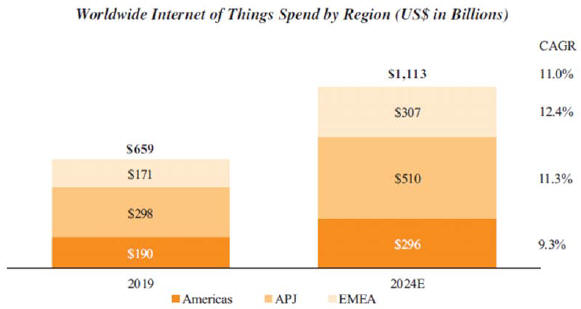
| 3. | According to IDC, IoT software spend has reached US$129.2 billion in 2019 and is forecasted to grow to US$237.0 billion by 2024, representing a CAGR of 12.9%. Software represents 19.6% and 21.3% of the total IoT spend in 2019 and 2024, respectively. IoT software spend in China is estimated to be US$21.5 billion in 2019 and US$42.9 billion in 2024, representing a CAGR of 14.8%. Within IoT software there are a range of categories such as application software, analytics software, security software and others. The chart below shows market opportunity of IoT software in 2019 and 2024. |
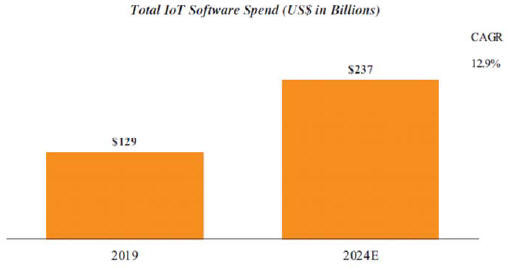
Source Info:
| • | IDC, Worldwide Internet of Things Spending Guide, December 2020 (V2 2020) |